Kirill Medvedev & Oleg Zhuravlev: Russia’s (Post)War Future

“A Russia without profanity. The word mom is sacred! Speak without swearing.” Photo: Igor Stomakhin, Moscow, 2025

What can serve as the basis for new Russian post-war identity? What sort of patriotism can there be in a country which has lived through an aggressive war? Of what should the people of this country be proud? What should they associate themselves with? Republic Weekly presents a programmatic text by the sociologist Oleg Zhuravlev and the poet and activist Kirill Medvedev on how the so-called Russian nation came to 2022 and what its prospects are in 2025.

How can Russia get beyond being either an embryonic nation-state or a vestigial empire? People have been talking about this for three decades now. Does it require years and years of peaceful development? A national idea painstakingly formulated by spin doctors in political science labs? A bourgeois revolution? Or maybe just a small victorious war? The so-called special military operation in Ukraine, which has grown into a global military and political conflict, poses these questions in a new light.

In our view, large-scale social changes are happening inside Russia today, changes which could help shape a new national project.

These changes are not always so easy to spot.

According to the social critique prevalent in the independent media, wartime Russian society is organized roughly as follows. Its freedom-loving segment has been crushed and disoriented, while its loyalist segment is atomized and under the thumb of government propaganda, which preaches xenophobia, imperialism and cynicism. Society is fragmented and polarized, suspended somewhere between apathy and fascism. But these tendencies, which are certainly important — and therefore visible to the naked eye, as well as exaggerated by the liberal discourse — are nevertheless not absolute and probably are not even the most important. Society lives its own life, meaning that different groups within it live their own lives and move in their own directions. When you analyze the trajectories of that movement you get a better sense of the major pathways along which these groups might in the future coalesce into a new nation. 

Despite the official rhetoric about unity during the war years, the regime has not managed to consolidate a nation, but it has laid the groundwork for its formation in the future. This has been significantly aided by the west’s anti-Putin policies and the information war waged by the new Russian emigration’s radical wing, which speaks of the collective guilt of all Russians, of their culture and language. Consequently, the only alternative to Putinism and war has seemed to be the disenfranchisement of all Russianness, and the only alternative to official government patriotism has been the “fall of the empire.” Meanwhile, there have been and continue to exist images of the country and modes of attachment to it which cannot be reduced to either of these two options. 

THE NEW RUSSIAN PATRIOTISM

The idea of a new Russian identity was expressed succinctly by Boris Yeltsin on 22 August 1991, when he said that the attempted coup had targeted “Russia, her multi-ethnic people” and her “stance on democracy and reform.” The new modern Russian identity was supposed to be the result of choosing Europe, overcoming the archetypes of slavery and subjugation, and transcending the legacies of the October Revolution, interpreted as a criminal conspiracy and lumpenproletarian revolt, and of the Soviet nation as a grim community of “executioners and victims.”

Ultimately, though, it was the reforms themselves, along with the trauma of losing a powerful state, that generated Soviet nostalgia and a new version of Stalinism. [Yeltsin’s] shelling of the [Russian Supreme Soviet] in 1993 and the dubious 1996 presidential election, which many initially regarded as a triumph for the liberal project, proved to be its doom.

Despite the fact that advocates of the radical anti-liberal revanche were momentarily defeated and exited the scene, widespread disappointment and depoliticization was a barrier for further democratization through people’s involvement in politics. The story of 1991 spoke clearly about what the new Russians could take pride in: victory over the revanchists, for which they had taken to the streets and sacrificed the lives of three young men. Subsequently, amid the chaos and bloodshed of 1993, two ideological projects of Russian identity took shape which were mostly in competition with each other, splitting civil society in the period that followed.

LIBERALS VS. THE RED-BROWN COALITION

Vladimir Putin was nominated to strengthen the new capitalism and prevent a “Soviet revanche.” But his most successful project, as was quickly revealed, actually lay in the Soviet legacy’s partial rehabilitation. Putin managed to bridge the gap of 1993: he drew in part of the pro-Soviet audience (by using patriotic rhetoric, bringing back the Soviet national anthem, and taking control of the Communist Party) and drove the most intransigent liberals and democrats into the marginal opposition. The grassroots yearning for a revival of statism, which had taken shape in the early 1990s, was gradually incorporated into the mainstream. Many years later, this enabled things that would have been impossible to imagine even during the Brezhnev era, let alone during perestroika: the erecting of monuments to Stalin, the creeping de-rehabilitation of Stalinism’s victims, the normalization of political crackdowns as the state’s defense mechanism, and, consequently, a greater number of political prisoners than during the late-Soviet period.

Today’s ideal Russians, in Putin’s eyes, are those who identify themselves with all of Russian history from Rurik to the present, see that history as one of continuous statehood, and regard the periods of turmoil (the early sixteenth century, post-revolutionary Russia, the 1990s) as instances of outside meddling which should never be repeated.

The ideological struggle over Russia’s image during the Yeltsin and Putin years was thus rooted in the opposition between the liberal narrative (based on Yeltsin’s reforms) and the Stalinist great power narrative. Putinism, which is institutionally rooted in the Yeltsin legacy, acted as a kind of arbiter in the argument between the Shenderovich and Prokhanov factions, but gradually dissolved 1993’s great power Stalinist and White Russian imperial legacy into semi-official rhetoric.

But was this semi-official rhetoric part of the national identities of ordinary Russians? Or were their national identities not so thoroughly ideologized?

Did most of the country’s citizens even have national identities during early Putinism, which deliberately atomized and depoliticized society?  

THE ESCALATION OF NORMALITY

Amid the relative prosperity, socio-economic progress, and apoliticality of the 2000s we see the emergence of a new, rather de-ideologized, “normal” everyday patriotism, involving a decent life, good wages, and an image of the country which made one proud rather than ashamed. Research by the sociologist Carine Clement has shown that this brand of patriotism could be socially critical and emerge from the lower classes (who criticized the authorities for the fact that far from everyone enjoyed good wages), but could also be more loyal to officialdom and come from the middle classes (who believed that the country had on the whole achieved a good standard of living, or had created conditions for those who actually wanted to achieve it).

In any case, early Putinism depoliticized and individualized society, neutralizing the civic conflict between the liberals and the “red-brown coalition,” but one outcome of this ideological neutralization was that it brought into focus something given to citizens by default: their connection to the motherland. This connection is not conceptualized through belonging to one ideological camp or another. It is grasped through one’s sense of the value possessed by a normal, decent life, a life which all the country’s citizens deserve individually and collectively.

This value was politicized after 2011. The Bolotnaya Square protests launched a peculiar mechanism: the escalation of normality. One author of this article recently decided to go back and re-analyze the interviews PS Lab did with people who protested in support of Navalny in 2021. The analysis showed something interesting: the most “radical” protesters, the people most willing to be detained and arrested, who wanted to go all the way and topple Putin, turned out to be the most “normal.” They were middle-class people whose demands were measured and respectable.

They did not dream of building utopias or radically restructuring society, but of a parliamentary republic and combating corruption. Both the Bolotnaya Square and post-Bolotnaya Square democratic movements, including the Navalny supporters, transformed the reasonable demand for a normal, bourgeois, prosperous country into the battle standard of a heroic revolutionary struggle against the Putin regime. Navalnyism, meanwhile, also integrated a measured social critique of inequality into its agenda.

The “normal patriotism” of the lower and middle classes thus became a stake in a fierce political struggle.

The new patriotic pride might have said something like this: “We can expose and vote out corrupt officials, push back against toxic waste dumps and insane development projects, vote in solidarity, and hit the streets to protest for the candidates we support whom Moscow doesn’t like. We have people who look to the west, people who miss the USSR, and people who defended the White House in 1991 and in 1993. We face Putin’s truncheons and paddy wagons together, and together we demand democratic freedoms and social justice.” This was how a civil society made up of Navalny fans, radical communists, and regional movements might have fought together for a “normal” country, how they might have shaped the political project of a vigorous nation pursuing solidarity. They might have done it, but they didn’t have time. They did manage to piss off the Kremlin, though.

In response, the regime launched its own escalation of normality. On the one hand, it responded to the protests with radically conservative counterrevolutionary propaganda and crackdowns. On the other hand, behind the façade of radical conservativism, Putinism erected its own edifice of “normality,” which would prove to be truly durable. Beginning in 2011, the Kremlin appropriated part of the Bolotnaya Square agenda not only in its slogans but also in practice by improving the quality of the bureaucracy, raising living standards, technocratically upgrading public amenities, and advancing technological progress. Sobyanin’s Moscow was the testing ground and façade of a new normalization which involved no democracy at all.

But the real escalation of normality on the Putin regime’s part occurred when the special military operation kicked off in 2022.

WAR, (AB)NORMALITY, AND PATRIOTISM

The war has been something profoundly abnormal for many people. It has meant a break with normal life and with any hopes for a normal country. This is what the war has meant for many people, but not for all of them.

PS Lab’s research has shown that a segment of the Russian populace, the middle-class economic beneficiaries of the new wartime economic policy, argue that Russia is now approaching the image of a normal country, even if they do not support the war. According to them, it is not the war per se but the concomitant economic progress (visible, for example, in the growth of wages and the creation of jobs) and the strengthening of national identity which have finally put paid to the period of crisis and launched a stage of growth.

Their argument goes like this. They do not know the reasons behind the tragic special military operation, which has taken tens of thousands, maybe hundreds of thousands of lives, but in trying to cope with this tragedy, they have strengthened the Russian economy and become more patriotic.

What matters is that the idea of growth is firmly separated, in the minds of such people, from the official “goals and objectives” of the special military operation and its ideological framework. It transpires that heavyweight official patriotism is digested by a significant part of society in a milder form. PS Lab’s respondents claim that they do not support violent methods of resolving foreign policy conflicts and are indifferent to the annexation of new territories, but that it has been a good thing that they have begun to think more about the motherland.

Wartime Putinism has two faces, in other words. On the one hand, we see war, increasing crackdowns, and spasms of neo-imperialist ideology. On the other, Russians are not overly fond of those things. They value other things more, such as economic growth and the strengthening of national identity, which unites the segment of society who feel alienated by the state’s ideological and foreign policy projects. When thinking about their own patriotism, many Russians underscore the fact that it is not defined by imperialist ideology. The country is going through a difficult moment, so would it not be better for Russia to take care of itself, rather than worry about acquiring new lands? This has been a leitmotif in many interviews done by PS Lab.

Economic nationalism in the guise of military Keynesianism and the sense of community experienced by citizens going through trials (in their everyday lives, not in terms of ideology) have thus laid the foundations less for an imperial project, and more for the formation of a “normal” nation-state.

Nor is the issue of democracy off the table: it has been missed not only by the opponents but also by the supporters of the special military operation. We welcome the growth of a sovereign economy, but if Putin strangles civil society and lowers the Iron Curtain, we will be opposed to it, say the quasi-pro-war volunteers. For them, however, Putin remains the only possible guarantor of a “normal” future. Many Russians who want an end to the war and a future life without upheaval have pinned their hopes on the president for years.

This focus on gradually developing and civilizing the country is nothing new. Since the 1990s, part of the intelligentsia and, later, the new middle class, pinned their hopes first on the reforms of the pro-market technocrats, then on the successes of a then-still-liberal Putinism, then on Kudrin’s systemic liberals, then on Sobyanin’s policies, and so on.

Something went wrong, and many of these people are now in exile, but it is quite natural that images of a normal life and a normal country, albeit in radically altered circumstances, continue to excite Russians. Normality can be politicized, however, as it was between 2011 and 2022.

The social movements and the independent opposition which emerged after the Bolotnaya Square uprising have been virtually destroyed by the regime: the last bright flashes of this tradition faded before our eyes at the 2022 anti-war rallies. Nevertheless, the tradition of democratic protest continues. As before the war, the latter can grow from the demand for normalcy.

Moreover, the demand for normalcy can sound particularly radical in wartime.

The hardships of war have given rise to movements such as The Way Home, whose activists, wives of mobilized military personnel, have evolved from human rights loyalism to collective protest as they have demanded a return to normal life. Starting with individual demands for the protection and return of their loved ones from the front, they then arrived at a national agenda of fighting for a “normal” and even “traditional” country in which every family should have the right to a dignified, happy and peaceful life.

After a period of struggle between the two versions of patriotism born in the 1990s, liberal and neo-Soviet, the time for everyday “normal” patriotism has thus dawned. Initially, it existed as a public mood which was not fully articulated, but subsequently we witnessed a mutual escalation of normality on the part of warring protesters and the Kremlin.

The “post-Bolotnaya” opposition, led by Navalny, launched a revolutionary struggle with the regime over the project for a “normal” bourgeois country, attempting to create a broad movement that would reach far beyond the former liberal crowd. In response, the Kremlin unveiled its neo-imperialist militarist project with one hand, while with the other hand it satisfied the public demand for normality on its own after the opposition had been defeated.

TWO SCENARIOS FOR A NORMAL RUSSIA

The above-mentioned contradictions of the Putinist discourse and the complex realities of wartime (and the postwar period?) allow us to imagine two scenarios for society’s growth, the realization of two images of Russian patriotism. In other words, we see two scenarios for a socio-political dynamic which could culminate in the creation of a new nation.

Military Putinism, contrary to its radically imperialist image, has in terms of realpolitik and public sentiment put down certain foundations for the formation of a nation-state in Russia.

If economic growth, redistributive policies, and the strengthening of everyday patriotism continue after the end of the war and captivate the majority or at least a significant segment of society, the project of turning Russia into a nation-state from above will have a chance.

Whether it materializes depends on many unknowns. Will the government be able to maintain economic dynamism after dismantling the wartime economy? Will everyday patriotism turn into a solid ideological edifice? Will the end of the war be followed by a liberalization of political life? (Is this possible at all?) Will the current pro-war and anti-war volunteerism serve as the basis for an industrious, widespread civil society? Will there be a change of elites?

Russia’s transformation into a nation-state under these circumstances would constitute a serious paradox. It would thus emerge not after a lost imperialist war or a war of national liberation, but in the wake of a partly successful war, which evolved from an imperialist war into a nationalist war. What would hold such a society together?

It is easiest to envision an identity based on Russia’s opposition to the west on the basis of geopolitical confrontation or economic and technological competition, especially if a fierce struggle between newly emerging geopolitical blocs lies ahead. This confrontation with the west, which we allegedly have pulled off with dignity (even if we are willing to recognize the special military operation itself as a dubious event), will be accompanied by various practices and emblems of cultural uniqueness.

But will this new nation be capable of producing a powerful culture, as in the nineteenth and twentieth centuries? Or will this future Russia be doomed to cultural and intellectual degradation as presaged by Dugin’s philosophy and pro-war poetry?

There are serious doubts that the grounds listed above would be sufficient for a multi-ethnic and multicultural entity like the Russian Federation to turn into a national community united by an understanding of a common destiny and values. The USSR as a community was based on the complex mix of the new Soviet individual and Russocentrism that took shape in the Stalinist period. The roles of this dynamic duo are currently played by the adjective rossiyskiy, which is a designation of civic membership in a multi-ethnic community, and the similar-sounding adjective russkiy, which is a grab bag of several easily manipulated meanings.

Putin is responsible for regular messages about multi-ethnicism, while numerous actors in the government and the loyalist media are charged with sending signals about Russian ethnicism. In this bizarre system, ethnic Russians, on the one hand, constitute a “single nation” with Belarusians and Ukrainians; on the other hand, they vouchsafe the coexistence of hundreds of other ethnic communities, supposedly united by “traditional values” (and, no matter how you look at it, the most important of these values is the rejection of homosexuality); while, on the third hand, they have a special message for the world either about their own humility, or about the fact that they will soon “fuck everyone over” again.

This complex edifice has been looking less and less persuasive. The zigzags and wobbles of the political top brass — Russia has swerved from alliances with North Korea and China to newfound friendship with the United States; from casting itself as a global hegemon to posing as an aggrieved victim — do nothing to help Russians understand who we are. They have, however, stimulated the growth of local, regional, ethnic narratives and identities which are much more reliable and comfortable. Ethnic brands, music and art projects involving folkloric reconstructions, the vogue for studying the languages of the peoples of the Russian Federation, and the plethora of Telegram channels about ethnic cultures and literatures are all outward signs of the new ethnic revival. Although they do not seem as provocative as the forums of radical decolonizers, they correspond less and less with a vision in which ethnic Russianness is accorded a formative role, while “multi-ethnicity” is relegated to a formal and ceremonial role.

When we draw parallels with the Soviet identity, we should remember that it was based not simply on a set of ideological apparatuses (as the current fans of censored patriotic cinema and literature imagine), but on a universal idea of the future, on the radical Enlightenment project of involving the masses and nations in history (including through “nativization” and the establishment of new territorial entities). The project had many weaknesses from the outset, and it was radically undermined by the deportation of whole ethnic groups and the anti-Semitic campaign (for which the current regime has less and less desire to apologize), but as the British historian Geoffrey Hosking has argued, the fundamental reason for the Soviet Union’s collapse was the lack of civil institutions in which the emerging inter-ethnic solidarity could find expression.

If an ethnic cultural and regional revival really awaits us amid war trauma, confusion, possible economic problems, and the deficit of a common identity, how would Moscow handle it? Would it try to control or guide the process? Or maybe it would focus on loyal nationalists and fundamentalists in a replay of the Chechen scenario? This may turn out to be a prologue to disintegration, or it may serve as the field for establishing new community. The radical democratic opposition, once it has a chance, would simply have to combine local, regional, and ethnic cultural demands with general social and democratic ones.

It is for the sake of this that we must rethink the imperial legacy, the Soviet project with its complex mix of colonialism, federalism and modernization, the way communities have lived together for centuries on this land, sometimes fighting and competing, sometimes suffering from each other and from Moscow, sometimes evolving, and sometimes coming together to fight the central government (as during the Pugachev Rebellion).

This combination of civil struggle and intellectual reflection can not only generate a fresh political counter-agenda but also reanimate the worn-out leitmotifs and narratives of Russian culture.

It can reintroduce the productive tension and contradiction, the universality inherent in a great culture, which the regime, while oppressing and exiling critical voices, has been trying to replace with an emasculated, captive patriotism.

***

We want a quiet private life without upheaval, the life which generations of Russians have dreamed of; we want to be independent, stick to our roots and remain who we are, says one group of our compatriots.

We want to overcome dictatorship, political oppression, inequality, corruption and war; we want to live in a society based on freedom and solidarity, says another group of our compatriots.

Interestingly, both of these scenarios are revolutionary. The first scenario, despite its adoration of technocracy and the petit bourgeois lifestyle, is the result of an anti-democratic revolution from above, during which the authoritarian regime has been transformed from a predominantly technocratic to a counter-revolutionary one and has challenged both the world order and the domestic political order. The abrupt transition to a redistributive military Keynesian macroeconomic policy, which was unthinkable ten years ago, and which fuels the current workaday patriotism, has emerged as part of the war. The war itself has been the decisive event of Putin’s counterrevolution, which, like any counterrevolution, always bears certain revolutionary traits.

But while the first scenario (albeit with a new, rather sinister twist) epitomizes the long-standing dream of a bourgeois life based on comfort and tradition, the second draws on a more grassroots and rebellious vision of social progress and related practices. It hearkens back to the defenders of the Russian White House in 1991 and 1993, the protesters against the monetization of benefits and the Marches of the Dissenters, the radical segment of the Bolotnaya Square movement, and the street movements in support of Navalny and Sergei Furgal. History, including Russian history, knows many such examples of new national communities emerging in radical joint struggles for democracy and justice.

Both scenarios could be generated by the current catastrophic reality, and both are fraught with fresh dangers: the first with the threat of a new descent into fascism, the second with violent civil conflicts. In our opinion, though, it is these two scenarios which shape the field for analyzing, discussing and imagining the country’s future.

Source: Kirill Medvedev and Oleg Zhuravlev, “The Russian nation’s (post)war future,” Republic, 9 March 2025. Translated by the Fabulous AM and the Russian Reader


Thе New Year Spirit


Faithful to its avant-garde nature, Noise Cabaret premieres the immersive series Dialogues, based on the philosophical works of Plato, on December 25. Alexander Khudyakov turns ancient Greek philosophy into a lively, witty and provocative dialogue with the audience.

Along with his partner Ivan Wahlberg, Khudyakov, who not only acts in the project but directs it, will guide the audience through the labyrinths of Plato’s thought. What is justice? Where is the line between existence and non-existence? What is the true nature of love? These and many other fundamental philosophical questions will serve as starting points for reflection and debate.

Dialogues is a series of interactive performances in which each viewer is involved in a philosophical discussion consisting of adapted texts by Plato and actorly improvisation, meaning that the way the performance goes depends on the audience’s involvement. Each new performance is a separate chapter dealing with a specific philosophical problem, so you can join the series at any stage. The first episode deals with the concept of justice.

Noise Cabaret plans to invite Petersburg celebrities to enrich the conversation with the audience with their own opinions and views.

Khudyakov shared the idea behind the project.

“We wanted to do a story related to people talking in a bar. But just people talking to each other is not interesting. There has to be a big focus. When I studied Plato, I was interested in several aspects of his philosophy. It would have been wrong to limit ourselves to a single topic. So the idea to make a series arose: take Plato, read him, and discuss the themes he raises in the Socratic dialogues.

“We plan to produce a new episode every two or three months. There’s no pretense here that we’re serious scholars of Plato’s philosophy: it’s more of an excuse to talk to people about difficult topics, to air the Dialogues and reflect on them. And a bar is a place where you can talk about all sorts of things, including philosophy.”

Source: Fontanka.ru, 23 December 2024. Translated by the Russian Reader


Russians spent almost 6 billion rubles on Ozempic generics in 2024

Semaglutide-based drugs are commonly used for weight loss

In the first ten months of 2024, Russians spent 5.9 billion rubles [approx. 52 billion euros] on over one million packs of generic versions of the drug Ozempic (semaglutide), according to DSM Group, as reported by Vedomosti.

Among the most popular generics are Geropharm’s Semavic and Promomed’s Quincenta. The original drug Ozempic stopped [sic] official supplies to Russia in December 2023, opening the market to domestic analogues.

2024 was a record year for drugs in this category. By comparison, in 2023, Russians spent only 297 million rubles on Ozempic, buying 20 thousand packs. In 2022, they spent 1.9 billion rubles (256 thousand packs); in 2021, 758 million rubles; and in 2020, 76 million rubles.

Semaglutide-based drugs are used to treat diabetes but have recently been gaining popularity as weight loss drugs, which has also contributed to their sales growth in Russia.

Source: ASTV.ru, 21 December 2024. Translated by the Russian Reader


St. Petersburg will open a new metro station this week, Governor Alexander Beglov announced Thursday, marking the former Tsarist capital’s first new metro station in five years.

The Gorny Institute metro station, located on Vasilievsky Island, will extend the fourth (or “orange”) line westward. It will begin operations at 9:00 a.m. on Friday, with its vestibule open for both entry and exit, Beglov said.

“The opening of Gorny Institute is a milestone,” the governor wrote on Telegram, noting that the city had overcome “significant challenges” during the station’s construction.

Beglov thanked President Vladimir Putin, metro builders, engineers and residents of St. Petersburg for their patience and support, calling the station’s completion the “first results” of sustained efforts to advance the city’s metro system.

The station’s opening comes after years of delays. Initially scheduled for completion in 2015, its opening was postponed to 2018 and later to 2022. Construction efforts were further overshadowed by a fatal scaffolding collapse in June 2020 that killed one worker and injured another.

Gorny Institute is the first station to open since 2019, when three others — Prospect Slavy, Dunayskaya, and Shushary — were inaugurated.

St. Petersburg’s metro is currently made up of five lines and 72 stations. However, it has expanded slowly over the years, in stark contrast to Moscow’s burgeoning metro system, which this year opened eight new stations.

Source: Moscow Times, 26 December 2024


[…]

In trying to grasp the tonality of the film [Anora], I am reminded of a line from Francis Bacon: “You can be optimistic and totally without hope.” The situation the characters find themselves in, being at the mercy of the rich, is totally without hope. The “hopeful” version of the script would be one in which Vanya does stand up to his parents and runs off with Ani, even at the price of losing his wealth—this is the film’s narrative lure. Or maybe another where the ruthless capitalist mother gains a grudging respect for her tough daughter-in-law, like in the last season of Fargo. But despite its grim closure, the impression the film gives is far from dreary or pessimistic. The hopeless optimism of Baker’s cinema lies in the sheer life that seems to almost burst out of the filmic frame, and, especially, his deep care for his characters, even Vanya.

Source: Aaron Schuster, “The Ethical Dignity of Anora,” e-flux Notes, 20 November 2024


In the fall of 2023, with the goal of understanding what is really happening with Russian society during wartime, the Public Sociology Laboratory team went on ethnographic research trips to three Russian regions—Sverdlovsk, Krasnodar and Buryatia. Over the course of a month, PS Lab researchers observed how people talk about the war and how it affects daily life in cities and villages. In addition, they recorded sociological interviews with local residents. PS Lab has compiled three detailed ethnographic observation diaries (more than 100,000 words apiece) and conducted 75 in-depth interviews. Overall, it has managed to collect truly unique data that provides an idea of what people say and think about the war in everyday situations, and not only when answering researchers’ questions.

The full text of the report is book-length and written in a book-style format: it consists of seven chapters, introduces many characters, and allows readers to be fully immersed in contemporary wartime Russia. The following summary, meanwhile, highlights the main analytical conclusions.

  • Russian society remains politically demobilized and deideologized. Despite the prevailing opinion that it is strictly militarized, we see that the war has become routine and therefore a disregarded part of reality. For example, compared to the first years of the war, the amount of prowar symbolism in public spaces has decreased in all three regions. The war has neither become a source of new ideas in the cultural life of cities or villages nor been integrated into familiar and already-established cultural formats. The war is not discussed in public places, including, with rare exceptions, local online communities.
  • In spontaneous conversations, Russians rarely discuss the overall goals and causes, criminality, or justifications of the war. They are concerned with the impact of the war on their everyday lives. When they talk about the war, they mostly talk about the same things they discussed before the war, for example, everyday difficulties, money, or ethics. Men more often discuss topics that are considered “masculine” in society, such as the technical side of the war, and women usually talk about “feminine” topics, such as how war destroys families.
  • Participation in various types of prowar volunteering and organized assistance for the military, which are often cited as an example of the mobilization and militarization of Russian society, is rarely motivated by people’s firm support for the “special operation.” It is usually associated with pressure from the administration, community moral norms (concerning mutual assistance), and/ora desire to help loved ones, rather than a wish to make victory for Russia more likely. Observation of volunteers’ activities show that while working, they do not discuss the war or politics, rather choosing topics that are personable and relatable to them: prices, pensions, families, and/or stories related to the volunteer centers.
  • Despite all these similarities, the war is perceived slightly differently in different regions. The peculiarities of each region’s view owe to factors like the number of military units and penal colonies from which prisoners are recruited, proximity to the combat zone, the prosperity of the region and the availability of decent jobs, the density of social ties, the circulation of news transmitted by friends on the front lines, etc. In other words, the differences in perceptions of the war are attributable mainly to the peculiarities of life in the regions before the invasion of Ukraine.
  • The conflict between opponents and supporters of the war is gradually subsiding, while the rift between those who stayed in Russia and those who left is growing. This is happening both because the shared experience of living through a difficult situation within the country is becoming more important for many Russians than any differences in viewpoint, and also because people are discussing the war less.
  • At the same time, the waning conflict between opponents and supporters of the war does not always mean more social cohesion. Since people are trying to live as if the war is nonexistent and the government does not talk about any losses or problems associated with the war, all negative consequences of the war are either normalized or pushed into the realm of “personal problems” that are not discussed with anyone and that everyone must deal with on their own.
  • Overall, many people do not feel able to influence political decisions. Therefore, they are increasingly distancing themselves from the war. They understand that they cannot change government policy, but they retain at least some control over their private lives—and therefore they are immersed in them. Over time, not only apolitical Russians but even sure opponents of the invasion experience this powerlessness and, as a result, some of them accept the new reality while continuing to condemn the war internally.
  • Consequently, many Russians are increasingly distrustful of political news from a broad range of sources. Instead, they put their trust in local media. Local problems and news seem much more important and relevant to them. Moreover, they feel that, unlike the war, local issues are at least sometimes within their ability to influence.
  • At the same time, the war is weighing people’s emotional state. Many of our interlocutors admit that they experience anxiety, tension, uncertainty, fear, even if these things are not usually spoken about openly. The departure of sons and husbands to war makes women “scream at the top of their lungs.” However, people rarely share such emotions with others, and if they do, they do so in groups with close friends.
  • Many Russians who are not interested in politics may justify or condemn the war depending on the communicative context.
  1. They tend to non-emotionally justify the war through normalization (“there are always wars”) or rationalization (“it was necessary”) when asked about it directly in more formalized settings, such as research interviews.
  2. They are more likely to criticize the war when prompted to think about how it negatively affects them as ordinary Russians. This criticism differs from that of war opponents. For opponents, the war is a moral crime against Ukraine, whereas for apolitical Russians, the war is seen as something that destroys Russian society and harms ordinary people. However, this criticism does not lead apolitical Russians to question the war’s necessity or inevitability, nor does it extend to criticizing the Russian government.
  3. They tend to emotionally justify the war when confronted with traditional anti-war narratives. When Russia is accused of committing moral crimes against the Ukrainian people, they often take such accusations personally and attempt to defend their own dignity.
  • Some people have experienced a strengthened sense of national identity, and sometimes a demand for greater solidarity arises. It’s important to note that this increased sense of national identity does not lead Russians to adopt the official imperial brand of nationalism. Unlike the Kremlin, ordinary people live in a world of nation states, not in a world of imperial fantasies (according to which Ukraine is not a real state and Ukrainians are an inferior people).
  • A feeling of uncertainty is what truly unites Russians today. Despite the fact that people choose various strategies to cope with this feeling, it still significantly complicates the ability to plan one’s life and plunges Russians into pessimism.

Thus, on the one hand, the formerly extraordinary nature of the war is giving way to normalization: the war is gradually becoming something ordinary, another unremarkable part of the surrounding world. In a sense, many Russians resist both the Kremlin’s attempts to turn ordinary citizens into ideological supporters and the attempts of the anti-war liberal opposition to force society to actively experience guilt and fight. On the other hand, the war constantly reminds us of its existence, creating new threats, new anxieties, and new reasons for discontent in Russians.

Source: Public Sociology Laboratory (The Russia Program), December 2024


Dear readers!
Times are tough, and the key in this case is holding on in every sense.
No one says it’s easy.
But it’s not so hard either.
The other day I asked Vladimir Putin whether he expected anything more from himself in the outgoing year.
But I want to ask you: do you expect anything more from yourself in the coming year?
We need to expect things. We need to want things. It’s a way of holding on to ourselves. Of looking after ourselves. Of not losing ourselves. And even of finding ourselves.
A hard sign (“Ъ”) will never be a soft sign (“Ь”)!
Happy incoming New Year!
Let’s not be on the defensive!

Andrei Kolesnikov, Special Correspondent, Kommersant Publishing House

Source: Email from Kommersant, 31 December 2024. Translated by the Russian Reader. The so-called hard sign, which the Bolsheviks dropped from the Russian Cyrillic alphabet in 1918, has been the logo of Kommersant since the newspaper’s relaunch in January 1990. Andrei Kolesnikov has been the newspaper’s special Kremlin correspondent — that is, its chief Putinversteher — for many years. Of course he’ll deny it all when push comes to shove and Putin goes, and he’ll point of course to the cynical, jocular (but ultimately loyal) way he’s written about the Russian dictator and war criminal all these years.

National Unity Day

Monterey, California, 4 November 2024. Photo: The Russian Reader

I’m worried about the left’s demonization of America’s origins and the future of Western civilization, as many conservatives feel that the basic tenets of society as we’ve known it are under attack.

Source: Scott Jennings, “Opinion: Why I’m voting for Donald Trump,” Los Angeles Times, 1 November 2024


Carolina Performing Arts, “Omar the Opera: Behind the Scenes”

Rhiannon Giddens’ opera Omar was presented at Carolina Performing Arts in February 2023. In this video, take a deep dive into the opera’s creation and hear from cast members about their experiences. To learn more, visit: https://southernfuturescpa.org/projects/omar/ Omar was co-commissioned and co-produced by Spoleto Festival USA and Carolina Performing Arts at the University of North Carolina at Chapel Hill. Additional co-commissioners include LA Opera, Boston Lyric Opera, San Francisco Opera, and Lyric Opera of Chicago.

Source: Carolina Performing Arts (YouTube), 2 October 2023


“Video has come out from Bucks County, Pennsylvania showing a ballot counter destroying ballots for Donald Trump and keeping Kamala Harris’s ballots for counting,” an account called “Dan from Ohio” wrote in the comment section of the far-right website Gateway Pundit. “Why hasn’t this man been arrested?”

But Dan is not from Ohio, and the video he mentioned is fake. He is in fact one of hundreds of inauthentic accounts posting in the unmoderated spaces of right-wing news site comment sections as part of a Russian disinformation campaign. These accounts were discovered by researchers at media watchdog NewsGuard, who shared their findings with WIRED.

“NewsGuard identified 194 users that all target the same articles, push the same pro-Russian talking points and disinformation narratives, while masquerading as disgruntled Western citizens,” the report states. The researchers found these fake accounts posting comments in four pro-Trump US publications: the Gateway Pundit, the New York Post, Breitbart, and Fox News. They were also posting similar comments in the Daily Mail, a UK tabloid, and French website Le Figaro.

“FOX News Digital’s comment sections are monitored continuously in real time by the outside company OpenWeb which services multiple media organizations,” a spokesperson for the company tells WIRED. “Comments made by fake personas and professional trolls are removed as soon as issues are brought to our attention by both OpenWeb and the additional internal oversight mechanisms we have in place.”

Breitbart replied to WIRED’s request for comment in Russian: “Пожалуйста, скажите Newsguard, чтобы они пошли на хуй.” In English, this means “please tell Newsguard to go fuck themselves.”

The Gateway Pundit and the New York Post did not respond to a request for comment from WIRED.

“The actors behind this campaign appear to be exploiting a particularly vulnerable part of the media landscape,” McKenzie Sadeghi, the AI and foreign influence editor at NewsGuard, tells WIRED. “Comment sections designed to foster reader engagement lack robust security measures, allowing bad actors to post freely, change identities, and create the illusion of genuine grassroots campaigns rather than orchestrated propaganda.”

The disinformation narratives being pushed by these accounts are linked to Storm-1516, according to Newsguard. Storm-1516 is a Russian disinformation campaign with a history of posting fake videos to push Kremlin talking points to the West that was also connected to the release of deepfake video falsely claiming to show a whistlelbower making allegations of sexual assault against vice presidential candidate and Minnesota governor Tim Walz. (WIRED first reported that the Walz video was part of a campaign by Storm-1516. A day later, the US government confirmed WIRED’s reporting.)

Links to the video were posted by multiple accounts with names like “Disobedient Truth” and “Private Patriot” in the comment section of outlets like Breitbart and the Gateway Pundit.

“More bad news for the Dems: Breaking: Tim Walz’s former student, Matthew Metro, drops a shocking allegation- claims Walz s*xually assaulted him in 1997 while Walz was his teacher at Mankato West High School,” the comments read.

The links posted in the comments came hours before the video was shared on social media platforms like X, where it racked up millions of views.

After the Bucks County video went viral, researchers quickly traced it back to Storm 1516US intelligence agencies then confirmed Russia was behind the fake video.

Russian influence operations have, in the past, made use of comment sections to boost their narratives, including during their campaign to disrupt the 2016 elections. This is the first time this tactic has been reported as part of Russia’s efforts to disrupt the 2024 presidential election.

“Replying in threads is a tactic that can have an impact with very little investment,” Darren Linvill, codirector at Clemson University’s Media Forensics Hub, tells WIRED. “By inserting disinformation into an unrelated conversation it might be seen, even if the account being used has no followers and was just created yesterday. It also doesn’t matter if the account you are using is caught and shut down because you haven’t lost an investment, you can just create another account five minutes later.”

The fake comments, Newsguard found, are also then used in reports from Russian state-backed media outlets to bolster claims about how Western audiences are responding to a particular incident.

After the Trump assassination attempt in July, Tsargrad TV published an article titled “Biden’s Trace in Trump’s Assassination Attempt. Americans Agree with the Kremlin’s Version: ‘Russians Are Right.’” The article outlined how Americans believe that the Biden administration played a part in the shooting, citing “comments to articles in Western media” as evidence.

NewsGuard’s researchers identified 104 articles in Russian state media that cited comments from Western news outlets as evidence to back up their claims between January and August of this year.

“This tactic allows bad actors to reduce the risk of detection and embed propaganda in a subtle, seemingly organic way, blending it into the casual commentary of supposed everyday Western readers,” Sadeghi said. “The repetition of the same claim across multiple formats and contexts can create a sense of familiarity that may lend the narratives an appearance of credibility.”

The network of accounts has also been used to seed other narratives, including one earlier this month where dozens of comments in the New York Post and Breitbart claimed, without evidence, that Ukrainian president Volodmyr Zelensky had used Western military aid to purchase a car that once belonged to Adolf Hitler.

That claim has been spread by the network of inauthentic websites controlled by former Florida cop John Dougan, who now lives in Moscow and runs a network of pro-Kremlin websites. Dougan’s network of websites have previously shared disinformation narratives from Storm-1516.

Source: David Gilbert, “A Russian Disinfo Campaign Is Using Comment Sections to Seed Pro-Trump Conspiracy Theories,” Wired, 1 November 2024. The emphasis is mine. ||| TRR


Carolina Performing Arts, “Omar the Opera: A Scholar’s Perspective”

Learn about Rhiannon Giddens’s opera Omar from the perspective of North Carolina scholars.

Source: Carolina Performing Arts (YouTube), 8 April 2024


This very disturbing story about Russian grassroots lucre in wartime was published on the front page of yesterday’s print edition of the New York Times. I’m quoting it in full here for the benefit of non-subscribers.

On the other hand, as perhaps only I am in a position to know, there is something disturbing about how certain of the sources for this story boldly claim eyewitness-like knowledge of events in the Russians provinces which they couldn’t possibly have witnessed, while also cashing in on the chaos unleashed by Russia’s vicious war against Ukraine, only from the opposite side of the world.

I’m also troubled that PS Lab, which was founded long before the war, is portrayed here as an outgrowth and brainchild of those selfsame academic entrepreneurs at George Washington University. ||| TRR


Expensive new cars and motorcycles crowd the streets. Apartment prices have more than doubled. And once-strapped residents are suddenly seen wearing fur coats and carrying ostentatiously overflowing grocery bags.

That is how one resident of a small, long-impoverished industrial city in Siberia describes her hometown these days. The explanation for the burst in prosperity lies in the isolated cemetery, with rows of Russian flags marking the new graves of soldiers killed in Ukraine, and also downtown, where a billboard lists the scores of local men who went to fight.

“I was stunned by how many,” said the resident, the wife of a middle-aged firefighter who enlisted last summer without telling her beforehand. “Money from the war has clearly affected our city.”

The Kremlin has been showering cash on men who enlist. It wants to avoid an unpopular draft, while also addressing the lack of men with sufficient patriotic zeal to join up. There are large signing bonuses, fat monthly salaries and what Russians call “coffin money,” a substantial payment to the families of the tens of thousands of soldiers killed in battle.

The money is changing the face of countless Russian backwaters like the Siberian city. “The allure of extremely high salaries and other benefits has been a major factor in attracting voluntary recruits, especially from relatively poor regions,” said a report issued this year by the Bank of Finland’s Institute for Emerging Economies.

By improving the standard of living among Russia’s poor, the payments have spurred support for President Vladimir V. Putin and the war, researchers noted, while also changing the perception of fighters from patriots to “soldiers of fortune.”

The names and hometowns of the people living inside Russia who agreed to discuss these war payments are not being published to avoid possible legal problems for speaking publicly about the conflict.

Russia has stopped publishing various economic statistics, leaving only a patchwork of indicators about the effects of the war payments. Some studies have documented the influx, however.

For example, the Bank of Finland researchers found that the number of bank accounts in Russia’s poorer areas surged over the past year. Nationwide data was too uneven to establish a concrete correlation with signing bonuses and enlistment data, the study said, but general estimates of casualties by region coincided with the areas experiencing high growth in bank depositors.

Also, in recent months, recruitment posters across Russia changed noticeably, replacing patriotic themes with financial offers. State TV and advertisements on social media carried the same messages.

“Pride of Russia,” some ads used to say, naming the soldier pictured, or “Homeland Begins with Family,” showing a soldier silhouetted with a mother and child. There were comparisons to heroic feats during The Great Patriotic War, as World War II is known in Russia.

Now, a ruble sign dominates the posters, which display the large sums on offer for signing a military contract. Payments vary by region.

“The people who wanted to join out of patriotic sentiment have mostly already been recruited and died or were wounded,” said Oleg Jouravlev, one of the founders of PS Lab, a group of mainly sociologists organized under the Russia Program at George Washington University to study attitudes toward the war. “There are not many like that left in Russia.”

On July 31, Mr. Putin issued a decree more than doubling the contract signing bonus from the federal government to 400,000 rubles, or more than $4,000, from 195,000 rubles. At least 47 regional governments followed suit after he encouraged them to match the reward, according to a survey by the independent media outlet iStories, with the average signing bonus nationwide quadrupling in the past eight months.

U.S. officials estimate that Russia is recruiting 25,000 to 30,000 new soldiers a month, roughly equal to the number of dead and wounded. As soon as local governments see interest lagging, they jack up the financial incentives, experts say.

This past month, the frontline Belgorod region broke all records with a signing bonus amounting to more than $30,000, well above the previous leader, Moscow, at about $20,000. The lowest bonuses are around $500.

The larger sums constitute a small fortune in many of the less developed towns and villages of Russia — where the average salary is a few hundred dollars per month — especially when combined with a frontline fighter’s monthly salary starting at 210,000 rubles, or about $2,100.

A study of the payments for Re: Russia, an online platform for political and economic analysis, found that the signing bonus equals roughly the average annual per capita income in Russia, and the monthly salary is three times the average wage. Rural wages are significantly lower than those in big cities.

“The money is a social elevator for those who went to war,” said Ayan, a resident of Buryatia, a Siberian region with a considerable proportion of people living below the poverty line and high levels of personal debt.

Coffin money payments amount to almost $150,000 per family, enough to buy an apartment in all but the most expensive Russian cities. While an apartment is often the main goal, recipients say they buy all kinds of things, including new teeth, breast implants and vacations.

The war payments are especially attractive to impoverished, middle-aged men who see them as their last chance to escape a lifetime of debt, said Ivan Grek, the director of the Russian Program at George Washington University. Beyond that, people getting the money are eating in restaurants, and buying cars, electronics, clothes and property.

Government statistics from early 2024 show a 74 percent growth in ordinary Russians across the country purchasing cars compared with the same time period last year, Mr. Grek noted, while those paying off consumer debts jumped to 21 percent, up from about 9 percent before the war.

“There is the spirit of a party out there,” he said, even if the source of the money limits the euphoria. His program recently sent three researchers to live for a month in small Russian communities to gauge perceptions of the war. “Now they have a car, they can drink and eat, it is a whole new life for them,” he said.

Artem, a soldier who fled Russia, estimated that 60 percent of the men in his unit signed up because they had unpaid loans. “Almost all of them had problems with alcohol and debt,” he said.

Some experts question whether the spiraling payouts are sustainable and expect that the draw, like patriotism, will eventually fade. Overall, war payments to Russian soldiers — whether for signing, injury or death — will amount to at least 7.5 percent of federal spending for the year, according to Re: Russia.

The sister of a dead officer from Makhachkala said that while he was alive he kept telling her that the death payment would take care of her, their mother and his daughter: “‘Buy an apartment,’ he said, and I told him, ‘You are a moron! Don’t even say such things.’”

Despite the shattering grief after his death, the sister said, the money makes it feel as if her brother is watching over them posthumously. “He did everything he wanted for us,” she said.

The money often has a trickledown effect. A resident of North Ossetia said that a couple of years ago his local plumber had applied to emigrate due to the lack of work. But recently, he said, the plumber told him, “I’ve never had so much work in my life,” with war widows buying new apartments or refurbishing old ones.

The firefighter from Siberia, aged 46, had gone heavily into debt over failed foreign exchange trades, according to his son. After losing several fingers in an industrial accident, he had burned through a $25,000 settlement and a considerable chunk of his disability pension. The father sold the family car to raise money, but ultimately the man filed for bankruptcy before enlisting.

A few days after the first interview for this article, the firefighter’s wife, who had not heard from him in a month, received a military report saying that he had been shot in the chest and killed on July 30, just four days after he deployed in Ukraine. Two younger soldiers trying to rescue him also died, but no bodies have been recovered.

“You are signing your death warrant,” his son said of his father’s decision to enlist. “It was a foolish decision to abandon my mother and my sister and cause everyone so much pain. Money is irrelevant in this situation.”

Source: Neil MacFarquhar and Milena Mazaeva, “Russia Showers Cash on Men Enlisting in Ukraine War, Bringing Prosperity to Some Towns,” New York Times, 2 November 2024. The emphasis is mine. ||| TRR


News from Ukraine Bulletin no. 120 (4 November 2024)

DOWNLOAD THE BULLETIN AS A PDF HERE

In this week’s bulletin: An Arab-Ukrainian perspective/ A Lithuanian view on Russian aggression/Evidence of Russian war crimes/ persecution of Crimean Tatars/ forced abductionsmiscarriages of justiceCultural genocide in Kharkiv/ UN report on torture as a war crime.

News from the territories occupied by Russia:  

Reporters without Borders demand Russia ends torment of Crimean Tatar journalist sentenced to 14 years for defending human rights (Kharkiv Human Rights Protection Group, 1 November)

Russian FSB abduct Ukrainian from her mother’s funeral in occupied Crimea (Kharkiv Human Rights Protection Group, 31 October)

Ukrainian POW sentenced to 18 years as Russia mass produces legally nonsensical ‘terrorism trials’ (Kharkiv Human Rights Protection Group, 30 October)

Horrific sentences where any Ukrainian will do in Russian-occupied Crimea (Kharkiv Human Rights Protection Group, 29 October)

Russia secretly buries the bodies of the Ukrainian teenagers it murdered in occupied Berdiansk (Kharkiv Human Rights Protection Group, 28 October)

The situation at the front:

Russia deploys 7,000 North Korean soldiers to areas bordering Ukraine (Ukrainska Pravda, 2 November)

Russia’s cultural genocide in Kharkiv (Ukraine Solidarity Campaign, 29 October)

News from Ukraine – general: 

Over 1,700 children missing due to war in Ukraine – Interior Ministry (Ukrainska Pravda, 29 October)

ZMINA took part in the presentation of the Shadow Report to the European Commission’s report on Ukraine (Zmina, October 29th)

Humanitarian deminers’ union join independent union confederation (Confederation of Free Trade Unions, 28 October)

Absence of extrajudicial procedure hinders access to Ukrainian documents for TOT residents – Alena Lunova (Zmina, 26 October)

Ukraine: Love+War, a Review (Turning Point, 16 October)

War-related news from Russia:

Verkhneuralsk political prison (Solidarity Zone, 2 November)

“For 72 days I was electrocuted, beaten, not allowed to eat or sleep”: how Russian convicts are driven to “meat-grinder assaults” (The Insider, 31 October)

The story of Roman Nasryev and Alexei Nuriev (Solidarity Zone, 31 October)

Special Demographic Operation: how Russian authorities are restricting women’s reproductive rights (Posle.Media, 30 October)

“Human safaris” and havoc on the “home front”: How Russian soldiers kill Ukrainian civilians, fellow Russians — and even each other (The Insider, 30 October)

Analysis and comment:

Serhii Guz: civil society and labour in Ukraine in the third winter of all-out war (Ukraine Information Group, 3 November)

Hanna Perekhoda: ‘Russian political elites are openly promoting a global project’ (Links, 1 November)

In the Shadow of Empires: From a ‘Hezbollah Stronghold’ to ‘Denazified’ Ukraine, the Experience of an Arab-Ukrainian (Turning Point, 30 October)

New Law Raises Religious Freedom Concerns (Human Rights Watch, 30 October)

Lithuania: ‘for us, the fear of being occupied is more real’ (People & Nature, 29 October)

Research of human rights abuses:

Finland to try Russian neo-Nazi Rusich mercenary for war crimes in Ukraine (Kharkiv Human Rights Protection Group, 1 November)

Torture by Russian authorities amounts to crimes against humanity, says UN Commission of Inquiry (UNHCR, 29 October)

Ukrainian POWs tortured for ‘confessions’ to Russia’s war crimes and for show trials (Kharkiv Human Rights Protection Group, October 28th)

International solidarity:

We have completed fundraisers for €7680 (Solidarity Zone, 2 November)

Fundraiser for scary drones (Solidarity Collectives, 30 October)

Upcoming events:

Thursday, 7 November, 19.00. On Zoom. Emergency Forum on the US presidential election with Tanya Vyhovsky (Vermont State Senator), Bohdan Ferens (SD Platform Ukraine) and Alex Sobel MP. Ukraine Solidarity Campaign.Information and registration here.

Monday, 18 November, 18.00. “Political prisoners in Russia and the Occupied Territories of Ukraine”.  Panel discussion with speakers from Memorial, Kharkhiv Human Rights Protection Group and others. Queen Mary University, London, Centre for Eurasian, Russian and East European Studies. This is a hybrid event with in-person and on-line attendance. Register on eventbrite here


This bulletin is put together by labour movement activists in solidarity with Ukrainian resistance. To receive it by email each Monday, email us at 2022ukrainesolidarity@gmail.com. To stop the bulletin, reply with the word “STOP” in the subject field. More information at https://ukraine-solidarity.org/. We are also on XFacebook and Substack, and the bulletin is stored online here.

Source: Ukraine Information Group


John Oliver’s compelling but soberly made case for voting for Kamala Harris was pointed out to me by my fellow exile from fascist Russia, Mark Teeter. ||| TRR


Expo of war materiel captured in SMO opens in Petersburg on National Unity Day; visitors handed volunteer army service recruiting brochures

Visitors to the Russia Is My History Park were shown equipment from the Kharkiv and Sumy fronts, including an American Abrams tank and a Bradley IFV. The city hall media outlet Petersburg Diary reports that the exhibition was organized at the behest of Governor Alexander Beglov.

Beglov himself attended the opening. In his speech, Beglov said that, in the SMO [special military operation], the enemy’s vehicles “burn just like they burned during the Great Patriotic War.”

“Only three of the twenty-two ‘death machines’ [on display] are Ukrainian-made. All the rest were made in America, Canada, Europe and even by our neighbors in Finland, who basically have always lived at our expense,” Fontanka quotes the head of the city as saying.

Fontanka reports that there were so many visitors in the park that it was difficult to get close to the [captured] equipment. Those who came to the expo were handed propaganda booklets about volunteering for the army. Volunteers who are sent to the SMO zone are now promised 2.1 million rubles [approx. 19,500 euros] in a lump sum and 210 thousand rubles [approx. 1,950 euros] monthly.

Source: Rotunda (Telegram), 4 November 2024. Translated by the Russian Reader. The emphasis, above, is Rotunda’s.

Russia’s Fascist Meltdown: The Cliff Notes Version

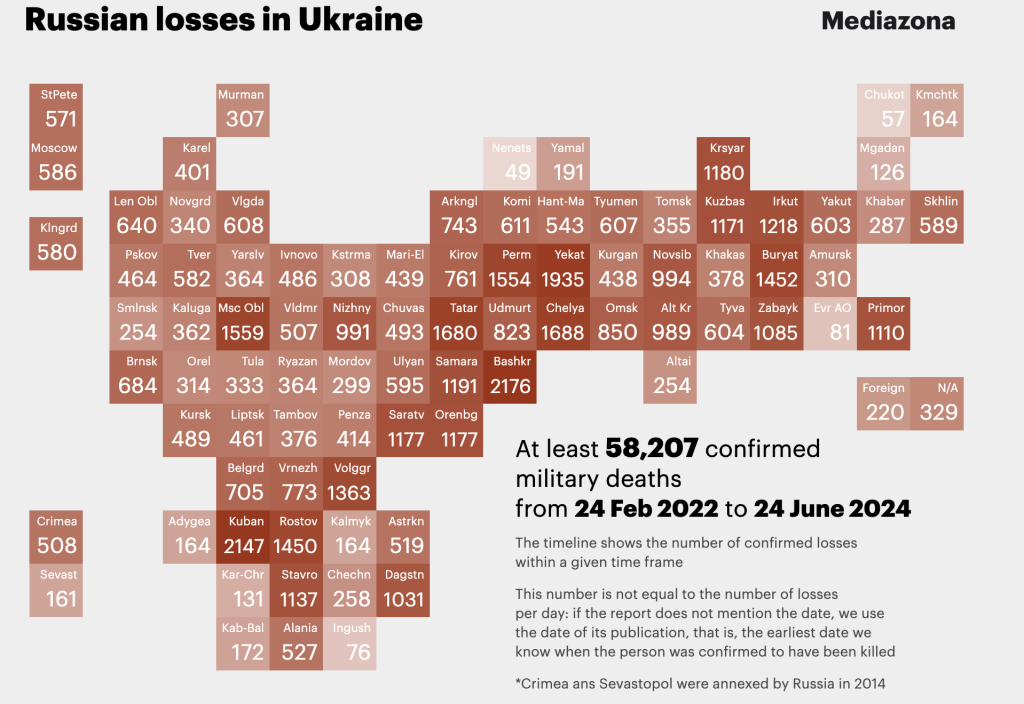
Screenshot of Mediazona infographic, as published here

Russia is losing more and more men in its war against Ukraine.

As of 5 July 2024, Mediazona and its partners in the casualty counting project have ascertained the names of more than 58,000 Russian soldiers killed in action.

The real losses are twice as many, however. Journalists have calculated the actual number of war dead based on information from the probate registry. How they did their work is described in this article by Mediazona. You can read here about how our methodology has been corroborated.

The real losses of the Russian army, including mercenaries, in the war against Ukraine, come to 120,000 dead. The Russian army’s casualties are thus already greater than both the number of US military deaths since the Second World War and all the losses of the Soviet and Russian armies since 1945. Most of the men killed were between the ages of twenty and forty. Those who were younger were usually draftees and prison inmates, while those who were older were “volunteers.”

Seventeen thousand prison inmates recruited by the Wagner Group perished at Bakhmut, according to the mercenary organization’s own documents, as examined by Mediazona. Meanwhile, journalists had estimated that Wagner had lost around sixteen thousand men, which is nearly the same number. Wagner has recruited a total of 48,366 men during the war, meaning that a third of them were killed in the so-called Bakhmut meat grinder.

Prison inmates, “volunteers,” and conscripts, if we judge only by confirmed deaths, have borne the brunt of the losses in the war. At 47.4 percent, they constitute almost half of those who have been killed.

In over two years of war, 3,700 officers of the Russian army and other security forces have been killed, 430 of them in the rank of lieutenant colonel and above.

Between 200 and 250 men are killed every day. This year, the Russian army’s losses have risen dramatically. In 2023, an average of about 120 men were killed every day.

Source: “Every day up to 250 Russians are killed in the war,” WTF? newsletter (Mediazona), 5 July 2024. Translated by the Russian Reader


There are two points of view on Russia during the full-scale war. The first is that Russia has turned into a fascist militaristic state in which everyone marches in step and sincerely hates Ukraine. The second is that cynicism and apathy have won the day in Russia: people don’t care about the war as long as it doesn’t affect them personally. Both of these views are mistaken, according to the authors of “We Have to Live Somehow,” a study from the Public Sociology Laboratory (PS Lab).

The researchers traveled to Krasnodar Territory, Buryatia, and the Sverdlovsk Region, living there for a month and interacting closely with the locals. What they tell us does not fit into either of the two common stereotypes about Russians and the war. Here are a few of the tendencies they observed.

The war is invisible in daily urban life. Residents in the Sverdlovsk Region town of Cheryomushkin (whose name was deliberately changed by the researchers) could not recall a single event in support of (or against) the war during the year. In Ulan-Ude, the capital of Buryatia, the pro-war agitprop consisted of a single poster on a Lenin monument. In Krasnodar, pro-war banners still hung on buildings, but people had long ago removed pro-war stickers from their cars. There is no institutional support for the war at the municipal level: such support is the bailiwick of ideological loners and small groups of pro-war volunteers.

Apolitical Russians justify the war, but arguments like “NATO soldiers” and “defending Donbas” are not of primary importance to them. Rather, they simply want to save face themselves, because they take the accusations directed at their country personally. For this reason, Russians have previously been inclined to justify the actions of the state, even when they do not understand or approve them.

The majority of the populace is not opposed to the war. They may disapprove of it in some respects, but they simultaneously defend the state. For example, in the Sverdlovsk Region, women were outraged by the deaths of young soldiers at the front (“They are sending children to fight! Why?!”) while also parroting the propagandists’ arguments about the war against the “collective West” (“Them United States are hammering civilians!”). Non-opponents of the war argue that Russia has been proactive, defending itself rather than attacking (“Now the Luhansk and Donetsk Republics are part of Russia, but our guys aren’t advancing any further—they’re defending all of it”).

Non-opponents of the war regard the residents of Donbas as Ukrainians, not Russians. They scold Ukrainians from the “Donetsk People’s Republic” and the “Luhansk People’s Republic” (“They don’t defend themselves. They’ll be coming here [to Russia], and what, I’ll have to go fight in their place? I don’t want that”) and do not regard these areas as “their own” (“They are not my blood relatives, they are not my own people”).

While opponents and supporters of the war initially had bitter conflicts, solidarity between them has emerged despite their differences of opinion. Those who generally condone the war are increasingly questioning the official version of events, while those who oppose the war are beginning to listen to their opponents (“I have to build a life and continue living with these people”).

Russians try to pretend that the war has not impacted their daily lives in any way, but its signs still permeate their everyday lives and conversations. In the Sverdlovsk Region, a woman is going to “go to great lengths” to prevent her son from serving as a contract serviceman. In Buryatia, a volunteer says mundanely, “I have eight grandchildren, all boys. And it just happened that four more died at the front.” In Krasnodar, a sociologist’s source says he is glad that the city is not being bombed and that the “Wagnerians” did not come their way, but then confesses in a low voice that the future is hazy and “let’s put it this way: things have become a bit tense.”

The big takeaway, however, is that Russians are pushing the war to the back of their minds. And this is bad news for the Kremlin: it has failed to convince the public, over the past two years, that the invasion was launched in pursuit of noble ends. Even as they justify Russia, its citizens don’t understand what good the war does for them personally.

Source: “How do Russians feel about the war? There seems to be an answer to this question,” WTF? newsletter (Mediazona), 10 July 2024. Translated by the Russian Reader


A week ago, a Moscow court sentenced fifteen-year-old Arseny Turbin to five years in prison after convicting him on charges of “involvement in a terrorist organization.” The security forces accused the schoolboy of aiding the Free Russia Legion, which has been officially banned in Russia.

Convicted 15-year-old “terrorist” Arseny Turbin in slightly happier times. Source: Mediazona

Arseny lived with his mother Irina in the small city of Livny in the Oryol Region. Although he was one of the most successful pupils at the local prep school, he was bullied by his classmates, and yet his teachers did not respond to his complaints. At the war’s outset, Turbin supported the Kremlin’s actions, but later became disillusioned with the government and took an interest in politics, even telephoning [exiled online news channel] TV Rain and telling them that the Conversations about Important Things lessons at school were “utter nonsense.”

In early June 2023, Arseny wrote an email to the Free Russia Legion (an organization we described in detail in a previous newsletter). He wanted to сampaign against the war, but they asked him for too much personal information and he did not send the application form to these strangers. Instead, he started distributing leaflets criticizing the authorities and taking pictures of himself in front of the white-blue-white flag. (The Russian authorities regard this flag as a symbol of the Legion, which has been fighting against Russian forces in Ukraine.)

Meanwhile, a strange thing happened. Turbin made the acquaintance of someone called Maxim, who immediately gave him access to the Telegram channel Occupy Slutophilia 14 (similar names have been used on the Web by the fans of the late Russian neo-Nazi activist Maxim “Tesak” Martsinkevich) and asked him to help with the channel’s content by editing videos. The channel had only a few subscribers, and it featured posts in support of Yevgeny Prigozhin and far-right content revolving around Tesak. Investigators then used Turbin’s involvement in the channel to accuse him of neo-Nazism, despite the fact that the schoolboy’s father was from the UAE, and Turbin himself had been bullied at school due to his dark skin.

At the end of the summer, FSB officers searched the Turbins’ home and summoned Arseny for questioning. It was a very strange conversation: for almost an hour and a half, in different ways, two investigators questioned the schoolboy about his connections with the Free Russia Legion. At the end of the conversation, as Mediazona discovered, they assured the teenager that it was “normal” and “not against the law” to send an application to the Legion, which has been declared a “terrorist organization” by the Russian authorities.

The court was not interested in this peculiar circumstance, however. It was interested in Turbin’s statement, allegedly made during the interrogation, that he had sent the application: this was the basis for the charge that he had “joined” the “terrorist organization.” The thing is that Turbin did not say this. Mediazona has in its possession a full transcript of the conversation, and it simply does not contain mention of Turbin’s sending off the application. The investigators inserted it for their own convenience.

Irina Turbina was present at the interrogation. She says that the investigators retyped the statement three times because of mistakes, and suggests that they could have discreetly amended it after lulling her into a false sense of security.

After seeing the transcript, the investigator, Trunov, had even wanted to close the case. In February 2024, however, the investigation was assigned to another investigator, Irina Simonova. She spun the line about Turbin’s alleged neo-Nazi views, obtaining testimony from the boy’s classmates, who assured her that his “idol was the so-called Tesak,” that he had advocated “exterminating the Ukrainians,” and had supported Alexei Navalny. Irina Turbina does not believe this testimony, producing correspondence in which her son called Tesak a “blockhead” and himself a “liberal.” Turbina argues that her son’s classmates testified against him in exchange for “excellent high school diplomas.”

Due to the increased harassment at school, Turbina transferred Arseny to home schooling. He managed to pass his year-nine exams before the verdict was handed down. On 21 June, the court sentenced Arseny to five years in prison, although the prosecution had requested an even longer sentence of eight years. After the sentence was read, he burst into tears, telling his mother, “Mom, I’m sorry—forgive me for letting you down. But I really didn’t know I was violating any laws.”

No one looked for the mysterious Maxim. The court was also uninterested in Turbin’s conversation with the FSB officers who openly provoked the schoolboy and falsified his statement.

Source: “The story of 15-year-old political prisoner Arseny Turbin,” WTF? newsletter (Mediazona), 27 June 2024. Translated by the Russian Reader


PROMPT: Make an illustration on the theme of “Russia’s Fascist Meltdown”

Creating an illustration on the theme “Russia’s Fascist Meltdown” involves capturing the essence of nationalism, authoritarianism, and geopolitical tension. Here’s a description of an illustration:

The illustration features a powerful and imposing figure symbolizing the Kremlin, with a stern-faced leader resembling Vladimir Putin at the forefront. Behind him, the Russian flag waves prominently, but instead of the usual tricolor, it blends with darker hues suggestive of authoritarian control. The background is a stark urban landscape, reminiscent of Moscow’s skyline, but with ominous shadows and smoke rising in the distance.

In the foreground, there are smaller figures representing dissenters and protestors, their faces obscured in shadows or masked to symbolize anonymity and resistance. They hold signs with slogans advocating for freedom and democracy, contrasting sharply with the dominant figure of Putin. The atmosphere is tense, with a palpable sense of division and discord.

To further emphasize the theme of “meltdown,” the illustration includes elements like cracked ice or fire, symbolizing internal turmoil and instability within Russian society. The color palette leans towards shades of red, black, and grey, evoking a sense of danger and crisis.

Overall, the illustration aims to visually convey the complex and contentious dynamics surrounding Russia’s shift towards authoritarian nationalism, capturing both the gravity of the situation and the resilience of those who oppose it.

Source: ChatGPT

The Spirals of Silence in Wartime Russian Society and the US Republican Party

Popular opinion polls show that the majority of Russians support the military action in Ukraine. Researchers, however, continue to argue that society’s support for the war is much lower than these figures suggest. In their new study “Perception of the conflict with Ukraine among Russians: testing the spiral of silence hypothesis,” V.B. Zvonovsky and A.V. Khodykin, drawing on Elisabeth Noelle-Neumann’s “spiral of silence” model, argue that many opponents of the war are not willing to voice their opinion, believing that it is unpopular and fearing social disapproval.

Noelle-Neumann argues that before people with a “limited interest in politics” decide to voice their opinion on a politically significant matter, they assess the risk of being condemned by others. The spiral of silence “twists” as follows: people who are afraid of being isolated due to the unpopularity of their opinion refrain from voicing it → this opinion is thus heard less and less often in society → people thus increasingly think that their own opinion is not popular → they are thus even less likely to be willing to voicing it.

Zvonovsky and Khodykin discovered that the spiral of silence actually does have a great impact on discussion of the Russian-Ukrainian conflict in Russian society. They were able to verify this by doing a nationwide telephone survey (N = 1977) using Noelle-Neumann’s “train test.” The “train test” measures the willingness of “adherents of a particular stance on a socially significant matter to openly voice it by discussing it on a train with a random fellow passenger.” Supporters of the more popular stance, in their opinion, are more likely to openly voice it, believing that they are “in a stronger camp and less at risk of being judged by others.” Sometimes, their opponents are also encouraged to side with the “stronger” position.

Applying the “train test” to the Russian context showed that the topic of the war is highly sensitive both to its supporters and opponents, and that the spiral of silence affects both sides of the discussion. However, its impact on opponents of the war has proved to be much stronger than on its supporters. Thus, people who oppose the special military operation in Ukraine are less willing to discuss the Russian-Ukrainian conflict with those who support it.

Another important finding made by the researchers is the fact that a person’s willingness to speak out about the war is influenced most by the distribution of opinions about it in their immediate circle of acquaintances. So, the more people in the orbit of respondents who had shared a similar opinion with them, the more the respondents were willing to discuss the war, and vice versa. It can be assumed that the need to maintain social ties is stronger for Russians than the need to defend and disseminate their political views, as we noted in our analytical report “The war near and far.” Zvonovsky and Khodykin suggest another explanation, however: the “bad experience” of political discussions, which often end in conflict and frustration, also has an impact, since the opinions of interlocutors are not changed, and the desire to talk about the war with one’s political opponents thus simply disappears.

The last interesting finding of the authors about which we want to tell you is the following. If the environment of the respondents is divided approximately equally (~50% “for” the war and ~50% “against”), then the probability that those oppose the special military operation will discuss it does not decrease—unlike supporters of the war, who are much less likely under the same circumstances to discuss the military operation with strangers of opposite views. Thus, the opponents of the military conflict “have learned to resist the spiral of silence better than their opponents.” This means that if the distribution of opinions in Russia changes, “opponents of the military conflict will have greater opportunities than [their] opponents to promote their own narrative about the Russian-Ukrainian conflict.”

Source: PS Lab (Telegraph), “The spiral of silence and the war in Ukraine: review of a new sociological study,” 14 December 2023. Translated by the Russian Reader. Image, above, courtesy of Businesstopia


IOWA CITY, Iowa — Anti-Donald Trump Republicans know they are in the middle of a critical moment to stop the former president’s political comeback. But for some, the steep cost of voicing resistance to Trump often renders them silent.

“If you go against Trump, like — you’re over,” said Kyle Clare, 20, a member of the University of Iowa’s College Republicans.

“I don’t talk about Donald Trump a lot because I’m afraid of the backlash,” said Jody Sears, 66, a registered Republican from Grimes, Iowa.

“If you would say something negative about Trump, we had one person that would just go bang for your throat,” said Barbra Spencer, 83, a former Trump voter describing her experience living in senior apartments in Spillville, Iowa.

Trump still enjoys broad popularity in the Republican Party, and that’s driving his polling leads among Republicans in Iowa, New Hampshire and every other state ahead of the 2024 primaries. But he has also used that popularity to enforce unity. And the same impulse that has led Republican officeholders to avoid criticizing Trump because of potential threats to their safety and their jobs is also holding back rank-and-file voters from opposing the former president in public with the full strength of their personal convictions.

NBC News spoke to more than a half-dozen Iowa voters turned off by Trump — but some were anxious about talking on the record out of fear of being shunned by friends or family. One Iowan said they plan on saying they caucused for Trump when asked by members of their community but will actually caucus for Vivek Ramaswamy.

That adds up to signs going unplaced on front lawns, conversations with friends and family about other candidates avoided — and fewer opportunities for opposition to Trump to take hold in different Republican communities.

NBC News first spoke with Clare in a University of Iowa auditorium Aug. 23, the night of the first GOP presidential debate. Fellow College Republicans were reacting to the debate and voicing steadfast support for the GOP candidate who wasn’t on the stage: Trump.

Clare chose to wait until the end of the night, after the rest of his classmates left the auditorium, to share his thoughts.

“I’m just so scared of doing this right now,” he said, fighting back tears. “I want to be able to have my opinions on our politicians, and I want to be able to speak freely about them and people still understand I’m a conservative.”

Clare criticized Trump, particularly for his actions Jan. 6, 2021, saying, “The end of his administration was un-American.” He also said Trump’s supporters are in denial about losing the 2020 election.

“They don’t want to believe he lost the election. It’s hard to swallow. Losing is hard to swallow. But it’s important that when we lose, we recognize that we lost and we think, ‘What can we do better next time to win over Americans?’” Clare said.

Clare was right to expect backlash from speaking out on Trump. After NBC News published the interview with him on a “Meet The Press” social media account, hateful and homophobic comments poured in. Clare said later that a student came up to him at a university event, shoved a phone in his face with the video on it, and asked him why he’s “scared of Trump and not scared of getting AIDS from having gay sex.”

“Say something they disagree with, and they go after your sexuality,” said Clare, who added that he doesn’t regret doing the interview with NBC News. Many of the comments questioned if Clare — who holds a leadership role at the University of Iowa’s College Republican organization, interned for a Republican on Capitol Hill, and is heavily involved in the Johnson County, Iowa, GOP — was truly a Republican.

“I think it shouldn’t be a bad thing for me to say I am conservative and that I think there are other options, and I don’t think that this person is good for our country,” Clare said. But he’s worried those opinions will stunt his own long-term political ambitions.

“If people as powerful and as prominent as members of Congress can be taken down because of their criticisms of one man, what’s stopping that from happening to me?” Clare noted, referring to the Republicans ousted from Congress after voting to impeach Trump.

Trump’s criticism forced several senators and House members into retirement or primary defeat during his first years in office. Later, of the 10 House Republicans who voted to bring impeachment charges against Trump following the Jan. 6 Capitol riot, four retired before facing voters in 2022 and another four lost their next primaries. Only two remain in the House.

In the Senate, three of the seven Republicans who voted to convict Trump have since retired or resigned, and Sen. Mitt Romney of Utah is retiring next year.

Romney recounted to biographer McKay Coppins that Republican members of Congress confided to him they wanted Trump impeached and convicted but would vote against the charges because they were worried about threats to their families.

Former Rep. Liz Cheney of Wyoming, one of the Republicans who lost a 2022 primary after voting to impeach Trump, detailed similar conversations in her new memoir.

Cheney wrote about one colleague that she “absolutely understood his fear” about what would happen if he voted to impeach Trump. But, she continued, “I also thought, ‘Perhaps you need to be in another job.’”

‘It was easier to be quiet about it’

Rank-and-file voters are less prominent and thus less likely to be harassed or threatened, but some of the same worries and experiences remain. Sears, the Republican from Grimes, Iowa, feels Trump doesn’t reflect her values. But that’s an opinion she kept to herself until recently, because of the fear of being cast off by family and friends.

“Family and people I work with are Trump supporters,” said Sears, describing her hesitancy to speak out about her beliefs.

“I think Trump supporters tried to coerce or bully people into also being Trump supporters. And so it was easier to be quiet about it,” she said.

Spencer, a retiree now living in a nursing home in Decorah, Iowa, says Trump supporters at her previous retirement community created a toxic environment that stopped her and her friends from voicing opinions.

“We were afraid of arguments,” she said. “When you live with that many old people, sometimes they have very strange but very firm thoughts and you better think the way they do,” she said, explaining her silence.

Clare, Sears and Spencer are not the only people who feel this way.

And as Cheney and Romney’s stories demonstrate, social ostracization isn’t limited to just voters who speak out against Trump. Former Rep. Denver Riggleman, a Republican who represented a slice of Virginia from 2019 to 2021, says his mother texted him, “I’m sorry you were ever elected,” after he came out against Trump.

“It was so soul-crushing to have a family member choose Donald Trump over you,” Riggleman continued. He said evangelical Trump supporters in his life saw Trump as being blessed by God. “I was going directly against religious beliefs. And that’s a losing battle.”

It’s now been almost six months since a member of Congress endorsed a non-Trump candidate in the 2024 GOP primary, according to NBC News’ endorsement tracking.

The trend has popped up elsewhere on the 2024 campaign trail, too. When Iowa Gov. Kim Reynolds endorsed Ron DeSantis in November, the Florida governor mentioned in an interview with NBC News that he “had people come to me and say they endorsed [Trump] because of the threats and everything like that” during the campaign.

Trump quickly went after Reynolds after news of her DeSantis endorsement broke, posting on social media that it would “be the end of her political career.”

‘Vortex of controversy and vilification’

Charlie Sykes was a conservative radio show host in Wisconsin for more than 20 years before Trump burst onto the political scene. Sykes was skeptical and critical of Trump, eventually confronting him in a heated interview about insults Trump hurled at Texas Sen. Ted Cruz’s wife in 2016. But for Sykes, it began to become clear that there was no room anymore for anti-Trump conservatives on talk radio.

“The audience of conservative talk radio began to think that loyalty was required. They wanted conservative media to be a safe space for them,” Sykes said, describing how his role became untenable.

After leaving radio, Sykes didn’t let up on his Trump criticism, which he says got him booted from a think tank and led him to lose friends and become a self-described political orphan. He says his criticism was met with bullying — and he understands why people who don’t work in the public eye might be hesitant to voice their true feelings about Trump.

“I do understand why people in their normal lives don’t want to be caught up in this vortex of controversy and vilification — why they would step back from all of this,” Sykes said.

Another longtime Wisconsin Republican recently detailed one of the results of that pressure.

Former House Speaker Paul Ryan recently spoke on video at an event for Teneo, a global consulting firm where he serves as vice-chair. Ryan said the impulse to avoid getting on the wrong side of angry Trump supporters pushed former colleagues to vote against impeachment even though they wanted Trump gone — and now he thinks there are many who regret those votes.

“They figured, ‘I’m not gonna take this heat and I’m going to vote against this impeachment because he’s gone anyway,’” Ryan said. “But what’s happened is that he’s been resurrected.”

Source: Alex Tabet, “Trump’s secret weapon consolidating the GOP: fear,” NBC News, 15 December 2023

What Goes On in Your Mind?

EXPLANATORY TEAM

Fixing the roof, installing windows:

It’s not the prices that are rising — it’s the ruble that is falling.
The “special operation” is a war.
You can’t force Ukraine to like you.
We haven’t surrendered to NATO.
The neighbors have no more Nazis than we do.
Soldiers should be alive, healthy, and at home.
The president has gone mad, and everyone is afraid to contradict him.
Your children love you and want to live like human beings.

That’s it, thank you.
So that’s how it is.
Yeah, it’s time to end it.
Wow.
Thanks, I feel relieved.
Oh, would that they would explain it that way on TV.

Source: Oleg Berezovsky (Facebook), 26 February 2023. Translated by the Russian Reader. Thanks to Nikolai Boyarshinov for the heads-up.


The war has made us take a look around. In whose midst do we live? Do our fellow citizens think the same way we do? Public Sociology Lab (PS Lab) is a research team that studies politics and society in Russia. In 2022, it launched a project to study the attitudes of Russians to the war.

How do people explain the conflict’s causes to themselves? How does their attitude to politics affect their personal interactions and self-perception? Do they have a political position at all? We talked about this with researchers at PS Lab. Svetlana Erpyleva works at the Center for Eastern European Studies at the University of Bremen, while Maxim Alyukov, a political sociologist, works at the Institute for Russian Studies at King’s College London.

How is your research on the attitude of Russians to the war with Ukraine set up?

Svetlana Erpyleva: Qualitative methods are the main difference between our team and the other teams doing systematic research on perceptions of the war. We have long conversations with our informants and try to find out not only their attitude to the war directly, but also many other things related to it — what sources of information they trust, how they interact with loved ones, their fears and hopes, and so on.

We searched for respondents using social networks, ads, and the “snowball” method (that is, when an informant helps us set up a conversation with their ow friends). It was a big help in contacting people who do not often reflect on politics.

Some people responded enthusiastically to the ads we placed about finding informants — they wanted to talk to us themselves. Moreover, these are not only people who have a clear stance for or against the war and are willing to share it, but also those who feel that their opinion is not represented in public discussion. Such people do not see other people who think like them on social networks or in the media and want to put themselves on the map.

For example, during the the second stage of our research, in the autumn of 2022, we realized that dividing people into “supporters of the war,” “opponents,” and “doubters” (as we had done in the spring) was no longer warranted. Our sources support some decisions by the authorities, but not others. They regard the war as necessary in some ways, but some things about it terrify them, while other things cause them to doubt. Our interviews, which last about an hour (sometimes longer), have in fact enabled us to understand the peculiarities of how the war is regarded by Russians, with all their contradictions and complications.

Our other goal is to study the dynamics of how the war is regarded. We conducted the first series of interviews in the spring of 2022. We did the second series between October and December 2022. It is important to note here that in the autumn we spoke only with “non-opponents of the war,” that is, with those whom in the spring we had provisionally labeled “supporters” and “doubters.”

Maxim Alyukov: I would also make another important clarification. When people talk about studying perceptions of the war, they often have in mind representative surveys. Using them, we can indeed more or less accurately describe the range of opinions around the country. But polls cannot show how opinions about the war are shaped, or what emotions people experience. We are going deep rather than wide. Yes, we cannot draw large-scale conclusions about public opinion in general, but, unlike the polling projects, it is easier for us to talk about specific mechanisms — what emotions tend to shape certain positions, how different types of media consumption affect perceptions of the war, and so on.

What is the difference between how people regarded the war in the spring and the autumn?

SE: On the one hand, we see from the autumn interviews that perceptions of the war had not changed radically. Almost none of the people with whom we had repeat conversations had changed their attitude to the war from “plus” to “minus” and vice versa. Of course, there have been small shifts in this regard. For example, some of the springtime convinced supporters remained “optimists,” while others had become “pessimists.” The former believe that the “special operation” is going in the right direction, despite all the shortcomings, while the latter criticize the chaos in the army, the chaos during the mobilization, retreats by Russian troops, and so on.

But we shouldn’t deceive ourselves: the pessimists have not stopped supporting the war. Rather, they want Russia to act tougher and more effectively, and ultimately win.

In the first series of interviews in the spring, we identified a group of so-called doubters. But it is clear that even back then different informants in this group were closer to one or the other pole of opinion. Some doubted, but were inclined to support the war, while others were against it. In the autumn, there were fewer informants who were completely unsure of their position. Those who had been closer to the supporters of the war had often begun to support the war a little more. The same thing happened to those who had been more against the war than not: many of them had become a little more strongly opposed to the war (without turning into unambiguous opponents).

On the other hand, the ways people have for justifying the war have changed. Some of the old methods are losing popularity, while others are emerging.

For example, one of the new justifications for war involves imagining it as a natural disaster. We feel sorry, of course, for those who perish in a flood. We cannot regard this other than negatively. But it is impossible for us to oppose it. The same thing has happened with the war.

From the viewpoint of the informants who have resorted to this excuse, the war just happened. It is a terrible reality that we can only accept.

Another new way of rationalizing the war involves turning its consequences into its alleged causes, as when our informants say, “Ukraine has been bombing our border cities, so we need to continue the war,” or, “The war has shown that we are fighting not with Ukraine, but with the collective West. We are fighting not with a fraternal people, but with our perennial enemy, so it is right that we started this war.” The second statement had also come up in the spring, but it has become much more popular. The rationale behind such justifications involves arguing that events that happened after the war started seemingly reveal the enemy’s true identity.

MA: Attitudes towards sources of information have also changed. There are two trends: polarization and stabilization. At the war’s outset, people tried to seek out information, including information from the “opposite camp.” For example, those who supported the war sometimes read opposition and Ukrainian media, because they understood that the Russian state media are propagandistic. Now, on the contrary, many people are so weary that they have not only reduced their consumption of information in general, but also have stopped following sources that reflect the opposite opinion.

At the beginning of the war, the following idea was often discussed: information about the destruction, civilian casualties, and losses among Russian soldiers would gradually undermine the effect of propaganda. Now we see that, over time, the simultaneous consumption of information from pro-government and opposition sources, which paint radically different pictures of the world, has had the opposite effect. It causes discomfort, which leads to the fact that people who are less involved try to shield themselves from information about the war in general, while more involved people consume propaganda and stop paying attention to alternative sources. This is a conscious choice: they realize that they are consuming propaganda. I remember the words of one informant: “There are different points of view, but the brain tends to stick to one theory. I’m inclined to choose the theory of my country, of the state media, so that my brain follows it.”

It transpires that the person understands perfectly well that they are consuming propaganda, and they consciously choose it amidst conflicting explanations that cause discomfort.

Do these changes produce any practical actions? Maybe people stop talking to certain people or get involved in charity?

SE: There are only a few volunteers among our informants.

People can have a positive view of charity, and worry about their country, but most of them do not take any action themselves.

And yet, volunteering that involves assistance to the mobilized is certainly seen positively by our informants (that is, by “non-opponents” with very different views of the war). Such volunteering is regarded not as involvement in the war, but as support for “our boys,” for “our country.” This is not surprising: there are always significantly fewer “activists” and volunteers than there are sympathizers. Only a few people are involved in protests, too.

Changes have also been taking place in the way people talk about the war with their loved ones. For example, many of our informants described the summer as a carefree time when the war had completely disappeared from their lives: they stopped discussing it. The mobilization was the “new February 24” for those informants (who were most often people remote from politics). The topic of war had returned to everyday conversations again. The informants were discussing the events even with strangers. For example, one of our sources told us that even at work meetings with her clients she had occasion to discuss the mobilization.

Do attitudes to specific events affect everyday practices? For example, the mobilization began and people decided to check whether their foreign travel passports were still valid.

SE: Unfortunately, we didn’t talk much about everyday practices in our interviews. Probably the most common reaction to the mobilization’s announcement was anxiety and, simultaneously, the absence of concrete action: “Whatever will be will be, but I hope that nothing bad happens.” Some of our informants who did not want to be sent to the front changed their places of work and residence, but we didn’t often encounter such people in our interviews. (It is important to understand that we were talking to “non-opponents” of the war.)

MA: It’s also worth recalling that a minority of Russians have the possibility of leaving the country. According to our research on social networks (this is another project that my colleagues and I are doing), the most common reaction to the mobilization has been evasion.

Is it possible, then, to talk about a desire for inner emigration among those who have remained in Russia? For example, a person says, “Actually, I have a lot more important and valuable things in my life [than the war], and I want to pursue them.”

SE: It was the presence of this desire among people in the spring of 2022 that made us single out the doubters as a separate group. All of them were typified by the notion that the “distant war” was secondary compared to more important values — work, loved ones, and family. But in the autumn, we saw that fewer and fewer of our informants were able to take a neutral stance, to completely distance themselves from assessing the war. Our informants talked about pressure: they seemed to feel that society demanded that they voice their opinion. In this sense, as Maxim has said, the polarization of views has been increasing.

But our informants assess [this polarization] in different ways. Many supporters of the war say that it is awesome because people are becoming more united, more interested in what is happening around them. The “anti-patriots” will leave the country, but patriotic Russians will remain. Others complain that it is hard for them to cope with the pressure. They would like to take a neutral position, but they cannot manage it. One of my sources described it this way (I’m quoting from memory, of course, but nearly verbatim): “I would like not to take a side, but my smart friends say that the war should be continued. And I understand that they are right, that one should support one’s country in such circumstances. I’m unable to take a back seat.” But a little later she said: “I’m afraid that time will pass and [people] will come and ask me, ‘Have you been reading Meduza? Have you been watching Channel One? Whose side are you on?’ And I won’t have any answer.” This situation even makes her think about emigrating. That is, on the one hand, she chooses to side with supporters of the war; on the other hand, she is afraid to make this choice.

MA: I would add that the desire for neutrality remains. One respondent put it this way: “There is war all round, but I try to maintain peace on my VKontakte page.” He moderates disputes there and shares links to articles about the importance of neutrality. For him, this is a way of creating a space for himself in which there is the possibility of remaining neutral, since he doesn’t have this possibility in other contexts. It is another matter that there are fewer and fewer opportunities for such neutrality.

You say that your respondents feel pressure. Where do they feel this pressure? In interactions with loved ones and colleagues, or somewhere else?

SE: It is often the pressure of their immediate environment. Many opponents of the war have left the country, and the doubters thus have fewer contacts with their viewpoint. They are surrounded, as a rule, more by supporters of the “special operation.” But the cause of such pressure may be an inner conflict. For example, our sources tell us that they were taught at school that when the country is in difficult straits, the worst stance is neutrality. But now they have found themselves in exactly this position. It is really difficult for them: they see the propaganda on both sides, but do not feel strong enough to resist it. This can be illustrated as follows: “Maybe Russia was right to attack, or maybe it was wrong to do so. Maybe Ukraine is the enemy, or maybe it isn’t the enemy. I don’t understand what’s going on at all. But how can I fail to take a stance?”

In such circumstances, people turn to what seems certain to them — for example, to their Russian identity. You may not know who is right, but you have a native country and it must be supported.

MA: This feeling of pressure consists of two parts. The first is personal interaction, about which we have said our piece. The second is the influence of the media, in which you can constantly see appeals and reminders of the war. This background encourages a person to clearly articulate their position.

Is the official newspeak (“special operation”, “line of contact,” etc.) incorporated into the explanations given by the “non-opponents” of the war? Is the state discourse generally used to justify it?

MA: Yes and no. It does happen that our sources literally quote propaganda narratives. For example, they start saying on TV that there are fakes everywhere, and a person repeats this idea. But at the same time, an absolute minority of our sources trust state broadcasts, although there are such people among them. They have doubts and come up with their own hypotheses. But it is important to take into account that our informants live in large cities, so it is likely that, for example, in smaller cities far from the capitals, the ratio is different, that there are fewer people there who are like the majority of our respondents, and more people who trust propaganda.

SE: You also have to understand that there are different types of support for the war, and therefore different explanations for it. There are people who accept the explanations given by the state media. Most often these people are elderly: they regularly watch TV, and then rehash the rhetoric of the propagandists. But there are other kinds of people — for example, those whom we call “committed supporters.” Their attitude to the Russian-Ukrainian conflict was shaped back in 2014, or even in 2004. They can be quite critical of propaganda narratives and are fond of saying, “We have bad propaganda. It is incapable of explaining anything.” Such people are able to explain the war’s causes on their own. And there are, for example, people who are remote from politics, who might watch TV sometimes, but it doesn’t convince them. They can even rehash propaganda cliches, but they do not adopt them, they do not present them as their own words. For example, they say, “We were told that…” or “We are told that…”

Is it possible then to say that, despite propaganda, polarization, and state pressure, even those who are not against the war are in a gray area? In other words, there are no views that could unite people, and accordingly, that is why they cannot unite and make demands.

SE: Yes, that’s right. Unless “convinced supporters” could try to create some kind of association. But I’m sure they’re a minority. Most people are busy with their daily affairs: they are not interested in political positions and movements. We are currently preparing a second analytical report on the results of the autumn stage of our study, and there we even try to avoid the word “position.”

Most of our informants have no “position.” Their attitude to the war is a bundle of fears, doubts, hopes, and other feelings. Such people may want Russia to win, but sincerely worry about the victims of the shelling in Ukraine.

One of our informants said, “If I had been subject to the mobilization I would have been out of Russia in three minutes.” And yet she, for example, wants Russia to win.

MA: Especially since propaganda does not just attempt to impose a certain point of view. It also generates a multitude of contradictory narratives that simply confuse people. This is a paradox of authoritarian propaganda: the state needs this vital demobilizing effect to maintain control, but it also prevents it from generating broad support for the war.

You mentioned sympathy for the victims of the shelling. In your spring report, some of your sources say that they would tolerate a decline in the material standard of living, because for them what matters are spiritual values. Since they are so clearly aware of losses, can we say that Russians perceive themselves as victims?

SE: We rarely see people regarding themselves as victims directly. They say, “The situation has become worse in Russia as a whole, but everything is fine with me. Yes, people are being mobilized, and that’s scary, but my loved ones aren’t being mobilized. Prices have gone up, but we’re coping.” Our sources often regard Russia as a whole as a victim. They are offended on Russia’s behalf: it was forced into the conflict, and it is humiliated everywhere and considered an aggressor. That is, they don’t think “[international] brands have abandoned me,” but those brands have abandoned “poor Russia.”

MA: Ukrainians are also regarded as victims. “The poor residents of Ukraine are being used by NATO. Would that it were over as soon as possible.” In many ways, this is part of the propaganda narrative that Ukraine has become a firing range on which NATO and Russia are fighting using Ukrainians as proxies. But this is, rather, a propaganda cliche that people simply repeat without thinking through their own position on this issue.

It follows that “non-opponents” of the war do not regard it as part of their personal lives?

SE: This is a generalization, of course, but I would say that it is basically true. For the opponents of the war, on the contrary, the war has become an existential challenge. Sometimes they even make themselves experience it as such: “I cannot live an ordinary life. I must remember that there is a war going on.”

But isn’t there a contradiction here? The “non-opponents” of the war do not regard it as a personal matter, but we are saying that they feel pressure from their loved ones, are trying to find their own identity, and are grasping for rationalizations.

SE: This is a difficult question, but let’s try thinking about it. Compared to opponents, supporters and doubters are more likely to try to rid themselves of negative thoughts, to distance themselves from the war. And yet it regularly makes its presence felt. The latter is a new trend, and many of [our respondents] do not like it: they would prefer to live their lives without being reminded about the war. But it has become more difficult to do this.

MA: In our research on how the war is seen by Russians, we have been observing what I had observed in my pre-war research. People, if they are not politicized, rarely hold consistent positions at all. I will give an example from my research on Russian perceptions of the conflict between Russia and Ukraine prior to February 24. A person has a smorgasbord of different political ideas. He supports all the decisions made by the authorities, including the annexation of Crimea and military backing for the so-called DPR and LPR. And yet half an hour later he says, “Basically, it would be a good idea to withdraw the troops and leave Ukraine alone. It’s bad for us.” It’s just that he hadn’t needed to make connections between his disparate views on this issue before. This necessity emerged during our conversation.

We have been observing the same thing now. People are trying to push the war out of their lives. They need arguments in favor of the war — not because it is their political position, but because it is safer to live that way. For many of our respondents, the interview was like an exam in which they were forced for the first time to think about logical chains and formulate at least some kind of a clear opinion about the war, which they had not tried to formulate before.

Source: Vitaly Nikitin, “‘One of the new justifications for the war involves imagining it as a natural disaster: we can only regard it negatively, but it’s impossible to oppose it’: what goes on in the minds of Russians who support the invasion of Ukraine?” Republic, 24 February 2023


What goes on in your mind?
I think that I am falling down.
What goes on in your mind?
I think that I am upside down.
Lady, be good, and do what you should,
you know it'll work alright.
Lady, be good, do what you should,
you know it'll be alright.

I'm goin' up, and I'm goin' down.
I'm gonna fly from side to side.
See the bells, up in the sky,
Somebody's cut the string in two.
Lady, be good, and do what you should,
you know it'll work alright.
Lady, be good, do what you should,
you know it'll be alright.

One minute one, one minute two.
One minute up and one minute down.
What goes on here in your mind?
I think that I am falling down.
Lady, be good, and do what you should,
you know it'll work alright.
Lady, be good, do what you should,
you know it'll be alright.

Source: The Velvet Underground (YouTube), 10 August 2018


Throughout Putin’s war on Ukraine, the attitudes of the Russian public toward the regime and the conflict have been the subject of much scrutiny. This talk addresses this question by analyzing data released by the Presidential Administration that summarizes monthly correspondence received from the public from January 2021 through December 2022. While the identity of these correspondents is not known, their decision to send non-anonymous appeals to the President suggests that they support or tolerate the Putin regime. The data demonstrate that after an initial period of uncertainty about the war’s economic impact, these concerns abated until the announcement of mobilization in September. Since then, the appeals depict a Russian public that is increasingly concerned about conditions of military service and the war’s impact on service members and their families. At the same time, the data indicate that the Kremlin’s strategy to shift the blame for mobilization from the President to regional authorities appears successful.

Source: Institute for European, Russian, and Eurasian Studies, George Washington University


Pollsters argue over how many Russians support the Ukraine war

Since the Russian invasion of Ukraine, sociologists have grappled with the question of how many Russians support the Russian army in Ukraine. Both independent and state-run pollsters claim they are the majority, and these studies are frequently referenced in Western media. However, at the same time, a group of independent sociologists have pointed out that these polls may not be representative — many Russians are reluctant to speak freely about their thoughts on the conflict due to draconian wartime censorship laws.

  • Independent researchers from the Khroniki project recently presented the findings from their latest survey, which suggest using a percentage of how many Russians support the war may not be a very meaningful statistic. In their view, this figure comprises a misleadingly wide spectrum of people: from those who volunteered to fight in Ukraine to those afraid of repression. Moreover, at least half of those who are opposed to the war are afraid to speak out, the Khroniki sociologists said.
  • To identify the core pro- and anti-war groups in Russia, the pollsters devised a series of questions. The results of their survey suggests that the core support group represents 22% of the population, while the core opposition is 20.1%.
  • Separately, researchers stress that “the fridge counters the effects of the TV,” and this effect is felt more and more with each passing month. The level of support for the war among TV viewers who are encountering economic pressures is falling. Among TV viewers who have encountered at least one economic problem, support for the war was down 11 percentage points in February.
  • Other polls, however, show that a vast majority of Russians support the war. For example, according to state-run pollster VTsIOM, 68% of Russian residents welcomed the invasion of Ukraine and just 20% are opposed to it. And leading independent polling agency Levada Center published results in January that suggested 75% of Russians support the war — to varying degrees.

Why the world should care:

It’s not easy to work out exactly what proportion of the Russian population supports the war, but Khroniki is certain that the pro-war lobby is far smaller than polls from leading agencies would suggest. If that is true, it casts doubt on the widely-held belief in the west that the war in Ukraine is supported by most Russians who remain inside the country.

Source: Alexandra Prokopenko, The Bell (Weekly Newsletter), 3 March 2023. Translated by Andy Potts


On 1 September 2022, I returned to Russia after almost a year away. The war that began six months ago had been present in my life daily: in the news, in conversations with friends and colleagues, and in the Ukrainian flags on the streets of the European city where I lived. But there was no trace of the war in the town near Moscow where I grew up, and where my parents still live. I did not see pro-war or anti-war graffiti or slogans; war was not mentioned in the streets or by my friends and acquaintances. As I sank into the familiar rhythm of my childhood town, I caught myself thinking that perhaps I was beginning to forget about it too. That all changed on September 21, the day ‘partial mobilisation’ was announced. Suddenly, the war was being mentioned all around me, or rather whispered about, in the cafe where I listened to Putin’s address, in the local library, in the street, on the train from Moscow to St. Petersburg. The war seemed to have reappeared in Russian society instantaneously, with the snap of a finger. 

I had observed something similar before, not around me, but as a researcher: in the data my colleagues and I collected. Our Public Sociology Lab began conducting a qualitative study on Russians’ perceptions of the war on February 27, 2022, just three days after the full-scale invasion of Ukraine began. During the first months of the war, we conducted (link in Russian) over 200 interviews with supporters of the war, its opponents and doubters. At that moment, many of our informants, including those who were far from being exclusively anti-war, also said that they had been shocked by the news of the start of the ‘special military operation’ and had tried to make sense of events in their conversations with friends and relatives. But after a few weeks, the emotions of shock and confusion began to fade. The war became routine and faded into background noise.

So we knew that the ‘return of war to society’ following the announcement of mobilisation would also likely be temporary. We waited a few weeks and, on October 11th, conducted our first interview as part of the second stage of our research into Russians’ perceptions of war. Between October and December 2022, we conducted 88 interviews with ‘non-opponents’ of the war, deciding this time to focus the study on support for and disengagement from the war, rather than resistance to it. Forty of these interviews were repeated conversations with supporters of the war as well as its doubters doubters, with whom we had already spoken in the spring. 

We were driven by the desire to understand how perceptions of, and predominantly support for, the war were evolving. From the interviews conducted in the spring of 2022, we roughly divided all ‘non-opponents’ of the war into supporters and doubters. Despite the fact that among supporters of the war, there were interviewees who were convinced to a greater or lesser extent, all of them found some means to justify the ‘special military operation’. Some were staunch supporters of ‘the Russian world’ and believed that the war would push the geopolitical threat away from Russia’s borders and strengthen the country’s position; some were worried about loved ones in Donbas and rejoiced at the prospect of an imminent resolution to the longstanding conflict; some, viewers of Russian TV channels, spoke of ‘combating fascism’ and ‘protecting the Russian-speaking population of Donbas’; many expressed confidence or, at the very least, hope: ‘if our government started the war, then it must have been necessary’. Although these people were worried about the casualties caused by the war and looked with apprehension at a future defined by isolation and sanctions, they remained supporters of the ‘special operation’.

It seemed to us, as it did to many others, that the announcement of mobilisation might fundamentally change something in the way Russians viewed the war. However, in addition to mobilisation, the war was marked by a series of other events, each of which could have left an impression on Russian society: the seizure of new territories and their subsequent annexation to Russia, the retreat of Russian troops, the bombing of the Crimean bridge, news of the bombing of Russian border regions. All this occurred against a backdrop of increasing Western sanctions, muddled explanations from the authorities as to why the country was at war, repression of dissenters, and increasing polarisation of views on the war in society. In such a state of affairs, we assumed that the views of the war held by ordinary Russians could not be sustained. In some ways, our assumptions were right, and in other ways, we were wrong.

It was not without reason that we waited a few weeks after the announcement of mobilisation and the swift ‘return of the war to society’ before we began the second stage of our research. The October interviews showed that the emotions associated with the announcement of mobilisation were as strong as they were fleeting. After a few weeks, they began to subside, and ‘partial mobilisation’ became normalised as a part of the new everyday reality. But, most interestingly, despite the negative attitudes towards mobilisation expressed by many of our informants who were not opposed to the war, their dissatisfaction with mobilisation rarely translated into dissatisfaction with the ‘special military operation’. 

[…]

Source: Svetlana Erpyleva, “‘Once we’ve started, we can’t stop’: how Russians’ attitudes to the war in Ukraine are changing,” Re: Russia, 14 March 2023. Read the rest of this fascinating article (whose translator is uncredited, unfortunately) at the link. ||| TRR

Watching the Watchers

Sveta Erpyleva after finishing her 24-hour shift as elections observer in the wee hours of Monday morning. Photo courtesy of the author
Sveta Erpyleva after finishing her 24-hour shift as an elections observer in the wee hours of Monday morning. Photo courtesy of the author

Sveta Erpyleva
Watching the Watchers
September 20, 2016

I want to articulate a few ideas about the practice of working as an elections observer from a slightly different perspective than people usually write about it. In my view, there are two things that make the practice attractive to many of us.

The first thing is the indescribable feeling of belonging to an anonymous community, a team of strangers involved in an important cause. Such communities are nearly absent in our everyday lives. We have friends and families, but that is not the same thing, of course. We have colleagues and people who share our interests. We might not know them personally, either, but we never come together with them to touch on something that affects the entire country. In this case, however, over the course of twenty-four hours we experience the same events and emotions as hundreds of other observers in different parts of the country. We share our impressions with each other in comments sections on social networks, we all stay awake for days on end, and together we quarrel with members of electoral commissions. It is a very unusual and powerful sensation. I think many people have experienced it, whether they were aware of it or not.

The second thing is the chance to feel we are not couch potato dissidents or whatever it is called, but real citizens, conscientious citizens. We voluntarily get up early in the morning, we wrestle with a large group of people on our lonesome, and we struggle mightily with fatigue. And then, naturally, we write about it, hearing in reply all sorts of compliments from loved ones and acquaintances. But that is what we expected to hear, isn’t it?

In connection with these two things, I think it is important we be aware of the following. An anonymous political community is groovy, but sometimes it is not worth getting carried away with it. Are we certain we want the exact same things as the conscientious, get-up-and-go people who seem so much like us on elections day?

I chatted with a pleasant, conscientious young man who, like me, had come of his own free will to work as an observer at my polling station. Nope, his way was not my way, I discovered. We wanted different things.

As for the second thing, it is quite simple to selflessly surrender twenty-four hours of your life to “civil society” once every two or three years and then hear lots of nice things about yourself. Meanwhile, there are people in our midst who selflessly give up several hours every day to political struggles and social activism. Ninety-five percent of that time vanishes into the mist, because that is the nature of modern politics. These people do not get any doughnuts in the guise of society’s approval for ninety-five percent of their work. I admire people like this if their views are congenial to mine rather than people who have worked as election observers. Sorry.

I am not saying you should not go work as an elections observer. I did it myself, and I imagine I will go and do it the next time round. What I mean to say is that, first and foremost, we should not look at ourselves through rose-colored glasses.

Sveta Erpyleva is a sociologist who works at the PS Lab (Public Sociology Laboratory) in Petersburg. This past Sunday, she volunteered as an elections observer at a polling station in the city’s Central District. My thanks to her for allowing me to translate and publish her remarks here.