Last Bolotnaya Square Defendant Flees Russia RBC
November 9, 2017
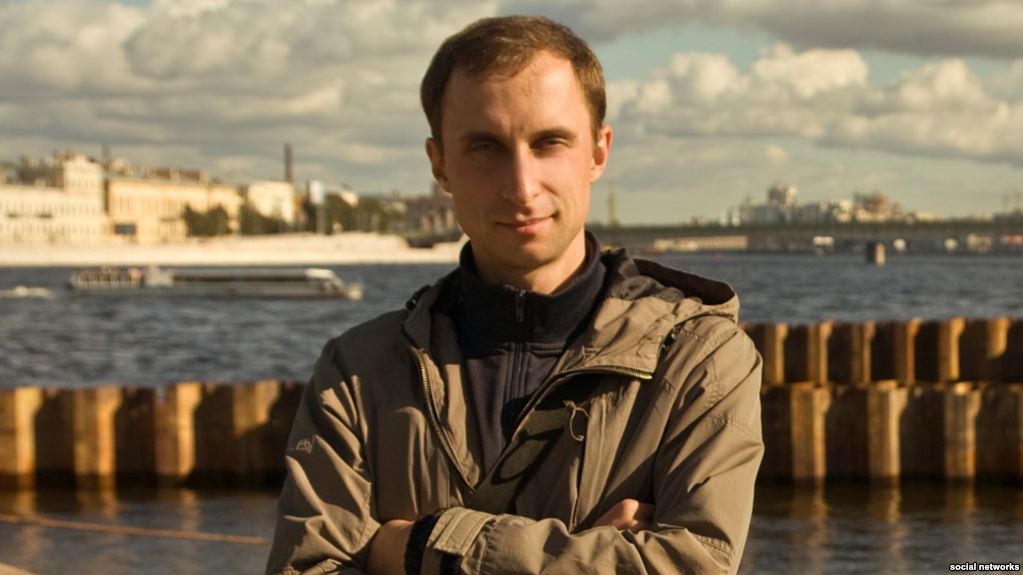
In an interview with Current Time TV, Bolotnaya Square defendant Dmitry Buchenkov said he has left Russia for a European Union country.
He said he has applied for political asylum in this country. Buchenkov failed to say exactly where he had gone.
“I’m calm about the fact I won’t be returning to the motherland soon. I won’t say leaving was easy. Psychologically, of course, I didn’t want to leave,” he noted. “The regime and the entire justice system forced me to take this step.”
He added he was currently not in touch with relatives.
When asked how he managed to cross the Russian border, the Bolotnaya Square defendant said he was “neither the first nor the last person to do it in such circumstances.”
According to Buchenkov, the Bolotnaya Square Case was “political” from the onset. He said that, after he was put under house arrest, “for six months [he] observed how the case was unfolding personally for [him]” and was convinced a guilty verdict lay in store. He said he was transferred from a pretrial detention facility to house arrest during a “brief thaw.” He was not outfitted with an electronic tracking bracelet, because the Naro-Fominsky division of the Federal Penitentiary Service had run out of them.
“I think the police investigators have long known they nabbed the wrong guy. But it was too late for them to back out,” said Buchenkov.
On the morning of November 9, Buchenkov did not show up to the Zamoskvorechye District Court for the latest hearing in his case, in which he stood accused of involvement in rioting. The Federal Penitentiary Service has accused him of fleeing, writes Current Time. Federal Penitentiary Service spokeswoman Natalya Bakharina said the defendant had “absconded,” since he was not to be found in his flat. She noted another family had been living there since November 5, and they were given keys to the flat in late October.
Buchenkov’s attorney Ilya Novikov wrote that he would refrain from commenting for the time being. In turn, Buchenkov’s other attorney, Svetlana Sidorkina, told RBC she did not know about her client’s departure from Russia.
“I don’t know about it. I do know he did not come to today’s hearing, during which the matter of whether to continue the forensic investigation or not was to have been ajudicated,” said Sidorkina.
According to her, the court decided to postpone the hearing since Buchenkov was not in attendance.
In April, at a hearing in the Zamoskvorechye District Court, Buchenkov declared himself not guilty of involvement in rioting and fighting with policemen. He was accused of violence against six Interiory Ministry officers and causing damage in the amount of 73,800 rubles to a commercial firm that set up porta-potties near Bolotnaya Square in Moscow.
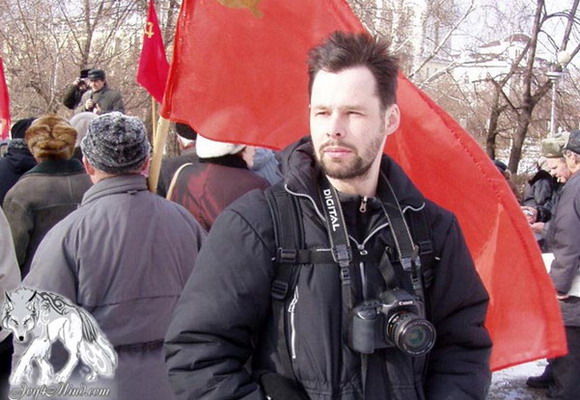
Buchenkov, a 38-year-old anarchist and history teacher, was detained and remanded to custody in December 2015, thus becoming the thirty-fourth defendant in the Bolotnaya Square Case. Later, the Moscow City Court released him from custody and put him under house arrest. Buchenkov’s lawyers insisted the activist was not in Moscow during the events of May 6, 2012. The claim was corroborated by Buchenkov’s relatives in Nizhny Novgorod.
According to the defense, the police investigators who, allegedly, identified Buchenkov on video recordings of the May 6, 2012, protest rally mixed him up with another person. The defense lawyers sought to enter higher resolution photographs into evidence, but police investigators refused to take them into account.
A couple of days ago I met Dima Borisov’s mother. Dima is the young man facing trumped-up charges for, allegedly, kicking a policeman. Dima now faces up to five years in prison. I don’t want to be a pessimist, but it’s highly likely that he will be sent down and sent down for a long time. But the topic of political prisoners has, apparently, has ceased to interest the opposition crowd.
Realizing that people are unable to free an innocent person on their own or in small groups, I asked Dima’s mom (Irina Andriyevskaya) what could be done to alleviate his plight. She said that people could repost stories about the case. If they couldn’t attend his court hearings, they could tell other people about Dima.
Guys, let’s just support Dima. Let’s show that we know about his misfortune and are not ignoring it. It’s not likely to change anything, but at least Dima and his mom, who is basically fighting this fight alone and certainly has it rougher than we do, will feel that they are not alone, that they have not been abandoned. Especially since nowadays absolutely anyone in this country can become a political prisoner.
I’m not making any demands or blaming anyone. I’m just asking decently.
Dmitry Borisov in court on October 20, 2017
Moscow City Court Denies Borisov’s Request to Be Released from Police Custody
Tivur Shaginurov Kasparov.ru
October 2, 2017
Moscow City Court has refused to release Dmitry Borisov, an activist with the 14% Movement. As our correspondent reports, the court heeded the arguments of police investigators, who claimed that Borisov was a flight risk or could influence the investigation.
A reinforced brigade of court bailiffs and two plainclothes policemen were present at Borisov’s appeals hearing. Ultimately, the court extended his term of detention for a month.
Investigators argue that Borisov’s guilt is confirmed by a videotape they have in evidence, adding that the accused has not admitted his guilt and, allegedly, resisted arrest. The accused claims he was resisting unknown men in uniform.
[In the videotape, inserted below, it is clear the police officers who detained Borisov were not wearing badges, as requiredd by the Russian law on police conduct—TRR.]
In turn, the defense argue Borisov is not a flight risk since both his foreign travel and domestic internal passports have been confiscated, and he is not a national of any other country. Borisov’s movements could be tracked with a special bracelet issued by the Federal Penitentiary Service. Nor, according to the defense, could Borisov influence witnesses, especially as the alleged victim and witnesses are police officers.
The defense likewise denied that Borisov had a prior conviction. Borisov explained himself that criminal charges had been filed against him due to a conflict with a drunken man who had insulted his mother. The defendant’s mother, who was present in the courtroom, confirmed her son’s story.
After a heated argument, Borisov’s relatives were removed from the courtroom along with a reporter from the publication Sota [?] who photographed the incident.
They were charged with administrative violations. We should note that the reporter was accredited and had the court’s permission to take pictures. However, court bailiffs argued their actions were justified because she had taken pictures of their faces.
Boris’s attorney noted that the requirements for keeping a defendant or suspect in police custody, as stipulated in Article 97 of the Criminal Procedural Code, were not contained in the prosecution’s demand that Borisov be kept under arrest.
In the video that police investigators cite as evidence of Borisov’s guilt, it is not apparent when and how Borisov kicks a police officer.
Borisov’s supporters plan to organize a flashmob during which they will submit appeals to the Prosecutor General, asking him not to approve the charges against Borisov.
Dmitry Borisov has been accused of twice kicking a police officer in the head when police dispersed a peaceful grassroots protest on March 26, 2017, in Moscow.
Translated by the Russian Reader. Thanks to Comrade NE for the heads-up. Photos courtesy of Kasparov.ru and the 14% Movement.
Court Extends Yuri Dmitriev’s Arrest to Late January Chernika
October 12, 2017
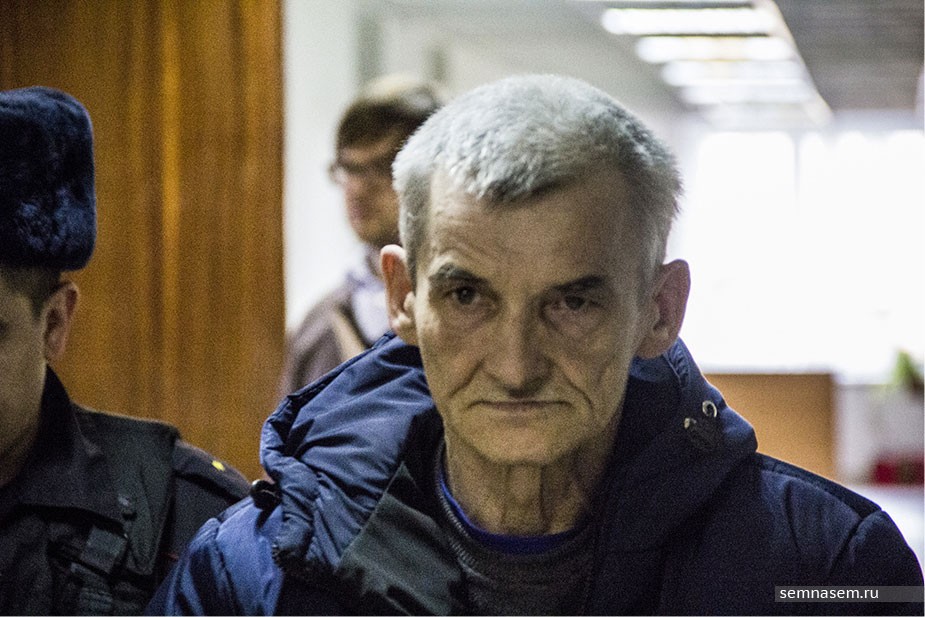
Yuri Dmitriev, head of the Karelian branch of Memorial, will remain in police custody until next year. Judge Marina Nosova made this ruling on October 11 as part of the criminal case against the famous historian and researcher of the Stalinist Terror, who has been charged with producing pornography featuring his foster daughter. The prosecution had petitioned the court to extend Dmitriev’s arrest for three months. The defense, however, plans to appeal Judge Nosova’s ruling in the Karelia Supreme Court.
Judge Nosova also rejected an appeal made by Dmitriev’s defense counsel to disqualify the forensic experts who have been evaluating the photographs of Dmitriev’s foster daughter, which are the main evidence in the criminal case. As Chernikareported earlier, the previous findings, reached by analysts from the Center for Sociocultural Expertise, who concluded the snapshots were pornographic, were smashed to smithereens by Dr. Lev Shcheglov, president of the National Institute of Sexology, who drew the attention of both the court and the public to the fact that the forensic experts in the Dmitriev case were not professionals, but an art historian, a maths teacher, and a pediatrician. Consequently, the court ordered a new forensic examination from the so-called Federal Department of Independent Forensic Expertise, based in Petersburg. It has transpired, however, that this “department” is an ordinary firm, founded with the minimal amount of charter capital.
Moreover, Novaya Gazeta v Sankt-Peterburge has claimed the pompously named firm is registered in a flat on Srednayaya Podyacheskaya Street in Petersburg. The firm was recommended to the court by Petrozavodsk prosecutor Yelena Askerova.
Yuri Dmitriev, head of the Karelian branch of Memorial, was jailed late last year. He has pleaded not guilty, calling the case against him a “set-up.”
According to Dmitriev’s defense attorney Viktor Anufriev, the photographs found on the historian’s computer, which are essentially the main evidence against him, are not pornographic, but a record of the child’s health. Anufriev also claims that shortly before Dmitriev’s arrest someone broke into his flat and turned on his computer. Subsequently, an anonymous complaint against Dmitriev was filed with the prosecutor’s office, and Dmitriev was detained soon thereafter.
Many famous politicians, writers, actors, filmmakers, and musicians have voiced their support for Dmitriev, including Lyudmila Ulitskaya, Vladimir Voinovich, Dmitry Bykov, Andrei Zvyagintsev, Venyamin Smekhov, and Boris Grebenshchikov.
Translated by the Russian Reader. Photo courtesy of 7X7/Barents Observer.
The Yuri Dmitriev Case The Accused Should Be Nominated for a State Prize
Maria Eismont Vedomosti
June 8, 2017
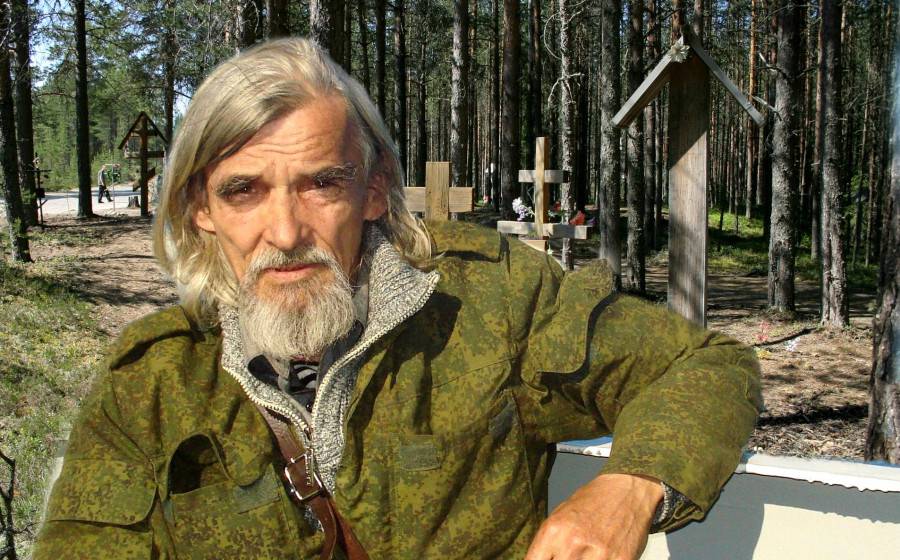
“A person cannot disappear without a trace. People differ from butterflies in the sense that people have memory,” the man with long grey hair and long grey beard said onscreen.
The presentation of books of remembrance for those shot during the Great Terror in Karelia packed the screening room at the Gulag History Museum in Moscow: people even sat on the stairways. The editor of the books, Karelian historian and search specialist Yuri Dmitriev, from Memorial, was the man talking onscreen. He has spent the last six months in a pretrial detention center, absurdly charged with the crime of producing pornography.
Dmitriev sent his greetings and gratitude from prison, not so much for the kind words said about him, as for acknowledgement of his life’s work. Memorial’s historians all concur it is unique. No other region in Russia has such a complete compendium of the names of those who were shot as Karelia does. As his colleagues argue, Dmitriev succeeded in turning the figures of those who perished during the Great Terror into memorial lists complete with names, biographies, and burial sites.
The speakers occasionally slipped into the past tense, but immediately corrected themselves. Dmitriev is still alive, and we must believe he will soon be released, find the execution site of the other two Solovki “quotas” [political prisoners at the Solovki concentration camp who were transported to three different sites outside the camp in 1937–1938 to be shot and buried in secret—TRR], and present the next book of remembrance. This powerlessness, these slips of the tongue, and the trembling voices fully convey the horror of a time when the days when people were shot are long past but people still fall victim to political repression.
The Yuri Dmitriev case is, perhaps, the most important thing happening in Russia right now, first of all, because a patriot who for decades had, bit by bit, resurrected thousands of names of this country’s citizens from official oblivion, citizens murdered cruelly and senselessly in the state’s name, has himself been subjected to persecution. “The introduction to the list of terror victims will be brief: may they live in our memories forever,” writes Dmitriev in the foreword to one of his compendiums, The Motherland Remembers Them, a book in which the names are listed not in alphabetical order, but under the names of the villages where the victims lived before their arrests. “The moral of the story is also brief: remember! As is my advice: take care of each other.” Now there is a Russian national idea for you. The author of these books of remembrance should be nominated for a state prize and a government grant to keep on with his work.
There is another important thing about the Dmitriev case: the charge his persecutors chose for him. He was not charged with “extremism” or “separatism,” which have been commonplace in politically motivated cases, but with child pornography and depraved actions towards a minor. The charges not only guarantee a long sentence and promise the accused problems in prison but also challenge the public to support him. “What if something really did happen?” Dmitriev’s friends and relatives acknowledge that while those who doubt Dmitriev or are willing to countenance the charges are an overwhelming minority, such people do exist, and some of them are “decent” people.
The number of “pedophilia” cases, based on controversial, contradictory, clearly flimsy evidence and flagrantly unprofessional forensic examinations, has been growing for several years. Recently, I attended a similar event in Naro-Fominsk, seventy kilometers southwest of Moscow. It was also a memorial evening for a living person who had been incarcerated on charges of depravity against a child, actions the man could not have committed, according to witnesses who were nearby when the crime was alleged to have occurred. Dozens of people had come to remember what a good male nurse Zhenya had been. Then they corrected themselves: not had been, but is and will continue to be. Then they cried.
“Pedophilia” cases have long been custom-ordered to rid oneself of rivals and used to pad police conviction statistics, but now they have been put to use in political cases.
Translated by the Russian Reader. Thanks to Comrade Koganzon for the heads-up
Terror in the Life of Yuri Dmitriev
Tatiana Kosinova Cogita.ru
June 1, 2017
On May 28, 2017, the Anna Akhmatova Museum in Fountain House in Petersburg hosted a presentation of books of remembrance, edited by Yuri Dmitriev, chair of the Memorial Society’s Petrozavodsk branch, who was arrested on trumped-up charges in December 2016.
The presentation was organized and emceed by Anatoly Razumov, head of the Returned Names Center at the Russian National Library and editor of the Leningrad Martyrology.
Agreeing to Razumov’s request to host the event, the Akhmatova Museum decided not to mention Dmitriev’s name in the event’s poster, on its website, and its mailing lists, as if it were already clear to everyone anyway what and who would be discussed. The event’s ostensible occasion was the eightieth anniversary of the Great Terror. Until the late spring of 2017, this had seemed possible in a museum dedicated to the life of the woman who wrote, “I would like to name all of them by name.” Unnoticed by the majority, however, a new wave of state terror has touched not only Yuri Dmitriev but also Petersburg, far from Petrozavodsk. A public museum risks providing a venue for an event in support of a man persecuted by the state, while making this man a figure of silence.
When the Petersburg Memorial Society found about this approach to Dmitriev, it was too late to find a new venue. It managed only to send out its own mailing list. The newspaper Moi Rayon mentioned the editor of the Karelian memorial books in its notice of the presentation, and the radio station Echo of Moscow in Petersburg mentioned the presentation as well. Unlike Petrozavodsk, where the presentation was poorly attended, the small hall at Fountain House was nearly packed, and reporters were present.
Dmitriev’s daughter Ekaterina Klodt came from Petrozavodsk for the event, joined by Dmitriev’s defense attorney Viktor Anufriev from Moscow, and Dmitriev’s colleague Nikolai Olshansky, director of the Novgorod Regional Society of Rehabilitated Political Prisoners and editor-in-chief of the Book of Remembrance of Victims of Political Repression of Novgorod Region. Irina Flige, director of the Memorial Research Center, was also involved. TV editor Bella Kurkova, who was scheduled to attend, did not come. In the early 2000s, she had filmed Dmitriev for a program, and Razumov showed an excerpt of this program to the audience.
Razumov has been friends with Dmitriev for fifteen years and considers him an astonishing man not only in terms of Karelia but also nationally. Razumov was involved with Dmitriev in searching for the prison camp cemetery on Sekirnaya Hill on the Solovki Islands. He continues to hope that Dmitriev will find the burial sites of the so-called second and third Solovki quotas of 1937–1938. Razumov still considers his friend’s most surprising find the cemetery of the tortured Belomorkanal construction workers at Lock No. 8.
“When he found himself in his present circumstances, he was accorded incredible support, and I haven’t met a man who would doubt his honest, kindness, and personal qualities,” Razumov said when opening the evening.
Razumov brought two books previously published by Dmitriev to the presentation and displayed them as historical artifacts. The first of these was the Memorial Lists of Karelia, 1937–1938, edited by Dmitriev and Ivan Chukhin, chair of the Karelian branch of Memorial. Dmitriev was Chukhin’s search expert and right-hand man, and after Chukin’s premature death in a car accident in May 1997, Dmitriev also had to master the skill of searching the archives. The book was published only in 2002 and is now rightly regarded as one of the best of its kind.
The second of Dmitriev’s main books, The Sandarmokh Execution Site, originally published in 1999 and long a bibliographic rarity, will be republished. Dmitriev has approved aplan to republish the book under a new title, The Sandarmokh Memorial Site. The new book will be a revised and expanded version of the first book about the memorial cemetery.
“I don’t know what else we can do. But we have managed to do something. We have turned some of the execution sites into memorial sites. May they remain memorial sites forever. That was Yuri’s dream,” said Razumov.
Anatoly Razumov
Razumov discussed two new books by Dmitriev, completed through the efforts of colleagues and friends: The Krasny Bor Memorial Site, which lists people executed at the site, and The Motherland Remembers Them: A Book of Remembrance of the Karelian People. Dmitriev had compiled both books before his arrest, and his friends and colleagues finished editing them and hastily published them in May of this year, before the start of his court trial. The books were presented in Petrozavodsk on May 24. The book will be available in Moscow in a week’s time both as DVDs and paper books. Roman Romanov, director of the Gulag Museum, has found the means to publish them. Five hundred copies will be printed in Moscow for the presentation, which takes place at the museum on June 6, 2017. It took Dmitriev many years to write these books. Krasny Bor was discovered twenty years ago, like Sandarmokh, in 1997. The site of mass executions in 1937–1938, it is located in a forest four kilometers from the village of Derevyannoye in the Prionezhsky District of the Republic of Karelia and nineteen kilometers from its capital city, Petrozavodsk.
According to the website of the Virtual Gulag Museum, Dmitriev conducted a detailed survey of the burials there. On the basis of typical depressions in the topsoil, he discovered around forty burial pits, each of them approximately eight meters in diameter and two and a half meters in depth. The Prionezhsky District Prosecutor’s Office confirmed that the Soviet NKVD had carried out mass executions at the site. According to prosecutors, the executions had been carried out during two periods: August 9–October 15, 1937, and September 26–October 11, 1938. During the digs, Dmitriev ascertained the number of people who had been shot (1,193) and most of their names, which are now included in the book Krasny Bor Memorial Site. After Dmitriev’s arrest on December 13, 2016, Jan Rachinsky, co-chair of Moscow Memorial, and Anatoly Razumov worked on the book. Dmitriev was able to carry out the final corrections in the Petrozavodsk Pretrial Detention Facility.
Razumov also presented The Book of Remembrance of the Karelian People. Dmitriev favors a geographical principle when drawing up lists of the executed, rather than alphabetical order. In his opinion, it is easier for people to find loved ones this way: the book is thus literally localized and bound up with Karelian history. The Motherland Remembers Them contains lists of Karelians who perished during the Great Terror.
The discs were available at the presentation, and they can also be obtained at the Returned Names Center and Memorial in Petersburg. Razumov reminded the audience that Dmitriev had always handed out all his remembrance books for free, but only to people who could say something about their perished loved ones and who had thus preserved their memory.
Sandarmokh Memorial Cemetery. Photo courtesy of Virtual Gulag Museum
Special Settlers in Karelia is Dmitriev’s latest massive work, on which he has been working for years. It deals with all those who were exiled to Karelia during the Soviet period: dekulakized peasants, deportees, and forced settlers—tens of thousands of people. Dmitriev launched his work on the book in the 1990s, but a great deal remains to be done.
Yuri Dmitriev’s house in Petrozavodsk “has been turned from a workplace into ruins. The police came, stomped about in their boots, and confiscated his computer, which contained his old and new remembrance book, on which work was still underway. But we shall continue the work,” Razumov said as he concluded his opening remarks.
Eldest Daughter
Ekaterina Klodt, Yuri Dmitriev’s eldest daughter
Ekaterina Klodt, Dmitriev’s eldest daugther, is very proud of her dad.
She and her friends were always struck by her father’s deep, penetrating eyes. Outwardly harsh and headstrong, Klodt’s father is a very kind and caring man on the inside.
“He’s a friend, a friend to everyone: colleagues, children, and grandchildren. He puts himself in everyone’s shoes. You can talk to him about anything.”
Klodt is the only person allowed to visit Dmitriev at the pretrial detention facility.
“I’m used to seeing him with his hair grown out and a long beard, like a lumberjack. But in there, his beard has been shaven and his hair cut short. He looks fifteen years younger. He’s had time off from sitting at the computer. At first, of course, I burst into tears, and he burst into tears. It is very difficult to talk through the tiny window.
“But his spirit, as always, is determined and militant. Father has always been someone we can all look up to, a paragon of strength and self-confidence.”
Klodst visits her father along with her own children.
“When his grandson and then this granddaughter followed me into the room, his eyes lit up. I had never seen Dad cry. He was genuinely happy.”
Klodt said prison was not a place where grandchildren should see their grandfather.
“That’s the reality. The children know where their grandfather is. They come with me to see him and will keep coming with me.”
The last time Klodt saw her father was in mid April.
Klodt said she has been communicating with her younger sister. Adopted by Dmitriev, she loves her dad very much, misses him a lot, and is worried about him. The girl hopes this ridiculous story will soon end, and she will again live with her dad.
“We lived side by side for so many years, as a single family. My children are her age. She and my son are the same age, and my daughter is a year younger. I treat her like one of my children, although she regards me as her sister. She is great friends with my children.”
Klodt cannot see her sister.
“She writes,” Razumov added.
Klodt feels sorriest of all for the confiscated computer. Day after day, she saw her father working, and his work was everything to him.
“The man spent a huge number of hours at the computer. His entire life was working on the computer and the digs. Knowing how much time he worked on the computer, I was constantly worried how he would get along in the pretrial detention facility without his dead ones.”
Klodt was twelve years old when Sandormokh was discovered twenty years ago. Her father took her along on the expedition to the area near Medvezhyegorsk. Klodt’s eldest son, Danya, had recently been traveling into “that huge forest, teeming with gadflies.” Danya is as old now as she was in 1997. This year, whatever the court decides, Klodt and her children will travel to Sandormokh on August 5 for the International Day of Remembrance.
Two Searches
Irina Flige (left)
Irina Flige and Yuri Dmitriev met exactly twenty years ago, in the spring of 1997 at the FSB archives in Petrozavodsk, “a normal place to meet if you’re people working on the memory of the Gulag.”
“That meeting was a point where two searches converged.”
“Such a narrow circle of people has gathered here today that I want to use the familiar mode of address, so I will refer to Yura rather than to Yuri Alexeyevich. At this time, Yura and Ivan Chukhin had located the main sites where executions and burials had taken place in Karelia during the Great Terror. Karelia is the only region or one of two or three regions where the documents stipulate the places where the sentences were carried out, that is, they indicate they occurred in the vicinity of a village or town. By this time, they had managed to compile a complete list of these places. And by 1997, many of the actual locations had been ascertained. For its part, the Memorial Research Center moved from the Solovki in search of the place where the so-called 1937 Solovki quota was executed. This was where our searches converged. We planned a joint expedition of the Petersburg and Petrozavodsk branches of Memorial to an area near Medvezhyegorsk on July 1, 1997. There were four of us who traveled there, not counting Yura’s dog. The expedition was led by Veniamin Iofe, who had done all the preliminary research before we traveled to the site. He had pinpointed the search area to within a kilometer. We set out on the expedition, thinking we would be working there all summer,” Flige recounted, continuing Klodt’s story of the search for Sandarmokh.
Anatoly Razumov took the opportunity to note that all the particulars of the expedition are extremely important, because “Yura was arrested due to Sandarmokh, to put it crudely, due to the fact that the place had become such an irritant.”
Flige illustrated her account with images from the website Sandormokh [sic], which was launched with Dmitriev’s involvement in November 2016. One of the long articles on the website describes the search for Sandarmokh.
Screenshot from the website Sandormokh
“Yura is a restless, active person. At some point, he grabbed the dog and ran off round the forest. Yura has a fantastic intuition. He was running in circles around a place where we had marked out a grid and started systematically digging meter by meter. He ran up to us at some point. ‘Come on, I think I’ve found it.’ Indeed, the place was quite striking. Common grave pits subside in a way that resembles saucers. Yura had seen there many such places there,” recalled Flige.
Sandarmokh was found on the very first day of the expedition, July 1, 1997. The shooting pits, marked by lathe fence, its pales numbered in red lacquer by Flige and Klodt, still constitute the basis of the memorial cemetery.
The lathe fence has given way to poles topped with dovecote-shaped wooden monuments, resembling Orthodox crosses in northern cemeteries.
In 1997, memory was quite alive all over Russia and functioned instantaneously, argues Flige.
“Knowledge and memory were closely related processes. One process immediately followed the other,” she said.
Sandarmokh was officially opened on October 27, 1997. In the four short months since its discovery, road builders had built a paved road to the site in record time, a log chapel had been erected, and the dovecote-shaped memorial markers were all in place. The Republic of Karelia hastily enacted a decree declaring the memorial cemetery open to the public.
“I ran around with the forest managers to mark off the border. I would add space all the time, because what if we had missed a pit? But they would add another thirty meters. It was a breakthrough in common, a breakthrough of knowledge, respect, and memory all at the same time.”
Sandarmokh is the only place in Russia where the August Fifth International Day of Remembrance is held. It has been held since 1998. The people who were shot there were not immediately sentenced to be shot after their arrests, but had spent time in the camps on Solovki and the Beltbaltlag. They had come to the camps from different parts of the Soviet Union. For the last twenty years, delegations from different countries and different parts of Russia have come to Sandarmokh on August 5. It has become the “only venue where people of different ethnic groups and faiths can meet and still speak the same same language, the language of memory.”
The website about the memorial cemetery includes a separate section, “Killed in Sandarmokh,” created by Yuri Dmitriev. It features biographical information about the residents of Karelia executed on this spot in 1937–1938.
It is also telling that Kurkova filmed her program on Sandarmokh with Yuri Dmitriev’s involvement.
A Colleague from Novgorod
Nikolai Olshansky
In Novgorod the Great, The Book of Remembrance has been published since 1993. Late 2015 saw the publication of its fourteenth volume, and there are plans to publish a comprehensive index to the previous volumes that would include information about residents of Novgorod Region subjected to state terror from 1917 to 1970. Nikolai Olshansky, the editor of these volumes, met Dmitriev eight years ago.
Olshansky also continues to pin his hopes on the genius of his Karelian colleague for finding burial sites in his own region. In Novgorod Region, the internment site of fifteen hundred Novgorodians shot during the Great Terror in Novgorod itself has not been ascertained (five thousand Novgorod residents were taken to Leningrad to be shot), nor has the execution site of five hundred residents of Borovichi been located.
Olshansky believes that he once “prophesied” his colleague’s misfortune.
“Yura, your directness and harshness are going to get you put in jail someday,” he told Dmitriev.
During the event at the Akhmatova Museum, Olshansky wished Dmitriev the will to withstand all the trials of detenition. Olshansky does not believe the prosecution’s charges. Under the Soviet regime, he himself was sentenced to four and half years of compulsory treatment in a psychiatric hospital on the basis of a denunciation, an experience from which he has never fully recovered.
The Defense Lawyer
Attorney Viktor Anufriev appeared at the event, answering the audience’s questions. He argued that the law in Russia still exists autonomously from law enforcement. Dmitriev’s rights as someone who has been accused of a crime are observed to the extent they permit the authorities to keep him under arrest by constantly extending the term of his detention. Anufriev is certain of his client’s innocence. There is no evidence of a crime in Dmitriev’s actions.
The case began with one charge, but now there are four, said Anufriev. The case file now consists of five volumes. The indictment now includes an illegal firearms possession charge: the firearm in question is a piece of a hunting rifle, which had been lying around Dmitriev’s house for twenty years and which the prosecution itself does not consider capable of firing. Once upon a time, Dmitriev had confiscated it from the lads in the yard, to keep it out of harm’s way. Why has he been charged with its possession? Anufriev argued that there are two hypotheses. In Soviet times, this article of the criminal code was brought into play if the main charge had been dropped to justify the arrest and pretrial detention. In our times, on the contrary, the court can find a defendant not guilty on this charge, to make a show of his objectivity.
“But the entire machine of repression is rigged against Dmitriev in such a way that there are very good chances he will remain in custody,” said Anufriev.
Anufriev argued that his job was to prove his client’s innocence on the basis of the law. Analyzing the circumstances with which Dmitriev’s persecution were fraught is not part of that job. But those who follow the trials underway in Russia see that, nationwide, similar things have been happening to people whose work the regime considers unnecessary and harmful.
The upcoming trial will be closed to the public. The first hearing on the merits of the case will take place in Petrozavodsk tomorrow, June 1, 2017, at 2:30 p.m.
Anufriev believes that no one’s testimony would help Dmitriev in making his case. His adopted daughter has said nothing bad about her father. The situation was such that Dmitriev adopted her when she was in a very poor physical state. It was hard for Dmitriev to adopt her: to become her foster father, he had to attend a number of court hearings. Until his own adoption, Dmitriev himself had been raised in an orphanage. Having raised his own children, Dmitriev felt obliged to raise another child. The authorities, who gave him custody of the child through the courts, initially tried to take her away. Three or four months after Dmitriev adopted, “bruises” from “beatings” were suddenly discovered on the girl’s body. They proved to be traces left by a newspaper through which her foster parents had applied mustard plasters to her body. Having gone through this experience, Dmitriev periodically photographed the girl from all four sides, storing the photographs in a file in his computer according to month and year. He did this in case children’s protective services made any complaints about his treatment of the girl. He showed the photos to no one. Over the years, he made fewer and fewer photographers. It would not occur to a normal person that these snapshots could be interpreted as pornographic. According to police investigators, there are 144 photographs, only nine of which investigators have interpreted as “pornographic.” This is the basis of the trumped-up charges that he committed perverse actions by clicking his camera. He clicked it three times a year, and has been charged with violating three articles of the criminal code that could send him to prison for up to fifteen years. The case kicked off with anonymous letter (a denunciation, as we say in Russia) that so-and-so, allegedly, has naked snapshots of his foster daughter stored on his computer.
“As someone who has lived a fairly long life and as the father of several children, I can say there is nothing pornographic about those photos,” said Anufriev.
“Yuri Alexeyevich feels well, as well as he can feel in the place where he is and given his age. He has not lost his optimism and perseverance, either. He understands the situation soberly. As a scholar of the Terror, he has seen and read his fill and could understand that it might affect him as well. Such is our country’s history. I could joke about it and say that the one good thing is people are no longer executed in Russia. But the practice is such that if someone was in custody before his trial, his complete acquittal would be someone else’s complete punishment. That is why it happens so rarely. We would be glad if the case were allowed to fade away.”
You can exchange letters with Yuri Dmitriev. Send your letters to: Respublika Kareliya, Petrozavodsk, ul. Gertsena, 47, SIZO No. 1.
Hyphotheses
Ekaterina Klodt cannot explain who would want to file charges against her father. She doesn’t know the answer to that question, but, according to her, “what he does might not suit everyone.” She regards the criminal prosecution of her father as “completely absurd.”
“It’s frightening, very frightening,” she said.
She said she knows nothing about the search for those did the killing (according to one hypothesis, the charges against Dmitriev were occasioned by his work on drawing up lists of executioners, of the people who implemented the Terror in Karelia).
“We never discussed it, and I don’t think he searched for the executioners. They were not so interesting to him. He always searched for the victims, the people who had been shot. They were the dead who interested him. He wanted to preserve their memory and believed everyone of them should have a grave. He was very concerned for the living, for the descendants, so they would be able to come to a cemetery, to a burial site, pay tribute to their ancestors and remember their loved ones,” said Klodt.
“In Russia, the truth usually becomes obvious after several decades. We can only guess whose toes Yuri Alexeyevich stepped on, and with what upcoming events it is connected. We can analyze our regime’s level of thinking and focus in terms of this case, as well as the direction in which it is headed, and the measures it takes to preserve itself. Yuri Dmitriev was not a member of the opposition in the Republic of Karelia. He did his work in the sincere certainty that it was of use to people and to his country. But it turns that at one point the state says that this work is necessary, that we have to establish what happened, that we have to publish books of remembrance of the victims of the Terror, but time passes and all of this becomes inconvenient to the state. The shadow of the past hinders the current regime. And Yuri Alexeyevich’s work has become not very popular, not so vital, and seemingly unnecessary. By looking for execution sites, Yuri Alexeyevich discredited the previous regime. The time has come when someone has deemed his work unnecessary and even harmful,” argued Viktor Anufriev. “The people who cooked up this case for their own purposes should have long ago understood that the case is so crazy that public opinion has been aroused. I have worked for a long time and know how easy it is to put someone away by planting a bullet or narcotics on him, but trampling a man like this…”
Anufriev argued that the best outcome in the case would be complete acquittal on the pornography charges. Despite the fact that cases involving depraved actions with respect to minors go badly against teachers and priests, this case stands apart.
Anatoly Razumov noted that Karelian children’s protective services had no complaints against Dmitriev during all the years he had custody of his foster daughter. This transpired during a special session of the Presidential Human Rights Council in Petrozavodsk in February of this years, a session in which Razumov, Flige, and Anufriev were involved as invited experts. According to Razumov, Sandarmokh had become the “main sore spot and irritant in the region.” But the authorities were mistaken. Dmitriev had proven to be a man with a man with a strong spirit who loved his children and grandchildren, and almost nobody has believed the accusations.
If Razumov was sure that Dmitriev was arrested over Sandarmokh, whose annual fuss bothered the authorities, Flige argued that closing Sandarmokh by putting Dmitriev in prison was unrealistic. On the contrary, the case had led to a renewed interest in the place, an interest only deepened by speculation as to the reasons for Dmitriev’s persecution. This year, the authorities have createda prisoner of conscience for the memorial cemetery. According to Flige, Dmitriev became a political prisoner the day the TV channel Rossiya 24 broadcast a made-to-order news segment entitled “What Is Memorial Hiding?”
Event photos courtesy of Nadezhda Kiselyova and Cogita.ru. Translated by the Russian Reader
Alexei Kungurov. Photo courtesy of the New Chronicle of Current Events
Tyumen Blogger Sentenced to Two and a Half Years in Prison for Post on Syria
Anastasiya Yuditskaya, Dmitry Nosonov & Yegor Gubernatorov RBC
December 20, 2016
Tyumen blogger Alexei Kungurov was charged under Russian Federal Criminal Code Article 205.2.1 (“public calls for terrorism or public justification of it”). A visiting panel of judges from the Volga District Military Court found him guilty and sentenced him to two and a half years’ imprisonment in a work-release penal colony, Asiya Bayshikhina, Kungurov’s wife, has informed RBC.
“There is very little information right now. I know only he has been sentenced to two [sic] years in a work-release penal colony. Alexei was on his recognizance from February, but in June he was placed in a pre-trial detention facility. He has been in Pre-Trial Detention Facility No. 1 in Tyumen the whole time,” Bayshikhina told RBC.
Kungurov’s attorney, Alexander Zyryanov, told RBC the defense planned to appeal the verdict.
“We are going to lodge an appeal with the Military Collegium of the Supreme Court. We plan to do this at the beginning of next week. We have ten days to do it.”
Criminal charges were filed against Kungurov in March over a LiveJournal post, entitled “Who Putin’s falcons are really bombing,” in which the blogger criticized the actions of the Russian armed forces in Syria.
In August, the Prosecutor General’s Office reported that terrorist crimes had increased by 73% in the first six months of 2016 compared to the same period last years. The office reported then that it had solved a total of 1,313 terrorist crimes and 830 extremist crimes.
Deputy Prosecutor General Alexander Buksman noted that the increasing numbers of such crimes were “the outcome of preventive work by law enforcement agencies in surveilling the Internet for banned publications and bringing to justice leaders and members of the armed underground in the North Caucasus and their accomplices, and persons who are fighting in Syria as part of terrorist groups.”
Because of the Pussy Riot case, I spent two years in prison. In recent months, I have been performing every night on stage as an actress with the Belarus Free Theatre. Every night, I have been trying to convey to the audience part of my life in prison. I do this so people understand and experience the mundane hellishness all political prisoners go through in Russia.
Oleg is a well-known, talented Ukrainian filmmaker. Perhaps he could have been debuting a new movie at the film festival taking place in London this week, but instead he is isolated in a penal colony in faraway Siberia. After being tortured, he was sentenced to twenty years in a maximum security prison on charges of terrorism. He was accused of planning to blow up a monument to Lenin in Crimea. The charges are absurd, total nonsense.
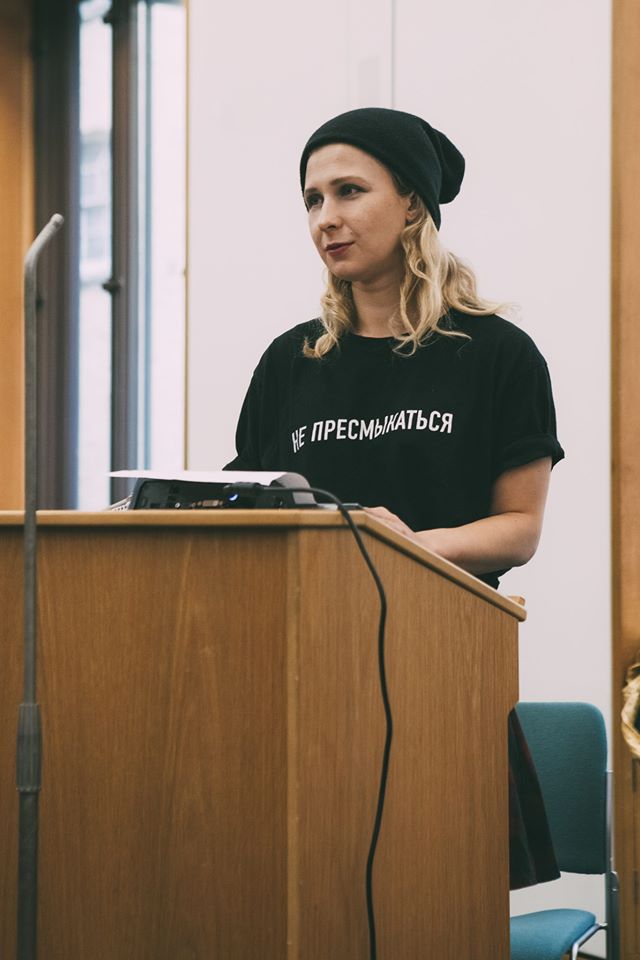
Masha Alyokhina speaking in the British Parliament, October 16, 2016. Photo courtesy of her Facebook page
We need to stop talking and start acting. We need to get Oleg Sentsov released from prison and save his life. When I was in prison, it was thanks to your support and scrutiny that nothing threatened my life. In Sentsov’s case, there is not enough scrutiny, and there is such a threat to his life. That has to change.
Sentsov’s trial was not just yet another instance of political persecution by the Russian regime. It was a symbolic attack on the liberties and values you espouse. Oleg still has eighteen years left to serve in prison. He was given this sentence only because he is a brave man who spoke out on behalf of these same values. We can learn a lot from him and what he did, but we must not accept the fact he remains imprisoned. We must pressure the Russian authorities. I am here to urge you to make Sentsov’s release our common cause. I am confident we can see this cause through to the end and free Oleg from prison.
Translated by the Russian Reader. Thanks to Masha Alyohkina for her kind permission to translate the original Russian text of her speech and publish it here.
Alexei Gaskarov and Anna Karpova. Photo courtesy of Anna Karpova and PRI
Anna Karpova The Unstable Prisoner, the Exclusion Zone, and Infinity Snob.ru
June 18, 2016
“Gaskarov has had reprimands both at the pretrial detention facility and the penal colony. There have been commendations, too. He works hard, studies well, and runs economics seminars for the inmates. But now he gets reprimands, then he gets commendations He is unstable somehow, unstable.”
Lieutenant Colonel Plaksin (I now always pay attention to such things) stared at the table. He was trying to explain to the judge why the wardens of the penal colony were opposed to paroling my husband.
I remember how I was invited to the studios of TV Rain the day the second wave of Bolotnaya Square defendants was sentenced to talk about we would do next. I put on a brave face and said the heck with the sentence. We would get everyone out on parole. But who knew Plaksin would be staring at the table?
There really is an outstanding reprimand in convict Gaskarov’s personal file: for not greeting an employee of the prison administration. When the judge was reading out the report on this terrible incident, I got goosebumps myself. Was this the man I had married?!
The handful of people to whom the Bolotnaya Square case still matters send us rays of supports and remind us that, in the worst circumstances, we have a little less than four and a half months to wait. They assure me the time can be done “standing on one leg.” It is nothing compared to the three years already served.
But that is not how it works.
Maybe I have been playing Fallout 3 (a video game about life on earth after a nuclear war) way too much, but I will say this. The trials and hearings, the pretrial detention facilities, and the penal colonies are like exclusion zones, places with elevated radiation levels that (I will tell you a secret) poison and destroy the individual. The more time you spend there, the worse the consequences are. Everyone involved in the process is irradiated. The prisoner and his family have it the worst of all, of course. Friends, acquaintances, and sympathizers are also affected, albeit on a lesser scale. The impact of the “radiation” does not end when the sentence ends.
The radiation sickness caused by the Russian penitentiary system can manifest itself in very different ways. For example, when it is quite hard to admit your absolute helplessness before court and prison functionaries, you might think there was “that one piece of paper” that could have fixed everything, but you fools did not bother about it. The thought eats into your brains and prevents you from working, sleeping, and communicating with each other. Worst of all, you look for someone to blame. Who messed up? The lawyer? The prisoner? His wife? His parents? The incident then comes up in every stressful situation, most likely, after release as well. The gulf between what prisoners have gone through and what their families went through fighting on the outside can be bridged only by the most patient and wisest. The former will never fully understand what it was like for the latter, and vice versa.
Each week spent there, behind the penal colony’s dilapidated fence, means the risk of sustaining all the major injuries and traumas that will make themselves felt in the most unexpected situations for a long time to come. Not to mention the fact that if you suddenly have the most ordinary appendicitis on the inside, you are probably a goner.
When I am asked whether everything is okay, whether there have been problems at the penal colony, it is enough for everyone to hear that my husband has not been transferred to maxim security, and that neither the wardens nor the inmates have been messing with him, but that amounts to only ten percent of possible problems. The other ninety percent have to do with how inmates and their families digest what has happened to their lives. And it not the done thing to talk about it, but an additional four and a half months feel like an infinity and keep on poisoning the lives of those who wait.
This means there is no “only” when we are talking about the remainder of a prison sentence. And it means we must fight for every month of freedom, even for a single month. By the way, that is how it is going to be with us.
“Russia is dead, although it seems to be alive. But Nadiya [Nadezhda] can be saved.” Demonstrator at International Women’s Day rally on the Field on Mars, Petrograd, March 8, 2016. Photo by and courtesy of Sergey Chernov
Nadiya Savchenko: Closing Statement in Court
I accept neither guilt, nor the verdict, nor the Russian court. In the case of a guilty verdict there will be no appeal. I want the whole democratic civilized world to realize that Russia is a third-world country, with a totalitarian regime and a petty tyrant-dictator, where human rights and international law are spat upon.
It is an absurd situation when those who abduct people subject them to torture then act as if they have a right to judge them! How can one talk about a fair trial? In Russia, there are no trials or investigations, only a farce played out by Kremlin puppets. And I find it superfluous to waste time in my life participating in it!
And so there will be no appeal, but this is what will happen: After the verdict I will continue my hunger strike for 10 more days, until the verdict comes into force, and this is regardless of the translation [of the verdict] into Ukrainian, because they can drag that out for a long time, too. In 10 days I will begin a dry hunger strike [refusing both food and water], and then Russia will have no more than 10 days to return me to Ukraine, where they abducted me! And I don’t care how they justify it! I have heard that [Ukrainian President] Petro Oleksiyovych Poroshenko is quite adept at diplomacy. I hope his diplomatic skills will suffice to reach agreement in Russia with a certain idiot; after all, he promised my mother that I would be home in time for the May holidays of 2015.
And while they are bargaining over me, my life will be draining away and Russia will return me to Ukraine in any case: it will return me, dead or alive!
Throughout these 10 days, day and night, my sister will be standing at the jail gates, and she will wait and see whether they release me or not. And if you put her in jail, my mother will come and take her place. She is 77, will you put her in jail, too? In that case my friend will take her place, and after her, Ukrainian after Ukrainian! And remember: you can’t shove everybody in here. And while my compatriots are standing there, simple, honest, and decent Russians living in nearby homes will bring them hot tea, sandwiches, and warm blankets, because each one of them understands that tomorrow their child could be in my place, in this prison of all peoples called Russia!
That is how Maidans (revolutions) start! Do you need that?! You fear it like the plague! So it is better for the Kremlin to return me to Ukraine as soon as possible, and alive!
And those in the world with democratic values ought to learn their history lessons before it’s too late and remember that there was a time when Europe was tolerant toward Hitler, and America wasn’t decisive enough, and this led to World War II. Putin is a tyrant with imperial manners and a Napoleon and Hitler complex put together. The [Russian] bear doesn’t understand human language, he understands only the language of force. Therefore, unless we become more decisive and determine the right priorities on time, we will soon have World War III.
And I, as a politician now, won’t shake Russia’s hand in the political arena. It is not right to extend a hand to someone who kept you in handcuffs and your people in chains. But every time I make a political decision, I will always think how it would affect ordinary people, both in Ukraine and Russia. Because in Russia, in spite of everything, there are many honest, kind, and decent people.
Demonstrator at International Women’s Day rally on the Field on Mars, Petrograd, March 8, 2016. Photo by and courtesy of Vadim F. Lurie
The Prison Blog of Ildar Dadin’s Fiancée: First Visit, January 14 Zekovnet.ru
Nastya Zotova and Ildar Dadin had agreed to get married in January 2015, when Ildar was detained. Imprisoned Russia continues its publication of his fiancée’s blog.
Nastya Zotova & Ildar Dadin. Photo courtesy of openrussia.org
I got permission to meet with Ildar from Judge Natalya Dudar on December 30, and I went for my first short visit on January 13. A short visit is not like a date at a cafe or the movies. There is no hugging and kissing. You see each other only through the glass, and there is also a metal grille on top of the glass.
Getting a “date” was not as difficult as I thought. I went to the pretrial detention facility at nine in the morning and handed over the authorization from the judge and the application form, which was printed on the same piece of paper. Then I waited until eleven for one of facility’s wardens to come. He collected everyone’s internal passports and took us to the fifth floor, where there were about fifteen cubbyholes with glass in the middle.
The visit lasted two hours. You can discuss a lot in that time, both life in prison and personal affairs. Apart from me, nine other people had come for visits. Most were women, some of them with children in tow.
Before the visit, a little boy showed me a drawing.
“I drew this for Dad. This is me, this is Mom, and this is Dad. And this is our home.”
Ildar was finally led in. The feelings provoked by such visits are mixed. On the one hand, there he was, my beloved one, whom I had not seen for five weeks. He was safe and sound, without a bruise on his face. The first few minutes we stared at each through the glass and smiled like fools. On the other hand, it was hard. I wanted to hug and kiss him. But talking with him through the glass was still better than nothing.
I quizzed him about prison life. It turned out that the inmates were often worried about the simplest problems, which were hard to solve imprison. For example, your socks are torn. If you were at home, you would grab a needle and thread and darn them. But there are needles and thread in the detention facility. You might be able to borrow a needle, but thread is totally inaccessible and is not allowed in care packages.
Or you have run out of toilet paper. You will have to wait until someone buys it in bulk through the Federal Penitentiary Service store. Toilet paper is not allowed in care packages. According to Ildar, the wardens should issue toilet paper to inmates, but in Pretrial Detention Facility No. 4 it is “not done.”
Or you need to write complaints and appeals in triplicate or quintuplicate. There is no printer, so you have to write everything by hand. You could use carbon paper, but for some reason it is also not allowed in care packages.
The inmates entertain themselves in peculiar ways. Whereas Oleg Navalny caught pigeons, Ildar and his cellmates catch mice. They are ordinary gray mice that run under the bunks at night.
To catch a mouse you need an empty milk carton. You cut a little hole and plant the bait inside. When the mouse enters the cartoon, you close the hole with your hand and then transfer the little beast to a plastic ice cream pail.
They managed to catch two mice in this simple way. Ildar’s cellmates decided to put them on trial and “sentenced” them to four days in prison. They were to serve their sentence in the plastic ice cream pail. Afterwards, they planned to “release” the rodents by throwing them out a third-floor window. But the prisoners escaped by gnawing a hole in their cell.
Smoking is another serious issue. There are eleven men in Ildar’s cell. Five of them are smokers, and they smoke right in bed. The others, who are nonsmokers, are not happy, to put it mildly.
There are only eight beds for the eleven inmates. They take turns sleeping. According to Ildar, however, this is even a good thing, because you can borrow a second blanket from someone. Otherwise, it is too cold to sleep. It got cold in the cell on January 1, so the thermal underwear that I bought on the advice of Alexei Polikhovich, who was convicted in the Bolotnaya Square case, was a real godsend. But Ildar is warm in it only if he sleeps under two blankets. And he still has to survive the transfer to the penal colony where he will serve his sentence—in winter in a cold train car!
After sleep, the second most important issue is food. Ildar admits the food is better than at the special detention center. However, the portions per inmate are not very big. It is not that he is completely hungry, but he would like more. He says that some cellmates eschew the prison food, and so the other prisons divvy up their helping among themselves. They can even warm the food up. A boiler is placed in a pot with water, and a plate with the food on it is place over the pot. The food is thus heated over a water bath.
I have been trying to figure how best to fatten up my inmate through care packages. Ildar already rejected hot meals ordered through the FPS website, and then canned buckwheat kasha with meat. I don’t feel like sending him instant mashed potatoes and noodles (which in prison are called “steamers”).
“Maybe you’d like more cheese? More sausage?”
Ildar frowned.
“I look at the prices in the FPS store and feel offended at how these thugs prey on us. I would rather eat the regulation hundred grams of soup, then shop there,” he said.
This is especially because, according to Ildar, all the care packages are put in the “kitty,” to which everyone has access, so Ildar himself does not end up with so much.
Ultimately, we agreed that I would cooperate with the relatives of other inmates, and that together we would buy food in bulk at ordinary stores and then pass it on to the lads in the cell, since there was a common pot there anyway. Regard the FPS store, Ildar nevertheless admitted that sometimes he wanted something sweet: chocolate, sweetened condensed milk or soda. He was very grateful to Olga Romanova for the garlic she sent him. Garlic was the best thing for you, he said, because it was full of vitamins! All his cellmates were ill, but he wasn’t.
There is no shower in the cell. The inmates are taken once a week to the shower room. But there is a sink, so they can wash up and launder their clothes. As Ildar put it, the toilet is “luxurious”: there are walls on two sides, and a door on the third up to the waist.
I asked Ildar how he spent his time at the detention facility, whether he had been writing complaints. Ildar admitted that he had stopped for the time being. The wardens had hinted to him as it were that if he continued, they could take it on his cellmates.
“However, maybe I’ll soon have to make an important decision: to be a living scoundrel or die,” he said.
Ildar did not explain what was the matter: our conversation was bugged. But he did promise in any case to send a letter, written in his own hand, indicating that under no circumstances was he planning to commit suicide. He believed this would protect him from the “accidents” that happen in Pretrial Detention Facility No. 4.
Despite this eerie message, Ildar was more or less optimistic and was planning to read books.
“I have a lot to learn: political science, economics . . . When I get out, we will change the country for the better,” he said hopefully.
Before his arrest, Ildar said he wanted to be a lawyer and specialize in human rights.
UPDATE
On the night of January 14, it transpired that immediately after our visit, Ildar was removed from his cell along with his things. According to the tentative information we have, he has been transferred to another cell in the same pretrial detention facility.
UPDATE: January 15
As it turned out, Ildar has been transferred to a special cellblock in the same facility. (Meaning greater scrutiny from the wardens and better living conditions.) Meanwhile, our marriage application is ready to submit to the registrar.
Ildar Dadin and Nastya Zotova’s marriage application. Image courtesy of Imprisoned Russia
Translated by the Russian Reader
__________
Russia: Peaceful activist sentenced under repressive new law must be released Amnesty International
December 7, 2015
Russia’s jailing of a peaceful opposition activist for violating the country’s new law on public assemblies is a shocking and cynical attack on freedom of expression, Amnesty International said today.
Ildar Dadin was sentenced to three years in jail by a Moscow court for repeated anti-government street protests. He is the first person to be jailed using the law, which was introduced in 2014 and punishes repeated breaches of public assembly rules.
“The shocking sentencing of Ildar Dadin shows that the Russian authorities are using the law on public assemblies to fast-track peaceful protesters to prison,” said John Dalhuisen, Europe and Central Asia Director at Amnesty International.
“This cynical move shows that compared to the drawn out criminal proceedings against peaceful protesters in the past, the authorities have now created a shortcut for imprisoning activists. It is more dangerous to be a peaceful activist in Russia than at any time in recent years.”

 Dmitry Buchenkov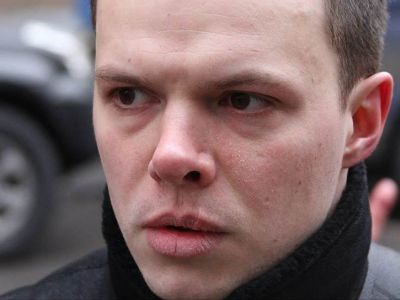



 Attorney Viktor Anufriev appeared at the event, answering the audience’s questions. He argued that the law in Russia still exists autonomously from law enforcement. Dmitriev’s rights as someone who has been accused of a crime are observed to the extent they permit the authorities to keep him under arrest by constantly extending the term of his detention. Anufriev is certain of his client’s innocence. There is no evidence of a crime in Dmitriev’s actions.