PERSCECUTION
No medical treatment, no letters, no visits. A political prisoner’s life in a penal colony. Zoya Svetova and Alexei Glukhov investigated the conditions of antifascist Alexei Sutuga’s imprisonment
December 14, 2015
Open Russia
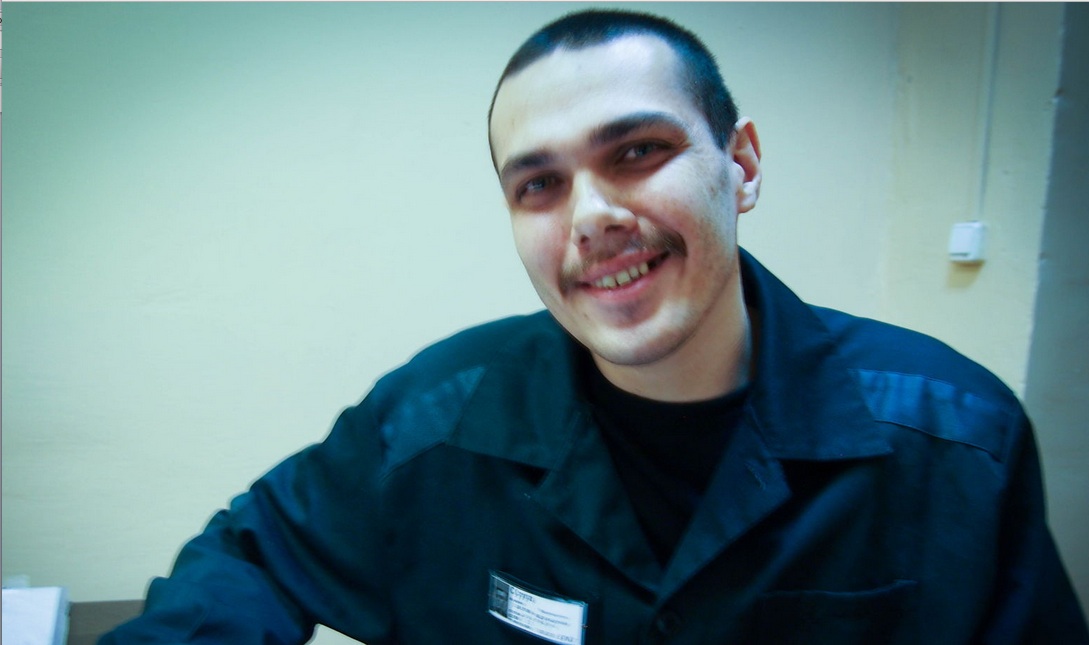
29-year-old Muscovite Alexei Sutuga is an antifascist activist known among antifa by the nickname Socrates. On September 30, 2014, the Zamoskorechye District Court in Moscow sentenced Sutuga to three years and one month in prison for disorderly conduct for his alleged involvement in a fight at a Sbarro restaurant in the city. Sutuga’s defenders believe the criminal case was revenge on the part of Center “E” officers who had already tried to put Sutuga behind bars for his alleged involvement in a fight at the Moscow nightclub Vozdukh, for which he had been amnestied.
The Memorial Human Rights Centre has declared Alexei Sutuga a political prisoner.
In March 2015, the antifascist was sent to Correctional Colony No. 14, a medium-security facility, to serve his sentence. He was soon put in solitary confinement, and two months later he was sentenced to a new type of punishment, a year’s imprisonment in a single-space cell. Now Sutuga is serving his sentence at Correctional Colony No. 2 in Angarsk, Irkutsk Region.
Olga Sutuga, Alexei’s mom, explained to Zoya Svetova how and why her son is being pressured in the colony.
Solitary confinement and single-space cells are forms of penitentiary repression. Is this improvisation on the part of local wardens or are there orders from above? Is there a plan to break your son?
It began in Moscow, when the FSB wanted Alexei to cooperate with them. They came to him while he was still in the remand prison and suggested he collaborate. They said he would serve his sentence in far from the best conditions, in a colony far from Moscow Region. That is what happened: he was sent to Siberia. And there, in the remand prison, he was again visited by two Center “E” officers who suggested he collaborate and promised that in exchange he would do his time in the Irkutsk Remand Prison and get parole. But he did not agree to these proposals.
What exactly do they want from him? To snitch on anarchists?
Apparently, yes, because he knows a lot of people, is a fairly authoritative person in that world, and has his own opinion. Not only anarchists but also other activists listened to him. He is a very inconvenient person for the secret services. He always spoke the truth, and they decided it was vital to break him and force him to cooperate with them.
How do you keep in touch with your son? He is not allowed visits, letters, and telephone calls. How do you find out what is happening with him in the penal colony?
Only through his lawyer. When his lawyer battles his ways through to see him, he finds out that Alexei has not been getting letters from his wife, from me or from his friends. On November 30 he was released from solitary confinement, where he had spent ten days. Now he is in a single-space cell in Correctional Colony No. 2 in Angarsk, Irkutsk Region. He is supposed to spend a year there—until May 2016.
Is he considered a repeat offender of prison rules?
Here are some of the violations he has been charged with: not making his bed, having his nametag torn from his clothing, and sleeping during the daytime while sitting on a stool. For all these things he was deemed a repeat offender. When in late May he was transferred for a year to the single-space cell, the warden of the single-space cell facility told him he would not be getting out of there, that he would be spending the rest of his sentence in the “jug,” that he would not be returning to the medium-security facility, although by the verdict of the court he should be serving his sentence in a medium-security penal colony.
Is Alexei in solitary?
No, there are four people in there.
How can we help him?
He has asked that people do not stop paying attention to the whole situation, because if they do not write and talk about it, the prison wardens will see they can do anything they like and will use even more repressive methods against him.
How long does he have till the end of his sentence?
One year and five months.
Do members of the Public Monitoring Commission (PNC) visit him?
Employees of the PNC come to see him every two or three months. They constantly file complaints about violations of his rights with the Federal Penitentiary Service. But it does not help: no one pays any mind to the complaints.
Those violations of the rules in the remand prison for which he has been punished, were they real or contrived?
It is impossible to comply with all the rules there one hundred percent. Maybe the nametag really was torn off his clothing. But Alexei definitely did not have a shiv, because when he was transferred from the remand prison to the penal colony, six people searched him, and the trip from the prison to the colony takes half an hour. [Angarsk is forty kilometers away from Irkutsk — Open Russia.] So it is completely unclear how he could have got hold of a shiv if he was in a paddy wagon with guards the entire half hour.
When is your next visit with him?
I was authorized to visit him in October but I was unable to go. I will go in late December. I wanted to get to see him during the January holidays. But I am not sure it will work out. When the lawyer went to see the head warden of the colony and find out whether I might be able to get this visit, the warden replied there would be no visits due to the fact that Sutuga was socially dangerous.
Is that even legal?
No, of course not. By law I have the right to visit him. I wrote to the head warden of the colony asking him to give me a visit. If he does not respond to me within fifteen days, then we will file another complaint. Unfortunately, though, complaints have no impact. We write to the Federal Penitentiary Service, the prosecutor’s office, and the court.
How does Alexei spend his time? Is it true he has no books and is unable to get periodicals?
The prison does not accept books sent to him, and it also does not give him the periodicals we subscribed to for him. I wrote to the warden and asked what happened to the periodicals that were sent by mail in my son’s name to the penal colony. After all, we had paid money for the subscriptions. It smacks of petty theft.
What is his mood?
When attorney Svetlana Sidorkina went to see him in October, she said that Alexei was very depressed, sick, and his knees were swollen and painful. He was diagnosed with acute arthritis and tossed out of the infirmary back into the cell. He receives no medical treatment or medical examinations. Sidorkina brought him letters from me and from his friends. That supported him. The local lawyer, who visited him the other day, says that Alexei’s mood has improved. Generally, he is a very active person, and if he has no opportunity to do anything he gets depressed. But now, apparently, he has realized we are fighting for him, his friends wrote that he has not been forgotten, and so his mood has been normal and he is holding up. He will turn thirty on January 24. It’s a big birthday.
How Alexei Sutuga Was Made a Repeat Offender
After his trial in Moscow, Alexei was sent to the Irkutsk Remand Prison. When the prison staff confiscated his personal belongings and letters, Sutuga protested by declaring a hunger strike and demanding to be transferred to a penal colony. Three days later, Sutuga was transferred to Correctional Colony No. 14 in the city of Angarsk, Irkutsk Region.
However, as soon as Alexei arrived at the colony, a shiv was found on him. Sidorkina believes prison colony staff planted the shiv on him.
Before his transfer from the remand prison, Sutuga was undressed completely, all his personal belongings were examined, and the procedure was filmed on a video recorder. No forbidden items were found. The paddy wagon in which he was transported in the company of three guards was also inspected.
At the penal colony, Sutuga was immediately taken to the search room, where in the presence of ten colony staff he was again forced to strip and put all his things on a table. As Sutuga was undressing and simultaneously replying to the questions of penal colony staff, one of them suddenly discovered a sharpened metal object in Sutuga’s cap. Sutuga claimed he had nothing to do with the shiv.
Sutuga was placed in solitary confinement for seven days.
Over the next month, Sutuga received three more disciplinary reprimands: for not wearing a badge, for not reporting to the on-duty guard, and for not cleaning his room.
Due to these clearly fabricated violations, Sutuga was declared a repeat offender of prison rules and was first transferred to a high-security cell, then to a single-space cell.
What Is a Single-Space Cell?
Sutuga is now imprisoned in a single-space cell [edinoye pomeshchenie kamernogo tipa or EPKT] at Correctional Colony No. 2 in Irkutsk Region.
Single-space cells were instituted in penal colonies after July 1997. Previous to this, each penal colony had contained an “internal prison”—a cell-like space [pomeshchenie kamernogo tipa or PKT]. Now single-space cells have been devised that are no longer managed by the particular correctional facility, but by the regional office of the Federal Penitentiary Service. Prisoners placed in single-space cells are often in the process of transfer to another city and sometimes another region. But Alexei Sutuga has been left in the very same city, in Angarsk.
Members of the Irkutsk Public Monitoring Commission reported what they saw at Correctional Colony No. 2 in June 2015.
“There were heaps of construction debris in the yard in front of the entrance to the space. The cells were dimly lit, there was no ventilation, and the radio was not working. The tables were ninety by fifty centimeters, and there were benches ninety by twenty centimeter benches on each side. They were in the middle of the room, so it was problematic for four people to fit in the room at the same time. There was also very little space to move around. The drinking water was poured from the tap into tanks in the rooms.”
Top brass at the Irkutsk Regional Office of the Federal Penitentiary Service reacted to the remarks, but as of October 2015 the construction debris had not been removed. In conclusion, the PMC wrote:
“Slag mixed with ash that is loosened up every day is scattered near the entrance to the building and around the entire perimeter of the room. It is not only that the slag exudes harmful substances (sulfates, phenol, etc.) but also that the dust from the slag and ash gets into the air and from there, through the windows, into the cells and exercise yards, harming the health both of convicts and staff.”
Alexei Sutuga Does Not Receive Medical Treatment in Prison
The antifascist has several ailments that require treatment.
“In October, the public monitors established that Alexei was not being given packages with medicaments: they were being sent back. Staff at the facility explained that they do not let packages through if the permitted number of them is exceeded. And yet they do not look inside to determine whether they contain medicaments or not, but just send them back. They say the sender has to personally come to the facility and submit the package through the infirmary,” recounts Irkutsk human rights defender Svyatoslav Khromenkov.
In the presence of members of the PMC, Sutuga was prescribed an x-ray. At the time of the visit Sutuga was in the facility’s medical solitary confinement cell with a foot injury. According to him, he had an old sports injury, which had flared up after he had struck his foot against a nightstand. Sutuga also complained about lung problems: he said he was having trouble breathing. He believed he had pneumonia.
Lawyer Denis Ivanets says the trauma specialist in the infirmary at Correctional Colony No. 6 diagnosed Sutuga with first- and second-degree severe arthritis in both knee joints. This is a chronic illness. Civilian trauma specialists told the lawyer that, given such a diagnosis, medication was insufficient. Sutuga would also need physiotherapy, including massage, as well as special orthopedic aids.
On December 10, 2015, the public monitors once again visited the antifascist. He said he had been given the package of medicaments that had been brought to the prison personally by his comrades. Sutuga was very happy that he had finally got the pills. According to Sutuga, a doctor, who had told him there was no need for an immediate operation, had examined him and it could wait until his release.
Lawyers and Public Monitors Are Often Not Allowed to See Alexei Sutuga
During the course of the calendar week (five working days) beginning November 25, 2015, lawyer Denis Ivanets and human rights defenders constantly attempted to visit the political prisoner.
Every time the visitors appeared at the headquarters of Correctional Colony No. 2, the Federal Penitentiary Service officers found a pretext to turn them away. Either the warden of the facility, who had to sign the lawyer’s request to visit the convict, was not there (although, as later transpired, he had been in his office having an intercom meeting with the head office), or the warden of the single-room cell facility was gone all day, and he was allegedly the only staff member who could escort the lawyer to the premises behind the barbed wire (although the warden of Correctional Colony No. 2 had signed off on the paperwork for visiting the convict).
Now members of the Irkutsk PMC are appealing in court Correctional Colony No. 2’s ban on holding a personal conversation with Alexei Sutuga under conditions of acoustic isolation from penal colony staff. The law “On Public Monitoring” directly stipulates this right.
Letters and Newspapers Are Not Delivered to Sutuga
According to lawyer Denis Ivanets, “Alexei’s mom says her son does not reply to letters from his spouse, parents, and friends. When I talked to him about it, it turned out that more than two thirds of the letters had simply not got to him! These letters had been sent to Alexei over a month ago.”
According to Article 91.2 of the Russian Federal Correctional Code, letters, postcards, and telegrams sent and received by convicts are censored by the wardens of the correctional facility, after which they must be given to the convicts.
In addition, Sutuga’s relatives took out subscriptions to several newspapers and magazines (Kommersant, Novaya Gazeta, Rossiiskaya Gazeta, GEO, Vokrug sveta), but Sutuga had not been receiving them. Staff in the warden’s office at Correctional Colony No. 2 could not give the lawyer an intelligible answer as to why this had been happening. According to the Article 95.1 of the Russian Federal Correctional Code, convicts are permitted to receive stationery supplies in parcels and packages, purchase literature through retail distributors, and subscribe to newspapers and magazines without limitation at their own expense.
Socrates Has Not Surrendered
Alexei Sutuga was placed in solitary confinement from November 20 to November 30 for his latest “rules violation.” As his lawyers report, the number of reprimands grows with each passing month, and this will make it impossible for him to be paroled.
On December 10, 2015, the members of the PMC were able to chat with Sutuga, who sent greetings to everyone, especially his loved ones, his mom, wife, and child. Sutuga asked for new photographs of them, as well as books on psychology, sociology, and political science.