Yesterday, after the protest rally, for several hours I made the rounds of different police precincts where detainees had been taken: Lenin Square, Prospekt Bolshevikov, Rybatskoye, and General Khrulov Street. It was night when I got home.
Today, I defended people who were involved in the rally and people who weren’t involved in the rally at the Primorsky District Court. I have just left the court building.
Total legal nihilism prevailed in the court. People were tried not individually, but in bunches. The judge said outright to the defendants that if they refrained from making any appeals she would go easier on them. Many defendants were not allowed to go to the bathroom all day. A police officer ate the food intended for the detainees from the 25th Police Precinct. Most of my defendants were convicted and sent off to jail for four to seven days.
But there were a number of important victories.
I managed to get one defendant’s charge changed from Article 20.2 Part 8 of the Administrative Offenses Code (“repeated violation”) to Article 20.2 Part 6.1 (“involvement in an unauthorized assembly, rally, demonstration, march or picket”). We were able to convinced the judge there were was nothing in the case file proving the repeated violation charge. Instead of fifteen to thirty days in jail or a fine of 150,000 to 300,000 rubles, he was sentenced to five days in jail.
The case of another defendant was completely dismissed. However, since I was removed from the hearing, it was hardly my doing. But the defendant thinks it was crucial I told him to tell the judge about his chronic illness.
The judge wrote in the sentence she handed down to ten guys that the length of their jail terms took effect today, not yesterday, when they were detained, but I convinced her to correct this mistake, and consequently they got back one day of freedom lawfully owed to them.
It went something like that. I wish all of you would go to the court hearings the day after a big protest rally at least once. Your world would never be the same again.
Max Stropov on his way to September 9, 2018, anti-pension reform demonstration in Petersburg. His placard reads, “Life is hard, but happily it’s short.” Photo courtesy of his Facebook page
Today [September 9], I was detained at a protest rally for the first time. I had lucked out at previous demos. The protest rally was against the pension reform, and it took place at Lenin Square [in Petersburg]. The event had been authorized by the authorities, but by a happy coincidence, a pipe near the square had burst a couple of days before the rally. Who knows whether it burst under its own power in such a timely fashion or not.
Whatever the case, it would have been a waste not take advantage of it, and so the entire square was cordoned off. The rally on the square was thus still authorized, but it was now impossible to hold it on the square. Antinomy is the modus operandi of the current Russian regime. What is permitted is impossible, and vice versa.
As I rode the escalator up from the subway, I met a colleague from my previous, academic life, Georgy Chernavin. We stood for a while and had a nice chat.
I was one of the first protesters detained since I was made up like a dead man and holding a placard that read, “Life is hard, but happily it’s short.” That is a title of a song by the band Communism, by the way, but the title is also a quotation, attributed to Varlam Shalamov and Yuri Nikolayev. Basically, the quotation is communist. It belongs to everyone.
Communism, “Life Is Hard, But Happily It’s Short”
I did not see the rest of the rally. There were a total of seventeen people in the first group of detainees, including one dead man (ho-ho-ho). We were put on a large articulated bus. It was spacious inside.
In the paddy wagon, a forgettable looking Center “E” or NKVD officer was in our faces the whole time filming us with a video camera. It was hard to say what secret service he was from. The police could not tell us who he was, and the forgettable looking guy pretended he was not there. When we spoke to him directly, he kept on filming us.
There was also a rather burly major, who never did tell us his name. We later learned from our administrative offense reports that his surname was Golodnyi [“Hungry”].
We cruised around town for a long time. Finally, we were delivered to Dybenko Street. First, the women and children who had been detained were left at one police precinct, and then six of us were taken to another precinct. The rest of the detainees were taken somewhere else, but I don’t know anything about them.
Our group included three young men from the Navalny Team, an older dude carrying a “Putin, resign!” placard, and an elderly man who had lost his telephone and glasses at the rally.
At the police precinct, we hung out in the hallway the whole time. The police told us that we had not been arrested, as it were, but at the same time, they would not let us go.
Antinomy is the modus operandi of the current Russian regime.
Varya Mikhaylova came to the precinct bearing care packages for vegans. At first, the police did not want to take any of the things she had brought for us, arguing we were not locked up in cells. She chewed them out, and they threatened to charge her with disobeying police officers, but finally and suddenly they took all the packages she had brought.
It was a really joyous moment. Everyone wanted to join the Party of the Dead. The old dude drank Agusha fruit puree, saying it was “Agusha from the next life.”
Max Stropov and his fellow detainees. The young man on the right holds a placard that reads, “Putin, resign!” Photo courtesy of Max Stropov’s Facebook page
We had hung out in the hallway for around three hours when the police set about writing us up for our alleged offenses. Everyone’s arrest report was worded exactly the same. It was apparently a boilerplate arrest report issued by police brass. In particular, there was a bit claiming the crowd had yelled, “Putin, skis, Magadan,” as if the boilerplate report had been drafted back in 2012.
The police threatened to keep me at the precinct until my court hearing because I would not sign a paper obliging me to appear in court at ten in the morning, but then I signed it, noting in writing I had done it “under threat of continued detention.” In fact, I had read the form is innocuous and does not oblige anyone to do anything.
The court hearing is tomorrow. The Nevsky District Court is located on Olga Bergholz Street.
Translated by the Russian Reader. According to Mediazona, more than five hundred protesters were detained by police at yesterday’s anti-pension reform rally in Petersburg. At the link, above, you will find a stunning photo reportage of the showdown between protesters and police, produced by photographer David Frenkel.
UPDATE. Petersburg news website Fontanka.ru, which can often be believed when it comes to these things because it is published and edited by former cops, reports that 603 protesters were detained by police during an anti-pension reform protest rally in the vicinity of the Finland Station and Lenin Square in Petersburg yesterday afternoon. Today, many or all of these protesters will be tried in the city’s district courts for their alleged administrative offenses. The calls for help coming over social media from members of the Aid to Detainees Group suggest that many of these people will have no legal representation, neither lawyers nor so-called social defenders, so they will have to fend for themselves. In any case, whether they get the book thrown at them or not will most likely have already been decided elsewhere.
Putin’s speech was supremely intelligible. It boiled down to this. We could just as well not change the retirement age over the next ten years, but we are going to do it anyway merely because we want to do it. We are going to fuck each of you over to the tune of one million rubles at least, because we like lining our pockets with the money, and no opposition can do anything to stop it.
We are not going to raise the taxes of the oil and gas bourgeoisie, because we are the oil and gas bourgeoisie. The Pension Fund’s palaces and the palaces per se of the ruling class are beautiful, but there is no need to touch them. Let them be. Anyway, things could be a lot worse, believe you me.
The speech was an open declaration of class warfare on the majority on behalf of the ruling minority. It was a rude statement by the modern-day equivalent of Yuri Olesha’s Three Fat Men, a group of people rendered insolent by their impunity.
The tsar in his mercy granted indulgences. He took three years off the proposed new retirement age for women, and six months off the retirement age for the first cohort whom the reform will roll over, as well as promising guaranteed employment and property tax benefits for pre-pensioners, and so on.
This summer’s political upsurge has borne preliminary fruits, but they are decorative. The wave of opposition to the proposed reforms must rise higher and higher, and popular hatred must adopt really effective guises, meaning guises that frighten the regime.
A genuine mobilization of society would smash this reform, conceived by thieves, to smithereens, and maybe some other things as well—if such a mobilization occurred, of course.
If the entire country takes to the streets in September, we shall soon see a new speech by Putin, in which he says he has changed his mind. Now the authorities will be gagging, demonizing, isolating, and banning vigorous opponents of their mean-spirited reform on a daily basis. All of us, therefore, must become vigorous opponents of the reform.
Alexei Tsvetcoff is a well-known Marxist writer and manager of the Tsiolkovsky Bookstore in Moscow. Thanks to Valentin Urusov for the heads-up. Translated by the Russian Reader
My father died two years ago; my mom, a year and a half ago. Both of them were fifty-nine. They worked their whole lives, my mom a little longer. She taught physical therapy and physical education. Dad was a military man and volcanologist. He went into business after perestroika.
I don’t want to generalize, but they had very different, very complicated lives. They did not communicate with each other for the last twenty years. But they had one thing in common: they did not think in terms of the future. They did not look forward to anything. They did not dream of traveling. They did not plan to move house or look for better housing. They did not want new friends. They did not pursue hobbies. They never got the hang of computers. (Although Dad used them, he did not like them at all.)
One another annoying but important thing was that they drank a lot. When they were on binges, they would turn into people who could not care less whether there was a future or not. In the aftermath of their binges, they would experience an agonizing sense of guilt.
I find it horribly painful to write this, but it is not only my family’s story. It is the story of many families in Russia.
When we cannot choose our own reality, we do not think in terms of the future. Along with poverty and helplessness, we learn the important lesson that we cannot change anything, and all that awaits us is death.
I have always asked myself whether anything would have been different if my parents had more money and opportunities. When it comes to alcoholism, I don’t know. Maybe nothing would have changed. As far as despair was concerned, maybe they would have made a difference.
The new retirement age in Russia will be sixty-three for women, and sixty-five for men. The government has been instituting this reform hastily, while people are watching the World Cup.
Photo and translation by the Russian Reader. Thanks to Ms. Apahonchich for her kind permission to translate and publish her piece on this website.
Russia has the money to build stadiums like Zenit Arena, in Petersburg, the world’s most expensive football stadium, and stage incredibly expensive mega events like the 2018 FIFA World Cup and the 2014 Sochi Winter Olympics, but it cannot afford to pay its workers decent pensions without raising the retirement age beyond the current life expectancy for forty percent of Russian men. Photo by the Russian Reader
It is quite likely a draft law on raising the pension age will be tabled in the State Duma in the very near future. The authorities probably want to take advantage of the restrictions on large-scale rallies during the 2018 FIFA World Cup. Raising the retirement age is not entirely an economic issue. The Pension Fund has been running a huge deficit because 40% of wages are paid under the table. This is a colossal amount. Even the most incompetent revenue service could easily reduce this figure.
It appears there is an implicit consensus between the regime and a segment of the business world that the latter agrees not to get involved in politics, while the regime agrees not to try very hard at auditing businesses. It is a commonplace that only suckers pay taxes to the current regime. Admittedly, there are grounds for this.
Nevertheless, wage laborers are the clear losers, and it is also obvious why. If the majority of people are so easily gulled during elections, as we saw recently, what reason does the regime have to keep its campaign promises and bother about reducing poverty?
I really hope liberals will also support the campaign against raising the pension age. There are market-based means of fixing the problem, for example, reducing mandatory pension deductions while simultaneously raising the corporate profits tax. When salary deductions come to 43%, while the corporate profits tax is 20%, it makes financial sense to understate salaries even without resorting to illegal gimmicks.
The trade unions have launched the campaign, but everyone is free to join it.
The Executive Committee of the Confederation of Labor of Russia (KTR) has issued a statement concerning plans by the Russian federal government to raise the retirement age. […] To sign the statement and join the grassroots campaign in your city, write to ktr@ktr.su or call +7 495 737-7250 or +7 903 140-9622.
Statement by the Executive Committee of the Confederation of Labor of Russia (KTR) on Plans by the Russian Federal Government to Raise the Retirement Age
On May 8, 2018, during a plenary session of the State Duma, Dmitry Medvedev spoke of the need to make a decision about raising the retirement age. Currently, various government proposals for implementing a decision are vigorously being discussed in the media.
The Executive Committee of the Confederation of Labor of Russia (KTR) argues that plans to raise the retirement age are not based on the available official statistics and do not meet the objectives set by the Russian president for the government. The KTR does not support solutions of this sort and announces the kickoff of a broadly based grassroots campaigns to oppose their implementation.
According to the Russia Federal Statistics Service (Rosstat), the average life expectancy in sixty-two regions of the Russian Federation is less than 65 years for men, while in three regions it is less than 60 years. If overall demographic trends in Russia remain generally the same, 40% of men and 20% of women will not live till the age of 65. Enacting proposals to raise the retirement age mean a considerable number of Russians will not live to enjoy retirement.
For many years, the Russian government has pursued an economic policy that has produced a deficit of 40–45 % in the Pension Fund. The KTR believes the deficit emerged primarily because a huge number of employees work without the benefit of an employment contract. Their wages are paid off the books, and mandatory pension contributions are not deducted from their wages. The Pension Fund’s managers estimate that regular deductions are made for only 43.5 million people out of a total working-age populace of 77 million people.
Rosstat has estimated that 10 trillion rubles in wages are paid under the table annually. This means that, annually, at the current rate of 22%, the Pension Fund does not receive 2.2 trillion rubles in deductions.
So, the current rate of deductions could be maintained and the Pension Fund would not show a deficit if all employment were legal and on the books. Moreover, average pension payments could be increased.
Illegal employment is grounded in the disenfranchisement of workers due to ineffective procedures for protecting their right to employment contracts and collective bargaining. The KTR argues that positive outcomes could be generated by increasing the liability of employers who pay employees off the books and fail to make tax and pension deductions. Overcoming powerlessness, however, necessarily involves changing the laws and restoring real rights to organize and join a trade union, bargain collectively and strike, and protect trade union organizers from summary dismissal.
The fight against informal employment must be the primary solution to the Pension Fund’s deficit.
If plans to raise the retirement age are enacted, the absence of government-funded retraining programs, automation of production, and the bleeding of low-skilled jobs from the labor market will generate a millions-strong army of elderly people who have no jobs and no pensions.
As an association of independent trade unions, the KTR appeals to all forces in society, political parties, and social movements to oppose the increase of the retirement age and get involved in the grassroots protest campaign.
We propose organizing an open headquarters for running the national campaign to protect the rights of workers to pensions.
June 1, 2018, Moscow
Boris Kravchenko, president, KTR Igor Kovalchuk, chair, KTR Executive Committee Sergei Kovalyov, secretary general, KTR; president, Russian Federal Flight Controllers Union Oleg Shein, vice-president, KTR

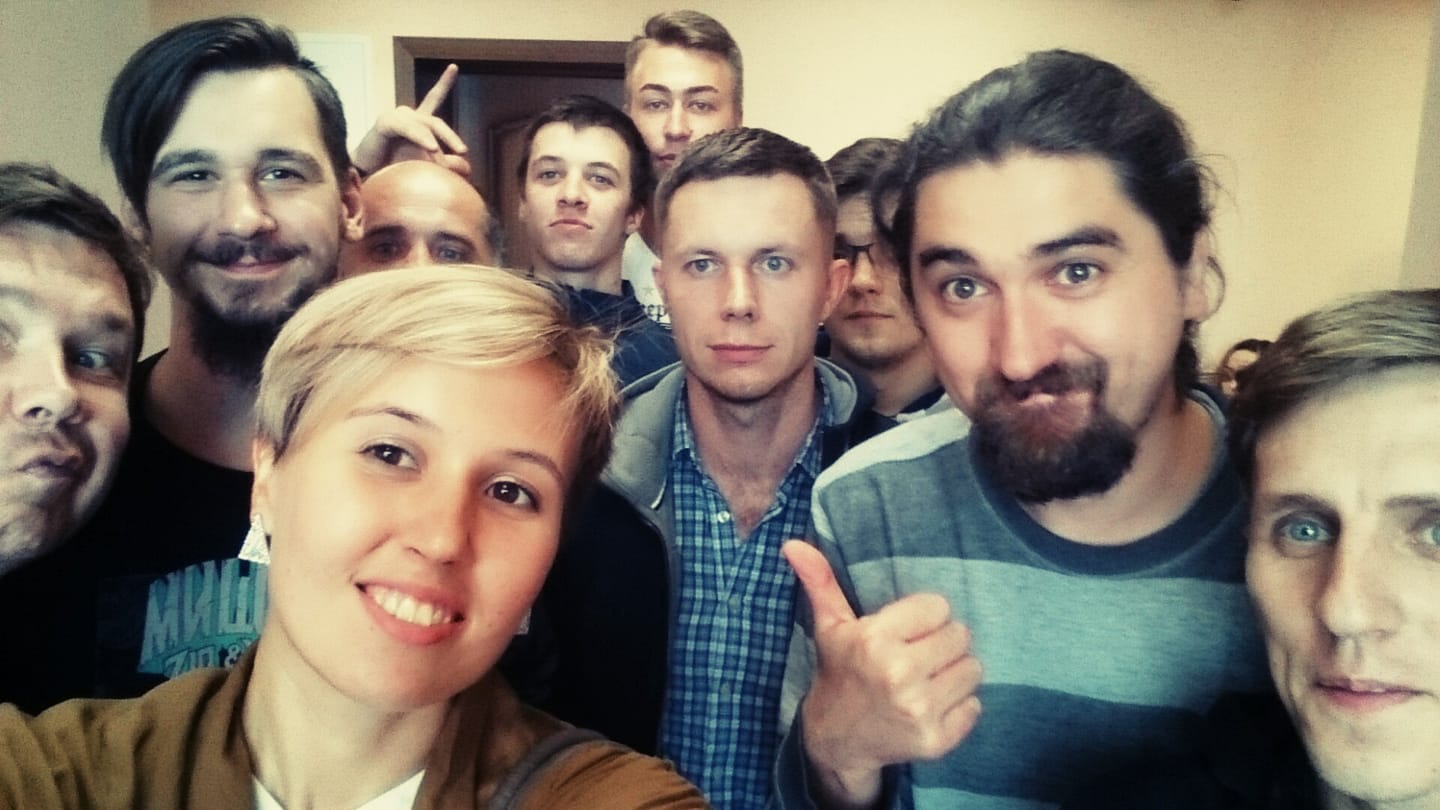 Varya Mikhaylova and her defendants. Photo courtesy of Ms. Mikhaylova’s Facebook page
 Max Stropov on his way to September 9, 2018, anti-pension reform demonstration in Petersburg. His placard reads, “Life is hard, but happily it’s short.” Photo courtesy of his Facebook page
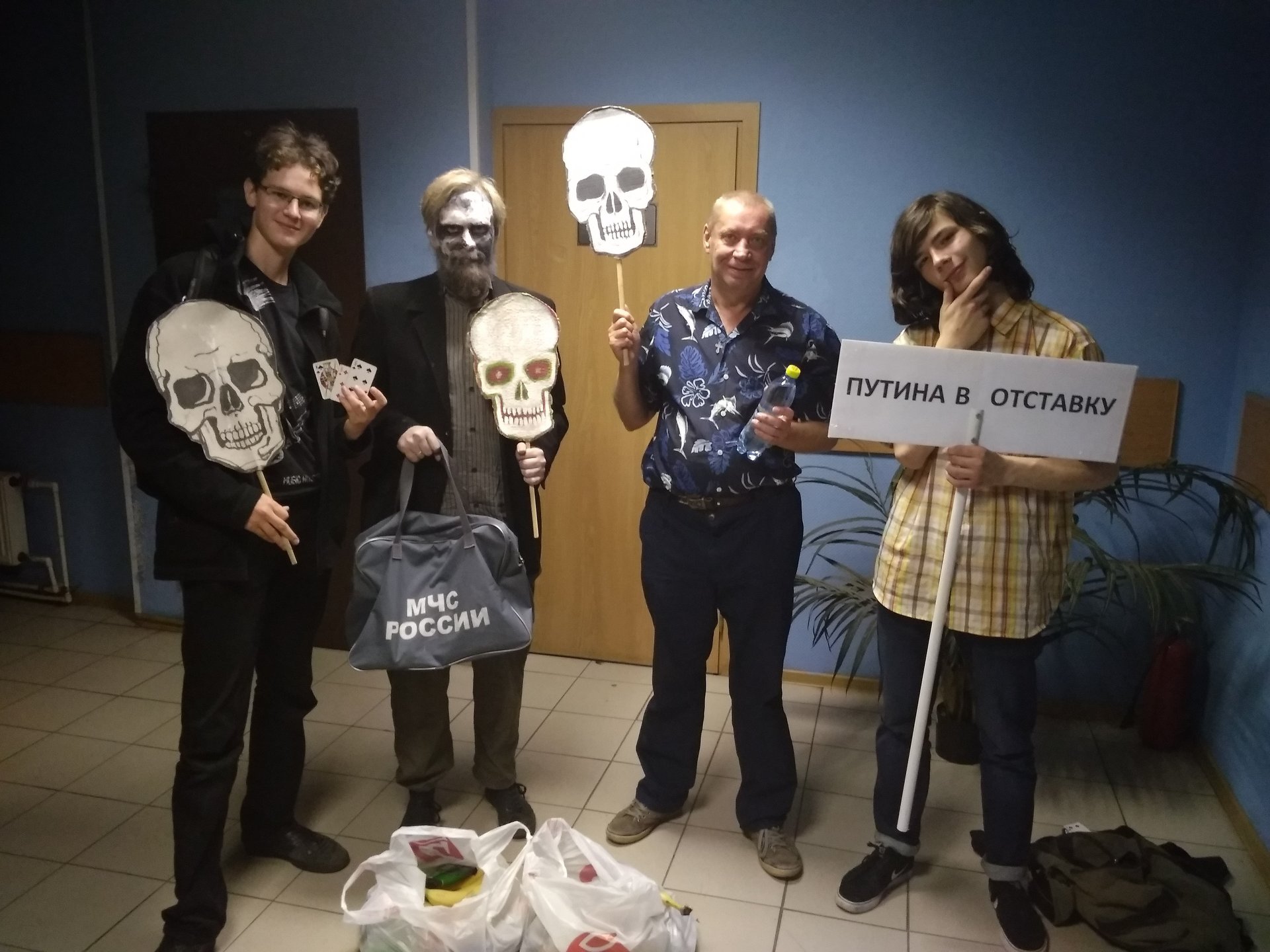 Max Stropov and his fellow detainees. The young man on the right holds a placard that reads, “Putin, resign!” Photo courtesy of Max Stropov’s Facebook page
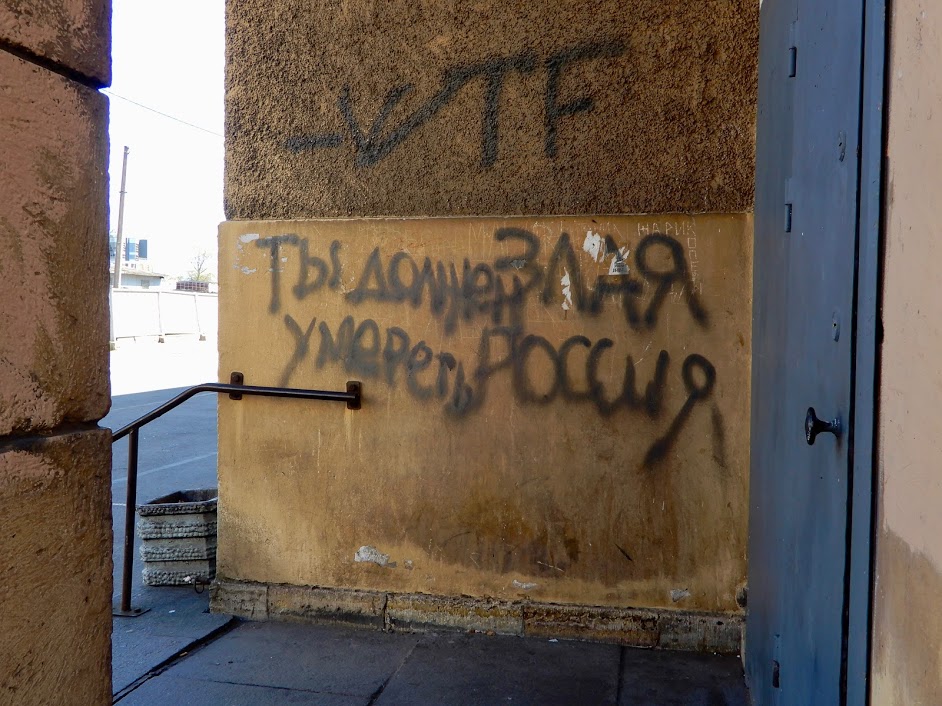 “You must die.” ∴ “Wicked Russia.” Downtown Petersburg, May 6, 2018
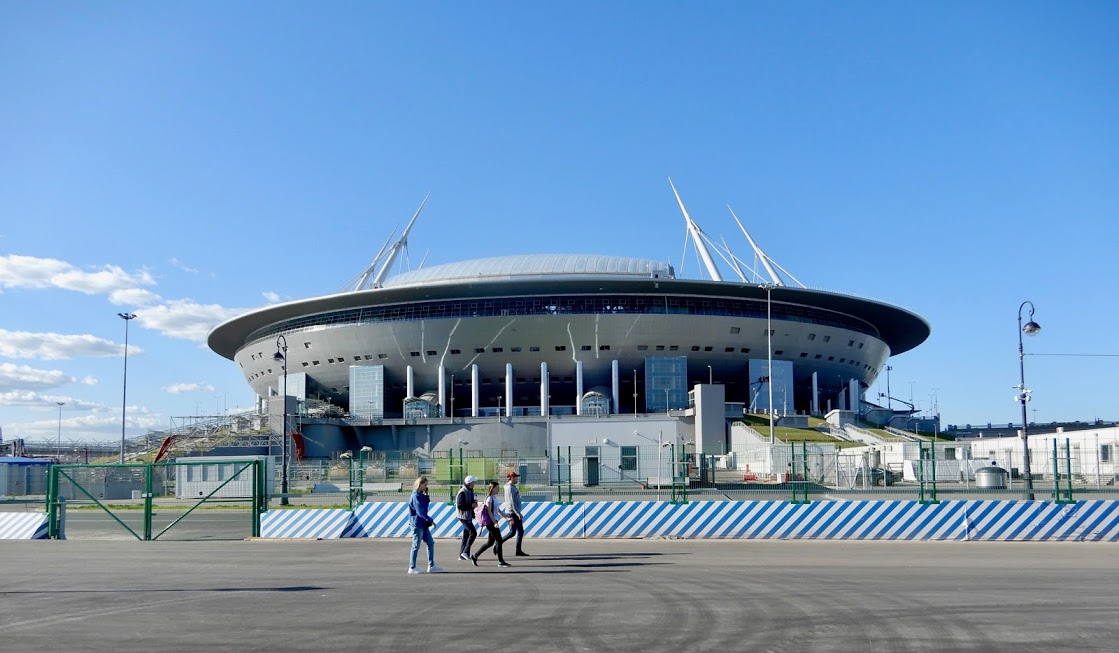 Russia has the money to build stadiums like Zenit Arena, in Petersburg,