Time of the Strikebreakers
Oleg Aronson
Index on Censorship (Russian Edition) 26 (2007)
It is difficult to write about Putin’s Russia, something one does reluctantly. One hesitates to use the word Putin because by this act alone you intrude into the political arena, where your least utterance cannot remain mere hot air but can also turn on you and make you regret what you have said. Such regret does not arise because you were wrong or unfair or because you were misinterpreted, but because your words are always addressed not to those who listen, but rather to those who eavesdrop. Some might be inclined to detect paranoia in this last phrase, to interpret it in the light of conspiracy theory, the “rise of the secret services” or something of the sort. I have in mind something else, however: the specific shift in Russian political sensibility that has taken place before our eyes. An oversupply of mutually repetitive utterances has now been stockpiled, and their lack of content underwrites their existence in the mediaverse. It is simply impossible to listen to them any longer, just as listening itself has become a chore.
It is not so much the political situation (in which power, capital, and the mass media are concentrated in one and the same hands) that I would like to discuss, as it is the “nonpolitical” situation. When we examine the zone of the nonpolitical, the lifeworld of the ordinary man, however, politics is, all the same, one of the conditions that shape it. Politics has long since ceased being something in which people take part; instead, it has become something that shapes people. It has ceased being a clash of parties, social groups, views, and convictions; it has ceased being a concern only of the state and its institutions. Politics courses through our bodies—bodies that vote, work, watch TV, sit in cafés, smoke cigarettes, sleep, die, etc. Politics has long ago become biopolitics. This is not news. It is always the time you live in that is the news.
It is this that makes us speak out today: this strange time that we did not anticipate and in which we find ourselves now. One struggles to find a precise description of this time or even an imprecise description, one that would nevertheless capture the current conjuncture. In our case, defining even a few of the situation’s peculiarities means giving a chance to the absolutely mute, feeble forces of the nonpolitical. It means revealing the possibility of another politics—not a politics devised by political scientists and political operatives, but one that grows out of the life of society itself. In our time, it is extremely hard to imagine such a thing. For a start, however, it would be good to describe this strange time in some way. When does it begin? In what sense is it strange?
We would be mistaken in thinking the time of this new political sensibility begins with the rise to power of the new politicians. Their rise is a symptom, rather. Many still remember (although the mass media have done everything they can to make us forget) Gorbachev’s perestroika and the first years of the Yeltsin administration. It was a romantic period when the experience of democracy became part of our lives. And it was because this experience was new that the very idea of democracy itself was perceived romantically. Ours was an anarchic democracy, one without the institutions on which democracy depends. In this sense, it was a popular democracy, independently of the fact that a significant part of the population might not have supported it. In turn, the spontaneity and popular character of democracy in the late eighties and early nineties might not have manifested themselves had revolt not become a vital necessity in Soviet times, especially during the Brezhnev years.
I consciously use the word revolt here, rather than “resistance” or “social change,” because the latter was the bailiwick only of society’s politically active members. Revolt, on the contrary, is always nonpolitical in nature: it springs from life itself, not from its political realities. Revolt is born of hunger and fear, of humiliation and injustice that exceed the individual and thus become social phenomena. Revolt is a resistance of bodies that marks the limits of biopolitics.
At the end of the Soviet era, the word democracy was the symbol of this revolt. We began building democracy then, and its shortcomings, aporias, and weak points were revealed. This is all more or less obvious to critics of the western model of democracy. Institutionalized democracy, of course, is a rather refined control mechanism premised on the clear equation of the ordinary man with the socially active individual. Your identity as an individual has everything to do with your having a “point of view,” the “right to vote,” the “franchise.” The main thing, though, is that you are endowed with power albeit paltry and imaginary power. This reduction of politics to the individual is the constant in democracy’s rhetoric and its ruse. Even our current political elite has not rejected this rhetoric, although the word democracy has ubiquitously become a term of abuse, and invectives against the western social order, commonplace. Here, of course, we discover a certain resemblance between our time and the Soviet period, when there was also a constitution, a system of elections, courts and lawyers, and the notorious of “grassroots criticism.” Then as well, however, there was a general albeit unspoken understanding that this entire system was fictitious and deceitful, and this was a source of the perestroika era’s consensus on revolt.
The situation today is different. First, it is “democracy” and “democrats” that have been officially blamed for all the woes of the Yeltsin years. Second and more important, this puppet democracy has acquired a service class that far outnumbers the standing political bureaucracy. This is mainly a new generation of people, most often young people, who do not remember even the early post-perestroika years, much less Soviet times.
It would be unfair, however, to limit this segment of society only to “new” people, most of whom are successful or hope to be successful. As opposed to many members of the older generation whose service to the current political authorities is wholly cynical and who have happily forgotten what they said a decade ago and what they believed in (perhaps sincerely) two decades ago, the “new” people have already been formed as political bodies per se. If we can understand what makes them tick we will go some way towards shedding light on the situation.
Television regularly treats us to political talk show hosts (Vladimir Solovyov and Maxim Shevchenko, for example) who have at the ready an amazingly cynical set phrase when anyone mentions the absence of free speech in Russia and the state’s control of the mass media: “You are saying this on national television.” We are constantly confronted by the fact that critical views on the current state of affairs are voiced by figures (Novodvorskaya, Zhirinovsky, Borovoi, Nemtsov, et al.) who have long ago become TV clowns. If new faces turn up by accident among this pack, then the hosts, feigning surprise that our democracy gives even such “nutcases” the chance to speak out, will find the right (prescripted) words to demonstrate to the home audience just how marginal their stance is.
Russia’s imitation “democracy” is in no way a social system with all its attendant shortcomings. It has long since been turned into a reliable instrument of the political hacks. It would not be worth mentioning it at all if not for the fact that our “democracy” incarnates the ambivalence that characterizes the current situation in general. Just like Health Minister Mikhail Zurabov, democracy is to blame for everything but it cannot be sent packing. It is “effective” after its own fashion, that is. It has to go on living because it is guilty and thus will continue indefinitely to swell the ranks of its detractors, the ranks of the current order’s zealous defenders.
Thus, a certain young writer, Anastasia Chekhovskaya, gives a rapturous account in Izvestia of her meeting with Putin. She relates how glad she is that the state has commissioned her to educate the populace, to teach them “good feelings.” Then, without batting an eye, she calls these same people lumpen who have been mutated by mass culture and almost openly declares that it is “young people” like her who are the new elite.
Or take our contemporary artists. Their state commissions have not come through yet, but they are already looking for the right people to serve.
And then there are other “young people,” the members of the Nashi (Ours) movement. Dressed in identical team jackets (it is clear who footed that bill), they are bused in an organized fashion to pro-Putin rallies.
Here they are on Pushkin Square, guarded by the police. They are singing songs and yelling patriotic slogans right at the moment when, on the other side of Tverskaya, the OMON is beating the March of the Dissenters with billy clubs.
Here are some other “young people.” They attend the Marches of the Dissenters not because they are dissenters but because they are provocateurs.
Finally, there are the Live Journal users. They are not members of any party, and they do not go to demonstrations. They are, however, incredibly active when it comes to voicing their support for practically any government campaign. They curse Georgians and Estonians and pensioners who refuse to sell off their garden plots in the countryside outside of Moscow.
These are not simply examples of “grassroots political activism.” There is nowhere from which such activism could emerge: the time is not disposed towards it. This is a new social space that has taken shape precisely in the last several years: we might describe it as an open call for a place in the sun. Only there is no search committee and no list of qualifications for the jobseekers. It is probably not even a job competition but a show in which only the most cynical end up in power or on the tube. All the other applicants master the art of “natural cynicism” (the ability not to see pain, humiliation or the trampling of liberty), expecting a summons to serve in the most miserable “bureaucratic” (in the broadest sense of the word) postings, where these mid-level satraps will employ their skills with the right amount of zeal.
A graduate of the school of political perceptivity, the new-model individual has been hatched in record time. This is the type of people Gleb Pavlovsky has dubbed “the victors.” They are instantly recognizable: they are the ones who talk about the “horrors of Yeltsin-era democracy,” who criticize the Dissenters for their lack of a “positive” program, who rejoice over the country’s growing budget and the size of the Stabilization Fund, who condemn businessmen who cheat on their taxes, who calculate how much doctors, teachers, and pensioners do not get as a result (while of course forgetting that tax revenues go to the state, which despite its enormous budget does not pay the needy anything). We could go on. While it would be wrong to say that all these folks are well off, they are already “others.” Even if their grip on power and money is still slight, power and money figure virtually in their way of thinking, in their sensibility. The state needs such people. They are the new (dependent) “power” elite. A semi-powerful elite whose power extends to the moment when they are reminded who made them what they are and how. Semi-victors.
But what is to be done with the losers? What is to be done with those whom we still call ordinary people? With people who keep their counsel and watch TV? (Whether they condemn or support Putin while doing so is unimportant.) With those who, with the best will in the world and even in their wildest fantasies, are unable to appreciate the Stabilization Fund’s significance? With those who protest when driven to their wit’s end, only to be told that they do not have permits to demonstrate and that the principles of democracy dictate that they should pursue their rights only through the courts?
The watershed that has happened today cannot be reduced to a divide between rich and poor. The media find it convenient to represent the state of affairs in this way, thus directing the energy of protest against the oligarchs. In today’s Russia, the demarcation line runs between “victors” and “losers.” It is not a line, even, but an abyss. Leaping from one camp to another is no simple matter. Strange as it may seem, it is much easier to become a “victor” (a lot is done to smooth the road to victory). It is much harder to side with the “losers,” to share with the injured their experience of humiliation.
No one needs the losers. They are not simply forgotten: systematically, for years on end, they have been the victims of real genocide. Everything points to the fact that it is not only the Anastasia Chekhovskayas of the world but also the central authorities themselves who are waiting for entire segments of the population to become extinct naturally. The lumpen will be the first to go. Then the pensioners. Then the people who for some odd reason continue to give them medical treatment. Then the people who continue to work in small towns and villages for a pauper’s wage. (In this sense, apparently, they expose their “passive” natures.) Then the people who remember something. Those who do not want to join the jubilant ranks of the victors will be the last to go.
Politics in Putin’s Russia is almost wholly constructed around the principle of exclusion. If you are not loyal to state power, then sooner or later you will end up a loser. Ordinary work that is even minimally connected to politics has taken on a completely different character. Whereas it was once possible to speak of “convictions” or “temporary alliances,” nowadays the line between cooperation and strikebreaking has become precariously thin and is disappearing by the day.
During Soviet times, people joined the Komsomol (Communist Youth League) because it was a condition for enrolling in university. They joined the Communist Party only because it was, once again, concomitant with professional advancement. Everyone understood the ambiguity of the situation: during the Brezhnev years, the number of sincere communists could have been counted on the fingers of one hand. Moreover, although there were frightfully few dissidents and human rights activists in those days, an enormous number of people (the majority, perhaps) were, if not exactly nonconformist, then “in disagreement” with the regime. Perestroika showed that such “dissenters” were numerous even within the country’s communist leadership.

Nowadays, there is no obligation to join the party, but one has to be a “consenter”: to be statist in one’s thinking; or, to be more precise, to have a body malleable to the state’s line. Otherwise, you are excluded, even if you are just a human being, not a dissident. Exclusion has become the principle of state policy. This exclusion is both economic and political. One has to be in the business of servicing the authorities or the natural resources extraction industries; if you are not, you will be forgotten. When the excluded are remembered, it is via the latest talk show (most often, during an election campaign), which usually leads to nothing. One has to go to the polls and vote for one of the party lists, any of which has long consisted of nothing but “victors” who are barely distinguishable from one another. If you are apolitical or a “protester,” then nowadays you do not exist: the minimal turnout threshold has been abolished, and so has the “against all” option on the ballot. Thus, the legal space for protest has been disappearing. So when you head to the polls to engage in the most democratic of democratic acts, you unwillingly become obedient to the general line and even a bit of a strikebreaker.
Isn’t this word too harsh? I don’t think so. You might ask: Where is the “strike,” the protest, the political movement (finally) that this great mass of people is, suddenly, breaking? Do you really think it is only the comments of television talking heads and the provocateurs planted in the crowd of protestors that lead me to such conclusions? After all, the former will foam at the mouth as they prove to you that they really are voicing their own beliefs, while the latter will claim they are merely engaged in run-of-the-mill “effective” politics. It is true: there is something awkward about the word, but in its harshness, it is quite accurate. There really is, as it were, nothing much to break (all protest actions are local and turn out few protestors), while the self-image of these people is just the opposite—that of positive builders. If we ask what it is they are building, however, then it will be clear what it is they are breaking.
Each and every one of them is building a “strong state.” They are volunteers. In the best (and extremely rare) case, they are sincere enthusiasts, but in principle, they are calculating pragmatists. The rationale of the strong state requires a triumph of victors over the vanquished on both the foreign and the domestic fronts. While it is easy to find foreign enemies (and even easier to find weak foreign enemies), on the home front the hunt for “enemies of the people” (aka enemies of the state) has already begun. And it is the people who protest—pensioners, the impoverished intelligentsia, part of the student body—who turn out be the enemies. It is of little importance who is “left-wing” and who is “right-wing” because their protest is not mere protest. It is a revolt, albeit for the time being a rather mild revolt. Although it is nonpolitical in character, it is occasioned by the political situation.
Revolt is a lawless thing. So-called democratic rights—the right to vote, the right of assembly and peaceful protest, the right to strike, the right to have one’s grievances redressed in the courts—are intended to limit the possibilities of revolt. They are mechanisms for regulating social discontent. That is why it is so hard to reject “democracy.” At the end of the day, it is an advantageous form of governance for states, especially those inextricably bound up with big capital. Tyrannies have the habit of crushing revolts, while democracies create mechanisms for controlling them. Any revolt can instantly be interpreted in political terms and used by politicians of all stripes for their own purposes.
The Kasyanovs and Khakamadas will always try and set up their soapboxes in the midst of a politically formless protest. Nor it is an accident that members of the absolutely servile Public Chamber appear amongst the outraged residents of the Moscow suburb of Butovo, rather than somewhere in the sticks, where the violence directed against its citizens by the state is no milder.
Aside from protest, however, revolt has another aspect: the stoppage of work. Not just any specific kind of work, but the work of the state itself. Hence, those who relate negatively to all forms of revolt are either bureaucrats or strikebreakers. The former are fond of repeating ad infinitum that protestors should use only legal means to exercise their rights. They are hostage to the notion that democracy is a form of the state. In practice, this transforms democracy into a means of manipulation. The latter group (and nowadays the numbers of such people are growing) consists of bodies. They are bodies that have become elements in the state machine (a “powerful” and “successful” machine), whose smooth functioning requires the elimination of all obstacles. The main obstacle is the class of unwanted, superfluous people. It is telling that the bodies servicing the state system constantly regale us with the rhetoric of “positiveness” and “hard effort.” While we are working, they are protesting. We draft new legislation, but all they do is hold demos. We are building the state up, but they are trying to tear it down.
In fact, revolts have become an important factor in our attempt to make sense of the present situation. From a political point of view, they do not exist. There are only random excesses committed by marginalized groups, and these excesses are described in a purely negative key. There is, however, a principally positive element in revolts that is not visible to political analysts. This positive element has to do with the fact that any revolt falsifies politics. To put it another way, life itself uses revolt to falsify politics, to point out the falsity of its claims.
It is no longer different species of politics at odds in this case, but different ethics. The first ethic is the corporate ethic, which has lately become ubiquitous—the ethic of doing what needs to be done, of usefulness and reliability. The second ethic is the ethic of community. It means standing with those people whose tastes, views, and ideals you cannot share, with people who are sometimes completely different from you. But you stand with them only because you are willing to join them in a community based on the experience of injustice, which everyone knows to one degree or another. Not recorded on any scrolls, the community ethic is the continually repressed source that nourishes the idea of democracy. It cannot be eliminated completely, although politics has developed a multitude of instruments for making us forget it. Once you do forget, however, you shall forever be deaf to the violence that is perpetrated right outside your door—sometimes by your own hand.
Translated by the Russian Reader. Updated on August 30, 2019. Images courtesy of Jane the Virgin and Ororo

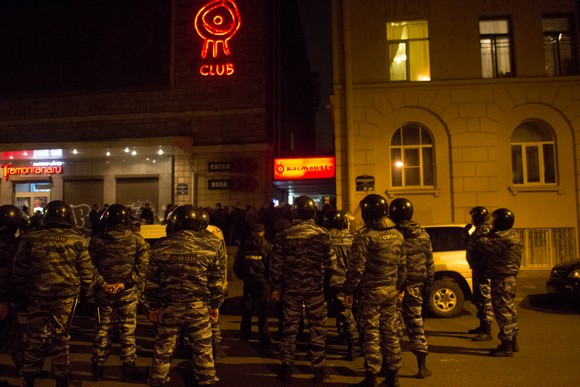 OMON police standing outside the Kosmonavt club, the venue of the canceled concert by Cannibal Corpse, on Sunday night. Photo by Sergey Chernov for The St. Petersburg Times