Programmer Viktor Filinkov was released after seven years in police custody and prison as a defendant and convict in the Network Case. Filinkov himself told Mediazona that he had been released in the morning from Penal Colony No. 1 in Orenburg, after which police officers drove him to the border with Kazakhstan and turned him over to local border guards.
Before his release, Filinkov was interviewed by the penal colony’s case officers, who warned him not to return to Russia after he was deported. Police officers transported him to the border in handcuffs.
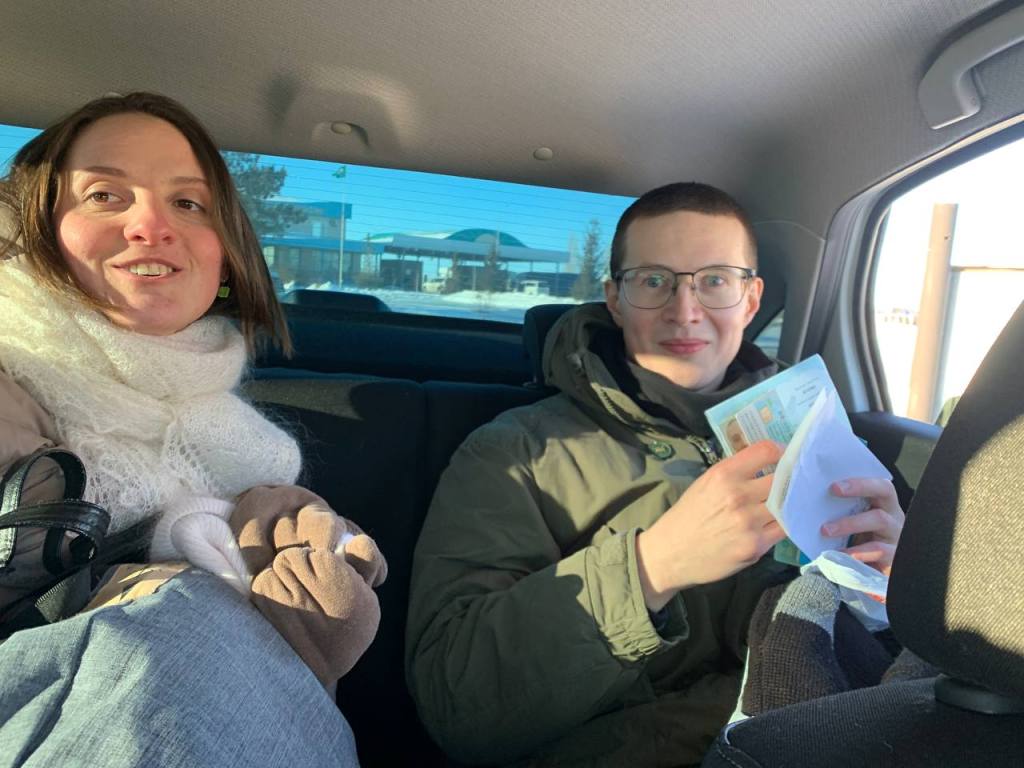
Jenya Kulakova and Viktor Filinkov after crossing the border with Kazakhstan. Photo: Mediazona
Filinkov is a Kazakhstani national. In 2021, while he was still incarcerated, the Federal Penitentiary Service (FSIN) ruled that Filinkov’s presence in Russia was “undesirable” and banned him from entering Russia for eight years, a common practice for those convicted on terrorism charges. Based on this ruling, the Orenburg office of the Interior Ministry ordered Filinkov deported.
Filinkov and his wife Yevgenia [aka Jenya] Kulakova are now in Kazakhstan. They are headed to Petropavlovsk in the north of the country, where Filinkov’s mother resides.
Before his release, FSIN officers laundered and gave Filinkov the green jacket in which Filinkov was detained seven years ago and tortured with a stun gun by FSB officers.
Programmer and antifascist Viktor Filinkov was detained in St. Petersburg on 23 January 2018. He was twenty-three years old at the time. After his arrest, Filinkov described in detail how FSB officers had taken him to the woods and tortured him with a stun gun, forcing him to memorize the testimony they wanted him to give. Other defendants and even witnesses in the case described similar torture.
FSB investigators then charged eleven antifascists and anarchists in Penza and St. Petersburg under Article 205.4 of the Criminal Code (which criminalizes “organization of a terrorist group”). According to the FSB, the young men had banded together into “the Network terrorist community” and were preparing for an“armed overthrow of the regime.”
The sentences handed down to the Penza defendants ranged from six to eighteen years in prison, while the Petersburg defendants were handed sentences of between three and a half to seven years in prison. Filinkov was the final of the Petersburg activists to serve out his sentence.
Since the summer of 2021, Filinkov had been incarcerated at Orenburg Penal Colony No. 1, where at first he faced pressure from the prison wardens: he was repeatedly sent to solitary confinement, and his letters were constantly stolen and forged. Filinkov, however, consistently filed legal appeals against the penal colony’s punishments with the assistance of his lawyer Vitaly Cherkasov and his public defender Yevgenia Kulakova. When they began to win one court case after another against the penal colony, the wardens preferred to leave Filinkov alone. They had not harassed him during the last couple of years.
Vitya and I are finally together and free. There was no certainty until the last moment that everything would work out, so today’s event is a miracle to me and a relief after a lot of effort and tension.
Thank you all so much for the congratulations that have been pouring in from everywhere! It’s quite cool to know that a happy event in my life has brought so much joy to people who know me. And thanks to the media for their coverage of Vitya’s release (and, consequently, their requests for interviews).
All of this is quite precious to me, but right now neither Vitya nor I can even read everything that has come in, let alone reply. Please understand that both of us (Vitya especially) need time to come to our senses and experience these moments.
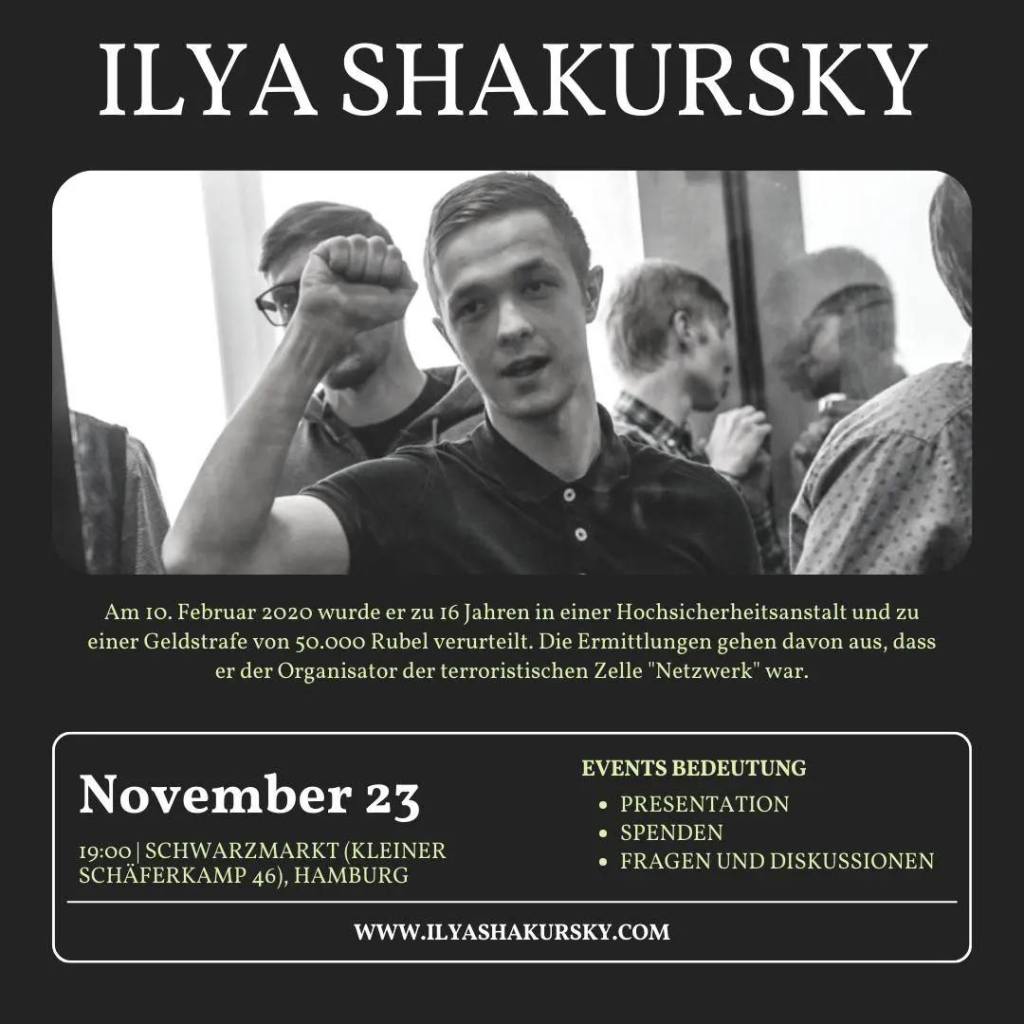
This Saturday, 23 November, at 7 p.m., the last presentation about and fundraiser for Ilya Shakursky will take place at Schwarzmarkt in Hamburg (Kleiner Schäferkamp 46). After the new year, a big update is in store for the project, but in the meantime we look forward to seeing the local public and thank everyone who has supported us this year!
Este sábado 23 de noviembre será la última presentación sobre Ilya Shakursky con posibilidad de donaciones en Hamburg im Schwarzmarkt (Kleiner Schäferkamp 46), después del año nuevo el proyecto espera una gran actualización, pero mientras tanto esperamos al público local y ¡gracias a todos los que nos han apoyado este año!
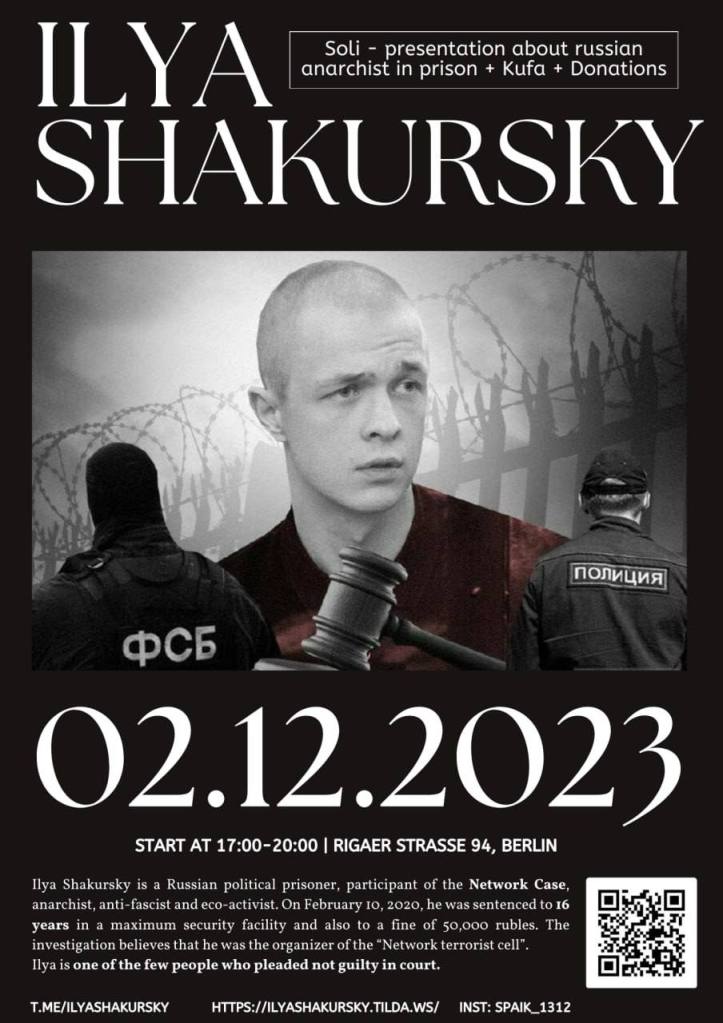
Since the all-out invasion of Ukraine, political repression in Russia has intensified, targeted in the first place at anti-war protest. But this is the outcome of a 20-year slide towards dictatorship. Russia’s antifascist movement has been a prime target for both armed nationalists and the state: it culminated in 2017–19 with the torture and imprisonment of the “Network” case defendants. In July this year, one of them, Ilya Shakursky, sent this letter from prison, looking back at the antifascist movement’s history. It was published on Avtonom, the anarchist web site. Translation and notes in brackets by People & Nature.
Ilya Shakursky in court in 2020. Photo: Penza News / Free Russia House
Ilya Shakursky: letter to a friend
It went like this. My friend shared his thoughts with me: he had arrived at this discomforting realisation that after my arrest, everything was finished – as if our world was sharply divided into “before” and “after”. It seemed that that life, in which we were immersed for many years – the atmosphere of the dvizha [slang: roughly, movement/ milieu], the concerts, demos, discussions, journeys, street fights, performances – had disappeared, had dissolved into fear and into the constraints that shroud so many of us. It seemed that that life had mutated into nostalgic reflections on those times when just to be yourself in Russia had not yet become so dangerous.
Of course, the root cause of my friend’s predicament is the reality: in the regions, the movement comprises fairly small circles of people, and all the activity depends on their enthusiasm. So it is not surprising that in a small town, after high-profile arrests, everything goes quiet. But now – when there’s a widespread tendency to analyse the history of the almost-destroyed antifascist and anarchist movements in present-day Russia – I have read in several articles the opinion that this latest defeat of the movement began precisely with the “Network” case. My own impression is that the movement at that time, although it suffered from a lack of coordination, exactly in 2016-17 began to aspire to, and head towards, unity and amalgamation.
We all know well about the devastating defeat of the young, audacious movement of the early 2000s and its consequences. It was then that the state power recognised the strength of the antifa, the subcultures, the anarchists and ecologists that it could not control. That all came to an end with the deaths of Fyodor Filatov [antifascist, founder of the Moscow Trojan Skinheads, killed on 8 October 2008 by the Militant Organisation of Russian Nationalists (BORN)], Ilya Dzhaparidze [antifascist killed by BORN on 27 July 2009], Ivan Khutorskoy [antifascist killed by BORN on 16 November 2009], [Stanislav] Markelov and [Anastasiia] Baburova [antifascist lawyer and journalist, killed in broad daylight in central Moscow by BORN on 19 January 2009], the “Khimki case” [showtrial of activists after the big Khimki forest protests] and emigration. The 2000s ended with Exodus (Iskhod) by Pyotr Silayev [author and antifascist activist]. Among us – young antifascist and anarchist men and women – that book was a big hit.
Time passed by. 2011: a vendetta in response to the break-up of the movement and the radicalisation of new people. 2012: Bolotnaya Square [a big anti-government rally, followed by mass arrests]. 2014: Maidan and the start of military action in Ukraine. We, young people whose outlook was shaped by these events, tried to re-awaken and breathe life into the flickering flame of the dvizha. Concerts, squats, days out, fist fights, graffiti, lectures, FNB [Food Not Bombs, Moscow] and free markets. We lived by all this: it was our culture, our self-expression and our inner inspiration. We got to know each other, we were inspired by the experience of our older comrades. We took the road of struggle, we cultivated an atmosphere, we kept the movement going – or at least we tried. And we reached the point where the spirit of the age put in front of us the need for militarisation. The stakes were raised. We realised we were getting closer to the point at which we would have to defend ourselves, to fight to survive. The times changed. …
Autumn of 2017. Arrests. Tortures. Exile from the country. New repressive laws. “The Network”. Sentences. Zhlobitsky [the 17 year old who suicide-bombed the FSB office in Arkhangelsk]. Attempts to protest and resist. People’s Self-Defence [anarchist network]. Kansk [a case brought under terror laws against teenagers who put up protest posters]. And again, tortures and repression. The 2010s came to their end, and now it was our “Exodus”. But not all of us could get across the desert. Some stayed right where they were. And here was the bleak emptiness that my friend told me about, that has reigned since 2017. Time has passed, and there is nothing left of that life that swirled around us. Fear infuses everything. Some were just tired out, some escaped, some – so it seems – went out of their minds and became completely different people. The desert swallowed people in endless emptiness. It’s as if previously optimistic, active people were shackled hand and foot by depression, apathy and disillusionment. Very few lights were left burning.
The new reality: crowds of roughnecks, saluting Nazi-style; billboards calling on people to sign contracts with the army; arrests and sentencing of dissidents daily; [Zakhar] Prilepin [leader of armed Russian nationalists in eastern Ukraine] in the state Duma [parliament]; anarchists and antifa outside the law; Stalinism; quotations from [Ivan] Ilyin [by Putin]; imperial flags and red banners.
When we were arrested, with every interrogation I realised more clearly that the chekists [security police officers] didn’t want simply to combat allegedly criminal activity or to strike fear into us. No, their aim was destruction – destruction of the ideological enemy that we represented. Destruction of those whose ideas of freedom and equality are absolutely alien to them, who hate “chinks” and “faggots” and love busty women and hunting parties. Portraits of those who executed the anarchists of the last century hang on their office walls, and, as if returning to the past, they are doing that Bolshevik work again. They started with the anarchists, and the Nazis they could not control, and ended up with the liberals and pacifists. The desert melts into the burning heat of repression. There’s no water and no life.
And why am I writing all this? This letter is to my friend, whose heart is full of sadness and mourning – but by writing to him, I am writing to all of you: to all with whom I met in the woods outside Moscow at concerts by Volodya Ukrop and Natasha Chetverio [antifascist singers]; all, who listened to “MDB” [Moscow Death Brigade, a punk and hip-hop band] on earphones, when taking a train to a stand-off with the “boneheads” [a “white power”/ racist subculture close to skinheads]; all who stood in defence of the Mosshelk dormitory [where activists supporting residents resisting eviction were arrested]; all who raised our flags at the demonstrations in central Moscow in 2017; all who spoke openly about problems of discrimination, and who wrote letters to Lyosha Sutuga [anantifascist activist] when he was in prison; all who wore “Will Power” (“Sila voli”) T-shirts; all who read “Avtonom”; and all who threw away those papers summoning us to chats at the Centre “E” [the state Centre to Counter Extremism]. We lived through all this together, and now we are again living through hard times that plant the darkest thoughts in our minds. But, friends, there’s no point in throwing up our hands, there’s no reason to convince ourselves that our community is dead, or that our spirit has been extinguished.
When the chekists fastened on to the term “Network”, they actually misunderstood something. They thought that we would hand over our party membership cards and renounce our responsibilities to an alleged organisation. But the anarchist movement’s networks exist without any clearly-defined structure. The network of the anarchist and antifascist movements is the smiles of two people who don’t know each other, but who catch each other’s eye in the metro with some characteristic attribute; it’s when you are in a city that’s not your own, but then someone sends you the number of a place to stay and it becomes your own; it’s when we get to know each other by a single handshake, more than likely without knowing each other’s real names; it’s when we can travel hundreds of kilometres to support our guys in a big street fight, support musicians we know or join an environmentalist sit-in. Neither the investigators nor the prosecutors and judges understand this. And for that reason they are unable to destroy us.
The European dictatorships of the 20th century annihilated those whose experiences, and heroism, is a source of inspiration for many of us today. Franco thought that he had wiped out the Spanish anarchists; Hitler thought that he had taken out all the German antifascists. But today we see how big the antifascist festivals in Berlin are, how substantial are the areas of European cities occupied by the anarchists.
It seems that we – rebels, idealists and dreamers – were always alien, marginal and incomprehensible for this country. But anyway, we are at home here. And after this next round of destruction and repression, we will rise again among new generations of young people, right here in this place. Yes, we lived through that last phase; yes, right now it’s that time when it seems that every day is more fearful and more difficult than the last. But we need to preserve in ourselves, at all costs, the honesty that has been awakened in our hearts, that spirit of freedom and the struggle for it that brings us together.
The recent blows struck at the movement have hurled some of us over the world, but they have not broken the links of solidarity and friendship. So let’s not bury ourselves in the darkness of these times, let’s continue to be ourselves, and to do all that we can to clear the darkness away.
Ilya Shakursky, July 2023. The letter was passed on by Ilya’s mum, Elena.
To support Ilya:
Russia,
431161 Mordovian republic,
Zubovo-Polynasky district, Ozernyi,
ulitsa Lesnaya 3,
FKU IK-17 UFSIN Russia (Republic of Moldova),
Shakursky Ilya Aleksandrovich (d.o.b. 1996)
2202 2005 6759 6000 (Sber, Nina Ivanovna Sh.)
PayPal: abc-msk@riseup.net (in euros, marked “for Shakursky”)
More in English on Russian antifascism
A letter from Ilya Shakursky sent in 2021 is here. People & Nature reported on the “Network” case verdicts here, and on other aspects of the case here, here, here and here. For The Russian Reader’s much more comprehensive coverage, start here. A recent comment on the security police’s attempts to link Azat Miftakhov, the jailed Moscow anarchist, with their invented “Network” is on OpenDemocracy here. The Rupression site has more information.
An overview of the antifascist movement’s history was recently posted on the Avtonom site here. On the campaign of killings of antifascists by armed nationalist groups at the end of the 00s, see here. Reports of the trial of the BORN killers here and here, and more on the fascists’ links with the Kremlin here. A memoir of Ivan Khutorskoy is here.
An article explaining why Russian and other antifascists began to mark 19 January – the anniversary of the killing of Stanislav Markelov and Anastasiia Baburova – is here, and an interview with Anastasiia’s parents here. A report of a demonstration in London on the 10th anniversary is here.
There’s a report on the 2010 battle for Khimki forest, which was threatened by road construction, here, a retrospective written in 2017 here, and a focus on the antifascists’ involvement here.
Source: “‘After this round of repression, we will rise again’ – Russian political prisoner Ilya Shakursky,” People and Nature, 2 October 2023. Thanks to Simon Pirani for the translation and publication, and for his kind permission to repost it here. People living outside of Russia will find it difficult or impossible to send letters to Russian prisons via regular mail. In many cases, however, you can send letters (which must be written in Russian or translated into Russian) to Ilya Shakursky, his co-defendants in the Network Case, and many other Russian political prisoners via the free, volunteer-run service RosUznik. You can also write to me (avvakum@pm.me) for assistance and advice in sending such letters.||| TRR
The ridiculous Meduza strikes again, now deliberately misnaming the (nonexistent) “Network” (and, by the by, passing off the FSB’s torture-“collaborated” fairytales as facts) after just as deliberately, three years ago, torpedoing the broad-based solidarity movement that had finally sprung up in support of the defendants in the so-called Network Case.*
There is unprecedented public outrage at the verdict and the prison sentences requested by the prosecutor. Hundreds of open letters and appeals—from musicians, poets, cinematographers, book publishers, artists, teachers, and municipal councilors—are published. For the first time in Russia, the practice of torture by the special services is openly and massively condemned. The verdict is called an attempt to intimidate the Russian people. The public demands a review of the Network Case and an investigation of the claims of torture. People stand in a huge queue on Moscow’s Lubyanka Square to take turns doing solo pickets.
But a week later, the wave of indignation is shot down. Meduza publishes a controversial article, “Four Went In, Only Two Returned,” in which a certain Alexei Poltavets confesses to a double murder that he committed, allegedly, with defendants in the Network Case. There had long been rumors about the so-called Ryazan Case—the murders of Artyom Dorofeyev and Ekaterina Levchenko in the woods near Ryazan—within the activist community, but the story had never surfaced, because there was no evidence. There is no evidence now, either: the Network’s involvement in the murder is not corroborated by anything other than the claims made by Poltavets. Poltavets himself is in Kiev, and no formal murder charges are made against the Network. But it is enough to discredit the solidarity campaign. Now, in the eyes of society, those who take the side of the Network Case defendants are defending murderers. Public outrage fades, and the verdict remains the same
Yuli Boyarshinov (left, facing camera) and his father, Nikolai (foreground), after Yuli’s release from the penal colony in Segezha on 21 April 2023. Photo courtesy of RFE/RL
Yuli Boyarshinov, convicted in the Petersburg portion of the so-called Network Case, has been released, our correspondent reports. His parents, wife, and friends were on hand to meet Boyarshinov.
Boyarshinov was released from Penal Colony No. 7 in Segezha, Republic of Karelia, early in the morning of April 21, although his relatives and friends had expected him to be released in the afternoon.
Boyarshinov said that the wardens gave him a ticket for the train to Petersburg, which departs at ten a.m., and released him right on time for that train. “Customer-oriented service,” Boyarshinov said by way of explaining the rush to release him from the penal colony.
The FSB launched a criminal case against the so-called Network “terrorist community” in October 2017. Eleven individuals from Penza, St. Petersburg, and Moscow, most of them anarchists and antifascists, were detained and then remanded in custody. According to FSB investigators, the young people had established a networked community with the aim of committing terrorist attacks and overthrowing the government.
Boyarshinov and Viktor Filinkov were arrested and eventually tried in Petersburg. Filinkov was sentenced to seven years of imprisonment, while Boyarshinov was sentenced to five and a half years in a penal colony. Later, however, his sentence was reduced by three months.
Most of the accused claimed that the evidence was fabricated by the FSB, and repeatedly stated that they had given confessions under torture. The Russian Investigative Committee, however, failed to find any illegalities in the actions of the FSB officers involved the case.
Yuli “Yulian” Boyarshinov, one of the Petersburg defendants in the Network Case, has been released from prison, after having spent over five years in custody. Bumaga was there to capture Boyarshinov’s first moments on the outside, where he was reunited with his wife and his parents.
Yuli Boyarshinov (right) with his wife, Yana Sakhipova. Photo by Andrei Bok for Bumaga
Yuli Boyarshinov (far right) with parents and wife, after his release from prison. Photo by Andrei Bok for Bumaga
Boyarshinov was detained in January 2018 and had been in custody from then until his release earlier today. In June 2020, he was sentenced to five and a half years in a penal colony on charges of “involvement in a terrorist community,” but an appeals court later reduced his sentence by three months. The sentence took into account the time Boyarshinov had already spent in jail.
The Network Case is also known as the Penza Case, since most of the defendants were detained in Penza. However, the FSB claim that the “terrorist community” operated cells not only in Penza, but also in Petersburg, Moscow, Omsk, and Belarus. Leftist activists, antifascists, anarchists, and airsoft players were detained as part of the Network Case.
Before his arrest, Boyarshinov had been employed as an industrial climber and was involved in charity work. He recounted that he had been tortured in the pretrial detention center.
Boyarshinov pleaded guilty to the charges, claiming that the Network’s participants had come together for the purpose of self-defense training. And yet Boyarshinov did not make a deal with prosecutors and refused to testify against the other defendants.
Boyarshinov is the second person involved in the Network Case to be released. The first was Igor Shishkin, who was detained at the same time as Boyarshinov. Shishkin was released in July 2021, after which he spoke to the press about having been tortured.
Ilya Shakursky. Photo courtesy of Elena Shakurskaya
Today, April 10, my son Ilya turns 27. This is the sixth birthday he has celebrated behind bars. But every year I wait, believe, and hope that he be released from captivity and be near us. I naively believe in justice and truth. A miracle must happen sometime and Goodness will triumph!
My son, the best in the world, I lovingly congratulate you on your birthday! You are a part of me, and from the bottom of my heart I want to wish you incredibly beautiful days and nights, the most wonderful emotions, and fulfillment of ambitious plans! You deserve everything wonderful; may sincere Faith, pure and devoted Love, and optimistic Hope always remain with you! I wish my son the brightest road today. After all, you are all I have. My mother’s heart very often worries about you. It hurts for every trial you go through. It hurts for everything! Know, son, that you are everything to me. You are my only man, for whom I am not sorry to give my life. You’re my rock.
Ilya’s payphones have been turned off, and at the moment there is no connection with him. Today the weather is as warm and sunny as it was in 1996 [on the day he was born]. May the sun’s rays give hope, faith, kindness, and most importantly freedom to Ilya and to all political prisoners!
Fundraiser for continuing Viktor “Vitya” Filinkov’s campaign against the FSIN, the Russian Federal Penitentiary Service!
I haven’t written here for a long time generally and about Vitya in particular. We haven’t seen each other for almost two months. That’s an awfully long time, and I miss him terribly. Soon I will fly back to Orenburg and tell you how Vitya is doing, but after meeting with him.
In the meantime, I’ll tell you about the money, my favorite topic, because there is a constant need for it and it is constantly running out.
Vitya is now “painting the town red” on his own money. Recently, I got hold of 100 thousand rubles from his bank account, which Vitya had earned before he was sent down and which were blocked because he is a “terrorist.” I couldn’t get my hands on the other 70 thousand. They are frozen until Vitya is removed from the registry of “terrorists.”
Those 100 thousand rubles have really come in handy. I am now using them to pay for trips and lawyer’s fees. In 2023, we have already spent 190 thousand rubles on tickets and lawyer’s fees over eight trips. (Luckily, the tickets in January were also quite cheap.) And to this we have to add lodging costs in Orenburg and monthly transfers to Vitya’s account for shopping in the penal colony’s commissary and penalties “for refusing to work” (we are now appealing the latter in court), as well as all sorts of unforeseen expenses, such as notary services, medicines, etc.
So very soon Vitya’s 100 thousand rubles will be done. In 2023, 60 thousand rubles have trickled onto the bank card we use to solicit donations for Vitya, and even then only because 50 thousand rubles were suddenly donated in February. In other months, total donations have ranged between three and 15 thousand. We still have a small reserve left, but it’s really small. It will last us for another month or two at most.
The good news is that we seemingly might be able to get back some of this money, but it will take a long time. In January, the court made the first decision to compensate our expenses in one of the cases we won. This is not compensation for moral injury, but only reimbursement of the lawyer’s travel expenses (50 thousand). The penal colony filed an appeal of course, and the date for that hearing has not even been set yet. And the district court judge has been postponing all our other claims for compensation, waiting for the appeal court’s decision on the first case. Then, if the ruling remains in force, we will wait for this money to be returned: it seems this will take up to three months, So it’s still a long time before we’ll see those initial 50 thousand again, so for the time being we definitely need donations. We have also finally started filing claims for compensation for moral injury, but there have been no hearings on these claims yet.
All the year and a half that Vitya has been in Orenburg, we have spent a lot of money fighting on his behalf, but we have been winning half of our cases in the courts, and ultimately this leads to an improvement in Vitya’s conditions (which are still harsh, however). Lawyer Vitaly Cherkasov has been working selflessly on all of Vitya’s cases since the first days of his arrest, traveling several times a month between St. Petersburg and Orenburg.
To get to the point: if you are able to donate money, please do. If you have no way to donate money, then maybe you know someone who does and you can share this post with them. Or just repost it. Or maybe you can advise us about where or to whom we can apply for financial support. All such help on your part is incredibly valuable.
In keeping with established tradition, if someone from the FSIN and their ilk are reading this, DON’T HOLD YOUR BREATH — WE’RE NOT GIVING UP.
Send your donations to help pay the lawyer’s fees and Vitya’s daily expenses to:
Source: Jenya Kulakova (Facebook), 20 March 2023. Ms. Kulakova, who is a friend of mine and one of my favorite people on this planet, is the public defender of Viktor Filinkov, a young Kazakhstani national convicted as part of the notorious Network Case, in which the Russian Federal Security Service (FSB) tortured and framed a dozen anti-fascists in Penza and Petersburg for, allegedly, “creating a terrorist community.” I have posted extensively on the case and its aftermath over the last five years. The wardens at the penal colony in Orenburg where Mr. Filinkov is currently serving his sentence have seemingly singled him out since his arrival there, endlessly finding him “guilty” of various (mythical) infractions. With the help of Ms. Kulakova and his defense attorney, Vitaly Cherkasov, Mr. Filinkov has mounted a series of successful legal challenges against this flagrant abuse of his civil and legal rights. The PayPal account that Ms. Kulakova lists, above, is managed by the Moscow chapter of the Anarchist Black Cross and is completely reliable. I have made donations to it on several occasions in the past. Thank you! ||| Thomas H. Campbell, The Russian Reader
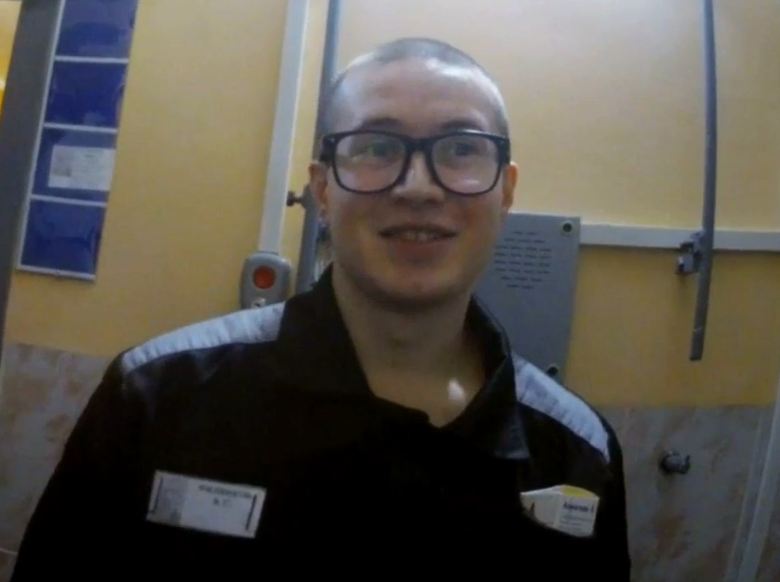
Ms. Kulakova and Mr. Filinkov met earlier today (25 March 2023), and Ms. Kulakova posted this snapshot from their meeting:
“An anti-prison coloring book for Jenya and Viktor and everyone”
Not so long ago I wrote that coloring brightens up my minutes and hours of waiting for Viktor at the penal colony. So Yana Teplitskaya has designed an entire coloring book in support of Viktor and me!!
The coloring book can be downloaded at the link below and printed out on a printer, and you can make a donation for it.
If you have a coloring maniac in your life, the book can be your New Year’s gift to them.
And if you’ve never colored, then maybe New Year’s is the time to check it out?
Download, print, and color the pages — and send us the results.
Donations for my trips to see Viktor in Orenburg should be sent to my Sberbank or Raiffeisen account via phone number 89217772541.
You can also make donations in euros [and dollars] via PayPal to abc-msk@riseup.net, [writing “Filinkov” at the “What’s this payment for?” prompt.]
Thanks.
You can and should share this post if you like.
Source: Jenya Kulakova, Facebook, 30 December 2022. Ms. Kulakova is the public defender of Viktor Filinkov, a young Kazakhstani national convicted as part of the notorious Network Case, in which the Russian Federal Security Service (FSB) tortured and framed a dozen anti-fascists in Penza and Petersburg for, allegedly, “creating a terrorist community.” I’ve published extensively on the case and its aftermath over the last five years. The wardens at the penal colony in Orenburg where Mr. Filinkov is currently serving his sentence have seemingly singled him out since his arrival there, endlessly finding him “guilty” of various (mythical) infractions and isolating him from the general population on these pretexts. With the help of Ms. Kulakova and his defense attorney, Vitaly Cherkasov, Mr. Filinkov has mounted a series of successful legal challenges against this flagrant abuse of his civil and legal rights. You can help pay for Ms. Kulakova’s frequent trips to Orenburg by donating to the PayPal account indicated, above. It is managed by the Moscow chapter of the Anarchist Black Cross and is totally reliable. I just made a donation myself and I screenshotted, below, the critical step in that process if you need help. Thank you! ||| Thomas Campbell, The Russian Reader
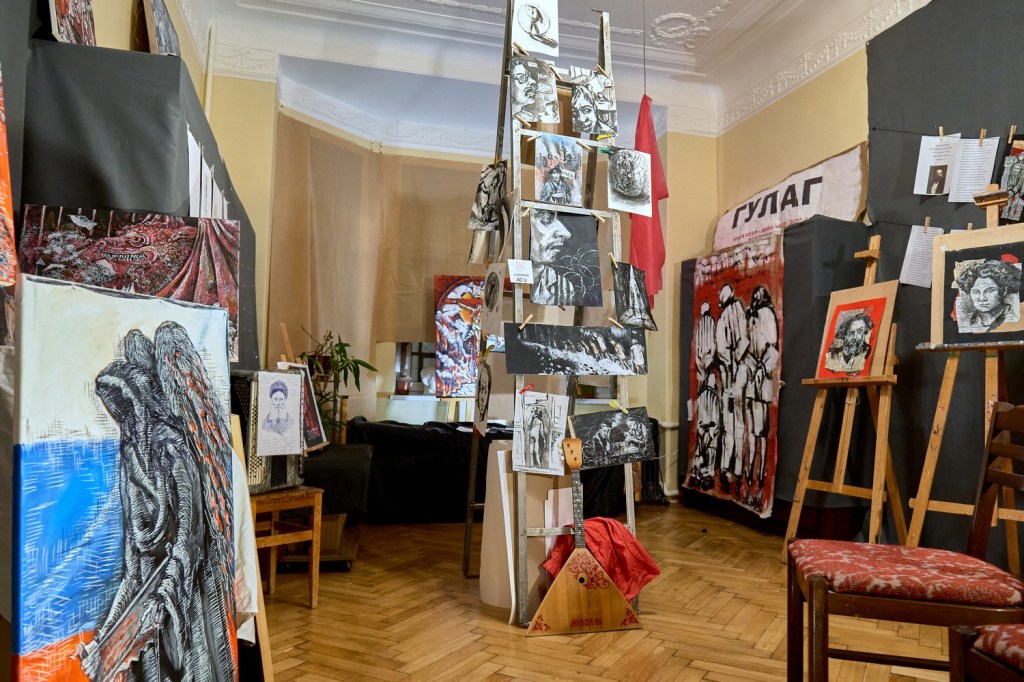
The “underground” exhibition Continuity [Sviaz’ vremen] has been underway in Petersburg since September. The parents of Yuli Boyarshinov, who was convicted in the Network Case, were involved in organizing it.
The exhibition is dedicated to political prisoners. They produced some of the works on display themselves using improvised means while in pretrial detention centers and penal colonies. Poetry readings and art therapy sessions at which postcards for political prisoners are produced also held in the space.
Bumaga visited Continuity and shows here how the exhibition is organized.
The “underground” exhibition opened in September in a private space. The organizers have already planned to close it several times, but people keep coming. “We didn’t think it would last that long. There is even a poetry reading scheduled for Saturday,” Nikolai Boyarshinov, Yuli Boyarshinov’s father, told Bumaga.
Photo: Andrei Bok
The exhibition features works by current political prisoners, including those involved in the Network Case. Some of the works are dedicated to the victims of the Great Terror.
Photo: Andrei Bok
The living room — the main exhibition space — contains paintings by the artist Ad’u. She says that exhibition spaces are reluctant to take her work. “They say, ‘Well, you know,'” she shares with us.
Photo: Andrei Bok
A portrait of Karelian historian Yuri Dmitriev and maps of Sandarmokh hang under the ceiling. Dmitriev was convicted of “sexual violence” against his adopted daughter. He was scheduled to be released in 2020, but the court toughened his sentence from three and a half years in a medium security facility to thirteen years in a maximum security penal colony.
Photo: Andrei Bok
There are paintings dedicated to Alexei Navalny. A protest action with flashlights, which took place in Russian cities on February 14, 2021, is depicted as a flashlight shining into the sky and signaling for help.
Photo: Andrei Bok
One of the paintings alludes to a protest action by Pavel Krisevich: a man on a cross, under whose feet dossiers of political cases burn. Next to it are drawings by Krisevich himself, which he made while in a pretrial detention center, using pieces of a sheet, improvised materials and homemade paints. In October, Krisevich, who had previously spent a year in pretrial detention, was sentenced to five years in a penal colony.
Photo: Andrei Bok
On the walls of the corridor outside the living room there are portraits of the young men convicted in the Network Case and their stories. Drawings by the men themselves are also presented. Nikolai Boyarshinov says that each of the convicts “has begun to draw to one degree or another.”
Photo: Andrei Bok
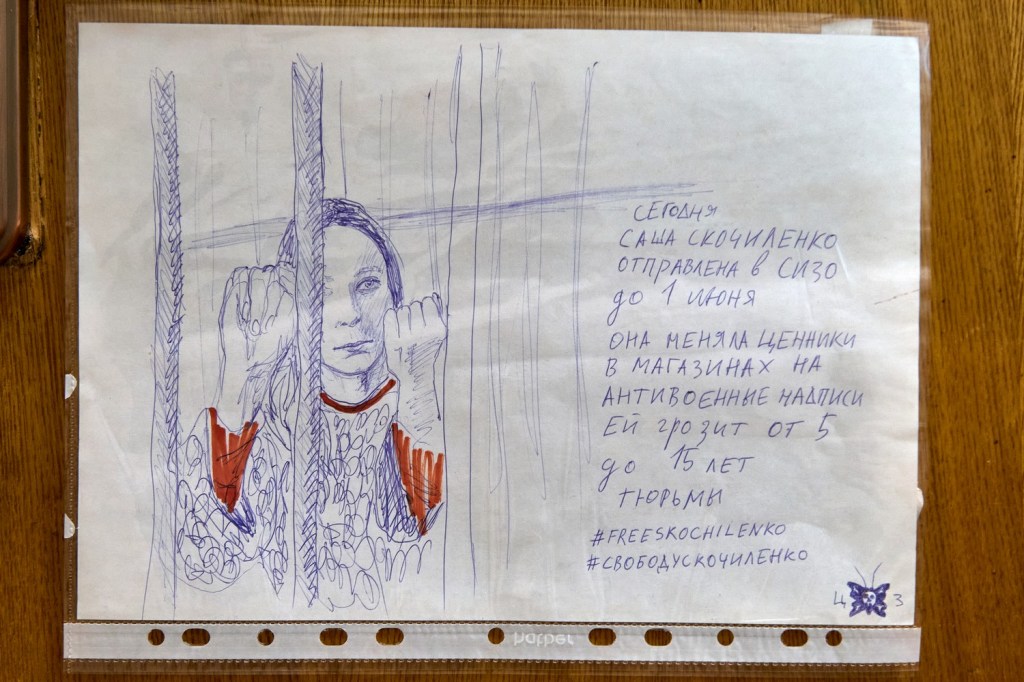
In a closet in the hallway there are drawings by the artist cyanide the angry [tsianid zloi]. Since February, he has been producing one image every day about the war and political crackdown. On the closet doors and inside it there are portraits of Sasha Skochilenko and Seva Korolev, who are charged with “discrediting” the Russian army, Kansk Teenagers Case defendant Nikita Uvarov, and scenes of Navalny in a cell.
“Today, Sasha Skochilenko was remanded in custody until June 1. She replaced price tags in shops [sic] with anti-war messages. She faces 5 to 15 years in prison. #FreeSashaSkochilenko,” Photo: Andrei Bok
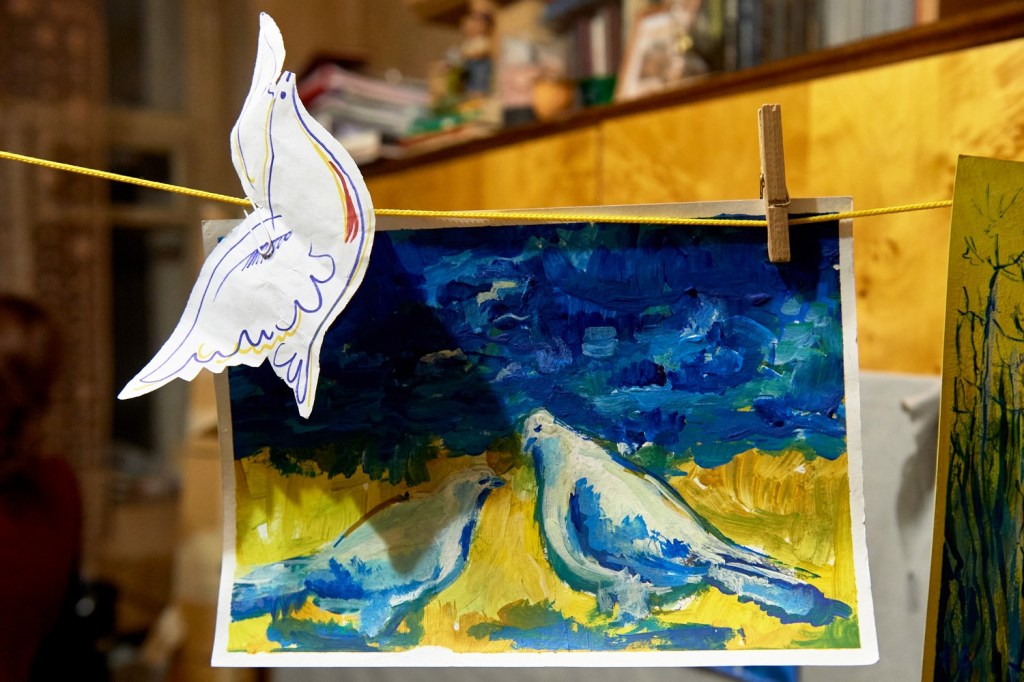
There are also anti-war drawings in the exhibition. They are painted in yellow and blue colors. They were created by Ad’u, who, along with other artists, was detained during a protest rally in April 2022, when she was painting riot police against the backdrop of St. Isaac’s Cathedral.
Photo: Andrei Bok
There is an art therapy group in the space, which has been led by Nikolai Boyarshinov’s wife Tatiana since May. The group’s members make postcards to fight burnout, stress and fear. They then send postcards to political prisoners.





 Fundraiser for continuing
  has been working selflessly on all of Vitya’s cases since the first days of his arrest, traveling several times a month between St. Petersburg and Orenburg.