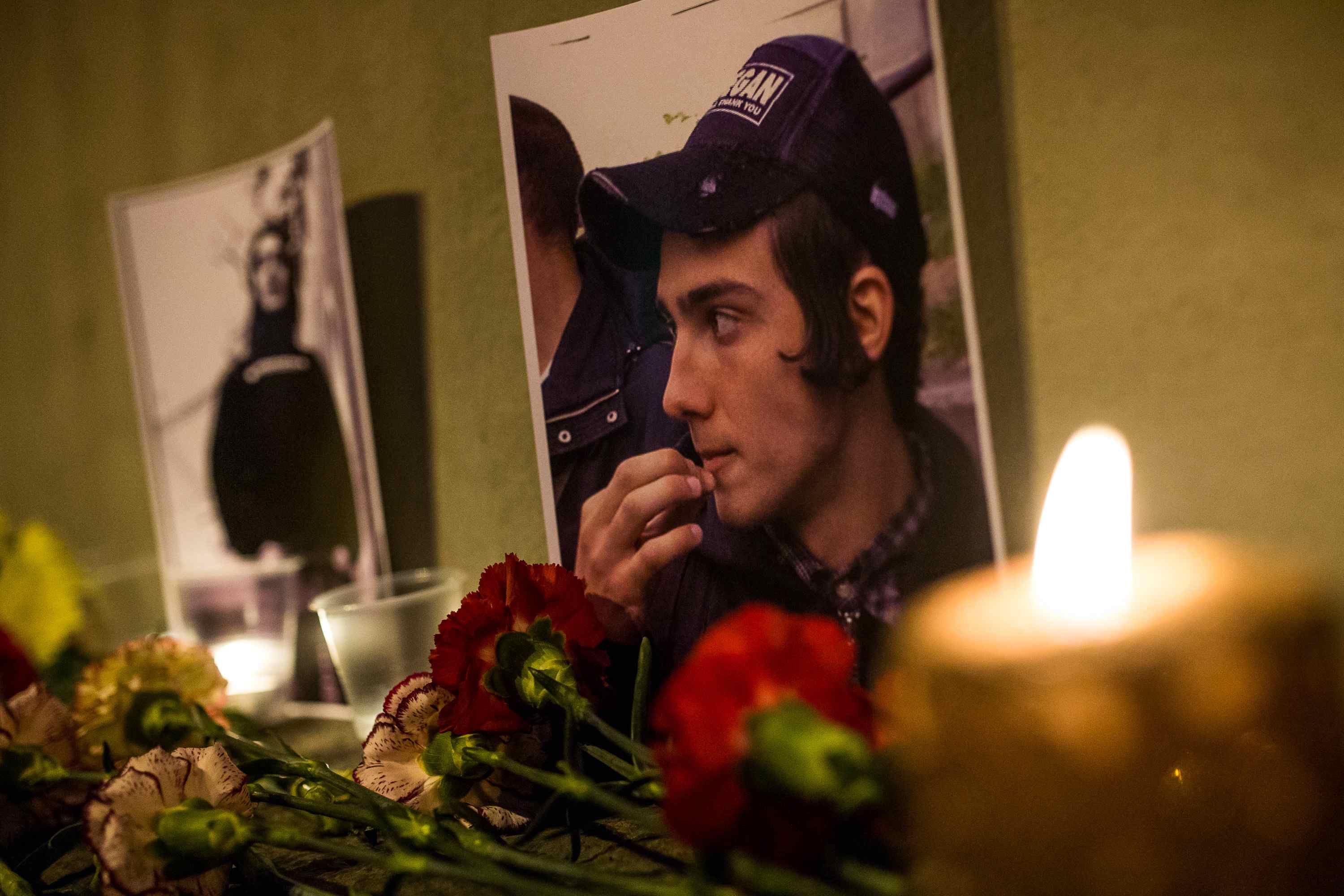
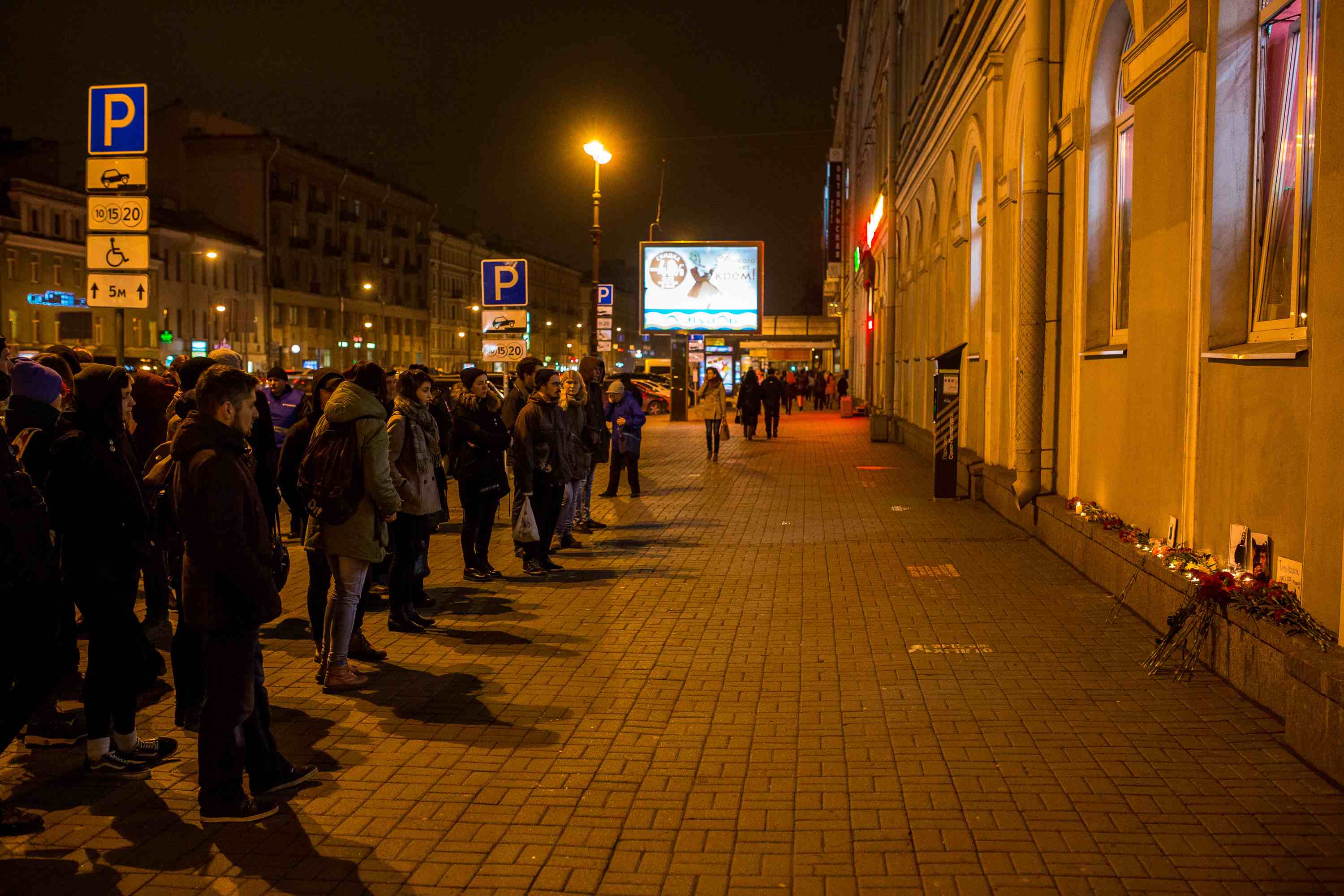
Flowers laid at the site where the antifascist Timur Kacharava was murdered: a photoreportage by Bumaga
Twenty years ago, neo-Nazis assaulted Timur and his friend Maxim Zgibay outside the Bukvoyed bookstore on Vosstaniya Square. Today [13 November 2025] a spontaneous memorial arose there once more.
The murder: On 13 November 2005, Kacharava received six stab wounds to the neck and died on the spot. Zgibay was hospitalized in critical condition. Alexei Shabalin, found guilty of Timur’s murder, was sentenced to twelve years in a penal colony. Four of the assailants were sentenced to terms of imprisonment ranging from two to twelve years, while the other three were given suspended sentences.
The plaque: Nearly every year, the inscription “TIMUR, WE WILL ALWAYS REMEMBER YOU” appears on the wall of the building next to the murder site. Today, Yabloko party chair Nikolai Rybakov sent an appeal to [St. Petersburg] Governor Alexander Beglov, urging him to install a permanent memorial plaque marking the spot of Kacharava’s violent death.
The film: Leftist organization RevKomsomol – RKSM(b) has released the trailer of an upcoming film with the working title Antifascists by Calling. The film is being produced with the support of the creative association RevKino, RKP(i), and the nonprofit initiative Food Not Bombs.
It is a tradition in Petersburg to visit the improvised memorial to Timur Kacharava outside the Bukvoyed bookstore on Vosstaniya Street every year on the evening of November 13. Candles and portraits of the antifascist, who was murdered at this spot nineteen years ago, are brought there by his mother and a changing roster of first-time visitors. Last year the memorial was torn down by far-right activists.
Eight people were convicted of the knife attack on the twenty-year-old Timur and his friend Maxim Zgibay (who was wounded but survived the assault), and five of them were sentenced to prison. All of them have been released (the killer was paroled in 2016) and disappeared from the limelight.
Bumaga asked Irina Kacharava about the people she has seen at the memorials over the past nineteen years, how she feels about the release of Timur and Maxim’s assailants, and what life choices her son would have made in today’s Russia.
— How do you usually spend November thirteenth?
— The day before, I always wish it wasn’t happening. I wish it was the twelfth or the fourteenth. I wish I could just forget it, erase it, and be done with it. But I cannot. The thirteenth comes. I spend it at work or at home. Between five and six-thirty my husband and I go to the wall [at the Bukvoyed bookstore] on Vosstaniya Square. We go to the cemetery the day before, of course. We make sure to leave Timur’s favorite flowers, irises, [at his grave].
We hate this day, and we don’t want it to happen. For some reason it’s easy to go to the cemetery, but it’s very hard to go to the wall. But we gave our word that as long as we are alive, as long as we are able, we will go, no matter how hard it is.
We are always surprised that we are not the only ones there. Each year we think that this time round no one will come for sure. People come, and I’m surprised that all of them are young people. I ask them how they even heard about Timur, since they weren’t even alive when it happened. Nineteen years have passed. They say they heard [about Timur] from their moms and dads, and some from their brothers and sisters. That’s surprising.
We dislike this day very much, but we go to the wall, and then we try to start living again.
— Do you meet Timur’s friends? Do you communicate with them on other days?
— For a long time, ten years at least, we kept in very close contact with all of Timur’s friends. We would even get together. That has been winding down now, but it’s normal, I think. So many years have passed, and some have families, while others have left the country.
Mostly strangers or people who have been going for years come to the wall — for example, adults [sic] from the former Memorial.
— Over the years, it has been suggested that a memorial plaque be erected or a street be named in Timur’s honor. Do you think it is still possible?
— MP Nikolai Rybakov(who is the national leader of the Yabloko Party but not an MP — Bumaga) launched the campaign to put up a plaque. He personally approached us at the wall: he said he had made a request to the authorities, and that he was waiting for response. Time has passed, but nothing has happened.
— Would you like it to happen?
— I don’t know: I never thought about it. I don’t believe anyone will ever do it. And I don’t think it could happen at all given the current situation [in Russia].
By the way, there were fewer lads of conscription age [at the yearly memorial] when all these sad events [the war] began. At the beginning of the [military] mobilization, they were afraid to come. Law enforcement agencies are always present there to prevent mayhem.
— How did you react when one of the people involved in the attack, Alexander Zenin, who had been in hiding for twelve years, was detained in 2018?
— I laughed. He had been living in Pesochny the whole time. During that time he had managed to have two children, but the police had been unable to catch him. The trial was hard for me; my husband went to it. The police investigator called us and told us that the case would start to kick off again, that we would have to go to the court hearings again. He said that if we signed a paper that the case could proceed without our presence, then it would be wrapped up in one hearing. So we signed it. It turned out that he just wanted to tick a box and close the case quickly, and so there was no investigation as such. But it didn’t matter by and large. Whether he was caught or not, I wish him well and hope that his children grow up, for God’s sake.
— In 2007, you said about the attackers: “I have no vengeful feelings.” You haven’t had any since then?
— No, it’s not rational to seek revenge.
— Did they try to contact you, to apologize?
— What apologies could there be after I attended the court hearings?! I was alone there without my husband, and our lawyer was away at the time. I was alone against the seven defendants, their parents, and their lawyers. Twenty-one people tried to bite me (figuratively speaking), cut me, and kill me. I had started going to the court hearings to defend Timur. The parents of the defendants felt so angry with me that Timur had crossed their paths and caused their children to suffer.
Zenin sent us fifty thousand rubles in 201. He was apologizing, as it were, so that he would get a big plus [in his character testimony] in court. But I didn’t take the money. I asked the investigator how I could inform the court that I had not taken the money. He told me: “It was the good will of the defendant — he sent the money. Nobody cares whether you took it or not.” (Alexander Zenin was sentenced in 2018 to one and a half years in a medium security penal colony for inciting hatred and enmity.)
— You are employed as a teacher. Do you observe political activism among young children? Have their views been radicalized? Or are their attitudes apolitical?
— I’ll talk about their parents, because everything comes from the family. The parents are completely susceptible to propaganda. Of course, there are children who voice their opinions, but I do not get into these conversations with them due to professional ethics.
There are children who repeat what the TV says, what their parents say. Although there were some pupils whose parents were of the same opinion as me, and, accordingly, their children also think differently. I didn’t discuss things with them, but I was pleased to hear that not everyone was marching in lockstep. Although young people are chewed out, they are decent folk; there are all kinds of different people [among them], just like we were, just like you are. There are always pros and cons. It’s just that now the propaganda is so heavy that it is difficult to analyze the situation and have an opinion.
I can tell you this about the younger children. Whereas before [the war] they played cops and robbers, and no one wanted to be a cop, and everyone wanted to be a robber, now they play terrorists. And for some reason both sides are terrorists.
— What would Timur be doing in Russia in 2024?
— I think he would have left by 2022. He would have gone to Europe: he had his own people there. I would not say that he would have left for political reasons. The most important thing for him was music. He expressed his views through music. That’s where he would have gone. The politics would have been secondary.
— Is life in Russia more dangerous now than it was in 2005?
— Of course. There is no comparison. Despite what happened to our family in 2005, it’s not even up for discussion.
— Would you have been happy if he had left the country, but was safe and doing creative things?
— When children leave home or leave the country, it’s always sad, I guess. I’ve been trying to fool myself all these years (as psychologists have counseled me to do) that he’s alive but has just left the country. But it doesn’t work for me.
Would I have welcomed his leaving? I think it would have been his choice. His father and I would have had to accept that choice. It wouldn’t have mattered much whether we liked it or didn’t like it, whether we were sad or not. And who’s to say he would have been safe there? We don’t know what he would have done there. We would just have had to accept his choices, like we accepted his life choices in 2005.
I was reproached at the trial for not forbidding him from doing all those things. Doing what? Rescuing animals from the streets and feeding homeless people? (Timur Kacharava was a vegan and fed homeless people at Food Not Bombs events — Bumaga.) What were we supposed to forbid him from doing do? I just didn’t realize at the time that it would prove to be so dangerous. We would have just accepted his choice, because he would have had the right to it, as well as the right to make it a reality.
So, it is better that he lived a short, tragic life that was his own life rather than than the long, boring life which we would have dreamt up for him. Of course I would have been sad [had he left]. How could I not have been sad?
“Last night, I stood for a while next to the memorial to Timur outside the Bukvoyed store on Vosstaniya. Suddenly three antifa showed up, one of them sporting a mohawk. They told me that a bonehead [a neo-Nazi skinhead] had just shot at them with a trauma pistol. He had been going to attack one of the antifa, but when he noticed that there were three of them he ran away and fired a parting shot. That’s what they said. E. saw young boneheads at Avtovo that evening. Considering that they now often attack couriers and janitors [i.e., Central Asian migrant workers] in particular, there is partly the same disturbing feeling as before [i.e., during the intense wave of neo-Nazi attacks on ethnic minorities, immigrants, and antifascists in Petersburg in the late 2000s]. That’s on top of everything else.”
Since the all-out invasion of Ukraine, political repression in Russia has intensified, targeted in the first place at anti-war protest. But this is the outcome of a 20-year slide towards dictatorship. Russia’s antifascist movement has been a prime target for both armed nationalists and the state: it culminated in 2017–19 with the torture and imprisonment of the “Network” case defendants. In July this year, one of them, Ilya Shakursky, sent this letter from prison, looking back at the antifascist movement’s history. It was published on Avtonom, the anarchist web site. Translation and notes in brackets by People & Nature.
Ilya Shakursky in court in 2020. Photo: Penza News / Free Russia House
Ilya Shakursky: letter to a friend
It went like this. My friend shared his thoughts with me: he had arrived at this discomforting realisation that after my arrest, everything was finished – as if our world was sharply divided into “before” and “after”. It seemed that that life, in which we were immersed for many years – the atmosphere of the dvizha [slang: roughly, movement/ milieu], the concerts, demos, discussions, journeys, street fights, performances – had disappeared, had dissolved into fear and into the constraints that shroud so many of us. It seemed that that life had mutated into nostalgic reflections on those times when just to be yourself in Russia had not yet become so dangerous.
Of course, the root cause of my friend’s predicament is the reality: in the regions, the movement comprises fairly small circles of people, and all the activity depends on their enthusiasm. So it is not surprising that in a small town, after high-profile arrests, everything goes quiet. But now – when there’s a widespread tendency to analyse the history of the almost-destroyed antifascist and anarchist movements in present-day Russia – I have read in several articles the opinion that this latest defeat of the movement began precisely with the “Network” case. My own impression is that the movement at that time, although it suffered from a lack of coordination, exactly in 2016-17 began to aspire to, and head towards, unity and amalgamation.
We all know well about the devastating defeat of the young, audacious movement of the early 2000s and its consequences. It was then that the state power recognised the strength of the antifa, the subcultures, the anarchists and ecologists that it could not control. That all came to an end with the deaths of Fyodor Filatov [antifascist, founder of the Moscow Trojan Skinheads, killed on 8 October 2008 by the Militant Organisation of Russian Nationalists (BORN)], Ilya Dzhaparidze [antifascist killed by BORN on 27 July 2009], Ivan Khutorskoy [antifascist killed by BORN on 16 November 2009], [Stanislav] Markelov and [Anastasiia] Baburova [antifascist lawyer and journalist, killed in broad daylight in central Moscow by BORN on 19 January 2009], the “Khimki case” [showtrial of activists after the big Khimki forest protests] and emigration. The 2000s ended with Exodus (Iskhod) by Pyotr Silayev [author and antifascist activist]. Among us – young antifascist and anarchist men and women – that book was a big hit.
Time passed by. 2011: a vendetta in response to the break-up of the movement and the radicalisation of new people. 2012: Bolotnaya Square [a big anti-government rally, followed by mass arrests]. 2014: Maidan and the start of military action in Ukraine. We, young people whose outlook was shaped by these events, tried to re-awaken and breathe life into the flickering flame of the dvizha. Concerts, squats, days out, fist fights, graffiti, lectures, FNB [Food Not Bombs, Moscow] and free markets. We lived by all this: it was our culture, our self-expression and our inner inspiration. We got to know each other, we were inspired by the experience of our older comrades. We took the road of struggle, we cultivated an atmosphere, we kept the movement going – or at least we tried. And we reached the point where the spirit of the age put in front of us the need for militarisation. The stakes were raised. We realised we were getting closer to the point at which we would have to defend ourselves, to fight to survive. The times changed. …
Autumn of 2017. Arrests. Tortures. Exile from the country. New repressive laws. “The Network”. Sentences. Zhlobitsky [the 17 year old who suicide-bombed the FSB office in Arkhangelsk]. Attempts to protest and resist. People’s Self-Defence [anarchist network]. Kansk [a case brought under terror laws against teenagers who put up protest posters]. And again, tortures and repression. The 2010s came to their end, and now it was our “Exodus”. But not all of us could get across the desert. Some stayed right where they were. And here was the bleak emptiness that my friend told me about, that has reigned since 2017. Time has passed, and there is nothing left of that life that swirled around us. Fear infuses everything. Some were just tired out, some escaped, some – so it seems – went out of their minds and became completely different people. The desert swallowed people in endless emptiness. It’s as if previously optimistic, active people were shackled hand and foot by depression, apathy and disillusionment. Very few lights were left burning.
The new reality: crowds of roughnecks, saluting Nazi-style; billboards calling on people to sign contracts with the army; arrests and sentencing of dissidents daily; [Zakhar] Prilepin [leader of armed Russian nationalists in eastern Ukraine] in the state Duma [parliament]; anarchists and antifa outside the law; Stalinism; quotations from [Ivan] Ilyin [by Putin]; imperial flags and red banners.
When we were arrested, with every interrogation I realised more clearly that the chekists [security police officers] didn’t want simply to combat allegedly criminal activity or to strike fear into us. No, their aim was destruction – destruction of the ideological enemy that we represented. Destruction of those whose ideas of freedom and equality are absolutely alien to them, who hate “chinks” and “faggots” and love busty women and hunting parties. Portraits of those who executed the anarchists of the last century hang on their office walls, and, as if returning to the past, they are doing that Bolshevik work again. They started with the anarchists, and the Nazis they could not control, and ended up with the liberals and pacifists. The desert melts into the burning heat of repression. There’s no water and no life.
And why am I writing all this? This letter is to my friend, whose heart is full of sadness and mourning – but by writing to him, I am writing to all of you: to all with whom I met in the woods outside Moscow at concerts by Volodya Ukrop and Natasha Chetverio [antifascist singers]; all, who listened to “MDB” [Moscow Death Brigade, a punk and hip-hop band] on earphones, when taking a train to a stand-off with the “boneheads” [a “white power”/ racist subculture close to skinheads]; all who stood in defence of the Mosshelk dormitory [where activists supporting residents resisting eviction were arrested]; all who raised our flags at the demonstrations in central Moscow in 2017; all who spoke openly about problems of discrimination, and who wrote letters to Lyosha Sutuga [anantifascist activist] when he was in prison; all who wore “Will Power” (“Sila voli”) T-shirts; all who read “Avtonom”; and all who threw away those papers summoning us to chats at the Centre “E” [the state Centre to Counter Extremism]. We lived through all this together, and now we are again living through hard times that plant the darkest thoughts in our minds. But, friends, there’s no point in throwing up our hands, there’s no reason to convince ourselves that our community is dead, or that our spirit has been extinguished.
When the chekists fastened on to the term “Network”, they actually misunderstood something. They thought that we would hand over our party membership cards and renounce our responsibilities to an alleged organisation. But the anarchist movement’s networks exist without any clearly-defined structure. The network of the anarchist and antifascist movements is the smiles of two people who don’t know each other, but who catch each other’s eye in the metro with some characteristic attribute; it’s when you are in a city that’s not your own, but then someone sends you the number of a place to stay and it becomes your own; it’s when we get to know each other by a single handshake, more than likely without knowing each other’s real names; it’s when we can travel hundreds of kilometres to support our guys in a big street fight, support musicians we know or join an environmentalist sit-in. Neither the investigators nor the prosecutors and judges understand this. And for that reason they are unable to destroy us.
The European dictatorships of the 20th century annihilated those whose experiences, and heroism, is a source of inspiration for many of us today. Franco thought that he had wiped out the Spanish anarchists; Hitler thought that he had taken out all the German antifascists. But today we see how big the antifascist festivals in Berlin are, how substantial are the areas of European cities occupied by the anarchists.
It seems that we – rebels, idealists and dreamers – were always alien, marginal and incomprehensible for this country. But anyway, we are at home here. And after this next round of destruction and repression, we will rise again among new generations of young people, right here in this place. Yes, we lived through that last phase; yes, right now it’s that time when it seems that every day is more fearful and more difficult than the last. But we need to preserve in ourselves, at all costs, the honesty that has been awakened in our hearts, that spirit of freedom and the struggle for it that brings us together.
The recent blows struck at the movement have hurled some of us over the world, but they have not broken the links of solidarity and friendship. So let’s not bury ourselves in the darkness of these times, let’s continue to be ourselves, and to do all that we can to clear the darkness away.
Ilya Shakursky, July 2023. The letter was passed on by Ilya’s mum, Elena.
To support Ilya:
Russia,
431161 Mordovian republic,
Zubovo-Polynasky district, Ozernyi,
ulitsa Lesnaya 3,
FKU IK-17 UFSIN Russia (Republic of Moldova),
Shakursky Ilya Aleksandrovich (d.o.b. 1996)
2202 2005 6759 6000 (Sber, Nina Ivanovna Sh.)
PayPal: abc-msk@riseup.net (in euros, marked “for Shakursky”)
More in English on Russian antifascism
A letter from Ilya Shakursky sent in 2021 is here. People & Nature reported on the “Network” case verdicts here, and on other aspects of the case here, here, here and here. For The Russian Reader’s much more comprehensive coverage, start here. A recent comment on the security police’s attempts to link Azat Miftakhov, the jailed Moscow anarchist, with their invented “Network” is on OpenDemocracy here. The Rupression site has more information.
An overview of the antifascist movement’s history was recently posted on the Avtonom site here. On the campaign of killings of antifascists by armed nationalist groups at the end of the 00s, see here. Reports of the trial of the BORN killers here and here, and more on the fascists’ links with the Kremlin here. A memoir of Ivan Khutorskoy is here.
An article explaining why Russian and other antifascists began to mark 19 January – the anniversary of the killing of Stanislav Markelov and Anastasiia Baburova – is here, and an interview with Anastasiia’s parents here. A report of a demonstration in London on the 10th anniversary is here.
There’s a report on the 2010 battle for Khimki forest, which was threatened by road construction, here, a retrospective written in 2017 here, and a focus on the antifascists’ involvement here.
Source: “‘After this round of repression, we will rise again’ – Russian political prisoner Ilya Shakursky,” People and Nature, 2 October 2023. Thanks to Simon Pirani for the translation and publication, and for his kind permission to repost it here. People living outside of Russia will find it difficult or impossible to send letters to Russian prisons via regular mail. In many cases, however, you can send letters (which must be written in Russian or translated into Russian) to Ilya Shakursky, his co-defendants in the Network Case, and many other Russian political prisoners via the free, volunteer-run service RosUznik. You can also write to me (avvakum@pm.me) for assistance and advice in sending such letters.||| TRR
Remembering Timur Kacharava Ten Years Later David Frenkel
Special to the Russian Reader
November 17, 2015
On the evening of November 13, 2015, more than fifty people gathered near the Bukvoyed bookstore on Ligovsky Prospect in the Vosstaniya Square area of downtown Petersburg to mourn anti-fascist and hardcore punk musician Timur Kacharava, who was murdered at the spot ten years earlier by Russian neo-Nazis.
Mourners gathered at the site of Kacharava’s murder on Ligovsky Prospect
In 2005, Kacharava and a friend were attacked by a group of young men after participating in a Food Not Bombs action in another part of the downtown. Kacharava was stabbed in the neck five times and died at the scene.
Kacharava’s murder alarmed certain segments of Russian society. Over three thousand students at Saint Petersburg State University, where Kacharava had been majoring in philosophy at the time of his slaying, petitioned President Putin to find and punish the murderers.
In December 2005, police arrested seven suspects who eventually confessed to the crime. In 2007, Alexander Shabalin was sentenced to twelve years in prison on charges of murder and incitement to ethnic or racial hatred. The other suspects were charged with inciting social hatred and sentenced to two or three years in prison. (Three of them were released on parole).
Since 2005, people have come to the crime scene every year on November 13 with flowers, candles, and pictures of Timur.
This year, police did not interfere with the mourners, although they asked them to remove pictures from the parapet and not to shout out any slogans.