Manufacturing Half-Baked Consent in Russia

Here is a textbook example of today’s Russian-language propaganda journalism (the bill footed by Russian taxpayers, one sixth of whom have slipped below subsistence level living, according to Rosstat).

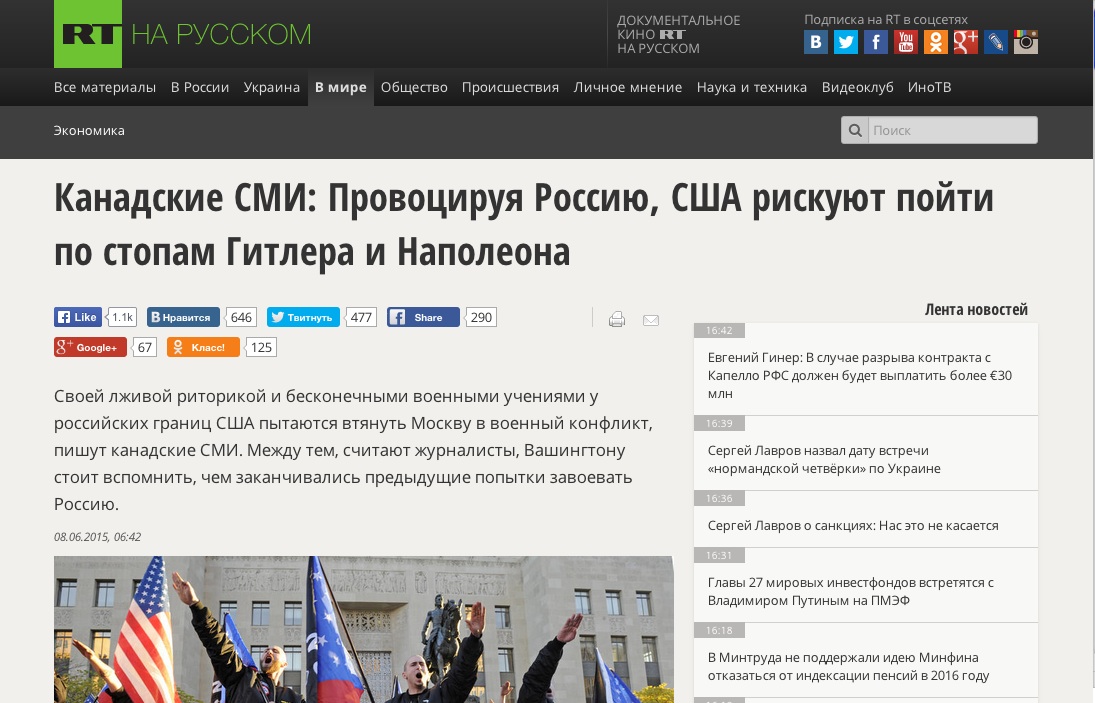
canadian smiThe headline reads, “Canadian media: By provoking Russia, US risks following in the footsteps of Hitler and Napoleon. With its mendacious rhetoric and endless military exercises near the Russian border, the US is trying to pull Moscow into a military conflict, write Canadian media. However, journalists [sic] argue that Washington should remember how previous attempts to conquer Russia ended.”

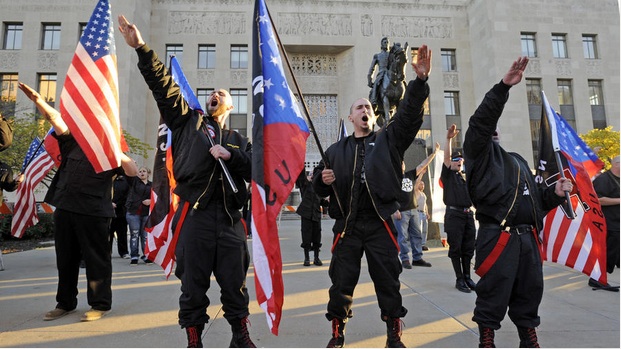
If you actually read the article—and why bother, because its robot compilers want you to scan three things very quickly and get the takeaway message in under ten seconds: 1) like Napoleon and Hitler, the US wants to “conquer” Russia for some reason; 2) the US has been taken over by neo-Nazis—just look at the picture; 3) even the otherwise loyal “Canadian media” are writing about this fiendishness—you’ll find out that the “Canadian media” referred to is really just this one article, published on the more than dubious Canadian Putin fan club website Global Research.

The article was written by someone named Stephen Lendmann, “who lives in Chicago.”

Well, Mr. Lendmann does much more than just live in Chicago. He has also edited a nice little anthology of pro-Putin writing by western leftists and “anti-imperialists,” entitled FLASHPOINT IN UKRAINE: How the US Drive for Hegemony Risks World War III.

At $24.95 a pop, it’s a steal, I think.

Meanwhile, back in Putinland, where it will probably soon be a crime to read or speak English (lest anyone get any funny ideas), Russian readers will have to content themselves with this Russian-language summary of Lendmann’s article, which features, inexplicably, a photo of someone dressed up as Hitler and looking desperate.

A waxwork of Adolf Hitler before a 41-year-old man tore its head off from the controversial exhibit on the opening day of Berlin's Madame Tussauds July 5, 2008 is seen in this July 3, 2008 file photo. The man was arrested by police after he jumped over the desk and ripped off the head of the waxwork figure in protest of the controversial exhibit that showed a glum-looking Adolf Hitler behind his desk in a mock bunker during the last days of his life.   REUTERS/Tobias Schwarz/Files  (GERMANY) - RTX7NQ0

A quick Google image search reveals that this is not someone dressed up as Hitler, much less the world’s greatest villain himself, photographed on the eve of his demise in the bunker, but a waxwork figure of Hitler whose head was torn off by an enraged visitor on the opening day of Madame Tussauds Berlin in July 2008.

This has been a brief lesson in how consent is manufactured facilely and cynically in Putin’s Russia at taxpayer expense. Basically, all the major Russian media outlets have been engaged in this manufacturing of reality for most or all of Putin’s reign, but since the winter of 2014, the brakes have come off the buggy and fact-based reality almost never makes an appearance in such “news reports.”

* * * * * *

Sadly, lots of people here buy into this stuff, at least partly, if only in a half-baked “since they rant on about it day and night, at least some of it must be at least sort of true” way. I am not the “liberal” (i.e., profoundly misogynistic, Russophobic) Levada Center, and I don’t believe that polls in this country are used in any other way than the implicitly violent, authoritarian “we get the feedback we want” mode, so I will never cite any of these dubious surveys to make an argument about how many people believe this crap, much less how they believe it. (Which really would be the only interesting aspect of this “pollocracy” to study.)

However, a student of mine, an otherwise level-headed psychiatrist, told me the other day that the large numbers of young patients he sees with severe personality disorders and traumas had something to do with the chaos of the nineties, when many of these young people, then small kids, were left to fend for themselves, emotionally, at least. It is hard to argue with that hypothesis.

But then he said something I am sure he didn’t believe himself when he said it.

“Russians have been better off psychologically when they have had a strong leader.”

The desire to conform to “public opinion” among God’s allegedly smartest creatures is strong, almost irresistible at times, and not only in Russia.

P.S. A simple Google image search revealed that the photo of the Sieg-Heiling US neo-Nazis, above, was undoubtedly filched from this Reuters article about how, according to the Southern Poverty Law Center (who never saw a hate group they didn’t like to blow out of proportion), the number of hate groups in the US has declined by 17% over the last year.

And yet, if RT is to be believed—visually and viscerally, so to speak—these selfsame declining neo-Nazis have somehow either seized power in the US or are dictating US policy towards Moscow. Or have something to do with provoking the powerful anti-American, pro-Moscow tilt of the “Canadian” media.

In reality, they have nothing to do with anything.

us neonazis

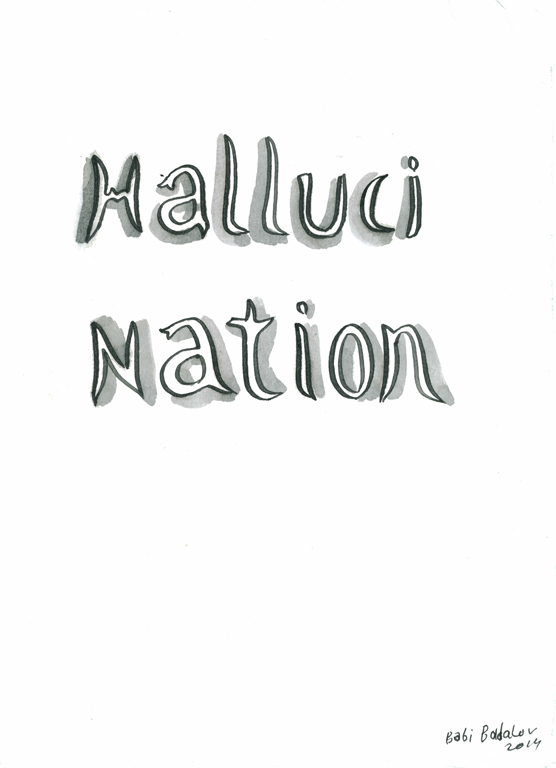
Halluci Nation

BabiBadalov8light

__________

Maybe there is no direct connection, but soon after the first article, below, ran in The Moscow Times, the following message appeared on the newspaper’s web site: “Due to the increasing number of users engaging in personal attacks, spam, trolling and abusive comments, we are no longer able to host our forum as a site for constructive and intelligent debate. It is with regret, therefore, that we have found ourselves forced to suspend the commenting function on our articles. The Moscow Times remains committed to the principle of public debate and hopes to welcome you to a new, constructive, forum in the future.” When I glanced at the comments to this article, it did seem that a lively “debate” was underway, but I no longer read such things to preserve what is left of my mental well-being. The emphasis, below, is mine.

Russia’s Empire State of Mind
Pyotr Romanov
October 26, 2014
The Moscow Times

Following World War I, the Russian Empire bid farewell to Poland, Finland, the Baltic states and Bessarabia [in modern Moldova]. The Soviet Union later regained only some of that territory — and yet that did not prevent the world from continuing to view the Soviet Union as an empire. After the collapse of the Soviet Union, Russia decreased in size even more than it had after World War I, and yet many today continue referring to it as an empire.

I recently read an impassioned plea on Facebook from several Ukrainians that God call down on Russia a host of biblical chastisements and hasten its demise. In their view, the only way to escape the claws of the Russian bear is to kill the animal. At the same time, they have no intention of fighting the beast themselves, convinced that Europe and the U.S. alone have the power and the responsibility to vanquish the foe.

In other words, they prefer that others break their bones in the bear’s den so they can mount the pelt over their fireplace. I somehow doubt that the rational West finds that prospect very attractive.

In fact, a number of historical figures dreamed of dismembering Russia. Peter the Great’s arch-rival King Charles XII of Sweden held that dream even before Russia formally declared itself an empire. The French ambassador in Stockholm at that time said, “The king will make peace with Russia only after he has arrived in Moscow, toppled the tsar from his throne, divided the state into small principalities and summoned the boyars to divvy up the kingdom into their personal provinces.”

In hindsight, knowing how the Swedes suffered defeat at the Battle of Poltava, it is tempting to assess such a claim as pompous bravado. However, that was a serious plan that the Swedish king and his allies had discussed on more than one occasion. Charles really did plan to install his own puppet ruler on the Russian throne. He dreamed of Pskov, Novgorod and all of northern Russia as Swedish possessions. He planned to allot all of Ukraine and the Smolensk region to Polish King Stanislaw Leszczynski. Charles agreed to give Russia’s southern lands to the Turks and Crimean Tatars. There are countless other similar stories in history — but where are all those dreamers today?

However, this is not the main point. I see no reason to blame my ancestors for their imperialist actions. Russians have no more to feel ashamed of in this regard than do the British, Germans, Spaniards and French. All of their imperialist pasts were dictated by fate, God, geopolitical factors and their national character — that with which it is absolutely pointless to fight.

The collapse of the Russian Empire deeply troubled many of its citizens, and the later collapse of the Soviet Union gave them a disturbing sense of deja vu. Even today, millions of Russians wax nostalgic for the past — particularly for the Soviet Union — recalling much that was also good from that time.

This is the second time in a century that Russia has gone through such painful “withdrawal symptoms” while overcoming its imperialist mentality. Russians have nothing of which to feel ashamed: the same process was no less painful for other “imperial” nations.

Of course, modern Russia is not an empire, and it is unbecoming to act like a broken record, continually repeating the same old cliches. It is just that the process of adapting to the new realities is not moving as quickly as some in the West — and also in Russia, by the way — would like it to. But it is impossible to hurry it along.

It is decidedly easier for a tiny little ship of a state such as Monaco to make a sea change than it is for a massive ocean liner such as religiously diverse, multiethnic and multicultural Russia. A little patience is needed.

I understand that what seems fast by historical standards might appear painfully slow to people. History is measured in ages, but individuals measure time in terms of a single lifespan. Nonetheless, it takes nine months for a baby to come into this world, and no amount of impatient fingernail-biting will change that.

Making a baby come into the world any sooner is not the healthiest option either. In the same way, it does no good to keep impatiently tugging on Russia’s sleeve. Every fruit has its given period of maturation. When the time comes, Russia will let go of the last vestiges of its imperial past.

Until then, praying for God to curse Russia with a swarm of locusts or the 10 plagues of Egypt is not only unseemly, but also a bit archaic and completely meaningless.

Pyotr Romanov [sic] is a journalist and historian. 

___________

Post-imperial melancholy has also got the unnamed editorial writer (the West’s most beloved Russian “leftist”?)  at Russian “leftist” web site Rabkor.ru waxing poetical in the vozhdist mode in the run-up to November 4, National Unity Day.

The West intends to play hardball in its long negotiations with Moscow. Zeal and rigidity might betray it, and then events will not go as planned. That has already happened in Ukraine. However, the US and the EU understand that Russian liberals have increased their grip on power and will stubbornly seek a compromise. Dmitry Medvedev has already said that a “reset of relations” requires a return to the “zero position,” meaning normal trade without sanctions. The ruling class will do anything for its sake, particularly if its position is complicated by economic problems. If solving the problem with Western Europe and the US requires presenting Putin’s head on a platter, then that it is how the problem will be solved.

But Russia is not a banana republic or a tiny country in Eastern Europe, where you can just organize a color revolution by gathering several thousand “civil society” activists on a central square. And so only Putin himself can remove Putin’s head for the US, and not only through his own carelessness.

Patriots stubbornly dream of persuading the current president to become like Stalin or Ivan the Terrible. Members of the liberal intelligentsia scare each other and the gullible western public with this same prospect. However, with each passing day, our ruler [sic] becomes like a completely different predecessor, Mikhail Gorbachev, who was also, incidentally, a politician who banked on compromises.

The growing prospect of a “liberal putsch” becomes more apparent with each passing day. The final act has not started, but the play is already underway. Liberals are making ritual sacrifices. They are sacrificing the exchange rate of the ruble and social policies. They are sacrificing Novorussia [Novorossiya]. They are sacrificing the country’s dignity. They are destroying the possibility of Russian society’s development. They are even willing to sacrifice the one who protected the system for many years. Only none of this will bear fruit, because only a different course can save Russia from economic disaster.

And let no one be deceived: if the liberal coup becomes a reality, its authors will quickly discover how correct the thesis “Ukraine is not Russia” was. Unlike its neighboring country, Russia, with the exception of the capital, will turn into one solid Donbass.

The preceding was an excerpt from “Who Will Bring Them Putin’s Head?”, published on October 20, 2014, by Rabkor.ru. You can read the entire editorial in English here, as translated by other, less shaky hands.

__________

After a friend mailed me the following “news” item, he wrote, “This is how the whole ‘television—Levada—television’ scheme works.” As Kirill Rogov has argued, many people will tell pollsters what authoritarian state television has told them to think, especially when it comes to things that don’t really matter to them, like musician Andrei Makarevich’s alleged “treason.” It’s no wonder that one of the world’s leading offshore Putin apologists was worried, last year, when it seemed as if the state was cracking down on the Levada Center. He needn’t have worried. My friend titled his email to me, “Levada will receive the Stalin Prize posthumously.” That about sums it up.

Almost Half of Russians Consider Makarevich a Traitor to the Motherland 
October 27, 2014 | Gazeta.ru

Almost half of Russians believe that when he performed in Slovyansk, which is occupied [sic] by the Ukrainian army, musician Andrei Makarevich betrayed the interests of the motherland, according to the results of a survey conducted by the Levada Center.

45% of those polled agreed with the statement “Makarevich betrayed the interests of Russia, and now the public does not want to go to his concerts.” However, among Muscovites there was a high percentage (32%) inclined to believe that Makarevich “acted in good conscience” and that he had been the target of a defamation campaign. 28% of respondents admit that Makarevich behaved unpatriotically, but that administrative resources have been used to disrupt his concerts in various Russian cities.

The percentage of those supporting Makarevich and condemning the defamation campaign was quite low—13%. Respondents with a higher education were generally more supportive of what the musician did than Russians with less than a secondary education.

The poll was conducted among 1,630 people aged eighteen years or older in 134 municipalities in forty-six regions of the country.

Earlier, Makarevich recorded a song about how he has been hounded. On October 27, news came of another cancellation of one of the musician’s concert, this time in Kurgan.

__________

Image (above): Babi Badalov, Halluci Nation (Orna-mental poetry), 2014; ink on paper, 26.5 x 19 cm. Courtesy of La Galerie Jérôme Poggi, Paris, and the artist.

Kirill Rogov: Why You Shouldn’t Trust Russian “Public Opinion” Polls

One of my hobbies in recent years has been closely observing the development of Russia’s “pollocracy”—the proliferation of “public opinion” polling, media discussions of poll results, and the obvious ways in which this “mirror” has been held up to the actual Russian public to con it into believing it supports the country’s authoritarian regime and its policies with ever increasing wildness and fervor, even as other democratic venues for it to voice its opinion, such as free elections, grassroots organizations, and protest rallies, have been whittled away, hacked at or more or less outlawed (depending on the season and the concrete causes) by the regime, its security services, and the loyalist media. 

So I was amused, the other day, to read about yet another such “public opinion” poll. This one “showed” that over seventy-two percent of Petersburgers support Georgy Poltavchenko, the Putin-appointed nonentity currently warming the chair, in the city’s upcoming gubernatorial elections. Even more hilariously, this same poll claimed to have discovered that the “majority of respondents rated the campaign as calm, and not interfering with the usual lifestyle” of Petersburgers.

When I sent the “news” article about this goofy, cynical poll I had found to a local journalist friend of mine, he responded by complaining that he had been having a hard time explaining to colleagues and acquaintances in the West that “public opinion” polls attesting to the Russian public’s allegedly overwhelming support for Putin and his aggressive policies vis-a-vis Ukraine should be treated with a grain of salt, at very least. Why, he had asked, do people who otherwise think that Russia is not a free country have an almost religious faith in Kremlin-directed polls alleging fantastic levels of support for Putin? Doesn’t it occur to any of these otherwise skeptical people that there might be something fishy about the polls, how they are conducted, and the conditions (of unfreedom, rampant propaganda, fear-mongering, and coercion) in which they are conducted?

He also wondered whether I had translated anything on this topic, something he could use in his arguments with Western friends. I said that I hadn’t, but I immediately recalled the following column by liberal political analyst Kirill Rogov, published in December 2013 in Novaya Gazeta. Sadly, it has become only more relevant and timely over the intervening nine months.

lifeforce-19_2124977i

The Fiction of the “Backwards Man in the Street”
Kirill Rogov
December 3, 2013
www.novayagazeta.ru

Not a week goes by without a dreary discussion in the media of the results of yet another opinion poll showing the narrow-mindedness and conservatism of the majority of the Russian people.

The week before last, the discussion focused on a survey showing that most Russians support the repressive decrees of the “enraged printer”—the self-styled Russian Duma. Last week, poll results showing that around eighty percent of Russians believe enemies surround our country were eagerly paraphrased.

Week after week, like cold raindrops falling on the heads of the educated class, these surveys persuade it of the futility of striving for something better. They demoralize the opposition and plunge business and the liberal elite into depression. Pack your bags and turn out the lights!

In general, the past year of Russian history has been an excellent case study for political scientists, showing how authoritarian regimes buy time by tearing it, so to speak, from the clutches of history.

An explosive mixture of revolving political (and not only political) crackdowns, unbridled propaganda, and a series of skillfully organized public hysterias have spread the dark pollen of proto-fascism in the air, which has settled as a deep depression in the souls of the educated class. And those people who a year and a half ago were confident in their strength and rightness (“Who is the power here?”) walk around with heads sunk down to their collars and their pretty tails tucked between their legs.

Polls are an important part of the picture. They are the “naked sociological truth,” after all, and have a powerful effect on just those people who are able to resist the onslaught of fear, hysteria, and propaganda. It is not so easy to understand how sociological surveys are turned into a weapon of authoritarianism in its fight against society’s desire for progress.

But let us turn to facts no less naked than the polls themselves. The experience of the elections of 2011–2013 definitely implies that data about the political preferences of Russians, as reflected in the polls conducted by two of our leading pollsters, FOM and Levada Center, are regularly biased in favor of the authoritarian regime by at least ten to twelve percentage points. When purged of falsifications, voting results show that not sixty-five percent, but a little over fifty percent voted for Putin in the 2012 presidential election; not sixty percent, as the pollsters had it, but around forty-eight percent voted for Sobyanin in the 2013 Moscow mayoral race; and not fifty percent, but a little over thirty-five percent voted for United Russia in the 2011 parliamentary elections. This follows from both statistical calculations and the data collected from a fairly broad sample of monitored polling stations.

We will leave the conspiracy theories as to why this is so to the lowbrows. The non-conspiracy theories are more interesting. We can assume that the regular shift in the data comes from the fact that everyone involved in the process has a solid understanding of the “correct” result.

Simply put, they know that the majority is for Putin, Sobyanin, United Russia, and “everything bad.” As a result, people who do not support “everything bad” will be on average more likely to shy away from contact with sociologists.

Of course, there are firm “supporters” and “opponents” who express their opinions, regardless. There are, say, from fifteen to twenty percent of such people on each side. But between them is the “majority,” those people for whom politics is not a matter of daily reflection. For them, the most important thing is not even fear, as is sometimes suggested, but ordinary self-doubt and discomfort from the fact that their feelings do not coincide with the views of the “majority,” views of which they are aware in advance.

It is logical these people will be more likely to refrain from participating in polls. (The quasi-Duma, after all, has not yet issued regulations stipulating fines, suspension of driving licenses, and corrective labor for such evasiveness.) We can assume, as is likely, that they participate half as often as those whose opinion coincides with the “correct” view. (Such escapism, by the way, is quite typical not only of the uneducated but also of many educated people, whose awareness of the gap between their opinion and the “common” opinion provokes an irritated rejection of the entire public sphere and social scientists as well.) On average, this will mean, for example, that of twenty people “for Putin” and twenty “against” him, ten of those who are “for” him will agree to respond to sociologists, while only five of those who are “against” him will respond. Sociologists will come to the depressing and mathematically precise conclusion that two thirds of respondents support Putin.

Let me say it again. The majority of people, who are not very politically motivated and do not think a lot about politics, find it extremely uncomfortable to express an opinion that is not supported by “public esteem” and does not coincide with the opinion of the “majority.” This can be defined as the indirect effect of propaganda. The direct effect is when people reproduce what they have heard on TV. The indirect effect is when they do not express opinions that differ from those they hear from “authoritative sources.”

In polls on “hot” topics, this distorting effect should be even stronger. People are asked whether they think Pussy Riot should be punished, whether adoptions of Russian children by foreigners should be allowed, and whether we should feud with our enemies. But the truth is that the majority does not think anything at all about these topics. The values conflicts behind these questions are remote from these people’s lives, and all they can say about them is what they have heard from the same authoritative sources. Or they can avoid answering the questions.

This does not mean we should give up on sociology. On the contrary, we need more of it. Personally, polls are like bread, water, and air to me. We just need to understand that what sociology measures are not “thoughts” and “opinions,” but the echoes of thoughts and opinions. It finds out what clichés and ideologemes people use. Under pluralism, quantitative sociology usually works as follows: the mass media, politicians, and experts actively discuss two viewpoints on a topic, and sociologists go out into the “field” and measure which way the scales are tipping. Under authoritarianism, in which channels of public communications are monopolized, this mechanism stops working or, rather, its meaning changes. In this case, polls reflect not the balance of opinions, but the imbalance in communications—authoritarianism’s informational superiority in quantitative terms.

However, we should remember that the “common people” do not always “obey” the TV. Thus, on the issue of corruption and lawlessness, the opinion of seventy to eighty percent of respondents radically diverges from the TV’s opinion.

That is because this problem lies within the scope of their daily experiences. But the admissibility of self-expression on church altars, the international situation, and adoption regulations are complete abstractions, and the man in the street can only repeat what he has heard in passing. And we know what he has heard in passing. But this does not mean that the average person is willing to put up with all the other outrages of the regime.

The image of the “backwards man in the street” who supports “everything bad” is a fiction created by authoritarianism and is meant to justify its existence by suppressing the will of “dissenters” to resist. Not that this “backwardness” does not exist, but authoritarianism amplifies it several times over, simultaneously suppressing other overtones of public perceptions. The success of this technique, on the one hand, extends the life of authoritarianism, but on the other hand, it generates the mechanism of unpredictability that plays a key role in its subsequent downfall.

rtx157tw

 Photos courtesy of The Telegraph and Business Insider.

The Closing of the Russian Mind: Four Snapshots

Here are four reasons why, despite my affection for Kirill Medvedev’s work, I found his recent appeal to the “intelligentsia,” the “youth,” and all other Russians of good will a little odd. He should be honest enough to know he is appealing to what is, increasingly, thin air. Fifteen years of Putinism have decimated “public discourse” and intellectual life in Russia, and now it seems the regime wants to finish the once-mighty Russian mind off once and for all.

Which is not to say that the pro-Putin “euphoria” described in the first two snapshots is not a stage-managed affair to a huge degree, as obliquely suggested by the fourth snapshot.

1.
According to a survey published this week by the respected independent pollster Levada Centre, 82% of Russians believe MH17 was brought down by either a Ukrainian army fighter plane or missile. Just 3% thought the insurgents were to blame. Given these kind of figures, the prospect of Putin facing a backlash of public anger over suspected weapons supplies to separatist gunmen is virtually zero. Ironically, Putin probably faces more danger from Russians disappointed by his failure to provide more assistance to the rebels. “Many people feel cheated by his refusal to use military force [in east Ukraine],” Alexander Dugin, an ultranationalist thinker whose ideas are reported to have influenced recent Kremlin policy, told me recently.

Western officials may be hoping economic sanctions will force Russians to rethink their support for Putin, but in reality such measures will achieve little more than an entrenchment of a growing fortress mentality. State media’s routine and increasingly vitriolic attacks on the west’s “decadent” morals mean Russians are likely to accept any economic and social hardships brought about by US and European sanctions. Tellingly, in another Levada Centre poll this week, 61% of Russians said they were unconcerned by the threat of sanctions, while 58% were similarly unfazed by the looming possibility of political isolation over the Kremlin’s stance on Ukraine.

These head-in-the-sand attitudes are bolstered by what the director of Levada Centre, Lev Gudkov, calls a “patriotic and chauvinistic euphoria”rooted in the almost bloodless annexation of Crimea in March, which was popular among Russians across the political spectrum. It’s alsoworth noting that many “ordinary” Russians are uninterested in politics and have only scant knowledge of the issues at hand.

source: The Guardian

2.
MOSCOW, July 31 (RIA Novosti) – Life satisfaction and social optimism indices in Russia skyrocketed, reaching all-time highs despite political challenges according to polls conducted by the Russian Public Opinion Research Center (VCIOM).

“Within the last three months, indices of social well-being have shown unprecedented growth, stabilizing at extremely high levels. In June the satisfaction index reached its all-time high of 79 points and the indices of financial self-assessment and social optimism, now at 76 and 77 points respectively, have also risen and stabilized at new highs,” says the poll.

The economic sanctions imposed by the US and EU over the crisis in Ukraine seem to have little effect on Russians. According to the polls, Russians are now far less concerned with the future of their country than they were last year.

The number of Russians who have not ruled out the possibility of a war with neighboring countries is now 23 percent of the population, up from just 10 percent last year. However, the number of those concerned about a Western military threat has held steady at 13 percent for the past eight years.

The VCIOM opinion poll was conducted in 2014, interviewing 1,600 respondents in 130 communities in 42 regions of Russia. Data are weighted by gender, age, education, working status and type of settlement. The polls have margins of error of no more than 3.4%.

source: RIA Novosti

3.
It’s bad news for Russian bloggers, then, that starting today, anyone who attracts more than 3,000 daily readers to his blog is considered a de facto journalist and must register. (In a largely symbolic gesture, LiveJournal has already stopped reporting blog subscribers beyond the 2,500 mark.) Registration entails turning over your personal details to the government—including, of course, your name, meaning anonymous blogging is now illegal for many. (By the way, the law applies to any blog written in Russian for Russians; a post you write from a Brooklyn cafe could face censorship from Moscow.) Bloggers will also be held liable for any alleged misinformation they publish, even in comments written by somebody else. And, insult to injury, bloggers aren’t even allowed to use profanity; a single naughty word would put them in violation of the law. Failure to comply results in a $280 to $1,400 fine as well as a ban on your blog.

The new legislation represents a rather obvious attempt by the Russian government to shut down all criticism of the Kremlin, particularly from the left. The government has already granted itself the authority to shut down any website and used this power to crush popular left-leaning news sites. With this next step, the Kremlin clearly hopes to scare the smaller fish into complying with the official party line. And Russia’s insane Internet crackdown won’t stop with blogs: Starting in 2016, all websites that store data on Russian citizens will have to move their servers to Russian soil—a blatant attempt to assert control over social networks and search engines.

source: Slate.com

orthofascists

4.
The application of [the new law on compulsory registration of NGOs receiving foreign funding as “foreign agents”] against scientific institutions, in fact, constitutes a professional ban on sociologists. Sociology that does not affect public opinion (directly or indirectly) is nonsense. Sociology that does not raise sensitive issues or suggest original answers that run counter to public opinion is intellectually bankrupt. Sociology that does not affect management decisions is as defective as governance that does not use the opportunities of independent social research. Sociology that is deprived of critical analysis of different “policies” loses connections with social science and turns into political technology. Sociology that does not succeed in the competitiveinternational research grant market is devoid of incentives for growth and is doomed to extinction.

In the modern world, any science that exists in isolation from the global context loses its ability to develop. All attempts to control global processes of scientific exchange only lead to the bureaucratization of science, the flourishing of pseudoscientific theories, and talented and open-minded scholars leaving the country. The persecution of independent researchers and research organizations puts an end to the development of a full-fledged scientific community and leads to the degradation of the humanities in Russia, which will ultimately result in a deficit of ideas and strategies for the future of our country.

The law on “foreign agents” is not the only sign of the long-standing crisis of the Russian administrative and political system. It is embedded in a series of decisions that aim to expand state control over various aspects of society and their submission to the bureaucratic logic of the “vertical” power. We can see this in the introduction of censorship and persecution of disloyal media, financial and administrative pressure on public (and especially human rights) organizations, the sterilization of historical memory (pressure on the “Memorial” and ”Perm 36”), criminal and administrative persecution for political reasons and independent (not controlled by the state) activism, dismissal of leading high school teachers for being disloyal touniversity superiors and many other cases. Self-censorship is booming in this society, for which survival has become the main motivation for its members. Overt or non-obvious subjection of one’s own activity to the goals of the “vertical” power is turning into the most effective model of behavior.

It is obvious for us that an independent social science is crucial for a society whose interests are not limited to maintaining stability and “unity” at any costs. An authoritarian state does not need reflection that a professional independent research can provide. It is satisfied with VCIOM polls and various ratings that allow the maintenance of “vertical” tension and promotion of “patriotism”. Such a regime will inevitably degrade and become obsolete, but during its heyday it manages to destroy much of what came before it and exists in spite of it.

We believe that the lack of interest towards the professional opinion of independent sociological community, which often oppose bureaucratic perspectives, points to the incompetence of the Russian administration. The pressure exerted on NGOs and non-governmental scientific centers indicates that the political administration of our country no longer needs feedback and has no interest in the actual state of affairs in Russia. This means it condemns our country to the harsh effects of unreasoned political and economic decisions.

source: Centre for Independent Social Research