“The Dmitriev Affair” in NYC (and Online)

US PREMIERE 

Through a thick layer of snow in the forests of Russia, historian Yuri Dmitriev searches for unmarked and lost graves. His singular efforts have uncovered mass burial sites of those who were killed under Stalin’s “Great Terror” of 1937. With no help from official channels, he traces the dead and rescues their memory from the eternal doom of oblivion. Dmitriev’s riveting story is a tale of one man’s fight against the erasure of history by the state. – Bedatri D. Choudhury 

Both screenings will be followed by a Q&A with director Jessica Gorter and cinematographer Sergei Markelov.

All in-person screening venues provide sound amplification headphones upon request with venue management. IFC Center can also provide a T-Coil loop for compatible devices.

https://zeppers.nl/en/film/the-dmitriev-affair-in-production

Director: Jessica Gorter

Producer: Frank van den Engel, Elize Kerseboom (line producer), Oksana Maksimchuk (segment producer, Russia)

Cinematographer: Sander Snoep, Sergei Markelov, Alexandra Ivanova, Jessica Gorter

Editor: Katharina Wartena

Language: Russian, English

Country: The Netherlands

Year: 2023

EVENT DETAILS

In-Person Date

Sunday, November 12, 2023 12:15 PM

Venue

IFC Center

BUY TICKETS

In-Person Date

Monday, November 13, 2023 12:15 PM

Venue

IFC Center

BUY TICKETS

Online Dates

Monday, November 13 – Sunday, November 26, 2023

Venue

Online Screening

BUY TICKETS

Source: DOC NYC


Dear friends! 

Please join us next Wednesday night, November 15, for a screening of The Dmitriev Affair (2023 | 96 min | Netherlands) by Jessica Gorter, followed by Q&A with the director! 

Our screening of The Dmitriev Affair at Hunter College CUNY takes place after its U.S. premiere at DOC NYC on Sunday and Monday, November 12 and 13! Please consider attending these earlier screenings, especially if you cannot make it to ours! 

Thank you, as always, and see you soon! 

Tamizdat Project

THE DMITRIEV AFFAIR
Film screening and Q&A with the director Jessica Gorter
Wednesday, November 15, 7 pm 
Elizabeth Hemmerdinger Center (709 Hunter East Building)
Free and open to the public. RSVP required

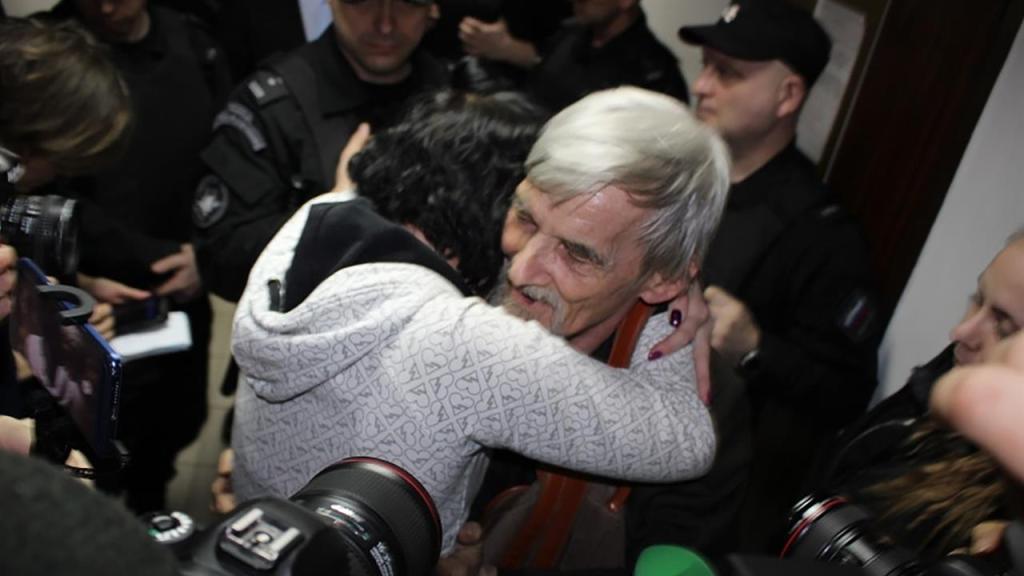
The riveting story of Yuri Dmitriev is a tale of one man’s fight against the erasure of history by the Russian state. Deep inside the Russian forests, against the wishes of the authorities, 60-year-old Yuri Dmitriev searches for mass graves from the era of Stalin’s terror against his own people – until one day he is arrested and sentenced to 15 years in a penal colony. Following Yuri closely, the film paints a shocking picture of the way the Russian state rewrites history and treats its citizens.

Yuri Dmitriev exhumes what the Russian rulers would rather forget. After years of searching the pine forests of Karelia in northwestern Russia, he discovers a mass grave containing thousands of people who were secretly executed during Stalin’s “Great Terror” of 1937. It is not the Russian government but Yuri Dmitriev who tracks down their identities in the archives and organizes commemorations for their next of kin. Thanks to his efforts, they finally find out what happened to their lost relatives. Having himself been left at a maternity clinic as a baby, he is a man on a mission: “Every human being has the right to know where they came from and where their family lies buried.”

Trailer for “The Dmitriev Affair” (2023)

While abroad there is increasing recognition for this “archaeologist of terror,” in Russia Dmitriev is discredited as someone collaborating with the West. Then he is arrested, on basis of a fabricated charge. Tragically accurate Dmitriev predicts his own future and that of his country.

Jessica Gorter is a Dutch documentary filmmaker. She studied directing and editing at the Dutch Film and Television Academy in Amsterdam. Her films are screened worldwide at film festivals, theatrically released and broadcasted internationally. Gorter made her breakthrough with 900 Days (2011) about the myth and reality of the Leningrad blockade. The film won a.o. the IDFA Award for Best Dutch Documentary, the Prix Interreligieux at Visions du Réel and the special jury prize at ArtDocFest in Moscow. In 2014 Jessica received the prestigious Documentary Award from the Dutch Prince Bernhard Cultural Fund for her work. In her other feature-length documentary The Red Soul (2017), the director investigated why Stalin is still seen as a hero by so many Russians. With her latest documentary The Dmitriev Affair (2023) Gorter continues the theme of the films she has been making in Russia since the 1990s: laying bare the consequences for individual lives of the disintegration of the Soviet Union.

Directions: At the reception desk of the Hunter West Building, please present your ID to get a pass. From there, take the escalator to the 3rd floor, turn right and walk across the sky bridge to the Hunter East Building, then take the elevator to the 7th floor. Hemmerdinger Center is at the end of the hallway past the turnstiles. 

Source: Tamizdat Project email newsletter, 8 November 2023
The Siege of Leningrad 75 Years Later

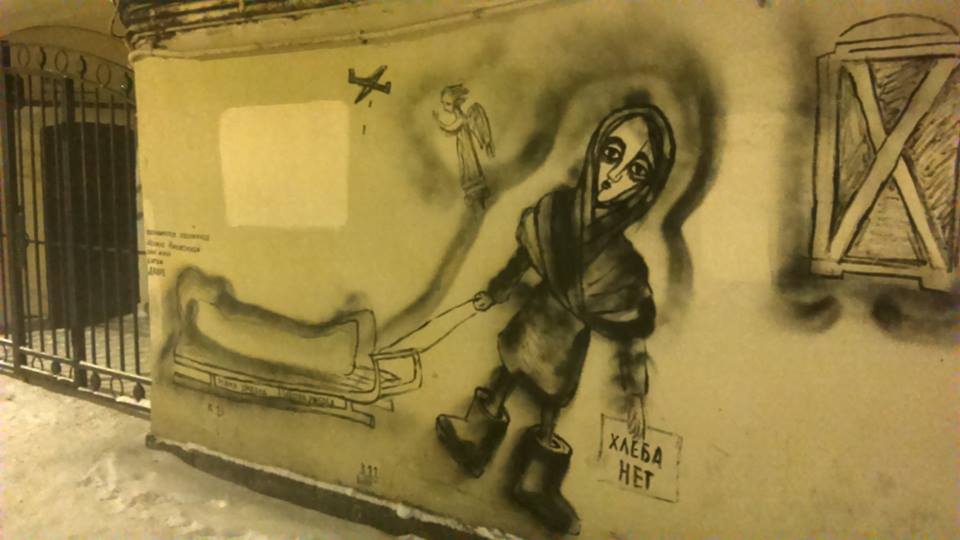
osipova-siege graffiti

The inspiring Petersburg artist and political activist Yelena Osipova has drawn this graffiti to commemorate the 75th anniversary of the lifting of the Siege of Leningrad during the Second World War.

The piece is dedicated to her late friend Lenina Nikitina, another wonderful artist, who lived in the building on whose walls Osipova drew her work.

Nikitina lost her entire family during the Siege, which lasted nearly 900 days, from September 8, 1941 to January 27, 1944.

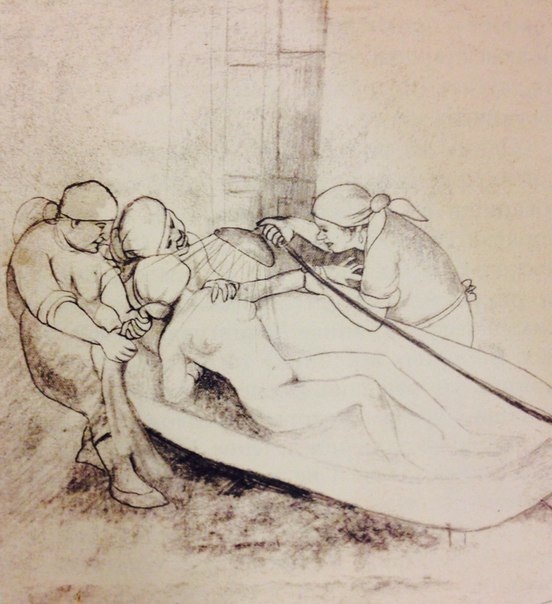
nikitina-cold bathLenina Nikitina, Cold Bath. Pencil on paper. Courtesy of ArtGuide and the Museum of Nonconformist Art, St. Petersburg
As many as a million civilians are believe to have died during the Siege.

The other evening, an arts program on one of the regional German channels broadcast a segment about Daniil Granin and Ales Adamovich’s Blokadnaya kniga (Book of the Siege), which has recently been translated into German by Helmut Ettinger and Ruprecht Willnow, and published as Blockadebuch: Leningrad 1941–1944.

Blokadnya kniga was translated into English by Clare Burstal and Vladimir Kisselnikov, and published in 2007 as Leningrad under Siege: Firsthand Accounts of the Ordeal.

If you don’t have time to read Blokadnaya kniga or any of the other hundreds of books about the Siege, please watch Jessica Gorter’s stunning 2011 documentary film 900 Days. {TRR}

_________________________________________

The Siege of Leningrad Ended 75 Years Ago Today: Here Are Nine Films and Books about the Siege Worth Watching and Reading
Anton Dolin and Galina Yuzefovich
Meduza
January 27, 2019

[…]

Once There Was a Girl
Viktor Eismont, 1944

Eismont began shooting this unique picture while the Siege was still underway. It premiered a year to the day after the Siege was lifted. The Siege is shown through the eyes of two children, five-year-old Katenka and seven-year-old Nastenka. Natalya Zashchipina, who played Katenka, would go on to star in children’s films such as The Elephant and the Rope and First-Grader in the late 1940s, while Nina Ivanova, who played Nastenka, would star in Spring on Zarechnaya Street in 1956.

Baltic Skies
Vladimir Vengerov, 1960

The best film about wartime Leningrad and Leningrad during the Siege, when Baltic Skies premiered, it outraged Nikolai Chukovsky, whose novel inspired the film and who is credited as the screenwriter. The movies features a star-studded cast, including Pyotr Glevov, Mikhail Ulyanov, Mikhail Kozakov, and Rolan Bykov. The film’s young lovers were played by Oleg Borisov and Liudmila Gurchenko, who would later act in Alexei German’s war films. German considered Vengerov one of his teachers.

We Looked Death in the Face
Naum Birman, 1980

A picture about the founding of the Frontline Youth Ensemble. In one of his final roles, Oleg Dahl played the former choreographer. The film features poems by Olga Bergholz and music by Dmitri Shostakovich.

Blockade
Sergei Loznitsa, 2006

https://mubi.com/films/blockade

A documentary film consisting of footage shot by cameramen during the Siege, it features rare scenes, including the execution of Germans. Loznitsa added a soundtrack to the film, bringing viewers closer to the events.

We Read the Book of the Blockade
Alexander Sokurov, 2009

Less a film and more an impressive project by Sokurov, We Read the Book of the Blockade shows Petersburgers both famous and unknown reading aloud Daniil Granin and Ales Adamovich’s book, a compilation of eyewitness accounts of the Siege. The readers include actors Vladimir Retsepter and Leonid Mozgovoi, and Sokurov himself.

Celebration
Alexei Krasovsky, 2019

[Posted on January 2, 2019, by Alexei Krasovsky. “Attention! This film was made without state financing or grants. The filmmakers paid for its production themselves. Please do not show Celebration without listing the information about how you can donate money to us.  It is the only we can cover the costs of this film and start working on a new one. Thank you.

Sberbank Visa/Mastercard Card (in Russia): 5469 3800 7030 3101 (Aleksei Olegovich Krasovskii)

DonationAlerts (featuring viewer poll): https://www.donationalerts.com/r/alkras

PayPal: https://paypal.me/alkras (alkrasss@gmail.com)

Yandex Money: https://money.yandex.ru/to/410013518953856

Cameraman’s Yandex Money account: money.yandex.ru/to/410013518953856 (Sergei Valentinovich Astakov, cameraman-sa@yandex.ru)

Ehterium address: 0xbA2224ba22f2f4494EF01C6691824A178651d615

Don’t forget to mark your contribution as a “donation” so that we’ll have any easier time making films in the future.

Happy New Year!

Screenwriter and director: Alexei Krasovsky

Cinematographer: Sergei Astakhov

Starring: Alyona Babenko, Yan Tsapnik, Timofei Tribuntsev, Anfisa Chernykh, Pavel Tabakov, and Asya Chistyakov

Executive producer: Yuliya Krishtofovich

Art director: Yevdokia Zamakhina

Sound: Nelly Ivanovna and Anastasia Anosova

Assistant director: Zhanna Boykova

Editing: Vladimir Zimin and Alexei Krasovsky

The song ‘Field, O My Field’ was written by Iosif Kovner in 1937 and first recorded in 1941.”]

Filmmaker Alexei Krasovsky shot this controversial, intimate, tragicomic film at his own expense and uploaded it to YouTube during the New Year holidays. The picture deals with the privileged classes during the Siege and contains transparent illusions to the present. Starring Alyona Babenko, Yan Tsapnik, and Pavel Tabakov.

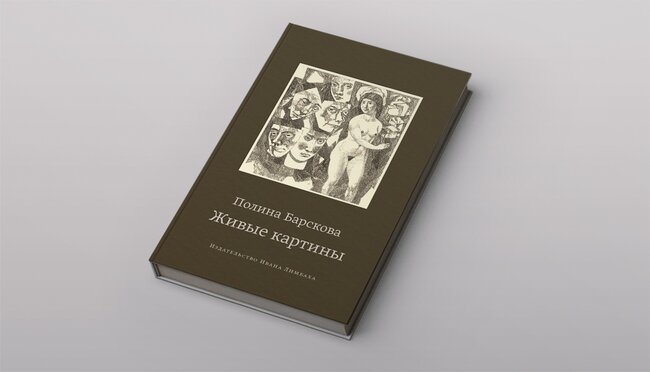
Polina Barskova, Zhivye kartiny [Living pictures], St. Petersburg: Ivan Limbakh, 2014 

Written by poet and academic Polina Barskova, this book is a miscellany of strange, heterogeneous, and genre-bending texts (several stories and essays on the verge of poetry, capped off with a short, semi-absurd play) that interweave the author’s own experiences as a researcher and human being with the real stories of people during the Siege.

Significant historical figures who survived the Siege (poet and literary scholar Dmitry Maximov, writer Vitaly Bianchi, playwright Yevgeny Schwartz) meet on the the pages of Living Pictures with other, unknown shades, such as the art historian Totya and the artist Moses, who made the mistake of falling for each other on the eve of the war, or six-year-old Katya, who plays a gloomy game of  bouts-rimés with her mother, composing a poem about people stricken by hunger-induced dystrophy. The famous, the nameless, Barskova’s other characters, and Barskova, some of whom did not experience the Siege themselves, ring the changes on the book’s main point, as voiced by one of the characters: the Siege was a peculiar civilization with all the qualities of other human communities. This civilization did not disappear without a trace. It has germinated anew in subsequent generations, who continue to feel its icy breath.

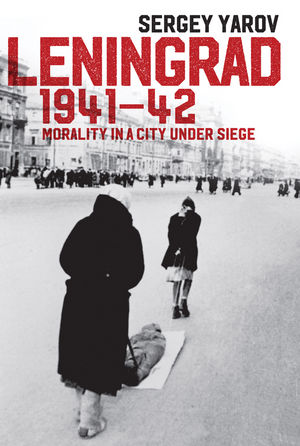
Sergey Yarov, Leningrad 1941–42: Morality in a City under Siege, trans. Arch Tait, Cambridge: Polity Press, 2017

1509507981

“The ethic of sympathy demands the gaze not linger on mournful scenes of human agony,” writes historian Sergey Yarov in his book, seemingly ruthlessly violating this ethic. Instead of charitably averting his gaze from the most horrific aspects of the Siege of Leningrad, Yarov peruses as keenly and closely as possible theft and deception, monstrous, incurable physical deformities and people’s aversion to them, assaults on children (it was easier to take food from them since they were weaker), indifference to the suffering and deaths of other people, willingness to endure any humiliation, the collapse of community, and cannibalism.

As he plunges into the abyss of diaries, memories, and official records, uncovering truly unimaginable things, Yarov nevertheless hits upon an impeccable tone for discussing them, managing to maintain in each episode the perfect balance between scholarly scrupulousness and supreme humaneness.

Olga Lavrentieva, Survilo, St. Petersburg: Boomkniga, 2019 

This graphic novel by the young artist Olga Lavrentieva is a laconic, black-and-white account of the life of her grandmother, Valentina Survilo. Survilo’s happy Leningrad childhood ended in 1937 with her father’s arrest. She was exiled to a village in Bashkiria, where her mother died, before making a long-awaited return to her beloved Leningrad. This was followed by the most important and terrible chapter in her biography, the Siege, which the still very young Survilo endured in a prison hospital, the only place willing to employ the daughter of an “enemy of the people.”

The relentless hunger, cold, bombings and artillery attacks, treachery of friends, and rare, miraculous instances of kindness left a deep wound in Survilo’s heart, causing her to suffer nightmares and be constantly anxious about family members during the relatively prosperous postwar years. Lavrentiev uses the rather typically tragic story of one Leningrad woman as a lens through which she and her readers can look at the history of her hometown and the entire country.

Survilo will be published in March 2019.

Thanks to Giuliano Vivaldi for the heads-up. Translated by the Russian Reader. I have replaced the trailers used in the original article with full-length public-access videos of the films themselves (except for Sergei Loznitsa’s Blockade, which can and should be viewed on MUBI). Please take note of filmmaker Alexei Krasovsky’s appeal for donations. If you watch Celebration, please consider making a donation to him and his crew via Sberbank, PayPal, Yandex Money or Etherium.