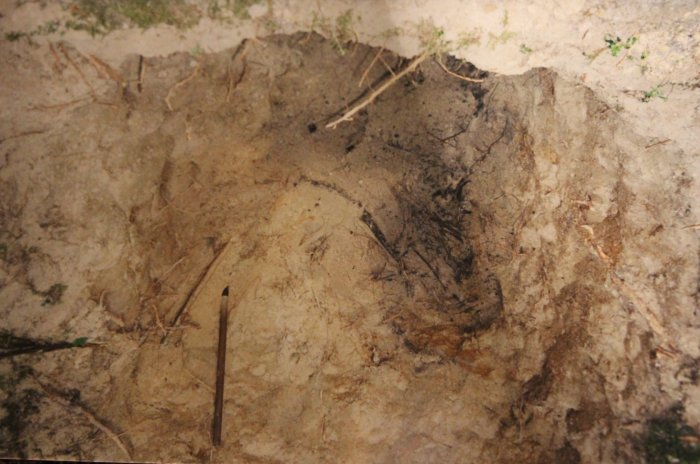
Exhumation of a mass grave in the area of Pit No. 5 aka Zolotaya Gorka (Golden Hill), which was supposed to be transformed into a memorial cemetery for victims of Stalinism in the 1930s. The mass graves are located in Shershni, a suburb of Chelyabinsk. The photo was taken in 1990. Courtesy of the Elizaveta Becker Collection, Gulag Museum, International Memorial Society
The Security Services Don’t Like Plaques: Chelyabinsk Officials Say Plaque Commemorating Executions Would Discredit Police
Yulia Garipova Kommersant
August 31, 2018
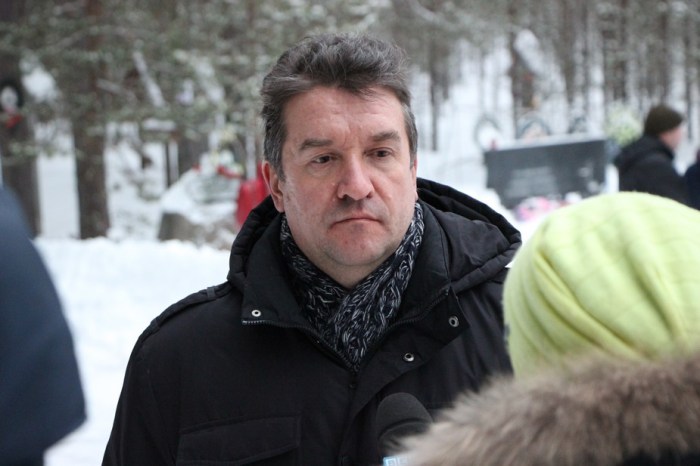
Chelyabinsk city hall has refused to assist community activists who have been trying to mount a plaque, commemorating the victims of political terror, on the walls of the city’s Interior Ministry [i.e., police] building. The site used to be the home of a building in which executions were carried out in the 1930s. According to officials, the inscription on the plaque could cause people to have “unwarranted associations about the work of the police” and undermine its authority in the eyes of the populace.
In 1932, a building was erected from the bricks of the demolished Christ’s Nativity Cathedral on Vasenko Street in Chelyabinsk. It was handed over to the OGPU (Joint State Political Directorate), later known as the NKVD (People’s Commissariat for Internal Affairs). Historians claim that, during the Great Terror, the building contained an execution room. In 1937–1938, nine Chelyabinsk priests were murdered in the room. In 1995, a memorial plaque was mounted in the courtyard of the building at 39 Vasenko Street.
The inscription on the plaque read, “During the period of mass repressions in the 1930s and 1940s, innocent people convicted of political crimes were executed in this building.”
In the early 2000s, however, the plaque vanished.
This year, Yuri Latyshev, coordinator of the local history group Arkhistrazh, launched a campaign to restore the memorial plaque. He asked Yevgeny Golitsyn, deputy governor of Chelyabinsk Region and chair of the regional commission for restoring the rights of victims of political repression, for help. Chelyabinsk city hall’s culture department sent him a reply.
Mr. Latyshev was informed the building that had once housed the secret police had been completely dismantled due to dilapidation. The land plot was handed over to the Interior Ministry’s Chelyabinsk Regional Office. A new building had been erected on the plot, and a new plaque mounted on the building. It reads, “In memory of the victims of the 30 and 40 years [sic]. Their memory will be preserved as long as we remain human beings.”
Citing the local Interior Ministry office as its source, the Chelyabinsk city culture department explained in its letter to Mr. Latyshev that the whereabouts of the old plaque were unknown. Restoring a commemorative plaque that claimed people were executed in the building during the period of mass repressions in the 1930s and 1940s would be a distortion of historical reality, the officials argued.
“There have not been any repressive actions of a physical nature [sic] carried out in the buildings used by the [local Interior Ministry office],” they wrote to Mr. Latyshev.
Chelyabinsk culture officials also stressed the inscription on the previous plaque could “provoke unwarranted associations about the work of the police in the minds of people, even as the Russian federal government has made considerable efforts to strengthen the police’s reputation.”
Mr. Latyshev, however, is convinced part of the old building survived the reconstruction.
“The [old] plaque was absolutely fair, correct, and decent, but someone clearly did not like it. It would be fair to hang it on the street side of the building,” says Mr. Latyshev.
He claims he has sent inquiries to the FSB and Interior Ministry, but has only been given the runaround.
“I’m surprised by the wording used by city hall officials—’unwarranted associations’—and how they immediately project these ideas into the minds of the people of Chelyabinsk,” Ivan Slobodenyuk, coordinator for the project Last Address in Chelyabinsk Region, told Kommersant.
Mr. Slobodenyuk stressed that restoring the memorial plaque would be consistent with the state policy for commemorating victims of political repression, as adopted by Prime Minister Dmitry Medvedev in 2015.
“Regional authorities have so far neglected this topic. The memorial on Golden Hill has virtually been abandoned. Part of the area containing mass graves has been redeveloped, and another section has been slated for redevelopment. Now the story with this memorial plaque comes to light,” said Slobodenyuk. “In my opinion, putting up a memorial plaque that begins with the phrase, ‘This was the site of a building in which, during the period,” and so on, in keeping with the wording on the original plaque, would not damage the police’s reputation. On the contrary, it would be a manifestation of courage and would make people respect law enforcement.”
The Dmitriev Affair
Anna Yarovaya 7X7
March 1, 2017
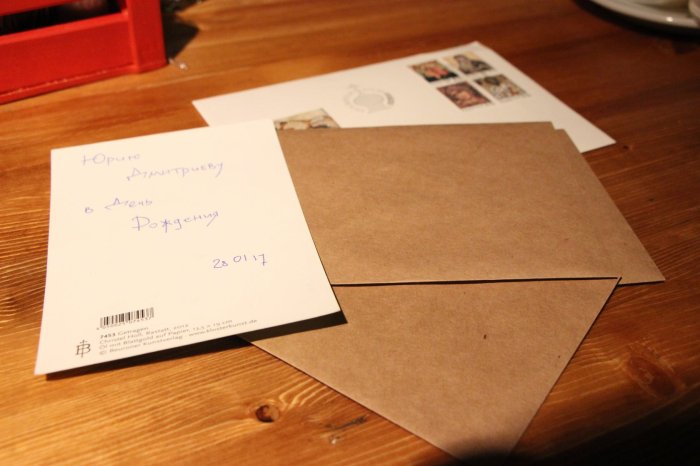
March 12 is, technically, the last day of historian Yuri Dmitriev’s term in police custody during the investigation of the accusations made against him. The 61-year-old researcher has spent nearly the last three months in Pretrial Detention Facility No. 1 in Petrozavodsk. During this time, solo pickets supporting Dmitriev have been held on the streets of the Karelian capital, his case has been discussed at a traveling session of the Presidential Human Rights Council, and the republic got a new governor.
According to Dmitriev’s attorney, the historian will probably be indicted and his case sent to court. Yuri Dmitriev has been accused of producing pornography.
Neither his colleagues, friends or people who have worked at some time with Yuri Dmitriev believe the charges are true. Many link his arrest to the work he has done his whole life: searching for the places where political prisoners were shot, compiling lists of victims of political crackdowns during the Soviet period, and heading Memorial’s Karelian branch.
***
But this article is not about the criminal case, which falls within the jurisdiction of law enforcement. Hoping for a objective investigation, we can only wait for a fair resolution to this situation. We decided it was important to tell readers about the cause to which the arrested historian has devoted his life.
This article might be called a series of interviews about Dmitriev. It has transpired we knew almost nothing about him. On the other hand, it has become clear why a man like him might have been seen as “inconvenient” by the current regime.
From the Author
I met Yuri Dmitriev in 2012. I was on assignment, shooting a story about the construction of houses on the site of a former cemetery, and it led me to the historian. The story first grew into a ten-minute TV program, and then ballooned into an investigative film. We visited archives and former burial sites, traveled to working cemeteries, sat at a computer for hours on end searching for documents, read articles from conventions and laws, and basically worked on the film, Northern Point, together.
What always struck me about Dmitriev was his enthusiasm, which materialized less in the help he gave me and more in his attitude to history, to events that had occurred many years ago. For example, in the same cemetery where I shot the film, he found the remains of a POW. None of the local authorities was in a hurry to bury the exhumed “youth,” as Dmitriev called him. So Dmitriev put the bones in his garage. A while later, he secured a spot in Peski Cemetery, found a sponsor to help him buy a gravestone, and asked the philologist Valentina Dvinskaya to translate the phrase “To the victims of war, disappeared but not forgotten” into German so that it could be engraved on the headstone. He did all this for an unknown man who had been killed over sixty years ago.
The gravestone Yuri Dmitriev erected on the spot where the POW was reinterred
The news of Dmitriev’s arrest was a shock to me. We had not communicated in a long while. A couple of years ago, we had planned to make a film about the burial of prisoners in the locks of the White Sea-Baltic Channel and the so-called Solovki execution transports. Dmitriev is indefatigable and has always been researching numerous topics. But it turns out that I’m not writing about them now.
Anatoly Razumov: The Solovki Quotas Anatoly Razumov came to Petrozavodsk from Petersburg on Dmitriev’s birthday, January 28. His longtime friend and colleague was not allowed to visit Dmitriev in the pretrial detention facility.
“I am here, nearby, and he knows it,” Razumov said to me then.
Indeed, he was nearby. He held a solo picket in support of his arrested comrade. For over an hour, Razumov stood on Petrozavodsk’s main street holding a placard that read, “Happy birthday, Yuri Dmitriev,” enthusiastically telling passersby about what his friend had worked on his whole life. It would have been an unpardonable mistake to turn down such a conversation.
Razumov and I spoke on the phone a couple of days later. I had a sense of déjà vu. The same thing had happened when Dmitriev had told me about the military cemeteries in Petrozavodsk. He had not just spoken, but had asked me a lot of questions whose answers I hadn’t known. “Ig-no-rance,” he would kindly drawl, ordering me to jot down the title of yet another book I “should have read before meeting” with him.
Razumov did not point out the gaps in my knowledge, but I heard about many things for the first time during our conversation. That was probably why the conversation did not turn into a proper interview. It was more of a monologue, a story about his friend, his cause, and his contribution to history. I decided it was vital to reproduce it verbatim, as Razumov told it to me, so readers could understand what a difficult and profound business Dmitriev had been involved in before his arrest.
The Book of Remembrance
I have worked in the Russian National Library (the Publichka) since 1978, and for over a quarter of a century I have been compiling and publishing The Book of Remembrance of Victims of Political Repression. In 1987, I started gathering material, and in 1990, compiling a card catalogue based on the published lists of the victims. I retyped biographical information about them in their birthplaces: Minsk, Tallinn, Pskov, Petrozavodsk, Murmansk, Tver, Novgorod, Kiev, etc.
The first books of remembrance were published in the late eighties and early nineties. Books of remembrance were only taking shape as a genre then. There had always been lots of talk about the war, about the Great Patriotic War: as a topic it was always at the center of attention. But to compile books of remembrance about the war that included lists of the dead and missing in action was permitted only during the second thaw, in 1985. Prior to this, the names of the dead and the missing were not published. The first books of remembrance about the war were usually quite modest in terms of structure: surname, first name, patronymic. They didn’t even always include information about the place of death, and of course there was no personal information about these people.
But a mere four years passed, and we had permission to publish the names of the victims in newspapers, magazines, and books. We were permitted to clean up the burial sites of those who had been shot or died in captivity that had been found. It had been forbidden to write and say anything about the millions of those who had been killed and gone missing during the purges and crackdowns. Whatever person you asked about, nothing was known about him. Then suddenly we could publish this information.
Different people in different parts of the country were compiling books of remembrance. There were lots of enthusiasts, like me and Yuri Dmitriev, albeit not in every region of Russia. None of us had thought we would live to see this great day.
The first book published, in 1989, was The Book of Remembrance of Soviet Diplomatic Corps Workers, victims of purges during the thirties, forties, and early fifties. There were 130 names in the book.
Other books of remembrance were gradually published, regional books, books dealing with particular ethnic groups, with crackdowns against believers of different faiths, with particular sites where those had been shot were buried.
Sandarmokh
I kept track of all the new publications on the history of the Soviet purges and crackdowns. We also needed a bibliography for Pages of History, a digest, published by Lenizdat, of which I was a co-editor. I kept track of the search for sites where the executed had been buried. I was educated not only as a historian but also as an archaeologist. Of course, I knew about the famous site of the Katyn massacre near Smolensk, which had been found long ago. But it was not common knowledge in the Soviet Union or, rather, you were not supposed to know about it, much less about other burial grounds. Of course, there were such burial sites near every major town and city in the Soviet Union.
In 1988, it was a bombshell when they found Kurapaty, an execution site from the time of the Great Terror near Minsk. I published the Belarusians’ story of the find in the Leningrad newspaper Smena, and we wrote wrote about Kurapaty in the Pages of History digest. Everything was read hot off the presses. The reporters at Leningradskaya Pravda called on Petersburgers to report all suspicious areas and find “our local Kurapaty.” Thus, in the spring of 1989, a special security facility was found in the village of Levashovo near Leningrad. It was the largest burial site of executed prisoners in the Soviet Union.
I followed all these developments closely. I knew, of course, about the work in the Karelia. Even before we had met, I had heard about Yuri and what he was doing.
In 1996, I was editing the second volume of The Leningrad Martyrology, which dealt with October 1937, and I needed to publish a list of the prisoners at Solovki Prison who had been shot. Where were they executed? Even state security officers in Petersburg didn’t know: they had no information about it. Yeah, they had been shot somewhere, and it was clearly not in Leningrad, because there was a record showing that one of the regular executioners, NKVD Captain Matveev, had been seconded to Kem in connection with this list of prisoners. That was all.
The second volume was published in 1996 with a preface by Dmitry Likhachov, and in July 1997 Sandarmokh was found. My Lord! There was no doubt prisoners transported from Solovki had been shot there in October and November 1937. That was the first time I heard Dmitriev’s name: in the reports about the find and from Petersburg members of Memorial, whom I knew quite well.
But I met Dmitriev later, as part of the Returned Names project. In 2000, an attempt was made to compile a single database containing the names of all victims of political persecution in the Soviet Union. It was an international project: we were supported by the Ford Foundation. During an academic conference in Nizhny Tagil, my colleagues asked me to be the project’s regional coordinator for Northwest Russia. I surveyed the entire region, and that was when I met Yuri personally.
Personal
Like Yuri, I’m from a military family. Our family wandered a lot. My father served in different places, mostly in his homeland of Belarus, but also with the Soviet troops in Germany. We lived for a time in Berlin, and then Eberswald. I was never able to make friends with my agemates, and I lost track of many of them. I started to make friends at university, and then on the job, the job I got at the library after finishing university. It was God’s will that I do this, that I found a vocation in life that totally suited me.
I had always been disturbed by the question of why it was wrong to think freely and ask questions, why a person’s life was so little valued that it could be ended just like that. A person should live a long life. Why are the tormented deprived not only of life, but even of a grave? You can imagine how I felt when it was possible to talk about executed prisoners. Nothing had been known about them. Not even their relatives said anything about them: either they lied or didn’t know. I took on the job of restoring memory. All the colleagues I met in this new life became kindred souls, but a select few became close friends. Yura was a close friend from the moment we met.
Yura immediately took me in his jalopy to Sandarmokh. We barely made it to Medvezhyegorsk in that wreck. From time to time, he would roll down the window for Veda (aka the dog Ved’ma, “Witch”), and she would happily bark at everything in the vicinity, thus replacing the horn, which didn’t work in that car, I think.
Yura showed me Sandarmokh. That was important to me. By that time, his book The Karelia Memorial Lists was nearly ready. I soon attended the book’s presentation. I opened up the packages from the printers (Yura taught me not to cut the plastic tapes but undo them), handed copies out to people, and made my own speech. It was a wonderful presentation. Everyone spoke very well, including the relatives of the victims, who regarded Yura as an important, valuable person. Since then he has been one of my greatest friends, and a wonderful person with whom to speak when I want to talk frankly.
He would come to Petersburg for presentations of successive volumes of the Martyrology and do what I had done at his presentation.
I liked Yuri’s position. I absolutely understood him. He would just say, “Old women need to know where their dead are buried, and I’m going to do everything to make that happen.” And he did what he could, and he still does that. I’m more in the habit of listening rather than asking questions, which complements his outgoingness and talkativeness.
Yuri Dmitriev and Anatoly Razumov
The Solovki: A Common Cause
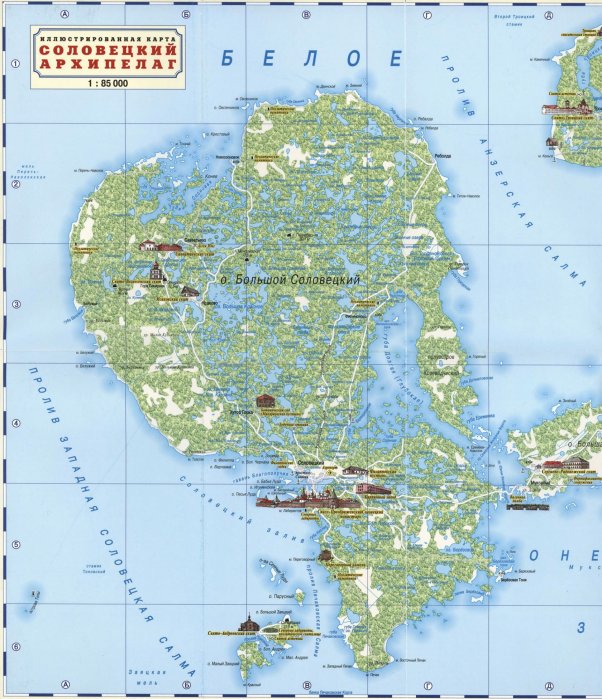
A map of the Solovki Islands
Until the summer of 1937, Karelia was administered by the NKVD’s Leningrad Regional office, meaning that Karelian folk were persecuted here, and people from Leningrad ended up there: their lives crossed. Yura and I exchanged information about the victims: he gave me info about his victims, and I gave him info about mine. Finally, we set about comparing the information about the Solovki execution groups of 1937 and 1938. Sandarmokh had been found, but that was the first group of executed Solovki prisoners. It was the first execution plan, the first “quota.” 1,200 people were supposed to be shot, and 1,111 were shot outside of Medvezhyegorsk. When was the next detachment of executed prisoners? December 1937, the group of prisoners in which Pavel Florensky was shot. Where they were shot remained a mystery. There was no mention of it in the papers I had found in the state security archives in Petersburg. It was forbidden to include information of this sort in the instructions.
Here is an execution order, issued to Commandant Polikarpov: “509 persons [in fact, three people on the list had already been sent to Moscow] from the Solovki Prison should be shot.” But where? Seemingly, since Polikarpov was commandant of the Leningrad office, they would have been sent to Leningrad. At our own peril and risk, when we were editing the fourth volume of the Martyrology (dealing with executions in December 1937), we wrote that the Solovki prisoners had been shot in Leningrad. We published the fourth volume, but questions still remained. After all, there were no documents with accurate information.
A third group of Solovki prisoners, another 200 people, was shot on February 17, 1938. The details about what happened to them were even murkier. If the second group had been transported to the mainland for execution in early December (it was a warm year, and the shipping season ended late), it was altogether unclear where the 200 people were shot in 1938.
In 2004, I decided to go on an expedition. It is each individual’s plight that matters to Yura and me, not statistics. When you read the files, the person appears right before you, and he doesn’t let you go.
Yura and I agreed to travel to Solovki. I couldn’t find a more knowledgeable and closer person to help me look for something on the islands. We were armed with a description of the execution, drawn from the testimony of former Solovki Prisoner officers, interrogated during the Thaw: they claimed the 200 prisoners had been shot on the way from the Solovki Kremlin to the lighthouse on Sekirnaya Hill. I had never been to Solovki. I knew the local places names from looking at maps and papers. So we arrived there in 2004. It was the first tentative expedition. We walked around looking. Yura would immediately stop at any suspicious spot. We would pitch tent in some places and try to probe the soil, but we didn’t find anything.
Anatoly Razumov and Yuri Dmitriev during the 2004 expedition to Solovki
We went again the next year. By then we had become friends with Father Matfei, rector of the Holy Ascension Hermitage, and he showed us all the suspicious spots on Sekirnaya Hill, drawing our attention to the vegetation, trees, and depressions. But I took ill then, and Yura wouldn’t let me go into the field. Yura is the sort of guy who is endlessly concerned about the people around him, albeit sometimes in a rough way. He laid me down with a temperature in a cell in the hermitage, and he went off with the writer Vasily Firsov, who had come along with us on the trip, to investigate one of the suspicious spots. Suddenly, they came running in: “We’ve found them!” Of course, I ran out to have a look and help them with the work. We then uncovered the remains of two prisoners who had been shot.
I was unable to make the trip in 2006: editing the forthcoming volumes of the Martyrology was taking up all my time. Teachers and students from the Moscow International Film School went to Solovki that year. They helped Yura clear the burial site of dry branches, undergrowth, and deadwood, and discovered many more pits. So the discovery of the cemetery where the executed prisoners were buried dates back to then.
And yet our long-standing goal of finding the site where 200 people were executed, the so-called third Solovki quota, has not been fulfiled. There were no more such mass executions on the islands. The site should be a trench or gigantic pit or series of pits. We haven’t found the place, but we’ll find it someday, just like the place where the group in which Florensky was shot, the so-called second Solovki quota. I think we should search near Lodeynoye Field, because the highly decorated executioner Shalygin was dispatched to the vicinity of the Lodeynoye Field Camp. I have told all this to Yura.
This arrest, you see… Not only did they trash his nest, his apartment, brazenly, tramping all over it in their boots, but they also dealt a blow to the work. I’d been helping Yura edit two new books of remembrance and had been sending him information from time to time. Yuri has edited another book of remembrance long ago: it just needs to be printed.
And when it comes to the search for the execution sites, the only hope lies with Yura’s expeditions. I have outlined the range of places to search, and Yura had set about searching. He had got his film school kids involved in the work. Yura and I have work to do together. I hope he will be released in a good frame of mind and finish the two books of remembrance, and I’ll persuade him to publish the third. And if we have the manpower, we will find the places where the second and third Solovki quotas are buried.
Remains of executed prisoners, Solovki
My Friend’s Arrest
Despite the fact Yuri is easy to get along with, he has keen insight into human nature. He is quite good at sizing up a person, sensing the direction his thoughts are moving. When he comes to Petersburg for the presentation of the latest volume of the Martyrology, what with his speeches, jokes, and irony, people here are just ready to idolize him.
I have thought about why this has happened to Yura now. I have my own opinion on this score, of course: how things were going in that direction, how everything was shaping up. I remember the Brezhnev era. I thought then I would not outlive the Soviet leadership, because I tried to speak my mind. Sometimes you’ll end up sweating like a pig, but if you can, you should try and speak your mind. Yura also acts that way and speaks that way, often in an absolutely denuded, harsh form. I imagine lots of people really don’t like either what he does or how he talks and acts.
Basically, it somehow happened the decision was made to shut him down, to knock him out of his work and life. For Yura is one of a kind, there is no one else like him anywhere else in Russia. And if he is shut down in this way, and it’s done a little more dirtily than usually, everyone else will hunker down. I won’t bother speculating about the specifics, but I’ve read my share of Soviet-era investigative files from the archives, and our modern justice system is based on that Soviet system, alas, not on the old Russian system. I know the clichés, we all remember them. “People don’t go to jail in this country for nothing.” “The prosecutor and the police see eye to eye on the case, and that’s how it should be.” “Our courts are the most humane and fairest in the world.”
I think all this will definitely start to recede someday in connection with some case. Will it be Yura’s case? I don’t know. But there is a chance they hung all this on the wrong man and don’t understand the strength of his spirit.
“They Always Existed”
I think about the horrible purges and persecutions of the Soviet era. I don’t think the crackdowns were harsher during one period and less harsh during a different period. They always existed. Only they existed relative to the political moment, and the persecutions were modified only in those terms. However the regime wanted to crack down on its enemies that was how it cracked down on them.
The current Russian legal system can be described as follows. If we call pre-revolutionary Russia Russia 1, it was followed by the Soviet Union, which wasn’t even Soviet Russia, but let’s call it Russia 2 for argument’s sake. Where do live now? At best, in Russia 2+, because there is no Russia 3. It hasn’t come into being. It hasn’t understood or realized itself. It has its roots in the Soviet past and grows out of that past.
The legal system of the current Russian state doesn’t hold a candle to the system that existed prior to 1917. It’s flesh of the flesh of the Soviet system. I have been interviewed on the subject several times, on the question of whether the purges could happen again and whether they could be even worse. But they are already happening: we have crackdowns right now. Could they intensify? Could they become scarier? You can never say never, but our job is to take a stand against political persecution and stand firm.
Dmitriev’s Daughter Katerina Gleb Yarovoi, my husband and colleague, was the first to meet Katerina. He was the first reporter with whom Yuri Dmitriev’s eldest daughter agreed to talk about her father’s arrest. We then communicated through social networks, and there were money transfers for Dmitriev, which different people sent to Katerina through me. Then we finally met in person at Dmitriev’s house.
“When they came for Dad, they made such a mess there. They ripped out all the wiring, so now the lights don’t work and you have to bring your own,” Katya says by way of explaining the lamp sticking out of her bag.
The last time I had been in the apartment was three years ago. Cigarette smoke, the buzz of the computer, a cup of coffee, and a bar of Osobyi chocolate: that is how I remember working on Northern Point. I cannot imagine how I would have managed without Dmitriev. It was he who showed me an entire period in the history of Petrozavodsk, a time of POW camps, POWs who died in the postwar city from being worked to death and were buried, and the modern residential buildings erected a short time later on top of their remains.
The apartment is completely different now: empty, quiet, gloomy. Disturbed by the police, Dmitriev’s workplace is no longer cosy. A lone pack of Belomorkanal cigarettes lies amidst papers, cables from the computer equipment dangle from his desk, and amongst other books I see the blue cover of The Memorial Lists of Karelia, which Dmitriev and Ivan Chukhin worked on for many years. The apartment’s owner, torn on December 13 from his customary working atmosphere, gazes on the scene reproachfully from a portrait hung on the wall.
“He had a dog then, Veda, short for Ved’ma [“Witch”]. She was with him on all the trips, on all the digs. He found her on Friday the thirteenth, so he called her Ved’ma. He never went anywhere without here. When she died, Dad cried over her,” Katerina tells me, showing me a photo of a dappled mongrel, seated at Dmitriev’s feet.
There are lots of photographs, a whole album. We had come to Dmitriev’s apartment to get them.
Dmitriev’s daughter Katerina
Did your father tell you and your brother what he did, where he would go, what he was investigating?
Of course. I remember that Dad was constantly going on different digs. He was constantly studying skulls, bringing them home. I was still in kindergarten then. We probably didn’t pay much mind to the particulars of his work. But as long as I can remember, he would sleep a couple of hours day. He would sit poring over those cards, he constantly had to dictate something. When we were a bit older, he tried to explain things to us. For example, my great-grandfather, Mom’s grandfather, had been shot. Dad found Great-Granddad’s burial site in a memorial book: the Zaretsk Cemetery next to Exaltation of the Cross Cathedral in Petrozavodsk. I cannot speak for my brother, but I’m a daddy’s girl, and I have always been around him. We would be sitting together, and he would tell me about the plights of people, how they were arrested, and why they might have been arrested then. He was always interesting to be around. His work has always interested me from a personal viewpoint. It’s frightening and, at the same time, interesting.
Did you help him?
It depends. I think sometimes he would have gladly refused our “help.” Say, when my brother and I were teenagers, we were terribly curious about what was on Dad’s computer. We got on the computer and poked the keys. Dad came in, and he was totally shocked: we had accidentally deleted all his files. So then we had to sit there and help him restore everything. It was interesting at one time, but at a certain point it irritated me. Imagine: I was fifteen years old, my friends were waiting to go for a walk, and he would say, “Help me.” And I would sit and dictate to him, and he would be looking for each letter with one finger, hammering out the dates. I would freak out then.
The trips were probably more exciting? Did you often go on the expeditions?
I can’t say I went that often. But as they say, seldom but to the point. One day, Dad said to us, “Who’s going with me tomorrow to Medvezhyegorsk?” My brother and I immediately said neither of us was going, we didn’t want to. But at six in the morning, for reasons I can’t explain, I jumped out of bed when Dad was getting ready to go and said, “Wait! I’m going with you.” And so we set out for the digs. We lived in a cottage on the shore of a lake. Dad’s colleagues from Petersburg and a group of soldiers were with us. The amount of walking we did then was inexpressible. We were constantly on foot. Dad and his colleagues would split up and discuss things amongst themselves. Dad understood, of course, that I needed to eat, that I needed breaks, that it was hard for me, but all the same we walked and searched a great deal. Ultimately, we found what we were looking for. We found Sandarmokh.
Katerina and Dmitriev. Expedition to the Medvezhyegorsk District in search of Sandarmokh, 1997
How did a teenage girl react to such a find?
Probably because Dad was calm about it, I reacted to the remains more or less calmly. The soldiers chuckled nervously when they found bones, and there were people who fainted, wailed, and felt sick. I remember there were very many gadflies and horseflies. The mosquitoes seemed like paradise compared with them. I then had the impression (maybe I believed in the transmigration of souls) that the horseflies were the people we had found. And I felt peaceful and scared at the same time. It’s hard to convey the emotions.
Did you understand why your father did this work?
It came with time. I would often ask him why he was always sitting at the computer and writing or retyping something. He would say, “I don’t know who I was in my past life, but I’ve understood the meaning of my life now, and I know I have to do this.” When I was older, I would constantly tell him to relax and ask him how he could spend so much time sitting poring over the lists and working at the computer. He would say, “I can’t relax. I have to finish the book. They’re waiting for me.” Yet he didn’t do it for money. When The Book of Remembrance came out, people would tell him that he could sell it, maybe even for good money. But he would always reply, “I can’t make money off of people for whom these memories matter, because everyone should know where their loved ones are buried.” I came to a new awareness after his arrest. I knew that Dad had a lot of acquaintances, but I didn’t expect such support. When I told him how much his friends and colleagues had supported him, he even shed a tear.
Did you go on any more trips with your father after Sandarmokh and those finds? Do you have any desire to continue his work?
It’s very difficult. Not everyone is psychologically capable of coping with it. After Sandarmokh, I was in Krasny Bor Forest when the cemetery there was opened. We went there several years ago. They had this program: children sang songs, there was a portable belfry that people played, and very poignant poems were recited. I haven’t been to Sandarmokh for a long time. A lot of people used to go there, crowds of people. But nowadays fewer and fewer people make the trip. The last few years, however, my son has gone there. He is now the same age I was when we found Sandarmokh. So the baton has been passed, as they say.
Valentin Kaiser: The Work Is His First Wife Valentin Kaiser is a longtime friend of Yuri Dmitriev. The news of his friend’s arrest certainly shook him, too. Kaiser has been setting up a shipping museum in a basement room at the River Academy. Now he recalls that he once helped Dmitriev establish a Museum of Victims of Political Repression, but city hall evicted it due to the tenant’s utter pennilessness.
Yura and I met in the 1980s, when the Popular Front formed. Back then, Yura cried, “Clobber the Communists!” He was an assistant to Ivan Chukhin, a deputy to the USSR Supreme Soviet. In his book The Practice of Terror in Karelia, Chukhin wrote, “I took up this question to rehabilitate my father, because I found his signature on thirty-four execution orders.” After Chukhin passed away, Yuri continued his cause.
Have you helped Dmitriev in his work?
I have tried to help Yura, but it’s quite difficult to help him. Working with this stuff, especially digging, is quite difficult. I once traveled with him to Krasny Bor Forest, where we found Japanese spies in a common grave. There were these green lacquered shoes in the grave: there was one Japanese woman in the city then. There were also twelve pairs of leather shoes: they belonged to the Japanese spies. I watched the soldiers digging and dragging them out. It’s not my thing. It’s quite heavy psychologically. There are many investigative files where the pages are covered in blood or torn. Only he alone could cope with this specifics of this, as well as the digging and reburials. Moreover, he did it in keeping with the scientific method, measuring and describing everything.
At one time, Yura had a Museum of Victims of Political Oppresion, at 25 Lenin Prospect, in a basement. He had collected wheelbarrows there, hardware, and God knows what else. But then the mayor’s office leased the space commercially, and Yura dragged everything in bags to a garage.
Valentin Kaiser
Recently, Dmitriev said something was about to happen. Did he share his thoughts and worries with you?
A year ago, Yuri said they were trying to put the squeeze on him. It’s my opinion, but I think the top brass really didn’t like what he was doing. The children of the people involved in the executions are usually amongst the top brass. They really don’t like it when people start making names and surnames public.
There was this incident. When Ivan Chukhin passed away, his last book, The Practice of Terror in Karelia, was published. The book’s final chapter is untitled: it contains the surnames of the men who did the shooting. During the book’s presentation at the university, a young man expressed his outrage: “Who gave you the right to mention my father’s surname?” Yuri said to him, “First, I didn’t write the book. Go to the cemetery and ask Ivan Chukhin why he did it. Second, if you had any brains, you’d keep your mouth shut. If you had a conscience, you’d hang yourself from a rope for having a dad like that.” Yura is an abrupt fellow by nature. He can tell anyone to go frack himself, even a minister.
You think it’s revenge for being too active?
Well, they sentenced someone from Moscow Memorial to seven years in prison [?], and now they’re trying to get at the rest of them to put an end to their cause. But I don’t think it will work out for them, because human souls are immortal. I’ll give you an example. When we took people to Sandarmokh for the first time, we had just stepped onto the path, and it was quiet in the forest, not a hint of a breeze, and suddenly the crowns of the trees stirred so furiously that this roar resounded over the whole forest. Yura said then that people’s souls had waited so many years to be remembered.
I certainly don’t believe Yura could do the things of which he has been accused. First, he’s not stupid: there’s no point being involved in this nonsense. Second, when I spoke with the police investigator, I told him that in order to do what Yura has been accused of, one would need lots of time, but when would he have managed to do the huge amount of work he was doing? Women avoided him because the work was his first wife.
Olga Kerzina: They Have a Pure, Cheerful Relationship Olga Kerzina is director of the Moscow International Film School. Like many of the people with whom I spoke, she was drawn to Yuri Dmitriev by a passion for history and, specificially in her case, an interest in Solovki. But Kerzina is not simply an associate of Dmitriev’s but also the godmother of his youngest daughter.
Everyone with whom I’ve spoken while writing this article has told me about they met Dmitriev? How did you meet?
In the early 2000s, we had a project entitled Freedom. We were trying to understand how freedom was understood by people imprisoned in the 1930s, for these were people from the aristocracy and the intelligentsia, and how the process works nowadays. We made a film about the Solovki Camp, interviewing the convicts who were still alive then. As part of the expedition, we went to a juvenile penal colony in Vologda. That was our itinerary. But there was one other stop, Petrozavodsk. We were trying to figure out who worked on history here, and that’s how we found Dmitriev. He immediately amended our itinerary and took us to Sandarmokh. Thus, in 2000, the first generation of students met him. That’s when we got the idea to make trips to Solovki. All we knew then was that it was the first camp established under Lenin. So of course when we met Yuri in Petrozavodsk, his stories made a big impression on us. He inspired us with the idea of erecting a monument on Solovki. In 2002, we erected a memorial cross (produced in the Solovki cross-making workshop of Georgy Kozhokar) in the Philipp Pustinya. We regard it as an echo of the inspiration we felt after meeting Dmitriev.
Meaning your relationship began as a working relationship?
Yes, and with stories about how to work with history, what its peculiarities and features are. But we really got to know each other and became friends later. In 2005, Yuri found an burial site on Sekirnaya Hill on Solovki. It was a really serious place for us. In 2006, he asked us to work on a memorial. In the summer of 2006, we had seven days of intense work with Dmitriev on Sekirnaya Hill. We had a lot of help from Father Matfei. He and Yuri supervised the work. So you could say our real collaboration began with the establishment of a cemetery on Sekirnaya Hill in 2006.
The film school kids, as many people call them, are in fact teenagers, children, basically. What was their attitude to work that was anything but childish? Even many adults cannot cope with this work psychologically.
The film school students weren’t involved in the digs, because it’s a serious business. A prayer has to be performed, and the whole thing is complicated. But you should realize this place on a hillside was an impenetrable forest, a pine and spruce forest. It was hard even to walk through it without scratching yourself. Basically, we cleared the whole place from scratch. We pruned the dry branches, carried away fallen trees, and made stairs from the boulders. Then we set up benches, dragged sand from a quarry to fill in the graves, and helped erect the crosses. Vasily Firsov and Yuri were doing the excavations then, and we did everything else, but under Dmitriev’s guidance. For example, we marked the premises of the cemetery. First, we wrapped tape around the trees, and then we drafted a map so the cemetery would be included on the map of Solovki.
As far as I understand, work on the Solovki memorial went on for many years?
And it’s still underway. In 2007, we put up a stand there, and then a chapel. In 2008, a memorial cross in memory of the Solovki neo-martyrs was erected next to the cemetery. That cross was also built in Georgy Kozhokar’s studio. The main breakthroughs happened in 2006 and 2007: they were the most dynamic years. Then we took a break, because Yuri adopted Sveta [name changed] then. We resumed work in 2011. But the cemetery is a burial site from 1929, and Dmitriev was looking for the third group of Solovki prisoners transported off the islands and shot, and then the second group as well, the group in which Pavel Florensky was shot.
Meaning there have been other expeditions to find the Solovki quotas?
After Anatoly Razumov hypothesized that Lodeynoye Field was the next place where prisoners were transported and shot, we organized an expedition there. Yuri and Sveta joined us then, and after that she took part in all our summer expeditions. So it turns out that since 2011, we have gone on two summer expeditions, to Lodeynoye Field and Solovki. Yuri tried to be involved in both trips.
We have somehow impercetibly segued to Sveta’s appearance. I know that you’re her godmother, and this choice mattered a lot both to Dmitriev and to the girl herself. How did you make this decision?
He introduced Sveta to us in 2009. She was still small then, and he wasn’t traveling anywhere then. He just came to see us in Petrozavodsk. And when he took her on an expedition for the first time, our kids made friends with her right away, of course. She’s a wonderful child. Yuri had long spoken of the fact he want to baptise her, and he wanted to do on Sekirnaya Hill, because the place meant so much to him, it was so bound up with his work. It was Father Matfei who baptised her. He took it seriously. I know he discussed it with Katya. And the choice was a serious one to him, an important aspect, partly due to the fact that he had been adopted himself, and as long as he had the strength he wanted to give another person the same chance. At the same time, he took great care of her during these trips, and yet it mattered that she be able to do everything herself: cook, dress herself, and clean up. He raised an independent lady.
The decision was obvious for me. After the Solovki expeditions, after all the hard work we had done (hard both physically and emotionally), when you experiece such extreme moments, you come to know a person and get closer.
We have found out what Yuri Dmitriev is like as a friend, colleague, and father. What is he like to you?
Of course, he’s amazing. What do our students find interesting? His determination to pursue his cause, the fact he fears nothing, that he seeks the means to do something even when obstacles arise and things don’t work. Well, and the goal itself is noble. He has a very profound understanding of his cause. Also, you can always count on him. The summer of 2007 was quite chilly. It was raining buckets the whole time, the temperature was around ten degrees Centigrade, and we had to work in the rain, but the bathhouse hadn’t really been set up yet. The students were really freezing. He then fired up the stove and showed how to caulk the windows, how to start a fire in the rain when the firewood is damp, and how to chop firewood generally. Basically, he was an exemplar of how to survive in difficult conditions. And despite the fact that outwardly he seemed harsh and abrupt, it was only outwardly. In fact, he’s a quite sensitive person on the inside, and a truly good father.
I’ll tell you an interesting story. In 2014, when we worked in Lodeynoye Field, he and Sveta came. He was then still working as a guard at a factory. He got his pay once and brought it home, but Sveta took it to school and handed it out to the children. I was stunned by his reaction. He was glad that the child was growing up to be a generous person, that she didn’t take it all for herself, but gave it to her friends. Meaning he wasn’t angry or upset. He was genuinely glad that his child was generous. And the kids gave nearly all the money back.
In a nutshell, how can you call this a father-daughter relationship?
It’s impossible to convey. They have a pure, cheerful relationship. It’s amazing how one can strike out against a loved one like that. It’s hard to live that down.
Are you planning an expedition to Solovki this summer?
Yes, and we hope to be going with Yuri.
Film school kids during expedition with Yuri Dmitriev
Irina Flige: Sandarmokh Irina Flige is head of Memorial’s Petersburg branch. In 1997, she was a member of the expedition to the Medvezyegorsk District during which she, Venianim Iofe, and Yuri Dmitriev discovered Sandarmokh.
When I found out that Flige was coming to Petrozavodsk with the commission from the Presidential Human Rights Council, I had to see her. We met not just anywhere, but in Sandarmokh. It probably could not been any other way.
Irina, tell me how you met and worked with Yuri Dmitriev. We could probably say that Sandarmokh introduced you?
Quite right. The fact is that Sandarmokh was found thanks to the work of two search teams. Starting in the late 1980s, Veniamin Iofe and I searched for huge number of people who had gone missing on Solovki in 1937. Our search was gradual, and by 1997 we were led to the Medvezyegorsk District by different sources, to this place. But what does it mean to be led to a place by archival documents? It means being led to the place with the accuracy of a single square kilometer. And at that moment, the spring of 1997, we met Yura. He and Ivan Chukhin had been working together for many years searching for people shot on verdicts rendered by the so-called Karelian NKVD troika.
Did he have more accurate information about the execution sites?
It wasn’t quite that way. Basically, the execution site was not listed on certificates of implemented death sentences in all regions. Karelia is an exception in this sense. The place of execution is listed on nearly all the certificates, but to the nearest settlements, for example, Petrozavodsky, Segezha, Medvezhyegorsk, and so on. By the time we met, Yura had been searching for the burial sites of people shot after being sentenced to death by the Karelian troika for many years. He had found Krasny Bor, and different points in the vicinity of Petrozavodsk. And he had his own notions of where this place was located in the vicinity of Medvezhyegorsk. When we met, we immediately had a common research interest and we agreed to make a trip here. That was July 1, 1997. The three of us, Yura and I, led by Veniamin Iofe, came here. Although in fact there were five of us, because Yura’s daughter Katya and his dog were with us.
How much time did you spend searching and digging?
One day. You wouldn’t believe it: one day! The fact was that we were fantastically well prepared. We had found this spot in the archive documents and came here. So set to work. In May, however, Iofe had made an agreement with the Medvezhyegorsk District administration. Its head supported the expedition and had agreed with the nearest military unit, which sent soldiers to do the work of uncovering the burial pits.
The soldiers were digging. It was one empty pity after another, and at the same they were giggling. Yura was dubious that we should search near the quarry mentioned in certain documents. He began running around in circles. Then he walked up and said, “I think I’ve found them!” He showed us two saucer-like shapes on the ground. In summer, they were quite visible: as time passed, the mass burial pit was sinking. We moved to this spot with the soldiers. They dug just as cheerfully, giggling as they did. Then suddenly they jumped out of the two-meter-deep pit (the burial was quite deep) as if they were on springs, frightened. That same day we summoned the prosecutor’s office, and the site was designated a mass grave.
Execution pit at SandarmokhSearching at Sandarmokh, 1997
Was the decision that there would be a memorial cemetery here taken promptly?
Yes, a memorial was opened here on October 27. 1997 was the sixtieth anniversay of the Great Terror, the sixtieth anniversary of the executions. At that time, we regarded October 27 as the day the first verifiable executions took, the first executions of the Solovki quota. Later, in 1998, and this is quite important, at Memorial’s behest, the Karelian government and the Medvezhyegorsk District administration established a International Day of Remembrance here at Sandarmokh. Its date, August 5, marks the beginning of mass punitive operations of the Great Terror in 1937. People travel here from every region of Russia and from other countries. This commemoration has gone on for almost twenty years.
How does Sandarmokh differ from other mass execution sites?
Many execution grounds have been located, but many of them do not have clear boundaries. We don’t where they begin and end. Here the entire grounds have been reliably identified and fenced off. The second things is that now we know all the names of the people executed and buried at Sandarmokh.
Are days of remembrance held at all the execution grounds?
Yes, days of remembrance of the victims of the Soviet terror are held in various parts of the country. But these are usually regional commemorative days, attended by people from that region. This is how they are held in Petersburg, Moscow, and all the major cities. Sandarmokh is different, because here there are lots of people who were not inhabitants of Karelia. There were the convicts of Solovki and the Belbaltlag, who were shot in 1937. These people were not free. They were either convicts or so-called special settlers who had remained in Karelia after serving their sentences. So the memory of these people draws people from different parts of Russia and different countries.
Sandarmokh is a unique piece of completed research. It is to Yura’s tremendous merit that he collected all the information, and today we know by name all the people who lie here. In October 2016, we launched the Sandarmokh website and produced a mobile app. We really hope the site will be popular. Indeed, the number of views of the site already shows that it’s popular.
Sandarmokh is unique in another way. When we speak of memory, quite often at many historical commemorative sites these two notions—history and memory— diverge a bit. History and memory only partially intersect, because of traditions, because of legends, because of incomplete historical date, incapable of refuting these legends. This is how it is at Levashovo in Petersburg. If we speak of Levashovo as a commemorative site, it is the Great Terror in Leningrad that is commemorated. If we speak of the historical aspect, it’s all quite confusing. Of the 19,450 people interred there, we can identify only eight thousand. The others are unknown. In this sense, Sandarmokh is also a unique place. The names attached to the site have been completely verified.
You have said that in the past two years the Karelian leadership has either been prejudiced against or has just ignored the days of remembrance held in Sandarmokh. What is the reason for this?
It’s difficult for me to say why this is. I don’t know what motivates them, and I find it hard to assess it. But I can say for certain that the tradition of holding the International Day of Remembrance on August 5 at Sandarmokh cannot be broken. This year marks the eightieth anniversary of the Great Terror and the twentieth anniversary of the discovery of the cemetary at Sandarmokh. So this year the days of remembrance will be especially solemn. In any case, round figures are quite important in human memory. The children of the victims, who are old and have been herew many times, attach a special importance to coming this year. For them, it will be eighty years since their father or grandfather was executed. We’d like to thionk that this year the commeroration will be organized properly, up to par, with the support and involvement of the authorities.
Can you imagine the day without Yuri Dmitriev?
It’s quite hard to imagine. But I’m an optimist, and I think that Yura will be involved in the commemorations on August 5.
There is a rather heated discussion on the political aspect of the case against Dmitriev going on right now in Petrozavodsk, and in Russia per se. What do you think about this?
Like all of us, I am sure that everyone realizes the case is a frame-up. And when a case is a frame-up, it becomes political for that reason alone. But we won’t be guess who ordered the frame-up, although it will come to light sooner or later. Right now we have to do what we can and what we’re able to do: mount a public campaign in defense of Yuri Dmitriev.
Irina Flige at Sandarmokh
Sergei Krivenko: Memorial I had not planned to write about the arrest, but as I wrote the article, the idea that the Dmitriev case was the yet another demonstrative flogging of free-thinking people grew more and more firmly in my head. Many people link Dmitriev’s arrest to Memorial. Memorial itself links the Dmitriev case to the organization’s work.
As Sergei Krivenko, a board member of the International Memorial Society, told me, after the film on nationwide television in which Dmitriev’s case smoothly segued into an account of Memorial, almost no doubts remained that the arrest was linked to the organization’s work.
After Dmitriev’s arrest, there was talk that the Karelian branch of Memorial had not been active, and that Dmitriev himself, allegedly, had nothing to do with the organization’s work. We realize that this is far from the case. As a member of Memorial, tell us how Dmitriev ended up in Memorial?
Yuri Dmitriev has always been in the Memorial movement. We communicated with him, and he took part in events and conferences. There has always been a branch head in Karelia, but in recent years this person was not particularly active since he was elderly. In 2014, however, we underwent re-registration, and we needed a presence in the regions. Dmitriev took over this work in Karelia. He went through the formalities of establishing a Karelian Republican Branch of the Memorial Society and headed it.
So it turns out the opinion that Dmitriev’s arrest is consciously directed against Memorial is not groundless?
You would reach this conclusion based on the segment shown on Rossiya 24. Since two topics, Dmitriev and Memorial, are linked in the segment, you could say there is an underlying cause having to do with Memorial’s work.
At the meetings of the Presidential Human Rights Council in Karelia, when we talked about preserving memory, I detected two clear trends. On the one hand, the local authorities support all commemorative work. Even Dmitriev himself has been awarded a certificate of appreciation from the Republic of Karelia for his work in preserving historical memory. They are grateful for this work. At the same time, however, officials let it slip that this work should not be politicized. We don’t need foreign delegations or any interest on the part of foreigners. We’ll deal with it ourselves. But Dmitriev was quite active. Many foreign delegations went through him. Apparently, this didn’t suit the authorities entirely. At any rate, that was the impression I had.
In mid 2016, the Finnish newspaper Kaleva published an article by Petrozavodsk State University Yuri Kilin, which was subsequently cited by Izvestia and Zvezda TV. These publications argued that Sandarmokh was a place where Finnish invaders executed Soviet prisoners. So again the rhetoric leans toward the notion that Memorial had distorted reality.
I think this is a general trend. There is no single coordination center, where the conspirators sit and lay their plans: now we’ll publish this article, and then we’ll do something else. The article was published in line with the zeitgeist, which is marked by the rehabilitation of Stalin’s name and anti-western rhetoric generally. I think everything has just converged. It resembles the situation in Soviet times when the authorities tried to draw attention away from Katyn, where Polish officers had been executed. The Soviet authorities found a tiny Soviet village called Khatyn, which had been burned to the ground by the Nazis, and they talked about it. It really was burned to the ground: that’s a fact. But subsequently Memorial’s researchers found documents in the archives that confirmed the Central Committee had pushed this news in order to blur the public consciousness: Khatyn/Katyn, either the Germans killed people there or they hadn’t. It is the same thing in this case. They are foisting a certain current of opinion on Sandarmokh. Maybe it was the Finns who did the shooting, maybe not. It produces an ambiguous perception.
What do you know about any changes in Dmitriev’s case after the Human Rights Council’s visit?
I know that during our visit, they sped up the case: they wanted to submit it for trial. That was what the defense attorney said after talking with the police investigator. But after our visit, the case was again sent back for further investigation. They had not filed charges yet. As for Sandarmokh, there will be a request in our recommendations, which are still being drafted, a request we will also send under seperate cover, that the council and the government of Karelia jointly participate in the August 5 International Day of Remembrance at Sandarmokh.
Sergei Krivenko
***
It was interesting to observe society’s reaction after Yuri Dmitriev’s arrest. People seemingly split into two camps, all vying with each other to assert they didn’t or did believe the accusations. Everyone tried to remember something that would tip the majority in his or her favor.
Interestingly, in the arsenal of those who tried to mock Dmitriev, there were no arguments, while many people had never met Dmitriev and knew nothing about him or his work. Yet for some reason they considered it their duty to come up with something and voice it to the public. But let these thoughts remain with the people who thought them.
I decided it was important to publish letters of support from people who knew Dmitriev personally, people who were not afraid to speak out personally in their defense. Of course, these are only a few of them. [The original Russian article contains a selections of such letters — TRR.]
Letters in support of Yuri Dmitriev
This was where I should have ended the article, and I had finished it and nearly published it. But for some reason I put it off. After I found this letter in my mailbox, I understood why. Apparently, it was a sign.
I publish the following letter with the permission of its author, that is, Yuri Dmitriev.
Good day, Anna!
Thanks for your kind words of support.
I could never imagine that such a trivial event as the arrest of Old Khottabych would cause such a public outcry. What matters is the reaction of normal people to the destruction of our family. The family is the most important thing. It shapes the personality and prompts a person to action. Any encroachment on the family by the state causes outrage among normal people. The enormity and impudence of the accusations against me only confirms the “human” essence of our current government.
I’m not afraid of the future. The worst thing that could happen has already come to pass: Sveta [name changed — Anna Yarovaya] has been taken away from us. She has again been deprived of a family and, at the whim of the state, plunged back into the life from I wrested her with great difficulty eight years ago.
Over the eight years spent in our family, Sveta went from being a tiny, sensitive girl to a completely independent young lady with a well-formed worldview, a variety of interests, the capacity to help people, and quite hardy health. Sveta independently chose the Orthodox faither as her main support in life, and she independently made the decision to take up sport. That was also quite a happy decision. In a year, she won three medals and won the city championship in her weight category. Sveta merged so organically with our family that we had forgotten she hadn’t been with us since birth, and Sveta responded to us with the same love.
How to return Sveta to the family? How to raise her and give her a good education? These are the questions that worry me more now than how many years the state is preparing to send me down for my civic stance. I see no other reasons for my “sudden” prosecution. Whose toes did I step on? I haven’t found an answer yet. But I realize that everything happens according to God’s will.
So far I cannot understand what role the Lord has given me for several years of my next life. Either I have been chosen to be a martyr or preacher or some kind of unifying element. The time will come and I will find out for sure. And then He will show me my way. But for the time being my attorney and I are fighting for our rights, fighting against the bias of the investigators and the blatant lies of the charges.
The meetings with Katya, the kind letters of support that have been arriving from different corners of the country, and daily conversations with God have helped me remain a reasonable, sensible person.
I follow the events in Russia with great anxiety. Unfortunately, the worst predictions are coming true, and I’m afraid that a great sorrow (for everyone) is not long in coming.
Translated by the Russian Reader. Thanks to Comrade Koganzon for the heads-up. All photos courtesy of Anna Yarovaya and7X7
_____________________
More Dubious Charges against Jailed Russian Historian of the Terror & Memorial Activist
Halya Coynash Human Rights in Ukraine
March 11, 2017
Three months after Yuri Dmitriev, a Russian historian and head of the Karelia branch of the Memorial Society, was arrested and remanded in custody on bizarre charges, the investigators have come up with two new indictments. There is no evidence to substantiate the original charge, and total mystery over the new accusations. The fact that the prosecutor was originally supposed to have acted on the basis of an anonymous denunciation brings a chilling flashback to the worst Soviet days, as does a great deal about this case. A recent slanderous attack on state-controlled television has only compounded the suspicion that the prosecution is part of a mounted attack on Memorial and its work exposing perpetrators of the Terror.
Everything about Dmitriev’s arrest and the charges elicit concern, and it is no surprise that the Presidential Human Rights Council announced on February 12 that they were taking the case, which appears fabricated, under their personal supervision.
The charges
The 61-year-old was originally accused of producing child pornography, with the charges based solely on a folder filed away on his computer with 49 photos of his adopted (in legal terms, fostered) 11-year-old daughter Natasha.
The photos record her height and weight and certainly appear to confirm his explanation that the photos were like a medical journal kept until 2015. The little girl had been painfully thin and in poor health when taken from the children’s home and the authorities had themselves advised him to monitor her development. The photos show her naked, which is logical if you need to see whether her ribs are protruding, etc. It was also, however, to ensure that the authorities saw that she was well-looked after and that there were no suspicious bruises.
Visits are frequent when children are growing up in foster families. Sergei Krivenko from the Human Rights Council spoke with officials from the childcare department involved who had carried out such monitoring over the entire eight years and had never once found any reason for concern. This was confirmed at the child’s school and clinic.
It is impossible to believe that Natasha’s interests have been considered at all. She has been prevented from seeing Dmitriev’s children and grandchildren whom she views as her family, and has now been sent away to live in a village with a grandmother she had not set eyes on for eight years.
The sudden arrest in the absence of any kind of background of concerns, Krivenko stresses, is one of the reasons for immense scepticism about this supposed blitzkrieg reaction to a single anonymous denunciation.
If one of the new charges is linked with Natasha, then it has been made too late in the day to arouse anything but suspicion. At a closed hearing on March 9, Dmitriev was remanded in custody for a further month with the prosecution citing not only the claim of producing pornographic material using a minor, but also charges under Article 135 of the Criminal Code (depravity without the use of force) and Article 222 (illegal possession of a firearm).
Dmitriev’s lawyer Viktor Anufriev believes that the new charges are meant to acquit Dmitriev on the original charge, which has served as pretext for three months in detention to demonstrate ‘objectivity’ while ensuring a hefty prison sentence. He says that the prosecution are taking a tough line, and that this case has obviously been agreed “at all levels”.
All of this supposedly arose from a highly suspicious denunciation regarding only the photos. Elaborate efforts were taken to ensure that Dmitriev spent a few hours at the police station on December 10 and that his partner was suddenly admitted to hospital for an operation she had long been waiting for. Dmitriev immediately understood on his return that somebody had been there, and had been on his computer.
It became clear why on December 12. An anonymous letter informing police of the photos had supposedly been received and this was deemed sufficient to arrest Dmitriev and take him away in handcuffs.
A background steeped in history
Dmitriev is well-known far beyond Karelia, particularly for his discovery of graves of victims of the Terror at the Sandarmokh Clearing (Karelia). It is thanks to him and his colleagues that we know the fate of 1,111 prisoners of the Solovki Prison, including 290 prominent Ukrainian writers, artists, scientists and others, who were executed ‘by quota’ between 27 October and 4 November 1937.
Over the years since Vladimir Putin first became Russian president, there has been a marked increase in the power of the FSB, Russia’s security service, and a deliberate shift towards emphasising the ‘positive’ features of the Soviet Union and downplaying the crimes committed by the Soviet regime. It is no accident that recent Levada Centre polls have shown a record number of Russians viewing bloody dictator Joseph Stalin positively, and found only 22% of respondents seeing the repression and crimes as something that arouses shame.
All of this has set the Memorial Society and the current regime on a collision course. We see, on the one hand Putin’s choice for education minister, Olga Vasilyeva, questioning the scale of Stalin’s crimes and Putin himself having issued a decree keeping huge amounts of documents about Soviet repression secret for another 30 years. Memorial and historians like Dmitriev, on the other hand, are continuing their work in disclosing not just the victims of the Terror, but those directly involved in implementing it.
Katerina Klodt learned after her father’s arrest that he had long received calls, with the main question being whether he would be publishing material about the perpetrators. She told Novaya Gazeta that she believes Dmitriev’s arrest is linked solely with his work: “repression, Sandarmokh, books about the victims and the executioners.”
There seems to be nobody in Karelia who believes in the charges against Dmitriev. Those who know him mention that he can be difficult, stubborn and direct in his efforts to expose crimes of the past and that he is very much a thorn in the side to local officials and FSB officers.
This is not just about personal scores, however. One of the reasons for resistance to publication of information about perpetrators throughout Russia is the fact that some of the people who wrote anonymous denunciations or arrested innocent people are still alive, or their children or grandchildren are in positions of authority and don’t want the information to be made public.
Attack on Memorial
The scale of the attack and the real target can be gauged from a 15-minute program broadcast on Jan 10, 2017, on the government-controlled Rossiya 24 TV channel. Most of the film is in fact an attack on Memorial, with the five minutes about Dmitriev and the photos clearly aimed at spreading dirt and convincing the audience of his guilt. Such films have been produced about Ukrainian political prisoners, like filmmaker Oleg Sentsov, and they demonstrate a profoundly disturbing level of collaboration between the FSB, the Investigative Committee and state-controlled media.
Challenged after the broadcast, an Investigative Committee official, Vitaly Konovalov, denied any leak from his department and said that the photos shown on the program were not from the investigation.
The photos are accompanied by commentary clearly aimed at ensuring that the audience are convinced of Dmitriev’s ‘guilt’, with this serving to discredit Memorial. Like most of the propaganda on Russian media, the film is very effective. Those who know Memorial are disgusted; others, perhaps not convinced, but influenced by the dirt flung about.
Fellow historian of the Terror Anatoly Razumov says that he immediately understood that all of this could not be the work of some local officials. With respect to the film, he was told by media people in Petrozavodsk that “this is not out material, it’s a Moscow matter”.
Memorial’s publication of 40 thousand former NKVD workers was published in 2016 and was widely reported in the international media. Since then Memorial has been forcibly labelled a ‘foreign agent’ and Dmitriev arrested. The charges, like the film on Rossiya 24, serve to spread dirt among those who know nothing of the historian and Memorial’s work. For those who do, their absurdity is doubtless also a warning of what they too could expect.
Evgeny Anisimov Russia’s Shame and Misfortune: Ivan the Terrible Monument Is Sacrilege Moskovsky Komsomolets
October 16, 2016
The undertaking by the Oryol authorities has left me, a historian of ancient Russia and a citizen of modern Russia, in a state of shock and amazement. Erecting a monument to Ivan the Terrible violates every conceivable ethical norm and Russian tradition.
Monument to Ivan the Terrible in Oryol. The statue was unveiled on October 14, 2016, amid great controversy.
In the 1850s, during the reign of Alexander II, a heated debate erupted among the intelligentsia and court circles over many of the historical figures proposed for inclusion on the monument The Millennium of Russia, which was to be erected in Novgorod the Great. They were unanimous on only one point. Ivan the Terrible should not be depicted on the monument in any way, for his reign had been Russia’s shame and misfortune. There had never been such a hideous villain in Russia’s history as its first tsar. And this opinion was voiced under an autocracy!
You can talk about the rivers of blood that Ivan spilled in his own country, the monstrous, cruel reprisals that he visited on his own subjects. We are talking about thousands and thousands of people. I will recall only one absolutely true story, the story of what happened to the highly respected boyar Ivan Petrovich Fyodorov-Chelyadnin, head of the Boyar Duma. Ivan accused him of a nonexistent conspiracy to seize power. He forced the boyar to don the tsar’s cloths, seated him on his throne, mocked the old man, and cut out his heart with a knife. The poor man’s body was tossed onto a pile of manure, where it was ripped to shreds by stray dogs.
But that was not enough for the tsar. He carried out a savage reprisal against Fyodorov’s relatives and servants.
As a contemporary wrote, “Having thus murdered [Ivan], his family, and all his people, the tyrant mounted a horse and for nearly a year made the rounds of his estates and villages (Fyodorov was wealthy) with a mob of murderers, sowing destruction, devastation, and murder everywhere. When he captured his soldiers and payers of tribute, the tyrant would order them stripped naked and locked in a cage. Sulfur and gunpowder would be poured into the cage and ignited so that the corpses of the poor men, lifted by the force of the explosion, seemed to fly in the air. The tyrant found this circumstance quite amusing. All the large and small animals and horses were gathered in one place, and the tyrant ordered them hacked to pieces, and some of them pierced with arrows, since he did not wish to leave even the smallest beast alive anywhere. He torched his estates and stacks of wheat, turning them to ash. He would order the murderers to rape the wives and children of those he killed as he watched, and do with them as they willed before exterminating them. As for the wives of the peasants, he ordered them stripped naked and driven into the woods like animals. However, the murders secretly waited in ambush there to torture, kill, and hack to pieces these women wandering the woods. He thus destroyed the clan and entire family of this great man, leaving not a single survivor among his in-laws and relatives.”
The tsar especially tormented women during the atrocities on Fyodorov’s estates: “The women and girls were stripped naked and in this state would be forced to catch chickens in the field.”
These recollections are confirmed by Ivan’s own written records. In later years, to beg God for forgiveness, he kept a “Synodicon of the Disgraced,” a book commemorating the people he had killed and tortured personally over a lifetime. He used a curious verb to describe the cruelest reprisals, otdelat’, “finish off.” This is how he describes Fyodorov’s people in the “Synodicon”: “In Bezhetsky Verkh, 65 of Ivan’s men were finished off, and 12 were chopped to pieces by hand.” So these last twelve people had relatively easy deaths by sword or ax, compared with the first sixty-five, who were “finished off” in some way—burned, drowned, sawed, and so on. Over three hundred of Fyodorov’s men were executed in this way.
The “Synodicon of the Disgraced,” which Ivan the Terrible kept himself, included around three and half thousand victims in one five-year period alone, including the tsar’s close relatives, famous generals, church leaders, simple peasants, and men taken captive in the fortresses taken by his army. The tsar himself conceived the brutal methods of execution and enjoyed watching as people were boiled alive, blown up on barrels of gunpowder, turned over a slow fire like kebabs, skinned alive, and impaled. Moreover, to exacerbate their torments, Ivan’s oprichniki raped the wives, daughters, and mothers in front of the men as they slowly died. None of these are fables and fairy tales, but real stories, recorded in numerous documents and the confessions of the tsar himself, who was sometimes given to bouts of remorse.
It is no wonder the Russian Orthodox Church did not even consider a recent proposal to canonize Ivan the Terrible: he mercilessly ordered the killing of hundreds of monks and priests. Look on the Internet for information about the tragic fate of Philip Kolychev, then head of the church, strangled by the tsar’s minion Malyuta Skuratov. The tsar ordered the Archbishop of Novgorod sewn up in a bearskin and baited by dogs.
Novgorod the Great suffered especially badly at the hands of the villain in 1570. Thousands of its residents, including women and children, were put to death in terrible ways. Some were drowned in the Volkhov River; Ivan’s oprichniki patrolled the river in boats and finished off anyone who floated to the surface with axes. Ivan committed a terrible sacrilege by pillaging the holiest place in Russia, St. Sophia Cathedral, a church that had stood untouched for five hundred years. The next people to rob the cathedral were German and Spanish fascists in 1941.
Ivan the Terrible was a genuine rapist and sadist. He himself bragged that he had raped a thousand girls in his life. It is important to note that he was not ill or insane. He was well aware of what he was doing. Sometimes, fear of divine punishment would scare him into repenting and writing down his sins and crimes, but then he would kill and rape again.
If everything I have written above means little to statist readers, I would underscore the fact that Ivan was a complete failure as a statesman. He botched all the good undertakings at the outset of his reign, lost all the wars he fought, forfeited all his initial conquests, and was incompetent and cowardly as a military commander, but he enjoyed finishing off captured prisoners with a spear. Ultimately, he brought Russia to the brink of ruin. His reign ended in complete failure: military, political, and economic failure. The once-flourishing country was desolated. In Northwest Russia, archaeologists are still finding numerous villages and new settlements that perished forever during Ivan’s reign.
What we know as the Time of Troubles, when Russia was invaded by enemies and plunged into civil war, was a direct outcome of Ivan’s reign. Russia sunk into oblivion for a time then, and even vanished from the map of the world, and only common folk, who had survived the hell of Ivan’s reign, saved Russia under the banner of Minin and Pozharsky. They saved Russia for us, too.
We can be amazed at the humility and patience of the martyr-like Russian people. As early nineteenth-century historian Nikolay Karamzin wrote, Russia “endured the destroyer for twenty-four years, armed only with prayer and patience. […] Generous in their humility, the sufferers died at the Lobnoye Mesto, like the Greeks at Thermopylae, for Faith and Faithfulness, having no thought of rebellion. […] The tiger reveled in the blood of lambs, and the victims, dying the deaths of innocents, demanded justice and touching commemoration from contemporaries and descendants as they took their final gaze at the pitiable country.”
We are their descendants. Was their sacrifice in vain? Was their blood not like ours, but water?
If we are alive, it means that the chain of our ancestors leads back to the time of Ivan. How many such chains the murderous tsar sundered! The people slain by Ivan the Terrible were people just like us, and we must honor their memory. The monument to Ivan the Terrible is a sacrilege against their nameless graves. All those innocent victims will no doubt someday demand a reckoning from us for this sacrilege, for erecting a monument to Russian history’s greatest villain. Oryol will pay a price for this.
At the end of his life, the tsar rotted alive, emitting a foul odor. Undoubtedly, the Lord did not let Ivan the Terrible escape hell. At the last minute, he tried to take monastic vows, which were then believed to be a sure way to save the soul. But no! The monastic dress had been laid out on the villain’s stiffening corpse, but there is no doubt he is in hell, where he belongs, not on a square in one of Russia’s wonderful, radiant cities.
Dr. Evgeny Anisimov is a full professor at the Higher School of Economics in St. Petersburg, and chief researcher at the St. Petersburg Institute of History (Russian Academy of Sciences). Translated by the Russian Reader
The Russian authorities do not like remembering and commemorating events that darken and cast doubt on the beatific picture of the country’s past, meaning conquests, mass murders, deportations, and so on. Not only the authorities but also many people who consider themselves intellectuals, thoughtful and knowledgeable people, avert their eyes and turn up their nose when they are reminded of such events. Why stir up problems? they say.
Another argument is that “there” (which usually means “the west”) things were much worse or no better at any rate. That is right, both the fact that memory has often been used to fuel conflict and political rivalry, and that things were no better “there.” But does this mean we should forget history, forget its difficult and controversial chapters, engage in censorship or self-censorship? Would that really help us solve our current problems in the here and now? Would such a simple trick help us feel that we and our history are “righter” than other countries and their histories?
On October 1, 1783, Suvorov defeated rebellious Nogai troops who had refused to abide by the decision to resettle them and their families from the Black Sea region to the Urals. Many of the Nogais who were not killed in battle or hunted down and killed were forced to scatter across the steppes and mountains, to escape to the Ottoman Empire. Thus, one of the most powerful nomadic powers to exist in what is now Russia perished.
Sergey Abashin is British Petroleum Professor of Migration Studies at the European University in Saint Petersburg. His most recent book is Sovetskii kishlak: Mezhdu kolonializmom i modernizatsiei[The Soviet Central Asian village: between colonialism and modernization], Moscow: Novoe literaturnoe obozrenie, 2015. Translated by the Russian Reader
“Socialist Street. Originally called Cabinet Street (from 1776 to 1822). Named after the Cabinet Court [sic].” Source: Partizaning, Facebook, November 19, 2015
Actually, the apparently much reviled Socialist Street was named Cabinet Street from 1784 to 1821. From 1821 to October 1918, it was named Ivan (?) Street (Ivanovskaya ulitsa), allegedly, after St. John the Baptist Church, which Wikipedia claims was located on the street itself (at No. 7). However, the redoubtable website Citywalls.ru says the church at this address was called the Church of the Transfiguration. Another source (K.S. Gorbachevich and E.P. Khablo, Pochemu tak nazvany? Leningrad: Lenizdat, 1985, p. 357) asserts the street was so called (Ivan is the Russian equivalent of John) because it “led” to the church of that name. The only extant St. John the Baptist Churches in modern-day Petersburg are the renowned Chesme Church at 12 Lensoviet Street, whose official name is, indeed, the Church of the Nativity of St. John the Baptist. But it is located approximately eight kilometers to the south of Socialist Street. An identically named church on Stone Island is nearly as far away: it is seven kilometers to the north of Socialist Street.
The former Leningrad Food Industry Workers House of Culture, now the State Hermitage Hotel. Pravda Street, 10, Petersburg, October 20, 2015. Photo by the Russian Reader
This is not to mention the fact that most Petersburgers with more than a passing interest in krayevedenie (local lore and history) would know it was the current Pravda Street, which intersects Socialist Street and is so named because the first issue of the newspaper Pravda was run off the presses there in 1912, that long bore the name Cabinet Street, from 1822 to 1921. The street was called that because the quarter was inhabited, among others, by clerks from His Imperial Majesty’s Cabinet, the agency in charge of the Russian imperial family’s personal property and other matters from 1704 to 1917.
Pravda Street, 3. October 20, 2015. Photo by the Russian Reader
His Imperial Majesty’s Cabinet was headquartered in the imposing neoclassical building, on the corner of Nevsky Prospect and the Fontanka Embankment, built in the early nineteenth century by Giacomo Quarenghi and Luigi Rusca. The funny thing is that most locals, if asked, would probably identify the building as part of nearby Anichkov Palace, which originally housed His Imperial Majesty’s Cabinet and then, years later, served as the residence of the future Alexander III and his family. In Soviet times, the Anichkov Place became the Young Pioneers Palace, but is now known as the Palace of Youth Creativity. TRR
Recently, there has been a vigorous public discussion of renaming Voykov subway station in Moscow, just as earlier, the renaming of Bela Kun Street in Petersburg was discussed. I will add my own five kopecks to the topic.
The arguments of those who support renaming the station can be summarized as follows. Pyotr Voykov was a terrorist involved in the murder of the royal family and basically a bad man. Opponents of the renaming argue, on the contrary, that the charges leveled against Voykov are exaggerated, to put it mildly. Apparently, Voykov did not take part in the murder of the royal family personally (except that, along with other members of the Ural Soviet, he was party to the decision to execute them), and many other charges are based on articles published in the yellow press. (You can find the particulars here.) However, in my view, even if all the allegations against Voykov were valid, the station should not be renamed. Why not?
On the one hand, toponymy is just as much as inalienable part of our history as folk songs, architectural landmarks, literature, music, and all the rest. Attempts to change place names many years after they emerged only because our attitude to historical figures has changed are just as much acts of vandalism as demolishing landmarks and destroying historic buildings. In my view, this species of vandalism is much more shameful than the similar renamings committed by the Bolsheviks. At least the Bolsheviks were consistent. They demolished historical landmarks because they wanted to start with a clean slate. Nowadays, on the contrary, the restoration of history is advocated, but the methods used to “restore” this history are Bolshevik and anti-historical.
On the other hand, condemnation of the Bolsheviks is an attempt to judge figures of the past in terms of today’s standards. Such an approach, again, is anti-historical, and this pretext can be used to call for demolition of monuments to any historical figure. Let us condemn Peter the Great for killing his son and the numerous fatalities incurred during implementation of his projects, many of which, in all honesty, the country did not need. Let us condemn Catherine the Great for carrying out a coup and murdering her husband. Let us condemn Alexander I for complicity in the plot to kill his father. Sound good? Moreover, many of Voykov’s opponents say he murdered innocent children. However, the monarchical system was organized in such a way that these same innocent children might have presented a direct threat to their political foes, since they could have served as a standard around which monarchist forces could have rallied. Let us recall that the rule of the Romanovs began with the hanging of three-year-old Ivashka Voryonok (Ivan Dmitryevich), son of Marina Mniszech. But he was no more to blame (and no less to blame) than the Tsarevich Alexei.
In addition, the current situation is also marked by flagrant hypocrisy. There is a lot of talk in Russia nowadays about national reconciliation. However, for some reason, reconciliation takes the form of dismantling monuments and changing place names associated with revolutionaries, while the cult of their opponents (primarily, the “innocent martyr and holy tsar” Nicholas II, who bore direct responsibility for the country’s downfall) is assiduously propagated. Excuse me, but I cannot call that anything other than a scam.
Translated by the Russian Reader
Busts of the “Holy Martyr” Tsarevich Alexei, “Holy Tsar and Martyr” Nicholas II, and “Holy Tsaritsa and Martyr” Alexandra, outside the Theotokos of Tikhvin Church, Petersburg, April 25, 2015. Photo by the Russian Reader
Crimean Prosecutor General Natalia Poklonskaya leading the Immortal Regiment memorial procession in Simferopol, Crimea, May 9, 2016. According to TASS, she carried a “wonder-working” icon of Holy Martyr Tsar Nicholas II that had been sent to Crimea from Moscow for the event.
The Regime’s Moral Defense: The Immortal Regiment as a Shield
Andrei Kolesnikov Forbes.ru
May 9, 2016
On December 5, 1966, sitting as his dacha in Pakhra, Alexander Tvardovsky, an agonizingly conscientious and grimly self-reflective poet, recorded in his diary thoughts that nowadays would cause the higher-ups to stop inviting him to receptions at the Kremlin, and hired “patriots” to douse him, as is the custom nowadays, with brilliant green disinfectant.
“Those who perished in the war for the Motherland have a indubitable, sacred right to be remembered and honored. […] However, there is a considerable admixture of ‘educational policy’ in all this as well, considerations on how to manipulate the moods of the ‘masses’ […] such as the tomb of the unknown soldier organized recently (God forbid he should prove to be a known soldier), a lot of needless bother, like the five or six of the twenty-eight [Panfilov Division Guardsmen] who utterly embarrassingly turned up alive.”
Tvardovsky then goes on to write about what is totally and even furiously excluded from the national memory and reflections on the topic nowadays.
“No doubt those who perished on the eve of the war and during the war, not at the front, but in the mad regime’s prisons, camps, and torture chambers, also deserve to be remembered in this way.”
Half a century has passed since Tvardovsky penned this diary entry, but nothing has changed at all or has been reborn in circumstances reminiscent of the Brezhnev period in terms of ideology and political strategy. The regime’s legitimacy was then directly linked to memory of the war, moreover, the official memory of the war, with many of the unpleasant particulars concealed. Today, too, the regime feeds on the juices of the past, powerful evidence of the effects of path dependence in the vast nation’s collective consciousness. Back then, however, there were still a couple of things that brought people together like conquering outer space and romanticizing the 1920s. (Fidel Castro and Cuba reproduced the spirit of that era.) Our day and age parodies the things that consolidated the Soviet Union. But then again, Nikita Khrushchev would never have deigned to be personally involved in launching rockets from a cosmodrome, as did Vladimir Putin, a man who endeavors to inherit the Soviet Union’s achievements.
The current Russian regime’s final privatization of the Soviet victory in the Second World War and the amazing propagandistic transformation of each new war, including the Syrian campaign, into a direct sequel of the Great Patriotic War has divided the nation instead of consolidating it.
And the minority, who are not at all against remembering the great war, but are opposed to hysteria, official narratives, vulgarization, schematic renderings of the war, marking “friends” with Saint George’s Ribbons, and rejecting critical takes on historical events, have been virtually excluded from the ranks of citizens.
If you did not take a Saint George’s Ribbon foisted on you at a football match, and your kid was not involved in an Immortal Regiment event at school, you are a renegade, not a citizen. Everything the state gets its hands on immediately acquires an imperative and moralistic aftertaste and helps to identify an individual as friend or foe. Strangers have no place in this political system. People who think about the Gulag, for example, have no place. They are attacked, even if they are children, as happened during a Memorial school essay contest, and declared “national traitors.”
In our hybrid political framework, these prescriptions and nearly obligatory moral codes, sometimes reinforced by the Criminal Code, have been rented not even from authoritarian systems but from totalitarian ones. In this model, morality is immoral, Russia’s heroes are anti-heroes, and vice versa. The nation has repented of the repentance it felt thirty years ago. It turns out that iPhones can peacefully coexist with the most primitive variety of Stalinism, and supermarkets, with archaization of the mind.
The Great Patriotic War is used, including to sell nonexistent threats to the general public. These threats strengthen the authority of the man commanding the besieged fortress and expand the food supply of the military and security services elites.
Today’s Russian society is a society of people who have been insulted a priori and attacked before the fact. We were attacked in 1941, and we are attacked now. We are attacked, so we defend ourselves and conduct just wars. These wars are triumphal and victimless, and ennobled and sterilized by TV. They resemble computer games where the players have a big supply of extra lives.
You cannot die a hero’s death in such wars, although you can go as a tourist. (According to Christopher Coker of the LSE, modern war is often a continuation of tourism by other means.)
In the name of the Soviet victory in the Second World War, you can do anything whatsoever. You can even crack down on the opposition, conduct a wild goose chase for “national traitors,” annex Crimea, invade Syria, and do battle with “Banderites.” Ceremony, rather than real success, has become a ritual means of “consolidating” the nation. Anyone who has avoided being consolidated during collective rituals is an internal enemy.
The victorious official narrative is a set of rote answers in the absence of questions. It is the triumph of simplification, the refusal to understand that history is complicated. It is the refusal to imagine the war as a tragedy. The topic of the unnecessary sacrifices and wastefulness of the Stalin regime, which did not count soldiers and devalued their lives, has disappeared from the discourse. Simplifying complicated things has also ben a means of simultaneously justifying the current regime and Stalin’s regime at a single blow, of dividing the nation into right and wrong, moral and immoral, by tying the “right” folks together with a single Saint George’s Ribbon, by marketizing the war and making it fashionable.
Everything in Russia is hybrid: the wars in Donbass and Syria, the political system itself, and now the celebration of Victory Day. Sacred memory has been placed at the service of solving a single albeit blistering problem: preserving the power of the current leaders and current elites as long as possible. To do this, the regime takes cover behind the Immortal Regiment’s morally impeccable shield, which, however, makes it look even more immoral.
Communists Propose Equating Feelings of War Veterans with Feelings of Religious Believers Grani.ru
May 8, 2016
A group of Communist Party MPs plans to submit a law bill to the State Duma that would criminalize insulting the feelings of war veterans and stipulate a punishment of up to three years of forced labor. As Gazeta.ruwrites, if the draft law is adopted, Article 148 of the Criminal Code (violating the right to freedom of conscience and religion) would be amended.
The newly amended article, 148.1, is entitled “Insulting the feelings of Great Patriotic War [Second World War] veterans.” The Communists will send the bill to the government and the Supreme Court for review on May 10, immediately after the holidays.
There are three paragraphs in the new law. The first paragraph stipulates punishment for “public actions expressing clear disrespect for society and committed with the intent of insulting the feelings of Great Patriotic War veterans by deliberately distorting information about the Great Patriot War, or humiliating or belittling the heroism of the Armed Forces of the USSR.”
Violation of the law would be punishable by a fine of up to 300,000 rubles, or up to 240 hours of community service, or up to one year of forced labor.
The second paragraph stipulates criminal liability for “dismantling, moving, destroying or damaging Great Patriotic War monuments,” even if they are not listed as Great Patriotic War cultural heritage sites. In this case, a violation would be punishable by a fine of up to one million rubles, or up to 360 hours of community service, or up to one year of forced labor.
The maximum penalties are prescribed in paragraph three and cover the same actions, as listed above, if they are performed on May 9, or involve the abuse of office, or are committed by someone who has already been convicted of the same violation. In this case, the offender faces a fine of up to four million rubles, or up to 480 hours of community service, or up to three years of forced labor, and a ban on holding certain positions during the period in question.
Communist Sergei Obukhov, who is spearheading the initiative, coauthored the law on “insulting the feelings of religious believers,” adopted by the Duma in 2013 in the wake of the Pussy Riot trial.
In the explanatory note to the new law, Obukhov defends the need to protect the feelings of war veterans, drawing parallels with the adoption of law on insulting the feelings of religious believers. According to him, that law “does not extend to the belief in goodness and justice, the ideals for which the veterans of the Great Patriotic War fought.”
According to Obukhov, he and his colleagues have tried to draft the most non-repressive law possible, so the punishments stipulated do not include imprisonment. Obukhov calls the bill a “full-fledged legal mechanism for defending their truth about that terrible war as well as criminal protection of their honor and dignity.”
In November 2013, A Just Russia MP Oleg Mikheyev proposed punishing those who insulted the memory of the Great Patriotic War with up to seven years in prison or a fine of one million rubles. Mikheyev submitted a draft of amendments to the Criminal Code and Criminal Procedural Code to the State Duma.
Mikheyev proposed adding an article entitled “Insulting the memory of the Great Patriotic War” to the Criminal Code. The offense was described as follows: “Actions expressing clear disrespect for society and insulting the memory of the events, participants, veterans, and victims of the Great Patriotic War, and committed at the sites of Great Patriotic War monuments and the burial grounds of those involved in the Great Patriotic War.”
The draft law stipulated a fine of between 500,000 and one million rubles or the amount of the convicted offender’s income for a period of three to four years, or a prison term of up to seven years. Mikheyev explained this choice by analogy with Criminal Code Article 148 (insulting the feeling of religious believers), “insofar as both articles deal with the spiritual realm of human life, the realm of values.” As an example of “insulting the memory” of the war, he cited the articles of journalist Alexander Podrabinek.
In April 2014, Irina Yarovaya, head of the Duma’s security and anti-corruption committee, proposed criminalizing “desecration of days of Russian military glory and memorable dates” connected with the Great Patriotic War. The United Russia MP said the relevant amendments would be inserted into a draft law on “rehabilitating Nazism” during its second reading.
“We will propose equating liability for this crime with the liability for desecrating burial sites dedicated to the fight against fascism [sic] or victims of Nazism,” said Yarovaya.
Individuals accused of “desecrating days of military glory” were to face up to three years in prison, forced labor of up to five years, arrest for a period of three to six months, or five years in a penal colony.
Yarovaya said she had found a post on a social network containing a negative assessment of the May 9 holiday.
“I think such statements should be assessed not just morally or ethically, but from the viewpoint of criminal law,” Yarovaya said in this connection. “Because it is a deliberate crime aimed at desecrating the memory of the Great Patriotic War.”
Translated by the Russian Reader. Photo, above, courtesy of Oleg Yakovlev/RBC
Prizewinners and mentors at the awards ceremony for the 2012 history research competition for high school seniors, The Individual in History: Russia in the 20th Century.
Yaroslav V. Leontiev, Doctor of Historical Sciences, Professor, Moscow State University Open Letter to the Headquarters of the National Liberation Movement (NOD) Facebook
June 29, 2016
A year ago, a friend of mine joked on the topic of what the participants in its school program and their schoolteacher mentors would be called after the International Memorial Society was declared a “foreign agent”? Accomplices of “foreign agents” or what? He was joking, but the idiots have taken it at face value.
So, messieurs idiots, with your escapade [see article, below] you have insulted, first of all, the cherished memory of Sigurd Ottovich Schmidt, the longtime jury chair of The Individual in History: Russia in the 20th Century, a nationwide historical research competition for high school seniors. The son of a Hero of the Soviet Union, the legendary polar explorer and scientist Otto Schmidt, Sigurd Ottovich Schmidt was a Teacher and a Historian with a capital “t” and a capital “h,” a man who educated many generations of professional source studies experts, archivists, and local history specialists. Schmidt was the founder and chair of the Russian Union of Local Historians.
At the same time, you have insulted the memory of the son of another Hero of the Soviet Union, a man decorated with the Gold Hero Star for the Berlin operation, Gennady Demyanovich Kuzov. Kuzov and I handed out the awards to the young participants of a previous competition onstage together.
For many years, I, a pupil of Sigurd Ottovich Schmidt, served as an expert for the competition The Individual in History: Russia in the 20th Century. I personally pored over hundreds of submitted works, and I detected no “national treachery” or “rewriting of history” in any of them.
The competition was a ticket into big-time scholarship for Lyosha Rakov, a wonderful boy from the Ural backwoods who was a winner of the first contest. While still a high schooler, he did a serious research project on the dispossessed kulaks and exiled special settlers who built the manufacturing plants in Chelyabinsk. Nowadays, Alexey Rakov has a Ph.D. in history and is an associate professor at the Higher School of Economics.
It was at the competition that I met a magnificent educator from the town of Kashin, history teacher Tatyana Mikhailovna Golubyova, who now heads the local history society. Along with her and her pupils, I walked hundreds of kilometers during historical hiking trips to study the military campaigns against the Polish-Lithuanian invaders during the early seventeenth century.
The same competition was the occasion for several encounters with Nikolai Makarov, a village schoolteacher from Voronezh Region who had compiled a genuine encyclopedia of the local villages and towns along with his pupils. The anthology We Are All from the Same Village, written by schoolchildren from the town of Novyi Kurlak in the Anna District, has been one of the best works on the history of everyday life published by Memorial.
And how can I forget the mother of a large family from the town of Likhoslavl, capital of the Tver Karelians, who herself served as a mentor for the competition, and her children, who were winners several years in a row? Or the girl from the Old Believers trading post of Sym? On the map of our immense country there is such a town on the Yenisei River, reachable only by helicopter. She wrote what is perhaps the only documentary history of the most remote and northerly point of the Yeniseysk District of Krasnoyarsk Territory.
Today, you gave these already-grown children a slap in the face, just as you gave a slap in the face to the hundreds of other children who visited Moscow for the first time thanks to this contest, and then went on to enroll in universities and become friends for years. You have insulted the dozens of teachers from the Russian hinterland, including those who went on to become winners of the nationwide Russian Teacher of the Year contest. (Such as Tatyana Mikhailovna Golubyova, whom I have already mentioned, but she is not alone.)
It is not for you idiots to teach them and me love for the Motherland and the graves of our ancestors. I happen to have spearheaded the raising of a monument to the heroic military commander of the Time of Troubles Prince Mikhail Vasilyevich Skopin-Shuisky in the town of Kalyazin, the second and most famous such monument in the country. In many respects, I spearheaded the raising of the first monument to the heroes of the First World War in Tver Region, the unveiling of a memorial plaque on the anniversary of Sergei Yesenin’s visit to Tver, and a number of other memorials honoring the heroes of the past in Tver, Vladimir, and Yaroslavl Regions. My ancestor was awarded the highest military honor for regimental priests, a gold pectoral cross on a Saint George’s Ribbon. The heroes of the First World War were later “awarded” arrests and exile. Our common ancestor had been decorated for the capture of Paris in 1814. My grandfather was awarded the main decoration for soldiers, the Medal for Valor, and two holes in his body, made by fascist bullets and shrapnel, that never did heal over.
Lazar Lazarev, the longtime editor-in-chief of the journal Problems of Literature, and father of Irina Shcherbakov, head of educational programs at Memorial and coordinator of the School Competitions project, was the highly decorated commander of a reconnaissance company. It is not for you idiot mummers to teach us patriotism. Authentic Saint George’s Ribbons are soaked in blood, while the sham ones you wear smack of bad slapstick or, to put it in Russian, of baboonery and buffonery.
Translated by the Russian Reader. Photo courtesy ofMemorial
__________
Human Rights Event Attacked in Moscow
Anastasia Bazenkova Moscow Times
April 28, 2016
Guests at an event organized by Russia’s leading human rights group Memorial have been attacked by nationalist activists, the organization’s executive director told the Moscow Times Thursday.
Participants at an award ceremony for high school history students were sprayed with disinfectant and ammonia, said executive director Yelena Zhemkova.
“Memorial was holding a very important event at Dom Kino in central Moscow, but the guests and the participants were attacked by a group of aggressive protesters who threw green disinfectant and ammonia at them as they tried to enter the building,” Zhemkova said.
The protests in front of the Dom Kino building were organized by the National Liberation Movement (NOD), local media sources reported.
Roughly twenty NOD activists congregated outside Dom Kino, holding banners reading, “We don’t need alternative history,” and shouting, “Fascists!”
Among those attacked was acclaimed Russian novelist Ludmila Ulitskaya. The writer, who headed the jury at the competition, was sprayed in the face with a green disinfectant.
A number of international guests were also present, including the German ambassador to Russia Rüdiger von Fritsch, Novaya Gazeta newspaper reported. The activists also attacked a delegate from a similar school history contest in Norway.
NOD’s youth wing coordinator, Maria Katasonova, denied the attack on Ulitskaya in an interview with Govorit Moskva radio station.
“We don’t know who sprayed Ulitskaya,” she said. “I only saw her turn around and she was already covered in green disinfectant.”
The high school competition, The Individual in History: Russia in the 20th Century, is an annual event held by Memorial. Students from around the country are encouraged to research local history by studying historical archives, interviewing witnesses, and examining newspapers and other sources.
Winning students are then invited to Moscow, where they visit a number of places and attend events organized by Memorial. The culmination of their Moscow program is the awards ceremony.
Police arriving on the scene said the protest was a one-man picket and took no action.
“Usually, even if it is a real one-man protest, the police will come and put everybody in the back of a van. This time the police did nothing, even though our college suffered an eye injury,” Zhemkova said.
Zhemkova said that although there had been protests during previous Memorial events, it was the first time counter-activists had been so aggressive.
There had been a picket in front of the Sakharov Center, where Memorial held an exhibition dealing with the First Chechen War last month, but no one had been attacked, she said.
NB.I edited this article, because no one at the Moscow Times bothered to do it before publication, thus making it practically unreadable. TRR
 Exhumation of a mass grave in the area of Pit No. 5 aka Zolotaya Gorka (Golden Hill), which was supposed to be transformed into a memorial cemetery for victims of Stalinism in the 1930s. The mass graves are located in Shershni, a suburb of Chelyabinsk. The photo was taken in 1990. Courtesy of the Elizaveta Becker Collection, Gulag Museum, International Memorial Society