Son of political prisoner Oleg Belousov sentenced to 7 years in prison
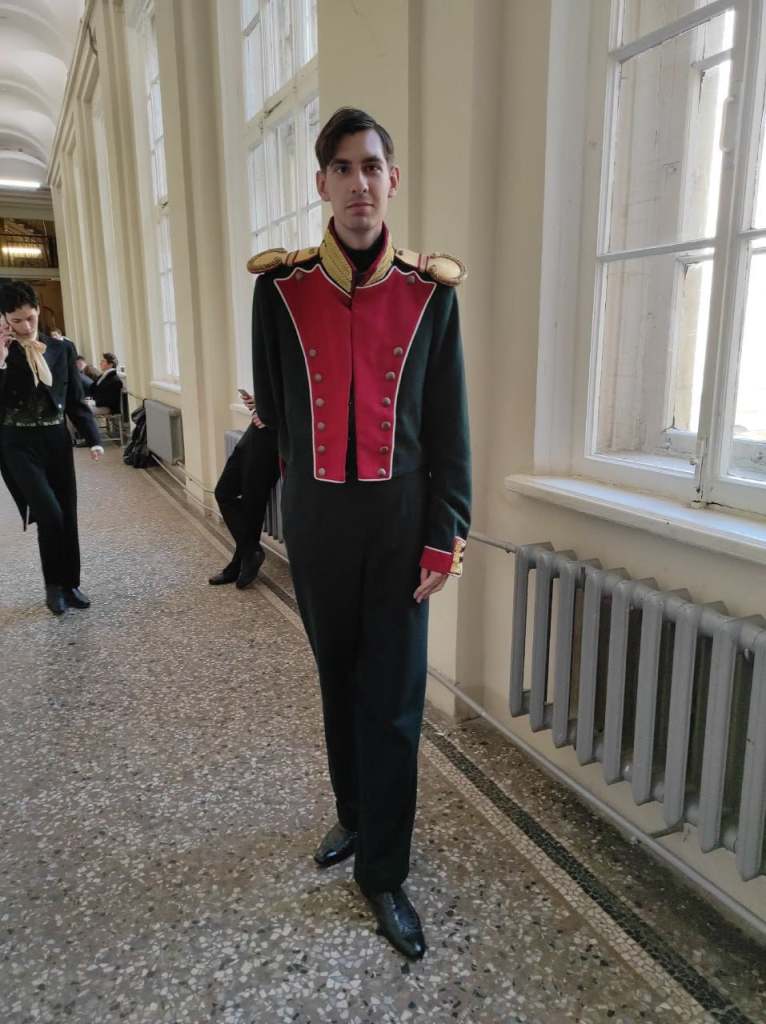
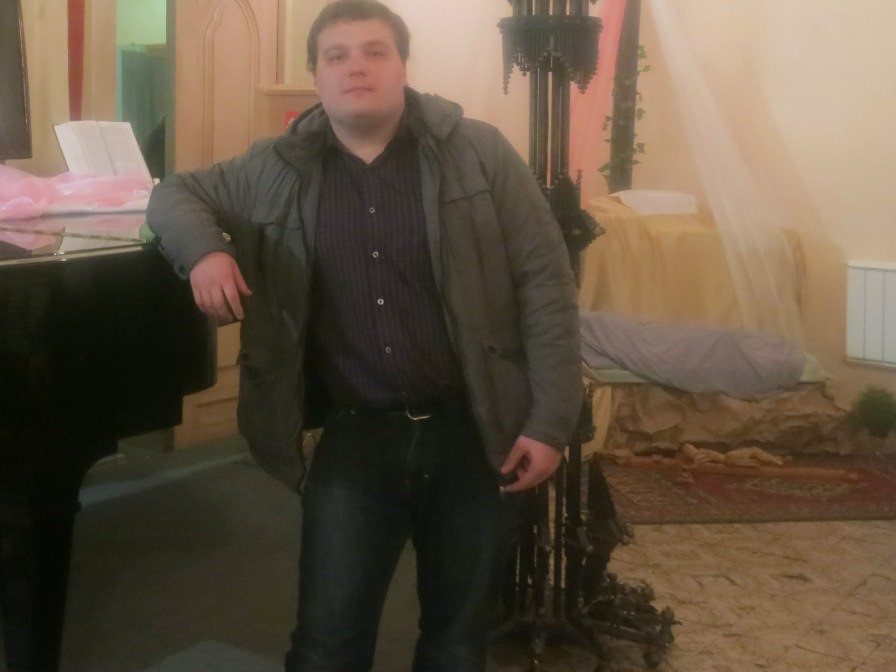
The 1st Western District Military Court in St. Petersburg sentenced Daniil Belousov to seven years in prison on multiple counts of “condoning” terrorism,” our correspondent reports. The indictment states that Belousov was an administrator of the project Media Partisans, which was declared a “foreign agent” in March of this year.
The prosecutor had requested a nine-year sentence. Belousov’s case was heard in closed chambers.
Bumaga first learned of Daniil’s arrest in March in a letter from Pavel Sinelnikov, a defendant in the Vesna Case. At the time, Belousov was being held in the Crosses pretrial detention center.
The case stemmed from a message posted in a public chat group called “No to War” (Net voine), Sinelnikov reported. Bumaga located a chat with that name where Belousov had posted photos of a pro-Ukrainian rally, organized by Ukrainian refugees near the [Moldovan] parliament building in Chisinau. The chat is linked to the Media Partisans project.
In April, Ostorozhno, Peterburg reported, citing a source in the FSB, that an administrator of the Media Partisans chat had been detained in Petersburg. According to security officials, the detainee had urged Russians to join the Russian Volunteer Corps and the Free Russia Legion. SOTA clarified that the individual in question was Daniil Belousov.
Daniil Belousov has a disability dating back to childhood: he suffers from a residual organic lesion of the central nervous system. He finds it difficult to secure employment and requires constant care, Oleg Belousov toldBumaga. Oleg Belousov raised his son as a single parent. And yet, according to the website Kino-teatr.ru, Belousov junior has appeared in several Russian films over the past three years.
Oleg Belousov is an amateur archaeologist from Petersburg who in late March 2023 was sentenced to five and a half years in a medium security penal colony under the law prohibiting the dissemination of “fake news” about the Russian army. According to investigators, Belousov senior had called Putin a war criminal and wrote about war crimes in Bucha, Hostomel, and Irpin in a private VKontakte chat group for treasure hunters.
Before his imprisonment, Oleg was unemployed and lived on state benefits, as he has a third-class disability due to an arm injury. In February, the EU identified the judge who sentenced Belousov senior as “culpable of serious human rights violations.”
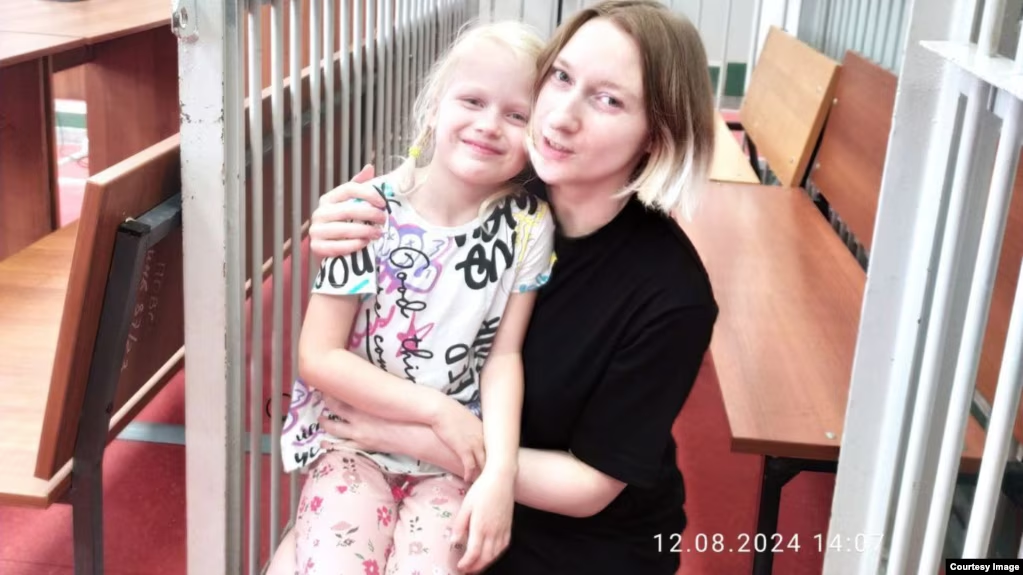
Polina Yevtushenko with daughter Alisa in court, August 2024
Polina Yevtushenko had deleted the social media posts for which she was tried prior to criminal charges being brought against her, she did not commit high treason, and her so-called crimes were victimless. And yet, she has been in a pretrial detention center for almost three years, and the prosecution asked the court to sentence her to eighteen years in prison. According to her lawyers, this would have been the longest sentence ever handed down to a woman in post-Soviet Russian history for a nonviolent crime that was not even committed. Today, the Central District Military Court found Yevtushenko guilty as charged and sentenced her to fourteen years in prison.
“This case is totally fabricated and unfounded. It’s completely unfounded, and the recordings that do exist and were submitted to the court speak to Polina’s innocence. In them, she repeatedly tries to dissuade her acquaintance Komarov from joining the Free Russia Legion. He made her acquaintance specifically so that this vile criminal case would be brought against her. This is a provocation,” say Polina’s acquaintances who attended the trials. (We are not naming them for their own safety.) “Polina is a courageous person. She’s a fine woman and never loses heart. It’s simply monstrous that she has been given such a long sentence for no reason.”
“I thought they were taking me to be killed”
Polina Yevtushenko, who is from the city of Togliatti, in the Samara Region, is twenty-seven. In July 2023, she was arrested for allegedly “inciting a Samara [city] resident to commit treason by defecting to the enemy, namely by joining the armed group the Free Russia Legion in order to take part in hostilities against the Armed Forces of the Russian Federation on Ukrainian soil” (per Article 30.1 and Article 275 of the Criminal Code of the Russian Federation: “preparation of terrorism”).
On that day, she took her daughter Alisa to kindergarten, and when she left, more than a dozen plainclothes security forces officers were waiting for her.
“They put cable ties on my hands and threw me into the car as if I were a sack of potatoes. Then these men got into the car and placed their feet on me. They didn’t explain anything. I thought that they were gangsters and that they were taking me to be killed. I screamed and called for help,” Yevtushenko later recounted.
After Yevtushenko was arrested, she was charged with five more crimes: publicly calling for terrorism on the internet (a violation per Article 205.2.2 of the Russian Federal Criminal Code), publicly calling for extremism, also on the internet (Article 280.2), disseminating knowingly false information about the deployment of the Russian Armed Forces, motivated by political hatred (Article 207.3.2.e), and condoning Nazism (Article 354.1.4). According to the FSB’s Samara office, she persuaded an acquaintance to go and fight in the Free Russia Legion, carried out “propaganda work,” and “posted instructions for Russian military personnel on how to surrender.”
Seven dates and “high treason”
Polina Yevtushenko
In this photo, Yevtushenko is a slender young woman with blue hair like Malvina’s, wearing a t-shirt and pink jeans. She raised her young daughter alone and painted pictures, which she posted on her Instagram and VKontakte accounts. She also publicized her anti-war views on these social media accounts, republishing a petition demanding Putin’s resignation over the war he unleashed in Ukraine, posts from the Free Russia Legion (at the time, it had not yet been deemed a “terrorist organization” by the Russian Supreme Court and was not yet banned), and instructions on how to surrender in order to survive the war. She was always quite sociable and interested in all kinds of people, easily meeting new people and making friends, according to her acquaintances.
Nikolai Komarov wrote to Yevtushenko on VKontakte. He said she was very pretty and drew beautifully, and that he really wanted to meet her and date her. What is more, her page said that she used to work at a Yota store, and he had a question he couldn’t figure out himself, so maybe she could help? He lived in Samara, she lived in Togliatti, an hour away by bus, but that was not a problem—he would come to Togliatti.
“They had a total of seven dates,” says a [male] friend of Yevtushenko’s. “He always told her how much he liked her. He invited her out to eat. They went for bike rides, went bowling, and sang karaoke together. He asked her about her pictures and her daughter. That is, he made it patently clear that he was interested in her as a woman and that he was courting her.”
It later transpired that the only dates with Yevtushenko which Komarov didn’t record on a dictaphone were the first two.
“He would constantly tell her that he was afraid of getting drafted and wanted to leave Russia, and asked her to advise him where to go, what to do, and how to make a living,” Polina’s friend continues.” She would reply that if he was so afraid, he should go to China or Kazakhstan, open a Wildberries or Ozon outlet there, and not worry. But he kept bringing up the subject again and again, asking her about the Free Russia Legion, whose posts she shared on social media. Polina told him that they were fighting Putin and that was why she supported them, that she had Ukrainian blood and opposed the war. At the trial, recordings were played of Polina telling Komarov many times that he should not go there and get involved, of her trying to talk him out of it. But Komarov kept at her: ‘I want to join the Legion, let’s choose a “street name” for me.’ (That was his term for ‘call sign.’) She communicated with him in a friendly manner and did not want to get closer because the conversations were always the same.”
Yevtushenko was later asked why she had not immediately pegged Komarov as a provocateur. She replied that she had believed “the FSB would not employ such dimwits.”
In court, Komarov testified that he had independently recorded Yevtushenko’s conversations on a dictaphone, but then became frightened by what she was saying and decided to hand the recordings over to the FSB because he thought she could get him into trouble. The recordings show signs of editing, with conversations cut short, Yevtushenko said in court. During the investigation and the trial, her defense demanded access to the complete recordings, but they allegedly do not exist. Komarov claimed that he had long since sold both the dictaphone and the laptop from which he transferred the recordings to discs for the FSB at a flea market. The court took him at his word.
Center “E” operative, FSB agent, or just a criminal on the hook?
In 2009, Nikolai Komarov was sentenced to two years’ probation for stealing a Sony Ericsson mobile phone, Kholod has discovered. While his probation was still in force, Komarov was caught again and charged with seventeen counts of theft of cable and internet equipment. In May 2011, he was convicted and sent to prison for two years and one month, but in April 2012, he was released on parole, after only eleven months in prison.
“He can actually be sweet, handsome, and charming. He knows how to get under your skin, and girls usually like him. He’s a bit of a con artist,” says a friend of Komarov’s.
You would thus never suspect that Komarov had had run-ins with the law. On the contrary, he maintained a Twitter account on which he demanded that the Samara municipal authorities fill in a pothole and finally resolve the issue of an open manhole cover, and he came across as a caring person and even a grassroots activist. This was before the war in Ukraine, however.
In 2017, Komarov showed up at the Navalny organization’s field office in Samara and introduced himself as a lawyer.
“He was a very active member [sic] of the field office. He wanted to be friends with everyone. He would invite people to barbecues, suggest that we drink vodka, hang out at the office all the time, and willingly do whatever needed doing—if we needed to buy water, he would go buy it without question. He took part in our campaigns and protest rallies,” says Marina Yevdokimova, who was a staffer at Navalny’s Samara field office at the time. In 2021, after the organization’s field offices were shut down across the country, she fled Russia.
In 2019, during the COVID pandemic, Yevdokimova was the field office’s social media manager.
“We had just reached the peak of the outbreak, which we wrote about in a post on Telegram. We also wrote that doctors had no PPE. An administrative case was brought against me. The police were staked out near my home. They would knock on my door, but I wouldn’t open it, so then they would go to my neighbors and question them,” Yevdokimova continues. “There was a court hearing in May, and Kolya Komarov was a witness for the prosecution, to my surprise. He hadn’t been at the Navalny field office for a long time. He was upset with us because we hadn’t gone along with his strange proposals. He had then become friends with the Communists and NOD (National Liberation Movement) members, posted photos of himself with them, and participated in their rallies.”
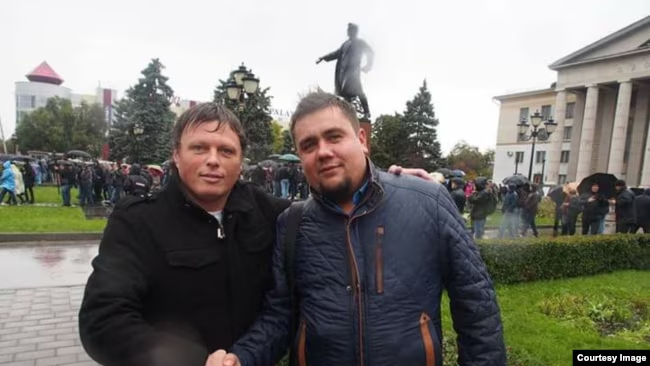
Denis Shepelsky (left), NOD’s “chief of staff” in Samara, and Nikolai Komarov. Source: Komarov’s VK page
At Yevdokimova’s trial, Komarov testified that he had seen her walking through the market in Microdistrict 15 and had allegedly heard her discussing on the phone that she would post this particular message on Telegram.
“I heard about her criminal intentions and could not fail to report them to law enforcement,” he told the court.
“Strangely enough, I was acquitted,” says Yevdokimova. “The lawyer asked [Komarov] simple questions that [he] couldn’t answer properly: ‘Where do you live? How did you end up in the market at that time?’ This was during the pandemic and no one could move freely around town. Besides, many people had access to our Telegram channel, so it was impossible to prove that I was the one who had posted it.”
Yegor Alasheyev, another former staffer at Navalny’s Samara field office, also emigrated from Russia.
“In March 2017, we held a rally called ‘Dimon Will Be Held to Account,’ at which twenty-three of our supporters were detained,” Alasheyev recalls. “We appealed all the fines [imposed on them as punishment] and they were later overturned. Komarov was also detained, but he turned down our assistance, saying that he was a lawyer himself and ‘knew what he was doing.’ It later transpired that he had pleaded guilty and been sentenced to pay a fine. At first, he kept quiet about the situation, then he telephoned our office and asked us to pay the fine. (At that point, he had already stopped hanging out with us.) I told him that we needed to talk to the lawyers and come up with a plan. But he refused to talk to them, and two weeks later, a video was released on TV featuring a ‘disenchanted Navalny volunteer.’ Soon after, he started attending NOD rallies. We looked into Komarov and learned that he had been convicted of stealing cable, but we had suspected that he was here for a reason even prior to that. He always hung around the office and listened carefully to what we were saying. But we didn’t pay much attention to it—he had seemed harmless. We understood of course that someone would inevitably be planted in our midst and that we were being watched.”
In 2022, Protocol Samara discovered that Alexander Melikhov, whom Komarov had befriended, had been planted in the local Navalny field office. Melikhov was a lieutenant colonel in the police, and his surname and passport had been changed for the sake of this operation. Yevtushenko’s acquaintances do not rule out the possibility that both men infiltrated the organization at the same time.
During Yevtushenko’s trial, it transpired that another criminal case had been opened against Komarov. He had been charged with thirty-seven crimes under Article 173.1.2.b of the Russian Criminal Code (“illegal creation of legal entities or provision of documents”). He was sentenced to 330 hours of compulsory community service.
“It seems that he has long been firmly ‘on the hook’ of Center ‘E’ (the Russian Interior Ministry’s office for combating ‘extremism’ and ‘dissidents’—Sever.Realii) and the FSB, but they cover for him. He created thirty-seven fake companies and only got community service,” says a lawyer working in Russia.
A new method of recruiting?
In July, it will have been three years since Yevtushenko was jailed in a pretrial detention center. In June 2025, she was found guilty of “violating” the center’s rules for passing store-bought cookies to a neighboring cell. In July of the same year, she was sent to solitary confinement for ten days because she had described her court hearings in her letters. All this time, she has only been able to see her daughter through glass; the judge has allowed them one-hour visits. Yevtushenko’s parents have been raising Alisa.
“Visits take place through glass over a telephone and last one hour. During this hour, I talk alternately with my mother and with Alisa. During the last visit, I brought a sketchbook with me in which I draw pictures for Alice. She really liked it,” wrote Yevtushenko from the detention center. “Before that, I showed Alice some old photos of us from the time before my arrest, but she started crying, so I decided not to do that again… Of course, conversations through glass can hardly be called visits, but we are grateful for what we have. I really miss hugs. I want to hug and kiss Alisa, but I can’t.”
“Polina gets plenty of letters at the detention center. Many people support her because they understand the injustice of what has been happening to her. She doesn’t get discouraged, she rejoices in every little thing, and she has been learning English by mail,” says a friend of Yevtushenko’s who has attended all the court hearings in her case. “How do we usually imagine sting operations carried out by the special services? They involve persuasion, bribery, blackmail—the classics of the genre. But a new method has supposedly emerged in Polina’s case, which we learned of when FSB expert Tatyana Naumova was cross-examined at the trial. According to her, in a new manual developed by FSB criminologists, which has not been made available to the public, a new method of recruitment is [defined]: it is deemed ‘propaganda’ and ‘recruitment’ when someone praises something—for example, when someone claims that the Free Russia Legion has good equipment. Polina’s defense asked to review this secret manual, but the judge turned down their request. The defense lawyer then asked the judge to examine them himself and confirm that everything was indeed written that way there. But the judge refused to do so. Naumova also said that Komarov was ‘a person conducting covert operations.’ In other words, she effectively admitted in court that the special services had organized a sting. From the point of view of the European Court of Human Rights (ECHR), this is a gross violation of the right to a fair trial (per Article 6 of the European Convention on Human Rights). Evidence obtained in this way is considered inadmissible by the ECHR. And Russia, until it ceased to be a party to the Convention due to the war it unleashed in Ukraine, had been repeatedly punished for this” (e.g., in Vanyan v. Russia, 2005, and Lagutin and Others v. Russia, 2014—Sever.Realii).
An excerpt from Polina Yevtushenko’s closing statement at trial
“Your Honor, you have known me for almost two years. I am confident that during these two years you have been persuaded that I pose no danger to the community and that I can be released.
“For two years, I have only been able to see my daughter through glass and cannot even hug her. I did not see her at all during the first year [in police custody]. Last year, Alisa started first grade, and this year, on March first, she will turn eight years old. She needs her mother’s love, care, and help, and I need even more to be with her, to see her grow up, to raise her, to take care of her. I need to make sure she becomes a decent person—well-mannered, smart, well-read, and fond of our Motherland.
“Your Honor, I ask you to release me so that I can raise my daughter. Be a conduit of happiness for two loving hearts—those of a mother and her child. I have never committed treason. I love my Motherland, Russia, and would never do anything to harm her. If I have made any mistakes or committed violations, then being in prison for almost three years is more than enough punishment for me.
“I have come to grips with everything [I have done] and promise you that from now on I will behave in such a way that you shall never be ashamed of me. I ask you to make a just decision and release me to be with my daughter.”
According to a study by the human rights project First Department, between February 2022 and mid-December 2024, 792 people in Russia were charged with treason (per Article 275 of the Russian Federal Criminal Code), espionage (Article 276), and secret cooperation with a foreign state (Article 275.1). In 2024, 359 people were found guilty and sentenced to actual prison terms on these charges, and four more were sentenced to compulsory psychiatric treatment. Of these 359 people, 224 were found guilty under Article 275, 38 under Article 275.1, and 101 under Article 276. A total of 536 people have been convicted of violating these criminal code articles since the start of the war; Russian courts have not handed down a single acquittal. According to First Department, a significant number of these cases were based on sting operations carried out by FSB officers or persons associated with them.
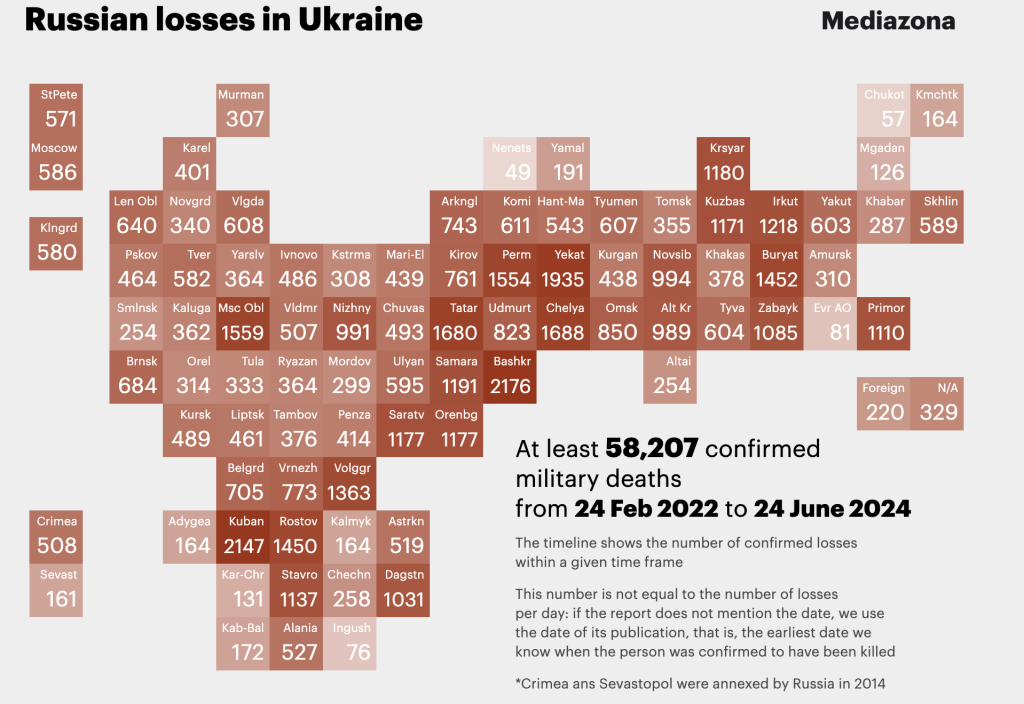
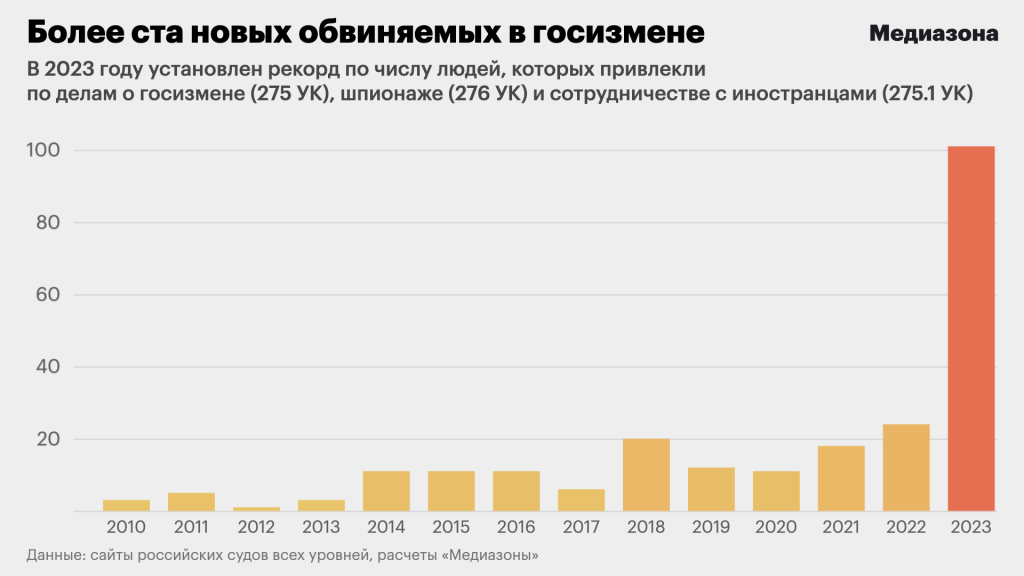
Screenshot of Mediazona infographic, as published here
Russia is losing more and more men in its war against Ukraine.
As of 5 July 2024, Mediazona and its partners in the casualty counting project have ascertained the names of more than 58,000 Russian soldiers killed in action.
The real losses are twice as many, however. Journalists have calculated the actual number of war dead based on information from the probate registry. How they did their work is described in this article by Mediazona. You can read here about how our methodology has been corroborated.
The real losses of the Russian army, including mercenaries, in the war against Ukraine, come to 120,000 dead. The Russian army’s casualties are thus already greater than both the number of US military deaths since the Second World War and all the losses of the Soviet and Russian armies since 1945. Most of the men killed were between the ages of twenty and forty. Those who were younger were usually draftees and prison inmates, while those who were older were “volunteers.”
Seventeen thousand prison inmates recruited by the Wagner Group perished at Bakhmut, according to the mercenary organization’s own documents, as examined by Mediazona. Meanwhile, journalists had estimated that Wagner had lost around sixteen thousand men, which is nearly the same number. Wagner has recruited a total of 48,366 men during the war, meaning that a third of them were killed in the so-called Bakhmut meat grinder.
Prison inmates, “volunteers,” and conscripts, if we judge only by confirmed deaths, have borne the brunt of the losses in the war. At 47.4 percent, they constitute almost half of those who have been killed.
In over two years of war, 3,700 officers of the Russian army and other security forces have been killed, 430 of them in the rank of lieutenant colonel and above.
Between 200 and 250 men are killed every day. This year, the Russian army’s losses have risen dramatically. In 2023, an average of about 120 men were killed every day.
There are two points of view on Russia during the full-scale war. The first is that Russia has turned into a fascist militaristic state in which everyone marches in step and sincerely hates Ukraine. The second is that cynicism and apathy have won the day in Russia: people don’t care about the war as long as it doesn’t affect them personally. Both of these views are mistaken, according to the authors of “We Have to Live Somehow,” a study from the Public Sociology Laboratory (PS Lab).
The researchers traveled to Krasnodar Territory, Buryatia, and the Sverdlovsk Region, living there for a month and interacting closely with the locals. What they tell us does not fit into either of the two common stereotypes about Russians and the war. Here are a few of the tendencies they observed.
The war is invisible in daily urban life. Residents in the Sverdlovsk Region town of Cheryomushkin (whose name was deliberately changed by the researchers) could not recall a single event in support of (or against) the war during the year. In Ulan-Ude, the capital of Buryatia, the pro-war agitprop consisted of a single poster on a Lenin monument. In Krasnodar, pro-war banners still hung on buildings, but people had long ago removed pro-war stickers from their cars. There is no institutional support for the war at the municipal level: such support is the bailiwick of ideological loners and small groups of pro-war volunteers.
Apolitical Russians justify the war, but arguments like “NATO soldiers” and “defending Donbas” are not of primary importance to them. Rather, they simply want to save face themselves, because they take the accusations directed at their country personally. For this reason, Russians have previously been inclined to justify the actions of the state, even when they do not understand or approve them.
The majority of the populace is not opposed to the war. They may disapprove of it in some respects, but they simultaneously defend the state. For example, in the Sverdlovsk Region, women were outraged by the deaths of young soldiers at the front (“They are sending children to fight! Why?!”) while also parroting the propagandists’ arguments about the war against the “collective West” (“Them United States are hammering civilians!”). Non-opponents of the war argue that Russia has been proactive, defending itself rather than attacking (“Now the Luhansk and Donetsk Republics are part of Russia, but our guys aren’t advancing any further—they’re defending all of it”).
Non-opponents of the war regard the residents of Donbas as Ukrainians, not Russians. They scold Ukrainians from the “Donetsk People’s Republic” and the “Luhansk People’s Republic” (“They don’t defend themselves. They’ll be coming here [to Russia], and what, I’ll have to go fight in their place? I don’t want that”) and do not regard these areas as “their own” (“They are not my blood relatives, they are not my own people”).
While opponents and supporters of the war initially had bitter conflicts, solidarity between them has emerged despite their differences of opinion. Those who generally condone the war are increasingly questioning the official version of events, while those who oppose the war are beginning to listen to their opponents (“I have to build a life and continue living with these people”).
Russians try to pretend that the war has not impacted their daily lives in any way, but its signs still permeate their everyday lives and conversations. In the Sverdlovsk Region, a woman is going to “go to great lengths” to prevent her son from serving as a contract serviceman. In Buryatia, a volunteer says mundanely, “I have eight grandchildren, all boys. And it just happened that four more died at the front.” In Krasnodar, a sociologist’s source says he is glad that the city is not being bombed and that the “Wagnerians” did not come their way, but then confesses in a low voice that the future is hazy and “let’s put it this way: things have become a bit tense.”
The big takeaway, however, is that Russians are pushing the war to the back of their minds. And this is bad news for the Kremlin: it has failed to convince the public, over the past two years, that the invasion was launched in pursuit of noble ends. Even as they justify Russia, its citizens don’t understand what good the war does for them personally.
A week ago, a Moscow court sentenced fifteen-year-old Arseny Turbin to five years in prison after convicting him on charges of “involvement in a terrorist organization.” The security forces accused the schoolboy of aiding the Free Russia Legion, which has been officially banned in Russia.
Arseny lived with his mother Irina in the small city of Livny in the Oryol Region. Although he was one of the most successful pupils at the local prep school, he was bullied by his classmates, and yet his teachers did not respond to his complaints. At the war’s outset, Turbin supported the Kremlin’s actions, but later became disillusioned with the government and took an interest in politics, even telephoning [exiled online news channel] TV Rain and telling them that the Conversations about Important Things lessons at school were “utter nonsense.”
In early June 2023, Arseny wrote an email to the Free Russia Legion (an organization we described in detail in a previous newsletter). He wanted to сampaign against the war, but they asked him for too much personal information and he did not send the application form to these strangers. Instead, he started distributing leaflets criticizing the authorities and taking pictures of himself in front of the white-blue-white flag. (The Russian authorities regard this flag as a symbol of the Legion, which has been fighting against Russian forces in Ukraine.)
Meanwhile, a strange thing happened. Turbin made the acquaintance of someone called Maxim, who immediately gave him access to the Telegram channel Occupy Slutophilia 14 (similar names have been used on the Web by the fans of the late Russian neo-Nazi activist Maxim “Tesak” Martsinkevich) and asked him to help with the channel’s content by editing videos. The channel had only a few subscribers, and it featured posts in support of Yevgeny Prigozhin and far-right content revolving around Tesak. Investigators then used Turbin’s involvement in the channel to accuse him of neo-Nazism, despite the fact that the schoolboy’s father was from the UAE, and Turbin himself had been bullied at school due to his dark skin.
At the end of the summer, FSB officers searched the Turbins’ home and summoned Arseny for questioning. It was a very strange conversation: for almost an hour and a half, in different ways, two investigators questioned the schoolboy about his connections with the Free Russia Legion. At the end of the conversation, as Mediazonadiscovered, they assured the teenager that it was “normal” and “not against the law” to send an application to the Legion, which has been declared a “terrorist organization” by the Russian authorities.
The court was not interested in this peculiar circumstance, however. It was interested in Turbin’s statement, allegedly made during the interrogation, that he had sent the application: this was the basis for the charge that he had “joined” the “terrorist organization.” The thing is that Turbin did not say this. Mediazona has in its possession a full transcript of the conversation, and it simply does not contain mention of Turbin’s sending off the application. The investigators inserted it for their own convenience.
Irina Turbina was present at the interrogation. She says that the investigators retyped the statement three times because of mistakes, and suggests that they could have discreetly amended it after lulling her into a false sense of security.
After seeing the transcript, the investigator, Trunov, had even wanted to close the case. In February 2024, however, the investigation was assigned to another investigator, Irina Simonova. She spun the line about Turbin’s alleged neo-Nazi views, obtaining testimony from the boy’s classmates, who assured her that his “idol was the so-called Tesak,” that he had advocated “exterminating the Ukrainians,” and had supported Alexei Navalny. Irina Turbina does not believe this testimony, producing correspondence in which her son called Tesak a “blockhead” and himself a “liberal.” Turbina argues that her son’s classmates testified against him in exchange for “excellent high school diplomas.”
Due to the increased harassment at school, Turbina transferred Arseny to home schooling. He managed to pass his year-nine exams before the verdict was handed down. On 21 June, the court sentenced Arseny to five years in prison, although the prosecution had requested an even longer sentence of eight years. After the sentence was read, he burst into tears, telling his mother, “Mom, I’m sorry—forgive me for letting you down. But I really didn’t know I was violating any laws.”
No one looked for the mysterious Maxim. The court was also uninterested in Turbin’s conversation with the FSB officers who openly provoked the schoolboy and falsified his statement.
PROMPT: Make an illustration on the theme of “Russia’s Fascist Meltdown”
Creating an illustration on the theme “Russia’s Fascist Meltdown” involves capturing the essence of nationalism, authoritarianism, and geopolitical tension. Here’s a description of an illustration:
The illustration features a powerful and imposing figure symbolizing the Kremlin, with a stern-faced leader resembling Vladimir Putin at the forefront. Behind him, the Russian flag waves prominently, but instead of the usual tricolor, it blends with darker hues suggestive of authoritarian control. The background is a stark urban landscape, reminiscent of Moscow’s skyline, but with ominous shadows and smoke rising in the distance.
In the foreground, there are smaller figures representing dissenters and protestors, their faces obscured in shadows or masked to symbolize anonymity and resistance. They hold signs with slogans advocating for freedom and democracy, contrasting sharply with the dominant figure of Putin. The atmosphere is tense, with a palpable sense of division and discord.
To further emphasize the theme of “meltdown,” the illustration includes elements like cracked ice or fire, symbolizing internal turmoil and instability within Russian society. The color palette leans towards shades of red, black, and grey, evoking a sense of danger and crisis.
Overall, the illustration aims to visually convey the complex and contentious dynamics surrounding Russia’s shift towards authoritarian nationalism, capturing both the gravity of the situation and the resilience of those who oppose it.
Vyacheslav Luthor, as seen in his online CV at Careerist.ru
The Second Western District Military Court in Moscow sentenced Vyacheslav Luthor, a bank clerk from St. Petersburg, to ten years in prison after finding him guilty of charges of high treason, secret collaboration with the representative of a foreign power, and involvement in a terrorist organisation, over his alleged attempt to join the [pro-Ukrainian] Free Russia Legion. Despite the fact that the courts usually hear such cases in closed chambers, our correspondent was able to attend one of the hearings. Thus, it transpired that last summer Luthor had been contacted by a recruiter who promised him a new job, a high salary, and assistance moving abroad.
Born and raised in Krasnoyarsk, Vyacheslav Luthor is thirty-three years old. According to his CV, he graduated from the local affiliate of the Moscow State University of Economics, Statistics and Informatics (MESI) in 2014, before working as an accountant in the local state statistics bureau and as a manager in real estate and trading companies. After moving to Petersburg, he took a job at Bank Saint Petersburg, which is also listed as Luthor’s place of work on his hidden VKontakte page.
The case against the bank clerk came to light last summer. On 29 July 2023, Mediazona found a record of his arrest on the website of Moscow’s Lefortovo District Court. At that time the charges of high treason and involvement in a terrorist organisation were listed there. Apparently, the charges were updated during the investigation, and so the Second Western District Military Court was asked to try Luthor on three charges: attempted high treason, confidential cooperation with the representative of a foreign power, and involvement in a terrorist organisation.
Previously, “high treason,” as defined by Article 275 of the Russian Criminal Code, was rarely charged, but after the outbreak of the full-scale war, involvement in combat on the Ukrainian side (or an attempts to go there to fight) and donations to the Armed Forces of Ukraine were equated with “high treason.” Also, a new article on “confidential collaboration” with foreigners—Article 275.1—was inserted into the Criminal Code.
2023 was a banner year in Russia for charges of “high treason,” according to Mediazona.
Last year, as Mediazona has discovered, at least 107 people were accused of high treason (Article 275), espionage (Article 276), or collaboration with foreign powers or organisations (Article 275.1). Many such cases are classified, so the actual number of people charged with these crimes may be higher.
The human rights project Department One wrote that sixty-three high treason cases and seven cases of collaborating with foreigneers were submitted to lower trial courts. Verdicts have already been handed down in thirty-seven cases. All of them were guilty verdicts.
Unlike the high treason cases of previous years, which were mainly transferred to Moscow, courts in the regions began hearing these cases in 2023, human rights activists note. According to our calculations, more than seventy percent of such cases are now being heard outside Moscow, in the places where the crimes were allegedly committed, but the arrests and indictments are usually made in the capital.
This is what happened to Vyacheslav Luthor. Before he was placed in a pretrial detention centre, he had been jailed twice on administrative charges: on 11 July 2023, for minor disorderly conduct (Luthor was accused of “using foul language, shouting loudly, and waving his hands” at the airport) and on 14 July 2023, for disobeying police officers (Lutor was jailed for fifteen days for allegedly refusing to show his passport to law enforcers). He was to be released from the special detention centre on the day he was sent to the pretrial detention centre on the criminal charges.
“He asked me to keep my fingers crossed for him”: the testimony of coworkers
The Second Western District Military Court began hearing the case against Vyacheslav Luthor on 5 February. The state’s case was made by prosecutors Igor Potapov and Dmitry Nadysyev.
Trials on charges of treason are held in closed chambers and members of the public are not allowed to attend them, but our correspondent was able to get inside the courtroom at the only open hearing. That day, the court questioned the prosecution witnesses’s from Petersburg via video conference, and it was from these interrogations of Luthor’s former colleagues that it transpired that the bank clerk was accused of having ties with the Free Russia Legion and attempting to leave the country to fight on the Ukrainian side. Luthor himself has denied his guilt.
Luthor’s boss described her attitude to her former employee as “neutral.” She said that last summer Luthor had asked for time off from 10 July to 19 July in order to fly to his hometown of Krasnoyarsk to deal with “family problems.” According to the investigation, Luthor had probably planned to leave Russia on these dates.
Responding to a question from Prosecutor Nadysyev, the defendant’s former supervisor said that she had never spoken to Luthor about politics or the war in Ukraine.
“Tell me, did Luthor ever come to work dressed in military-style clothing?” the prosecutor asked.
The supervisor replied that he came to the bank in regular clothes — a shirt and trousers. When asked by defence lawyer Yulia Kuznetsova whether Luthor had talked about the Free Russia Legion and his desire to leave to fight in Ukraine, she also answered in the negative.
“I didn’t know what this organisation was doing and didn’t pay much attention to it,” the witness said.
“Did Vyacheslav Alexandrovich inform you that he was going to be involved in combat?” the defence counsel clarified.
“No,” the witness replied, and then she added that the word “legion” made her suspicious, as it could be associated with military action.
A female colleague of the defendant said that Luthor had asked her to come with him, but she had turned him down. The woman noted that she had advised him to refrain from the trip, although she did not completely believe that he would dare to go, as she regarded Luthor as a “wallflower.” The prosecutors then petitioned the court to have the testimony given by the same witness during the investigation read aloud due to “significant discrepancies.” The defence counsel objected. Luthor himself, a large man with short hair and dressed in a warm jacket, supported all of his defence lawyer’s motions and answered the court’s questions briefly.
The court granted the prosecutors’ testimony. In her [original] testimony to investigators, the witness had described her correspondence with Luthor in more detail. In it, he said that he had been contacted by a representative of the Free Russia Legion, who had offered him a high salary, and explained his offer to her to go with him by the fact that the recruiter needed two people. In addition, Luthor had specified to her that he would be working in the “frontline zone.” Then he asked if she had acquaintances at the Almaz-Antey military plant [he probably had in mind the company’s Obukhov Plant in St. Petersburg], and afterwards advised her to stay away from it. Luthor himself confirmed in court that he had written this to the witness.
Another colleague of Luthor’s who was questioned in court could not remember what exactly he wrote to her, apart from the fact that he had been invited to work for the Free Russia Legion. Consequently, her [original] testimony during the investigation was also read out in court. When questioned, she had said that in late June 2023, Luthor wrote to her that while he was on sick leave, he had been contacted by “a certain organisation” that offered him a job in Poland. He later clarified that his contact in the “legion” told him that he needed to leave Russia, where a “civil war was about to kick off.” He explained that he was being “actively recruited” and had been asked to “go work in reconnaissance.”
On 5 July, he asked her to “keep [her] fingers crossed for him so that he comes back safe and sound.” The witness said that she “disliked” Luthor. She did not take what he said seriously, thinking he was making things up. Luthor once again confirmed that he had sent the messages.
Human rights activists from Department One have written that people accused of high treason are often “provoked” by Russian law enforcers themselves.
“FSB officers and field agents find those who are subscribed to the Legion’s social media channels (not only the real ones, but also fake ones), and [ask them to] send them messages via bot or fill out a questionnaire to join.”
The provocateurs then introduce themselves as members of the Free Russia Legion, the Russian Volunteer Corps, or the SBU [Security Service of Ukraine], and ask the victim to do something: to take pictures of a military recruitment centre or an FSB building, to paste up [anti-war] leaflets, to set fire to a military recruitment centre or buy equipment, and then to fly to Turkey via a particular airport.
“The FSB denies they are involved in these provocations,” wrote Department One. “The[ir] official position in the courts is that it was allegedly done by the Ukrainian special services.”
The human rights activists also noted that the provocateurs sometimes write even to random people who have not voiced their opinions about the war on social networks. They “initiate friendly chats, introduce themselves as people who work on behalf of Ukraine, and ask [their correspondents] to do something.”
“He was constantly being provoked”: the mother’s testimony
“I’m alarmed — I haven’t seen my son for eight months,” was the first thing the defendant’s mother said when the judge asked how she was feeling.
Luthor’s mother, an energetic red-haired woman, had flown to Moscow from Krasnoyarsk to testify in the first hearing. In court, despite the fact that she had a hard time hearing the questions posed to her, she described Luthor’s childhood and their home life in detail. Even the prosecutor’s provocative question about her attitude to the “special operation” did not trip her up. Clearly understanding where Prosecutor Potapov was going, she said that she and her son considered what had occurred inevitable, but both of them were in favour of a peaceful end to the conflict between the two countries.
“What is your relationship with your son like?” the judge asked.
“It’s very good,” the woman assured him.
According to Luthor’s mother, her son has “a total aversion to violence, so there were problems with that at school.”
“He was constantly being provoked, and he asked his father to help him with it, but [he] has a father who believed that he had to defend himself,” the witness said.
According to his mother, Luthor did not serve in the army due to illnesses, and was not interested in military affairs or martial arts.
“We tried to send him to wrestling as a child, but after two classes he was kicked out for skipping. He just can’t hit [another] human being,” she said.
“My son never wanted to fight, he was afraid of it. He dreamed of travelling around the country and the world, even buying a trailer and driving it,” the witness said.
She said her son has hypertension, “a high degree of vascular and cardiac complications,” a stomach ulcer, and occasional panic attacks. Both she and Luthor’s father had medical conditions “galore”: [the father] had his knee joint replaced with an implant and was scheduled to have the other one replaced soon, but due to his small pension he still had to work despite his aching knees.
“He’s very nice,” the witness continued her account of her son. “He and I are close, and in terms of our views as well. He and I are not of this century: we are very trusting. He couldn’t pass a single beggar by.”
She added that Luthor had been afraid of [the military] mobilisation, although “there were no grounds [for this fear],” and he was not against leaving [Russia] if he had the opportunity.
She said that around the beginning of July he had stopped answering her calls, although they usually contacted each other every day. The mother went to the police and was told that Luthor had been detained for using foul language at the airport, although, according to her, Luthor did not swear as a matter of principle.
The witness said that her son liked his job at the bank and was very fond of Petersburg, where he had gone on her advice. She said that she did not know about his plans to travel abroad and that she was even going to visit him in August.
The prosecutor’s questions made it clear that at some point Luthor had asked his parents to help him pay off a debt.
“Tell me, what was the story when fraudsters allegedly stole money from your son’s [bank] card and you had to sell your property to cover the debts?” asked the prosecutor.
“‘Property’ is too strong a word, but we had to [sell] part of it. It was at MTS Bank,” Luthor’s mother replied. “We sold the garage and just part of that sum—”
“Well, what was the amount? Was it large?” asked the judge, interrupting her.
“Approximately two hundred [thousand rubles],” she replied.
“And did you discourage your son from filing a law suit or going to law enforcement [to tell them] a fraud had been committed?” the judge asked.
“Well, yes, I said it was useless,” she replied.
After the judge sighed heavily, the witness repeated that they were very gullible and she herself had fallen victim to fraudsters.
“Did you contact law enforcement?”
“Yes. They managed to recover part [of the money].”
“You see,” added the prosecutor.
“The rest is being earned back by my husband,” the witness said in conclusion. She was dismissed from the stand, and the journalists were asked to leave the courtroom.
Luthor’s trial took only five hearings, four of which were held in closed chambers. On 28 February, the prosecution asked the court to sentence Luthor to fifteen years in a high-security penal colony. The very same day, the court handed down the sentence: ten years of imprisonment, of which Luthor will spend the first two years in a closed prison, serving out the remaining eight years in a high-security penal colony.