Brut America, “French Senator criticizes Trump,” YouTube, 7 March 2025
French politician Claude Malhuret critiqued the United States’ shifting stance on Ukraine and targeted President Donald Trump in his remarks during a general session of the French Senate on Tuesday.
Source: YouTube. Thanks to Olga Klymenko and Nancy Ries for the heads-up.
Monsieur le Président,
Monsieur le Premier ministre,
Mesdames et Messieurs les Ministres,
Mes chers Collègues,
L’Europe est à un tournant critique de son histoire. Le bouclier américain se dérobe, l’Ukraine risque d’être abandonnée, la Russie renforcée.
Washington est devenu la cour de Néron, un empereur incendiaire, des courtisans soumis et un bouffon sous kétamine chargé de l’épuration de la fonction publique.
C’est un drame pour le monde libre, mais c’est d’abord un drame pour les États-Unis. Le message de Trump est que rien ne sert d’être son allié puisqu’il ne vous défendra pas, qu’il vous imposera plus de droits de douane qu’à ses ennemis et vous menacera de s’emparer de vos territoires tout en soutenant les dictatures qui vous envahissent.
Le roi du deal est en train de montrer ce qu’est l’art du deal à plat ventre. Il pense qu’il va intimider la Chine en se couchant devant Poutine, mais Xi Jinping, devant un tel naufrage, est sans doute en train d’accélérer les préparatifs de l’invasion de Taïwan.
Jamais dans l’histoire un président des États-Unis n’a capitulé devant l’ennemi. Jamais aucun n’a soutenu un agresseur contre un allié. Jamais aucun n’a piétiné la Constitution américaine, pris autant de décrets illégaux, révoqué les juges qui pourraient l’en empêcher, limogé d’un coup l’état-major militaire, affaibli tous les contre-pouvoirs et pris le contrôle des réseaux sociaux.
Ce n’est pas une dérive illibérale, c’est un début de confiscation de la démocratie. Rappelons-nous qu’il n’a fallu qu’un mois, trois semaines et deux jours pour mettre à bas la République de Weimar et sa Constitution.
J’ai confiance dans la solidité de la démocratie américaine et le pays proteste déjà. Mais en un mois, Trump a fait plus de mal à l’Amérique qu’en quatre ans de sa dernière présidence. Nous étions en guerre contre un dictateur, nous nous battons désormais contre un dictateur soutenu par un traître.
The Center for European Policy Analysis (CEPA) has called for increased economic pressure on Russia as well as secondary sanctions on companies supporting its war efforts in a new report, released Monday, timed with the Munich Security Conference kickoff. The public policy institution states that the former U.S. administration’s foreign policy had been too cautious, resulting in a “war of attrition that neither side can win.”
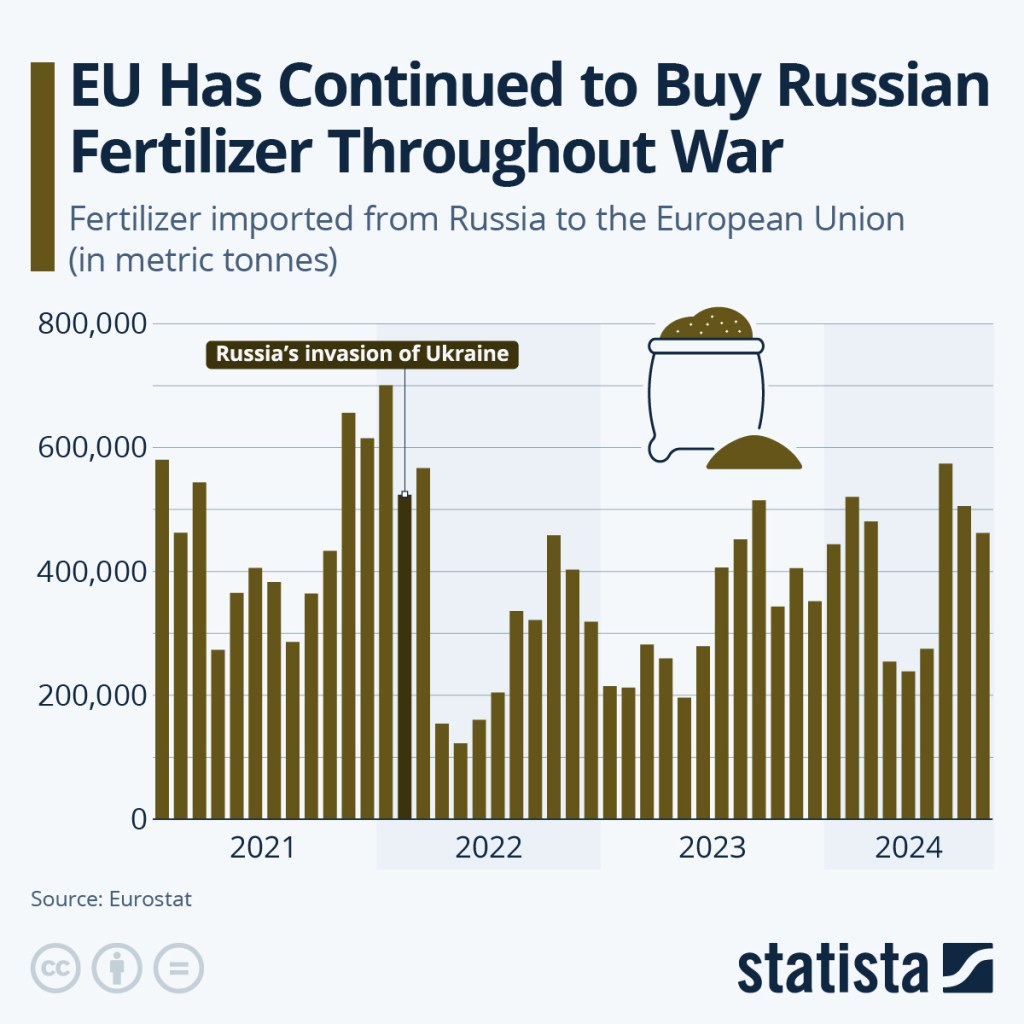
Despite heavy sanctions on gas and oil, the EU has continued to buy commodities such as fertilizer from Russia since its invasion of Ukraine in February 2022. Data from Eurostat shows that some 3.9 million tonnes of Russian fertilizers were imported to the EU in 2023 and 3.7 million tonnes were imported in the first nine months of 2024. In July 2024, 574,000 tonnes of fertilizers were imported to the EU, up 50 percent from July 2021, the summer before the war.
Last month, the European Commission finally proposed raising tariffs on fertilizers from the current 6.5 percent in proportion to the value to 100 percent in three years. If implemented, this means Russian fertilizers will likely continue to be imported until 2026. The proposed tariffs would bring a tonne of nitrogenous fertilizers to the sum of €315 and other fertilizers up to €430 per tonne. The measure is intended to support domestic production, allow for diversification of supply and cut off a financial flow to Russia’s economy. Until now, the EU has been resistant to placing sanctions on agricultural products from Russia due to global food security concerns.
While the proposal includes protective measures, European farmers warn of the risks associated with increased production costs as well as concerns over whether domestic production will be able to meet demand in time.
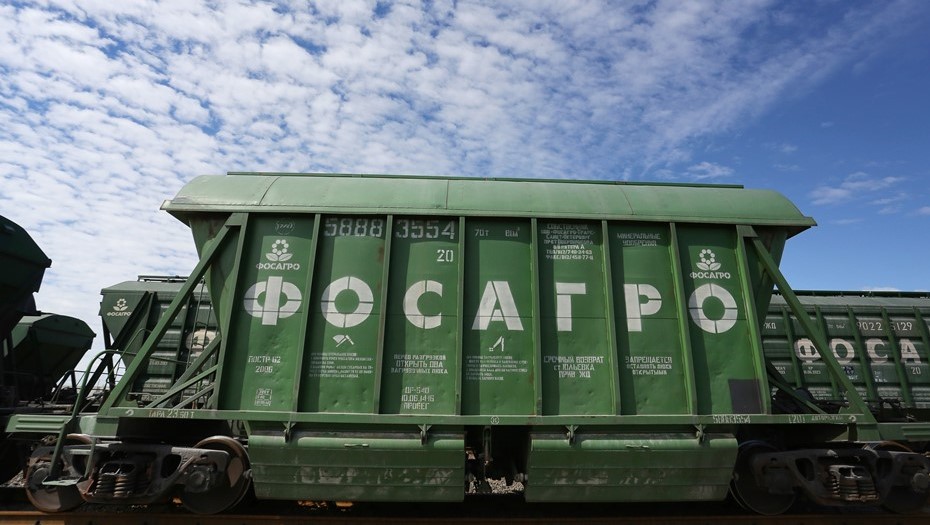
Every day Russian fertilisers move from the Vainikkala border crossing point to the Port of HaminaKotka in southeast Finland, where the major Russian fertiliser company Fosagro [sic] operates.
For food security reasons, the EU has allowed the import of Russian fertilisers since Moscow invaded Ukraine. This is why a freight train owned by North Rail Oy, a subsidiary of the Finnish logistics company Nurminen Logistics, makes daily transports of Russian fertilisers from the eastern border to the southeastern port.
These fertiliser-filled trains continue to run despite Russia’s nearly three-year war in Ukraine and the European Commission’s recent decision to impose import tariffs on Russian fertilisers in the bloc.
The Kremlin is now generating record-high revenues from fertiliser exports. Seven of the world’s ten largest fertiliser exporters are Russian companies, which collectively earned an estimated $1.4 billion last year.
Fosagro, with its presence in Kotka, is one of the world’s largest producers of phosphate-based fertilisers. It is backed by Andrei Guryev, a Russian oligarch and Vladimir Putin ally. He stepped down from the company’s leadership in 2022 after the EU sanctioned his son. Later, both the US and UK imposed sanctions on Guryev himself.
According to business magazine Forbes, Guryev and his family still own nearly half of Fosagro.
Yle asked how a sanctioned fertiliser oligarch’s exports are still flowing via Finland.
While Finnish Customs director general Sami Rakshit declined to comment on individual companies, he said that if a sanctioned individual holds a controlling stake in a company, the sanctions will also apply to the company.
At the same time, if Customs cannot demonstrate that the product, person, or company is subject to sanctions, the agency will not intervene.
“Fertiliser transport through the Port of Kotka is possible primarily for food security reasons,” Rakshit told Yle.
“When sanctions are being circumvented, shell company arrangements are often complex, making it very difficult to identify the true beneficiaries,” he added.
Russian connections
At the Port of HaminaKotka, Finnish firms Rauanheimo and Fertilog load the fertiliser onto ships. According to information obtained by Yle, Fertilog’s subcontractors employ Russian-background Finnish citizens and workers from the Baltic states.
The chairman of Fertilog Group’s board is Aleksei Sladkov, a Russian national living in Austria. The rest of the company’s leadership also has Russian-sounding names, though Yle does not know their nationality or whether they hold Finnish citizenship.
Fertilog has stated that it accounted for ten percent of the Finnish port’s traffic in 2020.
Most of the Russian fertilisers passing through Kotka are exported to North African countries and South America. Some also travel to other European countries, as long as they are not subject to sanctions.
In addition to Finland, Russia also exports fertilisers through Estonia and other Baltic countries.
In communicating with Fertilog via email, the company said its focus is on business and does not take a position on politics.
“We only handle fertilisers that are not subject to sanctions,” the company said via email.
The firm also claimed to have invested 80 million euros in the HaminaKotka port over the past 15 years.
“We’re a significant taxpayer and job creator in Kotka, both directly and indirectly,” the company stated.
According to Fertilog, the fertilisers they handle are exported to developing countries, where they play a crucial role in global food security, as well as to EU countries, where they contribute to the EU’s preparedness and security supply.
PhosAgro is a Russian chemical holding company producing fertilizer, phosphates and feed phosphates. The company is based in Moscow, Russia, and its subsidiaries include Apatit, a company based in the Murmansk Region and engaged in the extraction of apatite rock. The company is Europe’s largest producer of phosphate-based fertilisers.
Ownership history
The original owner of PhosAgro’s assets (most notably Apatit, a Soviet-era mining company) was exiled Russian billionaire Mikhail Khodorkovsky via his company, Menatep. In 2003, Khodorkovsky was arrested for tax evasion and fraud; the charges against him were ostensibly connected to Menatep’s purchase of shares in Apatit. However, some have seen the charges as punishment for publicly clashing with Vladimir Putin.
During Khordorkovsky’s trial, the state seized Menatep’s stake in Apatit. In 2004, Andrey Guryev, who at the time ran Apatit on behalf of Khodorkovsky’s Menatep and was also a Russian senator [sic], wrote a message to Khodorkovsky in prison to convince him to sell his remaining 50% stake in PhosAgro to Guryev. Khodorkovsky sold his shares to Guryev for a low price.
In July 2011, PhosAgro raised $538 million in a London IPO.
In 2012, PhosAgro paid $344 million at a state tender to buy back a 26.7% share in Apatit, bringing the company’s ownership to 76%.
As of 2012, Andrey Guryev and his family owned 5.47% of PhosAgro via various trusts.
PhosAgro is 19.35% owned by Vladimir Litvinenko, who oversaw Vladimir Putin’s plagiarized doctoral thesis in 1996.
In 2022, the company’s revenue amounted to 164 billion rubles.
In early 2015, current CEO Andrei Guryev Jr, Andrey Guryev’s son, was reported as saying, “PhosAgro is the most profitable phosphate fertilizer company in the world.”
PhosAgro is structured so that Guryev and his family are recipients of a trust, rather than outright ownership in their names, though Evgenia Guryev, Guryev’s wife, owns 4.82% of PhosAgro in her own name.
In July 2016, Forbes estimated his net worth at US$4.3 billion.
He is vice president of the Russian Union of Chemists.
[…]
Guryev is married to Evgenia and they have two children, Andrey Guryev, Jr. and Yulia Guryeva-Motlokhov. Andrey Guryev, Jr, is CEO of PhosAgro. Yulia Guryeva-Motlokhov is married to hedge fund manager Alexei Motlokhov, they have twin sons, and live next door in Highgate.
The Guryevs own Witanhurst in Highgate, London’s second largest house after Buckingham Palace, through an offshore company registered in the British Virgin Islands. He owns the five-storey penthouse of St George Wharf Tower in London. Guryev has never given an interview to the press.
Guryev owned a yacht, Alfa Nero, through an offshore company which is planned to be auctioned off in Antigua and Barbuda due to his sanctions.
Russian opposition forces will discuss with European officials the possibility of expanding opportunities for immigration from Russia to the EU countries. One of the measures they propose is a “relocatee card”: the bearer of this document would be able to freely obtain a residence permit in one of the EU countries, open a bank account, rent real estate, and get a job. The authors of the idea argue that the outflow of educated and well-off Russians can weaken Russia’s economic health while also “creating serious challenges to the Putin regime.” They argue this in a study on Russian relocatees in the EU, published on Tuesday, 11 June 2024.
The report was prepared by a new think tank, the Center for Analysis and Strategies in Europe (CASE), whose advisory board members from Russia are Dmitry Gudkov, Sergei Aleksashenko, Vladislav Inozemtsev, Andrei Movchan, and Dmitry Nekrasov. The study will be presented in Paris at the French Institute of International Relations (IFRI), which commissioned it. In the coming days, the report will also be presented at the PACE, the German Foreign Ministry, and the Bundestag, Gudkov said.
Portrait of Russian immigrants: good education, high income, anti-war views
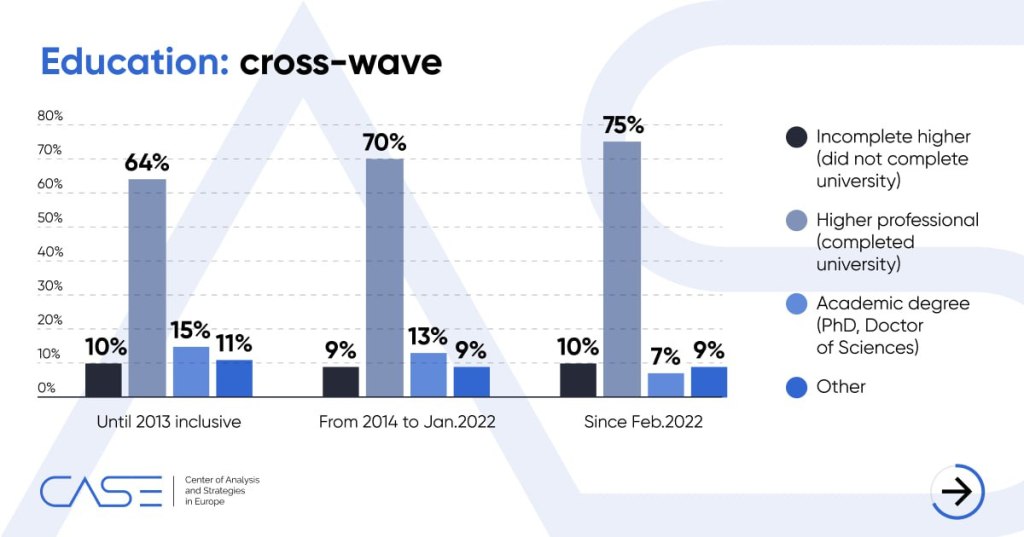
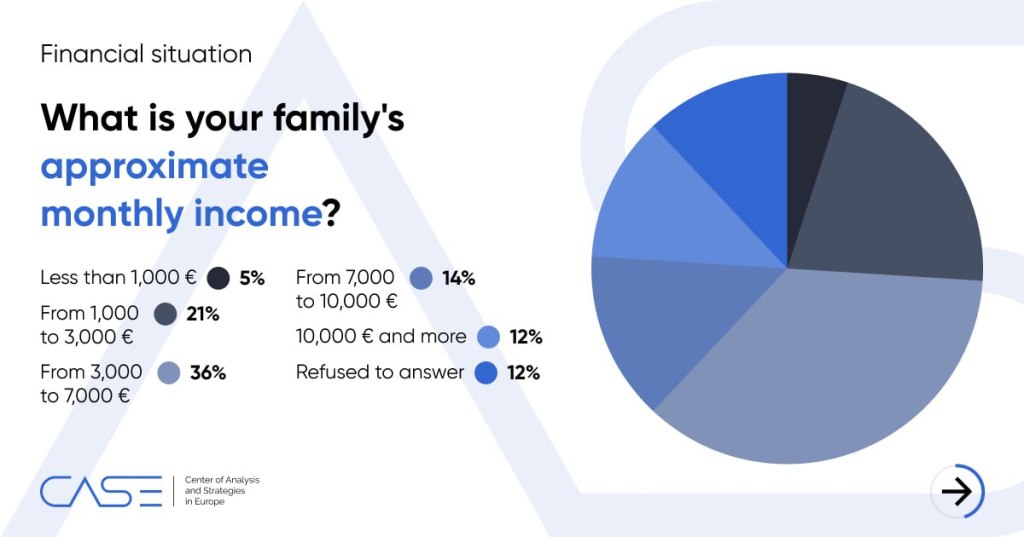
As part of the study, researchers surveyed three and a half thousand Russian nationals residing in France, Germany, Poland, and Cyprus. The results showed that most of those who left Russia after the start of the war in Ukraine — eighty-two percent — have a higher education or an academic degree. Sixty-two percent of those surveyed reported monthly earnings of three thousand euros or more. This category of people, Gudkov said, not only does not require benefits [sic], but also makes a significant contribution to the EU economy.
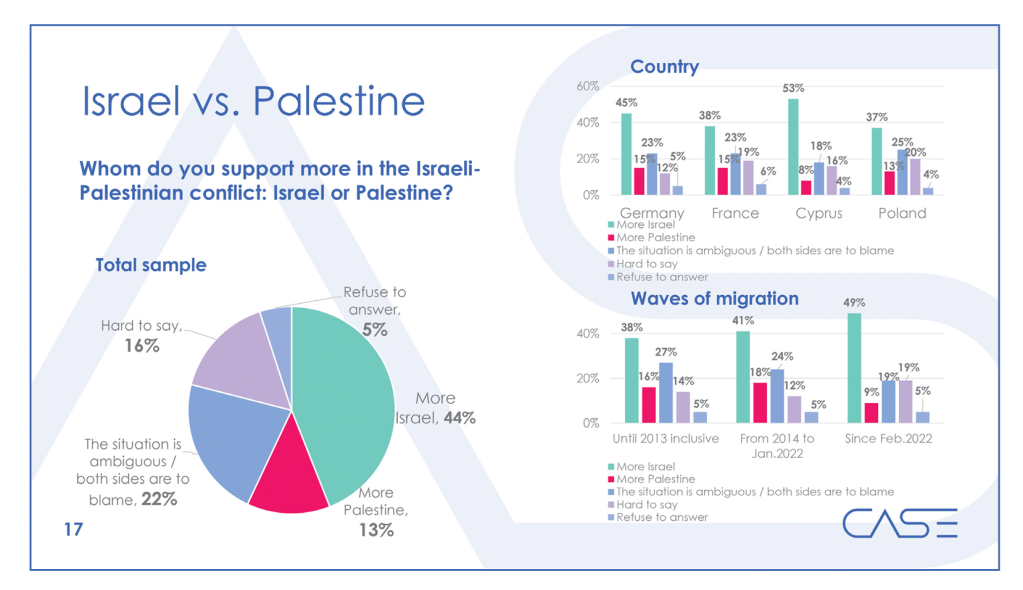
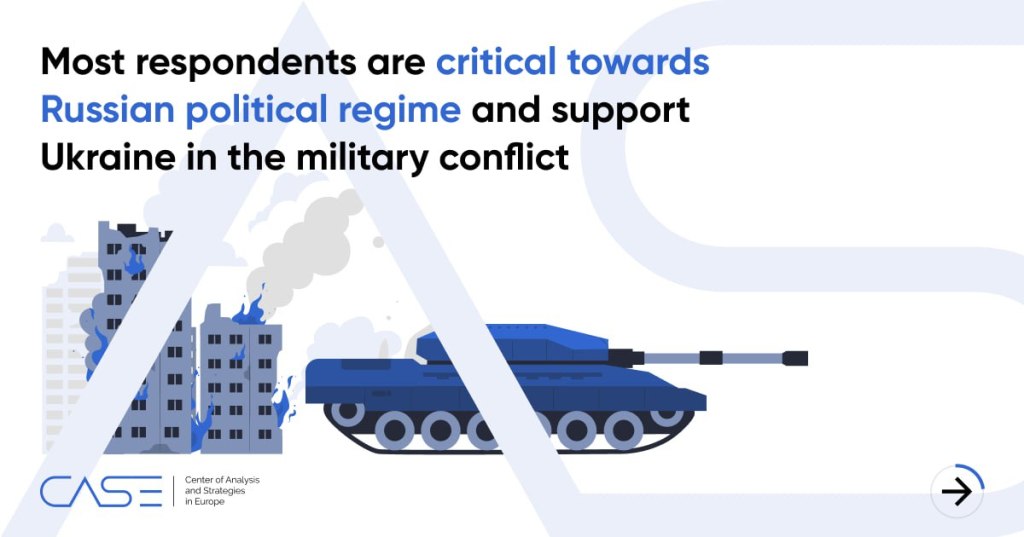
Among Russians who have relocated to the EU in the past two years, the vast majority oppose the policies of Russian President Vladimir Putin (79%) and support Ukraine (64%). Gudkov emphasizes that most relocatees are well-off, educated people with anti-war views.
“It is important that this is the work of European researchers confirming our long-standing argument that new immigrants from Russia hold European [sic] views. They oppose the war, and can rightly be called ‘Russian Europeans’. They are not a threat and represent an economic and social resource for European societies,” Gudkov told DW.
Report’s authors propose “relocatee card” for Russians
The study’s authors suggest that the authorities in the EU countries develop legal norms for the large-scale migration of Russian nationals to the EU, Gudkov said. According to him, Russian nationals now face restrictions in some European countries, including, for example, problems with obtaining residence permits and opening accounts in European banks.
The study proposes a new mechanism for attracting “economic migrants” from Russia to the EU: a “relocatee card,” whose holder could easily open a bank account, rent real estate, and get a job in one of the EU countries. The document, as stated in the report, could be valid for a year with the possibility of renewal. During this “trial period,” the cardholder would have to confirm that they are employed or opened their own business, lived three quarters of the time in the country which issued the residence permit, have a higher education, know one of the European languages, and also own a home or rent one in the EU. Moreover, the study proposes providing evidence of the relocatee’s liquid assets in Russia as proof that they have the means to pay for their stay.
“Today, the strategy for undermining Putin’s regime must include a staged ‘bloodletting’: stimulating the outflow from Russia of both skilled professionals and money from Russian businesses not involved in the war,” the report says. The emerging new diaspora from Russia has political potential: it can play an important role in the transformation of Russia in the event of the fall of Putin’s dictatorship, and thus this community would see “a close and understanding ally, not an enemy” in Europe and the west as a whole, the study emphasizes.
The oppositionists believe that the approximately 300,000 Russians who left their homeland after the start of the war in Ukraine but who want to live in the EU would be willing to apply for the program.
The authors paint a portrait of these Russians: “They are not activists or oppositionists, but are driven by a search for options for a professional career, a risk-free place to live and a country in which their children could be raised outside the culture of hatred that is being created in Russia today.”
The authors of the report also suggest issuing “relocatee cards” inside Russia through European embassies, thus shifting the focus away from tourist visas.
“Relocatee card” not the same as “good Russian passport”
“That idea, which has been perverted, has already lost its relevance,” the politician explained.
The opposition politician also stressed that, in parallel, the study’s authors also propose that European authorities expand the program of issuing humanitarian visas, for which there is now a waiting list.
“But ninety-five percent of those who have left Russia do not need humanitarian visas. They are ready to work, earn money, and pay taxes. They don’t need welfare checks. We are highlighting them and suggesting various options for resettling them in the EU, which may not necessarily involve a relocatee card,” Gudkov concluded.
Otherwise, he argues, some of the relocatees will continue to return to Russia and restore the country’s economy, while another segment could become disillusioned with the west, “which makes no distinction between the Putin regime and people of modern liberal views who have become its hostages.”
The “relocatees” are indeed the very models of modern major generals:
The Russians who have left also differ in their value system from those who decided to stay. They are much less religious, aligning more with the general sentiments of Europeans; they find it much easier to engage in collective, volunteer and non-profit projects; they display significant empathy — including towards Ukrainians who have become victims of Russian aggression — and are more often inclined to respect other ethnic groups and cultures, as well as showing a willingness to learn the languages of their new countries of residence, regardless of how long they intend to stay there.
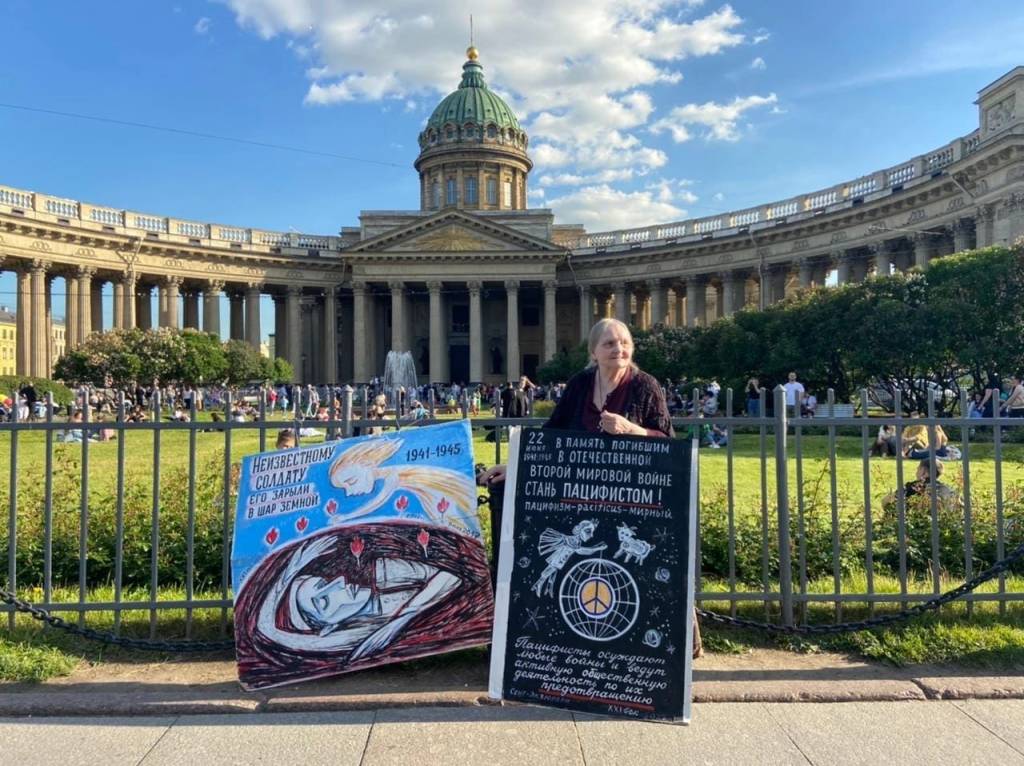
On 22 June 1941, Nazi Germany invaded the Soviet Union. On 22 June 2022, artist Yelena Osipova held a solo anti-war picket on Nevsky Prospect in Petersburg. On 22 June 2022, Rossiiskaya Gazeta, the official Russian government newspaper, published a lengthy interview with Mikhail Piotrovsky, the longtime director of Petersburg’s Hermitage Museum,, in which he justified Russia’s invasion of Ukraine as part of his country’s greater historical and cultural “mission.” Ms. Osipova and Mr. Piotrovsky were born a mere eleven months apart, in November 1945 and December 1944, respectively. If Ms. Osipova’s bravery doesn’t bring honor on her hometown, it’s not for her want of trying. Despite having much greater resources at his disposal and a bigger bully pulpit, Mr. Piotrovsky has definitely brought shame on his city. As long it is run by people like him, Russia’s great “cultural capital” has no future. In any case, Ms. Osipova’s barely audible message makes a jarring juxtaposition with Mr. Piotrovsky’s arrogant, “learned” apology for Russian fascism. ||| TRR
Yelena Osipova, photographed in front of Our Lady of Kazan Cathedral on Nevsky Prospekt in downtown Petersburg on 22 June 2022. Photo courtesy of Irina Bogdanovskaya, as posted on the public Facebook page Yelena Andreyeevna Osipova. Artist. Citizen. Thanks to Maria Mila for the heads-up. The placard on the left reads, “To the unknown soldier, 1941–1945. He was buried in the earth.” The placard on the right reads, “22 June 1941–1945. In memory of the Patriotic/Second World War. Become a pacifist! Pacifism – pacificus – peaceable. Pacifists condemn all wars and campaign vigorously and publicly to prevent them.” On 22 June 1941, Nazi Germany launched Operation Barbarossa, a massive invasion of the Soviet Union. Ms. Osipova was born on 11 November 1945, that is, six months after the end of the Great Patriotic War.
Mikhail Piotrovsky. Photo: RIA Novosti via Rossiiskaya Gazeta
[…]
[Elena Yakovleva]: We have all been shocked by the fighting not only on the fronts of the special operation, but also on the cultural front, by all the attempts to cancel Tchaikovsky and Rachmaninoff concerts, and the Russian language. What is behind “cancel culture”? Having ourselves escaped from the dictates of ideology, are we now witnessing its return in the West?
Mikhail Piotrovsky: The attack on us in the realm of culture is, of course, a semblance of what we had in Soviet times, when all connections were cut off by command, at a moment’s notice, at the snap of someone’s fingers. I have the sense that the Soviet Union, with its ideological dictates, has spread to the West. I did not expect that I would read in liberal Western newspapers such things as “The Hermitage is an imperial museum that preaches imperial ideology. It should not be allowed anywhere! The Hermitage’s [planned branch] in Barcelona should not be opened under any circumstances!”
I have been inundated with ultimatums. How dare you not speak out against the special operation in Ukraine?! Go out and protest immediately! Why are there no protests in your country?
But in this case we should understand that we have been subjected to such a powerful attack in the field of culture because culture is an area in which we are absolutely competitive.
We have the initiative here. We are trendsetters.
Are we an exporting country?
Mikhail Piotrovsky: Yes, and our cultural exports are more important than imports.
Our recent exhibitions abroad are a powerful cultural offensive, a kind of “special operation,” if you wish. Which many people don’t like, but we are advancing. No one can be allowed to thwart our offensive.
In response to calls to cancel Tchaikovsky, smart people in Russia have been saying, “We won’t cancel anything. On the contrary, we will continue to love the Europe that we learned about while studying at universities.” Is the asymmetry fundamentally important in this case?
Mikhail Piotrovsky: Of course. Given our cultural advantage, we don’t have to loudly announce that we are reneging on one cultural agreement or another in response to their bans. They can do it unilaterally. There is definitely no need for bilateralism — precisely because we are winning.
I think that under no circumstances should we succumb (and we shall not succumb) to the seductions of “cancel culture.” I believe we are immune to it because we have already been “canceled” six ways to Sunday. First, the entire culture of Tsarist Russia was canceled, and then Soviet culture was canceled. Monuments were demolished dozens of times. But we also know something else: monuments come back, everything is restored. The knowledge that memory and culture come back is in our blood. That is why we are not eager to overdo it when it comes to “cancelations.” Besides, you can’t cancel Tchaikovsky, except, perhaps, performances of Tchaikovsky by Russian orchestras. But this is just unfair competition.
Why is the West so passionate about “cancel culture”? And about the dictates of “public opinion”?
Mikhail Piotrovsky: I would not exaggerate the difference between the dictates of Soviet ideology and “public opinion.” Public opinion is bound up with governments or regulated by them.
As for “cancel culture” in the West, it is part of a large wave that was born amidst BLM, and linked to the culture of guilt and repentance for guilt. It suddenly surged: they began pulling down monuments and not standing for the American flag. They think that Voltaire is bad, and this guy, and that other guy. It’s a little ridiculous. How much can you repent for the terrors of colonialism, which in fact was so entirely categorical? Or for the unfortunate slave trade, which after all began not in Europe, but in Africa?
They seemingly had already begun to sense that this road leads nowhere, but then Russia turned up by chance. So let’s “cancel” Russia, they said. Although the glee with which they have rushed to condemn us, to tear us up and expel us, again speaks to the fact that we are strong in culture.
When the Bizot group boycotts Russian museums, it’s just ridiculous. I was one of the people who founded the group, and I know that we actually created it to help museums do cultural exchanges unencumbered by politics. But now it’s apparently been ideologized on the Soviet model. If this Soviet-style infection has gone so far, let them be sick alone. We don’t need to be sick too. We have historical immunity against this. I think we will spread it to others.
[…]
Since it hasn’t succumbed to the hype of cancellations, has the Hermitage keep its exhibitions abroad going?
Mikhail Piotrovsky: Not only the Hermitage. When the special operation in Ukraine began, exhibitions by Russian museums were everywhere. We have a Morozov [Collection] exhibition in Paris and exhibitions in Italy. Our most controversial exhibition, a Fabergé show, was in London. The Russian Museum had an exhibition in Spain.
This was our “special operation,” if you like, a great cultural offensive.
As soon as all the ideological sirens were turned on due to the special operation in Ukraine, we initially announced that we were pulling everything out immediately. But then we thought it over and said that we had been given guarantees. The organizers were quick to confirm them. We organized the Morozov exhibition in Paris in cooperation with the Louis Vuitton Foundation, and suddenly realized that this global commercial company was a much better partner in today’s “Soviet” Europe than government entities were. Having no freedom of maneuver, they were “ordered” to break off relations with us, while the business people who made promises to us did EVERYTHING to fulfill them. It was a matter of honor for them: they promised us that [they would send] everything back on time.
But then people in Russia started yelling, “Why did you take our treasures there? They’re worth so much money!” And all hell broke loss on the other side: “Since they’re worth ‘that much’ money, let’s impound them!” People with tormented mercantilist mindsets could not really understand the essence of the matter, so very provocative things were shouted on both sides. I must say that the provocation by the press was the main complication in this whole special operation. Yesterday, I was sent a copy of the FT featuring a discussion by journalists in their art (!) department on the topic of whether Russian paintings should have been impounded. It was due to such journalistic caterwauling that pieces from our museums were detained at the Finnish border. It was the weekend, and Finnish customs officers had read their fill of newspaper articles about how everything should be confiscated from the Russians. Although before and after that, ten of our truck caravans passed through their border post.
From our side, it was the bloggers shouted more. The journalists have been schooled by you.
Mikhail Piotrovsky: Only there are few real journalists left and just a couple of newspapers. Everyone is like a blogger now. And bloggers don’t understand that this is a cultural offensive, that the Shchukin and Morozov exhibition in Paris is like the Russian flag flying over the Bois de Boulogne. Do you know how everyone appreciated it in Italy? They said, “If the Hermitage can leave its paintings with us at a time like this, it means that they know what they are doing over there in Russia.”
It is also very important that the protagonists of our exhibitions were [Sergei] Shchukin and [Ivan] Morozov, Russian businessmen from the Old Believers community who largely defined the evolution of European culture. Matisse was once asked if he would have painted Dance had it not been for Shchukin. “And for whom would I have painted it?” Matisse said. Shchukin suggested things, commissioned things, was capricious, and great works were born. I was recently awarded the Demidov Prize, and it was an occasion to recall how Nikolai Demidov and the great French jeweler Pierre Thomire created this Russian style of malachite with bronze. They had such fights! Thomire said they should do things one way, Demidov said no, it must be done another way. But consequently, there is the Malachite Canopy in the Hermitage.
Does a producer [sic] have the right to interfere in an artist’s plans like that?
Mikhail Piotrovsky: He absolutely has the right. Yes, sometimes such interventions can be bad. But sometimes they can be good. In the case of Shchukin and Morozov, it was a good thing. They were the RIGHT customers.
Let’s not forget that it was the Old Believers who revealed to us the beauty of the old Russian icons. They were the first to clean them and preserve them. And Shchukin brought Russian icons to Matisse, in particular, to reverse the influence of Persian miniatures on him.
At the Morozov exhibition, we presented Russian paintings collected by him and showed art through the collector’s eye. Morozov collected Manet and [Valentin] Serov, and I would hear people say when they were leaving the exhibition, “You look [at their paintings] and you realize that Serov is no worse than Manet.”
The Fabergé exhibition made a very big splash. That is another Russian phenomenon that influenced the West.
So, we in fact did undertake a big cultural offensive. And we came out of it, having done everything we had planned to do.
[…]
Europe has long been a cultural model for us. The “RG” had a conversation with the writer Eugene Vodolazkin about attitudes to Europe. With reference to Dostoevsky, we talked about the fact it is almost dearer to us than to the Europeans.
Mikhail Piotrovsky: We recently held a round table at the Council of the History of World Culture at the Academy of Sciences, which we were going to call “Is Russia Europe?” but instead called “Is Russia Europe? Is Europe the EU?” The general sense of our debate was this: we are Europe, as much a part of it as France or Germany, and maybe more than the United States. If Europe were not us, Gogol would not have written Dead Souls while living in Italy. We recently held another round table on visual art, at which we recalled that Dostoevsky wrote about the Sistine Madonna.
This is our long-standing choice: we are inseparable from European culture and from Europe itself. The special military operation in Ukraine does not change anything. There have been plenty of disagreements and wars within Europe, from the Thirty Years’ War to the First World War. We are Europe and at some moments more Europe than many of its classic [sic] countries. And certainly more than the EU, which is now turning into the Soviet Union.
Of course, we also have an Asian aspect. But Peter the Great already knew how to balance all this wonderfully. We at the Hermitage understand this like no one else, because our main theme is world culture in the Russian context. I constantly talk about our right to be Europe, because in the south of Russia we have a Classical heritage — Chersonesus, Kerch, Taman. And whoever has a Classical heritage is Europe. In Norway, for example, there is no Classical heritage; there were neither Greek colonies nor Roman legions.
Therefore, it is all ours. We must dispose of it as our own, and not think that we are opposing Europe. Do we have different values? But they all have different values. Do we have special Orthodox values? But there are Orthodox values in Europe as well. In many ways they are consonant with Catholic values and not consonant with various secular ones. As an absolutely full-fledged and equal part of Europe, we will never be isolated. It’s just our sense of self. And the Hermitage is a symbol of this self-awareness. I keep repeating that the Hermitage is an encyclopedia of world culture written in Russian. The Hermitage’s Rembrandts, which have been in Russia for three hundred years, are Russian Rembrandts. The Russian Shakespeare is impossible without [Grigori] Kozintsev and [Innokenty] Smoktunovsky. Other doors — to Asia — are always open. But this does not cancel our presence in Europe.
Since people who value Russian culture have not yet gained the upper hand in Europe, must we now form a European model for ourselves?
Mikhail Piotrovsky: We must form this model now. And we are forming it.
Although there seem to be no Shchukins and Morozovs in Russia nowadays.
Mikhail Piotrovsky: Shchukin and Morozov shaped tastes. But now we are shaping, for example, international law. For many years, we have been carefully fashioning guarantees for the return of our paintings by changing international laws and creating immunity from impoundment. All this was first elaborated for Soviet exhibitions, and later, already in my own time, we constantly worked on developing it. The descendants of Shchukin and Morozov tried to sue us, so I urgently got the pictures out of Rome by plane. But every year we have strengthened our legal safeguards. We said, “Do you want our exhibitions? Then give us real guarantees. Spell it out in the contract: the exhibition will be returned on time even in case of lawsuits.” Europe accepted all these terms. The Americans didn’t, so we haven’t had any exchanges with the Americans for ten years. Although people who wanted to host exhibitions from Russia introduced a new law in the United States that enabled the government to give us guarantees and immunity. But it was too late; now it’s not enough. But with Europe, all the guarantees worked. In particular, when paintings from our Italian exhibitions were detained at the Finnish border, our diplomats and Italian businessmen helped us. They immediately sent all the paperwork to the Finnish government: “We gave guarantees, how can you not trust them?!”
At the last moment — even amidst the sanctions — our Western partners introduced a clause stating that prohibited luxury items do not include items that are in exhibitions of Russian museums abroad. It was even stipulated that Russian transport companies have the right to transport exhibitions throughout the EU. We didn’t take the risk — we transported [the exhibitions] in foreign vehicles — but this point was specially inserted. So, we not only look at Europe as a model, but also try and shape the international rules ourselves. This is quite important, especially now, when there are disputes about every [piece of art] in the world over who it actually belongs to.
[…]
Has the attitude towards the Hermitage changed among its Western fans?
Mikhail Piotrovsky: We’ve been getting stabbed in the back a lot lately. Outside the country, the Khodorkovskys of the world have been slinging mud at us, while here at home, as always, certain people have been calling for draconian audits. On the other hand, we have gotten a better sense of who our friends are and who are our enemies. The “society of friends of the Hermitage” have proved their mettle. In Israel, for example, they comported themselves brilliantly. They immediately spoke out. “How can we be friends of the Hermitage, using this honorary title, and then suddenly severe ties [with the museum]?”
We can see everything now. We see that there are people who break off their relationship [with us], but it makes them suffer and cry. But there are also those who happily took advantage of this opportunity. Apparently, they were friends solely due to the political conjuncture. Now we have a good “blacklist” of journalists and politicians This is very important. The world is not uniform.
Has your “blacklist” gotten a lot longer?
Mikhail Piotrovsky: It changed a lot. But besides those who have been writing maliciously about us, unexpected friends have appeared — for example, those French and Italian businessmen I mentioned.
What should we be doing in the field of culture?
Mikhail Piotrovsky: I think we have to do everything in such a way that we are seen, but we don’t have to travel anywhere at all to do this. After becoming director of the Hermitage, I announced a moratorium on exhibitions inside Russia because it was dangerous to transport things then: there were thieves everywhere, there was no money, no real insurance, either. So we didn’t send exhibitions around Russia for ten years. But now we are announcing a moratorium on exhibitions abroad.
I urge everyone now to look back at the experience of the Siege of Leningrad — at the know-how for saving things in an organized manner that was acquired then, at the understanding that when guns speak, the muses should not be silent. On the contrary, they should speak loudly. The experience of the Siege also taught us to address the world beyond the encirclement. During the Great Patriotic War, the Nizami and Nava’i exhibitions and evenings at the Hermitage were examples of this appeal. They showed the whole Soviet Union and the whole world that we remembered the great poets even in the midst of famine and war. Therefore, we are now, as part of the “Great Hermitage” program, going to be doing everything to make the whole world see us and, roughly speaking, envy us.
Now, for example, we are opening an exhibition of works by one of the most famous Danish artists, [Vigilius] Eriksen. He painted Catherine the Great and her court, and for the tricentennial of his birth he earned an exhibition at the Hermitage. We requested pieces from Denmark for the exhibition, but they were not given to us. Well, we have more of Eriksen’s works than they have in Denmark. So, an excellent exhibition is now opening in the Nicholas Hall featuring huge portraits of Catherine and the Orlov Brothers, accompanied by the amazing stories of how they were created, how they were repainted and the medals on the uniforms were altered. The exhibition is on the internet, including a lecture in English. We are broadcasting a message to Denmark: look, a small but very important piece of European culture is the great portrait painter Eriksen in the Hermitage.
[…]
What do you say to those who demand that you repent for Russian policy?
Mikhail Piotrovsky: Our country has now shifted into another time. The first period of the Scythian War is over. We retreated and retreated, now we are not retreating. A pivot has been made. And it is already clear that it’s the final one. Everything began in 2014 in Crimea. Crimea created a situation in which there was no other way, in which we had to pivot.
Our country is making great, comprehensive transformations. And we, respectively, are part of them and with her. Working calmly and normally is our stance.
The Hermitage has done exhibitions about war many times. What can you say about how it’s perceived? For example, a totally pacifist reaction is not something I find congenial. Apparently, I’m a militarist.
Mikhail Piotrovsky: We are all militarists and imperialists. (laughs)
First and most important, it is my country, and I must stand with it. I sometimes repeat the jingoistic formula: this is my country, such as it is. There are situations when it is absolutely clear that a person must stand with his country. In the West they understand that these are all substantive things — that we stand with our country. When a very serious issue is being resolved, there are no options.
I am currently reading Alexei Varlamov’s wonderful book about [Vasily] Rozanov, and [there is a section in it] about 1914 and his hyper-patriotic sentiments. This patriotism at the beginning of the 1914 war is [a phenomenon] known to everyone, but it has not been explained very well. We are somehow dismissive of it, but it was a quite important thing in fact. We, people of culture, must now understand our involvement in everything that is happening. A person involved in history, first of all, must do well what it is that he does [as a vocation], in keeping with the principle that when guns speak, the muses should also speak. And in keeping with the realization that culture, which for us stands above politics and everything else, will later ask us to account for what we did for it. As we were asked after the war, after the Siege: what did you do — on your own?
For me, the attitude to war is established by the great Pushkin in A Journey to Arzrum. Where is he rushing the entire book? To see the demoted Decembrists and then go into battle?
Mikhail Piotrovsky: Arzrum was also the only foreign land Pushkin visited. It expanded the world for him. There is nothing wrong with the fact that a person wants to have the most complete set of sensations. This is especially true when he wants to embody his deep feelings in something, to see and do something new. If he has grounds for it, he throws himself into it. It is an element of self-esteem. I always say that Russian patriotism is a sense of one’s own historical dignity. An individual understands that he must go to war, while another person understands that he must do something else, but which is no less important. Behind this is a sense of one’s own historical dignity, the desire to live up to one’s history and the mission of one’s country. It sounds quite dramatic, but we understand our country’s historical mission. This feeling that our country is changing world history, and that you are involved in it, is crucial now.
Nor are things so simple when it comes to attitudes towards armed hostilities. On the one hand, war is blood and murder, but on the other, it is a means for people, for a nation, to assert themselves. Everyone wants to assert themselves, and in their stances on the war, they undoubtedly assert themselves. We have all been brought up in the imperial tradition, and an empire unites many peoples. It unites people by finding things that are common and important to everyone. It’s very tempting, but it’s one of the good temptations, let’s say. Although we don’t have to succumb to it, ultimately, and we must be able to regulate it within ourselves. Nor should we forget the principle that a person should do what he must do, come what may. For museums, “doing what we must” means preserving and promoting culture. And keeping in mind all the time what is beyond the besieged territory. And speaking not only to people inside it, but also “outside” it.
Source: Elena Yakovleva, “Mikhail Piotrovsky explains why you have to stand with your country when it makes a historical pivot and choice,”Rossiiskaya Gazeta, 22 June 2022 (No. 33/8781). Translated by the Russian Reader, who omitted only the brief introduction and section headings, as printed in the original text. Mr. Piotrovsky, the longtime director of the State Hermitage Museum in Petersburg, located a short walk down the Nevsky from where Ms. Osipova held her anti-war picket on Wednesday, was born on 9 December 1944, that is, five months before the end of the Great Patriotic War.
Ethnic tensions flare up in Montenegro over church ceremony
Predrag Milic Associated Press
September 4, 2021
PODGORICA, Montenegro (AP) — Protesters clashed with hundreds of riot police in the old capital of Montenegro on Saturday, setting up blockades of tires and large rocks ahead of the inauguration of the new head of the Serbian Orthodox Church in the small Balkan nation.
The ceremony planned for Sunday in Cetinje has angered opponents of the Serbian church in Montenegro, which declared independence from neighboring Serbia in 2006.
On Saturday, hundreds of protesters confronted the police in Cetinje and briefly removed some of the protective metal fences around the monastery where the inauguration of Metropolitan Joanikije is supposed to take place. Montenegrin state RTCG TV said the protesters broke through a police blockade at the entrance to Cetinje and threw stones at them, shouting “This is Montenegro!” and “This is not Serbia!”
Waving red Montenegrin flags with a double-headed eagle, protesters then set up road barriers with trash containers, car tires and large rocks to prevent church and state dignitaries from coming to the inauguration on Sunday.
Montenegrins remain deeply divided over their country’s ties with neighboring Serbia and the Serbian Orthodox Church, which is the nation’s dominant religious institution. Around 30% of Montenegro’s 620,000 people consider themselves Serb.
Thousands protested last month in Cetinje, demanding that the inauguration be held somewhere else. The church has refused to change its plans.
Since Montenegro split from Serbia, pro-independence Montenegrins have advocated for a recognized Orthodox Christian church that is separate from the Serbian one.
Montenegrin authorities have urged calm during the weekend ceremonies, which start with the arrival Saturday evening of the head of the Serbian Orthodox Church, Patriarch Porfirije, in Podgorica, Montenegro’s capital.
Porfirije is set to attend Sunday’s inauguration of Joanikije, whose predecessor as the church’s leader in Montenegro, Amfilohije, died in October after contracting COVID-19.
Illustrating the deep ethnic divide, thousands of people waving Serbian flags gathered in front of the main Serbian Orthodox church in Podgorica on Saturday to welcome the patriarch. Many were bused to the capital from Serbia.
The Serbian Orthodox Church played a key role in demonstrations last year that helped topple a long-ruling pro-Western government in Montenegro. The new government now includes staunchly pro-Serb and pro-Russian parties.
Montenegro’s previous authorities led the country to independence from Serbia and defied Russia to join NATO in 2017. Montenegro also is seeking to become a European Union member.
The emphasis is mine. ||| TRR
New Montenegrin Gov’t Maintains Russia Sanctions, Deferring to EU
Samir Kajosevic BalkanInsight
December 14, 2020
Disappointing pro-Russian parties in the new government, Foreign Minister Djordje Radulovic says Montenegro won’t lift sanctions on Russia, as the country must respect European Union rules if it wants to join the Union.
Montenegro’s new Foreign Minister, Djordje Radulovic, said the country will continue with sanctions against Russia despite the demands of some parties in the new majority to lift them.
On Monday Radulovic said the government won’t lift sanctions on Russia because Montenegro must respect European Union rules if it wants to join the Union.
“I believe that sanctions against Russia hurt the sentiments of a certain number of people to whom Russia is close, rather than Russia itself. I fully understand those people, but they must know that by imposing sanctions, we are not declaring war on Russia,” Radulovic told the daily newspaper Vijesti.
“We are not enemies of Russia. I informed the Russian ambassador that the sanctions remain in force, but we will seek cooperation in all areas that do not violate our European strategic priorities,” Radulovic added.
In parliamentary elections held on August 30, three opposition blocs won a slender majority of 41 of the 81 seats in parliament, ousting President Milo Djukanovic’s long ruling Democratic Party of Socialists, DPS.
Montenegro has long had close ties to Russia, dating back to the reign of Tsar Peter the Great when Russia agreed to take the small Orthodox principality under its protective wing.
But these have faded since Djukanovic steered Montenegro towards the West. In March 2014, the government backed US and EU sanctions on Moscow for its perceived intervention in Ukraine and for its annexation of Crimea.
This sparked criticism, especially from the Serbian Orthodox Church, SPC, and pro-Serbian political parties who cherish ties to Russia. In August 2015, Russia added Montenegro to the list of countries from which it was banning food imports in retaliation to the Western sanctions imposed on it.
On September 13, an MP from the ruling majority, Marko Milacic, said that lifting sanctions must be the first move of the new government.
The new Prime Minister, and leader of the pro-Serbian For the Future of Montenegro coalition, Zdravko Krivokapic, on September 16 vowed to rebuild bridges with Russia.
“The current situation is absurd. Imagine that, as a small country, you impose sanctions on a large country like Russia. We will establish good relations with all countries of the world, including, of course, Russia,” he told the Russian Telegram channel Nazigar.
According to the new Montenegrin governing constitution, the government has the power to simply lift the sanctions, even if the EU was not impressed.
Candidates for membership are expected to align their foreign policy with that of the EU, but there is no legal obligation. Serbia, for example, has refused to join the sanctions despite negotiating to join the EU.
Most recently, the deputy head of the Russian Security Council, Dmitry Medvedev, flaunted the fact that Russia was ready to disconnect from the global internet, and today Foreign Minister Sergei Lavrov said that Russia was ready to break off relations with the European Union. What else is Putin’s Russia ready for? A ban on free travel from the country? Recriminalizing possession of foreign currency? Introducing a national ideology? Lifting the moratorium on the death penalty? Starving? A great terror? World War Three?
Why is Russia always “ready” only for such things, but absolutely not ready for the rotation of elected authorities, respect for human rights, economic and scientific growth, equality of all before the law, federalism, fair trials, freedom of speech, etc.? Maybe, for a change, we should start getting ready not for total confrontation and civil war, but for building a democratic state and a strong civil society?
Thanks to Ksenia Astafieva for the link. Translated by the Russian Reader
The Refugees and the “Death of Europe”
Raimond Krumgold
September 5, 2015 www.nihilist.li
This summer we went to Latvia on our way to Russia.
During the week we were waiting for visas, a lot of things happened along the lines of “they have completely broken away from the collective and become remote from their people.” But the main shock for me was a one-off attempt at reading the latest Russian-language press. The quotas of refugees for Latvia were being discussed just then, along with the great reluctance to take in these same refugees. I scanned several newspapers. They all wrote about the “nightmare brewing in Europe” in a tone of aggressive and malicious ignorance that I found quite unfamiliar. I really had the feeling I had opened a neo-Nazi website. The only difference was the gloating at the Latvians, who had discriminated against “us,” the good guys, and now were going end up with “them,” those awful people. At first, I decided something had changed over the years, and then I realized it was I who had changed. I tried to remember how things had been before and realized these newspapers had always written in a similar tone. It was just I used to think this was normal. I had even considered the Russian-language press internationalistically minded in comparison with the already quite right-wing Latvian press.
As long as I can remember, Europe has been dying. This has not been an article of faith, but a fact of reality. The sky is blue. Water is wet. Europe is dying of multiculturalism and political correctness. It would now be interesting to trace the origins of this ironclad certainty. Maybe it was the death of a huge country, which we experienced in the early nineties. Maybe it was ordinary ressentiment. We grew up in the ruins of one empire and maliciously anticipated another empire’s fall. I was not a racist, quite the contrary. But I had almost no doubts that a Munich caliphate would soon be fighting a Bavarian Kurdistan.
My first two trips to England were basically tourist trips. I brought back a huge number of impressions. But the main impression was that the country I saw did not look as if it were dying. Even in Birmingham, densely populated by immigrants, there was no sense of catastrophe. It gave me pause for thought for the first time.
Then there was my own emigration. It was economic emigration, triggered by the 2009 crisis, which took on the proportions of a natural economic disaster in Latgale, where I lived. It was one of the most difficult years of my life, probably the most difficult. And the experience of looking for work in a foreign country with my money quickly running out has forever changed my views. We lived for a month in Sheffield’s “colored” neighborhood and quickly learned to visually distinguish the various African and Asian ethnic groups. However, it is generally difficult to confuse Nigerians with Somalis, not to mention Ethiopians with Kenyans. We socialized with people at the very bottom. We even worked for a week at the very bottom, in a greenhouse growing flowers. It was a terrible experience. After that I could no longer look the same way at people who, just like me, were struggling to make it in a foreign country from scratch, but with no EU passport in their pocket and different skin color to boot. Of course, my experience is not equivalent to the experience of all Eastern European immigrants. For many of us, living in a multicultural country has only heightened our aggression and hatred towards “others.” But this is usually caused by the inability to examine our fears and ourselves calmly.
The 2011 London riots were probably the finishing touch. Reading the English press and Russian bloggers in parallel, I discovered that Russia, both official Russia and completely “oppositional” Russia, exists in an information space of its own, cut off from all unusual information. The tussle, launched by Jamaican gangs (whose people have been in Britain for at least three generations) and embraced by lower-class white youth, was transformed, in Russian popular consciousness, into an uprising by Muslim immigrants. It was then it first dawned on me that if I had still been within the purely Russian-language information space, I probably would have written such nonsense as well. Until recently, I would have seen this news as confirmation of my view of the world.
An objectively serious refugee crisis is underway in Europe. Something similar happened in the 1930s, during the wonderful Évian Conference, at which only the Dominican Republic acted humanely. All the other countries reported they had no more room. European Jews did not excite the most pleasant feelings among respectable burghers back then, so they had every reason not to increase the quotas for them. The beginning of the Final Solution was only three years away. Now people are fleeing from a place where a wonderful quasi-state quite capable of organizing a small genocide has sprung up. Part of Europe is once again saying there is no room. In the forefront are my dear Latvia and the Eastern European republics generally. Over on the sidelines, licking its chops and brandishing a giant walking stick, is old lady Russia, which was no less dear to me once upon a time. Moreover, it has been closing its borders to former subjects of its beloved Assad. But I don’t want to write about Russia. It is too unpleasant a topic.
I want to write about something else. I will never forget my own immigration experience, which was relatively soft core given that I had a EU passport. I will never forget the people, of various nationalities, who helped us that year. And I will also never forget the right-wing English “journalists” who were generating propaganda against us the whole time. They are Europeans, too, but Fortress Europe is not the Europe of which I am a citizen, a citizenship of which I am even beginning to be proud, despite the fact that initially I strongly opposed the EU.
So as a EU citizen and UK resident I personally signed a petition demanding an increase in the quotas for refugees. If I have to take to the streets to support this idea, I will do it. And I will personally greet the first families brought to our city and hand them flowers. Our island is small and overcrowded, but for their sake we will make room.
As a Latvian citizen I am seriously thinking about launching a similar petition to the Latvian government. This embittered rightwing marsh will not be able to hide from reality for long anyway.
You are burying Europe too soon.
Translated by the Russian Reader. Photo courtesy ofThe Gampr