The Center for European Policy Analysis (CEPA) has called for increased economic pressure on Russia as well as secondary sanctions on companies supporting its war efforts in a new report, released Monday, timed with the Munich Security Conference kickoff. The public policy institution states that the former U.S. administration’s foreign policy had been too cautious, resulting in a “war of attrition that neither side can win.”
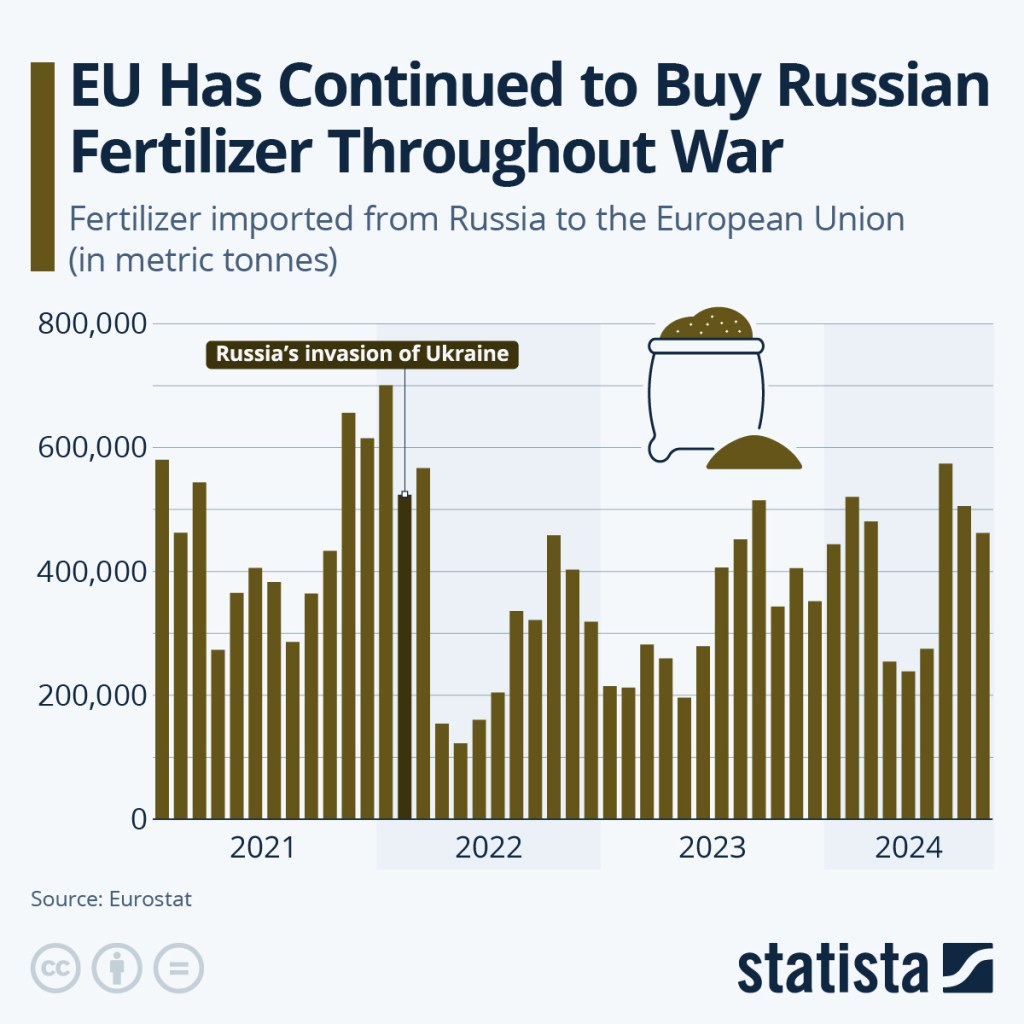
Despite heavy sanctions on gas and oil, the EU has continued to buy commodities such as fertilizer from Russia since its invasion of Ukraine in February 2022. Data from Eurostat shows that some 3.9 million tonnes of Russian fertilizers were imported to the EU in 2023 and 3.7 million tonnes were imported in the first nine months of 2024. In July 2024, 574,000 tonnes of fertilizers were imported to the EU, up 50 percent from July 2021, the summer before the war.
Last month, the European Commission finally proposed raising tariffs on fertilizers from the current 6.5 percent in proportion to the value to 100 percent in three years. If implemented, this means Russian fertilizers will likely continue to be imported until 2026. The proposed tariffs would bring a tonne of nitrogenous fertilizers to the sum of €315 and other fertilizers up to €430 per tonne. The measure is intended to support domestic production, allow for diversification of supply and cut off a financial flow to Russia’s economy. Until now, the EU has been resistant to placing sanctions on agricultural products from Russia due to global food security concerns.
While the proposal includes protective measures, European farmers warn of the risks associated with increased production costs as well as concerns over whether domestic production will be able to meet demand in time.
Source: Anna Fleck, “EU Has Continued to Buy Russian Fertilizer Throughout War,” Statista, 12 February 2025
Every day Russian fertilisers move from the Vainikkala border crossing point to the Port of HaminaKotka in southeast Finland, where the major Russian fertiliser company Fosagro [sic] operates.
For food security reasons, the EU has allowed the import of Russian fertilisers since Moscow invaded Ukraine. This is why a freight train owned by North Rail Oy, a subsidiary of the Finnish logistics company Nurminen Logistics, makes daily transports of Russian fertilisers from the eastern border to the southeastern port.
These fertiliser-filled trains continue to run despite Russia’s nearly three-year war in Ukraine and the European Commission’s recent decision to impose import tariffs on Russian fertilisers in the bloc.
The Kremlin is now generating record-high revenues from fertiliser exports. Seven of the world’s ten largest fertiliser exporters are Russian companies, which collectively earned an estimated $1.4 billion last year.
Fosagro, with its presence in Kotka, is one of the world’s largest producers of phosphate-based fertilisers. It is backed by Andrei Guryev, a Russian oligarch and Vladimir Putin ally. He stepped down from the company’s leadership in 2022 after the EU sanctioned his son. Later, both the US and UK imposed sanctions on Guryev himself.
According to business magazine Forbes, Guryev and his family still own nearly half of Fosagro.
Yle asked how a sanctioned fertiliser oligarch’s exports are still flowing via Finland.
While Finnish Customs director general Sami Rakshit declined to comment on individual companies, he said that if a sanctioned individual holds a controlling stake in a company, the sanctions will also apply to the company.
At the same time, if Customs cannot demonstrate that the product, person, or company is subject to sanctions, the agency will not intervene.
“Fertiliser transport through the Port of Kotka is possible primarily for food security reasons,” Rakshit told Yle.
“When sanctions are being circumvented, shell company arrangements are often complex, making it very difficult to identify the true beneficiaries,” he added.
Russian connections
At the Port of HaminaKotka, Finnish firms Rauanheimo and Fertilog load the fertiliser onto ships. According to information obtained by Yle, Fertilog’s subcontractors employ Russian-background Finnish citizens and workers from the Baltic states.
The chairman of Fertilog Group’s board is Aleksei Sladkov, a Russian national living in Austria. The rest of the company’s leadership also has Russian-sounding names, though Yle does not know their nationality or whether they hold Finnish citizenship.
Fertilog has stated that it accounted for ten percent of the Finnish port’s traffic in 2020.
Most of the Russian fertilisers passing through Kotka are exported to North African countries and South America. Some also travel to other European countries, as long as they are not subject to sanctions.
In addition to Finland, Russia also exports fertilisers through Estonia and other Baltic countries.
In communicating with Fertilog via email, the company said its focus is on business and does not take a position on politics.
“We only handle fertilisers that are not subject to sanctions,” the company said via email.
The firm also claimed to have invested 80 million euros in the HaminaKotka port over the past 15 years.
“We’re a significant taxpayer and job creator in Kotka, both directly and indirectly,” the company stated.
According to Fertilog, the fertilisers they handle are exported to developing countries, where they play a crucial role in global food security, as well as to EU countries, where they contribute to the EU’s preparedness and security supply.
Source: “Russian fertiliser exports continue flowing through Finland,” Yle News, 11 February 2025. Thanks to Delovoi Peterburg for the heads-up.
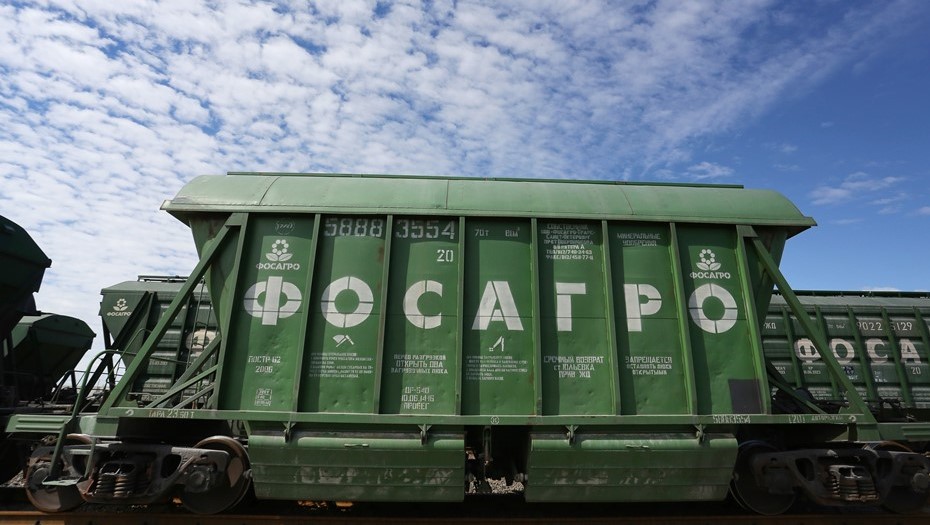
PhosAgro is a Russian chemical holding company producing fertilizer, phosphates and feed phosphates. The company is based in Moscow, Russia, and its subsidiaries include Apatit, a company based in the Murmansk Region and engaged in the extraction of apatite rock. The company is Europe’s largest producer of phosphate-based fertilisers.
Ownership history
The original owner of PhosAgro’s assets (most notably Apatit, a Soviet-era mining company) was exiled Russian billionaire Mikhail Khodorkovsky via his company, Menatep. In 2003, Khodorkovsky was arrested for tax evasion and fraud; the charges against him were ostensibly connected to Menatep’s purchase of shares in Apatit. However, some have seen the charges as punishment for publicly clashing with Vladimir Putin.
During Khordorkovsky’s trial, the state seized Menatep’s stake in Apatit. In 2004, Andrey Guryev, who at the time ran Apatit on behalf of Khodorkovsky’s Menatep and was also a Russian senator [sic], wrote a message to Khodorkovsky in prison to convince him to sell his remaining 50% stake in PhosAgro to Guryev. Khodorkovsky sold his shares to Guryev for a low price.
In July 2011, PhosAgro raised $538 million in a London IPO.
In 2012, PhosAgro paid $344 million at a state tender to buy back a 26.7% share in Apatit, bringing the company’s ownership to 76%.
As of 2012, Andrey Guryev and his family owned 5.47% of PhosAgro via various trusts.
PhosAgro is 19.35% owned by Vladimir Litvinenko, who oversaw Vladimir Putin’s plagiarized doctoral thesis in 1996.
In 2022, the company’s revenue amounted to 164 billion rubles.
Source: “PhosAgro,” Wikipedia
In early 2015, current CEO Andrei Guryev Jr, Andrey Guryev’s son, was reported as saying, “PhosAgro is the most profitable phosphate fertilizer company in the world.”
PhosAgro is structured so that Guryev and his family are recipients of a trust, rather than outright ownership in their names, though Evgenia Guryev, Guryev’s wife, owns 4.82% of PhosAgro in her own name.
In July 2016, Forbes estimated his net worth at US$4.3 billion.
He is vice president of the Russian Union of Chemists.
[…]
Guryev is married to Evgenia and they have two children, Andrey Guryev, Jr. and Yulia Guryeva-Motlokhov. Andrey Guryev, Jr, is CEO of PhosAgro. Yulia Guryeva-Motlokhov is married to hedge fund manager Alexei Motlokhov, they have twin sons, and live next door in Highgate.
The Guryevs own Witanhurst in Highgate, London’s second largest house after Buckingham Palace, through an offshore company registered in the British Virgin Islands. He owns the five-storey penthouse of St George Wharf Tower in London. Guryev has never given an interview to the press.
Guryev owned a yacht, Alfa Nero, through an offshore company which is planned to be auctioned off in Antigua and Barbuda due to his sanctions.
Source: “Andrey Guryev,” Wikipedia