
Source: Arkadiy Kurta (Facebook), 25 February 2025. Mr. Kurta posted this photo among a set of photos he took at yesterday’s pro-Ukrainian demonstration in Berlin on the Facebook public group Street Photography.
— I read about your wedding to Yana last year. Tell me, are you happy?
— Yes. But happy in what sense? I don’t feel like I’m in a happy period in my life as a human being. But I’m very happy with Yana. We didn’t even plan to get married: we just had to get married for the paperwork. We are now traveling a lot between countries and applying for visas, and it’s much easier to explain why Yana has to travel with me and I with her by showing them a marriage certificate than by telling them a long story about how we’re from Russia, where gay marriage doesn’t exist. Anyway, we got married, and it as if nothing has changed in our lives: we love each other just as much, and we have the same joint budget.
But the morning after the wedding, I woke up and looked at Jana and realized that she really drives me crazy.
And then Yana woke up and started looking at me funny. Basically, we went around for a week looking daggers at each other, and then we went to psychotherapists, each to her own, and found out that, despite the fact that getting married was a purely formal act to us, it meant a lot to our subconscious minds. That’s why all kinds of shit had started to come out of our heads, which had been building up there all our lives, as it transpired.
For example, after we got married, Yana suddenly moved from the category of “my lady love” to the category of “my family.” I have completely different requirements for my family. Yana looked at me and thought, “I never wanted to get married. Marriage is a trap, it’s the worst thing that can happen.” Because of her family history, she had come to the opinion that there was basically nothing worse than marriage. When we realized what was coming out of us, we just talked to each other and calmed down. Everything fell into place. Now my therapist says we should definitely learn to fight because it’s a good way to find a new common ground, to talk about things, to release emotions. We just haven’t fought yet.
— How many years have you been together?
— Three years. We’ve argued, we’ve been pissed at each other sometimes, but we’ve never really fought. My therapist says this is potentially the weakest point in our marriage, because people in real families should fight and yell at each other periodically. I agree with her. My sister and I or my mom and I sometimes yell at each other so hard that glass shatters. So now we’re learning how to fight.
— Don’t you think that the very fact that you were able to get married is a privilege for people from Russia?
— Of course I do. There is a huge number of people living in Russia who are no less deserving than me and who cannot get married because of their orientation. Of course, it’s very unfair. I’m aware of that, and I’m very grateful to the people who have given their lives, among other things, to make it possible for me to have a same-sex marriage in the United States and for that marriage to be recognized around the world by countries which agree on the simple fact that all people are equal and all people have the right to a family.
— You don’t feel guilty about that?
— No, because I remember that my goal hasn’t changed.
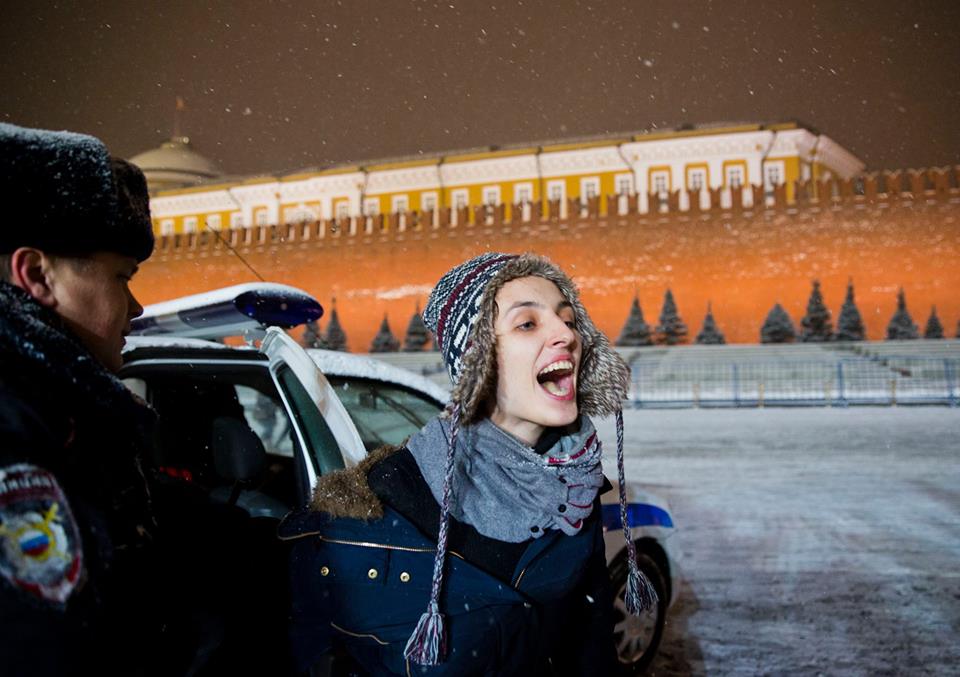
My goal is to get married on Red Square.
I believe that it will happen sooner or later. Every person should have the right to a family, every person should have the right to call their loved one a relative. This, by the way, should not necessarily be bound up with sexual orientation or gender identity. I think a lot about single women or men for whom the most important person in their life is a male or female friend with whom they would like to share a household, bequeath property to them, and identify them as their nearest and dearest. That is, the very mechanism of civil partnerships would be useful not only for LGBT people.
— In interviews you gave long ago, you said that people in Russia generally didn’t care who you slept with. Has propaganda succeeded in turning LGBTQ+ people into enemies?
— I’m not in Russia at the moment, so I can’t see what is happening there now. But I am glad that for every snitch and provocateur who goes to a gay club to turn people in to the cops, there are hundreds of people who know that their friends, brothers and sisters, and coworkers are not hetero- or cisgender people, and yet do not go to the authorities and snitch on them. But of course this is a very difficult time, because, pardon the expression, all sorts of scum who derive power and joy from the fact that they can take away another person’s life feel quite free and easy in Russia now, because a group of people with whom they can do as they pleased has been pointed out to them, and the state will only pat them on the heads for doing it.
Source: Konstantin Shavlovsky, “‘It hurts, hurts, hurts to love now’: a long conversation with Elena Kostyuchenko,” Republic, 12 January 2025. Excerpted and translated by the Russian Reader.
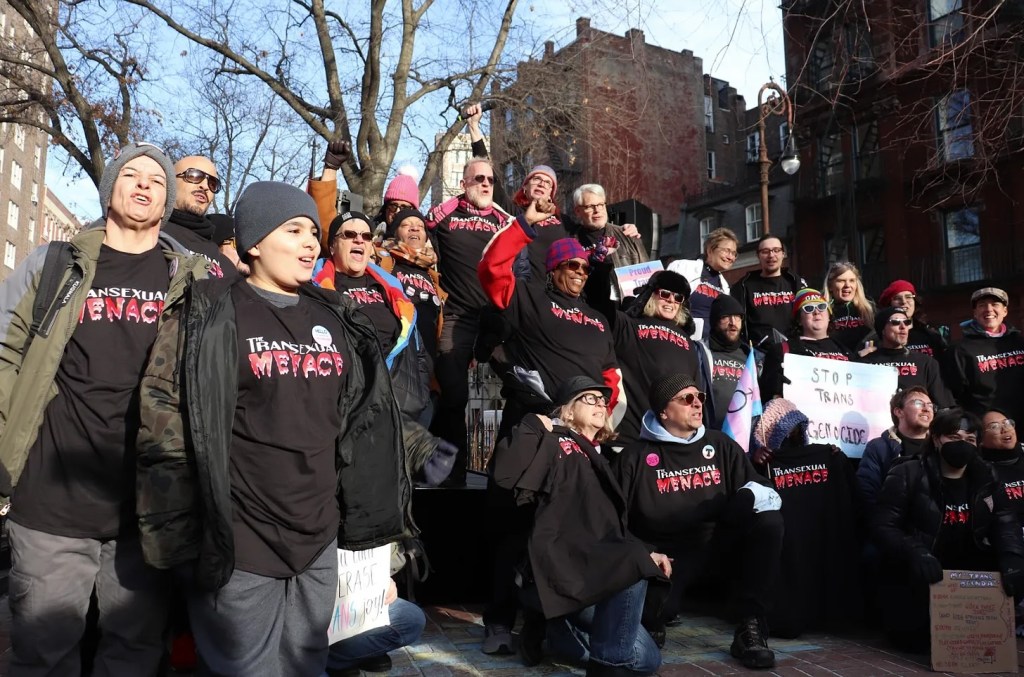
This weekend at Stonewall, trans pasts and trans futures collided. The crowd of over 300 people at Christopher Street Park cheered on as the two kids took the stage, all smiles as they were wrapped in the pink, white and blue. They were led by Denise Norris, co-founder of The Transexual Menace, a direct action group which began organizing against trans exclusion in 1993.
In 1969, the Stonewall uprising spilled out from the iconic gay bar and into the streets — including that same park, a small patch of pavement and grass across the road. Many see this as the birthplace of the LGBTQ liberation movement as we know it today.
Now, a new generation has joined the fight.
“Even in our middle school, which supposedly accepts everyone, we face hate from many of our classmates,” one of the kids told the crowd.
They passed the mic to their friend. “They’re saying, ‘Oh, this school is progressive. And we don’t stand up for hate, and homophobia, and transphobia,’” the other youngster added. “Well, maybe they should do something about it.”
Donald Trump’s second term as president has wrought an unprecedented wave of anti-trans vitriol. The administration has effectively sought to ban trans and intersex people — or likely anyone suspected of being trans or intersex —from joining the military, using the correct bathrooms, playing on sports teams, accessing life-saving medical care, and acquiring state IDs that acknowledge their existence, to name just a few of the provisions’ effects. Trans youth, especially, have been targeted. Meanwhile, politicians and pundits have condemned transness as “toxic,” a “virus” and “a fad”.
But Saturday’s rally was living proof of trans histories, resilience and joy. One protestor held a sign reading: “We are older than your laws and we will outlive them. There are queer and trans kids, adults and elders in the future.”

The area in and around Stonewall, including the park, was incorporated into the National Parks Service in 2016 as a historical monument of the West Village enclave where trans, queer and gender nonconforming youth made their home for decades. But after Trump’s return to office, even the NPS webpage for Stonewall saw the word “transgender” removed.
“Before the 1960s, almost everything about living openly as a lesbian, gay, bisexual (LGB) person was illegal,” the new website now reads, the “T” conspicuously missing. “The Stonewall Uprising on June 28, 1969 is a milestone in the quest for LGB civil rights.”
Norris spoke about organizing the event within her own intergenerationally trans family, including her nephew, Garrett. Now in his twenties, Garrett is working with his aunt to cultivate a national network, encouraging trans people and their allies everywhere to take autonomous action.
“If you don’t want to be transgressive, if you’re not here to make the systemic change that we need in this society so trans people have space to be equal — not merely acceptable — you might as well be the ‘transgender happy friends,’” Norris told Erin in the Morning at the rally. “The battle is not about if we are going to be passable or acceptable to the oppressor. It doesn’t matter if you’re ‘passing,’ they’re still going to come for you.”
The Transexual Menace, whose blood-stained logo is a campy, tongue-in-cheek nod to “The Rocky Horror Picture Show,” cut its teeth mobilizing against trans exclusion from queer spaces and causes in the 1990s. Where some gay and lesbian organizations sought to align themselves with more white, heteronormative, upper class sensibilities, the Transexual Menaces — “Stone Butch Blues” author Leslie Feinberg among them — refused to center respectability politics in their actions, Norris said.
At the rally, speakers showcased a tour de force of trans life spanning generations. Dr. Carla Smith, CEO of The NYC LGBT Community Center, told the crowd how she brought along her wife and grandchild. Jay Walker, a founding member of groups like the Reclaim Pride Coalition and Gays Against Guns, led the protestors in chants. Bernie Wagenblast, the much-beloved voice of New York City subways, was also spotted among the masses.
Angelica Torres, an actress and activist on the board of directors for The Stonewall Inn Gives Back Initiative, spoke passionately about trans histories, referencing the mass slaughter of gender nonconforming people by world powers like colonial Spain and Nazi Germany.
“We’re criminalizing trans people for existing and decriminalizing those that commit actual crimes, like Donald Trump and his 1,500 insurrectionists,” Toress said in her speech.
She could be heard from outside the metal gates of Christopher Street Park, which are adorned with archival images of trans and gender nonconforming youth — smiling, hugging, protesting. It was these street queens and butches of color that are said to have “thrown the first brick at Stonewall,” a common phrase used to characterize the much-mythologized riots. Protestors left bricks beneath the photographs in their honor.
Source: S. Baum, “‘We Will Outlive Them’: At Stonewall, Resistance Flares,” Erin in the Morning, 24 February 2025. The Russian Reader has been a proud subscriber of Erin in the Morning for over a year and encourages his readers to subscribe to it as well in this time of peril and resistance.


 “There are homophobes on the corner. They’re really creepy.”
 Post-screening discussion of

 Side by Side co-organizer
  Lena Klimova: “In our city, many people don’t even know the word LGBT.”
 LGBT Christian: “A persecuted minority is being oppressed in the name of the church.”
 Pastor: “The Bible unequivocally treats homosexuality as a sin.”
 Ed Wolf: “I’ve ridden around Petersburg. You have many gays here. I saw them myself.”
 Moderator: “So the American government wasn’t willing to solve the problem?” Ed Wolf: “An army of activists forced the government to act.”

 The audience at Lesbiana
 Sharing our impressions of Lesbiana at a cafe: “I wonder whether there are ‘feminine lands’ in Russia where only lesbians live?”
 Alexander Markov (on left). Elena Kostyuchenko: “As the only LGBT activist on the jury, I’m responsible for authenticity.”
 Elena Kostyuchenko: “If they start removing children from LGBT [families], our lives will change forever.” Marina Staudenmann (on right)
 Marina Staudenmann: “La vie d’Adèle.” Bård Ydén: “La vie d’Adèle.”
 Side by Side organizers describing what was in the “gift bags”: “The bags contained rope and bars of soap, along with a note reading, ‘From Russians with love.'”
