“You’re a Future Warrior!” Gender Stereotypes in School
Afisha Daily talked with teenagers from different cities who disagree with traditional gender roles
Afisha Daily
June 1, 2016
Lena, 16, Perm Territory
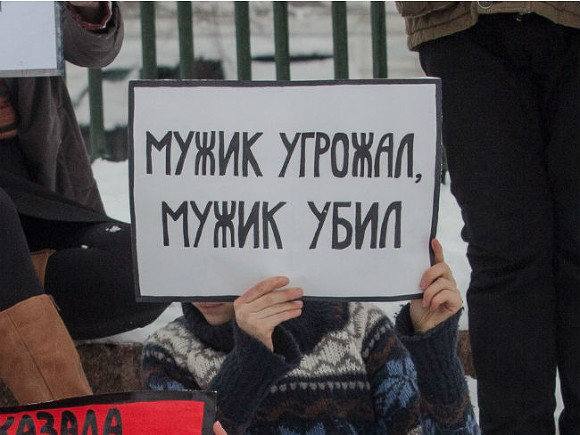
I started thinking hard about violations of rights a couple of years ago when I accidentally happened on a [social network] group featuring the stories of young women. The things they told about were horrifying: rape and domestic violence. But the criminals had not been punished because the police had found no evidence of crimes or no one had believed the young women. I wondered what had happened to justice if such egregious crimes went unpunished.
Since then, I have noticed more often the swinish behavior of males towards females, which is apparently considered the norm in our country. Men whistle at young women as they walk by, and they grope them just because they feel like it. Young women usually just put up with this.
I recently faced a similar situation myself. I like to dress nicely: not for anyone else, but for myself. One fine day, when I was walking downtown in a short skirt and high heels, an unpleasant elderly man touched my leg. My first reaction was shock. Nothing like that had happened to me before. I could not even react, and the man was able to get away. The outrage I had thus not been able to express swirled round in my head for the rest of the day. But it was a lesson to me. From now on, I will know how to behave in such circumstances. If something like that happens, I will try and stop the person from doing it, and then reason with him.
I often notice the unequal treatment of boys and girls at vocational school. We have only three boys in our group, but usually only one of them comes to class. There have been times when I was the only one to raise my hand to answer a questions, but the boy was picked to “take the rap for everyone,” because “the stronger sex must protect us.” During geography class, we learned about the unequal salaries of men and women for the same work. Someone shouted, “Serves them right!” The others laughed. In our nearly entirely female group no one voiced her disagreement. Was I really the only one who thought it was unfair? Back in high school, I was amazed when female teachers would say the main thing for girls was finding a good husband, while doing good in school was another matter.
I have also encountered injustice in the social networks. For example, there was a survey question: who should be the head of the family? The possible answers were “the man” and “both spouses are equal.” “The woman” was not even considered as an option, and more than half the people who responded voted for “the man.”
I am quite glad my parents really are equals in our family. Neither of them orders the other one round, and there is certainly no use of force. But I recently had an unpleasant conversation with Mom. It was explained to me that I would be a woman, and I would have to find a better half of the male sex (that was obligatory!) and have children, because it was, supposedly, my destiny. When I asked for arguments, I was told that was the way things were.
You cannot escape from the patriarchal mindset. We live in a country where ordinary life is closely bound up with the church and traditions. It is as if everyone has forgotten that ours is a secular country. I have the sense that our authorities judge people according to the Domostroi, which says you can beat your wife.
Some young women do not respect each other. As long as men see this, they will go on thinking they can treat them disrespectfully.
Mark, 17, Ivanovo
When I got fired up by feminism, many people thought it was really strange, because I was a boy. My outlook today is that I am against discrimination on any grounds. A lot of things have changed about me, but very little has budged in my environment.
It’s silly to deny the “adult” world is dominated by gender inequality. But things are worse in the world of kids, who have stereotypes and attitudes foisted on them. We are brought up on the standard system, which says that boys must be strong and are not allowed to shed tears, while girls must be dainty princesses.
School often abuses its right to educate children. It all starts with the school uniform. Your appearance, one of the most accessible forms of self-expression, is strictly regulated by other people. Then there is the division into “M” and “F.” Girls are taught to cook in home economics, while boys learn to be carpenters in shop class. Personally, I found it terribly offensive I was unable to learn to cook something tasty, although I consider it a wonderful occupation. Instead, I had to do stupid work that nowadays is done by wage workers for money. In physical education classes, we were divided into strong kids and weak kids. The boys, of course, were automatically the strong kids, so the physical education teacher would always be screaming at us, “Don’t give up! You’re a future warrior! Who is going to protect your wife?”
I felt less of this pressure in high school. Maybe it was because the teachers thought we had turned out “right” by then?
It is a touchy situation with friends. They have been brainwashed: the stereotypes are deeply rooted. They don’t want to see the framework into which they have been driven. They snap at me when I try to take into account the opinion of both boys and girls. As if our personal lives were already prescribed by someone in advance, and everyone follows these instructions.
Things are different at home. Everyone is family, and there is no one to fight with. My parents, who were raised in the seventies, project their gender attitudes onto me and my brothers. But can you blame them for this? My father sees us as future businessmen, entrepreneurs, and holders of high office.
Some might say that only in this way can we save humankind and a normal society. But who defined these standards, and why can’t we violate them? Nowadays, people have suddenly taken it into their heads to preserve certain truths. But if you take a look a history, you find that the “truths” have always been different.
I see feminist and similar ideas as a way out. I think activists should bring these ideas to the schools. Education has to be changed, not radically, but gradually. That is the only possible way to educate a society in which there will be no inequality.
Maria, 17, Transbaikal Territory
I live in a military town where nearly all the families consist of a wife and a husband in the military. The head of such families is the husband. He is considered the protector, and the woman is obliged to stay at home and do all the household chores. There are not so many jobs here nor any chances for self-improvement, either. These families have not even heard about equality. If the topic comes up, the conclusion is always the same. The husband is the breadwinner. The wife stays at home, meaning she doesn’t get tired, so she has no reason to pretend she is oppressed.
Having seen their fill of this, half of the boys definitely want to go into the military. It isn’t hard for them to achieve this goal. These fellows make it known to their girls right away that they should wait for them to come home from obligatory military service. And then, at the drop of a hat, they will have to give up their studies and their jobs and move with them to a godforsaken town to start their new careers as maids.
I have been trying to convey to others (including at school) that this is abnormal. Everyone takes it as a joke. The worse thing is that the girls have the same reaction as the guys. It’s a mystery to me why women don’t recognize this oppression.
I think that women’s rights are systematically violated just because feminism is a secret club spoken about in whispers, and even then not everyone gets to hear them. If all the stories about rape, abduction, and beatings were made public, everything would be a lot better. Women would give a lot more thought to the fact that such a number of crimes is not just a coincidence.
Nastya, 17, Minsk
When I was thirteen or fourteen, I wondered about all the gender stereotypes around me. I couldn’t understand at all why people encouraged this, and I fought back against equality, not even knowing what feminism was. When I found out there was such a movement I immediately supported it.
School is full of gender stereotypes, and that is sad. School should be a place where not only maths and history are taught but also respect. Even the teachers support inequality, to say nothing of the students.
Recently, our biology teacher told us, “If a girl says no, she means yes. Girls are all like that.”
And our home room teacher, a women, ended a public lesson on the bravery of Belarusian women during the war years by saying, “The point of a woman’s life is to have a family and raise children.”
She is a fairly religious woman. She is always saying that girls must be weak and bestow their beauty only on their husbands.
Once, in class, I said women were not obliged to have kids.
A male classmate replied, “If a woman doesn’t have kids, then what is she good for?”
The whole thing is sad.
Anton, 17, Moscow
Until the tenth form or so, I was dead set against modern feminism. I thought it was a total profanation and perversion of the suffragette movement. I changed my mind after meeting feminists and realizing the movement for equal rights was still relevant today as a means of combating domestic violence, rape, and discrimination.
Some girls might make fun of the reluctance of male classmates to go and serve in the army. They might voice incomprehension and ridicule. Personally, I haven’t witnessed such instances. What I saw has been limited to friendly teasing.
Teachers can sometimes have the gall to say boys should do physics, while girls have no need of it. That is a matter for their own conscience. Especially delusional persons have demanded that schoolgirls wear high heels, but that has led to nothing.
The stories my female classmates have told me have once again convinced me of society’s narrow-mindedness. Everyone already knows the list of stereotypes: hysterics and demands to “give us grandkids,” restrictions on socializing with the opposite sex, and insults based on a person’s sexual orientation.
Disrespect for one’s own children, students, and simply people, the rejection of any opinion except one’s own own, and fear of new things are just a short list of the ailments that have afflicted our society.
Translation and photo by the Russian Reader. See my previous posts in this occasional series on young people in Russia today and the moral panics generated around them by the media, politicians, and the public.
- We’ll Sail Away (Russian School Leavers) (June 28, 2013)
- The Kids Are (Not) Alright (May 27, 2015)
- The Kids Are (Not) Alright, Part 2 (May 31, 2015)
- Arseny’s Childhood (November 27, 2015)
- Sixteen Blue (June 5, 2016)