Dmitry Golynko-Volfson, 1969-2023

Dmitry Golynko-Volfson (standing, far right), with Viktor Sosnora’s literary club, in 1987 or 1988.
Photo by Viktor Tikhomirov. Courtesy of Elena Novikova

Mitya and I met in 1987 at Viktor Toporov’s translation seminar at the Leningrad Youth Palace. Translations and all sorts of quasi-literary and professional news were discussed at the beginning of the seminar, while at the end there were readings, first by the novices, then by the old-timers. One day Toporov announced, without a tinge of his usual irony, that a young genius, fourteen–year-old Dmitry Golynko, was about to read. And indeed, a young man, almost a boy, got up and read his own rendering of The Ballad of Reading Gaol, which reproduced the meter, stanzaic form, and length of Wilde’s original. Everyone sat listening, their mouths agape. Mitya and I quickly became friends. Mitya also attended Viktor Sosnora’s literary club at the Tsiurupa Recreational Center on the Obvodny Canal. About once a week, Mitya hosted the Sosnorovites at his own home on Bronnitskaya Street. They took turns reading their work and drank tea — Mitya’s mother strictly ensured that there was no alcohol, not a single drop. Thanks to his mother and her friends, who rubbed shoulders with the dissidents, Mitya was a child prodigy and a polyglot, a treasure trove of all sorts of knowledge. He memorized the poems of Gorbanevskaya and Brodsky, not to mention Sosnora. I don’t know whether his own poems from that period have survived, most likely not. But there is a website that contains slightly later pieces, from the late 1980s, and they show that he already wielded an intricate mastery of versification. Sosnora’s training was manifested not only in Mitya’s virtuosic and diverse technique. He also chanted rather than recited poems, and, like his mentor, he subscribed to the tragic model of the damned poet. And he set himself daunting tasks: never content with what he had already done, he consistently sought out new architectonics and fearlessly discarded old forms like spent rocket stages.

In the 1990s, he wrote large complex multipart poems. Enchantingly witty, they featured elements of kitsch and parody, an abundance of neologisms and anachronisms, and a carnival debunking of literary centrism (e.g., “The Tale of the Istanbul Lady Treasurer,” “Sashenka, or A Diary of an Ephemeral Death,” and “Dead Ears, or The Death of Anton Petrovich Shchedrikov-Saltyn”). We could call this his neo-baroque or postmodernist period. Gradually, as the 1990s drew to a close, this baroque harlequinade was adulterated with “cyberpunk”: hi-tech and dystopian subject matter emerged in his poems, while humor and eccentricity yielded to sarcasm. In the early 2000s, Golynko-Wolfson abruptly altered his style: he began producing gloomy serial compositions, ringing the changes on one or two colloquial phrases, sometimes obscene, deploying these “idioms” in an endless monotonous spiral spinning down into nothingness, into the black hole of the Real. Starting with “Elementary Things” (2002), his texts are dominated by an aesthetic of the abject. His poems explore various gradations of alienation and reification (commodification) at the micro-level of human and non–human relations; they are chockablock with cold despair, misanthropy, and often (let’s be honest) misogyny. The latter is a trace of romantic wounds. (Mitya was loved by wonderful young women, but every one of these affairs, of which, I confess, I was a little jealous, ended in a breakup, and Mitya wound up alone.)

Acting the role of the accursed poet at some point ceased to be an act. Friends left the country and died, and his circle of friends fell apart. For some time Mitya was sustained by his academic research, his collaboration with Moscow Art Magazine and other contemporary art periodicals, and the latest philosophical concepts. (He continued to be a polyglot.) But as a poet — as an outstanding poetic innovator who had created not one, but several original poetic systems — he clearly did not receive the recognition he deserved, at least at home in Russia. He was fired from the Institute of Art History, where in 1999 he defended his PhD dissertation, “The Contemporary Russian Post-Avantgarde: Styles, Models, Strategies.” At Borey Gallery, which published his first book Homo scribens (1994), the Petersburg fundamentalists [a right-wing group of writers] had firmly established themselves. The atmosphere in Russia was becoming poisoned. I noticed more and more often that when Mitya spoke or read, the corners of his lips drooped in a disgusted, contemptuous half-smile, and his face was like a mask. He was consumed by an object-oriented disgust, and it was this disgust that fueled his writing. At some point, it turned on him as well. For the last three or four years, he had been slowly killing himself with alcohol. I watched it happened, horrified, realizing that there was nothing I could do. (Once upon a time, when his mother died — and she died young, and Mitya, still very young, was left an orphan — he moved for a while to a communal flat on Rubinstein, provided by a friend, to collect his wits, as they say. One day he telephoned me at the boiler plant where I worked and said that he wanted to make himself eggs sunny side up, but he couldn’t manage it. Couldn’t I come over and help him? I went to the flat, made the fried eggs, and sat with him in the kitchen as he ate them, before quickly returning to my shift. I remember his shaking hands and childish confusion. I will always remember them.)

Dmitry Golynko-Volfson — a poet of metaphysical orphanhood and despair — has left behind a huge legacy. With his departure, a similarly huge hole has formed in Petersburg’s cultural fabric — and in my heart. Goodbye, dear friend, and forgive me.

Source: “In memory of Dmitry Golynko-Volfson (9.12.1969—6.01.2023): Alexander Skidan on the late poet and New Literary Review author,” New Literary Review, 7 January 2022. Translated by Thomas H. Campbell, who met Mitya in 1995 and for several years lived a few doors down from him on Bronnitskaya. His funeral and wake took place earlier today in his hometown of Petersburg. You can read more tributes to him by his fellow poets here (in Russian).

UPDATE: 16 January 2023. Eugene Ostashevsky writes: “For a pdf of Dmitry Golynko’s 2008 UDP book As It Turned Out, please go to https://uglyducklingpresse.org/publicat…/as-it-turned-out/ and click on ‘View Digital Proof.’ The book is bilingual and includes work from the 1990s and the 2000s.”
Ekaterina Zakharkiv: A Sharpened Grammar

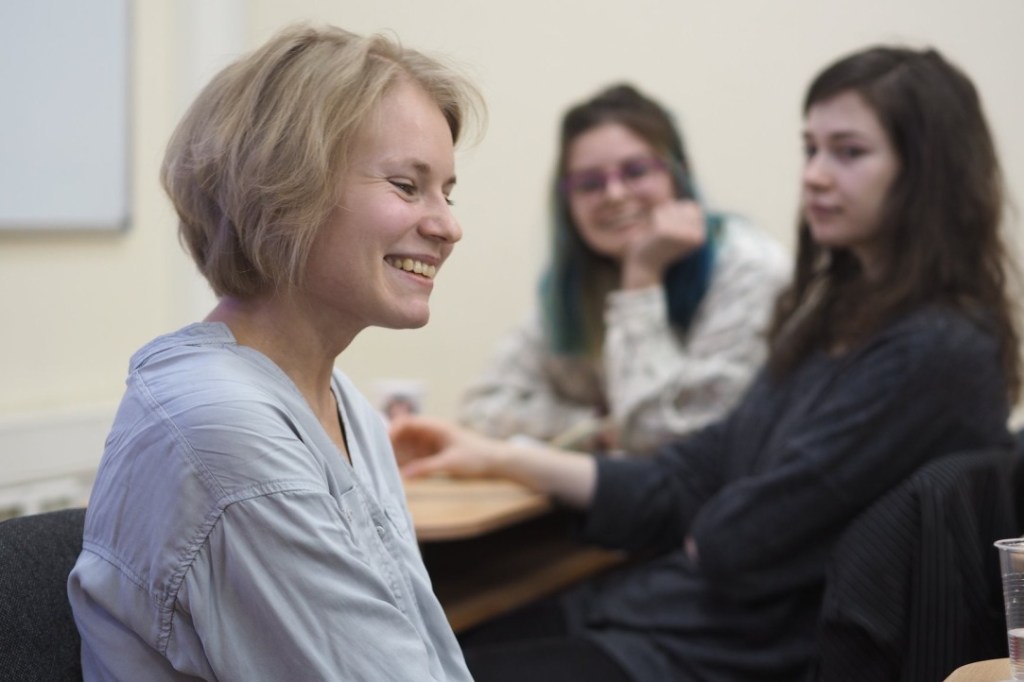
In many ways, Ekaterina Zakharkiv is my favorite contemporary Russophone poet. While her verse is manifestly avant-garde, there is something about the way she combines different lexical and stylistic registers into a seamless and, one could say, “collectivist” idiom that always reminds me of Alexander Pushkin and the revolution he led in Russian poetic discourse. Born in Magadan, Zakharkiv graduated from the Gorky Literary Institute in Moscow and is currently a graduate student at the Institute of Linguistics of the Russian Academy of Sciences. She is an editor at F-Writing, Dream, and the new Almanac Fire, which focuses on the intersection of writing and music.

Ekaterina Zakharkiv

These three translations were published last year in Lana Turner #12. The issue is now available for free as a pdf, so I decided to put them up here as well, hopefully bringing Zakharkiv’s work to a broader audience online.

***
strange weapon of the body, promising to assemble under the targeting apparatus of itself
into the composite noun of the square, the collision of adversaries without confusion of sides
this is touching openness, you say that love is touching
openness
don’t love me then

separation opening division of
po
lice bu
dget re
lations
trucks for an incomplete project
last shots on the national TV stations
last mechanisms last montage
right here, atop the wreckage of the signal, I touch the dust of our collective text
move my fingers over your skin mottled with italics “in the failure of time”

under the smoke-filled sky of an invisible Orleans, doubled maidens unfurl their banners
in the heart’s murky fissures

on the squares of our city the long since melted schedule
of movements, instants of matter
surmounting information

at the crossing of places
in a sundered embrace, a gold lord looks back at the eye
the cool mouth of rose sor
rows of speech
can’t close
even night
even the thin air of night

***
[you’ll forgive me, won’t you, especially if you recognize]
how crooked flames rise and fall from the black sky into the mowed carpet of the conference room
the endless weight that takes the bandages off voids of armchairs, sheets of A4 paper and the exits
if you recognize the fear that buildings stand in, immersed in the hypnosis of context and
the tall aquarium building in spreading cracks, artificial landscapes
through the rolled back ceilings of the music hall, washed out in rays of cold light
especially if you recognize how the constantly changing architecture of hybrid groups
is quietly penetrated by catastrophic panoramas

colonnades, metro tunnels, auditoriums, houses of culture,
an agalma of reinforced plastic

a boarded-up door on the outskirts of language, torn down by a construction brigade
they see thresholds, taste dust
fix the flowing water of the day, a concrete mass, object number 446
everything seems to recoil somewhere, they hear only the deaf breath of the smog above the construction site, leaning on steel railings
only the long peal of this floating, a wind of rubbish, turned inside out
you’ll forgive me this elusive idiom in the flickering of a uniform, especially
if you see the aerial views of history’s treachery, if you can stop
the wire and roses, ripping up the wrappings

***
I catch the blood of the tags by the dim coat check
and walk to the ancient academic rows
exercises in freedom of the approach
of one hundred and forty people, among whom а seeing wolf calls:
you know, they’re asking for you

name a sharpened grammar and, hesitating, become a smoldering heap of broken translation
everything whipped up into living smoke, steel-grey, impersonal
a floor crumbling in the sky above us, yet one particle of the murky front, fed with a spoon of nuclear structure, asks:
where are the centuries that took my younger sky?

othersbiological colonies
endure, no longer being
a large insect pollinates zero which must be plucked
despite certain stalks of long sadness
it’s better if he roam the web links

when we’re trying to sleep and we touch
nothing, resisting nothing
fallen body convulsive
like speech, murdered measure
not stanzas
but nervous fire
more often than not
during the extortionate night

basically, what Nikita’s saying is that you have to capture the moment
when you begin to be the text, and at the same time the not-text
and hold it
then you will attain equality
well, he doesn’t say that so much, or not exactly that
and also I read: the beginning is the negation of what it begins
I would like to capture this moment
and touch the plainness of equality in our given historical paradigm
instead of a splicing of two autonomies
instead of economized language, instead of brotherhood, brother
sister, instead of sisterhood, instead of this very gesture of “stand down.”

Source: Ekaterina Zakharkiv, Felicity Conditions (M.: ARGO-RISK, 2017), pp. 7-8, 5-6, 13-14. Photo courtesy of HSE. Translation and commentary by Joan Brooks. If you would like to support the author’s work, please consider donating. Any amount helps. Please include “Zakharkiv” in the memo line of your contribution.

Donate Button

Stanislava Mogileva: Doing Perfectly Nothing Imperfectly

mogileva
Stanislava Mogileva

This text about quarantine life by the poet Stanislava Mogileva made me weep with spiritual feeling (umilenie).

[24.05.20 17:42]

how to do nothing imperfectly and, what is most important, perfectly nothing,* nothing faster, better, with higher quality, more effectively or interestingly. nothing is the only important thing, besides nothing there is nothing else. the lurid blood of festivals and the tough meat of days of the week have ended, but there remain the sugary pits of dates, numbers. what remains, as usual, is what there was before the imagined excess. the flow, become invisible and insensible, hasn’t been interrupted so long as to stop completely. beyond the limit it’s clean, empty, and not lonely at all, me alone,* it turns out, is completely enough. not too much and not too little—just right, just as much as possible so as not to carry off, not take, not grab, and not saddle. I am lying on the couch, I can’t get up from the couch, and I don’t get up, and this is wonderful. bring me a coffee and a sandwich, my little son. do you know how to make coffee? there’s no cheese and sausage in the house? then give me bread and water. you’ve already learned how to turn on the faucet and open the breadbox, right? excellent, bring it then. good morning.

* “как можно быстрее […] не делать и, главное, не сделать ничего.” I have added the words “imperfectly” and “perfectly” to compensate for the lack of verbal aspect (imperfective and perfective) in English. This is a word-by-word rendition: “how possible faster, better, higher quality, more effectively and interestingly not do [imp.] and, important [nom. adj.], not do [perf.] nothing.” The best (indeed, sublime) discussion of Russian verbal aspect is Boris Gasparov, “Notes on the ‘Metaphysics’ of Russian Aspect,” which tragically doesn’t seem to be online.

* This is the only place in the text that indicates the speaker’s gender as feminine. Since Russian is typically swimming in gendered inflections, this is worth noting.

My readerly associations with this text are overflowing, but let me just say that Mogileva has two sons (4 and 6), as do I (8 and 14), and her text really captured something for me about how, amid all the horrors and traumatizing effects of the corona crisis, my boys are adapting to (evolving/devolving through) the new “idleness” and, I think, doing very well. Suddenly, I see the release of a blocked emergence and independence. And it is helping me unlearn everything I was ever taught about parenting.

Fetch your mom a coffee, my little son. She’s writing a text.

For the original text in Russian and more, see Mogileva’s Telegram channel.

Translation and commentary by Joan Brooks. If you would like to support Stanislava Mogileva’s work, please consider donating. Any amount helps. Please include “stanislava mogileva” in the memo line of your contribution.

Donate Button