Ukraine: Resistance and Solidarity

Polk Street, Monterey, California, 20 March 2026. Photo by the Russian Reader

In this week’s bulletin: 

Ukraine union leader interviewed/ Dnipro minersUN defines Russian crimes against humanity/ Militarism and defence of Ukraine/ Sanctions-busters identified/ Russian journalists & propagandists/ Civilians tortured to death/  

News from the territories occupied by Russia:  

29 civilians abducted from Kherson oblast were tortured to death or died from lack of treatment in Russian captivity (Kharkiv Human Rights Protection Group, March 13th)

Russia sentences Crimean to 15 years for sharing information available on Google Maps (Kharkiv Human Rights Protection Group, March 13th)

The Face of Resistance: Crimean Tatar Activist Eskender Suleimanov (Crimea PlatformMarch 13th)

I repeated it like a prayer: ‘Donbas is Ukraine! ’ (Kharkiv Human Rights Protection Group, March 12th)

Russia’s deportation and enforced disappearances of Ukrainian children are crimes against humanity – UN Commission (Kharkiv Human Rights Protection Group, March 12th).  

Ukrainian political prisoner faces new ‘trial’ and life sentence for opposing Russia’s occupation of Crimea (Kharkiv Human Rights Protection Group, March 11th)

Weekly Update on the Situation in Occupied Crimea (Crimea PlatformMarch 10th)

Occupiers are blackmailing the families of prisoners of war by demanding they register Starlink terminals in their names (Kharkiv Human Rights Protection Group, March 10th)

10-year sentence for love of Ukraine against 71-year-old pensioner under Russian occupation (Kharkiv Human Rights Protection Group, March 10th)

Crimean Tatar political prisoner with a malignant brain tumour forced to sign a fake ‘clean bill of health’  (Kharkiv Human Rights Protection Group, March 9th)

Russia sentences 69-year-old Ukrainian pensioner to 11 years for sending money to Ukraine (Kharkiv Human Rights Protection Group, March 9th)

Ukrainian PoW fined for “discrediting” Russian army during 18-year sentence (Mediazona, 3 March)

News from Ukraine:

Train as a Witness  (Tribunal for Putin, March 13th)

Russian Forces Attack Trade Union Office and Bus Carrying Miners in Dnipropetrovsk Region (Confederation of Free Trade Unions of Ukraine, March 11th)

3,000 women march in wartime Kyiv demanding rights the state is rewriting (Euromaidan, March 9th)

“Change is inevitable” and Free Iryna Danylovych: the ZMINA team joined the Women’s March to become the voice of women prisoners held by the Kremlin (Zmina, March 8th)

‘We work to gather coal’: Ukraine’s mines are war’s second frontline (Sianushka writes, March 7th)

Dispatch from Ukraine (Krytyka, March 2026)

‘The part of our work – and truly of my life – which is connected with war is never ending’ (Unison magazine, February 26th)

Saving Putin from justice. Who in Europe is stalling the trial and who is helping Ukraine (European Pravda, February 26th)

War-related news from Russia:

The War on Poverty (Russian Reader, March 14th)

“Join the elite drone forces, and you’ll come home famous!”: Russian universities are luring students into paid military service (The Insider, March 13th)

Lost in translation: How Russia’s new elite hit squad was compromised by an idiotic lapse in tradecraft (The Insider, March 13th)

Polina Yevtushenko: 14 years behind bars for nothing (The Russian Reader, 12 March)

The Insider identifies 6,000 exporters trading with sanctioned Russian firms or defense industry suppliers, 4,000 of them based in China (The Insider, March 11th)

Pro-war bloggers welcome arrest of Sergey Shoigu’s top deputy as Russia’s Defense Ministry purge continues (Meduza, March 9th)

A phantom refinery: How Georgia helps Putin bypass oil sanctions (The Insider, March 9th)

Our Dear Friends in Moscow: from journalists to propagandists (Posle.Media, 4 March)

Analysis and comment:

Sultana Is Right About Zelensky. Now What? (Red Mole, March 13th)

Trump’s US temporarily lifts sanctions on Russian oil (Meduza, 13 March)

European socialism, imperial militarism and defence of Ukraine (People and Nature, March 12th)

Russia’s war: stop trying to delegitimise resistance (People and Nature, March 12th)

The US-Russia-Ukraine negotiations: Architecture of tactical theatre and strategic deception (New Eastern Europe, March 9th)

Interview with Andriy Movchan: “If the Occupation of Ukraine Is an Acceptable Price, What Else Is Acceptable? (Europe Solidaire, March 8th)

Presentation of the Research “Words that Kill: How Russian Propaganda Shapes Mobilization and Combat Motivation” (Lingva Lexa, February 27th)

Putin’s Four Antifascist Myths (Rosa Luxemburg Stiftung, May 2025)

Research of human rights abuses:

UN concludes that forcible transfer of children and enforced disappearances are crimes against humanity (UN Commissioner for Human Rights, 12 March)

International Criminal Justice: Beautiful Myth or Imperfect Reality? (Tribunal for Putin, March 10th)

International solidarity:

“That’s How We Founded the Ukraine Solidarity Campaign”: An Interview with Chris Ford (Commons.com, March 12th)

Art Exhibition on Crimea Opens in Warsaw (Crimea PlatformMarch 11th)

Upcoming events:

Saturday 28 March: Together March in London – Eastern European bloc against the far right, meeting 12:00 midday at Deanery Street, off Park Lane.

Wednesday 15 April, 6.0-7:30 pm. Try Me for Treason: Voices Against Putin’s War – Part of the Think Human Festival 2026  Actors will perform extracts from speeches made from the dock by Russian oppositionists who have been tried for sabotage for actions taken against the Russo-Ukrainian war  Clerici Building, Clerici Learning Studio, Oxford Brookes University, Headington Campus, Oxford.


This bulletin is put together by labour movement activists in solidarity with Ukrainian resistance. To receive it by email each Monday, email us at 2022ukrainesolidarity@gmail.com. More information at https://ukraine-solidarity.org/. We are also on TwitterBlueskyFacebook and Substack, and the bulletin is stored online here.

Source: News from Ukraine Bulletin 187, Ukraine Information Group, 16 March 2026


The second of two linked articles. The first is here: European socialism, imperial militarism and the defence of Ukraine

In the labour movement and civil society organisations in the UK, support for Ukrainian resistance to Russian imperialism is countered by those who argued that Ukraine is only a proxy of western powers.

The underlying idea, that the only “real” imperialism is western – and that resistance to Russian or Chinese imperialism, or their puppets in e.g. Syria or Iran, is therefore illegitimate – has its roots in twentieth-century Stalinism. But it retains its hold, in part, because the western empire’s crimes are so horrific. It is Gaza, and climate change, that angers young people in the UK above all.

This “campism” (division of the world into a US-centred “camp” and other, not-so-bad camps) transmits itself, in part, through activists who seek simple principles on which to build social movements.

It has reared its ugly head again during the US-Israeli war on Iran this month, treating the theocratic, authoritarian regime as the victim rather than the Iranian people caught between that regime and the murderous US-Israeli onslaught.

This article is a plea to avoid such simplicity. It has grown out of an email, written last year to one such activist, who told me I was wrong to support the provision of arms to Ukrainians resisting Russian aggression. I asked him these five questions, and I still hope he will reply.

1. What is the character of Russian imperialism, and what is its relationship to Ukraine?

We often hear, or read, on the “left” that the war in Ukraine is an “inter-imperialist war”. I don’t agree. There’s certainly an inter-imperialist conflict that forms the context, but the actual war is between Russia (an essentially imperialist country) and Ukraine (clearly not an imperialist country). I’ll come back to the character of the war below (question 2). But I think we agree that Russia is essentially imperialist. What sort of imperialism?

For all socialists in the 19th and early 20th centuries, Russia was the most fearsome empire and Ukraine was its oldest, and largest, colony. Throughout the Soviet period, as far as I know, none of the versions of socialism or communism, however exotic, argued that Ukraine and the other 13 non-Russian republics had somehow disappeared or lost their right to self-determination.

As far as extreme Stalinists were concerned, that right was guaranteed by the Soviet constitution and all was fine. There were plenty of arguments about the extent to which the speaking of Ukrainian in Ukraine, Kazakh in Kazakhstan, Azeri in Azerbaijan etc should be implemented. But as far as I’m aware, not even when Stalinist nationalities policy zig-zagged into extreme insanities, did anyone suggest that these were not nations with their own language and culture.

Russia emerged from the Soviet period as a severely weakened empire, or a would-be empire, but still an empire. The large stock of nukes and gigantic army made up for what Russia lacked in terms of its economy.

A large part of Putin’s project is to strengthen the Russian empire. That was what the incredibly brutal wars in Chechnya in the 1990s and early 2000s were about, and a large part of what the Russian intervention in Syria was about. In my view, this is essentially what the war in Ukraine is about too.

What about Ukraine? The friend I was arguing with wrote to me: “we’re not talking about an ‘oppressed people’ in the sense we may talk of resistance in Palestine, we’re talking about an advanced capitalist state’s army, which is supported by NATO powers and in a war with another state’s army, with all the consequences that brings”.

Let’s unpack this. Of course there’s no comparison, in Ukraine or anywhere else, to the long-running history of violent ethnic cleansing in Palestine, let alone the genocide now being carried out. It would be analytically meaningless, and I’d say morally dubious, to try to make a comparison. So let’s not try.

I would not compare Ireland’s situation to Palestine either, but I would say that Ireland – which also has an “advanced capitalist state”, right? – and Ukraine are both examples of countries that have historically been subject, by Britain and Russia respectively, to long-term forms of imperial domination.  

Some people think that in the post-Soviet period, Russian domination of Ukraine has been fading away. I myself thought that in the early 2000s, and how wrong I turned out to be.

Certainly the Ukrainian bourgeoisie tried to carve out for itself an independent economic path (or rather, a path towards closer economic integration with Europe), with some success.  Other republics took distance, economically, from Russia: Azerbaijan towards Turkey, some of the central Asian states towards China. But Ukraine’s aspirations took a crushing blow from the 2008-09 financial crisis. Russia attempted to reassert control through local politicians, but found itself in a cul-de-sac in 2014. The Kremlin then opted for military subversion.

2. What caused the war (which is relevant to how it might be stopped)?

The standard explanation of the 2014 invasion by campists and “realists” is that Putin’s hand was forced by NATO. To my mind (i) that’s a heap of happy horse manure, and (ii) while there was strand of thinking (albeit not consistent or dominant) in the NATO powers that Putin should be more tightly controlled, it is just deceptive to present this as the cause of the invasion. Actually, Yanukovich was forced out by a popular movement – extremely politically heterogenous, but a movement all the same – and Putin felt forced to act.

I remember going to Kyiv literally the day after Yanukovich left. I met a friend. She said: “the Russians are going to invade”. I said: “no they won’t. That would be madness, it would ruin all they have been trying to do with the economy for years”. It was madness, it did ruin Russia’s economic strategy, but they did it anyway.

Why? I was then working at the Oxford Institute for Energy Studies, in which context I had to interact with Russian business people and researchers. I spent several years asking them: why did they think the Kremlin did it? The best answer I got was: “Because they could, given the confusion in Ukraine at that moment. And because if they had not taken the opportunity, they would have had to answer to the military, and to the nationalists, as to why they had not done it.” (A forthcoming book by Alexandra Prokopenko answers a slightly different question, i.e. why didn’t the Russian elite, most of whom saw the war as a disaster, do more in 2022 to stop it.)

What was the social reality of the initial invasion in 2014? What were Russian troops and the Russian-supported forces in Donetsk and Luhansk up to in 2014-21? The “campists” and “realists” have little or nothing to say about this. The answer is that they were terrorising people who disputed their right to set up tinpot dictatorships, jailing trade unionists, putting in place an arbitrary, dictatorial legal system, attempting to stop people speaking or teaching kids the Ukrainian language, and so on.

It’s estimated that as well as wrecking the economy, these bastards managed to reduce the population by half between 2014 and 2018 or so. Many people who were young and able to leave, left.

Surely this was not an inter-imperialist war? And without understanding this, it’s impossible to claim seriously that the conflict post-2022 is an inter-imperialist war. Militarily, it’s a war between Russia and Ukraine, and grew out of the 2014-21 war. No matter how much support is being given to Ukraine by the western powers – and it’s actually pretty small scale by historical standards – this is not a conflict between two imperialist armies.

3. Are there circumstances in which, against a background of inter-imperialist conflict, socialists would take the side of one state against another?

Of course there are – which is another hole, or a crater, more like – in “campist” and “realist” arguments.

Sure, there’s an inter-imperialist conflict going on. But I would say socialists are justified in supporting Ukraine because we stand for nations’ right to self-determination, free of imperialist bullying.

An example of this is Iran, which is surely as much an “advanced capitalist state” as Ukraine, and also surely close geopolitically to Russia and China. Does that mean that as socialists we are indifferent to the attack on Iran by the US and Israel? Of course not. Neither were we indifferent to the attack on Iraq in 2003.

In fact I can think of examples of socialists actually supporting a capitalist, perhaps would-be imperialist, power invading another country. One such is the Indian invasion of Bangladesh in 1971, when Pakistan was threatening to crush the Bangladeshi independence movement militarily. I wrote to an Indian socialist friend to ask about this, and she replied:

I am not sure if it’s correct to refer to India at that time as a “would-be imperialist power”, although it certainly was the dominant power in South Asia. But you are right in thinking that Indian socialists, including the Communist Party of India and the Communist Party of India (Marxist), with the exception of the Maoists, supported the Indian intervention to halt what I would subsequently call a genocidal assault on East Bengal, with an especially horrifying number of rapes. No doubt [the Indian prime minister] Indira Gandhi was being opportunistic, and, as I found later when I visited Bangladesh, workers there had no illusions in her or in India. But the rapes and killings had to be stopped, and she did it.

If we go back to the 1930s and 40s there are numerous examples of socialists supporting the supply of weapons to states, and quasi-state formations, by imperialist countries. Socialists in the UK and across Europe supported the supply of weapons by British and American imperialism to the French resistance, which was led by a bunch of reactionary bourgeois politicians, who after the war led reactionary bourgeois governments. I do not know what Irish socialists thought of the supply of weapons to the IRA by Nazi Germany, but certainly they made no vocal demands that the arms be sent back.

Of course there are political reasons to be cautious about focusing on the supply of weapons, to do with our larger attitude to militarism and our attitude to the state. (I have mentioned these in this related article.)

But let’s again consider Ukraine specifically. In his email, my friend contrasted Palestinians (an “oppressed people”) to Ukrainians (who have “an advanced capitalist state’s army”). What difference does this make?

In my view, the absence of a Palestinian capitalist state with weapons is a key factor that has allowed the genocide to proceed in Gaza. It’s no accident that the Israeli right has spent the last quarter of a century making sure that no steps are taken in the direction of the formation of such a state (the “two state solution”).

If only Palestinians had had that advanced state with an army, that Ukrainians have!

To see what happens to people attacked by Russia without a fully-fledged state and army to protect them, we have only to look to Chechnya, which was subject to a war of mass extermination as a result.

4. Is there a difference between the manner of social control in Russia on one side, and Ukraine, Poland and other eastern European countries on the other? And does this make any difference?

Last year, I picked a polemical argument with people who talk about the war in Ukraine being a confrontation between authoritarianism and democracy, because I think that that folds too easily into the western imperialist powers’ narratives. But the issue of bourgeois democracy is not irrelevant.

In Ukraine, however dire the situation, it is still possible – as we saw, dramatically, with the “anti-corruption” demonstrations last summer – for people to demonstrate, to criticise the government in the media, etc, in other words to exercise the rights of free speech and assembly – with a risk of repression that I suppose is comparable to the UK, i.e. low.

In Russia, this is obviously not the case. We have seen no movements involving street demos since 2022, and the standard punishment for criticising the war on social media is seven or eight years in prison. Numerous people have been killed for opposing the government. Our socialist and anarchist friends and comrades are either in jail, or have left the country, or, if they can not do so, have stopped doing any public political activity or organising.

Does this difference matter? Does it mean that some of the considerations that were discussed in the 1940s – that the axis powers, i.e. not only Germany which was fully Nazi but also fascist Italy and fascist Spain – represented a threat to democracy that was qualitatively different from the threat posed by the British, French and American bourgeoisies? I think it matters, and I think that again has implications for whether socialists favour the Ukrainian side in the war.

5. Can we make clear that we favour the use of weapons by the capitalist state for one thing (defending Ukrainian people) but not another (general rearmament)?

In his email, my friend said he would find it difficult to justifying arms deliveries to working-class Brits who are faced with monstrous spending cuts. We need to discuss this seriously, analytically.

I think it’s obvious that there are some uses of force by the state that we favour, and some we don’t. If we were on a counter-demo against a bunch of fascists outside a hotel being used to house migrants, and were significantly outnumbered, and all that was protecting the hotel was a line of cops, we would not be urging the cops to go away, would we? We would not lambast their defence of the hotel in the same terms that we lambast many other things that police officers do, would we?

Obviously we would hope not to be in that situation, and we would put all the emphasis on mobilising to ensure that the counter-demos were bigger.

But working-class Ukrainians never hoped to be in the situation they are in either.

This argument can easily be extended to examples of military force. I asked some Argentine comrades about the Malvinas war of 1982. Many in the largely-underground labour movement urged the military dictatorship, which had killed, tortured and imprisoned many thousands of their friends and comrades, to divert its resources to fight the armed forces sent by Margaret Thatcher to the islands. One comrade wrote to me that the Argentine Trotskyist organisations

held a critical position, differentiating the Malvinas cause (which they supported) from the military leadership of the military junta, which they considered a genocidal dictatorship that used the war to remain in power.

Sections of the left proposed the nationalisation of British-owned properties, the confiscation of British assets, and the non-payment of the external debt to Great Britain, seeking to make the war “popular” and not directed by the military junta.

The Argentine left maintained a position of national sovereignty over the islands, denouncing the British occupation since 1833. It criticised the dictatorship’s handling of the war, viewing the conflict as a way in which the military junta sought to perpetuate its power. The general approach is sovereigntist and anti-imperialist, differentiating it from the positions of the center-right or liberal sectors.

Were the Argentine socialists right to support the war, and to call for it to be “made popular”, even in the face of a brutal, inhuman dictatorship?  

Why, now, should we not put demands on the racist, anti-working-class, genocide-supporting Starmer government to step up UK arms shipments to Ukraine?

My friend said in his email that he “simply could not face [working class people in dire circumstances], or the people I work with around [climate impacts] and defend the absurd amount of money which has gone to continuing this bloody stalemate”.

I would suggest to him that he could say to his comrades: the state can fund this stuff if it has the will to do so. The state can tax the rich, or whatever. It’s not an either/or. It’s a matter of principle.

Conclusion

The damage done by western “leftists”’ cynical attempts to delegitimise Ukrainian resistance has already been done. At least since 2014, and rising to a crescendo in 2022. Always wrapped up in earnest-sounding, empty words about “anti imperialism”. The damage is not to Ukrainian people – that is done by Russian bombs, and by the gangsters and torturers that the Kremlin has put in charge of Donbas – but rather damage to socialism, damage to its development as a movement.

Simon Pirani, 12 March 2026.

□ A linked article: European socialism, imperial militarism and the defence of Ukraine

□ There are detailed discussions of UK “left” groups’ attitude to Russia’s war on the Red Mole substack, e.g. hereherehere and here.

Source: Simon Pirani, “Russia’s war: stop trying to delegitimise resistance,” People and Nature, 12 March 2026

Simon Pirani: No Path to Peace in Ukraine Through This Fantasy World

The Russian army’s meagre successes in Ukraine – such as taking the ruined town of Avdiivka, at horrendous human cost – have produced a new round of western politicians’ statements and commentators’ articles about possible peace negotiations.

Hopes are not high, because the Kremlin shows no appetite for such talks. Its actions, such as nightly bombing of civilians and civilian infrastructure, speak louder than political and diplomatic words on all sides.

The desire and hope for peace is widely shared, and I share it too. How can it be achieved?

Among “left” writers, the “campists” and one-sided “anti-imperialists”, who deny Ukraine’s right to resist Russian aggression, say that peace talks could start now … if only the western powers did not stand in the way. (By “campism”, I mean the view that the world is divided simplistically between a western imperialist camp dominated by the US, and another camp comprising China, Russia and other countries, in which some progressive potential resides.)

Mariupol, after the siege. Photo: ADifferentMan / Creative Commons

The “campist” case is made by literally ignoring what is actually going on in Ukraine, and Russia, and focusing – often exclusively – on the political and diplomatic shenanigans in western countries.

In this blog post I will look at seven recent articles by “campist” writers. All of them call for peace talks; and all claim that the main obstacle is the western powers.  

I will cover (1) the selection of subject matter by these authors; (2) what little they actually say about peace negotiations; and (3) why the claim that the western powers sabotaged peace talks in April 2022 is less convincing than they believe it to be.

The seven articles are: “Europe sleepwalks through its own dilemmas” by Vijay Prashad (Counterpunch, Brave New EuropeCountercurrents and elsewhere); “Exit of Victoria Nuland creates opportunity for peace in Ukraine” by Medea Benjamin and Nicolas Davies (Common Dreams, Morning StarConsortium News and elsewhere); “Ukraine: Pope pipes up for peace” by Andrew Murray (Stop the War coalition); “Where are the righteous Ukraine partisans now?” by Branko Marcetic (Brave New Europe); “Diplomacy is the art of compromise: that’s what’s needed for peace in Ukraine” by Alexander Hill (Stop the War coalition); “US repeatedly blocked Ukraine peace deals; is it rethinking its strategy yet?” by John Wojcik and C.J. Atkins (People’s World); and “The Grinding War in Ukraine Could have ended a long time ago” by Branko Marcetic (Jacobin).

Selection of subject matter 

None of the seven articles says one word about Russia’s political system, its politicians’ nationalist rhetoric or its war economy, which are among the central causes of the war. Not a word. Only one of the articles (Alexander Hill’s) attempts to assess Russian war aims; one more (Andrew Murray’s) makes glancing reference to these.  

Only one of the articles (Hill’s, again) touches on what Ukrainian people are thinking or doing. None of the other six articles says a word about this, despite Ukrainian popular resistance being, by any measure, a key factor in the war.

Only one of the articles (Hill’s, again) says much about what has happened on the battlefieldOne more (Branko Marcetic in Jacobin) has one paragraph on Ukrainian battlefield losses, but no mention of Russian losses. Two more (Murray’s, and Wojcik and Atkins’s) have very brief references to this.

While saying almost nothing about what is going on in Ukraine, or Russia, all seven articles discuss statements by western politicians, diplomats and/or military leaders. At length.

Five of the articles (by Medea Benjamin and Nicolas Davies, by Hill, by Wojcik and Atkins, and two by Marcetic) focus on a peace deal that was supposedly on the table in April 2022, and claim that western politicians, who twisted president Zelensky’s arm, wrecked it (see last section). On the other hand, only two of the articles (Hill and Murray) make any suggestion about what peace talks might look like (see next section).

Dear readers, I can hear you say: but you have just picked seven articles at random. No. It’s a fair sample. I searched the largest-circulation English language “left” web sites; these were the most visible articles by don’t-support-Ukrainian-resistance writers.  

The key point is that none of these writers mention how the Kremlin works. No reference to Vladimir Putin’s attitude to the world, or whether it has changed. No assessment of the deranged nationalist, even genocidal, rants about Ukraine by him, his close colleagues and high-profile Russian TV personalities. No mention of whether Russia can be considered an imperialist power or not. Not a word about the way that its invasion of Ukraine not only breached international agreements and laws, but also offends the principle of nations’ right to self-determination that socialists have held dear since the 19th century.

It is telling, too, that these “campist” writers have no interest in what Ukrainian people say or do. Nor Russian people. They don’t pretend to look at the interaction of social, political and economic forces. They are concerned largely – some of them, exclusively – with the western elite. They see themselves as its opposite and its nemesis. Russian or Ukrainian soldiers, Russian anti-war protesters, Ukrainian trade unionists on the front line, Ukrainian refugees – these are bit part players in a drama played out in Washington, London and Berlin.

The result is a fantasy world that bears only indirect relation to reality.

When I say “campists”, I mean a very narrow group among “left” writers, who embrace a fake “anti-imperialism”, historically descended from 20th century Stalinism.

They do not speak for the labour movement more broadly, or for the millions of people in western countries who think of themselves as “left wing”, or who vote for Social Democratic parties. These are powerful forces for change. But the “campist” influence is dangerous and divisive.

Of course many journalists in the mainstream press also focus exclusively on this elite world of diplomats and politicians. But they usually see themselves as part of it. The “campists” sees themselves in opposition – but only to the western powers, the US above all. For them, the American empire is the only empire worth fighting.

Whether Russia might have traits of empire, whether China might seek to construct some sort of empire, whether bloodthirsty dictators like Bashar al-Assad are tied to imperial interests – all this is excluded from the conversation. Real struggles that confront the American empire, such as the Palestinians’, are welcomed; those that face other enemies, such as Ukrainians resisting Putin, or Syrians and Palestinians resisting Assad, are shunned.

What could peace negotiations look like

Andrew Murray writes:

Moving from ceasefire to a permanent peace will of course be challenging. Russia will need to accept a sovereign and independent Ukrainian state, and Ukraine will have to accept remaining outside NATO and self-determination for minorities within its borders.

The Stop the War coalition, in which Murray is a leading voice, sets out its policies in the form of calls for UK government action. So it’s fair to assume that this, too, is a call for the UK government to take a particular stance – in this case, the most pro-Russian stance possible. Going through the points in turn:

1. “Russia will need to accept a sovereign and independent Ukrainian state” is meaningless. It did so, in the Belovezha accords that dissolved the Soviet Union (1991), and the Budapest memorandum under which Ukraine gave up its nuclear weapons (1994). Since 2014 Russia has been pounding Ukraine militarily, in breach of those agreements. Any attempts to stop the fighting in Ukraine diplomatically would have to start by recognising that reality – which is why a peace treaty, as opposed to a ceasefire or simply “freezing” the conflict, is extremely unlikely.

2. “Ukraine will have to accept remaining outside NATO” is essentially a demand for NATO to allow Russia to decide which states join (why no objection to Finland and Sweden?!). The UK government may indeed be cynical enough to take such a position, but why should the labour movement encourage it to do so? What sort of solidarity is that with the Ukrainian population – which before 2014 was in its vast majority opposed to NATO membership, but has largely come to see it as the only security arrangement that can prevent their country being invaded again and again?  

President Zelensky in Bucha, April 2022

3. “Self-determination for minorities within its [Ukraine’s] borders.” This is a distortion of the principle of the right of nations to self-determination, historically embraced by socialists. Self-determination includes the right to secession. (It is relevant that Russia killed tens of thousands of people in Chechnya in the early 2000s, to help ensure that this right would not be exercised.)

From 2014, the extreme right in Russia called for the establishment of a new state, “Novorossiya”, in south-eastern Ukraine, effectively a demand for “self-determination” of Russian people there – but the Kremlin refused to support this. Moscow was aware that the vast majority of Russian-speaking Ukrainians neither wanted “self-determination” nor regarded themselves as Russian. The exception was Crimea, where a referendum on annexation by Russia (a strange type of “self-determination”) was held under military occupation.

Long before 2014, there had been support in eastern Ukraine for greater autonomy within the Ukrainian state, and distrust of Ukrainian nationalist politicians in Kyiv. The Kremlin did its best to whip up divisions among Ukrainians on this basis. It engaged in a long campaign of disinformation, claiming to support the rights of Russian speakers in Ukraine. (I wrote about this e.g. here.) But on a diplomatic level, until 2022, the Kremlin pretended that the Russian army was not present in Ukraine, although it was, and left the status of the Luhansk and Donetsk “republics” vague. All this changed in 2022, when the Kremlin recognised the “republics” and invaded Ukraine.

In 2022, people in Donetsk, Luhansk, Kherson and Zaporizhzhyia voted – sometimes literally looking down the barrel of a soldier’s gun, and always under the shadow of the biggest military operation in mainland Europe since world war two – on accession to the Russian federation. This is the Kremlin’s version of “self-determination for minorities within Ukraine’s borders”. The Stop the War coalition has been conspicuous in its failure to denounce this violent abomination.

Why, then, demand that the UK government raise the issue of “self-determination for minorities” in peace talks? Andrew Murray can not believe there is the least chance of them doing so. The point is to preserve the fantasy world in which “campism” lives, in which Russian imperialism, Russian assaults on democratic rights and the Kremlin’s distortion of democratic principles for its political ends do not exist.

Alexander Hill writes:

The key outcome [of peace talks] will be the separation of the Russian-dominated Donbass and Crimea from the remainder of Ukraine – something that will hopefully be the cornerstone of a lasting peace in the region.

Although Hill clearly favours a ceasefire, and the Stop the War coalition opposed the Russian invasion in 2022, that is not what is under discussion here. Hill is envisaging the outcome of peace negotiations. Why endorse the imperial power’s demands in this way? Where is the evidence that, if these demands are met, “lasting peace” will ensue? How is this in the labour movement’s interests or the interests of international solidarity?

What happened in April 2022

The idea that peace talks have been blocked solely by the western powers – rather than by Russia’s war strategy – has been repeated over and over again by the “campists” over the past two years. They claim, in particular, that a deal was on the table in Istanbul in April 2022, that Ukraine was ready to sign, but that Boris Johnson, then UK premier, visited Kyiv and persuaded president Zelensky not to do so.

This version of events was demolished by Volodymyr Artiukh and Taras Fedirko in October 2022. They showed that the single source for the claim, a report in Ukrainska Pravda, had been misinterpreted, and that a mass of evidence suggested that the talks failed due to Ukrainian and Russian political factors, and the dynamics of military operations. Commentators who focus on “a magic turning point when everything could have gone otherwise” ignore that “in Russia’s repertoire, diplomacy has consistently been subordinated to the use of force”, they wrote. I urge readers to read this thoughtful, rounded argument.

Recently, accounts of the Istanbul talks have surfaced from people who were involved: the former Israeli prime minister Naftali Bennett, and the Ukrainian politicians Davyd Arakhamia and Oleksiy Arestovich. The “campists” have cherry-picked lines from these sources to revive their narrative.

Branko Marcetic of Jacobin claimed that an interview given in July last year by Bennett, who had been in touch with the Russian and Ukrainian governments, was a “bombshell”. Bennett said that in April 2022 there had been “a good chance of reaching a ceasefire”, and when asked “had they [who?] not curbed it”, “he replied with a nod”.

While it is unclear what that nod meant, and who “they” referred to, Bennett’s statement that the April deal was killed off by the revelation of the Russian army’s massacre of civilians at Bucha, outside Kyiv, is unequivocal. In Marcetic’s own words:

“Once that [Bucha] happened, I [Bennett] said, ‘It’s over,’” he recounts. Bennett pointed to the potential for such an atrocity to emerge and derail the political prospects for peace in Ukraine as proof of the importance of making haste on negotiations at the time. The Pravda report likewise pointed to Johnson’s visit as only one “obstacle” to peace, with the discovery of the Bucha killings the other.

Marcetic, writing in early August last year, chose not to look more widely at the circumstances in which Bennett gave his interview. Shortly beforehand, in June, the leaders of Comoros, Senegal, South Africa and other African nations had met with both Zelensky and Putin to propose peace talks. Putin had told them that one of their proposed starting-points for talks – accepting Ukraine’s internationally recognised borders – was unacceptable. (During this meeting, Putin held up what he claimed was the draft of the April agreement, although this has not been published before or since.)

A proper account of the failure of peace initiatives would mention not only the western powers, who of course influence decision-making in Kyiv (in recent months increasingly to constrain the war effort), but also Russia’s real intentions. Marcetic ignores that.

In November last year, Wojcik and Atkins sculpted another piece of evidence that Boris Johnson, and the western powers, were the obstacle to peace, from an interview with Davyd Arakhamia, one of the leaders of Zelensky’s Servant of the People party. They quoted Arakhamia reflecting on the Istanbul talks as follows:

“[The Russians] were ready to end the war if we accepted neutrality like Finland once did. And we were ready to make a commitment that we would not join NATO. When we returned from Istanbul, [then-British Prime Minister] Boris Johnson came to Kiev and said: ‘Do not sign anything with them at all; just go to war,’” Arakhamia said.

Now let’s look at what Arakhamia actually said, as reported by the Russian opposition web site, Meduza. Wojcik and Atkins have cut out a key passage, after the words “would not join NATO”. I have put it back, in bold type.

“They actually hoped until nearly the last moment that they could press us into signing this agreement, adopting neutrality. That was their biggest priority. They were willing to end the war if we took on neutrality, like Finland once did, and gave assurances that we wouldn’t join NATO. That was essentially the main point. Everything else was cosmetic and political embellishments about ‘denazification’, the Russian-speaking population, blah blah blah,” Arakhamia said.

When asked why Ukraine didn’t agree to Russia’s terms, Arakhamia was resolute:

First of all, to agree to this point, we would have to change the [Ukrainian] Constitution. Our path to NATO is written into the Constitution. Second of all, we did not and still do not trust the Russians to keep their word. This would only have been possible if we had security guarantees. We couldn’t sign something, walk away, everyone would breathe a sigh of relief, and then [Russia] would invade, only more prepared this time — because the first time they invaded, they were actually unprepared for us to resist so much. So we could only work [with them] if we were 100 percent confident that this wouldn’t happen a second time. And we don’t have that confidence.

Moreover, when we returned from Istanbul, Boris Johnson came to Kyiv and said that we wouldn’t sign anything with them at all, and that we should just fight.

Oh dear! The really important part – that Ukraine needed guarantees that Russia would not once again break its word and invade – went missing!!

This reminds me of Soviet censors who, when a Communist party leader fell out of favour, would cut the unhappy has-been out of official photos. Snip snip snip.

Arakhamia’s statement, in full, suggests that, with Russia’s brutal invasion at its height, the Ukrainian side needed a more substantial security guarantee than Putin’s piece of paper.  

Of course, what Arakhamia said should be treated with scepticism, as should all statements from all politicians. But it shouldn’t have vital parts surgically removed, to make it say the opposite. All the more care is needed, given the efforts by Russian state propagandists to distort Arakhamia’s meaning.

In March this year, Benjamin and Davies cited a third source – Oleksiy Arestovich, Zelensky’s former spokesman – in support of the claim that Putin’s Istanbul deal had been negotiated and “already had the champagne corks popping in Kyiv”. Again a politician, and one whose words need to be treated with special care. Readers should read his interview themselves.

But to pretend that Arestovich’s account shows that the western powers wrecked the peace talks is deceitful. Asked if Johnson twisted Zelensky’s arm, Arestovich says:

I don’t know exactly if that is true or false. He came to Kiev but nobody knows what they spoke about except, I think, Zelensky and Boris Johnson himself. I think it was the second of April, and I was in Bucha the next day. The president got in [to Bucha] one day later. […]

Arestovich here underlined his point that: “The president was shocked about Bucha. All of us were shocked about Bucha. […] Zelensky completely changed face when he came into Bucha and saw what happened.”

My conclusion is not that news of the Bucha massacre alone changed Zelensky’s mind. My best guess is that Bucha, combined with the other brutal Russian offensive operations in progress – especially the attack on Mariupol – focused the minds of Zelensky and others on the issue of security guarantees outside of NATO. And they could not see clearly what these were.

Despite the importance attached to Bucha by Bennett, Arakhamia and Arestovich, none of the “campists” mention it – except for that one dismissive reference by Marcetic (see above). They live in a fantasy world where Russian imperialism is absent, and its crimes of no consequence.

And that is not really a problem about Ukraine, but about the deep political malaise of a section of the western “left”. There is no path to real international solidarity and effective anti-imperialism through this fantasy world. And no path to peace either. SP, 8 April 2024.

Download this article, and a linked one, as a PDF

□ A linked article: Palestine, Ukraine and the crisis of empires 

Source: Simon Pirani, “No path to peace in Ukraine through this fantasy world,” People and Nature, 8 April 2024. Reprinted here with the author’s kind permission.

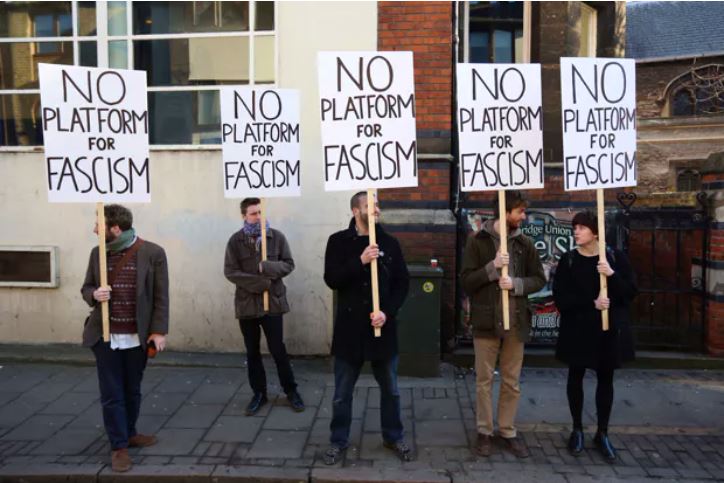
No Platform for Boris Kagarlitsky

no platform

You can not fight the far right by giving a platform to their friends
Simon Pirani’s Archive
July 25, 2019

The editors of Transform, a socialist journal that aims to strengthen the fight against the far right, are to publish a letter from me protesting their use of an article by Boris Kagarlitsky, a Russian “left” writer who collaborates with fascists and ultra-nationalists.

In 2014, Kagarlitsky energetically supported armed action in eastern Ukraine by Russian forces, mainly ultra-nationalist and fascist volunteers. He also began to cooperate with, and to share platforms with, extreme ideologues of Russian ultra-nationalism and fascism. Antifascists and trade unionists in Russia broke all ties with him. I gave details about Kagarlitsky’s position in 2014–16 in an open letter to the Stop the War campaign here.

Kagarlitsky continues to collaborate with the ultra-nationalists. Earlier this year he addressed a Moscow rally supporting Russia’s claim against Japan to the Kurile Islands, alongside the fascist mercenary Igor Strelkov-Girkin and other ultra-nationalist speakers.

At the same time, Kagarlitsky has never expressed solidarity with the young Russian anti-fascists who have been tortured by the security services and put on trial in the notorious Network case. Antifascists in Russia and internationally have united in a defence campaign around these victims of state repression; Kagarlitsky and his friends have not.

Despite this, Transform published an article by Kagarlitsky—about France, not Russia—in the last issue. This week I wrote to the editors to express concern. One replied, saying that my letter would be published in the next issue, later this year, and that they were “not aware” of Kagarlitsky’s cooperation with the right.

To raise awareness, I have put on line this short statement that you are reading.

This gap in the Transform editors’ knowledge is regrettable. All participants in Russia’s beleaguered antifascist movement know of Kagarlitsky’s high-profile defection. Plenty of material alerting English-language readers to his changed stance was published in 2015–16.

Obviously, this is not just about Russia or about Kagarlitsky. The right-wing populists and fascists, through nationalism and campism, pull “left” demagogues into their orbit more widely. This trend must be understood and fought.

Simon Pirani, 25 July 2019

My thanks to Mr. Pirani for permission to reproduce his statement here. Image courtesy of the Spectator and Getty. // TRR