Russian Bus Plunges into River, Killing Passengers

Security camera footage shows a bus in St. Petersburg, Russia, veering across the road and off a bridge into the Moika River. At least three people were killed, with several others in serious condition in hospital.

Source: NBC News, 10 May 2024. Thanks to Marina Varchenko for the heads-up.


“Multipolarity Forum”

While the international far right was busy meeting in Washington, D.C., for the CPAC 2024 conference in late February, on the other side of the world, a grab bag of “anti-Western” groups, including a handful of far-right leaders from Europe, North America, and South America, gathered in the Lomonosov innovation cluster in Moscow for two conferences held in parallel. One was the Multipolarity Forum (Форум многополярности) and the other, the Second Congress of the International Russophile Movement (Второй конгресс Международного движения русофилов, МДР). 

The two meetings, which centered on support for Russia’s invasion of Ukraine, attacking the LGBTQ+ community, opposition to “Western hegemony,” and opposition to the “russophobia” of the West, brought together an odd assortment of leaders. There were representatives from the Global South, National Bolsheviks, acolytes of far right Russian ideologue Alexander Dugin, European neo-fascists, revolutionary leftists, and leaders of various religious denominations. All in all, the gathering included more than 300 representatives from 130 countries.

While Moscow has hosted large conferences attended by significant far-right groups in the past, these two events mark a shift towards official institutional support as high-ranking government officials officially sanctioned the gathering. Present were two members of Putin’s cabinet, Maria Zakharova, the director of the information and press department of the Russian Ministry of Foreign Affairs, and Sergey Lavrov, the Russian foreign minister, who presented opening remarks from Putin. 

Other foreign state officials were invited to the congress as well. They included Darko Mladić, the son of General Ratko Mladić, convicted war criminal for genocide and former general of the Republika Srpska (RS), Zhang Weiwei, an ideologue for the Chinese Communist Party (CCP), Syrian diploma and current ambassador to Russia Bashar Al Jaafari, former Prime Minister of the Slovak Republic Jan Czarnogursky, and South African MP for the African National Congress (ANC) and grandson of Nelson Mandela, Zwelivelile “Mandla” Mandela. Pierre de Gaulle, the grandson of former French President Charles de Gaulle, who has expressed pro-Russian sympathies throughout the war, noted his grandfather’s alleged support for relations with Russia.

“Russophobia,” the “racism” of the West, and the “canceling of Russia” were common themes at the event. Tsargrad TV founder Konstantin Malofeev claimed that the current wave of alleged xenophobia and racism against Russians was comparable to what happened in Nazi Germany. Going further, he underlined that, “we understand that this is the hatred of the globalist elite, not the people.” However, at times, some speakers revealed that the “russophobia” they were referring to was not simply a perceived xenophobia towards Russians, but the West’s insistence that LGBTQ+ people simply not be discriminated against. In fact, one of the three thematic sections for the International Russophile Movement Congress included a section on “traditional values.” In his speech, Alexander Dugin mentioned the following: 

“The West has racistly and imperialistically identified itself with humanity. There was a time when Britain claimed all seas and oceans as its own. Western civilisation declared all of humanity its property — primarily its consciousness. This led to the formation of a unipolar world. In this world, there are only Western values. Only one political system — liberal democracy. Only one economic model — neoliberal capitalism. Only one culture — postmodernism. Only one conception of genders and family — LGBT. Only one version of development — technological perfection up to post-humanism and the complete displacement of humanity by AI and cyborgs.”

Dugin, the leader of the International Eurasian Movement (Международная евразийская движения, MED), and theorist of “Eurasianism,” and the neo-fascist “Fourth Political Theory” which aims to unite far right and far left groups around the world to destabilize Western democracies, was a key speaker at the event. He received widespread attention from conference attendees and Russian propaganda outlets RT, Sputnik, and Tsargrad. Other followers of the “Fourth Political theory” present at the conference included Raphael Machado, leader of the far right Brazilian group Nova Resistência (New Resistance), which the U.S. State Department recently classified as a source of “Pro-Kremlin Disinformation” in Brazil. According to Machado, the conferences, which were first organized in 2023, are the brainchild of he and Dugin, with support from the Thinkers Forum in China and the International Movement of Russophiles. Following the 2023 conferences, Machado was named the Latin American coordinator for the event. During Machado’s trip to Moscow, he met with many of the speakers, including Maria Zakharova, the President of the Eurasian Youth Union (Евразийский союз молодежи) chapter in Russia, Pavel Kiselev, and Leonid Savin, the longtime editor of Dugin’s website Geopolitika.ru.

Another individual with whom Machado had contact while on his trip was a member of the ultranationalist Two-Headed Eagle movement (Всероссийский съезд общества “Двуглавый Орел”), led by Malofeev, and which Machado claims has a formal partnership with Nova Resistência and is currently fighting in Ukraine. The Two-Headed Eagle movement was created by Malofeev in 2017 with the objective of supporting Putin, ridding the country of secularism and returning the Orthodox monarchy to the country, as well as the demolition of Lenin’s mausoleum.

Malofeev, the director of Russian Christian nationalist and conspiracist media platform Tsargrad (Царьград), and wealthy financier of anti-LGBTQ+ causes around the world, who has paid millions of dollars to separatists in the Donbass region of Ukraine, was another star speaker. During his speech, he made the following comments directed at the LGBTQ+ community: 

“I think everyone in this room is well aware that the World Health Organization was created with Rockefeller money, and now its main sponsor is the Bill Gates Foundation. Therefore, transnational corporations and international organizations have long merged and serve the interests of the globalist elite. WHO recently adopted the International Classification of Diseases No. 11 (ICD-11), which excluded perversion from mental disorders and pedophilia ceased to be a disease, but became just a disorder. This is not the imposition of new social norms, but rather it is the abandonment of God and the embodiment of Satanism.”

Formally, the Russian Ministry of Foreign Affairs and the head of the International Movement of Russophiles (MDR) Nikolai Malinov, a former Bulgarian politician who was once accused of spying for Russia and sanctioned by the United States, organized the events. In practice, however, it is understood that Malofeev was the primary financier of the congresses.

Italian far right leader Roberto Fiore, acting as a representative on behalf of his neo-fascist political party Forza Nuova (New Force, FN) and the EU parliamentary far-right coalition Alliance for Peace and Freedom (APF), made up of the Die Heimat (DH)Parti Nationaliste Français (PNF)Democracia Nacional (DN) and other far-right parties, was also an invited attendee of the conferences. Fiore presented a proposal for “a Russian intervention of 50 billion euros to regenerate the agriculture of our territory and consequently its social fabric, eroded by years of capitalism and policies distant from the earth.” This would apparently “allow Italy to gradually move away from the diabolical Western world that is leading our country to the abyss.”

Another attendee was Belgian Kris Roman, a Russian propagandist with ties to both Russian intelligence, and various groups on the international far right. Roman, who considers himself a “reformed racist,” has a history steeped in Nazism and white supremacist politics, which later led him to make connections with the Russian far right in the early 2000s and build bridges with Russians over the years through his organization Euro-Rus. During the event, Roman met with Maria Zakharova. Other far-right attendees included Zmago Jelinčič Plemeniti, the leader of the far right, anti-LGBTQ+, anti-Roma party Slovenska Nacionalna Stranka (Slovenian National Party, SNS), Mitsuhiro Kimura, the leader of the Japanese ultranationalist and anti-American group Issuikai (一水会), and Kemi Seba, a French-Beninese, pro-Russian activist against French colonialism in Africa with a history of holding strongly antisemitic beliefs.

A number of pro-Russian journalists, who frequently speak on air on Russian propaganda channels such as RT and Sputnik, were present for the event. Brazilian journalist for the Asia Times Pepe Escobar, who commonly appears on Russian media channels, was invited to speak alongside Maria Zakharova. Another attendee was conspiracist and Syrian dictator Bashar Assad propagandist Maram Susli, AKA “Syrian Girl,” known for her television appearances on Russia Today (Россия Сегодня, RT) and the American conspiracy outfit Infowars, who has ties to white nationalist identitarian groups in Austria and the US. Other influencers present at the conferences were Peruvian war correspondent and Russian propagandist Carlos Mamani, American MMA fighter and RT host Jeff Monson, and Russian-American television host for Channel One Russia (Первый канал) Dimitri K. Simes. A representative from the far right conspiracist website Counterspin New Zealand was present to cover the event.

A cohort of representatives from religious movements were invited to the conference, including the Archbishop Savva of Zelenograd, the Catholic Cardinal ViganòSheikh Iman Hussein, and Archpriest Tkachev. The Duginist outlet Geopolitika’s summary of the event described their speeches as follows: 

“In the speeches of Cardinal Viganò and Archpriest Tkachev, a verdict was made on the hegemony of Western elites, a condemnation of their diabolical roots and the closed club of Satan worshipers. They openly criticized the hatred of traditional biblical man, dotting the i’s and calling a spade a spade.”

The Portuguese commentator Alexandre Guerreiro, was also present to give a speech on multipolarity. Guerreiro was previously named in a report by Portuguese news outlet Sábado to be a part of the “far-right network spreading Russian propaganda in Portugal,” and has appeared several times on the podcast of Nova Resistência. From Poland, Tomasz Jankowski, previously the general secretary of the pro-Russian Zmiana political party (Change), and the magazine Myśl Polska, made an appearance. CIA veteran Larry Johnson was another popular guest who claimed in his speech that the United States had become a country like the Soviet Union that “restricted free speech, jailed political opponents, and had elderly leaders.”

Finally, testifying to the Red-Brown alliance (between far left, far right, and nationalist groups) that the Russian government has done so much to help foster in recent years, members of the traditional radical left also sent representatives to the conferences. Chief amongst them was Jesus Salazar Velásquez, the Venezuelan ambassador to Russia who voiced his support for “Russia and the country’s fight for a just world without the hegemony of the ‘collective West.’” From the U.S., the pro-Russian communist Haz Al-Din, and the German communist Liane Kilinc, president of the “Peace Bridge – War Victims Aid,” met with other pro-Russian influencers outside of the event. Two attendees coming from Latin America, Elier Ramírez Cañedo, the Deputy director of the Fidel Castro Ruz Center, and the Argentinian sociologist Atilio Boron, were in attendance. Jackson Hinkle the “MAGA Communist” from the United States, was another attendee who met with many of the speakers including Alexander DuginMaria ZakharovaSergey Lavrov, and Kris Roman.

Source: “Russia Hosts Large Far Right Conference Attacking LGBTQ+ Rights, ‘Russophobes,’ and ‘Globalists,'” Global Project Against Hate and Extremism, 5 March 2024


Crimean pensioner Maria Zamyrailo-Levytska has been jailed for five days and fined 35 thousand roubles over ‘liked’ posts on the social network Odnoklassniki, including one containing the Ukrainian trident.  The 64-year-old is one of a huge number of Ukrainian men and women who have been ‘denounced’ by so-called ‘Crimean SMERSH’ vigilantes working closely with the Russian occupation enforcement bodies to hunt down those expressing pro-Ukrainian views or opposition to Russia’s war of aggression against Ukraine. 

Judging by the material shown on the Crimean SMERSH Telegram channel, Zamyrailo-Levytska may well have only ‘liked’ the posts of others, with this on Odnoklassniki meaning that the posts appear on her page also.  All of the posts which Crimean SMERSH and the Russian occupation regime found ‘incriminating’ demonstrate support for Ukraine, as well as gratitude and deep respect for Ukraine’s defenders.

The occupation enforcement bodies came up with two charges.  She was accused of ‘discrediting’ the Russian armed forces, under Article 20.3.3 of Russia’s code of administrative offences.  This was one of four charges hastily added to Russian legislation following the full-scale invasion of Ukraine and it is standardly used in occupied Crimea to prosecute for Ukrainian patriotic songs, the Ukrainian flag or for expressing opposition to the war.  She was, however, also charged under Article 20.3 § 1 because of the Ukrainian Trident on posts.  Although the ‘court press service’ typically reported this as being a conviction for “publicly demonstrating Nazi symbols”, it went on to explain that it was, in fact, because it was considered to be a symbol of the Organization of Ukrainian Nationalists, one of many Ukrainian organizations banned in Russia and in parts of Ukraine while they remain under Russian occupation.   There were, seemingly, two separate ‘hearings’ on 7 May 2024, with both under ‘judge’ Georgy Davidovich Tsertsvadze from the occupation ‘Kirovske district court’.  It is likely that she received the five-day term of imprisonment over the Trident, and the 35-thousand rouble fine over posts claimed to ‘discredit’ the invading country’s armed forces. 

‘Crimean SMERSH’ do not appear to have extracted one of their standard videoed ‘confessions’ which are normally shot in occupation ‘police’ offices.  It is clear from the part of the ‘court’ hearing that Crimean SMERSH, or the latter’s most notorious collaborator Aleksandr Talipov, posted, that Zamyrailo-Levytska was clearly terrorized, and can be seen ‘admitting guilt’ and promising not to do it again. 

The original SMERSH was active in the Soviet Union during World War II and immediately afterwards.  While supposedly created to hunt down those working for the Nazis, it is most notorious for having targeted opponents of the communist regime. The term SMERSH was, apparently, coined by Joseph Stalin as an abbreviation for ‘death to spies’.  As in Stalin’s USSR, the victims of the modern day ‘Crimean SMERSH’ are those who oppose the current occupation regime.  Russia originally used ‘videoed confessions’ as part of its terror in Chechnya, however the Russian human rights monitors OVD.info reported in June 2023 that two thirds of these alleged ‘confessions’ now come from occupied Crimea. 

If, in occupied Crimea, Talipov & Co. carry out their denunciations and use torture or terror to extract ‘confessions’ in obvious, yet not officially stated collaboration with the occupation authorities, that may well be about to change.

In December 2023, Russian Duma deputy Andrei Gurulev, a lieutenant general on the Duma defence committee, announced the creation of SMERSH in occupied parts of Ukraine.  The aim of SMERSH, he claimed, was “to fight saboteurs and spies” and he called for SMERSH to be revived throughout Russia.  While the security service is working all out, he wrote, they could miss something, and claimed that there are internal enemies acting against Russia’s interests “with the help of Western security services”.  Although both Russian-installed Crimean leader Sergei Aksyonov and Yan Gagin from the Russian proxy ‘Donetsk people’s republic’ were cited as having called for such units, this was seemingly the first time that a Russian official said that SMERSH was already functioning in occupied parts of Donetsk, Luhansk, Kherson and Zaporizhzhia oblasts.

Source: Halya Coynash, “64-year-old pensioner jailed in Russian-occupied Crimea for social media posts of a Ukrainian Trident and thanking Ukraine’s defenders,” Human Rights in Ukraine, 10 May 2024


The Russian capture of Avdiivka and its military’s slow subsequent advance this spring has come at the cost of thousands of deaths of its own servicemen, to say nothing of Ukrainian losses. Since the summer of 2022, Russian commanders have repeatedly sent their soldiers on suicidal assaults, essentially using them as cannon fodder. Deprived of proper support, sapped of motivation, denied medical aid, and left with no route of retreat that does not involve the high risk of being shot by their own side, Russian soldiers are dying in droves for every kilometer of uninhabitable territory “liberated” by Kremlin forces.

Survivors of these “meat grinder” assaults supplied The Insider with harrowing accounts. They took cover behind the corpses of their former comrades during shelling. They were tasked with collecting the shredded remains of blown apart bodies. They were trapped in trenches for days with no food, water, ammunition, or hope of evacuation.

[…]
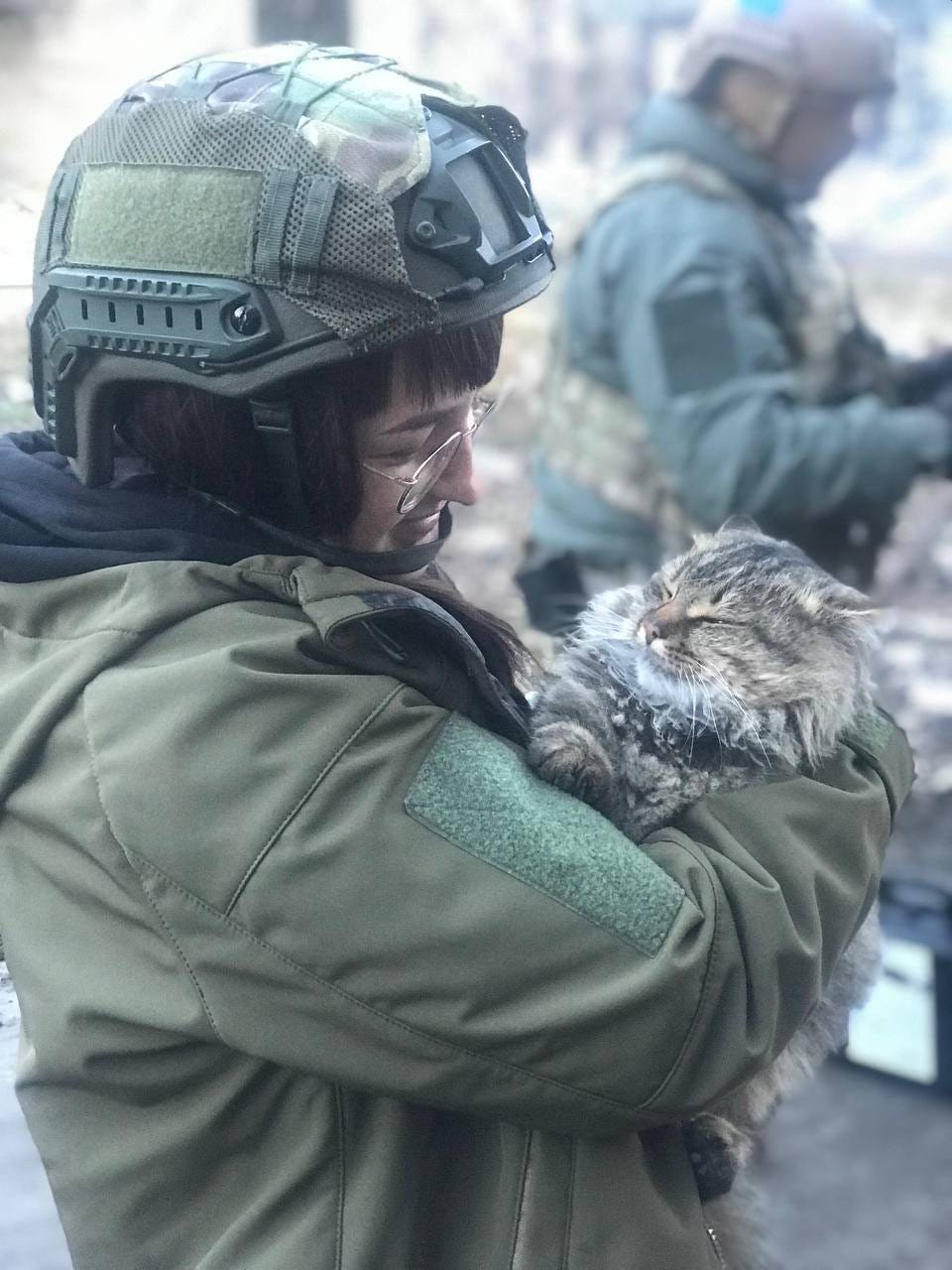
Source: Victoria Ponomareva, “‘Shreds of bodies hung from the branches’: Confessions of ‘meat grinder’ assault veterans,” The Insider, 8 May 2024

What Is Avdiivka?

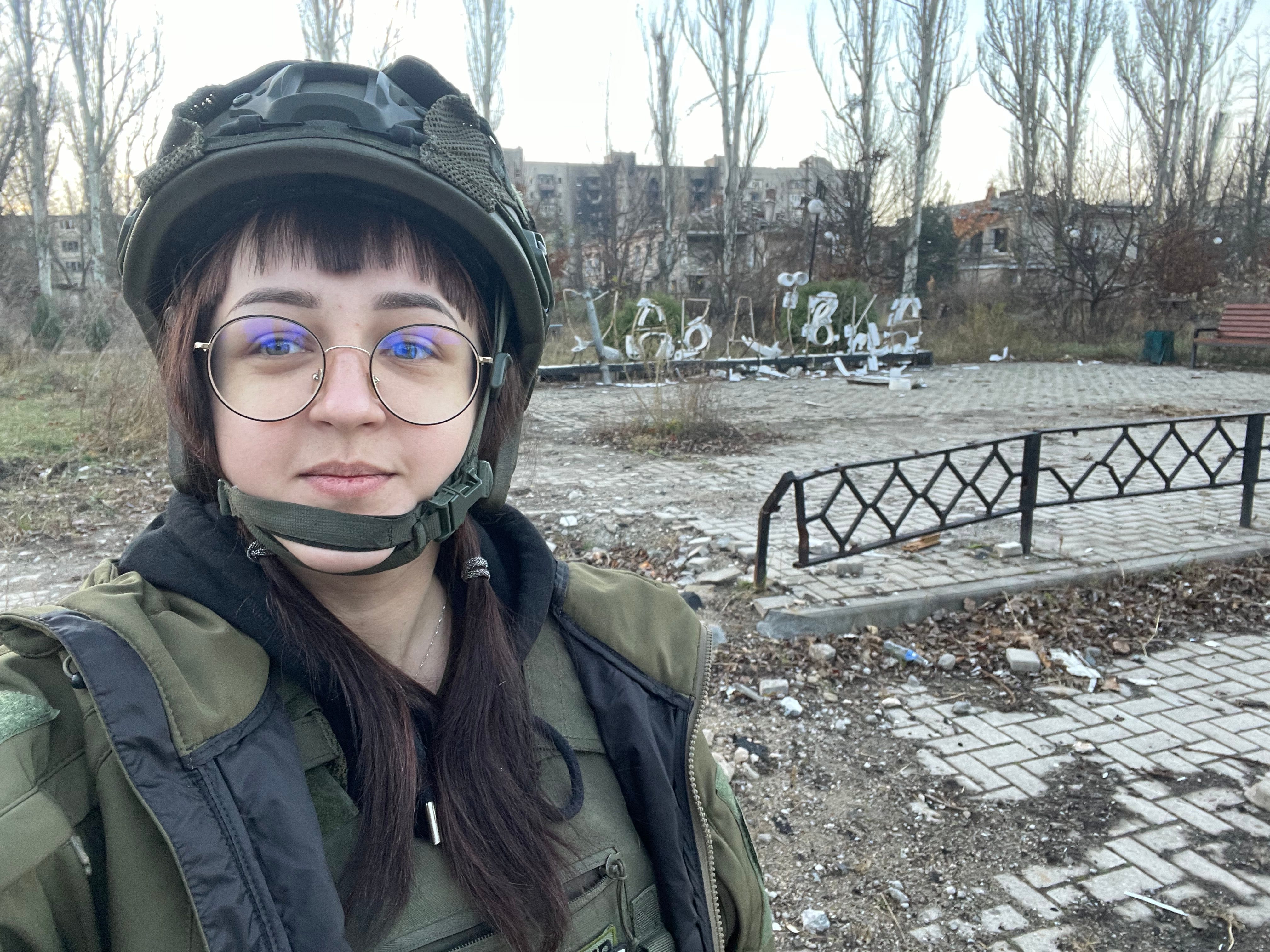
Our team is thrilled to present an incredible interview featuring Yana, a 28-year-old Ukrainian volunteer who has recently returned from Avdiivka. It’s a highly illustrative story showcasing how people, specifically young Ukrainian women, continue to support Ukrainian troops on the most dangerous frontlines. If you’re curious about what’s happening in Avdiivka and wish to hear a firsthand account from a location typically closed off to journalists and the general public, look no further. We found her answers insightful, so don’t miss out!

FI (Frontelligence Insight): Hello! Could you please provide a brief introduction and tell us more about yourself?

Y (Yana): My name is Yana, and I am 28 years old. Before the full-scale invasion, I worked in the construction industry as a manager of construction projects. I dedicated a lot of time to learning English and took additional courses in ArchiCAD and LIRA-SAPR. A significant part of my free time and, in general, my life, was devoted to studying and improving my knowledge in the field of design. However, after February 24, everything changed. All construction projects that were planned for 2022-23 were canceled and frozen. Currently, I am busy in the field related to my economics education.

FI: How and when did the war start for you?

Y: The war began for me in 2014. It was a very challenging period during which I experienced depression. I constantly felt unwell both physically and morally. Of course, this affected the learning process, at times impacting my performance, interaction, and communication with people. I worked with a psychologist. It was a huge blow for me to realize that, 1000 km away from where I was living, studying, and currently residing, the most terrible thing was happening – war. It was surreal for me that while I was performing mundane actions, someone was dying, someone was getting injured, homes were destroyed. It was shocking to see that despite these events, people could calmly attend classes, go to work, cafes, and clubs.

A part of what I loved was forever lost in 2014. It tore me apart to think that while I was attending an accounting class, there were ongoing military actions in the Donbas region. It was also challenging because many people said, “They themselves called for the Russian world,” “They wanted Putin,” “It’s because of them that there’s a war.” These were people who never knew the history of Eastern Ukraine and never understood it.

FI: When and why did you decide to become a volunteer? (In Ukraine, the term “volunteer” refers to individuals engaged in providing military and humanitarian aid to both military personnel and civilians. These volunteers contribute by fundraising, purchasing, and delivering essential goods to military units and civilians on the frontlines.)

Y: It seems that, like many others, it all started for me with weaving camouflage nets. Yes, there were requests for them, and we were told how important it was and how it helps our defenders. It was enough for me as a second-year student at that time. But, as I shared earlier, I found these events deeply painful, and I wanted to do more. I spent my entire scholarship on supporting the Armed Forces of Ukraine (ZSU). It wasn’t about large-scale fundraising; I didn’t inquire about who was buying what and why. We had local volunteers and civic organizations in Chernivtsi (which are still active), and I financially supported them. It was important to me. At that time, intense battles were taking place in Donetsk Airport (DAP), Debaltseve, Ilovaisk, and so on. It was heart-wrenching, and I felt the need to be somehow involved in providing assistance.

Later, my mother and I started preparing homemade treats, and I delivered them to the military hospitals in our city. Every Tuesday, I would enter a random ward to visit the soldiers. There was a period when I consistently donated and supported the army without hesitation. Again, my mother always assisted me—whether it was making Easter bread for the soldiers or baking Christmas cookies to send to the front lines.

When the full-scale invasion began, on February 25th, my father and I filled our car with essential items and headed to the Territorial Defense headquarters in our city. We collected items for units that were being prepared and sent to the East. We were also helping civilians – by evacuating people from Donetsk, Luhansk, Kharkiv, Kyiv oblast, and evacuating animals, transferring them to Europe. Only when I completed my second higher education in May 2022 did we start going on humanitarian missions directly to the frontlines.

FI: What is the essence of volunteering and who are volunteers?

Y: The essence of volunteering is perhaps in selfless work, in ongoing activities aimed not at gaining profit or any other additional benefits. Volunteering is, above all, the opportunity to influence environment, to initiate one’s own projects, and to change the country. When people become volunteers, they not only get a chance to express themselves, get new knowledge and skills, but also strive to make the lives of others better.

I believe that each person who calls themselves a “volunteer” has their own motives that prompted them to engage in this activity. For me, it is primarily patriotism and the fact that my country is at war. Parts of our land are immersed in pain, suffering, and blood. And then, it is about fulfilling the needs of the less fortunate, gaining new experience in working with people, organizing, and conducting various social projects.

Currently, the activities of the majority of volunteers and volunteer organizations in Ukraine are focused on helping the military, supporting refugees, and assisting people affected by the war. Because this is our own, our homeland, and I simply cannot comprehend or accept how one can be indifferent to this movement in such challenging times.

FI: You’ve been to many cities and villages that were destroyed by Russian forces. What impressed you the most during your volunteer trips?

Y: Oh, here one could talk for days and nights because for almost 2 years of trips to the front and near-front cities and villages, there were many different situations and moments when I could cry and scream from pain and despair, when we laughed, probably hysterical laughter, when we said goodbye to life dozens of times and rejoiced because an important evacuation had succeeded, and when we scolded ourselves for arriving late.

I approach each of our trips calmly. For me, it’s like going to work, with one important nuance. I perceive it as work because I go to various locations to work with civilians and the military, to help them.

This time, I’ll share just one incident from our recent trip. We were working specifically along the Mariinka direction, and we entered the village of Maksymilianivka, just 5 km from Mariinka, or more precisely, the stones and ruins left of it. Before the war, 3000 people lived there; now, there are probably around 100. Maybe more, maybe less – it’s hard to count accurately because it’s constantly under shelling, and people hide in their homes, rarely coming out. In Maksymilianivka, they don’t allow entry without an escort; everyone is checked at the checkpoint. And it was the last day of our trip: we traveled to Avdiivka and its surroundings, Bakhmut direction, Vuhledar direction – everywhere destruction, grief, no communication, and here we enter a house in Maksymilianivka, and there’s light. It so impressed me, and I said to my colleague, “Wow, there’s light here, it’s a real miracle!” In the midst of terrible devastation in the village, constant shelling, lack of communication, and internet just 5 km from the front line, we saw light in a house. The thing is, electricians stay there, and despite the constant threat of artillery, MLRS shelling, and Orlan drones, these people work until the last moment and provide light to the people who stay in the village. Our people will probably never cease to amaze me.

FI: Let’s talk about the painful – Avdiivka. Tell me about your personal impressions from the recent visits.

Y: Avdiivka is my personal pain and a wound that has probably been with me all my life. Working and helping in Avdiivka – I mean both the military and civilians – is like living another life. Perhaps, after the war, I will write a book about it because so much has been experienced there. A lot of things that I cannot always talk about, and things that need to be told and shown to those who come after us, so that these things and stories are not forgotten.

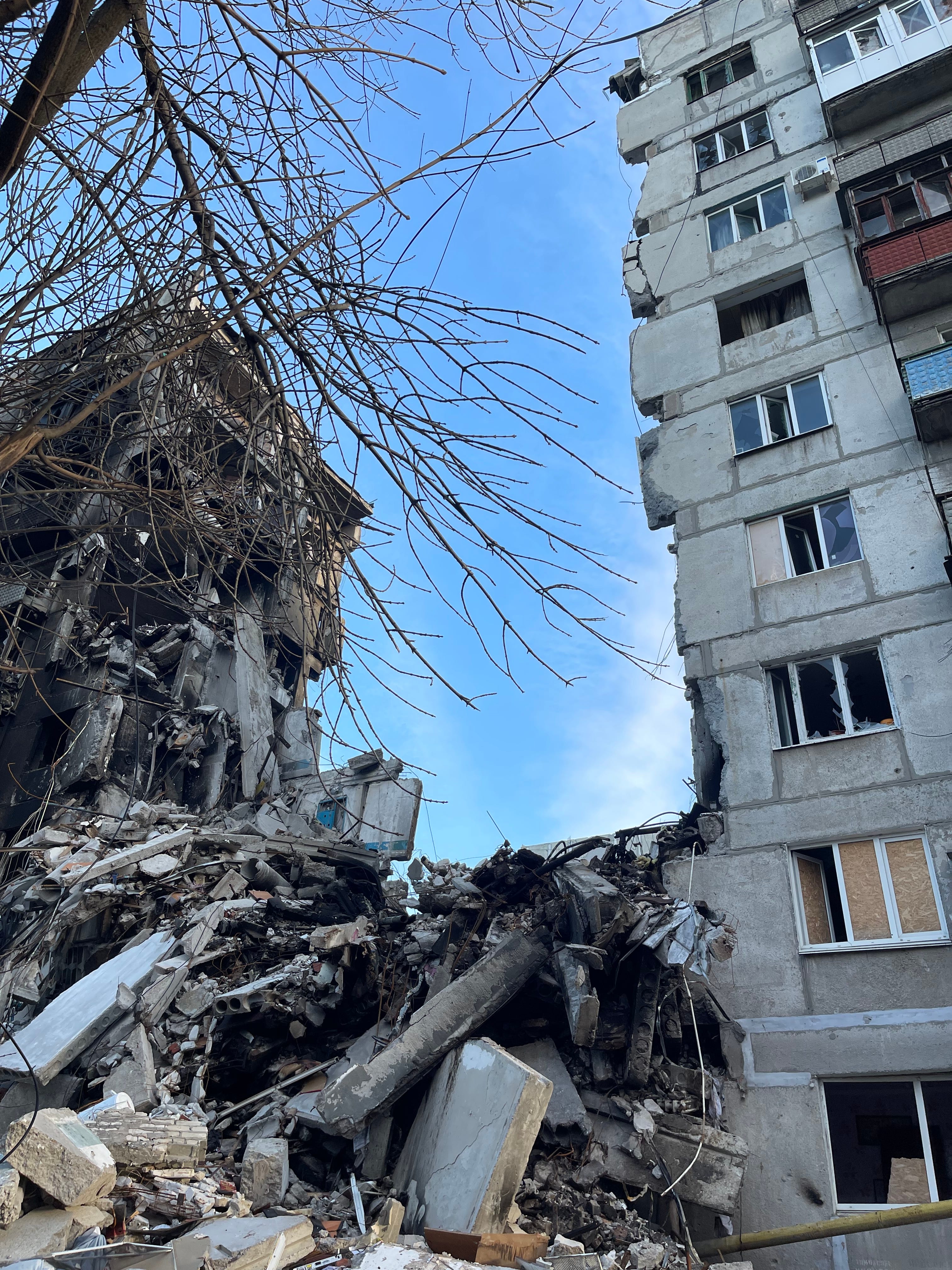
I remember Avdiivka differently, in every season, and, of course, it hurts every time… as if for the first time when, instead of a city, I see piles of rubble and construction debris, and on the way to the city, instead of the outlines of a giant industry, I see clouds of black-black smoke from the next shelling…

I’m not saying it for the last time because I know that we will still work in the Avdiivka direction – and the last time I was there on my birthday.

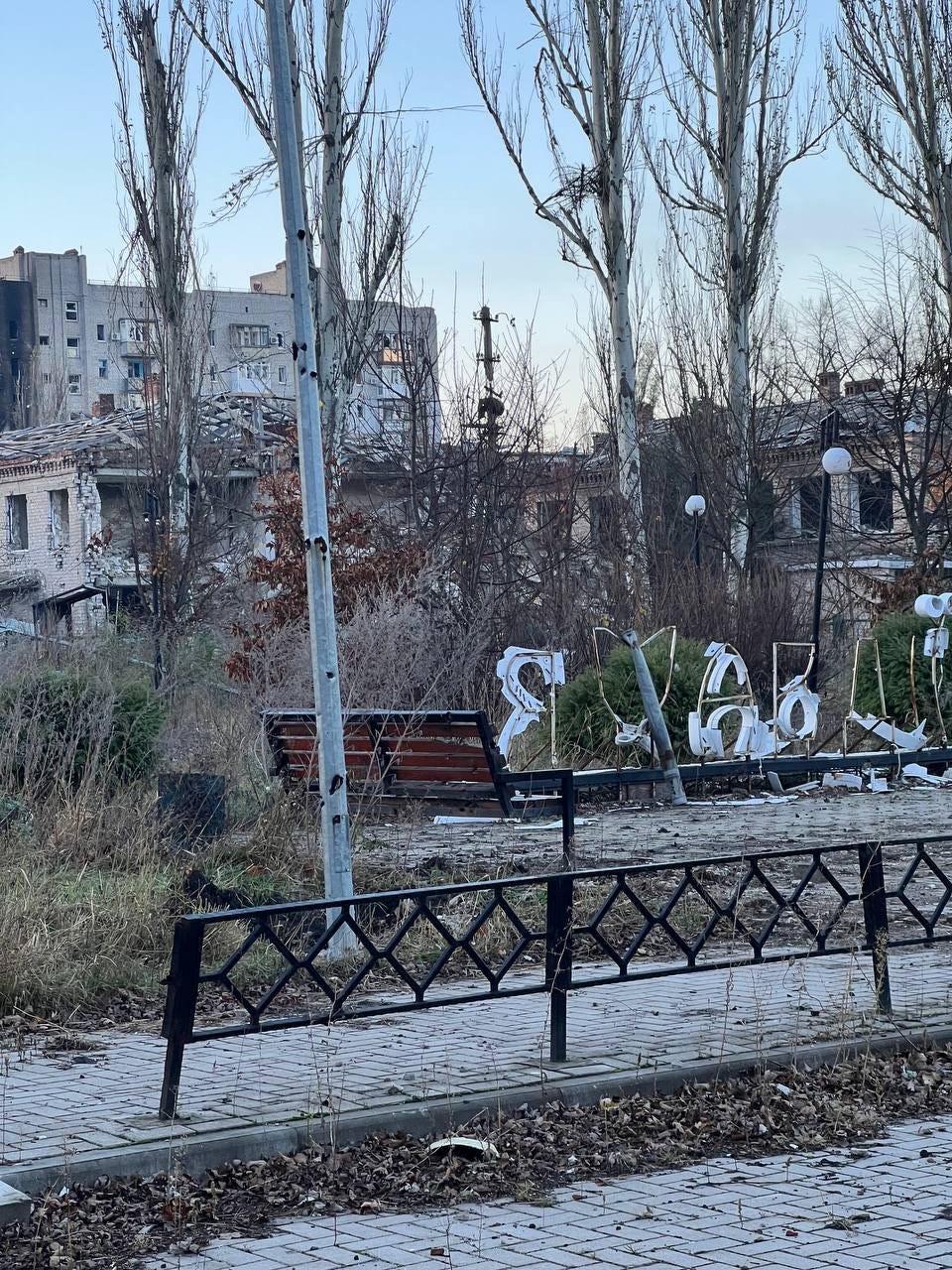
On November 18, we woke up at 4 in the morning to load humanitarian aid for civilians and equipment for the military, so that by 6:00, a maximum at 6:30 AM, we would already be in the city. Avdiivka now is 22 km of a constantly shelled road. There are sections where enemy UAVs are actively working, so, as we say, we need to “skip” quickly. We entered without headlights, quickly, with open windows in the car to hear enemy UAVs.

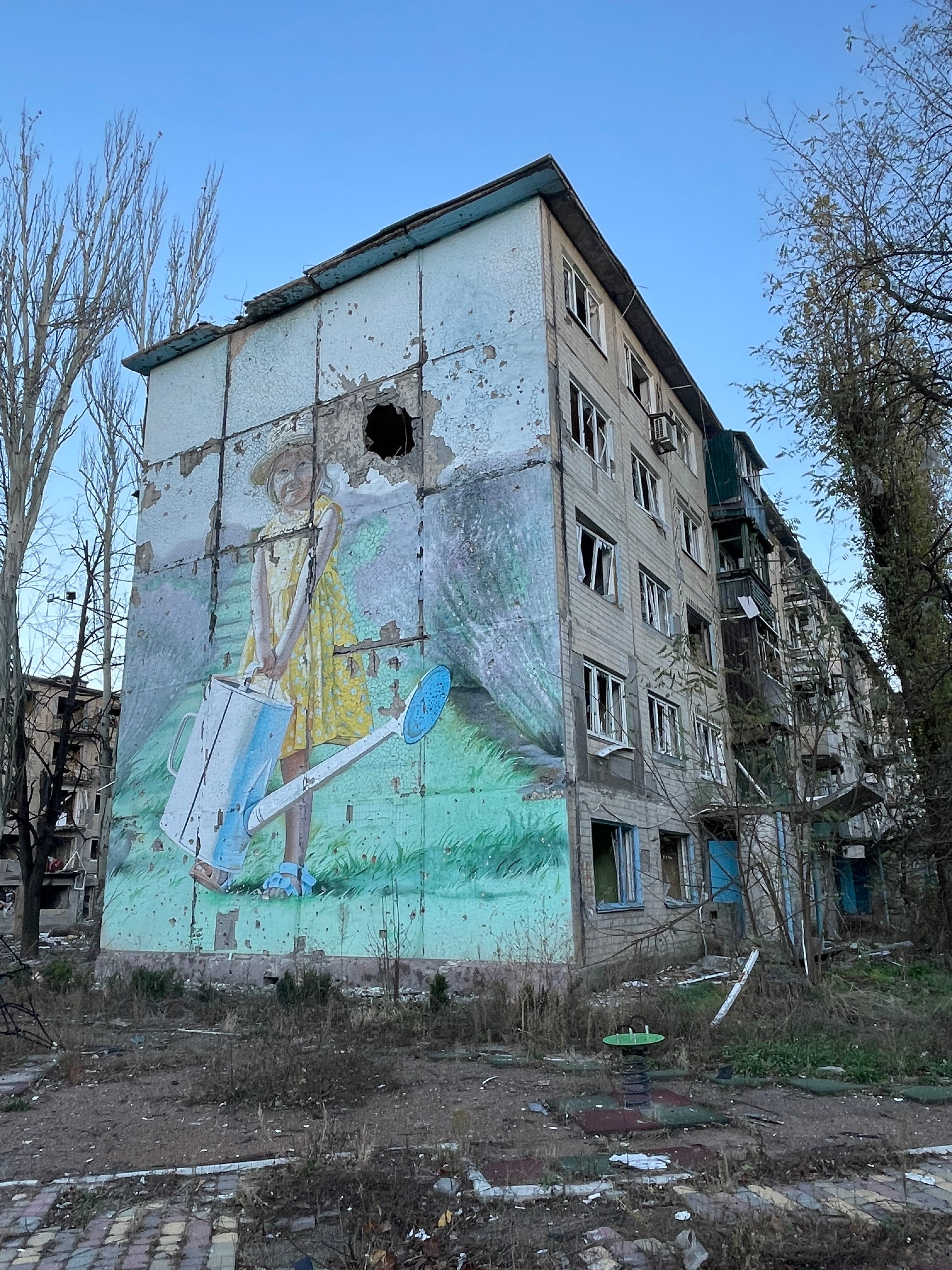
The landscape in Avdiivka changes every night. Dozens of air strikes per day turn the city into complete ruins. There are fewer and fewer places for shelter, constant “KABs” (Guided Aerial Bombs), the scariest thing imaginable, when a building collapses like a house of cards before your eyes – I’ve seen that only in apocalyptic movies.

If you work with civilians: humanitarian aid and evacuation – everything needs to be done in the morning and very quickly. After the morning, the Russians fly with Orlans (recon UAV); they observe, and determine where there are groups of people (3 or more), from which building smoke is coming from a home stove, and KABs target it. Just damned scum waging war on absolutely unarmed and defenseless people.

It’s very hard for me when through the window of a burned, black building with broken windows, I see remnants of life – a small intact chandelier that will never shine again, winter clothes on the shelves that no one will ever wear, and neatly arranged books.

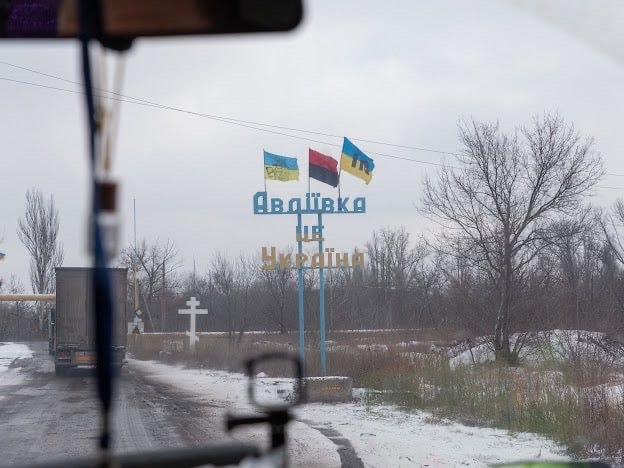
But every damn time we enter this city, and at the entrance, Ukrainian flags greet us, it adds strength and motivation to move forward. I want everyone, both here and around the world, to realize the price we pay to see these blue-yellow flags in Avdiivka, and what irreparable losses we suffer. When I see our tired, exhausted soldiers who clearly say, “It’s hard, but we’re fighting,” I understand that we have no right to get tired and stop. I’m ready to sacrifice my health, but I will be sure that I did everything to protect and help the bravest people in our country and our city, Avdiivka.

FI: In your opinion, why is Avdiivka so important for the Russians?

Y: Avdiivka, like a bone in the throat of our enemies, has remained an impregnable fortress. Unfortunately, this fortress is now forced to defend itself. As they say now, “capturing Avdiivka is purely a political goal” for these damn Russians and Putin in particular. They need victories. But a victory over what? Over peaceful people who have been deprived of their homes or because they destroyed the entire city?!

Avdiivka is the gateway to Donetsk. From there, the Armed Forces of Ukraine have the opportunity to control the presence of the enemy in the oblast center, even by preventing them from moving certain vehicles and ammunition around the city. So, of course, they want to push the front line away from Donetsk. Another point, Avdiivka is probably the only defensive area that the Ukrainian Armed Forces have not lost from 2014 to 2022. That is, during the time when there were large and difficult battles for Soledar, Bakhmut, Lysychansk, Severodonetsk, etc., their advances in Avdiivka were insignificant. Only the surrounding settlements from Avdiivka were lost to the Russians, and that was very long and very difficult for them. And another logistical component. I believe and will always believe that Avdiivka is a symbol of resistance. Probably even the Russians understand this, and that’s why they are pushing so hard in this direction. You have to look at the map and understand that Avdiivka is precisely that outpost that, from 2015 to the present, has practically not moved forward or backward. It’s a strong defensive zone that has been fortified.

FI: Do you agree with the opinion that when the Russians cannot quickly surround a city, they systematically destroy it?

Y: Yes, I often think about it… Bakhmut, Popasna, Rubizhne, Severodonetsk, Lysychansk, Svatove, Kremenna, Mariinka, Vuhledar, Mariupol, Avdiivka, Krasnohorivka, Siversk, Soledar, and so on… and these are just the territories of Donetsk and Luhansk that Russia has destroyed, erased below the foundations. Once peaceful, flourishing, industrial or not, these cities may never be rebuilt. And how many villages? It’s impossible to count. Millions of destroyed homes and millions of shattered human lives.

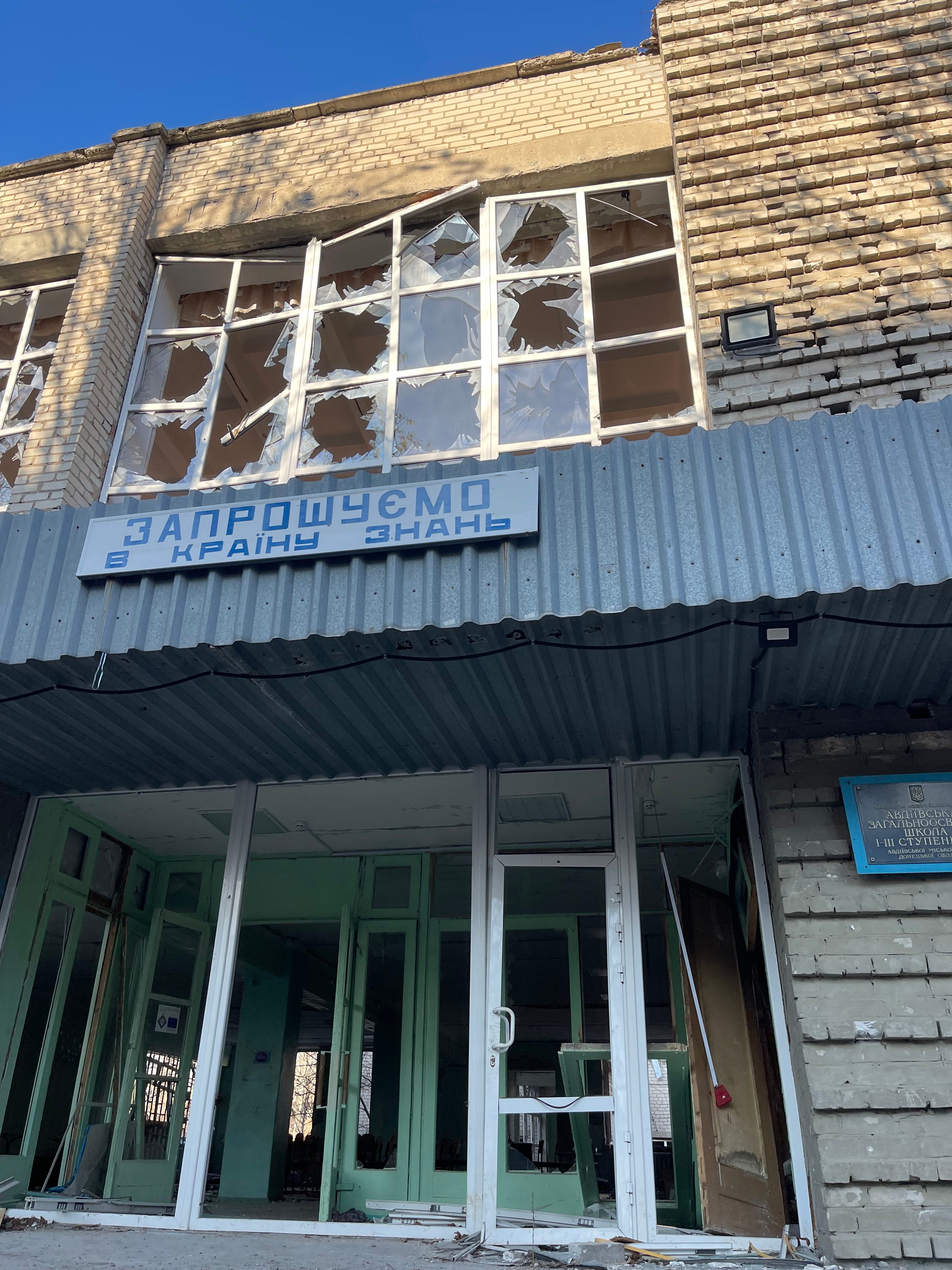
And when they write in their damn publics about the “liberation” of Donbas, I am disgusted with this phrase. Because it is total destruction. In some points of Avdiivka, the destruction is so catastrophic, but it is still being bombed, that I can no longer remember what this city looked like before. Avdiivka is a city where no building is suitable for even a major reconstruction. Also, a key location in Avdiivka was the AKHZ – once the largest coke-chemical plant in Europe, and a city formed around it. If the plant cannot be restored, there will be no more Avdiivka. All the industry of Avdiivka is destroyed, ruined, and brought to a state where it simply can never function again. Probably, this is what they seek – to destroy even the industrial potential of this region so that after the war, it will be simply unusable. These are absolute degenerates, despicable degenerates with nothing sacred, who just, for the sake of entertainment or idiocy induced by imperialist propaganda, destroy everything: schools, hospitals, kindergartens, abandoned warehouse buildings, residential and non-residential buildings.

School in Avdiivka

When there is no success on the battlefield, they show their vile power through terror against civilians and through the total destruction of the city. Take, for example, Popasna – they just destroyed the city and announced that they would not rebuild it, and now they are using it as a military base.

FI: I know that many Ukrainians trust you and constantly try to help. Do you feel foreign aid from ordinary citizens or organizations?

Y: Yes, as strange as it may sound, during this terrible war, there are pleasant moments, such as meeting incredible and strong people or receiving feedback from people. Trust from the community is the best thing anyone can receive. And of course, I am very pleased to receive trust and support from my fellow citizens and from foreigners. Getting help and support from the civilized world is very valuable to us. I always mention and sincerely thank Ukrainians abroad and foreigners in general for supporting the Avdiivka front. Sometimes people, when they see where we are going, how and where we work, say, “I want to help the defenders of Avdiivka!” I repeat, this is very important to me. It is important that the world sees the crimes that the Russians are committing in the once-small industrial city of Avdiivka.

Avdiivka is currently closed to journalists, so it is important to show how the city lives and fights, that there are still civilians here, and that the Russians are committing genocide against them. I am very grateful to everyone who supports our fundraisers for the defenders of Avdiivka, and to those who simply support me with warm words and wishes for success, because now it is more dangerous in Avdiivka than ever.

FI: How can one help the defenders of Avdiivka? Are there any urgent needs that need to be addressed?

Y: Today, once again, I spoke with servicemen from the 110th Separate Mechanized Brigade, who have been firmly defending this direction since March 2022. The primary need is for combat equipment! There is also a shortage of personnel. Additionally, there is a constant need for drones: daytime, nighttime, strike, and FPV drones for installing surveillance cameras on various objects. Maximum unity and concentration of efforts are required. We must show that we are a reliable and worthy support for our defenders on the front lines.

FI: After the war, what would you like to do?

Y: Certainly, I would like to return to my former job in the construction industry. I hope to resume working in the field of design. However, it is very difficult to imagine what life will be like after the war. In any case, I can never go back to my previous life. Our work will continue in one way or another, with a lot of tasks in the de-occupied territories, working with civilians, and humanitarian missions. But yes, along with that, I would still like to engage in design.

FI: What places would you recommend for foreigners to visit in Ukraine?

Y: Currently, this is a very difficult and painful question for me because dozens of places I would recommend to visit to immerse oneself in the culture, better understand the locality, and experience the uniqueness of the region are unfortunately either destroyed, no longer exist, or are in temporary occupation.

Of course, I would like to recommend visiting Donetsk – as we used to call it, the “City of a Million Roses.” Or Soledar, there was something to be surprised about in Soledar: remnants of the ancient Permian Sea, industrial objects, steppe landscapes, vast lakes, and even “Martian landscapes.” And, of course, the salt mines. There, the descent is almost 300 meters deep, where there used to be a salt mining museum, a salt football field, a naturally occurring salt crystal the size of a human, sculptures created by local craftsmen, and a special hall for symphonic concerts. I also really liked the Avdiivka quarry, or as the locals called it, the “Maldives of Avdiivka.” They used to extract quartz sand there. The former industrial zone eventually turned into a local landmark. It had clean and cool water. But many, many other places were destroyed and ruined by the Russians.

So, I would recommend visiting the Carpathian Mountains. Take a walk through the wooded hills and blooming meadows, and definitely climb the highest mountain – Hoverla.

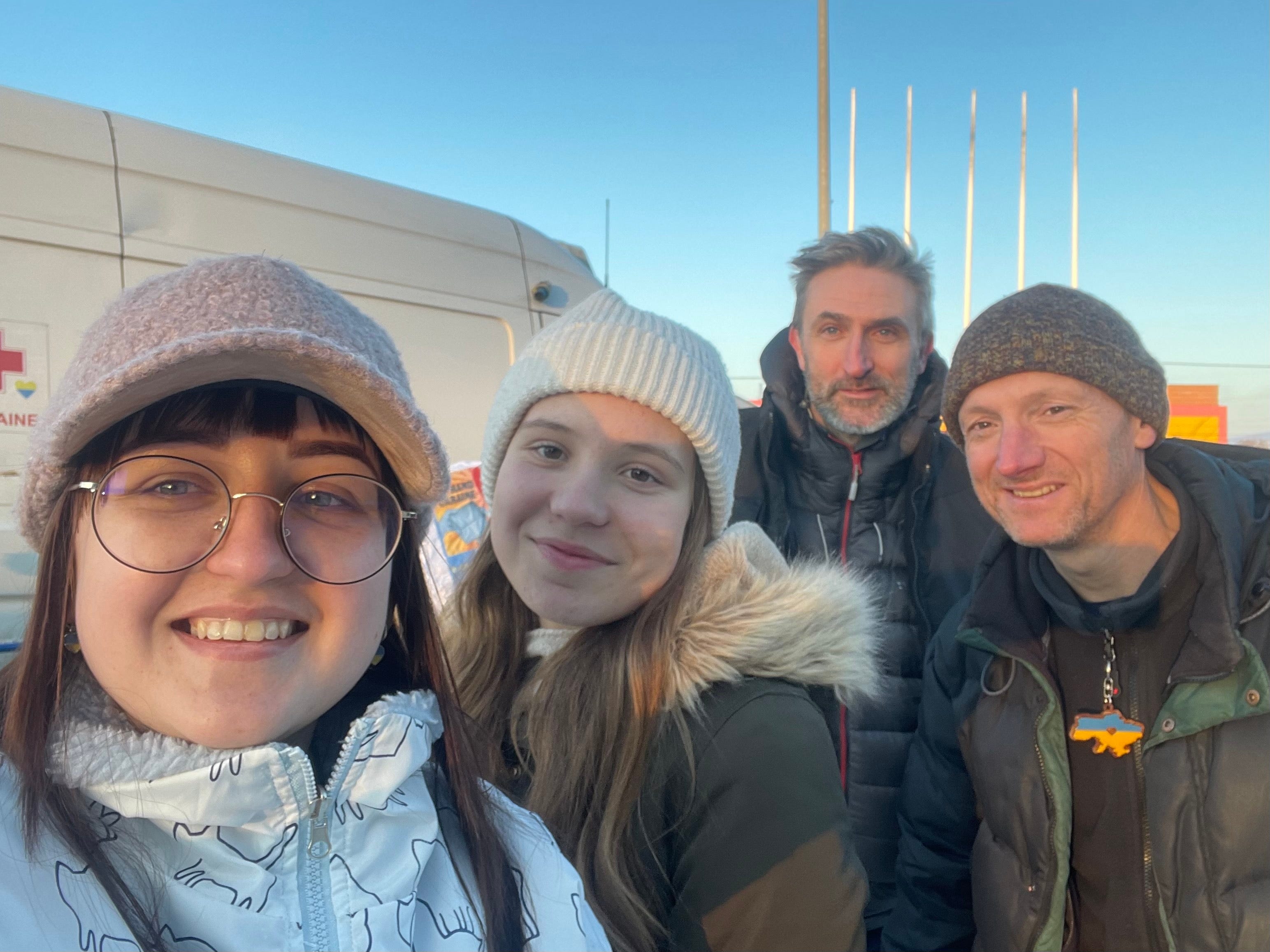
If you enjoyed reading this, please consider supporting our defenders in Avdiivka – you can find more information on Yana’s account, or can directly contact her.

Source: “The Russian Invasion of Ukraine: A Personal Account of the Battle for Avdiivka by 28-Year-Old Ukrainian Volunteer Yana,” Frontelligence Insight, 1 December 2023. Thanks to the amazing Monique Camarra and Eurofile for the heads-up.


Russian troops are trying, for example, to capture Avdiivka. The bulge in the front line it forms enables the Ukrainians to easily strike at Donetsk, thus complicating logistics for the Russian military.

Both Ukrainian and western media write that the undoubted, albeit small, successes of Russian troops in Ukraine are primarily due to the huge number of soldiers and officers whom the high command dispatches to certain death, apparently, without the slightest pity or doubt. Soviet Marshal Georgy Zhukov was infamous for this terrible “tactic,” which today’s General Staff has adopted as a precept in its own military campaign.

The terrible loss of Russian soldiers and officers bothers no one, however. And Dmitry Medvedev (it is not very clear why he is the one) reports constantly about the new cannon fodder which he has succeeded in herding off to the front.

Is it a lot? No, it is not enough for Vladimir Putin, who has signed a decree ordering the authorities to recruit more cannon fodder, another 170 thousand men.

The dolphins got it good: they can just swim off when their cages are flung open by a powerful storm in Crimea. Russians have nowhere to swim, and nothing to swim for. War and murder shower a lot of money on a Russian man or his widowed family, and the war suddenly gives meaning to his hopeless existence.

Medvedev’s figures make it clear that the mobilization which everyone so feared will most likely not happen. And this means that it will not harm political developments, as it did last year.

But the authorities will not permit the men who were mobilized last year to go home, contrary to their promises.

The grass widows continue to demand the return of their men. They even wrote a manifesto, but all for naught.

Writer Denis Epifantsev suggests that the liberal opposition take advantage of the situation by getting involved and trying to assist both the wives of the mobilized and [pro-war] journalists in pushing their thoughts and arguments to their logical conclusion, thus regarding them as temporary and vital allies in informing the indifferent masses about the regime’s crimes. But no is likely to listen to him.

It takes a massive sum of money to feed, arm, and equip such a mob of men (i.e., the military) who are neither doing useful work nor are being taxed. They already figure in the Russian Federation’s budget for 2024: it is the highest expenditure on the army since the Soviet era.

Political scientist and economist Vladislav Inozemtsev argues that the Russian Federation will be able to weather even such fantastic expenditures for some time, but wonders whether the west will have enough patience to continue supporting Ukraine.

By the way, we must also take into account the embezzlement factor. Rosfinmonitoring head Yuri Chikhanchin reported to Putin that money allocated for defense spending has been cashed out! No surprise, eh?

Source: Moscow Times Russian Service, Saturday email newsletter, 2 December 2023. Translated by the Russian Reader


Russian forces are intensifying attacks on the eastern Ukrainian city of Avdiivka, seeking to encircle Kyiv’s troops there as Moscow’s war in Ukraine grinds on.

The fighting is reminiscent of a battle for another eastern city, Bakhmut, which fell to Russian forces last May after months of brutal urban combat.

Since Moscow launched its renewed offensive around Avdiivka in October, Ukraine’s top general and Western military experts have made downbeat assessments of Ukraine’s ability to break Russian lines.

In Kyiv and Western capitals, there is an acknowledgement that Russia’s full-scale invasion more than 21 months ago, which Moscow calls a “special military operation”, could drag on into a much longer war.

WHAT IS AVDIIVKA?

Avdiivka, which had a pre-war population of around 32,000, has been a frontline city since 2014, when it was briefly occupied by Moscow-backed separatists who seized a swathe of eastern Ukraine in what Kyiv and the West.

Avdiivka, much of it now damaged, is home to Ukraine’s largest coke plant, a Soviet-era facility which before the war was one of Europe’s top producers of the fuel.

The plant, which Moscow says is being used by Ukrainian forces as a base and weapons storage facility, is now the primary focus of Russian attacks.

Located just north of the Russian-occupied city of Donetsk in the industrial Donbas region, Avdiivka hosts deeply entrenched Ukrainian defences.

Today, just 1,500 residents – many sheltering in cellars and basements – are estimated to remain in Avdiivka, where officials say not a single building remains intact.

FIERCE FIGHTING

Ukrainian and Western analysts say Russia’s renewed offensive on Avdiivka, its largest operation since the assault on Bakhmut, is proceeding at an extremely high human cost.

In a Nov. 27 update, British military intelligence said the fighting had contributed to “some of the highest Russian casualty rates of the war so far”.

“Every day there are new fresh forces, regardless of the weather, regardless of anything – of losses,” one member of Ukraine’s 47th Separate Mechanized Brigade told Radio Liberty.

“But no matter what, they keep crawling, literally over the bodies of their own.”

Andrei Gurulyov, a Russian lawmaker and retired military officer, has said the offensive has shown the need for Russian forces to improve their ability to attack.

Russian war bloggers, whom the Kremlin’s media handlers have brought under tighter control, have acknowledged heavy losses on their own side but pointed to significant Ukrainian losses too.

The main war bloggers’ collective account on the Telegram messaging service – “Operation Z: War Correspondents of the Russian Spring” – has given its more than 1.3 million followers detailed accounts of what it says is the steady but hard-won progress of Russian forces in Avdiivka.

It has described how they have been using air strikes with targeting assistance from special forces, artillery, drones, helicopters, tanks and infantry against heavily dug-in Ukrainian troops.

Semyon Pegov, a prominent Russian war blogger who has attended Kremlin meetings with President Vladimir Putin, has described Avdiivka, which Russians call Avdeevka, as “a fortress” with numerous concrete-reinforced bunkers.

Pegov, who has likened the fighting to trench warfare in World War One, said Russian forces took control of Avdiivka’s industrial zone in recent days and that Russian cluster munitions were inflicting “huge losses” on Ukrainian forces.

The Russian defence ministry issues spare but regular updates. Unlike late Wagner mercenary chief Yevgeny Prigozhin, whose forces spearheaded the assault on Bakhmut, it does not offer predictions or set out its aims.

WHAT’S AT STAKE?

Both sides see Avdiivka as key to Russia’s aim of wresting full control of the two eastern provinces of Donetsk and Luhansk – two of the four Ukrainian regions Russia says it has annexed but does not have full control of.

Avdiivka is seen as a gateway to Donetsk city, about 15 km (9 miles) to the south, whose residential areas Russian officials say have been regularly shelled by Ukrainian forces.

Pushing Ukrainian forces out of Avdiivka would be seen as enlarging the amount of territory Russia controls and making Donetsk city safer.

Seizing Avdiivka could boost Russian morale and deal a psychological blow to Ukrainian forces, which have made only incremental gains in a counteroffensive launched in June.

Mykola Bielieskov of the National Institute for Strategic Studies, an official think-tank in Kyiv, said taking Avdiivka would not “decisively” tip the situation in Moscow’s favour but “would make the situation more tenable for occupied Donetsk as a major Russian logistics hub.”

Bielieskov believes the campaign to capture Avdiivka is mostly driven by what he called the Kremlin’s eagerness to “strengthen the hand of Western sceptics” who are calling for a cut in military and financial support for Kyiv, citing the limited impact of billions of dollars in military aid.

Source: Dan Peleschuk and Andrew Osborn, “Explainer: What’s at stake in Russia’s assault on Avdiivka?” Reuters, 1 December 2023

Bhaskar Sunkara: “You Say East Ukraine, I Say West Russia”

Has Bhaskar Sunkara ever been to “West Russia”?

west-russia

Source: Facebook

bhaskartwitter-660x440
Bhaskar Sunkara. Photo courtesy of Magculture

Bhaskar Sunkara (born June 20, 1989) is an American political writer, editor and publisher of Jacobin magazine.

The son of immigrants from Trinidad and Tobago, Sunkara described Jacobin as a radical publication, “largely the product of a younger generation not quite as tied to the Cold War paradigms that sustained the old leftist intellectual milieus like Dissent or New Politics.”

The New York Times interviewed Sunkara in January 2013, commenting on Jacobin’s unexpected success and engagement with mainstream liberalism. In late 2014, he was interviewed by New Left Review on the political orientation and future trajectory of the publication and in March 2016 was featured in a lengthy Vox profile.

Sunkara writes for Vice magazine, Washington Post and The Nation, among other outlets. He has appeared on the PBS Tavis Smiley program, MSNBC’s Up w/ Chris Hayes and the FX show Totally Biased with W. Kamau Bell.

Source: Wikipedia

________________________

Residents in eastern Ukraine face worst fighting in years in war with Russian-backed separatists
Sabra Ayres
Los Angeles Times
February 15, 2017

The news reached Mariupol Mayor Vadim Boychenko via a morning phone call from an assistant: A rocket attack damaged 11 houses on the outskirts of the Ukrainian city.

There were no casualties, but a major concern had become a reality: The escalation of fighting elsewhere in the nation in recent weeks had reached the industrial city, a key component in southeast Ukraine’s struggling economy.

“We’ve gotten used to a peaceful life,” Boychenko said during a recent interview at his office. “I really don’t want to return to the problems we had started to forget.”

Ukraine’s nearly three-year battle against Kremlin-backed separatists in the east erupted into the worst fighting in two years in late January. Exactly why the fighting intensified recently remains unclear, though such encounters have occurred with some frequency during unrest that included Russia’s annexation of Crimea in March 2014.

The small city of Avdiivka, 90 miles north of Mariupol, became the epicenter of the recent violence. The fighting quickly spread along a 300-mile line separating the Ukrainian government-controlled lands and those claimed by separatists in the Donetsk and Luhansk regions.

Mariupol had seen only sporadic fighting over the last two years, primarily in the region’s eastern villages. But as news trickled in about the bombardment of Avdiivka, Mariupol began again hearing the deep rumble of explosions and heavy artillery fire less than 10 miles away.

The fighting halted vital shipments from Avdiivka’s coal processing plant to Mariupol’s massive iron and steel works plants, jeopardizing production at one of the region’s biggest employers.

Many local residents said they feared the renewed violence could quash the growing sense of confidence in Mariupol after nearly two years of relative stability.

One concern in the region is that President Trump and Russian President Vladimir Putin could strike a deal that would lift U.S. sanctions on Russia or force Ukraine to make painful compromises with Moscow. Ukrainian President Petro Poroshenko has urged Western leaders to keep sanctions in place.

“Sanctions are the only way to get Putin to the table,” he said last week in an interview with journalists and academics in Kiev, the capital.

Nationally, there is little faith in the Minsk agreements, a road map to peace brokered in 2014 by European leaders between Ukraine, the Kremlin and the separatist rebel leaders. Poroshenko maintains that Ukraine is committed to its obligations to the agreements.

“Minsk is my plan. Putin accepted it. His signature is there,” he said.

Mariupol has gone through a noticeable transformation since war erupted in eastern Ukraine in the spring of 2014. Once the epitome of a run-down, Soviet industrial port city with two massive metallurgy plants puffing out pollution day and night, Mariupol in the last two years has emerged as a center of civic activism in Ukraine’s southeastern battlefront.

The city was the center of several violent outbreaks in spring 2014, when Ukrainian forces and supporters of the pro-Russian separatist groups fought gun battles in the downtown streets. The charred former police headquarters and city council buildings still stand as reminders. On Jan. 24, 2015, a missile attack hit an eastern region of Mariupol dense with Soviet-era concrete housing blocks, killing at least 30 people.

The previously politically passive, mostly Russian-speaking city created community groups that mobilized to gather whatever money they could to buy medical kits, food, and flak jackets and helmets for Ukraine’s ill-prepared military. The fighting displaced 1.75 million eastern Ukrainians, but locals opened their homes and about 56,000 newcomers settled in Mariupol.

“We don’t call them refugees anymore,” Boychenko said. “They are ‘new Mariupolites’ and have already become part of our city.”

Once-thriving Donetsk is now occupied by rebel forces, so Mariupol, the largest city in the Donetsk region under Ukrainian control, became the de facto cultural hub of the eastern industrial area along the Don River basin, known as the Donbas.

Displaced activists from Donetsk opened an avant-garde theater and creative space that has hosted some of the country’s big names in modern talent.

Small businesses — grocery stores, small restaurants and mom-and-pop shops — whose owners fled the fighting returned, and new cafes have opened. Ukraine’s most popular music group, Okean Elzy, gave a free concert in May attended by more than 30,000 people.

“We’ve been working all year to create a positive mood in the city,” Boychenko said.

Alex Ryabchyn, a deputy in Ukraine’s parliament who was born in Mariupol, said the city is in the early stages of reinvention.

“The population is starting to think of themselves as being the center of southeastern Ukraine. That’s new, “ said Ryabchyn,  who was an economics professor in Donetsk State University before fleeing to Kiev after the pro-Russia rebel takeover.

Mariupol faces major challenges, particularly in the economic sphere. Ukraine’s economy has been battered since protests ousted a Moscow-friendly president, Viktor Yanukovich in 2014. The war ripped apart the country’s coal mining and steel processing industry, destroying many plants and severely curtailing production in those that survived.

The aging steel plants need modernization and the economy needs diversification to revitalize the region. Highways linking Mariupol to other cities are so bad that drivers are forced to reroute to avoid the worst sections. Train rides from Kiev to Mariupol, about 500 miles, take 18 hours, and the airport cannot accept commercial flights because of its location near the front lines of fighting.

Mariupol can feel like an isolated peninsula in Ukraine, an image many hoped was changing.

“You can see why [an increase in fighting] is a problem,” Irina Chirkova, 24, a waitress in Mariupol, said as a series of explosions pierced the cold air. “We have a lot of potential here — a big port, an airport and nice beaches. But our infrastructure needs investment, and who is going to invest in us now with this war?”