Dmitry Kozhnev: Anyone Defending Their Rights Is Branded a Fifth Columnist and Agent of the State Department

“Anyone who tries to defend their rights is a fifth columnist and agent of the State Department”
A trade union leader talks about pressure from the security forces and badgering from the National Liberation Movement
Darina Shevchenko
March 24, 2015
Yod

The automotive industry has been laying off employees around the country. Since the beginning of the year, the demand for cars has fallen 20-30%. Management has forced workers to quit, shift to part-time work or agree to significant pay cuts. The Interregional Trade Union Workers Association (ITUWA) has countered with strikes and pickets. Center “E” (Center for Extremism Prevention) has responded by taking measures against union members. Last weekend, Center “E” officers detained members of the ITUWA Kaluga local. They demanded that the activists confess to working for western secret services and acting to destabilize the situation in Russia. Dmitry Kozhnev, leader of the ITUWA Kaluga local, told Yod that the trade union has long had a difficult relationship with the local security forces, and more recently, members of the National Liberation Movement (NOD) have targeted workers for persecution.

The ITUWA was founded in 2006 by members of trade union organizations from the Ford plant in the Petersburg suburb of Vsevolozhsk and the AvtoVAZ plant in Togliatti.*** The trade union unites workers from more than fifteen companies. Its chair, Alexei Etmanov, was elected to the legislative assembly of Leningrad Region in 2011. The ITUWA’s motto is “Don’t cry, organize!”

On what grounds were trade union members taken in by Center “E” over the weekend?

Under the pretext that a robber who had hit a passerby with a bottle and stolen something had dashed into the room where we had gathered for a routine meeting. About forty security forces officers arrived. They detained fifteen of us, took us to a police station, and asked us about our activities, what protests we were planning. They told us that, under the guise of defending workers’ rights, we were spying for the US, destabilizing the regime, and engaging in provocations. We hear this song from Center “E” constantly. Apparently, law enforcement officers find it difficult to believe that an organization can be independent and act on its own.

Have Center “E” and the FSB showed interest in your activity before?

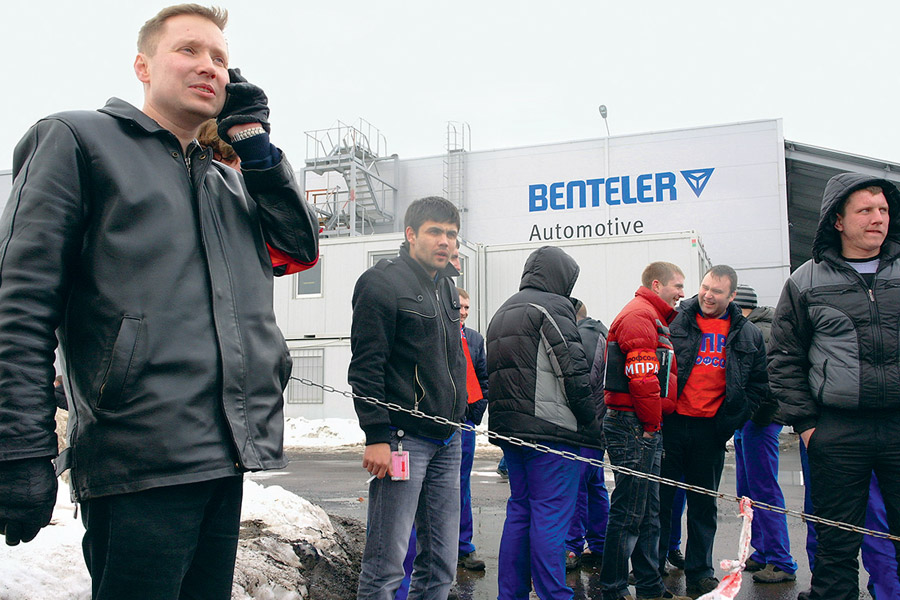
Our union emerged in 2008. During this time we have become stronger and our actions have gotten results. In [2012], a strike at the Benteler Automotive plant led to the workers signing a collective agreement that we drafted. We got the bonus included in the salary and a ban on duties other than those stipulated in the contract. At the Volkswagen plant we forced management to increase salaries by almost four times, from seven to thirty thousand rubles a month.
rep_242_016
Dmitry Kozhnev (left) on the picket line during the 2012 strike at Benteler Automotive

In the summer of 2013, Volkswagen management was changing equipment. They wanted to let the workers go for a week, and then have them work off the missed days on weekends. By law, management has a right to do this, but plant workers opposed it. They were furious at the prospect of working weekends in the summer, when every day off is worth its weight in gold. We told management they should pay the missed week as down time, while the workers would go to work voluntarily and at double the pay. Management stood their ground, and then we began to prepare for a strike. By the way, according to Russian law, it is almost impossible to strike. Management must be notified seven days in advance. During this time, management can succeed in appealing the strike in court and then the strike cannot start on time. So we start the strike and notify management simultaneously. That is what we did back then at Volkswagen. We also picketed dealerships and informed consumers that we could not vouch for the quality of the cars assembled during the strike. We got what wanted.

Now our trade union has influence at different plants and can exercise control over the situation. After the number of union members went over four hundred at Volkswagen in 2009, and we began doing street protests, Center “E” got on our case.

And as soon as relations between workers and management would heat up, Center “E” would show up and put pressure on us, including arrests, harassment, and surveillance. But pressure and persecution have only strengthened the organization.

Give an example of persecution by Center “E”.

As soon as our work started to produce results, we began getting summons to Center “E” and were threatened with criminal prosecution. Once they blocked my car on the street and took me down to the station. They tried to catch several comrades with allegedly faked sick leave forms, threaten to take them to court, and force them to inform on trade union leaders. One worker and trade union member had a weapon planted on him. He got into a car with security officials. They handed him a bundle, said it contained a gun used to commit a crime, and now he would either rat on his colleagues or be convicted for the crime. The comrade refused to be an informant and took the story public big time, and they left him alone. Another comrade of ours was press-ganged into the army. Because of a serious leg injury, the guy had been declared unfit for military service. During a routine medical exam at the draft board, he was suddenly declared healthy. He insisted on an independent medical examination. The guy was then abducted on the street and sent to the army. He served his term, and came back angry and able to use weapons. And he is working in the trade union again. The ranks of our trade union’s foes continue to swell. Recently, the National Liberation Movement (NOD) joined them.

How come? You don’t participate in opposition rallies, do you?

NOD considers us Banderites because anarchists carrying flags with anarchist symbols attend our rallies. They think that since the Banderites have black-and-red flags, and anarchists use the same colors, they are in cahoots. It is ridiculous, of course. It is useless to ask the NODites questions; it is better not to talk with these cartoon characters. Anatoly Artamonov, governor of Kaluga Region, has also called us agents of the West. And this is a guy who has built his region’s economy on cooperation with companies from NATO countries and has awards from NATO countries! This is the trend now. Anyone who defends their rights is a fifth columnist and agent of the State Department.

The security forces’ interest in you has to do with the crisis in the automotive industry and presumed activism on the part of trade unions. At what plants is the situation the most tense?

It is easier to say which plants have no problems: the plants that produce luxury-class cars. They are the only ones where everything is all right. All the other plants are undergoing layoffs, which are hidden for the time being. Workers are being persuaded to quit voluntarily, to accept part-time schedules and pay cuts. But I think the crisis will continue, and the actions of management will become harsher. But we will vigorously defend the interests of workers.

Translated by the Russian Reader. Photo courtesy of Russian Reporter

*** Editor’s Note. The ITUWA was originally known as the Interregional Trade Union of Autoworkers (ITUA). It changed its name in 2013, although the union’s well-known abbreviation in Russian (MPRA) has remained the same.

Anti-Americanism Is the New Black

“If the growth of anti-Americanism testifies to anything, then only to the success of Russian propaganda”
Olga Serebryanaya
February 19, 2015
online812.ru

There is a new trend on Facebook: folks complain to President Obama about the mess and collapse in Russia. Exemplary in this sense is a post written by Oleg Bulgak.

“Why the fuck, Mr. President, is there no seat on the toilet and no toilet paper in the only bathroom for younger visitors at Children’s Clinic No. 133 in northern Moscow? Have you shed your last shred of conscience back there in America? You are personally to blame for the fact the children have to climb onto the toilet bowl, although they could fall off it! Why are you taking such ingenious revenge on us? You make me mad, Barak Obama! Stop playing your little tricks!”

There are many such posts on Facebook, and yes, they are parodies, parodies by sane “outsiders” on the majority opinion, announced last week by Levada Center. According to the pollsters, 81% of Russians have a negative view of the US. Do I need to spell out the fact that if the growth of anti-Americanism testifies to anything, then only to the success of Russian propaganda?

The aim is clear: to shift attention from domestic to foreign issues. At first, this was done by means of a news agenda consisting wholly of events in Ukraine. Now, on the contrary, Russian events are served up only with a foreign connection.

56c92a558932e79371e7dddd011bdc5f

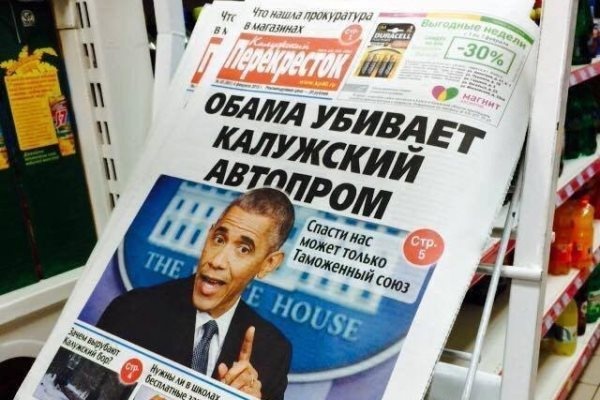
On Twitter, everyone had a laugh at “Obama is killing Kaluga auto industry,” a headline in a regional newspaper, but few people noticed the following news item, because “outsiders” have long ago stopped reading the news.

“Environment Minister Sergei Donskoi told RIA Novosti that the insects destroying boxwoods and palms in Sochi could have been brought into the resort city deliberately on the eve of the Olympics. ‘We have asked the prosecutor general’s office to establish who introduced the pests. I would like law enforcement agencies to get to the bottom of it,’ said the minister.”

The rhetorical device of propaganda has proven to be a very convenient governance strategy. If you have a problem, blame saboteurs, who will surely turn out to be foreigners or agents thereof. Hence, the capture of the female “spy” with a large family from Vyazma or the crazy Russian Orthodox Church staffer with an FSB ID.

Kirill Rogov explained the idea behind it.

“[The project] is called ‘legalizing repression.’ The idea is inure the public to arrests ‘for treason.’ The arrestees will be weirdos, people around whom there is no consensus in society, and with whom the ‘majority’ finds it hard to identify. The guidelines suggest that the number of arrests that go public should be between twenty and thirty. Then the chief executive will come out and say that the excesses trouble him. […] After this statement, which will be widely publicized, within a month, approximately, the intensity of the arrests will increase tenfold.”

Rogov’s hypothesis is confirmed by the fact that the spy mania has already been substantiated historically. Literaturnaya gazeta made a breakthrough on this front last week. Responding to a question posed by a reader from Stavropol, Nikita Chaldymov, Ph.D., explained that Russia’s woes had begun with Peter the Great’s modernization. Peter badly tarnished the country’s mores, сaused the subsequent persecution of Russian scientist Mikhail Lomonosov, and cut out that very same window through which “crowds of foreign adventurers began infiltrating” Russia. How could it have happened? The answer is clear: the sovereign was switched with someone else during the Grand Embassy.

“Could the tsar, being an Orthodox man, have so quickly turned into an alcoholic and libertine who dispatched his wife to a convent and married a Baltic washerwoman?” Chaldymov asks readers.

It stands to reason the real Peter could not have done these things. Foreigners had planted a spy on the throne.

There is only one hitch with this spy strategy. Another question might occur to the reader from Stavropol. Who occupies the Kremlin now? The real president? Or, God forbid, a changeling?

Why Is There No Anti-War Movement in Russia, or, What Craft Beer Would You Like with Your Kansas City Burger?

Russian leftist activist Ilya Budraitskis has given a quite eloquent answer to the first question, which you can (and should) read here. But these recent, seemingly irrelevant items from Russian urban lifestyle web site The Village seem more to the point.

beergeek

Beer Geek, a craft beer store, has opened in the courtyard at Rubinstein Street, 2/45 [in central Petersburg]. Both Russian and foreign beverages are sold there, including beverages from small experimental breweries.

The selection includes very bitter American-style ales, sour Belgian specialities, cherry beer, and much more. Twelve taps have been installed right in the wall to save bar space. The beer is predominantly poured for takeaway, but you can drink it right in the store if you like. Most of the varieties will cost 200 rubles per half liter [approx. 4 euros].

The owners of the place are Pyotr Gordeyev and Dmitry Evmenov. They have installed steps, rising towards the ceiling, on which you can sit or even lie down on the store’s small premises. Another interior design element is a cupboard with sliding drawers in which the bottles have been arranged as in a filing cabinet.

Source: The Village

[Petersburg’s] third City Grill Express recently began operating at Rubinstein Street, 4. The owners had long intended to open the new place near Nevsky Prospect, and over the next few years they plan on launching four more burgernayas with the same name.

The menu feature around three dozen burgers, french fries, Idaho fries, and several kinds of beer, including cherry beer and house beer. City Grill has beef, pork, veal, chicken and turkey burgers, as well as a Kansas City Burger with mushroom filling. All dishes are cooked to order in the open kitchen. The average check is 300 rubles [approx. 6 euros].

The first City Grill Express opened at Griboyedov Canal, 20, in 2012. Previously, City Grill cooked and sold burgers in street carts for six years. The second diner has operated for more than a year at Vosstaniia, 1. The chain’s owner, Yevgeny Arkhipov, comes up with the recipes and names of the burgers and the interior designs.

Source: The Village

NB. Words and phrases highlighted in boldface, above, are specimens of Anglicisms, transliterated English or Rusglish in the original. Photo courtesy of The Village.

The Root Beer Hall Putsch

Food-23-foodPhoto-861-serfburger

As their president makes as if to invade a neighboring country and his supporters show their true “anti-imperialist” colors, Petersburg’s creative class gets ready to quaff root beer and gnaw on cheeseburgers at Geek Picnic 2014:

Butcher 
serves the best American burgers in town, made ​​from fresh, quality ingredients.

Located on Kommendantsky Boulevard, they will soon be opening a branch at Salon (Bolshoi Kazachy Lane, 11). They deliver.

Representing Butcher [at Geek Picnic 2014] will be the favorites of Petersburgers, the best of the best athletes—the classic cheeseburger (Classy Cheese) and, in the lightweight category, the vegetarian burger with mushrooms (Veggie Trip). For beverages, guests will be offered homemade lemonade and root beer, a carbonated drink based on sassafras tree bark that is very popular in North America, but little known in our homeland.

source: Geek Picnic 2014

Sergey Chernov: Grymov’s Hollow War

grymov-strangers
A still from Yury Grymov’s Strangers

A Hollow War
Sergey Chernov
St. Petersburg Times
October 17, 2008

Condoleezza Rice, allegedly, has banned Yury Grymov’s new film, but is it all just a cheap, blog-led PR stunt to drum up publicity?

Local channel 100TV opened its evening newscast on Wednesday last week with a report that Moscow director Yury Grymov’s film Strangers (Chuzhiye) had been banned in the U.S. The film is due for release in November, and critics suggest this “news” was part of the publicity campaign for the film, which kicked off last week. The channel itself was hard pressed to name its source, claiming it arrived by e-mail from a news agency.

“Grymov’s film Strangers has been banned in the U.S.,” said the newscast’s presenter. “Condoleezza Rice’s staff has not recommended it for distribution.”

“Most likely, this has something to do with the anti-American mood of the picture, which would be inappropriate in view of the upcoming presidential elections in America.”

It is unlikely that the station’s claims have any real basis. The U.S. Secretary of State’s purview does not include monitoring either new Russian films or, more to the point, giving recommendations to U.S. film distributors.

The report was, however, in tune with anti-American sentiments in the Russian media, which have been on the rise in the aftermath of the war in Georgia. TV100 did not provide any sources for their report.

The report ended with a fragment of a tape-recorded telephone conversation with Grymov, a TV ad maker turned feature-film director. He described the news as a “surprise.”

“I think this is nonsense, but everything is possible. I don’t know anything about it for certain yet,” he said.

The 100TV report also aroused suspicions because, as a Google News search revealed, there was no mention of the subject, or even of Grymov, in the international media.

100TV editor-in-chief Andrei Radin did not respond to an e-mail inquiry sent on Oct. 9, but when called on his cell phone on Thursday he said he “did not know” the source of the information.

Yekaterina Dodzina, 100TV news editor and the evening newscast presenter (whom Radin referred to), said the news came by e-mail from an agency, although she does not remember the name of the agency.

“We were surprised as well, but we checked it with Grymov and his assistant,” she said by phone on Thursday. However, Dodzina said she did not verify the information with anyone in the U.S. or with U.S. officials.

According to the film’s official website, Strangers is set in a war zone in a third-world country. The plot involves doctors from a U.S. charity organization who become responsible for some terrible crimes as the film unfolds.

“Viewers will see how the American nation tries to instill its morals in another world but at the same time it doesn’t understand one simple thing—there is no such thing as one’s ‘own’ morals. Since morals are one and the same for all,” states the film’s English-language press release.

The news was picked up by several publications, most of them web-based. All of them referred to different sources for their information.

Gazeta.ru quotes the RIA Novy Region news agency, which, in turn, refers to “news agencies that quote Condoleezza Rice’s staff.”

Research has revealed that the news originated on Internet forums and was subsequently cross-posted in several blogs.

Russian entertainment website Life.ru refers directly to “Condoleezza Rice’s staff,” adding that “censorship as such does not exist in American film distribution but in this specific case the U.S. State Department recommended that U.S. film companies not distribute Strangers within [the U.S.].” Life.ru is published by OAO News Media, which also publishes the tabloids Zhizn and Tvoi Den.

The website also added that the U.S. Department of State had previously not recommended Michael Moore’s Fahrenheit 9/11. In reality, Moore’s film had a general release in the United States in June 2004. It became the highest-grossing documentary of all time on its first weekend in release, taking in $21.8 million.

However, at least two publications soon deleted the news from their websites, although they did not publish corrections or disclaimers. The local edition of Argumenty I Fakty newspaper published an article entitled, “Condoleezza Rice Is Unhappy About Grymov’s Film Strangers,” on its website on Oct. 9. When accessed on Saturday, this page was blank. Cinema website Film.ru also later removed its article on the apparently fake controversy.

But it was in the blogosphere where the story gathered real force. There, the news was reposted dozens of times after the initial report on TV100.

The most persistent blogger on this front was Alexander Korsunov, who writes under the nickname “jordan_korsun.” Korsunov uploaded the video link from 100TV to the popular Livejournal.com community “ru_politics,” and he was especially active in responding to the comments and misgivings of other bloggers. In several postings, he corroborated the veracity of the report, claiming that American film distributors obey the recommendations of the U.S. State Department.

Research on the web has shown that Korsunov works in public relations and has himself been involved in the blogosphere advertising campaign for Strangers.

On Livejournal.com, the business offer that Korsunov made to Ruslan Paushu, who blogs under the nickname “goblin-gaga,” was found.

“Do you remember how you and I tried to launch a campaign against Ukraine over the ‘gas war,’” Korsunov wrote to Paushu on Sept. 30.

“I want to invite you to take part in a PR campaign [in the blogosphere]. Grymov is releasing a new film, Strangers, about American doctors, Arabs, and the Russian military. The film is patriotic and ideological, especially in connection with the [war in] South Ossetia. […] If [you’re] interested, please write to [inform me] about your conditions […] and come to the pre-release screening.”

Last year, Paushu was identified by Vedomosti newspaper as one of two bloggers who launched an infamous advertising campaign for Utkonos, a Moscow store chain. Several popular Livejournal.com bloggers almost simultaneously made similar postings advertising the chain.

Dozens of popular bloggers were caught placing Utkonos ads in their postings. According to Vedomosti, Paushu said the postings were commissioned by an advertising agency that he declined to identify. He added that bloggers are usually paid $50 to $300 for covert product placements in their blogs.

In a posting to another blogger (the deleted comment is available in the cache of search engines), Korsunov confessed that there was a budget for advertising Strangers in the blogosphere.

“There is a budget for PR, not especially large, but I think the stance of the film is close to yours and you’ll find it interesting,” he wrote.

Further research showed that the news originated in two places, a Canadian website (where it was later deleted) and an Arabic-language forum. There, the report, which had apparently been translated into Arabic from Russian by a computer program, was still available as of Thursday. In another discussion on Livejournal.com, which took place on the afternoon of Oct. 8, several hours before the 100TV evening newscast, Korsunov referred to the Arabic version as the “original.”

Korsunov first achieved a modicum of fame in 2005, when, as a 22-year-old student, he launched the website Skaji.net. Now defunct, it was described as a source of political news independent from the Kremlin. “Information is the first step toward democracy,” he said in an interview with The Moscow Times at the time.

Film critic Stanislav Zelvensky, who writes for Afisha, arguably Russia’s leading listings magazine, said the news that Grymov’s film had been banned in the U.S. could easily be part of the film’s advertising campaign.

“When I first saw, or rather read this [on the web], I thought it was an advertising campaign,” he said. “It looks like a publicity stunt.”

Zelvensky said film companies occasionally hire bloggers to advertise a movie, but more often their own publicists do the work.

“I’ve read all this, but it’s not clear who was paid and who was not,” he said.

“Actually, they do not pay many people. Usually, it’s someone who works for the film company itself. This person launches a blog, or starts to write to Internet film communities about what a wonderful film it is.

“To put it crudely, there is a girl on salary who sits and types postings to endless numbers of silly [Live Journal] communities. ‘Such-and-such a film is being released, and I would love to see it. Guys, do you know what it’s about?’”

However, such stunts like the one probably used to advertise Strangers help film companies economize on their advertising budgets, according to Zelvensky.

“It’s clear that there’s a certain advertising budget in any case, and a portion of it can go to blogs,” he said.

“But it’s more effective when some copywriters come up with something like this, and it spreads all by itself, and then, when you realize that it’s fake, it’s already all over the place.”