Contemporary Art Killed My Dog

On a number of issues and events you have opposed Putin’s policies, and now you are at the Moscow Biennale [of Contemporary Art] at the VDNKh, a venue where the order of things is supposed to be questioned [sic]. Do you believe that here, in the current political situation, there can be a place for real criticism that is both anti-Putinist and anti-capitalist?

Yanis Varoufakis, anti-anti-Putinist

[Yanis Varoufakis:] Absolutely. But let me clarify something. I am not an anti-Putinist.  Anti-Putinism is too strong a word. I am very critical of Putin, but his demonization in the West is something I also resist. We should be smarter and think about what it means to be critical. I am extremely critical of what Putin did in Chechnya, and I have not forgiven him for it. But on the other hand, Putin was absolutely right about what happened in Georgia, and the West was absolutely wrong. I think that the West’s position on Crimea has also been inconsistent. Russia was surrounded [sic] by NATO when Latvia, Lithuania, Estonia, and other countries were included in the alliance. And for Russia it was an insult, as well as something close to violating the agreement between Reagan and Gorbachev [sic]. And Putin has been right about this, too. So I have never supported the policy of demonizing Putin. And I am afraid that Russians will have to suffer the awful consequences of this process, consequences which they do not deserve.

So I believe that spaces like this give us hope for the existence of another, rational, critical approach that does not take one side or the other and allows people from the West and Russia to get together and develop a more sophisticated optics for seeing the world and politics, for being critical without demonizing.

—Excerpted from Sergei Guskov, “Yanis Varoufakis: ‘Being critical without demonizing,’” Colta.Ru, October 2, 2015. Translated, from the Russian, by the Russian Reader

__________

There are only a few things I would add to Mr. Varoufakis’s remarks, above. First, he presumably made them in English, not Russian. Since he is an extremely persuasive speaker and conversationalist, it is quite possible some nuances in what he said at the Moscow Biennale of Contemporary Art were flattened or distorted when translated from English (?) into Russian, and these distortions have only been amplified further in my back translation.

But I doubt this is the case. The point of his remarks seems quite plain, so they are either a fabrication on the part of Colta.Ru or what Mr. Varoufakis more or less said in the event, minus the “static” of two consecutive translations.

If this is what he said, then Mr. Varoufakis is only another in a long line of Western leftist thinkers and activists who, seemingly, have found something “anti-hegemonic” or “anti-imperialist” or “productively” anti-American or, God forbid, “anti-capitalist” about Putin’s policies and actions, or have found it possible to hobnob with or shill for Putinists, on the Putinist dime, in the name of some kind of “criticality” or “third position” above the current fray, or just because they were bored and wanted an all-expenses-paid junket to Moscow or Petersburg or Rhodes.

A smarter person than me (and an actual Russian leftist activist to boot) has pointed out that Putin is nothing remotely like an anti-imperialist or anti-capitalist. On the contrary, my smart friend has argued, folks in the west should make an effort to find out about grassroots social and political activism and activists in today’s Russia and look for ways to make common cause with them. Or, at least, not stab them in the back by supporting Putin explicitly or implicitly.

Because Russia, like “the West,” is not a monolith. And that is the second way in which Mr. Varoufakis went wrong in his remarks in Moscow. “The West” is not a single entity, even among its political, intellectual, and media elites. It is not an organism singularly hellbent on “demonizing” Putin, whatever that means. It requires no effort at all to compile a very long league table of Putin’s wholehearted or partial supporters in “the West,” from Stephen Cohen to Donald Trump, from Silvio Berlusconi to Mary Dejevsky, from Nick Griffin to any number of leftist and centrist politicians in Europe. For reasons I haven’t been able to explain, that table has been growing fatter as Putin’s actions have become more aggressive and “demonic,” both at home and abroad.

Neither is Russian society nor the fabled (and utterly imaginary) “Russian people” monolithic, but over the past fifteen years the Russian state apparatus, the Russian mainstream media (especially television), and Russian mainstream political parties have become a monolith, one of whose primary goals, especially in the last two or three years, has been to demonize “the West” and the domestic opposition any way it can, no holds barred.

You would have to have been in the middle of this properly demonic media hysteria, moral panic, and “cold civil war” to appreciate just how thoroughgoing and thoroughly frightening it has been, and since I have been following Mr. Varoufakis’s own adventures over the past year or so, I can imagine he simply has no clue about what has really been happening in Russia since the blocks came off completely post Maidan, because he was very busy with more important matters.

One job this blog has taken on has been to provide little snapshots of that awfulness while also, more importantly, giving non-Russian speakers a chance to hear Russian voices other than Putin’s, however unimpressive or inaudible they might seem to big shots like Putin and Mr. Varoufakis.

Finally, I would like to address the question of why Mr. Varoufakis imagines, apparently, that big hoedowns like the Moscow Biennale of Contemporary Art are such perfect places for elaborating a “sophisticated optics for seeing the world and politics, for being critical without demonizing.”

Just a year ago, my hometown of Petrograd hosted Manifesta 10, another such prominent venue for “criticality.” In the midst of an occupation and invasion of a neighboring country by the host country, the host country and host city’s continuing legal demonization of LGBT, and a local election campaign, for the city’s governorship and district councils, that involved making sure the non-elected incumbent in the gubernatorial race would face no real opposition in his bid to legitimize his satrapy and, on election day, threatening independent election observers with murder, the Manifestashi did absolutely nothing that would really ruffle anyone’s feathers, least of all their sponsors from city hall and the State Hermitage Museum, and they barely reacted to the maelstrom of neo-imperialist hysteria and officially authorized criminality raging around them. Basically, they partied like it was 1999, while providing their fellow citizens with the welcome illusion that the shipwreck wrought by fifteen years of Putinism in politics, the economy, civil society, culture, education, medicine, science, industry and, most painfully, people’s minds could be conjured away or endured and understood a little better by taking a sip of contemporary art’s renowned and heady “criticality” and pretending Petersburg was Helsinki or Barcelona, if only for a summer.

10497395_10152669630307289_178016388250142251_o

What has got better on Russia’s broken social, political, and art scenes since last autumn to make it even more desirable to engage in “criticality” at a biennale in one of Russia’s capitals, this time with the Russian Federal Ministry of Culture footing the bill?

Latterly, a cynical lunatic named Dmitry Enteo has smashed up a bunch of sculptures by the late Soviet sculptor Vadim Sidur and gotten off almost scot-free for his crimes. On the other hand, the list of political prisoners in Russia has continued to grow, and it now includes Crimean activists Oleg Sentsov and Alexander Kolchenko, sentenced to hard time in prison for no particular reason.

And then there is Alexei Gaskarov, who, if he lived in a more democratic country, would be running a party like Syriza or Podemos (minus the “criticality” and verbal cuddling up to other people’s dictators), but instead looks to be facing another two and half years in a penal colony, again, for no particular reason other than his own staunch opposition to Putin’s regime.

In the current dreadful “conjuncture,” a good day is a day that goes by without news of yet another anti-Putinist activist being arrested, an art exhibition’s being trashed by “Orthodox activists” or otherwise shut down because it might offend the sensibilities of someone’s grandmother, or a new law’s speeding down the State Duma assembly line so as to tighten up the screws on dissent and “treason” yet again.

In fact, I had a bit of such good news earlier today, when I learned that Andrei Marchenko, a Khabarovsk blogger whose case I have been following, was only fined 100,000 rubles (approx. 1,350 euros) instead of being sent down for two years to a work-release prison, as the prosecutor had demanded, for the horrible crime of writing one untoward sentence about Putin’s Ukrainian misadventure on his Facebook page in 2014.

Where does Mr. Varoufakis fit into this picture? Probably nowhere, which is probably where he should have stayed instead of playing to Moscow’s art and hipster crowd, always happy to let itself off the hook when it comes to taking responsibility for the ongoing disaster, and to the invisible figure up in the emperor’s box, especially at an opera with the almost deliberately ham-fisted and parodical title of Acting in a Center in a City in the Heart of the Island of Eurasia.

Thanks to Comrade AW for the heads-up. Images courtesy of BBC News and the Manifesta Biennial Facebook page

Andrei Marchenko: Closing Statement in Court

The Closing Statement of Andrei Marchenko
Industrial District Court, Khabarovsk, September 30, 2015
Grani.Ru

Exactly one year and two months ago, I had a knock on the door around this time of day. The people knocking identified themselves as election campaigners, but then a huge crowd of people with a video camera turned on burst in as soon as I opened the door. Because of one sentence on the social network Facebook, the FSB had come in connection with the criminal investigation opened against me.

82499
Andrei Marchenko. Photo by Alla Viktorova. Courtesy of Grani.Ru

It was my first search and a lesson for the rest of my life. You should never be afraid of anything, and must know and defend your rights.

Let us start with the fact that I was shown the search warrant in passing, as well as IDs. Apparently that is why I still do not know the first names or surnames of the men who came to search my place. Next, I was denied a telephone call and not allowed to ask neighbors to act as official witnesses during the search. (The official witnesses were soldiers brought by the FSB themselves.)

Naturally, pressure was put on me during the search. But it lasted only until they had checked everything and realized that what they had come for was not in my house (nor could it have been there). There was no money from foreign sponsors, no extremist literature, nothing.

The only thing that gladdened my visitors was the business card of Elizabeth Macdonald, a US consul in Vladivostok, although I do not understand why it is forbidden to communicate with foreigners. In a daze, I signed the search record (which was also a mistake), and they left. They departed, leaving me with a summons to an interrogation.

May it please the court to know that from the outset I considered this criminal case political, and I still do. The charges were filed only to silence me and force me not to voice my personal opinion about the current political situation in the country and the world.

May it please the court to learn that when they were conducting their investigation before criminal charges were filed, the investigators from the FSB Khabarovsk regional office during their so-called private chat with me were intensely and primarily interested in my role in organizing a flash mob in Khabarovsk six years in a row to protest the homophobic policies of the Russian leadership. They asked about my friends from the Khabarovsk LGBT community (both generally and about specific people). They asked about my meetings with a representative of the US Consulate in Vladivostok during her visit to Khabarovsk. I stress it was this aspect of my life that primarily concerned the investigators.

The investigators were also interested in my political views and my personal opinion about the anti-terrorist operation in the east of Ukraine.

I venture to guess that the FSB was investigating me as a “gay foreign agent.”

But after searching my home and questioning witnesses, the investigators at the FSB’s Khabarovsk regional office decided, nevertheless, to charge me with extremism under Article 280, Part 1 [of the Russian Federal Criminal Code].

May it please the court to hear that the forensic examinations made it clear I am not a terrorist and extremist but a simple Russian citizen who takes to heart all the news happening both to Russian citizens and other peoples.

Your honor, when rendering the verdict, I ask you to take into account the propagandistic hysteria that the Russian state media fanned during the summer of 2014.

It was in May and June 2014 that round-the-clock hysteria about “Ukrofascists,” “Banderites,” “crucified boys,” and so on wafted from every TV set. Russians were really being zombified. But I had and have the opportunity to get accurate information from different sources, including Ukrainian, European and American news and analysis channels, and programs on the independent Russian TV station Rain and the radio stations Echo of Moscow and Radio Svoboda.

It was then that my freedom-loving mind (my whole life has been a struggle for justice, for compliance with human rights and freedoms) revolted against all this, and I decided I could freely express my value judgment among like-minded people and friends on the American social network Facebook, which is not subject to Russian laws.

But it turned out (this is in the case file) that my behavior and statements had been monitored for a long while. Although, as a popular blogger, I had heard about total surveillance, it was a shock to me when I learned I was on the list of those being monitored.

Your honor, when I posted the statement for which I have been charged, I was not inciting anyone to carry out acts of violence. It was my impulsive and, perhaps, overly emotional response to the rubbish broadcast that night (Far Eastern Time) by Russian state television.

And, as follows from the results of the forensic examination (volume 2, pages 9–15), the post was my way of expressing my negative attitude towards a specific group of people in Russia who are supporters of fascism and terrorism, and who forcibly seized the territory of another country, Ukraine. I think that, just like me, every honest Russian citizen has a negative attitude towards this group of so-called volunteers. I should emphasize that, according to legal experts at the SOVA Center for Information and Analysis, the current prosecution under Article 280 is unlawful. “Citizens of Russia [who are] supporters of fascism and terrorism and forcibly seized Ukrainian territory” are not a group protected by anti-extremist legislation and, therefore, the use of violence against this group cannot constitute foul play as stipulated by Article 280.

Your honor, I would also like to emphasize that publication of the post mentioned in the charges was nothing more than an expression of my personal point of view. I just wanted to draw attention to the news, to the lies of the propagandists on state television (using their own way of putting things), and to my [Facebook] page.

Your honor, as I have said, this case is purely political and was initiated not because of extremism, but because I, being openly gay and a media figure, have been very civically active and express my opinion, which differs from the general ideological line in Putin-era Russia.

Translated by the Russian Reader


Editor’s Note. According to Grani.Ru, Judge Galina Nikolayeva adjourned the trial until ten o’clock tomorrow morning, Thursday, October 1. It is expected she will announce a verdict in the trial then.

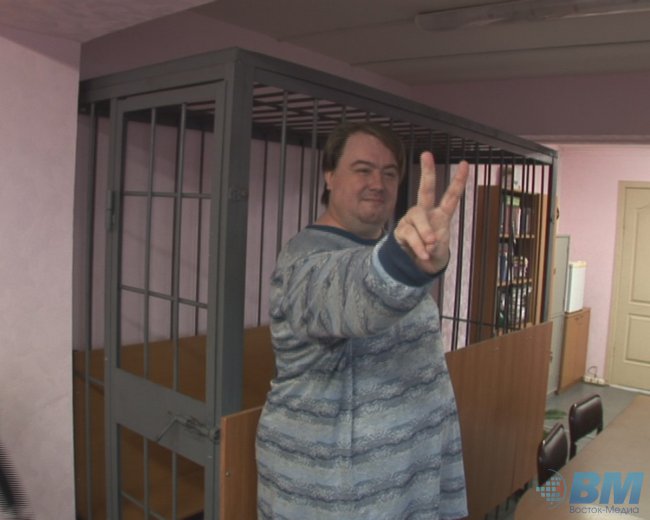
Update. According to an article on the news website Vostok-Media, on October 1, 2015, the Industrial District Court in Khabarovsk found Andrei Marchenko guilty as charged and sentenced him to a fine of 100,000 rubles, but immediately amnestied him as part of a general amnesty celebrating the seventieth anniversary of victory in the Second World War.

Andrei Marchenko celebrating his virtual victory in court. Photo courtesy of Vostok-Media

The “Gay Terrorist Underground” in Khabarovsk: The Case of Andrei Marchenko

Prosecutor Requests Two Years in Open Penal Settlement for Khabarovsk Blogger Marchenko
September 28, 2015
Grani.Ru

Prosecutor Olesya Demina has asked Khabarovsk’s Industrial District Court to sentence blogger and LGBT activist Andrei Marchenko to two years in an open penal settlement, as reported by Grani.Ru’s correspondent from the courtroom. Marchenko has been accused of extremism for posts he made on Facebook.

andrei marchenko
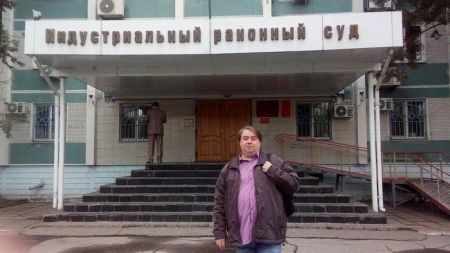
Andrei Marchenko outside of Industrial District Court in Khabarovsk. Photo by Alla Viktorova. Courtesy of Grani.Ru

During closing arguments, defense attorney Natalya Gladych drew the court’s attention to Marchenko’s positive character references, as well as the findings of a psychologist, who concluded that the defendant’s only purpose had been to draw attention to himself and to his position on the war in the east of Ukraine.

“Two years in an open penal settlement is an excessively severe punishment given that the evidence presented by the prosecution is insufficient. The prosecutor speaks of Marchenko as an out-and-out extremist, although the man was simply expressing his opinion. The harsh form in which he delivered it was due only to heightened emotionality,” said Gladych.

On Monday, the defendant was to make his closing statement, but Judge Galina Nikolayeva unexpectedly adjourned until Wednesday, September 30, when Marchenko will deliver his closing statement and the judge will return a verdict.

“I did not expect that the prosecution would request real prison time. There is not a single injured party in the case. There is only the one sentence on Facebook, which did not lead to any real consequences. And for this the representative of the state machine asks the court to sentence me to real prison time,” Marchenko commented to Grani.ru after the hearing.

Marchenko has pleaded not guilty and hopes for an acquittal.

On June 8, 2014, Trinity Sunday, Marchenko published a post on Facebook dealing with the events in the east of Ukraine.

“Impale all the terrorists!!!!!!!!” he wrote. “Kill all of them!! Blood Sunday! Free Ukraine from the fascist Russian terrorists on Trinity Sunday!”

The post was made visible only to Marchenko’s friends in the social network. Nevertheless, it was this publication that led to the blogger’s prosecution.

On August 28, 2014, FSB officers carried out a search at Marchenko’s home during which they seized all his office equipment and mobile phones. The following day, the blogger was charged at regional FSB headquarters under Article 280, Part 1 of the Criminal Code (public incitement to extremism)

andrei marchenko-2
Andrei Marchenko. Photo courtesy of amurburg.ru

A week before the raid, the blogger had also been summoned to regional FSB headquarters. There he was shown screenshots of a certain site according to which Marchenko and another Khabarovsk LGBT activist, Alexander Yermoshkin, were the founders and masterminds of a “gay terrorist underground” that were pursuing the goal of organizing an “orange revolution” in Khabarovsk. As Marchenko noted, the FSB investigator was “utterly serious.” Marchenko was then asked why he did not like “Novorossiya.” He was told that his numerous posts in support of Ukraine and criticizing the Kremlin were the reason for the FSB’s concern.

On September 11, 2014, another five phrases from Marchenko’s summertime posts were sent off for forensic examination.

“Including phrases in support of Poroshenko and phrases about the fact that prices are higher but Crimea is ours,” wrote the blogger.

Two weeks later, it transpired that Rosfinmonitoring had placed Marchenko on its list of terrorists and extremists. However, the blogger kept his bank accounts only for withdrawing money he earned through official freelance bureaus from the WebMoney system. For many years, these earnings had been Marchenko’s only source of income. Thus, Rosfinmonitoring’s decision left the activist penniless.

“Now I don’t even have money for groceries,” wrote Marchenko.

The blogger expressed bewilderment at his inclusion in the list, noting that the court had not yet deemed him either a terrorist or an extremist.

On December 30, 2014, final charges were filed against Marchenko.

Translated by the Russian Reader

NB. Grani.Ru, the opposition news and commentary website that published this article about Andrei Marchenko’s plight is itself banned in Russia as “extremist” and can only be viewed there through VPNs, anonymizers, and mirror sites.

Update. According to an article on the news website Vostok-Media, on October 1, 2015, the Industrial District Court in Khabarovsk found Andrei Marchenko guilty as charged and sentenced him to a fine of 100,000 rubles, but immediately amnestied him as part of a general amnesty celebrating the seventieth anniversary of victory in the Second World War.

Andrei Marchenko celebrating his virtual victory in court. Photo courtesy of Vostok-Media