NUMB3RS (Wages of War)

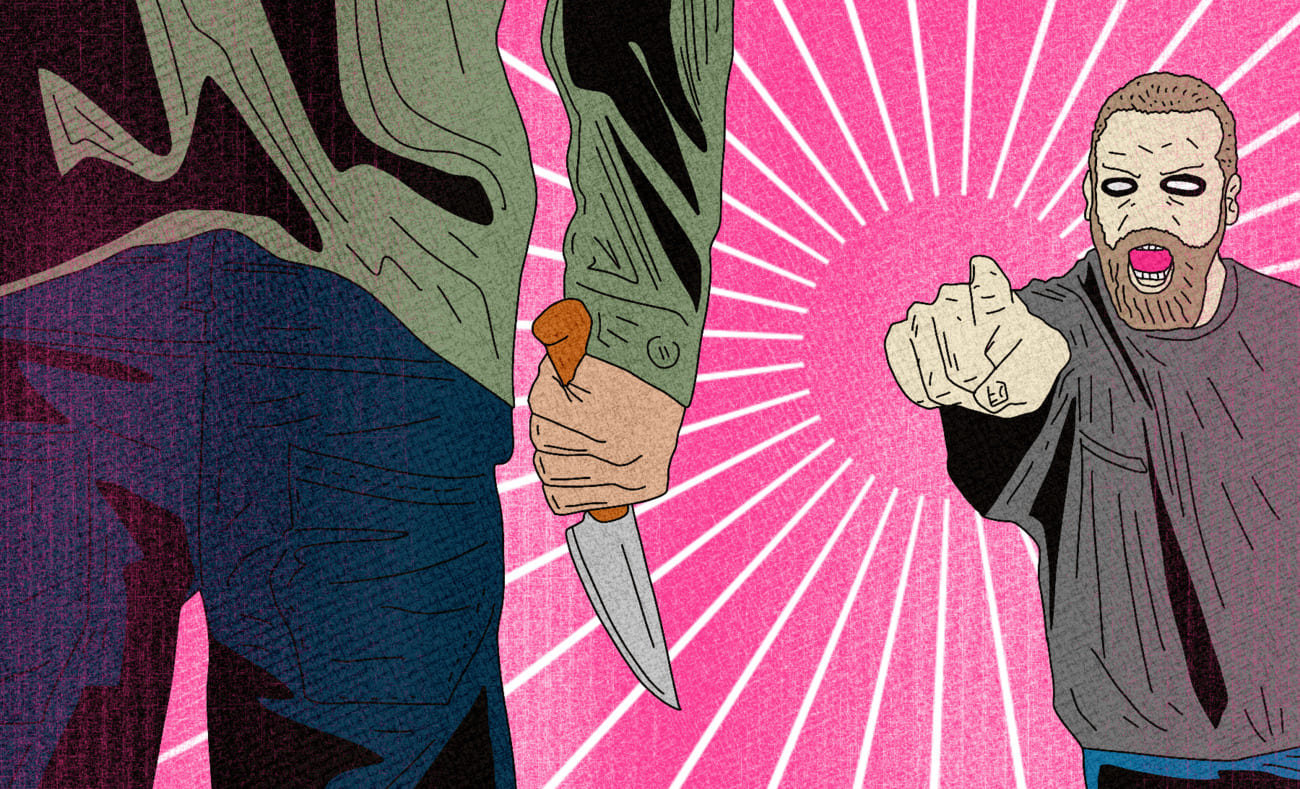
Illustration by Danny Berkovskii for Mediazona. Source: New Tab

Aided by a team of volunteers, journalists at Mediazona and the BBC’s Russian Service have identified 41,731 Russian soldiers killed in the war in Ukraine using open sources. This number includes employees of the Wagner mercenary group, but it does not include those who fought on Russia’s side in military units fielded by the self-proclaimed Donetsk and Luhansk “people’s republics,” the BBC noted in an article published on Friday, 12 January.

According to the article, more than 1,100 Russian military personnel killed in the war were under 20 years of age. Since the State Duma approved amendments to the relevant laws, in April 2023, thus permitting 18-year-old high school graduates to sign military service contracts, 48 Russians born in 2004 and five born in 2005 (who were thus “barely 18 years old” when they enlisted) have perished in the war.

As of 11 January, 2,377 airborne troops, 913 marines, 537 members of the Russian National Guard’s special forces, 450 members of the GRU’s special forces, 206 military pilots, and 77 FSB and FSO officers have been killed in combat operations.

The BBC points out that the number of casualties among those who voluntarily signed a contract to serve in the Russian armed forces has increased in recent months. Thus, volunteers, prisoners, and private mercenary company “recruits” now account for 37 percent of all confirmed losses 0n the Russian side. Another 12 percent of the identified casualties were draftees (of whom 5,005 died in Ukraine and 62 in Russia).

Source: Yevgeny Zhukov, “Journalists have confirmed the deaths of 41,700 Russian soldiers in Ukraine,” Deutsche Welle Russian Service, 13 January 2024. Translated by the Russian Reader


According to Ukrainian intelligence, the Russian forces in Ukraine currently consist of 462,000 military and 35,000 National Guard troops, responsible for the functioning of the occupation regime. This number of troops allows the Russians to carry out rotation — to withdraw units and subdivisions and bring them to the front line.

Source: Monique Camarra, “Jan 13: E-Stories,” EuroFile, 12 January 2024


When looking for a new advertising/PR agency in Ukraine in autumn 2023, PepsiCo made it a condition for a potential partner to exclude any mention of the war, or support for Ukraine and its army in future communications, according to a brief seen by B4Ukraine.

“NO: mention of war, hostilities, aggression, military personnel (from Brand side), Armed Forces of Ukraine. NO: support Ukraine and the army. NO: negative connotation, creating a feeling of ‘unsafe,’” states the “Pepsi restrictions” section of the brief.

The B4Ukraine Coalition contacted Pepsi offices in Ukraine and the US to ask for comment on this article but at the time of publication had not received any response.

In the meantime, the October 17 message on PepsiCo’s Instagram page announced that “PepsiCo volunteers distributed food kits to 1,200 families in the city of Borodyanka, whose homes were destroyed.” The message does not specify who exactly brutally destroyed the homes of these people.

Perhaps because PepsiCo’s Russia net profit increased by 333% to $525 million last year and the company paid about $115 million in taxes to the Kremlin? Treating such contributions as support for the economy of the aggressor state, Ukraine’s National Agency on Corruption Prevention (NACP) in September included PepsiCo in the list of international sponsors of war.

PepsiCo produces soft drinks, juices, chips, snacks, dairy products and other food products under the main brands Chester’s, Chipsy, Lay’s, Mirinda, Pasta Roni, Pepsi, Propel, Sandora, 7Up, Simba, Snack a Jacks, Sonric’s, Tropicana, etc.

The company has 19 factories, about 20,000 employees, 40,000 agricultural workers, and 600 open vacancies in Russia, according to the NACP.

The company announced the cessation of advertising activities and the production of some beverages in Russia in March 2022, while still allowing other products, such as infant formula and baby food to be sold, in order, as PepsiCo put it, “stay true to the humanitarian aspect of its business.” Yet in fact, the company continues the production and distribution of chips, snacks, and soft drinks. According to Bloomberg, PepsiCo’s revenue rose 16% in Russia and profits quadrupled, and the soda maker said operations in Russia accounted for 5% of consolidated net revenue for 2022, up from 4% a year earlier.

Now the iconic Pepsi cola is sold under the Evervess-Cola brand, although regular Pepsi Cola is still easy easily purchasable in Russian supermarkets due to the so-called parallel imports, when goods are imported without the manufacturer’s permission.

At the beginning of September last year, PepsiCo came under fire over its Russian business when the firm’s products were dropped by the Finnish parliament and Scandinavian Airlines’ operator SAS, and already on September 21, ironically, [a] Russian missile damaged a PepsiCo plant near Ukraine’s capital Kyiv.

A global [c]oalition of civil society organizations, B4Ukraine, is calling on PepsiCo to exit Russia ASAP and for the US government to issue a business advisory, warning US businesses of the growing legal, reputational, and financial risks of doing business under military control in Russia.

Source: “‘No support for Ukraine and its army’: PepsiCo restricts mentions of war in its PR,” B4Ukraine. Thanks to Monique Camarra (EuroFile) for the heads-up.


The war has markedly changed the Russian economy. Moscow has had to adjust its policy to fund its armed conflict against Kyiv, maintaining its military apparatus and police force, and integrating the territories it has annexed from Ukraine. These priorities have necessitated significant spending commitments that collectively threaten Russia’s economic stability. The Kremlin will spend six percent of GDP (more than eight percent when combined with spending on national security) on the war in 2024. This is more than the 3.8 percent of GDP that the United States spent during the Iraq war, although it falls short of the prodigious sums the Soviet Union allocated during the years of stagnation and its invasion of Afghanistan (18 percent of GDP).

Military spending has even eclipsed social spending—currently less than five percent of GDP—for the first time in Russia’s post-Soviet history. This pivot toward a militarized economy threatens social and developmental needs. The four annexed regions of Ukraine have already received the equivalent of $18 billion, and in 2024 almost $5 billion is expected to be transferred from the federal budget to regional budgets. No other regions in Russia receive this level of investment, which only increases interregional inequality. Rather than restore dilapidated housing in Russia, the Kremlin prefers to spend money on building houses and roads in annexed territories, to replace the houses and roads that Russian troops destroyed during their brutal invasion.

Russian industry has been transformed, with defense sectors now overshadowing civilian industries. The defense sector’s enterprises are now operating at a fever pitch and, as a consequence, any surge in demand is likely to force prices to rise because of the sector’s inability to increase supply. The military sector is receiving a disproportionately high amount of government spending, and it is also siphoning off labor from the civilian workforce, leading to an abnormally low unemployment rate of 2.9 percent. Before the war, Russia’s unemployment rate typically stood at around four to five percent. The military and public sectors now employ 850,000 more people than in late 2022–23. The invasion of Ukraine also prompted about 500,000 Russians to emigrate in 2022, driving shortages of qualified specialists and blue-collar workers.

Meanwhile, living standards have risen across Russia, and the percentage of Russians living below the poverty line has dropped to 9.8 percent, the lowest since 1992. Naturally, there are regional variations, and areas that have sent a significant number of their men to fight in Ukraine—including Altai Krai, the Altai Republic, Buryatia, Chechnya, and Dagestan—have witnessed the fastest income growth in low-income groups. This relative increase in prosperity can be expected to continue as Moscow disburses funds to the families of the deceased and wounded.

Overall, the Kremlin wishes to maintain an illusion of normality and even increasing prosperity for its citizens. The distortions in the labor market have pushed up salaries in military industry, as well as in civilian manufacturing, because of the need to compete to attract workers from well-paying military plants. Moscow is, meanwhile, making high payments to soldiers and people mobilized to fight in Ukraine, which are driving consumption. At the same time, thanks to a supply of cheap credit, the government is handing out subsidized mortgages, that are, for the moment, shielding families from economic reality.

Source: Alexandra Prokopenko, “Putin’s Unsustainable Spending Spree: How the War in Ukraine Will Overheat the Russian Economy,” Foreign Affairs, 8 January 2024


Elsewhere there are signs that the invasion of Ukraine may have disrupted the Russian economy more severely than the frothy party scene suggests. The Olivier salad, a mayonnaise-drenched confection of root vegetables, sausage and boiled eggs, is a staple at every table during the holidays. This winter the price of eggs suddenly rocketed (no one is quite sure why, but it may have been because farms were short of labour since so many workers have been conscripted or left the country). In some regions people cannot afford a box of six eggs and have to buy them individually. One pensioner even raised this with Putin during the president’s annual end-of-year call-in with the public. Putin promised to look into it.

Source: Kate de Pury, “Gucci is cheap and eggs are pricey in Russia’s surreal economy: War spending has Russians partying like it’s 2021. But some are also stockpiling dollars,” 1843 Magazine (The Economist), 10 January 2024


In the two years that have passed since the start of Russia’s large-scale invasion of Ukraine, residents of Ukraine have become less likely to use the Russian language, according to a press release on the outcome of research done by the Ludwig Maximilian University of Munich in cooperation with the University of Bath and the Technical University of Munich, which was published on Wednesday, 10 January.

Language plays a leading role in the identity of post-Soviet Ukraine, the authors of the study say. Many Ukrainians are fluent in both Ukrainian and Russian. And yet, only a few years ago, 50 to 60 percent of the country’s residents called Ukrainian their principal language of communication. After the Maidan protests in late 2013, sparked by then-Ukrainian President [Viktor] Yanukovych’s refusal to sign an association agreement with the EU, and Russia’s subsequent  annexation of Crimea in 2014, more Ukrainians abandoned Russian.

[…]

The researchers explore this trend in a study published in the journal Communications Psychology. Using artificial intelligence and statistical analysis, they examined more than four million messages posted by 63,000 Ukrainian users on the social network X (formerly Twitter) between January 2020 and October 2022.

According to the study’s authors, users began switching from Russian to Ukrainian even before the large-scale Russian invasion, but this trend increased dramatically after the war began. In their opinion, this change in user behavior was a political reaction to events. Users wanted to distance themselves from both support for the war and Russia as such, so they started using Ukrainian en masse.

Source: Sergei Gushcha, “Ukrainians use Russian less since war began,” Deutsche Welle Russian Service, 10 January 2024. Translated by the Russian Reader


The full-scale war in Ukraine, which began almost two years ago, has led to increased violence in Russia itself. Military personnel with PTSD and criminals recruited into combat return from the front and maim and kill people in civilian life. Sometimes conversations about the war even end in violence. Mediazona and New Tab have uncovered over thirty criminal convictions for assaults and murders that occurred during quarrels about the “special military operation.” (The courts use the official wording for the war as mandated by the authorities.)

In Berdsk, Novosibirsk Region, draftee Khuler Mongush stabbed Nikolai Berezutsky, a passerby. The latter had asked Mongush why he was going to Ukraine. Saying that he was going there “to defend the Motherland,” the mobilized man attacked Berezutsky. Mongush was sentenced to eight years in prison for murder.

In the Irkutsk Region, farmer Maxim Khalapkhanov was drinking with an acquaintance, who began ridiculing the state of the Russian army during the war. Khalapkhanov eventually got angry and killed the acquaintance with a knife, whose handle was decorated in the colors of the Russian flag, and drew the letter Z on his stomach with a fireplace poker. Khalapkhanov was sentenced to seven years in a high-security penal colony.

Anton Rakov, a resident of Orenburg, was drinking with a new acquaintance. They began arguing about the war. Rakov did not like what his interlocutor was saying and killed him. While his victim breathed his final breaths, Rakov recorded a video with the dying man in the background, shouting, “This is what will happen to anyone who disagrees with me!”

Viktor Konnov of Zlatoust beat up a friend who said something nice about Ukraine, while Ivanovo resident Mikhail Vitruk received two and a half years in a penal colony for beating up his girlfriend, who allegedly called him a “Nazi” while they were watching the news.

In 2020, Mikhail Taskin attempted to shoot three people over a parking space and was sentenced to nine years in a penal colony, whence he was freed by the Wagner Group. Taskin spent several months in combat, where he lost a leg, eventually returning to his native village of Nerchinskiy Zavod in the Transbaikal Territory. In August 2023, he got into a fight at a local cafe. Taskin mocked the waitresses and promised to “hump all of them.” The incident ended in a brawl, and the police detained five people, but not Taskin was not among them. His sister and the local authorities argued that the disabled man had been assaulted by “opponents of the war.” But the news website Regnum discovered that two of the detainees were certainly not against the war because they had been involved in patriotic campaigns in the region.

It is not only drinking buddies and casual acquaintances who quarrel and fight over the war. Mediazona and New Tab turned up no less than seven court rulings in cases where the defendants and the victims were members of the same family. Vladimir Tofel from Petropavlovsk-Kamchatsky killed his nephew during an argument about the war. Yuri Makarkin stabbed his son, while Anna Cheremnova, a resident of the Altai Territory, stabbed her husband.

The experts asked for comment by Mediazona and New Tab argue that these are signs of a deep split within society, and the policy of the authorities does not help society to overcome this fissure. On the contrary, the hysterical rhetoric of propaganda only heightens the degree of intolerance, and people are increasingly willing to maim and kill each other.

Source: WTF (Mediazona) newsletter, 10 January 2024. Translated by the Russian Reader
Em Uyaya’am (Things I Saw, Read and Watched This Week)

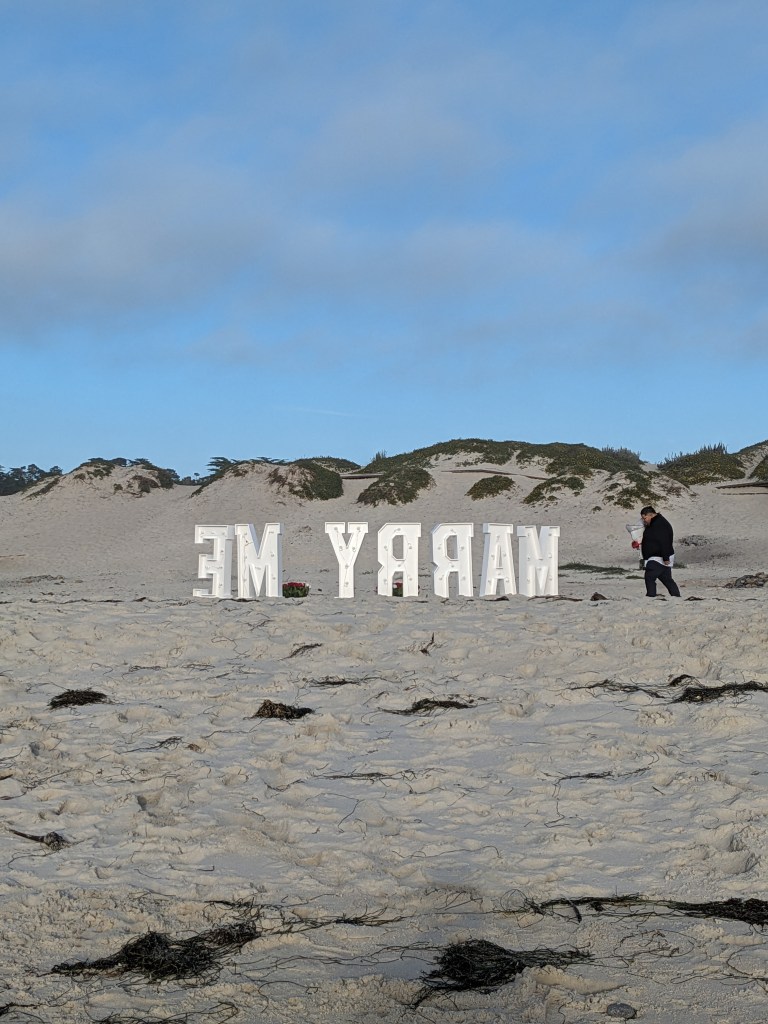
Asilomar State Beach, 21 July 2023. Photo by the Russian Reader

Who is Girkin?

Igor Girkin (Strelkov) is an ethno-fascist FSB officer and the warlord who prepared the ground and then launched the war in Donbas in 2014. He stated that without him, “there wouldn’t be any war”. He is also responsible for ordering the execution of numerous civilians, for which he still face justice. He was sentenced to life imprisonment in absentia by the International Criminal Court on November 17, 2022 as perpetrator of the downing of Malaysian Airlines 17 and the murder of 298 people—a war criminal.

[…]

Source: Monique Camarra, “Igor Girkin arrested in Moscow: the Kremlin is clamping down,” EuroFile, 22 July 2023


“The all-clear hasn’t sounded, the fight continues.”

Source: Sergey Abashin (Facebook), 21 July 2023


Stunning drone footage has revealed details of the Batagaika crater, a one-kilometer-long gash in Russia’s Far East that forms the world’s biggest permafrost crater.

In the video two explorers clamber across uneven terrain at the base of the depression, marked by irregular surfaces and small hummocks, which began to form after the surrounding forest was cleared in the 1960s and the permafrost underground began to melt, causing the land to sink.

“We locals call it ‘the cave-in,'” local resident and crater explorer Erel Struchkov told Reuters as he stood on the crater’s rim. “It developed in the 1970s, first as a ravine. Then by thawing in the heat of sunny days, it started to expand.”

Scientists say Russia is warming at least 2.5 times faster than the rest of the world, melting the long-frozen tundra that covers about 65% of the country’s landmass and releasing greenhouse gases stored in the thawed soil.

[…]

Source: “World’s biggest permafrost crater in Russia’s Far East thaws as planet warms,” Reuters, 21 July 2023


“Let’s remember these people”

After the court hearing [in his criminal case], Oleg Orlov read out a long list of names of people convicted of “disseminating fake news” or “discrediting the army.” He mentioned Alexei Gorinov, Dmitry Ivanov, Samiel Vedel (aka Sergei Klokov), Vladimir Kara-Murza, Ilya Yashin, Maxim Lypkan, and many others.

“I am not imprisoned, and I can say what I deem necessary. I can answer your questions. But how many of my and your kindred spirits are deprived of this opportunity,” Orlov reminded. “I consider it my duty to read out the list. These are only some of the people who have been imprisoned for their anti-war stance.”

After reading out the names, Orlov cited data from OVD Info. “634 people from 78 regions [of Russia] have faced criminal charges for anti-war protests, for words and statements,” the human rights activist said. “And 200 of them have already been incarcerated. Let’s remember these people.”

Orlov stressed that he was fighting not only for his own sake. “Both my lawyer Katerina Tertukhina and my public defender Dmitry Muratov — we are fighting like this and trying to prove the nullity of the charges [against him], the nullity of the [prosecution’s] expert witness analysis, because we are trying to fight for all people.”

Video courtesy of SOTA

Source: memorial.hrc (Instagram), 21 July 2023. Translated by the Russian Reader


Crimean Tatar-led underground movement is already active behind Russian lines and hundreds of young Tatar men are ready to take up arms to liberate the occupied peninsula, a veteran community leader has said.

Mustafa Dzemilev, widely seen as the godfather of the Crimean Tatar rights movement, pointed to operations by the Atesh guerrilla group, comprising Crimean Tatars, Ukrainians and Russians, in Crimea and other occupied Ukrainian regions.

Atesh, which means “fire” in Crimean Tatar, was created in September last year, primarily to carry out acts of sabotage from within the ranks of the Russian army. It claims more than 4,000 Russian soldiers have already enrolled in an online course on how to “survive the war” by wrecking their own equipment.

There is no evidence linking the group to the latest attack on the Kerch Bridge, early on Monday morning, but the group has claimed a string of smaller-scale attacks, blowing up Russian checkpoints, assassinating Russian officers, setting fire to barracks and feeding sensitive information to Ukrainian intelligence. It recently accused Russian sappers of laying mines in the Krymskyi Titan chemical works in Armiansk, northern Crimea. An explosion there could spread an ammonia cloud across the land bridge between the peninsula and mainland Ukraine.

“Atesh is very deep underground,” Dzhemilev, 79, told the Guardian in an interview in Kyiv. “There was not a single arrest among Atesh members, but they are working inside Crimea territory blowing up targets.”

[…]

Source: Julian Borger, “The underground Crimean Tatar group taking up arms against Russia,” Guardian, 17 July 2023


Hello! This is Alexandra Prokopenko with your weekly guide to the Russian economy — brought to you by The Bell. In this newsletter we focus on the Kremlin’s decision to seize the Russian assets of two major foreign companies and what it means for the business climate and the other Western businesses who cannot — or will not — leave Russia. We also look at Friday’s interest rate hike and new Western sanctions on Russia.

Nationalization of Western assets heralds broader property redistribution

Finland’s Fortum and Germany’s Uniper saw their Russian assets seized by the Kremlin earlier this year. This week was the turn of France’s Danone and Denmark’s Carlsberg. It feels like we are witnessing the final chapter in the history of Western business in post-Soviet Russia. If the transfer of Fortum and Uniper’s energy assets to external management was explained as a response to the European Union’s treatment of Russian energy companies, there is no such obvious reason for the behavior toward Carlsberg and Danone and it likely reveals the Kremlin’s real intentions. This is direct nationalization — and opens the door to a new distribution of property in Russia.

[…]

Source: Alexandra Prokopenko, “Kremlin asset seizures the new normal,” The Bell, 21 July 2023


This image has an empty alt attribute; its file name is 360096182_6574069839310211_6569062695868766924_n.jpg

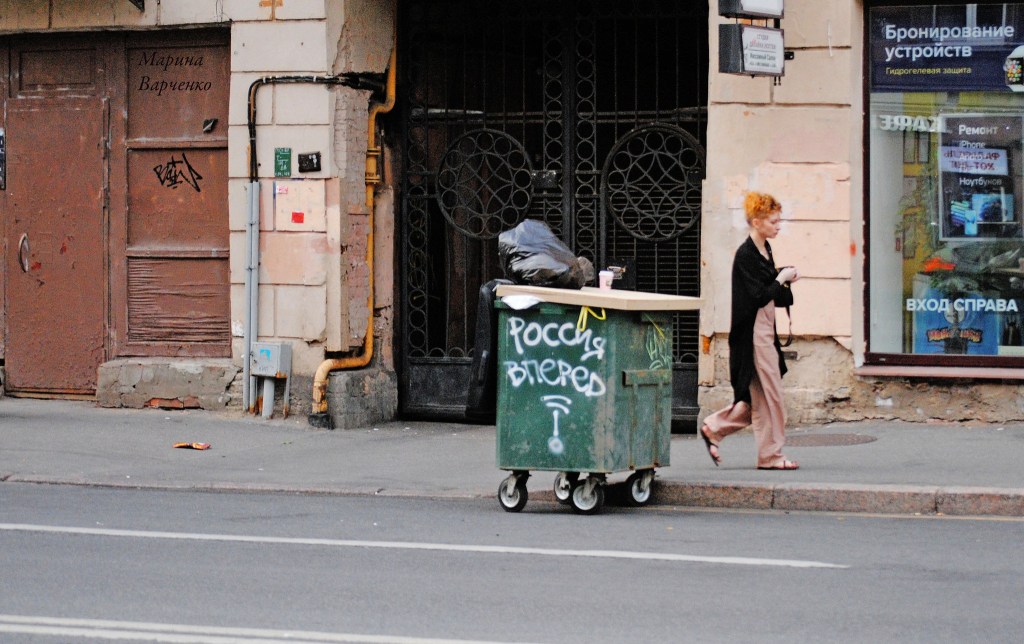
“Russia, forward!”

Source: Marina Varchenko (Facebook), 14 July 2023. She writes: “In our hood) Petersburg, Razyezzhaya Street.


The Arkhangelsk Region has allocated 800 million rubles to the occupied Ukrainian city of Melitopol, which will be used to repair the city, which has suffered from Russia’s invasion. However, the region itself does not have enough money to repair its own housing. Arkhangelsk is considered the capital of the Russian North, but has been informally dubbed the “capital of dilapidated housing.” Many people live in substandard housing: the city is chockablock with barracks and crumbling wooden houses. Watch Valeria Ratnikova’s report on how the region copes with a budget deficit while its money is spent on the war.

00:00 Opening 02:15 Ruins, barracks, and crumbling houses 06:00 Brevennik Island: expensive prices and derelict housing 10:56 Natalia Zubarevich about the lack of money in the region 12:04 The campaign against waste haulage to the region 16:18 The authorities are taking revenge on opposition activists opposed to landfills 31:35 Denunciations and criminal cases for statements about the war 33:22 One of the protesters went to the war 36:15 What residents say about the war 38:26 Getting fired for criticizing the war 39:40 A female student fled to Lithuania — the authorities wanted to jail her for talking about the war 46:25 The region’s environmental problems 49:10 Journalists detained during Putin’s visit 51:11 How the war has affected life in the region

Source: “The ruins of Arkhangelsk: how people whose money was given to occupied city live,” TV Rain (YouTube), 16 July 2023. Annotation translated by the Russian Reader

Whiskey, You’re the Devil

A .7-liter bottle of Ladoga’s Carrygreen “Irish whiskey” will set you back 1,285 rubles (approx. 17 euros) if you order it online.

Amid the departure of a number of foreign brands, Ladoga Group is the first in Petersburg to launch the production of Irish whiskey under its own brand.

The products will be produced at the plant in Petersburg from Irish grain and malt distillates aged in oak barrels for more than three years. The company is counting on the new product’s success due to Irish whiskey’s growing popularity in Russia and the withdrawal of several foreign brands from the market, Ladoga president Veniamin Grabar said.

“If bottling Scotch whiskey in Russia is already a familiar thing, then Carrygreen is one of the first whiskeys from Irish distillates bottled in Russia. It is now a rapidly growing product in its category,” he said.

Grabar claims that the volume of imports on the market is about 70%. And yet, Irish whiskey’s share of this market has been growing — from 16% in 2017 to 25% in 2021. Since 2017, the number of Irish whiskey brands on the Russian market has doubled, growing to fifty.

As the company told DP, the first batch of products under its own brand will total 63,000 bottles. The planned annual volume is 400,000 half- and .7-liter bottles. At the moment, the project is aimed at the domestic market: the company plans to take a 30% share of Russia’s Irish whiskey segment, and the entire Ladoga Group (including its own import distribution companies) aims to grab 7-8% of the domestic whiskey market. If its resources and feedstocks allow, the group does not rule out starting exports to the CIS countries.

According to Maxim Chernigovsky, head of the Club of Alcohol Market Professionals, whiskey in Russia is currently produced by about twenty factories.

“A significant part of the whiskey market in past years was taken up by imports from the UK and the USA. After the departure of a number of foreign brands, there was a shortage. Russian producers eliminated it by ramping up the production of this alcoholic beverage by 37% in 2022 compared to 2021,” he notes.

Thus, the shortage of whiskey in Russia has already been surmounted by domestic producers. Competition in this segment will definitely be intense, says Chernigovsky. “The segment is interesting: it is premium and high-margin. In fact, there is competition only among our own Russian homegrown factories. Foreign-made whiskey, delivered to Russia through parallel imports, show up on store shelves at a price at least 20% higher,” the expert argues. “Irish whiskey will be bottled in St. Petersburg for the first time, and Ladoga’s prospects can be called positive.“

According to estimates by the Club of Alcohol Market Professionals, 2,838,000 decaliters of whiskey were produced in Russia in 2021; in 2022, production increased by 37% to 3,891,000 decaliters. Among the largest players in this market are the Stavropol-based Alvis Group, the Stellar Group, Beluga’s Georgiyevsk distillery, as well as Tula’s 1911 Distillery. In addition, Bacardi bottles whiskey under the William Lawson’s brand at a Russian plant.

The Ladoga Group consists of several companies, including a production facility with an annual capacity of 4.5 million decaliters and a network of wholesale distributors. In 2021, Ladoga Distribution’s revenue increased by 18% to 12.9 billion rubles, and its net profits amounted to 121.9 million rubles, compared to 345.2 million the previous year.

Source: Svetlana Afonina, “Production of Irish whiskey up and running in Petersburg,” Delovoi Peterburg, 6 February. Translated by the Russian Reader


The Pogues, “Whiskey, You’re the Devil”

Barrister gins have won three medals at the UK’s Gin Of The Year™, considered the most important gin competition in the world. Barrister Organic and Barrister Blue gins won gold medals, Barrister Dry was awarded silver.

Once a year, the world’s most successful gin producers gather in London to present their production to prestigious jury of the UK’s most authoritative gin buyers. Gin of the Year organizer Peak Publishing is “the world’s most influential beverage competition entity” with 1 billion bottles sold since 2006. Barrister family gins traditionally show high results in international competitions such as CWSA, The GIN Masters, Beverage Tasting Institute, World Gin Awards, Frankfurt International Trophy, International Wine & Spirit Competition, New Zealand Spirits Awards and others. Today Barrister gins are available in overseas markets in Europe, Australia, New Zealand, India, China and the Middle East.

Source: “New Barrister triumph in London,” Ladoga, 23 November 2022


International economic institutions, which recently doubted Russia’s economy could survive under Western sanctions, are now sounding more optimistic than even the Russian government. The International Monetary Fund (IMF), known for its gloomy forecasts, this week predicted Russia’s GDP will grow at 0.3% this year.

The typically conservative IMF was much more upbeat than usual in its most recent forecasts for the global economy — for which it anticipates 2.9% growth (up 0.2 percentage points from its October forecast) because of “unexpectedly stable” dynamics. 

Russia’s forecast was upgraded even more than the global figures: in October, the IMF expected a 2.3% fall in Russian GDP in 2023, now it is talking about 0.3% growth. In 2024, they believe Russia’s GDP will increase by as much as 2.1%.

IMF economists explain this surge of optimism with a familiar narrative: the stability of Russian oil exports. “At the current oil price cap level, Russian crude oil export volumes are not expected to be significantly affected, with Russian trade continuing to be redirected from sanctioning to non-sanctioning countries,” the report stated.

The IMF’s latest figures are the most optimistic forecast around. They are well above the February consensus among Russian economists (decline of 1.5% in 2023) and the official projections of the Russian authorities: the Ministry of Economic Development currently predicts a fall of 0.8% in 2023, while the Central Bank expects a drop of up to 4%.

If Russia’s economy is to live up to the IMF’s expectations, output needs to increase by 0.4% every quarter from the fourth quarter of last year to the fourth quarter of 2023, according to a Telegram channel run by Bloomberg Economics’ Alexander Isakov. The economist thinks this is realistic. “The shocks of losing the European gas market, the departure of car manufacturers and others remain… while retail lending is accelerating to finance a recovery in consumer demand,” Isakov wrote. “Thus, the IMF’s figures seem persuasive.”

Russia’s economy has adapted quicker than expected after the shocks of 2022. Central Bank analysts see five underlying reasons for this:

  • The stability of the banking system. Thanks to ample capital reserves, banks have remained in reasonable shape — while lending was supported by regulatory easing;
  • Falling export volumes offset by rising prices;
  • Rapid redirection of exports toward Asia;
  • An effective reshaping of logistics chains by import-based businesses;
  • Government support, with an increase in budget spending.

Business activity in Russia continues to recover. According to an updated State Statistics Service (Rosstat) estimate and the Central Bank’s figures, in the third quarter the economy turned a corner (+0.86% compared with the previous quarter). Russia’s economy moves into 2023 with a higher level of activity than was expected in the spring, Central Bank analysts wrote last month. Demand has been underpinned by government spending.

However, it’s important to point out that the economic recovery is patchy.

Constraining factors include a growing preference for saving rather than spending among the general population, difficulties with maintaining imported equipment and staff shortages. 

In November, almost half of Russian businesses (45%) reported staffing problems. The dwindling workforce and the significant wartime brain drain could result in fierce competition to hire the remaining talent. And that will likely push up salaries faster than productivity can match, bringing inflationary risks (The Bell recently spoke at length with Vladimir Gimpelson, director of the Center for Labor Studies at the Higher School of Economics about current trends on the labor market).

“The IMF scenario is clearly the most optimistic of the possible outcomes that have some chance of happening in 2023,” said Dmitry Polevoi, investment director at Loko-Invest. 

“However, from our point of view, GDP will still fall by 1.5-2.5% in 2023 due to weak demand at home and abroad, coupled with high levels of uncertainty.”

Source: Alexandra Prokopenko, “IMF upbeat on Russia’s economy,” The Bell, 4 February 2023. Translated by Andy Potts