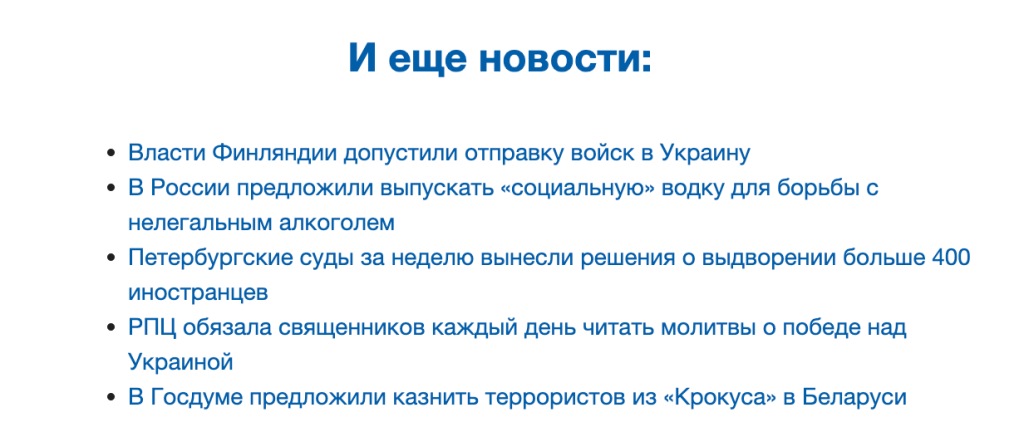
Source: Moscow Times Russian Service daily newsletter, 1 April 2024. Translated by the Russian Reader. Unfortunately, none of these headlines is a joke.
State Duma (Russia’s lower chamber of parliament) Maria Butina has proposed an option that would allow the Russian authorities to implement the previously voiced threat to execute those involved in the Crocus City Hall terrorist attack. Agenstvo news agency says she has proposed to extradite the Crocus City Hall terror attack suspects to Belarus, which maintains the death penalty.
“Unfortunately, the tragedy has become common to us, because citizens of Belarus also died there. I am quite knowledgeable about your legislation, including the death penalty, which is maintained [in Belarus]. In this case, it is the murder of two or more persons, therefore you have exactly the same right to try these people as the Russian Federation,” MP Butina was quoted as saying.
“I think that discussions are already underway among the competent authorities. If they count on the fact that, since Russia has imposed moratorium on the death penalty they will be able to escape this type of punishment, then let’s wait and see, because negotiations are underway,” Butina was cited as saying in an interview with Belarus 1 TV Channel.
Pervy Otdel (First Department) lawyer Yevgeny Smirnov told Agenstvo that “indeed, the Russian legislation allows, on the basis of an international agreement, to extradite people who committed a crime in the territory of Russia to another country.”
According to him, “if a request arises from Belarus, the agreement with it will have priority over Russian norms.”
“However, in the case of at least one accused — Alisher Kasimov, who rented out the apartment to other defendants – it is impossible, because he has Russian citizenship,” Smirnov noted.
Belarus still maintains the death penalty.
Capital punishment is a legal penalty in Belarus. At least one execution was carried out in the country in 2022. Also known as an Exceptional Measure of Punishment it has been a part of the country’s legal system since gaining independence from the Soviet Union on August 25, 1991. The current national constitution prescribes this punishment for “grave crimes.” Later laws have clarified the specific crimes for which capital punishment can be used. The death penalty can be imposed for crimes that occur against the state or against individuals. As of 2021, Belarus is the only country in Europe that continues to carry out the death penalty.
Maria Butina (born November 10, 1988) is a Russian politician, political activist, journalist, and former entrepreneur who was convicted in 2018 of acting as an unregistered foreign agent of Russia within the United States.[
While residing in Washington, D.C., Butina was arrested by the FBI in July 2018 and charged with acting as an agent of the Russian Federation “without prior notification to the Attorney General.” In December 2018, she pleaded guilty to felony charges of conspiracy to act as an unregistered foreign agent of Russia. In April 2019, a federal judge sentenced her to 18 months in prison. She served around five months at Tallahassee Federal Correctional Institution. Her 9-month pretrial prison term was counted towards her sentence. She was released and deported back to Russia in October 2019. She publicly denied being a Russian spy. In 2021, she was elected to the State Duma as a member of United Russia.
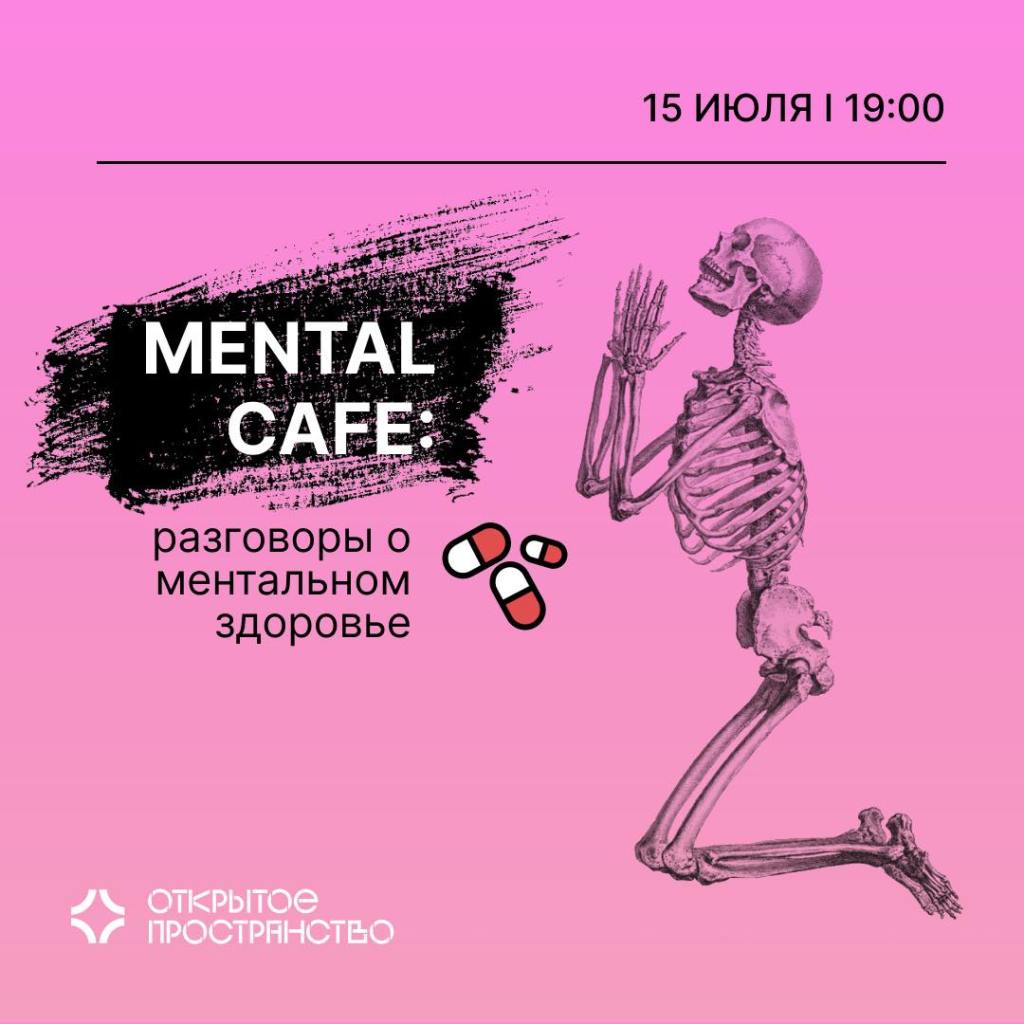
“July 15, 7 p.m. Mental Cafe: conversations about mental health. Open Space”
Mental Cafe is a cafe without food service and a permanent address where people come together to discuss topics related to mental health.
It is not a support group or a grief group. It does not provide psychological assistance. It is just a conversation club where you can share your experiences and ask any questions about mental disorders.
You can even choose not to participate in the conversation, but just listen. Anyone—not just people with mental disorders—can attend.
7 p.m., Saturday, July 15
Open Space in St. Petersburg, 25 Rubinstein Street
The war with Ukraine, which has been going on for more than a year, continues to intensify the psychoticization of Russian society. Russians spent 4.32 billion rubles on antidepressants in the period from January to May 2023, Vedomostireports, citing statistics compiled by the DSM Group.
Sales increased by 2% compared to the same period last year. And yet the early months of the invasion of Ukraine were accompanied by a surge in demand for antidepressants, which increased by 87% year on year. Thus, in 2023, Russians set a new record for purchases of antidepressants, whose volumes nearly doubled compared to pre-war levels.
Players in the psychotropic drugs market confirmed to Vedomosti the further increase in demand for antidepressants, despite the high benchmark set last year. According to Eapteca, the demand for this category of medicines increased by 30% in the period from January to May 2023. According to Kirill Yakobenko, general director of Uteca, sales of such products “have grown in terms of both sheer numbers and turnover.”
The increase in demand for antidepressants may indicate that people have become more prone to mental disorders treated with antidepressants. These include not only depression but also adjustment and anxiety disorders, psychiatrist Viktor Lebedev told The Moscow Times.
He notes that his colleagues in Russia speak of their increased workload. “People come to see them more often and talk during their sessions about the special military operation and how it has affected their lives,” he says, adding that large-scaled emigration has also led to an increase in depression and other mental problems among Russians.
It will be possible to make a genuine assessment of the war’s impact on overall mental health only a few years from now, but we should not expect positive forecasts, psychiatrist Dmitry Kutovoy said pessimistically.
“After Putin, the new regime will face the daunting task of normalizing society’s mental state and we, as professionals, must be ready for this,” he adds.
In 2022, alcohol sales in Petersburg increased by 4.8%, although prior to this they had been declining. The demand was powered by cheap and strong Russian drinks, which have replaced the beverages produced by departed foreign producers. At the same time, the reported incidence of alcohol dependence has been growing in Petersburg.
Bumaga requested data from official departments and analysts. We show how much alcohol is consumed both nationwide and in Petersburg, how many people have been diagnosed with alcoholism, and how alcohol consumption is associated with an increase in homicides.
Russians drinking more, alcohol consumption in Petersburg four times greater than in 2021
According to Rosalkogolregulirovanie (Federal Service for Alcohol Market Regulation), Russians are buying more and more alcohol every year. In 2022, this volume reached its peak: 2.2 billion liters of strong alcohol and beer were purchased. Rosalkogolregulirovanie told Bumaga that this was mainly due to an increase in sales of spirits and wine, while beer was bought in roughly the same quantities as a year earlier.
Alcohol consumption decreased in Petersburg from 2018 to 2020, but the trend was reversed in 2021, while growth in 2022 was four times higher than a year earlier.
Purchases of alcoholic beverages (in millions of liters) in Petersburg, 2017–2022
Strong and cheap alcohol more popular
In 2022, foreign alcohol producers such as Brown-Forman and William Grant & Sons left the Russian market. Because of this, the prices of imported alcohol increased by 10–20% from the beginning of the year, restaurateurs noted. Prices for foreign-made beer increased even more, by an average of 30–50%, Alexander Romanenko, the founder of Bakunin Brewery and several other Petersburg establishments, told Bumaga.
“If we take into account premium brands, then the price increase most likely did not affect their consumption in any way, since elite alcohol is drunk by wealthy people. The consumption of alcohol in the mid-price range has been changing the most. With the price rises of these products, consumers have been looking for cheaper substitutes or switching to other categories of drinks,” said Agvan Mikaelyan, who sits on the board of directors of the audit and consulting network FinExpertiza.
Rosalkogolregulirovanie notes that domestic producers have already more than doubled the volume of alcoholic beverages that were once imported to Russia.
However, new products often prover to be of poorer quality, Mikaelyan told Bumaga. According to him, Russian-made gin, rum, and whiskey are “imitations,” since they have not yet gone through a full production cycle.
Purchases of alcoholic beverages stronger than 9% ABV (in millions of liters) in Petersburg, 2017–2022
In 2022, the level of consumption of beverages with a strength greater than 9% ABV increased by 6% in Petersburg. In the first four months of 2023, Petersburg residents purchased a third of what they had bought during the whole of last year—that is, there has been no slowdown in sales.
According to FinExpertiza, Petersburgers bought 3.2% more strong alcohol (i.e., vodka, cognac, and other distilled beverages), raising their consumption to 6.9 liters per capita. At the same time, in Russia as a whole, purchases of these beverages rose by 7.5%, thus increasing per capita consumptions to 6.8 liters. In 2021, this figure had increased by only 1.2%, while it went up by 3.3% in the pandemic year of 2020.
Purchases of vodka (in millions of liters) in Petersburg, 2017–2022
Mikaelyan added that vodka consumption has been growing, as it remains the cheapest strong drink. In Petersburg, as in all of Russia, 2022 saw a 6% increase in purchases of vodka. Vodka consumption had decreased by about the same percentage in 2021.
Level of alcoholism falling, but more new cases reported in Petersburg every year
Despite the recent rise in alcohol consumption (especially of strong beverages), the number of residents with diagnosed alcohol addiction has been decreasing in Petersburg for the past five years. In 2022, there were a little more than 18,000 people official diagnosed with alcoholism in the city, according to data provided to Bumaga by Petrostat.
Diagnoses of alcoholism in Petersburg, 2018–2022. Total diagnoses are indicated by the figures inside the dark green bars, while first-time diagnoses are indicated by the figures next to the light-green bars.
However, the number of Petersburgers who were diagnosed with alcoholism for the first time increased last year. It exceeded one thousand people for the first time in five years.
The latest data we have on deaths due to alcohol poisoning is for 2021. In that year, according to Rosstat, 9,274 Russians died of alcohol poisoning, 199 of them from Petersburg.
Only incidents of “accidental alcohol poisoning,” which is classified as an external cause of death, are counted in the official statistics, and so these figures do not show how many people died from diseases caused by alcohol consumption. At the same time, Rosstat points out that among those who died from diseases of the circulatory, nervous or digestive systems, as well as from neoplasms, there are also those who suffered from alcoholism.
The more Russians drink, the more murders occur
Every year, between a quarter and a third of the crimes in Russia are committed under the influence of alcohol, according to data from the Judicial Department. In 2022, however, this figure fell by 2.7% compared to the previous year.
The states in which crimes for which people were convicted in 2022 were committed: sober – 74%, alcohol inebriation – 25%, narcotic intoxication – 0.5%, other – 0.2%
The Trauma Center Lawyers Association claim that up to 80% of murders in Russia occur after alcohol is consumed. The lawyers point out that in 2022, for the first time in twenty years, the number of murders and attempted murders increased by 4% in Russia. The lawyers attribute this increase to the growth in sales of alcoholic beverages.
Due to alcohol consumption, there are more murders on holidays than on other days. On New Year’s Eve, for example, the murder rate increases as much as fivefold, criminologist Vladimir Kudryavtsev, an associate researcher at the Institute for the Rule of Law, explained to Bumaga.
“During the holidays, a certain standard scenario is replayed that leads to lethal violence: people sit together in a closed room, consuming alcohol. And most often people kill people they know, people with whom they must share things. The holidays are a ‘petri dish’ that reproduces the environment for conflicts,” he said.
The war in Ukraine, which began on 24 February 2022 at the whim of the President of Russia, destroyed the lives of thousands of people overnight. Almost immediately after the outbreak of hostilities, the government of my country issued decrees that cut off the oxygen to independent journalists, forbidding them to cover events truthfully and without partiality toward Russian politicians. News websites were blocked, freedom of speech ceased to exist. As a freelance photographer, I was forced to leave Russia on 4 March 2022 to avoid the risks associated with my work.
Like other Russians who do not support the war, I departed for points unknown, taking with me only a backpack and hope for change. I left tormented by feelings of guilt and shame, which still haunt me at every step. I have been having nightmares the entire time since I left. The news from the frontline and Ukrainian cities has been even more unbearable, however. I still can’t believe that all these events are real. My current project, based on self-portraits, visualizes my nightmares and explores feelings of shame and guilt. The visual sequence also incorporates drawings from the diary I have kept since my departure from Russia and screenshots of the news from Ukraine. All these layers recreate my personal space, thus enabling the viewer to dive deeply into my state of mind. I hope that this work will show that not all Russians support this terrible war or have been brainwashed by propaganda.
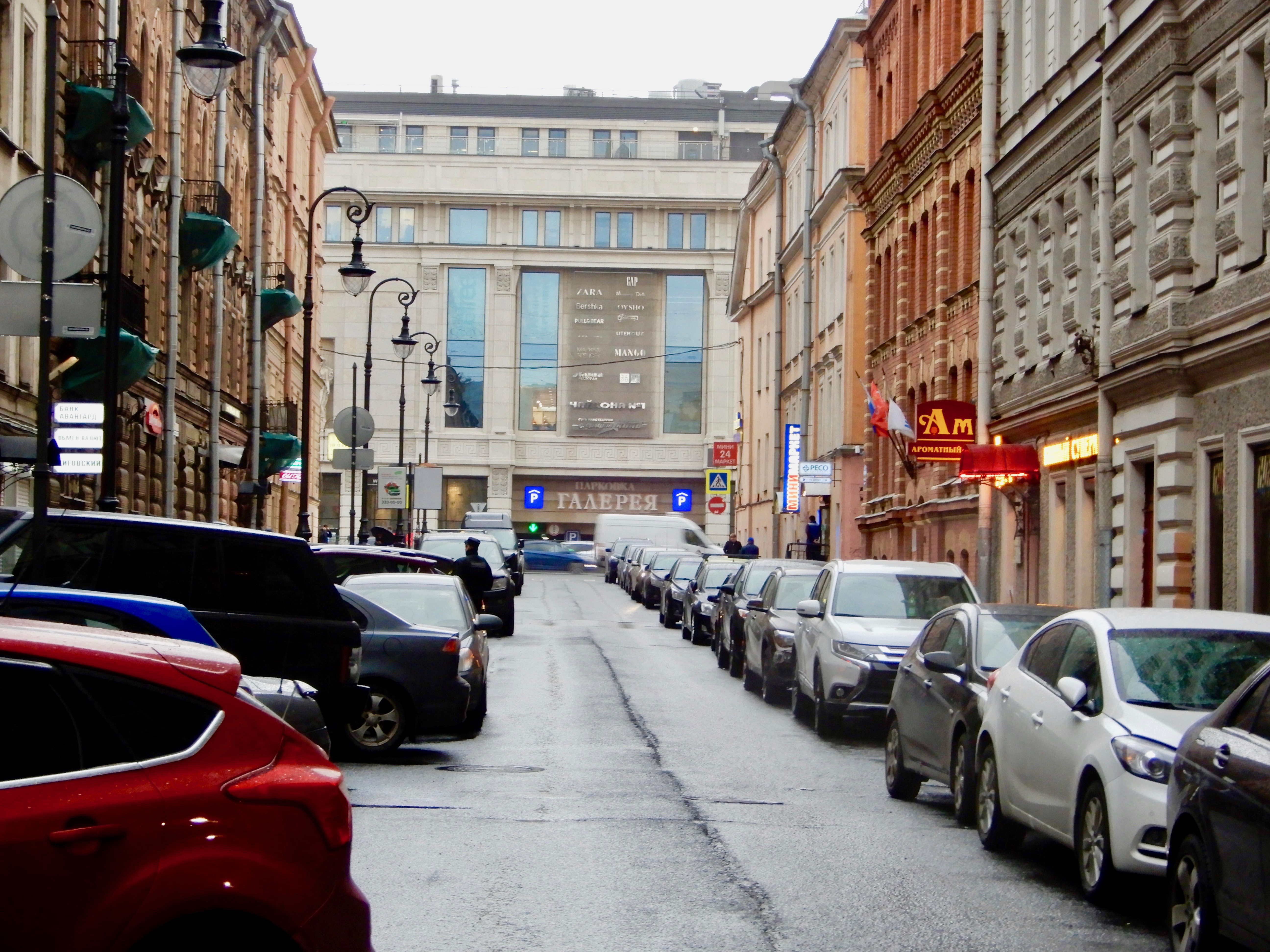
In the background of this photo, you can make out the Galeriya Shopping Center, located in downtown Petersburg. It’s gigantic, covering the land once occupied by five or six graceful tenement buildings and a cultural center and cinema. They were demolished in the mid 1990s, not to make way for the shopping mall, but so a new train station could be built there, cheek by jowl with the existing Moscow Station, because federal and regional officials wanted to build a high-speed train line between Petersburg and Moscow. Millions of dollars were allocated for the project, but ultimately, the train line was never built nor was the new station erected. No one knows what happened to the millions of dollars allocated for the project. They simply vanished into thin air.
The site of the former-future high-speed train station sat vacant for many years behind a tall, ugly construction-site fence. No one could figure out what do to with all that wasteland, which was in the very heart of the city, not in some forgotten outskirts. However, before the money had vanished, and the project was abandoned, construction workers had managed not only to demolish all the tenement buildings on the site but had also dug a foundation pit. Over the long years, this pit filled up with water. Some time after Google Maps had become all the rage, I took a look at our neighborhood via satellite, as it were, and discovered to my great surprise it now had a small lake in it. It was the foundation pit of the former-future high-speed train station, filled to the brim with water.
Good times came to Petersburg in the 2000s, when the country was flush with cash, generated by high oil prices, a flat tax rate of 13%, and runaway corruption. It was then the city’s mothers and fathers (I’m not being ironic: most of Petersburg’s “revival” was presided over by Governor Valentina Matviyenko, a former Communist Youth League functionary who had converted to the gospel of what she herself called “aggressive development”) decided that Petersburg, one of the world’s most beautiful, haunting, enchanting cities, should be extensively redeveloped, despite its status as a UNESCO World Heritage Site, into a mecca of consumerism that would give pride of place to cars and new highways, since cars had become the new status symbol among the city’s rich and poor alike. They also decided that, since other big cities in the world had lots of high-rise buildings, their city, which did not have almost any high-rise buildings, should have lots of them, too.
Basically, they decided to demolish as much of the inner and outer city as they could get away with—and they could get away with a lot, because they had nearly unlimited political power and lots of the country’s money at their disposal—and redevelop it with high-rise apartment buildings, superhighways, big box stores, and shopping and entertainment centers, each one uglier and bigger than the last. Thanks to their efforts, in a mere fifteen years or so they have gone a long way toward turning a Unesco World Heritage Site into an impossible, unsightly mess.
But let’s get back to our miniature inner-city lake. Finally, developers came up with a plan to convert the site into a giant shopping mall. Even better, the architects who designed the mall were clearly inspired by Albert Speer, Hitler’s favorite architect and a leading Nazi Party member, to turn a rather oversized mall into a celebration of kitsch faux-neoclassicism, precisely the sort of thing Speer had championed in his projects. This, indeed, was a bit ironic, because Petersburg, then known as Leningrad, had survived a 900-day siege by the German army during the Second World War. Considered the longest and most destructive siege in history, it killed at least 800,000 civilians, that is, it killed the grandparents and great-grandparents of many of the people who now enjoy visiting this mall, with its distinctly neo-fascist aesthetic.
Along the sides of the street running down towards the photographer from the Albert Speer Memorial Shopping Center, you see lots of shiny new, fairly expensive cars, parked bumper to bumper. In fact, the Albert Speer has a huge underground car park where you can park your car relatively inexpensively (our neighbor lady, a sensible woman, does it), but most Petersburg car owners actually think parking their cars wherever they want—especially either right next to their residential buildings or, worse, in the tiny, labyrinthine, incredibly charming inner courtyards of these eighteenth- and nineteenth-century buildings—is their legal right. It isn’t, but they don’t know it or don’t want to know it. I know they think this way because many Petersburg car owners have told me so.
To my mind, the precipitous rise in personal car ownership in Petersburg has done more to degrade the city’s beauty than all the underinspired colossal high-rises put together, because the city was purposely designed by its original builders, beginning with Peter the Great, to have a good number of intersecting and radiating, awe-inspiring, long and clear sightlines or “perspectives.” Hence, many of the city’s longest avenues are called “prospects,” such as Nevsky Prospect (the title of one of Nikolai Gogol’s best stories) and Moskovsky Prospect. Nowadays, however, you gaze down these “perspectives” only to see traffic jams and hectares of other visual pollution in the shape of signs, billboards, banners, and marquees. It’s not a pretty sight.
On the right of the picture, somewhere near the middle, you should be able to spot a small shop sign with the letters “AM” emblazoned on it. It’s one of the dozens of liquor stores that have popped up in our neighborhood after the Kremlin introduced its countersanctions against US and EU sanctions, which were instituted in response to Russia’s occupation of Crimea and invasion of Eastern Ukraine. The US and EU sanctions targeted individuals and companies closely allied with the regime. Putin’s countersanctions, in a manner that has come to seem typical of how the Russian president for life’s mind works, were targeted against Russian consumers by banning the import of most western produce into the country. An exception was made for western alcoholic beverages, especially wines and beers, and this meant it was suddenly profitable again to get into the liquor business. The upshot has been that you can exit our house, walk in any direction, even putting on a blindfold if you like, and you will find yourself in a liquor store in a matter of minutes, if not seconds.
Last summer, I tried painting a little verbal and photographic sketch of the effect this massive re-alcoholization has had on our neighborhood, along with other, mostly negative trends in the use and abuse of commercial space in the city.
Finally, there is one other thing you should know about all those new, mostly oversized cars parked on the street. Since the average monthly salary in Russia barely crawls above 600 or 700 euros a month, even in a seemingly wealthy city like Petersburg, most of those gas-guzzling, air-polluting status symbols were bought with borrowed money.
Just the other day, in fact, I translated and posted a tiny article, originally published in the business daily Kommersant, about how people in the Voronezh Region currently owed banks approximately two billion euros in outstanding loans. In 2015, the region’s estimated population was around 2,300,000, so, theoretically, each resident of Voronezh Region now owes the banks 870 euros, which I am sure is more than most people there earn in two or three months. Of course, not every single resident of Voronezh Region has taken out a loan, so the real damage incurred by real individual borrowers is a lot worse.
I could be wrong, but I think what I have just written gives you a rough idea of how you go about reading photographs of today’s Russian cities, their visible aspect in general, turning a snapshot into something meaningful, rather than assuming its meaning is obvious, right there on the surface. You don’t just tweet a photo of a new football stadium or fancy restaurant or street jammed with expensive cars and make that stand for progress, when progress, whether political, economic or social, has not occurred yet in Russia, despite all the money that has been sloshing around here the last fifteen years. Instead, you talk about the real economic, political, and social relations, which are often quite oppressive, murky, and criminal, that have produced the visible reality you want to highlight.
Doing anything less is tantamount to engaging in boosterism, whataboutism, Russian Worldism, and crypto-Putinism, but certainly not in journalism. That so many journalists, western and Russian, have abandoned real journalism for one or all of the isms I have listed is the really scary thing. ||| TRR

 7 p.m., Saturday, July 15
 Open Space in St. Petersburg, 25 Rubinstein Street