Five Years in Prison for a Tweet

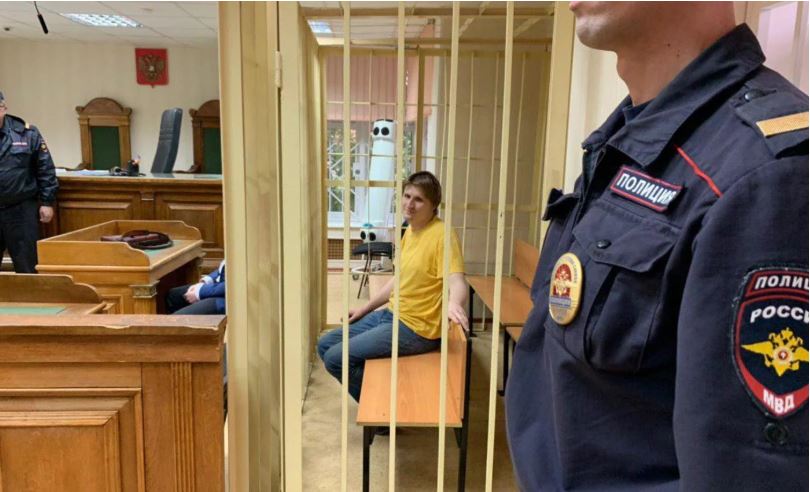
sinitsa in dockVladislav Sinitsa in the cage during his custody hearing on August 5. Photo courtesy of Mediazona

Court Sentences Vladislav Sinitsa to Five Years in Prison for Tweet about Children of Security Forces Officers
Mediazona
September 3, 2019

Moscow’s Presna District Court has sentenced Vladislav Sinitsa, a financial manager from the Moscow Region, to five years in a medium-security penal colony for a tweet about the children of security forces officers, reports the Moscow News Agency.

Judge Elena Abramova found Sinitsa guilty of inciting hatred with the threat of violence (punishable under Article 282.2.a of the Russian Criminal Code). The prosecutor had asked her to sentence Sinitsa to six years in prison.

The court handed down the verdict on the second day of the trial per se.

The court questioned two witnesses: Russian National Guardsmen Alexander Andreyev and Artyom Tarasov, who, allegedly, saw Sinitsa’s tweet.

Andreyev said he regarded the tweet as a call to “kidnap the children of National Guardsmen and slaughter them.” However, he was unable to tell the court his own username on Twitter. He claimed he saw the tweet after searching for “Max Steklov,” which is Sinitsa’s username.

Tarasov also said he took the tweet as a threat.

After the witnesses were questioned, the prosecutor summarized the two volumes of the case file, including the findings of forensic experts from the Center for Socio-Cultural Forensic Testing [sic]. They found evidence in the tweet of calls for violent action against the security forces, and signs of threats and incitement of hatred towards them.

It has transpired that the people who performed the forensic examination for the prosecution had no specialized education in the field.

In turn, the defense questioned forensic experts who had examined Sinitsa’s tweets at its request: Elena Novozhilova, a linguist from the nonprofit Independent Forensic Testing Center, and Maria Kulikova, an analyst with the Center for Forensic Examination and Research.

Kulikova harshly criticized the forensic examination commissioned by the prosecution. Both experts spoke of its poor quality.

Mediazona has written at length abut the criminal case against Sinitsa.

On July 31, Sinitsa supplied his own answer to the question of whether it was a good idea to publish the identities of security forces officers in a tweet published under the username “Max Steklov.”

The tweet was quoted on national TV channels.

Later, on August 3, the Russian Investigative Committee opened a criminal investigation. Two days later, the Presna District Court remanded Sinitsa in custody.

Sinitsa has insisted he was not calling on anyone to do anything but had implied popular unrest could arise if the security forces continued beating protesters.

Translated by the Russian Reader

Beglov, Big Love

Rotunda
August 31, 2019

It is eight days before the Petersburg gubernatorial election.

On Palace Square, there is a free concert by local rock group Splean, with the city footing the bill.

The winners of the creative contest Bolshaya Lyubov are also to be announced at the event.

If you reflect a bit on the elusive play of words and meanings in the contest’s name, you should easily be able to translate it into English as “Big Love.”

The contest winners are congratulated in person onstage by (drum roll, please) Alexander Beglov.

Several times, he says that all of us really love our city.

The gubernatorial candidate ushers a war veteran and singer Alexander Rosenbaum on stage.

Rosenbaum and Beglov sing “The City on the Wild and Free Neva.”

Palace Square is packed to capacity.

“The City on the Wild and Free Neva,” as performed and recorded by Valery Belyanin

Video footage courtesy of Rotunda. Translated by the Russian Reader. This is the 1,500th entry on this website. To learn how you can support my work, read this.

Bortko Jumps Overboard

bortko (gleb morev).jpgCampaign poster for Vladimir Bortko in downtown Petersburg: “Bortko: The City Has a Choice. September 8. CPRF.” Photo by Gleb Morev
Bortko Withdraws from Petersburg Gubernatorial Election, Ensuring Beglov Victory in First Round: Northern Capital’s Acting Governor Now Faces Only Two Opponents
Yelena Mukhametshina
Vedomosti
September 2, 2019

Filmmaker and Communist Party MP Vladimir Bortko has withdrawn from the governor’s race in Saint Petersburg. He announced this on Friday during a televised debate. Experts said his departure was necessary to secure a victory for acting governor Alexander Beglov in the first round of voting, scheduled for September 8.

At a press conference, Bortko said he asked the other candidates to withdraw due to possible vote-rigging after it transpired polling stations would be opened in Leningrad Region and Pskov Region.

“If I had not withdrawn, the methods for rigging the vote would have been employed to the hilt and we would have been looking at 200,000 to 250,000 extra votes. But I don’t want to get seventeen or eighteen percent and an honorable mention for second place.”

Admitting the Smolny [Petersburg city hall] had helped get him through the so-called municipal filter, Bortko said his withdrawal had been his own spontaneous decision and that the president’s first deputy chief of staff, Sergei Kiriyenko, had tried to talk him out of it.

Meanwhile, last week, Culture Minister Vladimir Medinsky wrote on Instagram that he and Bortko had discussed the idea for a new TV film about the 1812 war against Napoleon.

Bortko is the second parliamentary party candidate to withdraw from the Petersburg elections. Earlier, Oleg Kapitanov, an LDPR member of the Petersburg Legislative Assembly, accepted Beglov’s offer to take up a post in the city government. The acting governor now faces only two opponents: Mikhail Amosov (Civic Platform) and Nadezhda Tikhonova (A Just Russia).

Bortko said the Communist Party did not know about his decision. But our source inside the part said Bortko had informed party chair Gennady Zyuganov about his intentions early last week. The Communists had talked Bortko out of withdrawing but he changed his mind.

Our source admitted it was possible that Bortko had been used “without his knowledge” as “an emotional person,” but thought it was unlikely that Beglov could not have won in the first round without his help. He did not believe Kiriyenko had tried to talk Beglov out of it.

Zyuganov said the party would evaluate Bortko’s actions after the elections.

Earlier, a source close to the Kremlin told Vedomosti that Bortko’s support rating had climbed to nearly thirty percent and thus increased the likelihood of a second round.

Another source close to the Kremlin said Beglov did not have enough support to win in the first round: fewer than fifty percent of Petersburgers who were polled said they would vote for him.

Two other sources close to the Kremlin told us about the danger of a second round.

“The expectation is some older voters who supported Bortko could switch their support to Beglov,” one of them said.

Bortko’s name will now be manually stricken from the ballots. Dmitry Krasnyansky, a member of the Petersburg City Elections Commission, said the electronic ballot boxes set up at a quarter of polling stations provided for this option.

“However, this has to be done with maximum precision. If it’s a little crooked, it won’t read. It’s a real problem. In such cases, the electronic ballot box would simply be turned off,” Krasnyansky said.

One of our sources argued that, in this case, there would be “great opportunities for adjusting the final vote tallies.”

Political consultant Grigory Kazankov argued Bortkov’s withdrawal would not help Beglov in any way since Beglov was his own worst enemy.

“Beglov has no strong opponents. The situation is similar to the one faced by Governor Svetlana Orlova in the Vladimir Region in 2018. She lost to the LDPR candidate. Whether the election is legitimate or not will depend on whether it is run properly. So the question is whether the votes will be counted honestly or, as is usually the case in Petersburg, there are controversies,” Kazankov said.

Bortko’s withdrawal suits the powers that be since it will lower voter turnout. If the turnout was around thirty percent, the majority of Petersburgers who come to the polls would be pro-government voters, argued political consultant Valentin Bianchi.

“No matter what anyone says now, everyone will assume the government got Bortko to withdraw. This is a minus sign for the authorities, and for Beglov in particular. Although Bortko is a creative type, he’s a rational man. His meeting with Medinsky could be the piece of the puzzle that explains what happened,” Bianchi said.

Translated by the Russian Reader

Five Time’s the Charm

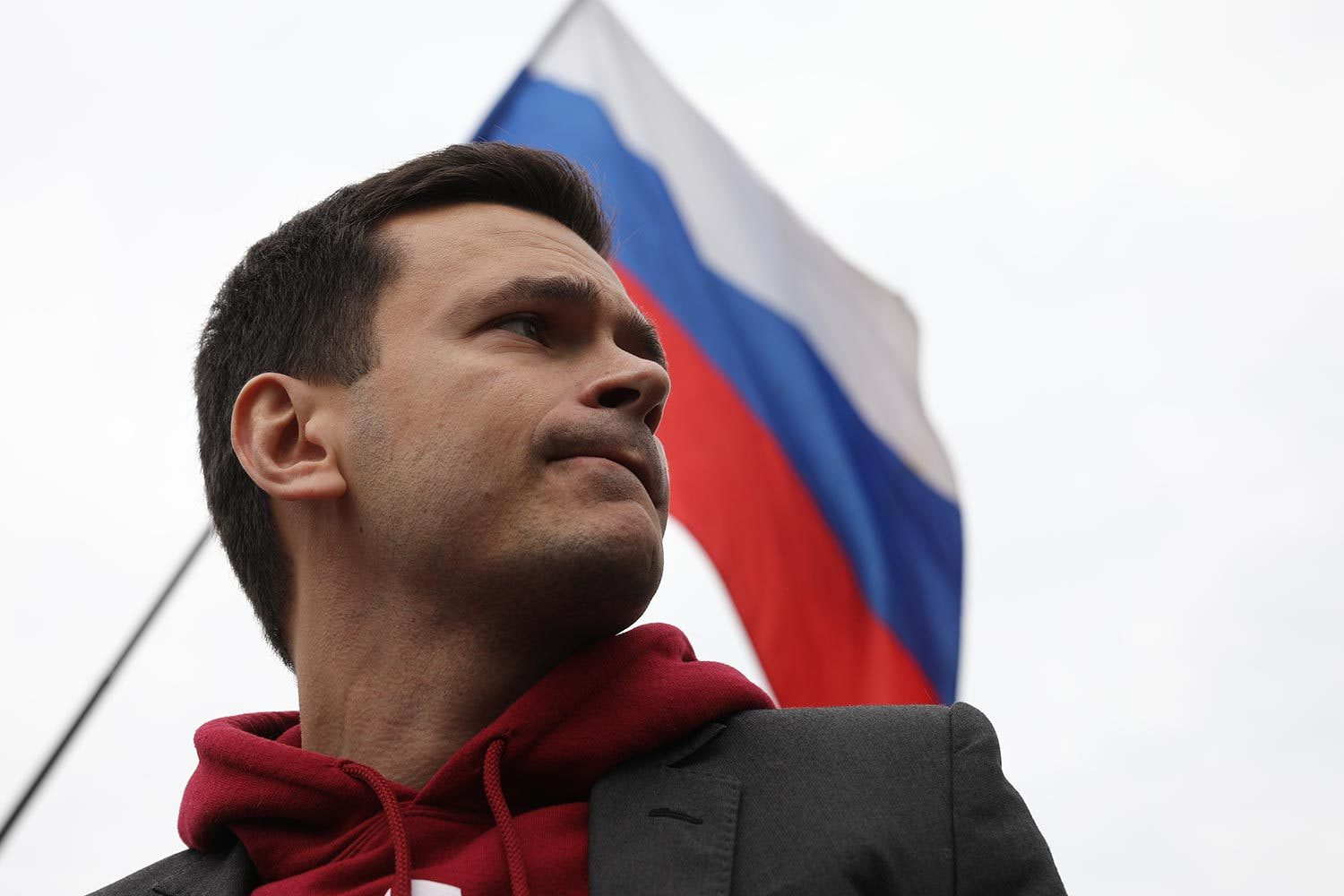
yashinIlya Yashin is not the only unregistered candidate for the Moscow City Duma against whom the tactic of consecutive arrests has been used. Photo by Yevgeny Razumny. Courtesy of Vedomosti

Yashin Breaks Record for Numbers of Arrests: Moscow Test Drives New Method of Combating Activists
Anastasia Kornya
Vedomosti
August 30, 2019

On Thursday, Ilya Yashin, head of the Krasnoselsky Municipal District Council in Moscow, was sentenced to his fifth consecutive jail sentence of ten days for an administrative violation. The Tverskaya District Court found him guilty of calling on the public to attend an August 3 “unauthorized” protest rally in support of the independent candidates barred from running in the September 8 elections to the Moscow City Duma.

Yashin has been in police custody since July 29. He has been detained every time he left the special detention center after serving his latest sentence. Police have taken him to court, where he has faced fresh charges of holding an “unauthorized” protest or calling on the public to attend one and then been sentenced to jail again. The municipal district councilman has thus been in detention almost continuously for thirty-two days, while the total time he has spent in jail this summer is forty-one days. This considerably exceeds the maximum allowable sentence of thirty days, as stipulated by the Criminal Procedures Code.

Yashin is scheduled to be released on September 7, but there is no guarantee he will not go to jail again.

Yashin’s lawyer Vadim Prokhorov told the court that the prosecution of the councilman was tantamount to a political reprisal. Formally, he noted, one arrest can follow another without violating the law. The problem was that the courts could make one wrongful ruling after another. Prokhorov saw no point in amending the laws, which are quite logical on this point.

“It would be like treating cancer with aspirin,” he said. “We have to change the whole judicial system.”

Ilya Yashin is not the only unregistered candidate for the Moscow City Duma against whom the tactic of consecutive arrests has been used. Former MP Dmitry Gudkov was sentenced to thirty days in jail on July 30, but several days before his scheduled release he was sentenced to another ten days in jail for calling on people to attend the July 27 protest rally. Yulia Galyamina has been convicted of three administrative offenses and sentenced to ten days in jail twice and fifteen days once; she is still in police custody. Konstantin Yankauskas has been arrested and sentenced to seven, ten, and nine days in jail, respectively; like Yashin, he was detained by police after leaving the special detention center. Oleg Stepanov has been sentenced consecutively to eight and fifteen days in jail; Ivan Zhdanov, to ten and fifteen days in jail.

The authorities are unwilling to charge the protest leaders with felonies and remand them in custody, but they clearly do not want to see them at large, said Alexei Glukhov, head of the project Defense of Protest. He noted that the current tactic of arresting opposition leaders multiple times is something novel: in the entire history of the protest movement [sic], no one had ever been arrested more than two times in a row.

Glukhov warned that the tactic was quite dangerous. Courtesy of the Russian Supreme Court, which in the recent past has ruled that violating the deadline for filing charges (legally, the authorities have two days to do this) did not preclude filing charges later, any person who attends a protest rally has the sword of Damocles hanging over their head for a year after the rally.  The authorities can arrest them at any time, for example, by claiming they had only just established their identities.

Glukhov pointed out that, in its review of the government’s draft project for a new Criminal Procedures Code, the Presidential Council on Human Rights had drawn attention to the fact that the one-year statute of limitations in such cases was not justified and could be misused.

Translated by the Russian Reader

Pskov Region: Copyright Trumps Voting Rights

Yabloko Candidate in Pskov Region Barred from Election for Not Crediting Composer in Campaign Videos
Novaya Gazeta
August 30, 2019

A court in the Pskov Region has disqualified Yabloko Party candidate Sofia Pugachova from standing in the election for the post of head of the Novorzhev District due to the fact that the composer of the music used in her campaign videos was not credited, according to Lev Schlosberg, a member of the Pskov Regional Assembly.

“There was no copyright violation since the composer had consented to use of his piece. The original agreements, in English and Russian, were submitted to the court. The court, however, failed to react to this evidence, not even mentioning it in its ruling,” explained Schlosberg, adding there was a danger similar lawsuits would be filed in the Pustoshka District and Pushkin Hills District.

Schlosberg said the videos did not credit the composer, but when the error was caught, the videos were removed from the web and replaced with new ones.

The music in question was the Italian composer Daniele Dinaro’s Lux.

Pugachova said that Alexei Ivanov, the Growth Party’s rival candidate for the same post, had petitioned the court to disqualify her.

“They could not find fault with anything else, so they found this way of barring me from the election. The court even questioned whether the composer’s signature on the agreement was genuine. That was why we also entered into evidence a video showing Dinaro signing the agreement with us,” Pugachova said.

She argues that the court’s ruling was completely illegal and is currently preparing to appeal it.

Translated by the Russian Reader

The After Party, or, The Electoral Iguana

iguana

Artplay to Hold “Posh Gubernatorial Election After Party”
Sergei Feofanov
The Village
August 30, 2019

Artplay Design Center in Petersburg (Red Guard Square, 3) will hold Election Night 2019 in the wee hours of September 9, the event’s organizers have informed us. They have dubbed the event a “posh invitation-only after-party” to celebrate the city’s gubernatorial election [on September 8].

Political operatives, politicians, and celebrities [selebriti] will take part in the event. Guests will be treated to projection mapping [sic] and musical sets by Markschneider Kunst and Junkyard Storytellaz, as well as an immersive show [immersivnoe shou] involving actors “made up to look like the eye-catching residents of a communal apartment.” In addition, organizers plan to release an “electoral iguana,” which will crawl to one of four bowels representing the candidates.

Last year, Election Night was held in Moscow, and this autumn the main event will also take place in the capital, including video links with the regions. Organizers include the Russian Public Chamber, National Public Monitoring, the Russian Public Relations Association (RASO), RASO’s Political Strategists Committee, and the Russian Political Consultants Association.

Znak.com reporter Ksenia Klochkova, who writes on the Telegram channel Rotunda, told us that spin doctors working for the campaign of [acting governor and gubernatorial candidate] Alexander Beglov have their headquarters at Artplay. Activist and public figure Krasmir Vranski said that “all normal people” would be up all night contesting the elections.

The organizers claim there will be no campaigning and support for any candidate at the event. Artplay simply met certain criteria as a venue, they explained.

Earlier, the band SBPCh [“The Largest Prime Number”] canceled a concert in the infamous, political scandal-plagued municipal district of Ekateringof. The band’s musicians did not want to play at a politically charged event.

Thanks to Julia Galkina for the heads-up. Photo courtesy of Newsweek. Translated by the Russian Reader