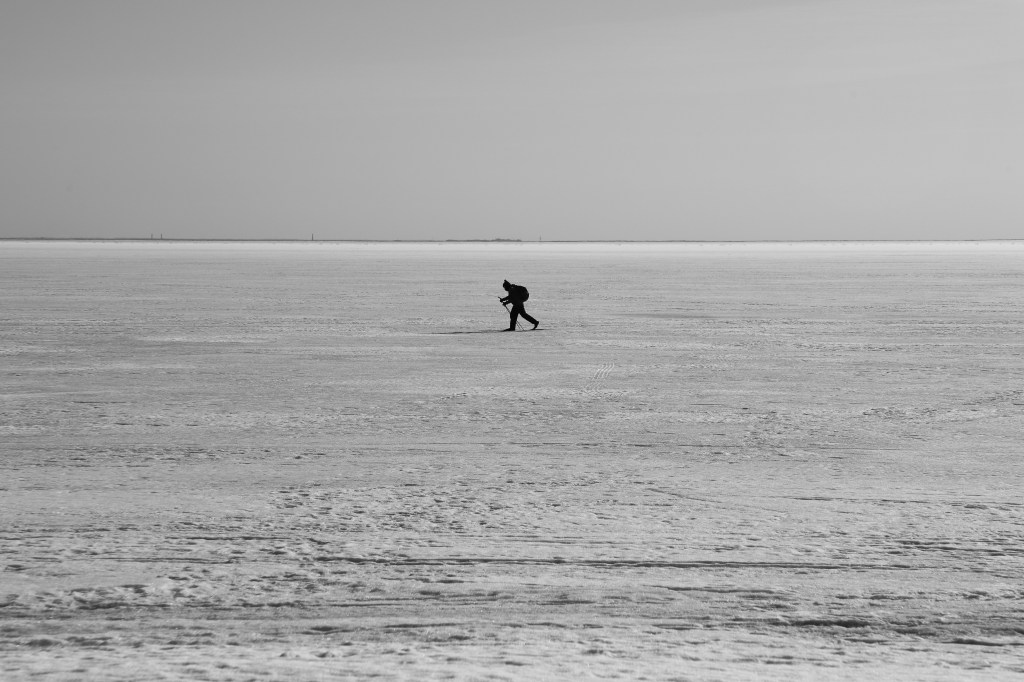
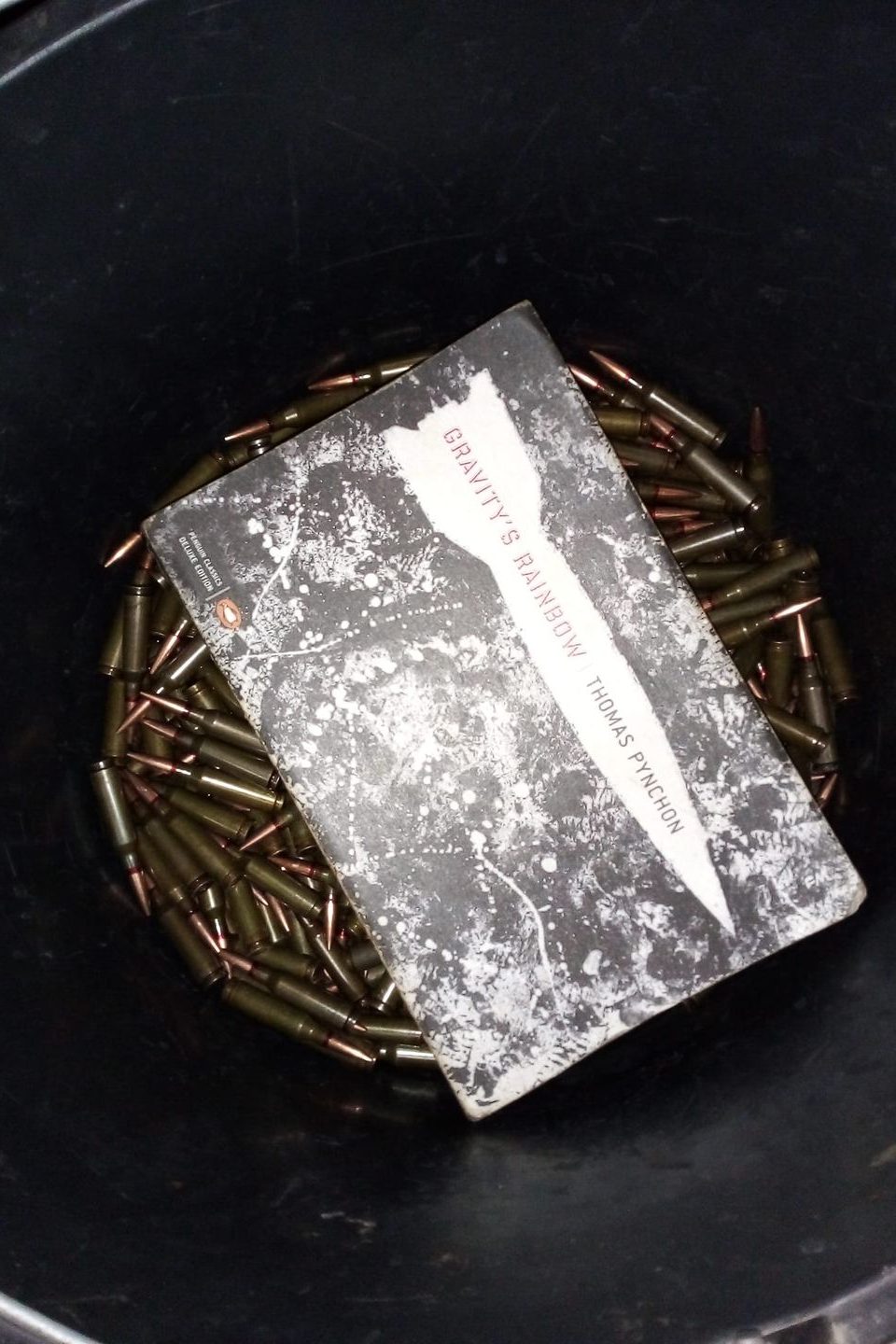
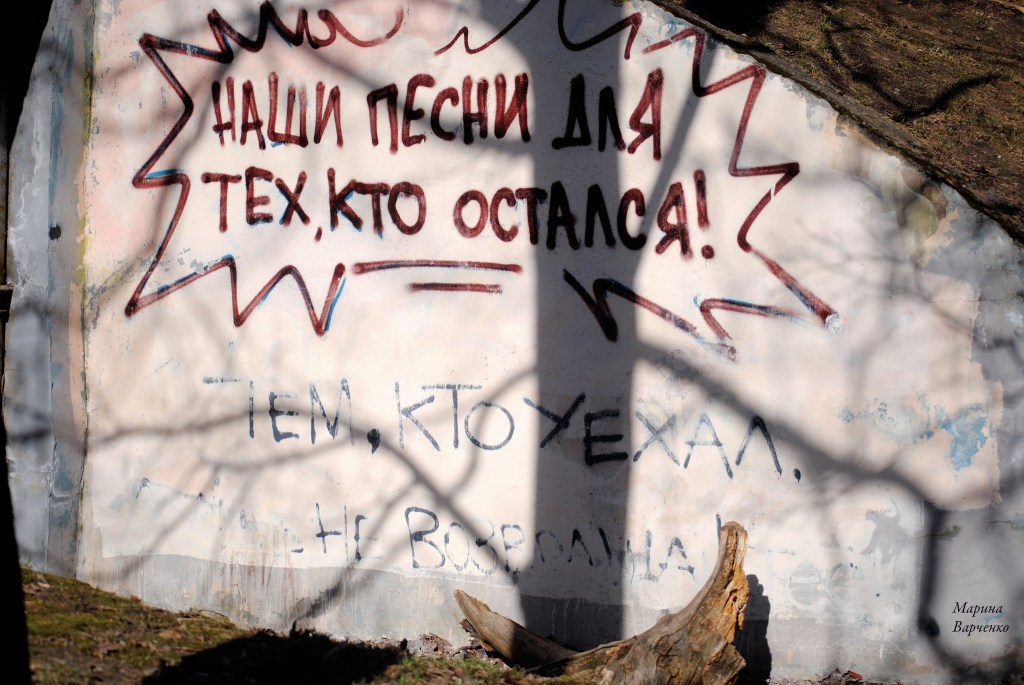
anatrrra, from the series “Petersburg in April,” 2023 You can see the entire series on their LiveJournal
I just spent many hours roaming around Kolomna. I love the neighborhood: it soothes my soul, if only for a short time.
I came upon two dudes approximately my age sitting on a bench and drinking beer. From what I heard them saying it was clear as a bell that they had listened to Kinchev, Sukachov, and Butusov in their youth.
“That’s where such old scum comes from. But they used to be regular guys—bright eyes, rock and roll, the whole deal.”
“They drank, shot up, and snorted away their conscience, but money doesn’t smell, supposedly.”
“It stinks like hell nowadays.”
I was going to walk past them, but I turned around.
“Excuse me,” I said, “but I accidentally overheard what you were saying. I think they were like that from the get-go. They just adopted a stage persona in their youth. It was cool then, the niche was open, and you could no longer go to prison for things like that (unlike now). It was a beauty way to go.”
The men looked up at me, exhaled, and shook their heads.
“If that’s so, it’s even worse,” one of them said.
I apologized again, and went on my way. My back already turned, I heard one of them say:
“Check it out. Our people are still roaming these parts…”
“Underwear and swimsuits from 900 rubles.” An image from a circular I got this morning from Russian online retailer Ozon
We are not ashamed
I’ve been doing my favorite thing for almost the whole month—hanging out with ordinary Russians, not only in Moscow, but also in the regions—in my capacity as a sociologist, via focus groups. Ten random people are brought together, and we sit and simply talk “about life,” and I’m among them with a dictaphone. It’s the best format, and ordinary folk like it too.
Naturally, I was curious about people’s opinions about what was happening: their reactions were very different, expressing a whole range of emotions. In most cases, people sense the crisis, and they complain especially about prices… Although then they cheer up and say that “life is livable.” Some even argue that this is not a crisis, but that there are “certain crisis phenomena.” However, after thinking about it, they usually said that it would get worse; this is the easy part now, they said.
I won’t describe everything they said, because I want to get to the main point, the horrible point.
People voiced a variety of emotions (and I carefully monitor them: focus groups are not so much about information as about feelings, about which events excite people more): despair, apathy, depression, anger, patriotic enthusiasm, complacency, and braggadocio… Some still “believe in victory,” some already have doubts, but most are unable to articulate what “victory” would look like… But one emotion—and I conducted more than a dozen focus groups both in Moscow and in the back of beyond—was practically absent, manifested by no one.
I’m talking about shame. There was “we’ve been betrayed,” or “we can still win,” or even “we shouldn’t have started it at all,” but there was no shame. And this, in my opinion, is a very bad symptom, showing that society has not even started down the road to recovery yet. And it may well happen that they will lose and fall face first in the mud, but will still not understand a thing.
This is sad. I’m not trying to show off my own “moral rectitude.” I don’t claim to have it, of course: I’m just as much a bastard as my dear compatriots. My claim is purely pragmatic: if we are still not ashamed, it means that for the time being we are a long ways away from the only emotion that gives us a chance at rebirth—horror towards ourselves. While everyone continues to justify themselves (even if by citing their own weakness: “What can I do?”), the cart won’t budge an inch.
We know that no one ever feels sorry for anyone in Russia. We have always known this, and we didn’t need Sergey Shnurov to tell us that. But the complete absence of shame, and in its place, again, this incredibly vulgar self-pity, pity for us poor unfortunates, “the whole world is against us,” is still quite eye-opening. You listen to how enthusiastically folks pity the “Russian people,” and all you can do is feel gobsmacked. They screwed up completely, betrayed everyone, they are up to their elbows in blood, they can’t do anything, they don’t know how to do anything – but no, they don’t feel even a smidgen of shame.
Nothing’s going to change their minds. Indeed, this, apparently, is the Russian people’s principal tragedy.
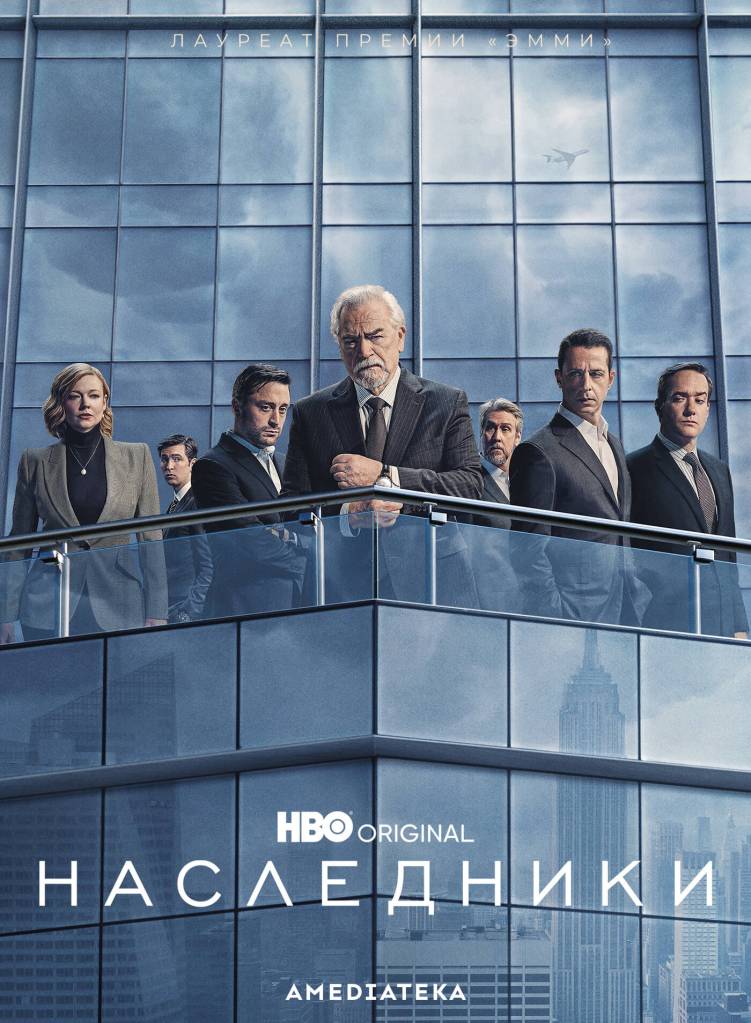
HBO and Russian streaming service Amediateka have made sure that wartime Russians are au courant when it comes to prestige television, as illustrated by this image from a circular I found in my mailbox the other day.
[…]
After witnessing the country’s crackdown on opposition activists and independent journalism — and the prosecution of hundreds of people who do not support the war or President Vladimir Putin — many emigres expect to encounter a dystopia when they arrive in Russia.
The reality is more banal.
“It’s corny, but the first thing that caught my eye after returning was that Twitter and Instagram don’t work without a VPN,” said Yulia, referring to Russia’s wartime ban on several foreign social media sites.
“Moscow bars were packed with visitors even on Monday evenings,” added the 25-year-old screenwriter who returned in April after fleeing to Georgia last year.
“Recently, my friend and I went out for a glass of wine. All the tables were occupied.”
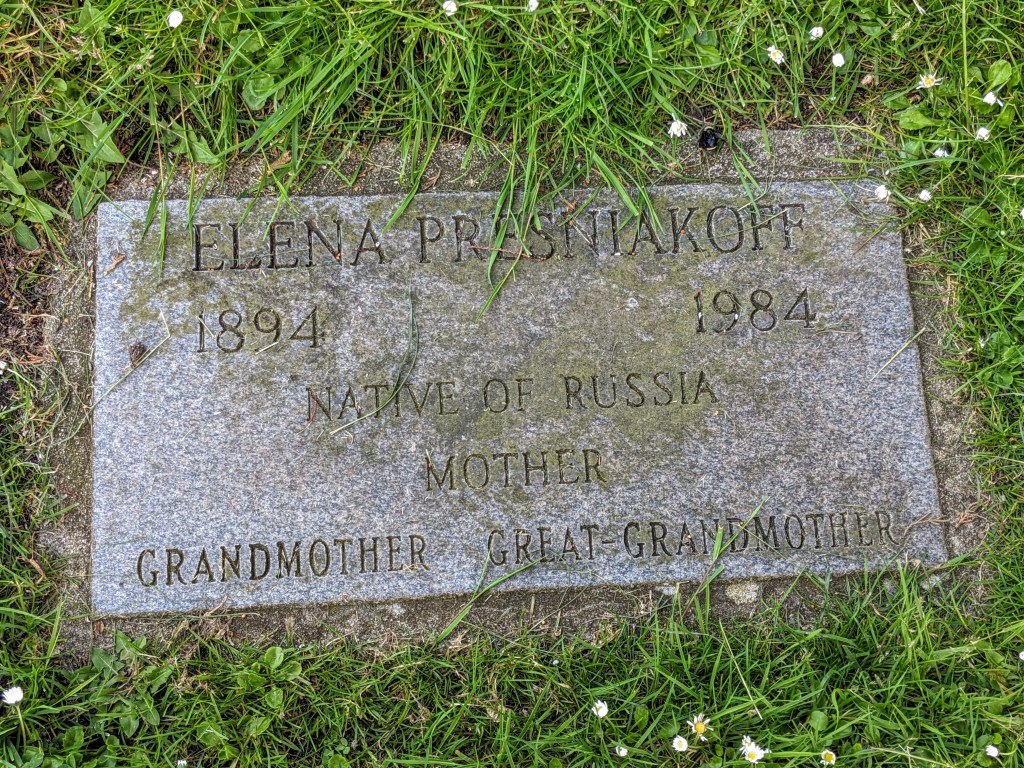
A gravestone at El Carmelo Cemetery, Pacific Grove, California, 25 May 2023. Photo by the Russian Reader
Everyone I know who has left [Russia] has improved their circumstances by leaving. I understand that mine is a biased sample, but it is still a sample. One young woman recently said it to me outright: “Things have got better for all of us because of the war. And that scares me.”
We are beneficiaries of the war, me included. I have started earning more money. I live in a great place, better than where I lived in Moscow. Everyone respects me, which was unheard of in Moscow, and sometimes they even recognize me on the streets. Every day something good happens to me: new projects, interviews, interesting encounters. And I’ve generally started feeling better. I have become calmer, kinder, more confident in myself, and I smile more often.
And all because the war is underway.
It scares me to admit it, but sometimes I think: if only it had started fifteen years earlier, when I was younger and I had more vim and vigor. Would it have been to hard for them to arrange? How wonderful my life would have turned out then.
I realized this back in 2014, when I spoke with people who had gone to fight in Donbas completely voluntarily. Yes, of course, there were ideological idiots among. Some were in it for the money. But many honestly admitted that there was nothing else for them to do. Life had become meaningless and hopeless: TV, vodka, the wife. Life was boring, there were no prospects. They had to raise the stakes, and so they went to war.
I was like that myself. In 2014, I worked at a terrible dreary job. My personal life had come to a dead end. I felt that what mattered most in life was happening somewhere other than where I was, and I was just rotting where I was. It was like Groundhog Day, like being in a sludge which you can not get out. Everything was unreal, inauthentic, imaginary. And so I went to report in Donbas, because I knew for sure that that was reality. It didn’t matter what kind of reality, but whatever it was, it was the real thing.
And suddenly everything fell into place. I am a feckless, indecisive person, poorly adapted to life. But suddenly, in the midst of war, I felt that I was in my element. I knew exactly what to do, I had no doubts, I took responsibility. And everything panned out for me, something I wouldn’t have dared to dream of in peacetime. But why was war just the ticket?
There was even a fire in my belly. I thought: there is a chance for people like me in this mess, in this chaos. Now I’m going to show you assholes just like—you’ll dance to my tune. You had me all wrong…
It sounds nice, but there’s something despicable about it.
So did all those failed poets, provincial schoolteachers, and hairdressers with cosmic-scale ambitions who in 1917 posed for pretty photographs and then engaged in mass executions. That’s how history is made. And then they were shot themselves.
And it also eliminates the need for choice. Oh, how easy it is to make decisions when there is no other choice! Can’t make up your mind? It’s okay, the course of things will choose for you. “The coercive force of reality,” as Babel said. Force majeure, as they say in the courts.
In December 2022, I had good papers made for myself, and so now I can move freely around the world. And my first thought was: that’s it, now I’m going to Kyiv. From there I’ll go to Odesa and Kharkiv. I know how it’s done. I have to go. I won’t forgive myself later if I don’t go, so off I go!
But I didn’t go. I wasn’t able to double dare myself. I couldn’t explain to myself why I had to go to the war and what I would do there. I already have a different life from the one I led in Moscow. I don’t need to compensate, to show my worth in a particular way, to prove anything to myself. I think I’m recovering, I’m getting better.
“Have you read the news? What a beautiful article you could write!” a friend recently wrote to me. “Come on, have a whack at it! It would be a powerful move!”
I texted him: “Go fuck yourself!”
But another person wrote: “We have a problem here. Can you…” I answered briefly: “Yes, I’ll do it.”
I’m recovering, but I’m not quite recovered yet.
P.S. For those who are outraged by the first sentence.
I lived badly in Russia, I had nothing to lose. So yes, my life has improved. Everything is relative.
You had been living well, apparently, and now you are experiencing difficulties trying to restore your previous standard of living. That’s also the way the ball bounces. I hate everything about the way things were. I wouldn’t want things to be like they were before.
Ultra Bra, “Sinä lähdit pois” (“You Went Away,” 1997)
In the wee hours neither of us can party anymore In the wee hours neither of us can party anymore Tired gazes, hoarse voices In the background a sun that doesn’t warm In the background a sun that doesn’t warm
You went away From the balcony I watched Your receding back You skirted the puddles And I guess you won’t regret this parting
All the birds in the bushes sing before seven in the morning All the birds in the bushes sing before seven in the morning Tired gazes, hoarse voices In the background a sun that doesn’t warm In the background a sun that doesn’t warm
You went away From the balcony I watched Your receding back You skirted the puddles And I guess you won’t regret this parting, parting
The night’s last drink Turns into breakfast To which I added coffee
You went away From the balcony I watched Your receding back You skirted the puddles And I guess you won’t regret this parting
You went away From the balcony I watched Your receding back You skirted the puddles And I guess you won’t regret this parting, parting, parting
Source: Genius. Translated from the Finnish by the Russian Reader
KYIV, May 29 (Reuters) — Explosions rang out across Kyiv on Monday as Russia launched its 16th air attack on the Ukrainian capital this month, hours after unleashing dozens of missiles and drones overnight.
Panicked residents, some of whom initially ignored the air raid siren as they ate breakfast in cafes, rushed for cover when the sky filled with smoke trails and blast clouds.
All the Russian missiles were shot down, but one person in the central Podil district was taken to hospital, authorities said. No major damage was reported.
Kyiv mayor Vitali Klitschko said explosions sounded in the capital’s central districts and emergency services were dispatched.
“The attack on Kyiv continues. Don’t leave the shelters!” he wrote on the Telegram messaging app.
Ukraine shot down 11 cruise and ballistic missiles fired in the second of Monday’s attacks on Kyiv, said Valeriy Zaluzhnyi, commander-in-chief of the armed forces.
Heavy air strikes about six hours earlier had targeted the capital, put five Ukrainian aircraft out of action in the west of the country and caused a fire in the Black Sea port of Odesa.
“I would say there has been an activisation, a serious activisation… there are fewer missiles flying, but the regularity of strikes has increased,” said air force spokesperson Yuriy Ihnat.
Russia’s main targets are typically stocks of Western weapons, energy facilities and government buildings, but the fact the missiles over Kyiv were shot down made it difficult to establish their target on Monday, he said.
Russia has increased the frequency of air attacks as Ukraine prepares to launch a counteroffensive.
Kyiv metro stations were packed with people taking shelter although many residents ignored the air raid alarm until they heard loud blasts in city centre.
A local television report from a junction on a busy highway showed missile wreckage that appeared to have hit a traffic light.
Just two of the soldiers who were rebuilding the machine-gun nest had been with the battalion since Kherson. One of them, a twenty-nine-year-old construction worker called Bison—because he was built like one—had been hospitalized three times: after being shot in the shoulder, after being wounded by shrapnel in the ankle and knee, and after being wounded by shrapnel in the back and arm. The other veteran, code-named Odesa, had enlisted in the Army in 2015, after dropping out of college. Short and stocky, he had the same serene deportment as Bison. The uncanny extent to which both men had adapted to their lethal environment underscored the agitation of the recent arrivals, who flinched whenever something whistled overhead or crashed nearby.
“I only trust Bison,” Odesa said. “If the new recruits run away, it will mean immediate death for us.” He’d lost nearly all his closest friends in Kherson. Taking out his phone, he swiped through a series of photographs: “Killed . . . killed . . . killed . . . killed . . . killed . . . wounded. . . . Now I have to get used to different people. It’s like starting over.”
Because the high attrition rate had disproportionately affected the bravest and most aggressive soldiers—a phenomenon that one officer called “reverse natural selection”—seasoned infantrymen like Odesa and Bison were extremely valuable and extremely fatigued. After Kherson, Odesa had gone awol. “I was in a bad place psychologically,” he said. “I needed a break.” After two months of resting and recuperating at home, he came back. His return was prompted not by a fear of being punished—what were they going to do, put him in the trenches?—but by a sense of loyalty to his dead friends. “I felt guilty,” he said. “I realized that my place was here.”
Open Telegram and keep up with the news.
Rate this year in terms of its nineteenthirtysevenness.
Take a look at it, at its wooden hands,
At its iron cheeks, splotched with new partings.
This is a theater being demolished, a theater in which there is neither audience nor actors.
This is a theater being demolished, a theater in which there are only fishes and corpses.
Take a look at it and set aside your New Year's fun.
Rate the extent of this city's Stalingraditude.
Wave to the harlequins, dragons, and princesses,
And look at it, monitor the process without blinking.
Hang on to it: it will be both lamentation and reward.
Preserve its shadow if you like.
On second thought, forget it.
A video of a read-through of “Finist the Brave Falcon,” the play for which Russian theatrical director and poet Zhenya Berkovich was detained in Moscow earlier today on suspicion of “condoning terrorism.” Here is a link to a website where you can download the (Russian) text of the play, by Svetlana Petriichuk, who was also detained today. Thanks to Sergey Abashin for the heads-up.
Many have nearly forgotten the criminal case against the theater director Kirill Serebrennikov and his colleagues, who were tried several years ago. That affair was dubbed the Theater Case. Apparently, there will be another Theater Case in Russia: director Zhenya Berkovich (a former student of Serebrennikov’s, by the way) and playwright Svetlana Petriichuk have been detained in Moscow.
The criminal investigation is centered on the theatrical production Finist the Brave Falcon, which premiered in 2020. The play was staged as part of the theater project SOSO Daughters, which is run by Berkovich. It is based on the criminal trials of [Russian] women who married radical Islamists. They came to know the men online and, having never met them in person, went to live with them in Syria.
“Zhenya Berkovich’s staging of Svetlana Petriichuk’s provocative, documentary style play, tells the story of a Russian woman who befriends and is seduced by a member of an Islamic radical sect online, goes to Syria, marries him, and upon her eventual return to Russia is tried as a terrorist. In recent years, there have been hundreds, if not thousands of such cases in Russia, Kazakhstan and Uzbekistan. From what are these women running? What is driving them to abandon their friends, relatives, universities and workplaces for the promise of some shadowy paradise? All this takes place in the metaphysical space of the Russian fairy tale “Finist the Brave Falcon,” in which the heroine Maryushka seeks and cannot find her betrothed, the mysterious hero, whose face she has never seen and will never see, but is ready to sacrifice everything in order to meet him.” [This annotation has been edited slightly to make it more readable.]
The Investigative Committee claims that the production “publicly justified terrorism,” which is a criminal offense per Article 205.2 of the Criminal Code and punishable by up to seven years in prison. The details of the case are still unknown. Berkovich and Petriichuk spent the entire day undergoing interrogation as witnesses in the case, and it had seemed that they might be released, but as of evening both were still in police custody.
Last year, Finist the Brave Falcon won two Golden Mask Awards—for best playwright and for best costumes. Costume designer Ksenia Sorokina handed over her award to Petersburg artist Sasha Skochilenko, who has been in jail since April 2022, charged with disseminating “fake news” about the Russian army. (Skochilenko is alleged to have replace price tags in a grocery store with information about the war.)
Zhenya Berkovich has also not made a secret of her anti-war views, including in her poetry. A collection of her poems was published in Israel earlier this month.
“Open Telegram and keep up with the news. / Rate this year in terms of its nineteen-thirty-seven-ness,” one of them begins.
According to Berkovich, her grandmother, the 88-year-old writer Nina Katerli, was worried about her granddaughter, even going so far as to tell her, “Zhenya, be quiet for a while.” Actually, the director explained that she had decided to stay in Russia, no matter what, because she had to take care of her sick grandmother.
“It is to a large extent a necessity, due to all sorts of family obligations,” Berkovich said in December. “If it were now a question of going to prison or taking care of my grandmother, then of course I would leave, because I wouldn’t be able to take care of my grandmother from prison. But right now this is not the choice I’m facing.”
“Zhenya Berkovich: Why I have stayed in Russia and how to go on living”: Berkovich interviewed by journalist Liza Lazerson, as posted in on YouTube in December 2022 (in Russian)
This morning, the security forces searched Berkovich’s grandmother’s apartment. Berkovich and Petriichuk will spend the night at a temporary detention facility, and tomorrow a court will decide whether to remand them in custody or subject them to other restrictions.
A man sporting a “Made in the USSR” tattoo, Liteiny Prospect, Petersburg, May 1, 2023. Photo by Vadim F. Lurie, reproduced here with his kind permission
Victory Day is a memorable holiday for every citizen of St. Petersburg! During the celebration of the Great Victory, each of us remembers the heroic deeds of our grandfathers. In keeping with a long-established tradition, many musicians dedicate their concerts to this important date.
On May 15, the Lensovet Palace of Culture will host “Echo of Victory,” a soulful solo musical performance by Dmitry Pevtsov and the Pevtsov Orchestra.
Dmitry Pevtsov, “Echo of Victory,” 15 May, Lensovet Palace of Culture
“Echo of Victory” is a new themed concert in which poems and songs of the war years and the best songs of Soviet and modern composers will be performed. The program will feature such songs as “Airplanes First of All,” “From Dawn to Dawn,” and, of course, everyone’s favorite song, which has become a symbol of the celebration of May 9—”Victory Day”!
We invite everyone to the “Echo of Victory” concert on May 15 at the Lensovet Palace of Culture. Let’s remember the great songs of that heroic time and once again feel proud of our great nation!
Directed by Denis Isakov
Duration 1 hour 40 minutes (without intermission)
Source: Bileter.ru. Translated by the Russian Reader
The Russian authorities and Russian propagandists have been competing with each other to recreate something outwardly similar to the Soviet system in our country. The message to Russian society is simple: we are different, we have a different path, don’t look anywhere else, this is our destiny — to be unlike everyone in the world. And yet there are more and more traits of our country’s yesterday in its tomorrow.
For some reason, the speakers at the Knowledge educational forum, starting with Prime Minister Mikhail Mishustin, called directly for Russia’s self-isolation. Mishustin demanded that we achieve independence from foreign designs in the information sphere. The word “independence” has been increasingly used to mean isolation and breaking ties.
Deputies in the State Duma have proposed re-establishing the mandatory three-year “repayment through job placement” for university graduates, and prohibiting those who have not served in the army from working in the civil service.
With Ella Pamfilova, head of the Russian Central Elections Commission, on hand as a friendly observer, Uzbekistan held a referendum on April 30 to decide whether to adopt a new constitution that would grant the current president, Shavkat Mirziyoyev, the right to de facto lifelong rule by lengthening presidential terms from five to seven years and nullifying Mirziyoyev’s previous terms. The ballot, which involved digital technologies, produced a turnout of 84.54%, and according to preliminary data, 90.21% of voters said yes to the amendments, which would change two-thirds of the Constitution, while 9.35% of voters voted no, and 0.49% of the ballots were disqualified. Although democratic procedures were seemingly followed, Uzbekistan is moving away from democracy.
Something makes us see Pamfilova’s visit to Uzbekistan not only as a trip “to strengthen friendship and cooperation,” but also as a completely practical exchange of know-how in organizing such referendums. Only by adopting a new constitution can the first and second chapters of the current Russian Constitution be amended, and it is the second chapter that enshrines civil rights and freedoms, we should recall.
Alexander Bastrykin, the prominent human rights activist and chair of the Russian Investigative Committee, has proposed adopting a new Russian constitution that would enshrine a state ideology, completely eliminate international law’s precendence over domestic law, and re-envision human rights as an institution alien and hostile to Russia, as something encroaching on its sovereignty. Uzbekistan’s know-how in voting on a new constitution will come in handy for the Russian Central Election Commission.
At seven o’clock this evening live on Citizen TV, we will talk about why, exactly, the Russian authorities are so enthusiastic about Soviet political practice and the Soviet style, and where such intentions can lead our country.
Russian President Vladimir Putin agreed with the need [for Russia] to develop its own communication protocols instead of foreign TCP/IP to ensure the country’s technological sovereignty and independence.
On Thursday, the head of state held an event at the Rudnevo Industrial Park during which the specifics of the development of domestic unmanned aerial systems were discussed. In this context, Alexander Selyutin, board chair of the Technojet group, spoke about the “Internet from Russia” project.
After listening to the proposals, Putin turned to his aide Maxim Oreshkin.
“Maxim Stanislavovich, talk to your colleagues, then report back to me separately, we need to help. This is obligatory, because if you have advanced proposals, your own, of course, we need to do everything to support them. It means technological sovereignty, and better competitiveness, and independence. […] We will definitely help,” the president said.
Those wishing to take part in a virtual LDPR rally at the monument to Vladimir Zhirinovsky created in Minecraft have overloaded the server. The number of applications exceeded twelve thousand, LDPR’s press service informed us.
As Andrei Svintsov, a member of the LDPR faction [in the State Duma], noted, this is only the first such event. The Liberal Democrats plan to continue using [Minecraft] and other gaming platforms to communicate with voters and attract new supporters, becoming in fact “Russia’s first digital party.”
The MP also recalled that experts continue to work on the “Cyber Zhirinovsky” political algorithm, which was previously announced by the party’s current leader Leonid Slutsky.
In late April, Judge Yevgenia Nikolayeva closed a court hearing at which it was decided how much time to give Alexei Navalny to examine the 196 volumes of the latest criminal case against him. According to the police investigator, this was necessary in order to protect investigatory privilege.
Over the past five years, judges in Russia have increasingly closed court hearings to observers, journalists, and even relatives of defendants. Because of this, defense lawyers cannot inform the public about what happens in these proceedings. Mediazona reviewed the judicial statistics and discovered that, in 2022, judges ruled 25,587 times to hear cases in closed chambers. This was almost twice as often as in 2018, when judges decided 13,172 times to hear cases without outsiders present.
The Constitution actually guarantees that your case should be heard in open court, but there are exceptions. The principal exceptions are cases involving state secrets (which is why all treason and espionage trials are closed), cases against defendants under sixteen years of age, and cases involving sexual offenses. The statistics for all such cases have not changed much in recent years.
But there is one more exception — a trial can be closed to “ensure the safety” of the people involved in the proceedings and their loved ones. This extremely vague wording allows judges to close any court hearing. Judges make vigorous use of it, especially when hearing high-profile cases.
Here’s another example. In September, the Moscow City Court closed the hearing of an appeal against the verdict in the “fake news” trial of municipal district council deputy Alexei Gorinov, who had been sentenced to seven years in prison for an argument over a children’s drawing contest in which he had said that children were dying in the war in Ukraine The judge alleged that the court had received threats, and said that the hearing would have to be closed for the safety of the parties to the proceedings.
Russian judges may be following the lead of their Belarusian colleagues, who have learned how to conduct political trials without outside scrutiny. They cite covid regulations, or fill the gallery with persons unknown, or don’t let anyone except the relatives of the defendants in the courtroom. Russian courts have begun to use many of these methods. And the Belarusian courts can declare a hearing closed without explaining the reasons at all.
The authorities do not want people to know about political trials, to monitor these trials, or to support the accused. That is why, on the contrary, it is important for society today to talk about political prisoners and help them.
A Russian version of the song by the French left-wing chansonnier Georges Moustaki. Translation: Kirill Medvedev. Guitar: Oleg Zhuravlev. Video: Nikolay Oleynikov
Don’t ask what her name is, she’s Beloved and tender, but fickle Very spunky, she’ll wake up and go forward To a new life that shines and sings
Bullied and branded Tortured and executed Well, how much can she suffer! And she rises up and strikes, And spends many, many years in prison, Yes, we betrayed her But we only love her more and more And so we want to follow her Right to the end
What her name is, don’t ask, my friend, She’s just a mayflower and a wild fruit She sprouts anywhere, like grass Her path will take her wherever she wishes
Don’t ask what her name is, she’s Sometimes beloved, sometimes persecuted, but faithful This girl that everyone is waiting for Permanent revolution is her name
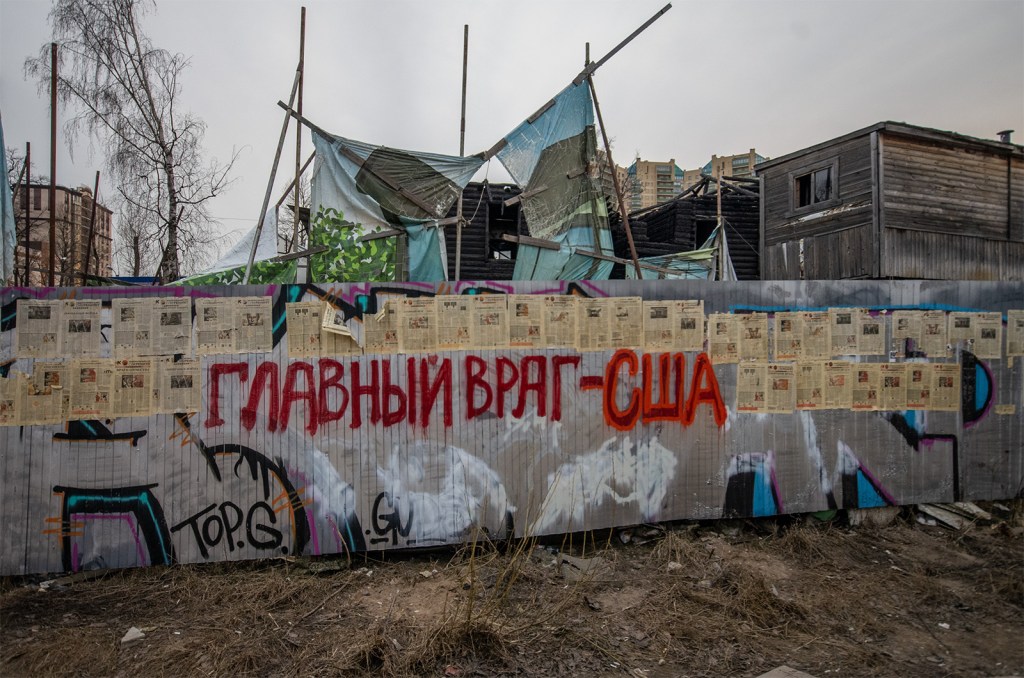
“The USA is the archenemy.” This photo was taken by my friend M. on a recent walkabout in Petersburg.
I had a dream before finally waking up today.
My husband telephoned, saying that he had been working in Pushkin today (which never happened, but okay), and couldn’t come home. I asked why he couldn’t—it was just past six in the evening, according to the clock.
“Just you take a look at the sky,” he replied. “It’s as black as pitch. It’s impossible to travel, you can’t see a thing. It’s probably a shitstorm—a big one, the final one.”
I looked at the sky, and it actually was black. Incredibly low fluffy white clouds floated past, lit up from within by something. Right under these clouds a building was being built; it was already six floors tall. Little devils rode on the clouds, grimacing and pulling up people who were clinging to the edges. The entire scene seemed quite tiny to me.
I told my husband what I saw.
“What is that huge thing they’re building?” I asked. “And who are those people clinging to the clouds?”
My husband was quite surprised.
“They’re building a fence around our beautiful motherland, the tallest fence in the world. Those are people who didn’t leave in time. The little devils are having fun with them by picking them up, but no one knows where they’ll throw them off. They just hope it’s on the other side of the fence.”
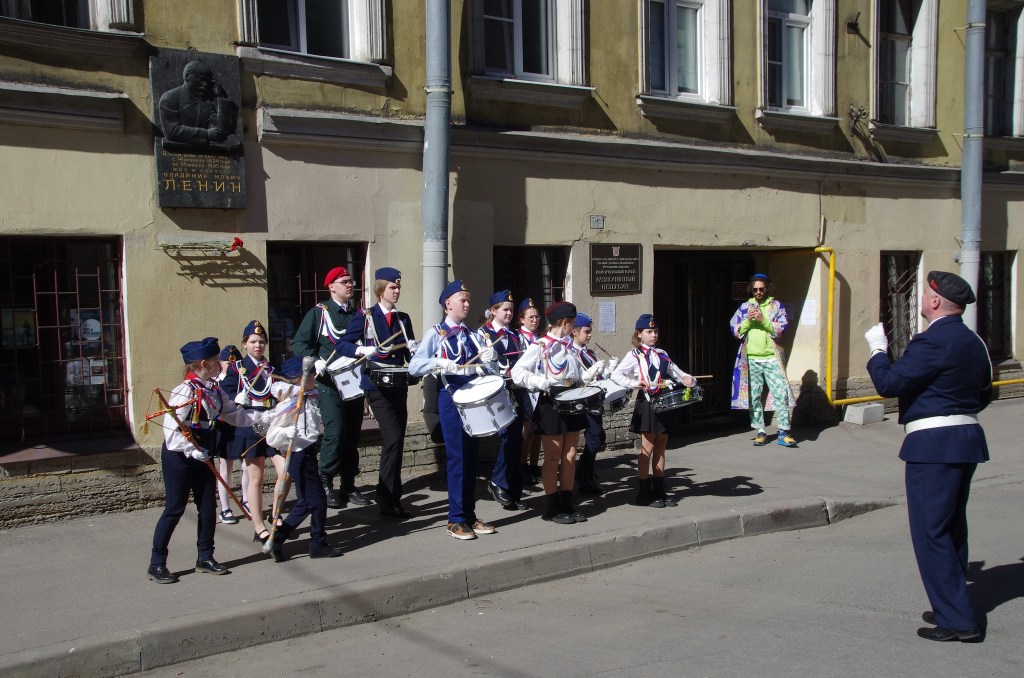
A military youth band plays outside the former Lenin Apartment Museum on Cossack Alley in Petersburg as a local hipster documents the happening, 22 April 2023. Photo by PZ, who kindly gave me permission to reproduce it here.
In pre-revolutionary Russia, the raznochintsy were people whose social status did not strictly conform to the notions of “hereditary nobleman” or “eminent merchant.” Minor clerks, retired soldiers, servants of various stripes, laborers and, of course, students and other intellectual workers lived in neighborhoods remote from Nevsky Prospect.
The museum traces its roots back to 1924.
Cossack Lane has been home to a memorial address since 1924. Vladimir Ilyich Ulyanov (Lenin) lived here from February 12, 1894 to April 25, 1895, and after his death, residents of the neighboring buildings established “Ilyich’s Corner” on the street.
In 1938, Ilyich’s Corner was turned into the V.I. Ulyanov Apartment Museum, part of the Leningrad branch of the Central Museum of Lenin. In 1992, the mayor of St. Petersburg ordered that the museum be preserved as as a historical landmark. It was granted the status of a state museum under the jurisdiction of the Lenin District (later, the Admiralty District) of St. Petersburg and became known as the Museum of the History of the Revolutionary Democratic Movement of the 1880s and 1890s.
In September 2003, by order of St. Petersburg city hall, the museum was transferred to the jurisdiction of the St. Petersburg Culture Committee. In 2006, in connection with the opening of a new permanent exposition, Around the Semyonovsky Regimental Parade Ground, the museum was given its current name — the Raznochintsy Petersburg Memorial Museum
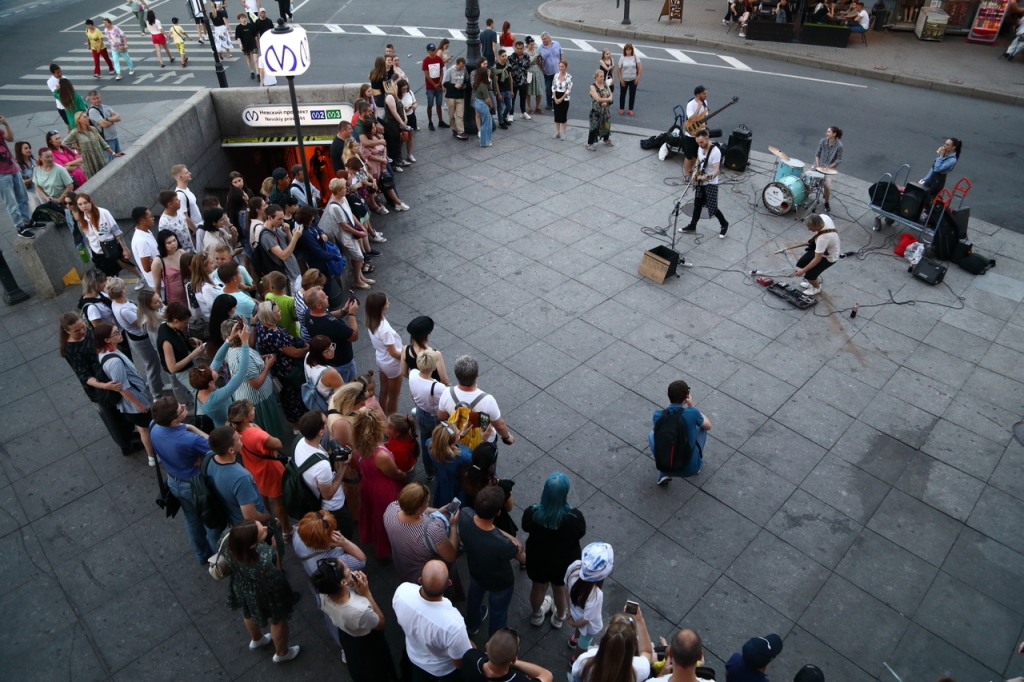
Buskers playing on Nevsky Prospect in downtown Petersburg, date unknown. Photo courtesy of ZAKS.ru
A draft regulation for the authorization of street performances was published on the website of the Government of St. Petersburg on April 11. The new rules should take effect from May.
Musicians will be obliged to notify the district council of their desire to perform ten business days before the concert. If they are going to play without percussion instruments and amplification, the deadline is three business days before the concert.
They can apply by using the Public Services in St. Petersburg app or via the websites of the district councils. To fill out the application, they will have to enter their passport details or information about a letter of proxy authorizing someone else to act on their behalf if the musicians are not seeking permission for the performance independently. In addition, they will have to provide a layout of stage and technical equipment and a list of sound amplifying equipment.
Legal entities will have to attach a copy of their charter, signed and stamped by its management, as well as a document confirming its representative’s authority to act on its behalf.
An approval already issue can be invalidated if necessary. It is planned to notify musicians about the decision of officials via SMS, e-mail, the Public Services portal, or social networks. The notification method will be chosen by the applicants themselves.
The project is undergoing an anti-corruption assessment. Earlier, the Petersburg district administrations presented lists of places where it was planned to allow street performances.
Yesterday, a man who was well over sixty was seated opposite me in a trolleybus going down Nevsky. He clutched a one-hundred-ruble bill.
“Has it been a long time since conductors stopped selling tickets?” he asked. “How do I pay the fare? I haven’t been on Nevsky for over forty years. And I haven’t been on public transport. I have a vintage Lada. That’s what I drive.”
“But your pension is probably transferred directly to your bank card,” I said. “Press it against that doodad to pay your fare.”
The man got up and pressed his Mir card to the validator. His eyes lit up with surprise and delight, as if he’d seen a magician pull a rabbit from a hat. I was сonsumed with envy toward him.
We continued our journey. Seated next to me was a fairly young woman, in her early forties, I think.
Looking disapprovingly at the man, she asked, “How is it that you haven’t been on Nevsky for forty years? What about the Immortal Regiment?”
“I don’t go,” the man said guiltily. “I came to Leningrad in 1979 and rented room on 1st Soviet Street. That’s where my wife was murdered. I moved to Vasilyevsky Island, and came to hate Nevsky. I haven’t shown my nose here since.”
The woman chuckled angrily.
“That’s no defense.”
We rode on in silence. I wanted to ask the man what had brought him to Nevsky today. But then I looked at him — in his striped sailor’s shirt, his face quite patriotic — and decided against it.
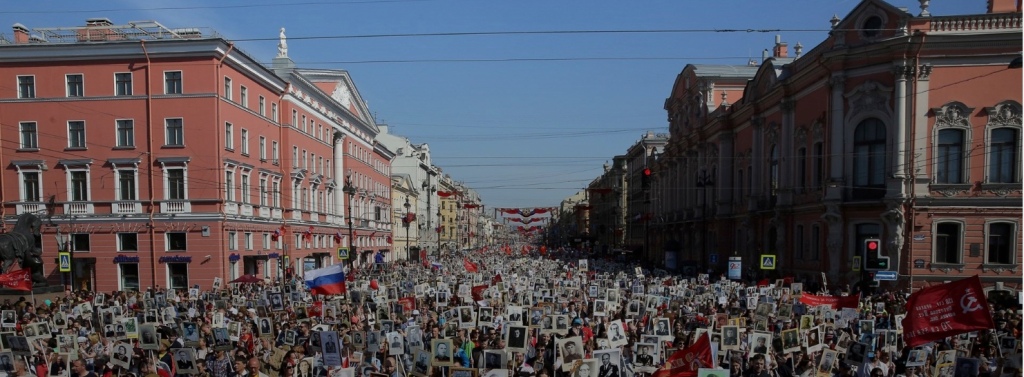
People marching down Nevsky as part of the Immortal Regiment event. The source and date of the photo are unknown. UPDATE (19 April 2023). This year’s Immortal Regiment processions have been canceled Russia-wide.
After two decades spent in Russian politics, after all that I have seen and experienced, I was sure that nothing can surprise me any more. I must admit that I was wrong.
I’ve been surprised by how far my trial, in its secrecy and contempt for legal norms, has surpassed even the “trials” of Soviet dissidents in the 1960s and 1970s. And that’s not even to mention the harsh sentence requested by the prosecution or the talk of “enemies of the state”. In this respect, we’ve gone beyond the 1970s – all the way back to the 1930s.
As a historian, for me this is an occasion for reflection.
At one point during my testimony, the presiding judge reminded me that one of the extenuating circumstances [in my case] was “remorse for what [the accused] has done”. And although there is little that’s funny about my current situation, I couldn’t help but smile: A criminal, of course, must repent of his deeds. I’m in jail for my political views. For speaking out against the war in Ukraine. For many years of struggle against Vladimir Putin’s dictatorship. For facilitating the adoption of personal international sanctions under the Magnitsky Act against human rights violators.
Not only do I not repent of any of this, I am proud of it. I am proud that [assassinated opposition politician] Boris Nemtsov brought me into politics. And I hope that he is not ashamed of me. I support every word that I have spoken and every word of which I have been accused by this court. I blame myself for only one thing: that over the years of my political activity I have not managed to convince enough of my compatriots and enough politicians in the democratic countries of the danger that the current regime in the Kremlin poses for Russia and for the world. Today this is obvious to everyone, but at a terrible price – the price of war.
In their last statements to the court, defendants usually ask for an acquittal. For a person who has not committed any crimes, acquittal would be the only fair verdict. But I do not ask this court for anything. I know the verdict. I knew it a year ago when I saw people in black uniforms and black masks running after my car in the rear view mirror. Such is the price for speaking up in Russia today.
But I also know that the day will come when the darkness over our country will evaporate. When black will be called black and white will be called white; when it will be officially recognised that two times two is still four; when a war will be called a war, and a usurper a usurper; and when those who fostered and unleashed this war will be recognised as criminals, rather than those who tried to stop it.
This day will come as spring comes after even the coldest winter. And then our society will open its eyes and be horrified by what terrible crimes were committed on its behalf. Through this realisation, through this reflection, the long, difficult but vital path toward Russia’s recovery and restoration begins, its return to the community of civilised countries.
Even today, even in the darkness surrounding us, even sitting in this cage, I love my country and believe in our people. I believe that we can walk this path.
A Russian court sentenced opposition politician Vladimir Kara-Murza to 25 years in prison on charges of treason and “fake news” Monday, capping a high-profile trial of one of the country’s most defiant anti-war voices.
Moscow City Court found Kara-Murza, 41, guilty of treason, “false information about the Russian army,” and affiliation with an “undesirable organization,” Interfax reported.
“Russia will be free, tell everyone,” Kara-Murza said after the verdict, according to the independent news site Avtozak.info.
Russia has witnessed a widespread wartime crackdown on dissent, but the severity of Kara-Murza’s sentence marks a new record as the Kremlin seeks to muzzle any criticism of its ongoing invasion of Ukraine.
The Western-educated politician was detained in April 2022 on charges of “spreading false information about the Russian army” in an address to U.S. state legislators a month earlier.
Kara-Murza was later accused of being affiliated with an “undesirable organization” for participating in a conference in support of political prisoners. His treason charges came in October over anti-war comments made at three public events abroad.
Prosecutors had requested a prison sentence of 25 years — the maximum possible jail term — for Kara-Murza.
“My self-esteem even went up [on the prosecutors’ request]. I realized I was doing everything right,” Kara-Murza’s lawyer Maria Eismont recounted her client as saying.
“Twenty-five years is the highest score I could get for what I did, what I believe in as a citizen, as a patriot, as a politician,” Eismont quoted him as saying, adding that he greeted the verdict “with a smile.”
His trial was held behind closed doors.
Monday’s hearing was attended by several Kara-Murza supporters and foreign diplomats including a U.S. embassy official named David Bernstein, according to the Mediazona news site.
The Kremlin declined to comment on Kara-Murza’s prison sentence, which his supporters and Western governments slammed as politically motivated.
U.S. Ambassador Lynne Tracy called Russia’s criminal prosecution of Kremlin critics “a symbol of weakness, not strength,” while Canadian Ambassador Alison LeClaire said Kara-Murza’s sentence marked a “dark turn” in Russia’s post-Soviet history.
The British Ambassador in Moscow Deborah Bronnert denounced the court ruling and called for the “immediate” release of Kara-Murza, a dual British-Russian citizen.
“The British government expresses solidarity with Vladimir Kara-Murza and his family,” Bronnert told journalists from the steps of the courthouse.
A Russian citizen by birth, Kara-Murza received British citizenship after moving to the United Kingdom with his mother when he was 15.
Russia’s Ambassador in London Andrei Kelin was summoned by the U.K. Foreign Office, which condemned Kara-Murza’s sentence as a violation of his right to a fair trial under international law.
The European Union denounced Kara-Murza’s sentence as “outrageously harsh” and called on Russia to provide access to health care for the ailing Kremlin critic.
The opposition activist suffers from a nerve condition called polyneuropathy which his lawyers say was due to poisoning attempts in 2015 and 2017.
The condition has worsened in prison, and he was too unwell to attend some of his hearings, his lawyers said.
Kara-Murza says he was poisoned twice because of his political activities, but he continued to spend long periods of time in Russia.
Kara-Murza has said he stands by all of his political statements, including those opposing the Ukraine offensive.
“I subscribe to every word that I have said, that I am incriminated for today,” Kara-Murza said in his final address to court last week, highlighting his fight against the Ukraine offensive and President Vladimir Putin.
“Not only do I not repent for any of it — I am proud of it,” he said.
Germany condemned the “shocking level repression” in Russia on Monday, and Latvia announced it had banned 10 Russian nationals from traveling to the Baltic country in retaliation to the court ruling.
Today, coming out of the front door of my building, I saw the following tableau. A neighbor from the third floor, who is somewhere between thirty-five and forty, was, on the contrary, coming in the front door. Judging by the bag he was carrying, he had just been grocery shopping. He doffed his baseball cap, clamped it under his arm, and crossed himself three times as he looked at the mailboxes. Then he peered into his own mailbox and let out a sigh of relief. His draft notice had not yet arrived, apparently. To be honest, it took a while for the meaning of his maneuvers to dawn on me. Of course, I pretended that I hadn’t noticed any of it.
On Wednesday, April 12, Samara journalist Sergei Podsytnik posted on the website Change.org a petition calling for the repeal of amendments paving the way for the introduction of electronic military draft notices, as passed the previous day by the State Duma and the Federation Council.
“These amendments violate our rights. A citizen cannot be stripped of their rights without a trial, but now this right has been given to the staff of military enlistment offices,” the petition says. Podsytnik draws attention to the fact that the public services portal Gosuslugi, through which it is planned to serve draft notices to Russians, has a number of vulnerabilities. In addition, not all residents of the country have access to their accounts on the portal, and almost thirty percent of Russians over thirty are not active internet users.
According to the amendments as adopted, if a conscript did not receive a paper summons and did not log into his Gosuslugi account, the summons will still be considered delivered within seven days after it was entered into the register of draft notices. He will then be banned from leaving the country. After twenty days, new bans will come into effect: those who failed to report to a military enlistment office will not be able to work as individual entrepreneurs, manage real estate, drive a car, or take out loans.
“To deprive people of the ability to sell real estate, drive a car, or travel abroad at the request of a person with no specialized legal education is an outrage against our rights and freedoms,” the petition says. At the time this story went to press, the petition had been signed by more than thirty thousand people, and their number was growing rapidly. For the amendments to go into effect, they must be signed by Vladimir Putin and published.
The legislative changes mean that once a Russian citizen has received a military summons online, they will be automatically forbidden from leaving the country, and therefore avoiding the call-up.
If they fail to appear at a draft office within 20 days, they will face a range of restrictions, including a ban on using their own vehicle, selling property or receiving a loan. They also face a fine of between 500 and 3,000 rubles (£5 to £29).
The head of Russia’s parliamentary committee on defence claimed that these measures will only come into force during the next conscription campaign.
The new system also anticipates a unified database where personal data about Russian reserve personnel can be collated by a range of government institutions, such as the tax service, law enforcement, the pension fund and medical facilities.
Such a database will make it “practically impossible” for reservists to avoid being called up, anti-conscription lawyer Alexey Tabalov told independent Russian media outlet Verstka, because military registration offices will have more detailed information about an individual’s home and work address.
This changes the advice he has been giving people who want to avoid mobilisation, Tabalov says.
Whereas he previously recommended that people avoid receiving the physical summons document, that “recommendation has lost all meaning” now, he said. “If you don’t want to serve, don’t go to the military registration office, but you’ll still face restrictive measures,” Tabalov said.
Andrei Kartopolov, head of the State Duma defense committee, spelled out tough penalties for those who do not respond to electronic summonses, including potential bans on driving, registering a company, working as a self-employed individual, obtaining credit or loans, selling apartments, buying property or securing social benefits. These penalties could apply to the thousands of men who are already outside the country.
The electronic summons will be issued via a government services portal, Gosuslugi, used for all manner of state payments and services including taxes, passports, housing services, social benefits, transport documents, medical appointments, employee insurance and countless other matters.
Under the law, personal data of conscripts including identity documents, personal tax numbers, driver’s license details, phone numbers and other information will be transferred by Gosuslugi to military enlistment offices. Universities, business employers, hospitals and clinics, government ministries, law enforcement agencies, the electoral commission and the tax authority are also required to transmit data to the military.