Western “observers” of Russian politics have the strangest notions of which Russian sources can be trusted. I was told earlier today, by a subscriber to the late Louis Proyect’s Marxmail list, that if I (meaning me, the guy who lived in Russia for twenty years) wanted to know what was really happening in Russia nowadays, I should read Boris Kagarlitsky.
— Meduza, who in the halcyon pre-war days discredited themselves so many times, but especially when they destroyed the burgeoning grassroots solidarity campaign in support of the Network Case defendants by publishing a thoroughly scurrilous “investigative report” implicating some of the defendants in an unsolved double murder.
— Boris Kagarlitsky, the man who in 2014 did more than anyone else to peddle to gullible westerners the obnoxious hogwash that the Russian takeover of parts of the Donbas was really a grassroots populist uprising against the bad guys in Kyiv, a man whose flimsy “institute” and odious opinion website Rabkor were financed directly by the Kremlin back in the days when the Kremlin still regarded him as a useful idiot. (The Kremlin doesn’t see him that way anymore, clearly, but now it should be too late for him to redeem himself in the eyes of progressive humanity.” ||| TRR
It was a clear sunny day. When I approached the square at the Church of the Intercession[in Petersburg], I saw the following scene. Sazonov, sitting on a bench, was exhaustively and animatedly relating to Sikorsky how and where to sink the bomb. Sazonov was calm and seemed to have completely forgotten about himself. Sikorsky listened to him attentively. Borishansky sat on a bench in the distance, his face imperturbable as usual. Even further away, at the gates of the church, stood Kalyayev who, doffing his cap, crossed himself.
[…]
When I approached 7th Company of the Izmailovsky Regiment Street [currently known as 7th Red Army Street], I saw a policeman on the corner stand at attention. At the same moment, I noticed Sazonov on the bridge over the Obvodny Canal. He walked, as before, with his head held high, carrying the projectile at his shoulder. Immediately, I heard loud trotting behind me, and a carriage pulled by black horses rushed past.
[…]
Suddenly, a heavy, strange, unwieldy sound rent the street’s monotonous hubbub. It was if someone had struck a cast-iron stove with a cast-iron hammer. At the same moment, the broken glass in the windows rattled pitifully. I saw a pillar of grayish yellow, almost black smoke rising from the ground in a narrow funnel. This pillar, ever expanding, flooded the entire street to the height of the fifth floor. It dissipated as quickly as it rose. I thought I saw some black debris amid the smoke.
For the first second, my breath caught in my throat. But I was waiting for an explosion, and so I came to my senses more quickly than the others. I ran kitty-corner down the street to the Warsaw Hotel.
One hundred and eighteen years later.
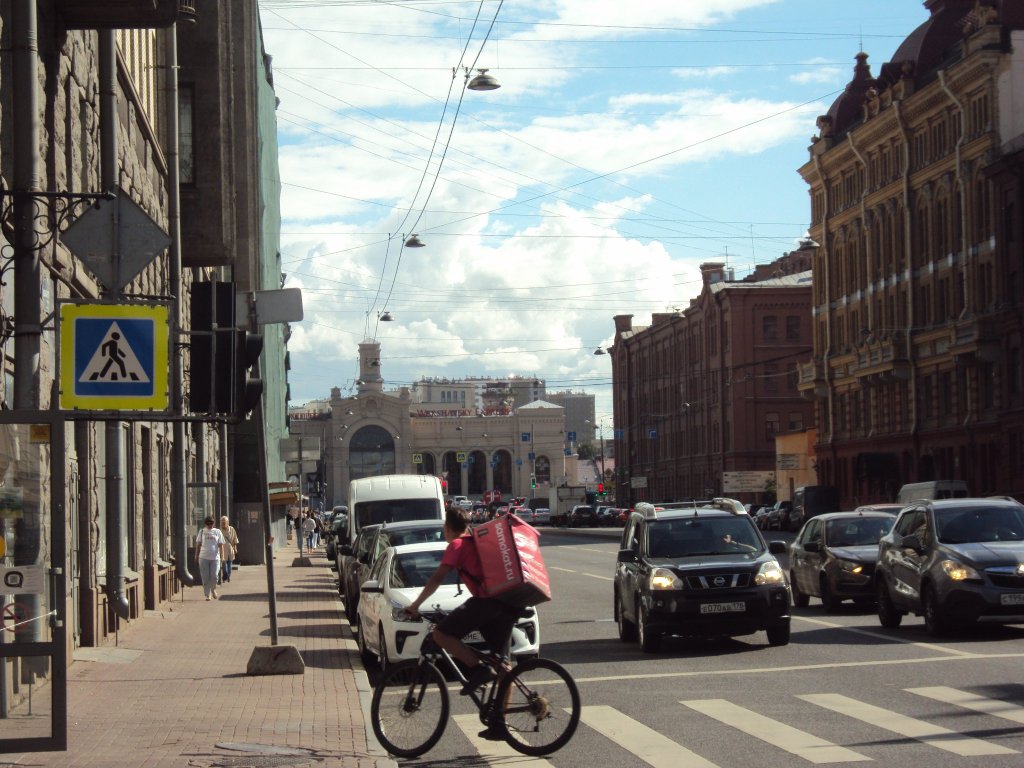
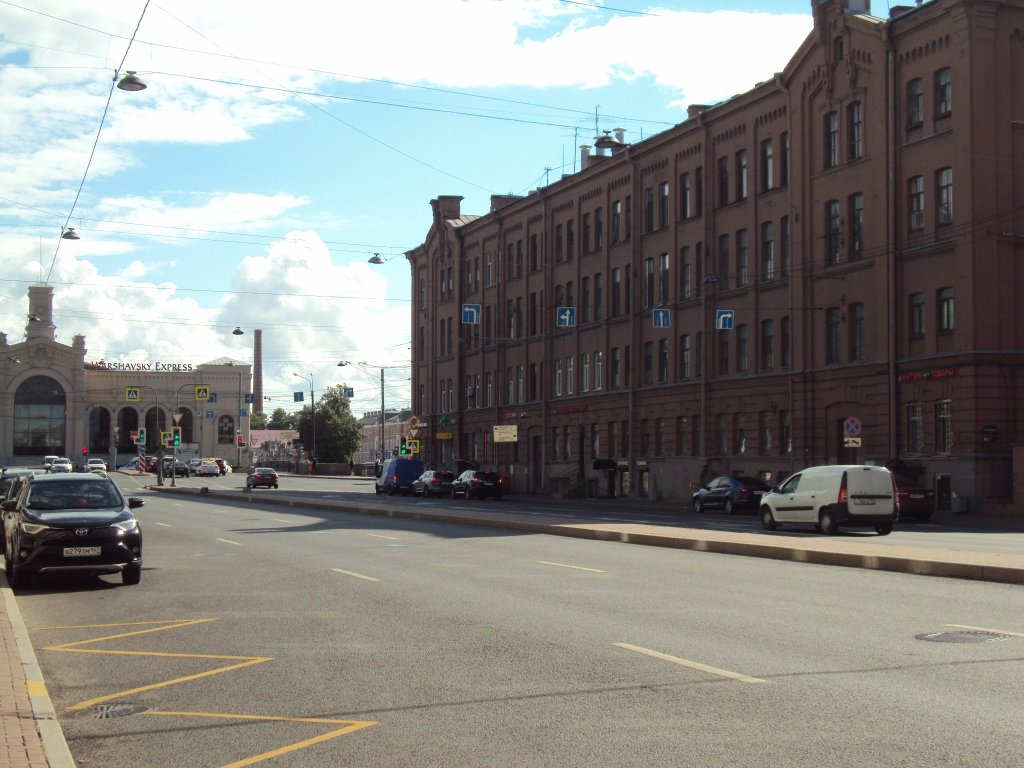
Pokrovsky Square (Church of the Intercession Square) aka Turgenev Square, in central PetersburgIzmailovsky Prospect in Petersburg. The former Warsaw Station, now a shopping and entertainment center, is in the background.The end of Izmailovsky Prospect, with a clearer view of the former Warsaw Station. A statue of Lenin once stood in front of it.
Source: Aleksandr Ermakov, Facebook, 28 July 2022. Translated by the Russian Reader, since a copy of Joseph Shaplen’s 1931 English translation of Boris Savinkov’s Memoirs of a Terrorist is hard to come by in print and nearly invisible online. I also added the captions to Mr. Ermakov’s snapshots.
The routes taken by Savinkov, Plehve, and the members of the SR Combat Organization on 28 July 1904. Source: Visions of Terror
On 15 July 1904 [28 July 1904 in the reformed, post-revolutionary calendar], the notoriously oppressive and unpopular Minister of the Interior, Viacheslav Konstantinovich von Plehve stepped into his armored carriage, complete with an entourage of bicycle detectives, and set off from his dacha to the Warsaw Station on his way to regular meeting with Tsar Nicholas II, now residing at his summer palace in Peterhof. Plehve, who had already survived several attacks on his life, probably took this trip in stride, but as he approached his destination, a young man, Egor Sazonov darted towards his carriage and threw a bomb underneath its speeding wheels. Sazonov was just one of several assassins that day who were poised and ready to trade their own lives for the Minister’s. They were members of the Combat Organization (Boevaia Organizatsiia), the terrorist branch of the Socialist Revolutionaries who ultimately murdered a number of prominent political figures, most notably […] Tsar Alexander II.
At the moment I’m worried by the sense that there is no way out of the situation at the regional level—the war between Russia and Ukraine can go on indefinitely long. Continuing within the pre-established framework of geopolitical nationalism, Russia wants to expand its borders or fortify them with new puppet buffer entities; Ukraine wants to preserve existing territories and get back lost ones; other countries in the region are concerned about preserving themselves as nation-states; and finally, there are territories that someone hopes become new nation-states. We understand some of the above while condemning others, but all of it together is a nationalistic impasse in globalization from which there is no global way out.
A sensible global response to the crisis will emerge only if the situation (no matter how scary this is to say) actually escalates into a global confrontation, into a Third World War. And then those who abstractly and dogmatically insist today that everyone is to blame for the new insane war and the new arms race—Putin, NATO, Ukrainian and European elites—will be proven right. Because the global war, which has been going on for a long time and has lost even a semblance of meaning, naturally provokes peoples and nations who are worse off to ask questions of elites who are still well off or even better off than they were before.
Apparently, this is the only way the one big question to the world order of the last thirty years can be posed and give rise to a big answer—in the form of a new global anti-war, anti-imperialist, redistributive, climate, human rights, unifying federalist, etc., agenda, which would be articulated by new international bodies fueled by genuinely widespread grassroots discontent.
It would be just terrible if different parts of humanity had to kill and maim each other even more in order to feel unity again, embrace common challenges, and suggest common responses.
[Comments]
Hanna Perekhoda Here the Western left has been looking and looking for an anti-war movement on the Russian left. They have searched high and low, wondering how to help them and guessing that those poor people are thinking how to stop the war and undoubtedly need support. With your permission, I will show them this post as an illustration of the ardent zeal on the Russian left to accelerate the defeat of its own fascist regime and stop the war in Ukraine.
Hanna Perekhoda I reread [this post] and was even more gobsmacked. Has helplessness really crushed your brain so much that you are practicing at imagining exactly how the Third World War would solve problems that you no longer have the courage to try and solve, let alone to think about normally? Have even basic moral and ethical principles fallen by the wayside? This is the living end, and a pathetic one at that. No fucking war indeed. Game over.
Source: Kirill Medvedev, Facebook, 11 July 2022. Translated by the Russian Reader
In an existential crisis and looking to solve a cold case, Max checks into a secretive hotel with elaborate assisted suicide fantasies. He uncovers a disturbing truth, questioning the nature of life, death, and his perception of reality.
“There used to be diasporas, now there are communities,” say newcomers in Kas. Some of them organize traditional guided tours, some are in charge of taxi services jointly with locals or are developing food delivery companies.
Maksim Zaikin creates co-living spaces for people with similar habits and values by subletting villas. Maksim, a mentor for several projects in Moscow and St. Petersburg, creator of Co eco-system, arrived in Kas in November 2020 to pass the winter. He first organized a party in the neighboring town of Kalkan attended by 45 people mostly from Kas. Maksim then realized that it’s better to move there.
“All people that I am talking to here say that it’s a sort of place of power,” he says. “Kas gives you energy and helps you grow. Everyone in my circle can feel it. I was meeting people that I knew through Facebook but never had personal contacts with when Russians were arriving here in big numbers. Now, the trend has reversed — people stayed in Turkey for the officially allowed 90 days and decided to move back home or change the location.”
“We often see people leave, realise what they really want and come back. In the time of war, Kas has become not just an isle of calmness but also a space for development.”
At their peak, Maksim and his business partner Nikita had 6 villas on the peninsula and apartments in the centre. Prices start from $1,000 per month for a double room outside of the tourist season. When it gets hotter, prices go up as well to at least $1,700. Coworking spaces that host events, lectures and workshops are also available. It has essentially transformed into a home for the community or a culture centre. “It’s very easy for us to find speakers, they themselves come looking because Kas is a place with a lot of fantastic people.”
The team is planning to set up camps with experts on their villas and launch educational programs for kids. Maksim himself has two, 8- and 10-year-olds, they are currently studying online. But the entrepreneur is dreaming of creating an offline program for education.
Many Russians come with kids but the nearest school offering education in Russian is located in Antalya.
“I am not thinking of going back to Russia,” Maksim concludes. “I want to create a lifestyle where I can move between hubs: Kas, Bali, Portugal. We go where there’s a market for it, where Russians go. I want to live on the planet, not in a country.”
Source: Olga Grigoryeva, “Russians in Kas: A small town in southern Turkey turned into a hub of Russian intellectuals,” Novaya Gazeta. Europe, 14 July 2022
Darya Polyudova, holding a placard that reads, “Ukraine, we are with you.” Image courtesy of Ivan Astashin
A subscriber has reported that he received a letter from political prisoner Darya Polyudova in which she told him about her court hearing in the Moscow City Court on May 12.
Let me remind you that left-wing activist Darya Polyudova is currently doing her second stint in prison on political charges.
In 2015, the activist was sentenced to two years in prison for “calling for extremist activities and separatism”: this was how the authorities viewed her preparations for a March for the Federalization of the Kuban.
After her release, Darya continued to be involved in political activism. But in January 2020 Polyudova was arrested again. In May 2021, she was sentenced to six years in prison on charges of “condoning terrorism” and “calling for terrorism.” The court regarded posts about Shamil Basayev and a phrase about the “Lubyanka shooter” Yevgeny Manyurov, who opened fire on FSB officers near Lubyanka Square in Moscow in December 2019, as evidence of Polyudova’s guilt.
In both cases, the Memorial Human Rights Center recognized Polyudova as a political prisoner.
However, the Russian state’s persecution of Darya Polyudova has not ended there. In late 2021, the FSB opened another case against the activist. Now she stands accused of “organizing an extremist community,” i.e., the so-called Left Resistance movement. Under the new charges, Darya may face another six to ten years in prison.
In this new case, Darya has been remanded in custody. Of course, she is already in custody. Without a new criminal case she would have been in a prison camp a long time ago [serving the sentence for her previous conviction], but the investigation wants her in a pretrial detention center.
Darya is appealing all the court decisions on the extension of her remand in custody. The court will consider her appeal of the latest extension on May 12.
Come and support Darya Polyudova!
11 a.m, 12 May 2022, Moscow City Court, 8 Bogorodsky Val, Room 327
Source: Ivan Astashin, Facebook, 7 May 2022. Translated by the Russian Reader
Is this monstrous war of aggression really between two equal sides?
An open letter in response to the Manifesto Against the War
Dear comrades,
I write in anger and sorrow about your Manifesto Against the War, to which I turned in the hope of learning from you about how we can situate the anti-war movement in the wider struggle against capital.
Enumerating the causes of military conflict, you refer, first, to “the growing rivalry between the greatest imperialist powers”. Third is “Islamic fundamentalism”. But before that, second, comes that “the US government has positioned its military alliance system, NATO, against the Russian Federation to prevent the integration of the defunct Soviet empire’s successor into an enlarged, stable and peaceful European order with mutual security guarantees”.
Demonstrations in Ukrainian cities occupied by the Russian armed forces are part of a people’s war
You don’t explain why you think that, in this age of the deep crisis of the capitalist system – which in your words “unleashes ever more violent struggles for geostrategic zones of influence” – such a “peaceful European order” could ever have been possible.
That hope, embraced by Mikhail Gorbachev and many social democrats in the 1990s, was surely dashed as the economic crises of neoliberalism (1997-98, 2008-09, etc) multiplied, as the Russian bourgeoisie emerged in its 21st-century form on one hand, and the alliance of western powers pursued their murderous wars in Iraq, Afghanistan and elsewhere on the other.
You don’t explain why you name the US government and NATO, and Islamic fundamentalism, as causes of the current war … but not the Russian elite, which actually started it.
You turn causes into effects, and effects into causes, in order to justify this focus on the US and NATO. So, immediately following your point about the US using NATO to prevent Russia’s integration into a stable European order, you continue: “The sabotage of Nord Stream 2 shows that economic pressure is just as important here as it is in the positioning against China.”
This just doesn’t fit with the facts. Nord Stream 2 was a major point of dispute between the German ruling class and its US counterpart. For years, the US sought to sanction the pipeline, and the German government resisted. In July 2021, the Biden administration struck a deal with chancellor Merkel under which the pipeline would be completed. The German desire to integrate Russia, at least as a trading partner, prevailed.
The pipeline was finally frozen by the new German chancellor, Olaf Scholz, on 22 February, the day after Russian president Putin recognised the Donetsk and Luhansk “people’s republics” – a clear indication that the Minsk peace process was finished and that Russia was preparing for some sort of war. Russia acted; Germany reversed its long-standing policy.
The freezing of Nord Stream 2 put no discernible economic pressure on Russia, anyway. The point of the pipeline was to enable Russia to pipe gas to European destinations without taking it across Ukraine. It was designed to reduce Russian dependence on Ukraine for pipeline transit, that is, to produce a geopolitical benefit rather than any significant economic benefit. The western powers have imposed heavy economic sanctions on Russia – after it invaded Ukraine on 24 February.
The reason you mix up causes and effects is clear. Your narrative description of the post-Soviet period mentions the collapse of the Soviet empire, the loss of those (to my mind illusory) “quite favourable” chances of Russia “democratising” – and then the failure of that option due to NATO expansion. The arrogance inherent in that expansion “created the external conditions in Russia for the implementation of a strategy of imperialist revisionism” under Putin, you say.
I would dispute the prevalence of NATO expansion as an “external condition”. I think the broader crises of capital, and of its neoliberal management strategy, were far more important. But what about the internal conditions? You don’t mention those. What about the reconstruction of the Russian bourgeoisie in the post-Soviet period, and its relationship with the post-Soviet repressive apparatus represented by Putin? Where does that fit into your analysis?
Your focus on the “external condition” means that your account of Russian militarism is one-sided. The Georgian war in 2008 and the annexation of Crimea were “warning signals” that were “disregarded” by NATO, which, according to you, built “infrastructure” in Ukraine. What “infrastructure”? (NATO was always divided about admitting Ukraine as a member, and until last month’s invasion kept its military relationship with Ukraine at a low level.)
Your account of Russian militarism starts in 2008. What about the murderous assault on Chechnya in 2000-02, which first cemented Putin’s position as president, and was supported by NATO? What about the Russian assault on eastern Ukraine in 2014, which you incorrectly describe as a “civil war with indirect Russian involvement”? What was “indirect” about a war in which Russian mothers lost their sons on the front line, fighting in Russian army uniforms? What is “indirect” about the massive logistical, financial and political support given by the Russian government to the Donetsk and Luhansk “republics”?
Most telling of all, you don’t mention Syria. The drowning of the Syrian uprising in blood in 2015-16, surely the greatest defeat of a revolutionary movement in this century, was accomplished by the Assad regime with powerful Russian military support.
The NATO powers stood back and allowed this to continue (while they themselves fought their own wars in Iraq, Libya and Afghanistan) for the same reason that they acquiesced in Putin’s actions against Chechnya, Georgia and Ukraine: because for all their disavowals of “spheres of influence”, they were content that Russia should act as a gendarme for international capital in certain geographical areas. As indeed they were content to see Russian troops intervene against the Belarussian uprising in 2020, and in Kazakhstan in 2022.
You write: “this catastrophic war of aggression was also preceded by imperialist acts of aggression on the part of the West, which provoked in Putin’s Russia a geostrategic logic common to all imperialist power elites”. Sure! The Russian empire, with its rich history of suppression of its colonies and its own people, needed to be provoked by the western powers, in order to make war on the oldest of those colonies. Just like the British ever needed provoking, before making war on Ireland. (I hope my sarcasm comes through OK in a written text.)
Your policy proposals reflect your skewed view that this is a war between two equal sides. You make serious points, and I hope they are discussed. But first we have to be clear. Is this monstrous war of aggression really between two equal sides? Only one side is shelling and terrorising civilians, and arresting and murdering those who defy its occupying forces. (Remember Putin’s declaration on the first day? “We don’t intend to occupy”? Tell them that in Mariupol.)
Do you really believe this is an inter-imperialist conflict, with no element of a people’s war? Why else did you neglect to mention those thousands of Ukrainians fighting outside the state framework to defend their own communities, with arms in hand or in other ways? Because they didn’t fit your preconceived interpretation?
I write with anger because I have had such great respect for some of the signatories of the manifesto, and the contribution they have made to the development of socialist thinking. In the 1990s – when studying both the Russian revolution and modern-day Russia showed me that Trotskyism, the framework I had accepted before then, was wanting – autonomism was one of the trends that I began to study and learn from. Including what some of you have written.
Your statement looks as though you decided the conclusion – that this is fundamentally an inter-imperialist conflict, and nothing more – and worked back from there to interpret the facts. Comrades, that’s the wrong way round. The younger generation deserves better, from all of us.
In solidarity,
Simon Pirani. (21 March 2022.)
PS. I have written about my own view here, if it’s of interest.
Source: People and Nature, 21 March 2022. Reprinted here with the author’s permission. ||| TRR
Speech balloon: “The children of officials won’t be going to the front. No war!” Movie poster: “An Alexei Pimanov film. Eleven Silent Men. In theaters from February 17.”
We have received a message from an anonymous activist group and are posting it to declare our support.
This is not the time to be discouraged! No one but us will save the world!
On the eve of a major war, Russia looks disconcertingly unanimous. Although the majority of the population has a negative attitude to war with Ukraine, their opinion is not represented at all in the media or the national conservation.
The media is completely controlled by the state. There is no force yet to organize rallies. High-profile opposition figures are either in prison or have left the country. Individual protest is also virtually banned — solo picketers are sent to jail and sentenced to absurdly huge fines. In the media, reports of arrests overshadow the meaning of the protest actions themselves, while on social media, information is distributed only among people who are already politicized. The police are hunting down all the more or less well-known opposition activists and preemptively throwing them in jail.
But the situation can be changed. It is easy to imagine Russian cities covered with anti-war agitation. In such circumstances, there would be no talk of the unanimity of the regime and the people in the face of war. People who came out to protest brandishing creative posters a year ago may well not want to stand holding them and wait to get arrested, but they could paste a dozen such posters on fences, walls, window niches, billboards, and the reverse side of road signs. Graffiti, stencils, leaflets in mailboxes and on shopping mall stands, business cards in elevators — we are limited only by our imaginations.
We are not talking about one-off heroic actions, or large formats, although large formats would do, but about daily, slightly routine, thoughtful, and maximally safe work to change the urban environment here and now.
The target of this activity would be the still passive 50% of society — the lower strata of the working class, pensioners, and apolitical youth who do not read opposition bloggers, and who until now have had things other than politics to worry about. It is these segments of the populace that war, a collapse of the ruble, and a rise in prices would hit first and foremost, and it is these people who need to be shown that people opposed to war do exist.
The authorities will certainly put street cleaners to work [tearing down the anti-war posters], but as the snowfalls have shown, the resources of the municipal services are very limited. By engaging reliable friends who will watch our backs when we are putting up posters, we can become an anti-war snowfall ourselves. This snow will trigger a political spring!
The authorities will beef up foot patrols and continue preventive arrests, but the more people take part in the snowfall, the safer it will be for the rest. However, we shouldn’t forget about cameras, hoods, and PPE either.
Don’t be scared, get organized! Think globally, act locally! Don’t wait for leaders, be leaders! Let’s meet on the streets!
#NoWar! #HandsOffUkraine!
You can find more illustrations of this street anti-war agitprop at the original Facebook post. Translated by the Russian Reader
Ukraine: ‘condemn Russia’s imperialist threat’ • People and Nature • 24 January 2022
Ukrainian socialists are urging international unity against the Russian government’s imperialist policies that threaten a new war.
The Social Movement, a group of mainly labour activists in Ukraine, calls in a statement for “solidarity with people who have suffered from the war that has lasted almost eight years, and who may suffer from a new one”.
The statement expresses “gratitude and solidarity to Russian left-wing activists who oppose the imperialist policies of the Kremlin and are fighting for democratic and social transformations in their country”.
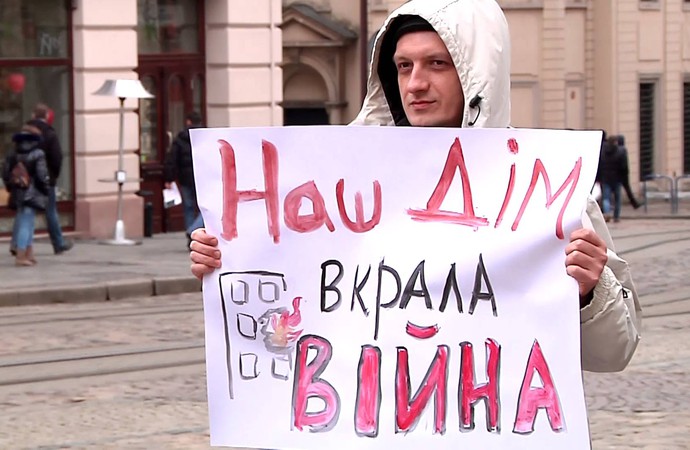
“Our house was stolen by war”: one of Ukraine’s 1.5 million internally displaced people. Photo from commons.com.ua
The Social Movement denounces the “myth, popular among some Western leftists”, that the Russian-supported “people’s republics” in Donetsk and Luhansk are “the result of popular will”. Their statement says:
The heads of the “Donetsk People’s Republic” and “Luhansk People’s Republic” are integrated into the ranks of the ruling elite of the Russian Federation and have become the mouthpiece of the Kremlin’s most aggressive predatory sentiments. In the “republics” themselves, any opposition political activity, even the most loyal to the Russian government, is suppressed.
The (Ukrainian) Social Movement statement concludes with a call for “complete withdrawal of Russian troops from Donbas”. It says that “one of the best means of pressure on the leaders of the Russian Federation would be the seizure of the property and assets of Russian oligarchs and officials in London and other places”.
It calls for “revision of the socio-economic course proposed to Ukraine by the West: instead of destructive neoliberal reforms under the pressure of the IMF – the cancellation of Ukraine’s external debt”. And it urges “more inclusive and progressive humanitarian policies in Ukraine, ending impunity for the Ukrainian far right, and abolition of the ‘de-communisation’ laws”.
One thing many Ukrainians find grotesque is the sight of their country’s fate being discussed by the US and Russia, as though the Ukrainian state did not exist. This is the focus of an article, “Moscow and Washington should not determine Ukraine’s future”, by socialist activist Taras Bilous.
So is a facebook post written on 20 January by Marko Bojcun, the socialist historian of Ukraine, which I reproduce here with his permission:
Though Putin, the artful player, has several options in his hand, his ultimate objective has been to get the US to join an expanded Normandy format and the Minsk negotiations, and there to help force Ukraine to accept further limitations to its state sovereignty. Basically, that means Kyiv would accept the separatist Donetsk and Luhansk “republics” as internationally recognised autonomous state institutions within Ukraine, but in reality bodies that continue to be run by Russian state ministries – as they already are in a concealed manner. Russia would use them to lever Ukraine’s domestic and foreign policies.
Putin recognises that he can achieve his main goal only with US endorsement. He needs the US to join him in twisting the arms of the stubborn Ukrainians. That has been the point of all these Russian troop movements to Ukraine’s current borders: to get the Americans to weigh in, to keep Ukraine out of any direct talks and to conclude a deal over their heads.
Ukraine is critical to Russia’s long term project of economic, military and diplomatic recovery, its resumption as a Great Power. That means Russia will not stop its drive until it achieves much more. The present conjuncture resembles in some way another historical moment, in 1938, when Neville Chamberlain, the British prime minister, met Joachim Von Ribbentrop, Nazi Germany’s foreign minister, over the Czechoslovak crisis. Chamberlain came out of that meeting, waved a scrap of paper in his hand and declared peace in their time. I wonder what US foreign secretary Anthony Blinken and his Russian counterpart Sergei Lavrov will have to say after their meeting tomorrow?
The answer to that last question turned out to be: nothing much. Blinken offered Lavrov the carrot of a meeting between the US and Russian presidents, something Putin has long craved in his efforts to claim Russia’s “great power” status.
□ A recent comment article by the journalist James Meek is on the London Review of Books web site, on open access. Meek and Paul Mason are among the panelists appearing at an event organised by the Ukrainian Institute in London about the war danger, on Wednesday 16 February. (The Institute, run in the distant past by cold-warrior right wingers, is now managed by liberal, post-Soviet Ukrainians. Its educational and informational events are well worth looking out for.)
□ The London-based, official-labour-movement-focused Ukraine Solidarity Campaign regularly publishes information.
□ The biggest gap in English-language coverage is about what is going on in eastern Ukraine. I have occasionally translated and published stuff on this blog (see e.g. a recent post here, and, from further back, here, here and here).
□ The Kharkiv Human Rights Protection Group web site has excellent, and accurate, coverage of an appalling range of repressive state and military activities – see, e.g., their tags on Crimea and “terrorism” (which includes those “people’s republics”), but note, too, their more general reporting on human rights abuses in Ukraine and Russia.
□ It is a job of work to counter the stream of deceit and misinformation from Putin-ists in the UK labour movement. I summed up the arguments in a recent blog post here. I even wrote to the Morning Star, about one of its more grotesque lies – that “hundreds of trade union leaders” were killed by the post-2014 Ukrainian government. Accuracy about dead bodies is not their big thing, it seems. My letter is reproduced below. SP, 24 January 2022.
False reporting of “hundreds” of trades unionists’ deaths
I I sent this letter to the Morning Star newspaper, which claims its favours “peace and socialism”. It was published, in the print & pdf edition only, on 17 January
Dear Editor,
In the article “Opinion: US and NATO play with fire in their latest anti-Russia campaign”, 9 December, John Wojcik stated: “Hundreds of trade union leaders and activists were murdered by the new right-wing Ukrainian government shortly after it came to power [in 2014].”
This is incorrect. The two major Ukrainian union federations reported no such deaths of union leaders. Nor did the detailed reports by the UN High Commission for Human Rights on civil rights in Ukraine. Some activists were killed in this period, during numerous civil disturbances, but there is no evidence that the government was responsible. (Many people were killed, by Ukrainian, Russian and separatist forces, in the military conflict that began in the summer of 2014. This is not what Wojcik is referring to.)
Many of your readers will have mourned the death of friends and comrades killed for their trade union activity. It would be disrespectful to them to leave uncorrected the statement that hundreds of union leaders were killed.
The article also states that the new Ukrainian government “banned the use of the Russian language”. This is incorrect. A law making Ukrainian the single state language was adopted in 2019. It requires Ukrainian to be used – but not exclusively, i.e. it can be used together with other languages – in certain public spaces. It will be applied to educational institutions and the media, but not to private or religious life. Many Ukrainian socialists are opposed to it. But exaggerating its effect can only help to exacerbate differences between working people on grounds of nationality and language, that historically the labour movement has endeavoured to overcome.
Simon Pirani, London.
Correction. This article has been corrected on 4 February, to reflect the fact that this letter was published in the Morning Star’s print & pdf editions. It was not published in the on-line edition.
Timothy Ash: “Nord Stream 2 is about undermining Ukraine.” The most cogent analyst of the Russia-Ukraine conflict is hiding out at a place called Bluebay Asset Management. Watch this six-minute clip if you want to know why Putin is likely to invade Ukraine. Thanks to the indomitable Mark Teeter for the heads-up.
Meanwhile, in the total absence of an anti-war movement in Russia, I share these recent reflections from two past contributors to this website.
Putin’s little helpers undermine solidarity • People and Nature • December 29, 2021
We know what solidarity in the face of war looks like. It looks like the Grupa Granica, set up to support those stranded on the Polish border by the government’s vicious anti-migrant policy and the Belarusian government’s cynical manipulation of refugees.
To those supporting refugees – whether in Poland or Belarus, or in the English Channel, targeted by the UK government’s murderous crackdown – it makes no difference which war people are fleeing. It might be the US-UK-supported war in Iraq, or the bloodbath perpetrated in Syria by Bashar al-Assad’s regime.
Now, we face the possibility of renewed Russian military action in Ukraine. This carries the greatest threat of war in Europe since the Balkan conflicts of the 1990s.
The war in eastern Ukraine in 2014-15 has already caused 2 million or more people to flee their homes: more than 1 million now counted as “internally displaced” in Ukraine; at least as many have crossed the border to Russia. A new conflict would be both a human tragedy and a threat to social movements.
Solidarity is needed. An anti-war movement is needed.
Already, pro-Putin propaganda – that corrodes parts of the so-called “left”, as well as thriving on the extreme right – is being dialled up. It seeks to justify Russia’s military preparations. And it could endanger efforts to galvanise anti-war protest.
Putin’s little helpers on the “left” generally have a world view inherited from Stalinism: they believe that authoritarian regimes that spout anti-American rhetoric (Russia, China or both) are to be praised; the imperial character of these regimes’ actions is ignored; and these regimes, rather than popular movements, are seen as the means to resist western powers.
Andrew Murray, writing on the Stop the War website, claims that “if there is conflict over Ukraine, it is the west that bears most of the blame”. But it’s not “if”. There has been a conflict going on for more than six years, which has taken more than 14,000 lives.
The forces involved are the Ukrainian army, the vastly better-resourced Russian army, and separatists and mercenaries supported by, and to a large extent funded and armed by, the Russian state. The western powers have been noticeable by their absence.
Murray says the 100,000 Russian troops stationed on the Ukrainian border are “allegations” and “media speculation”. John Wojcik in the Morning Star says they are there “if corporate press outlets are to be believed”. In the real world where the rest of us live, the Russian forces actually exist (see satellite pictures here and here).
Murray claims that the NATO military alliance is “trying to seize Ukraine by means of moving NATO right up to Russia’s borders”, that the US is “arming Ukraine to the hilt to resist” and that “British troops are stationed in the Balkans”. The journalist and commentator Paul Mason has demolished these claims point by point. He writes:
There is, in short, no NATO plan to “seize” Ukraine; no possibility of Ukraine joining NATO; no “arming to the hilt”; no significant number of British troops in the Balkans; no major deployment of NATO troops “eastwards towards Poland”.
The danger of war is real. But to deny the central role of the Russian military is to deny reality.
Putin’s helpers have form on this. During the civil war in Syria, the Stop the War campaign and their friends had little or nothing to say about the murderous Assad regime and the Russian government that armed and militarily supported it – despite the fact that they were responsible for an estimated 90% of the killings.
While the regime preferred to butcher and torture its own citizens, rather than to grant them a measure of democratic rights, Putin’s helpers spoke up only about minor incursions by western forces … the “anti-imperialism of idiots”, as Syrian-British writer Leila al-Shami called it.
As for Ukraine, the Stop the War campaign did nothing to support the victims of the 2014-15 conflict, but nevertheless hurried to the defence of the Russian “leftist” Boris Kagarlitsky, who joined fascists and nationalists in supporting the Russian intervention.
Putin’s helpers are everywhere, including the Moscow Carnegie Center. Screen shot by the Russian Reader
Fairytale no. 2: Ukraine is fascist, really
There was a “fascist coup” in Ukraine in 2014, writes John Wojcik in the Morning Star (in an article republished from the US-based People’s World, of which Wojcik is editor). “Hundreds of trade union leaders and activists were murdered by the new right-wing Ukrainian government shortly after it came to power.” He also claims that the new government “banned opposition political parties, including the widely supported Communist party”. And it “banned the use of the Russian language, the primary language of 40% or more of the Ukrainian people”. Let’s go through the bits of this fairytale one by one.
(a) A “fascist coup”. The overthrow of the government headed by president Viktor Yanukovych in February 2014 was, by any measure, a mass popular action. A crowd of more than half a million people occupied the centre of Kyiv for more than two weeks, in the face of assaults ranging from baton charges to sniper fire, making it impossible for the government to continue. There were mass actions on a similar scale in dozens of other towns and cities. The politics of this “Maidan” protest were complex. Participants ranged from fascists, who played a key part in the violent confrontations with the old regime’s armed forces, to socialists and anarchists. But the word “coup” is meaningless to describe it. As for the new government, while its record on defending democratic rights was mixed to put it mildly, it was no more “fascist” than the governments of e.g. Poland or Hungary. And, in terms of the rights to assembly, free speech and workplace organisation, less repressive than the governments of e.g. Turkey or Russia.
(b) “Hundreds of trade union leaders and activists were murdered by the new right-wing Ukrainian government.” This is false – shockingly so. No such murders took place. No such murders have been recorded on the web sites of Ukraine’s two trade union federations. None have been mentioned in the detailed reports of the United Nations High Commission for Human Rights on attacks on civil rights in Ukraine. Demonstrators were killed in clashes with the security forces, but this was mostly before Yanukovych was overthrown. Activists and journalists have been attacked, and some killed, apparently by non-state actors, albeit sometimes with covert support from elements in the state. In 2014, prior to the military conflict, there were other deaths and injuries resulting from civil conflict. The most serious incident, by far, was the deaths of demonstrators opposed to the new government who, confronted by its supporters, took refuge in a trade union building in Odessa that was then set on fire. Ukrainian law enforcement did little to investigate. Tragic as these deaths were, they were not murders of trade union leaders or activists by the government.
(c) The government “banned opposition political parties”, including the Communist party. It didn’t. The electoral commission banned the Communist party from participation in the 2019 presidential and parliamentary elections, under the 2015 “decommunisation” law. This law, which forbids the promotion of “totalitarian regimes”, defined as Nazi and Communist, and their symbols, has been and is being used to attack democratic rights. Together with similar laws in other eastern European countries, it deserves to be denounced and resisted. But note, too, that the Communist party continues to operate legally; that it has mounted legal challenges to the ban; that no other party has been banned from electoral participation under the law; and that the government and the electoral rights group OPORA are currently in dispute over the extent of proportional representation – an election procedure that in the UK, for example, remains an unattainable dream.
(d) The government “banned the use of the Russian language”. It didn’t – and it’s irresponsible and inflammatory to sit in an editorial office in the US claiming it did. A law making Ukrainian the single state language was adopted in 2019 – the culmination of three decades of argument, shaped both by by aspirations to revive Ukrainian culture that has suffered historically from Russian imperial domination, and by hard-line Ukrainian nationalism. Ukrainian socialists opposed the measure (and I sympathise with them). Remember, though, that the law requires that Ukrainian be used in public spaces, and not exclusively; that it does not apply to private or religious life; that it will be applied in the education system, and to TV, over an extended period; and that breaching the law is essentially a civil, not criminal offence. (See reports by Russia’s state owned TASS news agency here, and Russia’s opposition newspaper Novaya Gazetahere.)
Another of Putin’s helpers’ favourite tricks is to portray Ukraine as protective of the memory of wartime Nazi collaborators. With no reference to the real, complex battles over memory (see e.g. here and here), they point to Ukraine’s opposition to a Russian resolution on the holocaust at the UN, in a ridiculous diplomatic ritual repeated annually since 2005 (see here and here). This is a facile attitude to a serious subject. Putin’s helpers seem blind to the reality that it is the security forces in Russia, not Ukraine, that have recently tortured and jailed a group of young anti-fascists.
Fairytale no. 3: Ukraine is part of Russia, really
Putin’s helpers insist that Ukraine is not really a country with a history. The Stop the War site says that the collapse of the Soviet Union in 1991 “turned what had been internal borders, arbitrarily drawn with no great significance, into inter-state boundaries”; Ukraine has “failed to develop anything like a common democratic culture”; therefore what is now “decisive” is the “international aspect” and the actions of the western powers; and what mattered about 2014 was that the government established in Kyiv was “anti-Russian”.
Both Stop the War and the Morning Star quote Putin’s article On the Historical Unity of Russians and Ukrainians, published in July. It heightened fears in Ukraine of imminent invasion, with insanely exaggerated warnings of a path towards “an ethnically pure Ukrainian state”, that would be comparable to “the use of weapons of mass destruction against us”. (Putin followed up earlier this month, with a deranged claim that “current developments in Donbass” are “very reminiscent of genocide”.)
In his article, Putin explains the tsarist empire’s anti-Ukrainian legislation of the 1870s on the grounds that the Polish nationalist revolt was in progress; argues that Ukrainian nationhood was an invention of the Poles and/or Austro-Hungarians; and describes the Molotov-Ribbentrop pact of 1939, by which Poland and the Baltic states were divided between the Soviet Union and Nazi Germany, with the words “the USSR regained the lands earlier seized by Poland”. He never once refers to Russian imperialism and colonialism, and the role they have played in shaping, and trying to deny, Ukrainian national identity.
That Putin justifies his imperial aspirations with reference to Russia’s imperialist past is not surprising. For western “leftists” to endorse this logic suggests that the “left” has sunk to a new low.
Fairytale no. 4: Putin is protecting Russia’s riches from imperialist looters
“Possible western aggression against Russia” is caused, in part, by “the desire of the fossil fuel monopolies to control the world energy market”, the Morning Star claims. These western interests seek to “turn Ukraine into a base”, in order to “achieve economic control of Russia”. This is unbelievably upside-down and back-to-front.
The Russian economy was subordinated to world markets, as a supplier of raw materials such as oil, gas and minerals, in a process that took two decades after the Soviet Union collapsed in 1991. In the first decade of Putin’s presidency, especially, large chunks of the wealth earned from these exports found its way into private hands and was shipped to offshore locations, at the rate of tens of billions of dollars per year.
Although Putin insisted that the private owners of oil and metals companies pay more taxes than they did in the 1990s, and some oil assets have been renationalised (the state owns an estimated 50% of the oil industry now), investigations by journalists and the anti-corruption campaigner Alexei Navalny have shown conclusively that his governing team put far, far more effort into diverting many billions in to their own accounts. Russian oil companies remain open to foreign investment; the largest of them, Rosneft, is 22% owned by BP.
So Russia’s economy has been integrated into the world capitalist economy in a way that serves its elite, not its people. Material inequalities have widened substantially under Putin.
Since 2014, a giant contradiction has opened up for the Russian government. The elite’s economic interests would be best served by developing these good relations with foreign capital. But its political interests required it to stoke up nationalism, to seek to reinforce its diplomatic and military control over its near neighbours that have slipped from its imperial grasp, Ukraine first among them. The war fought by Russia in Ukraine in 2014-15 was driven by these politics, not by economic interests. It, and western sanctions that resulted, damaged those interests.
The western powers already have most of what they want from the Russian economy. The idea that they are plotting military action to control it is, frankly, daft. There’s no doubt that the US hopes to constrain Russia’s geopolitical and military reach in central Europe – although the western alliance is split, and Germany is generally readier to compromise with Russia. But there is another factor here: the popular movement that removed Yanukovich and drastically weakened Russia’s political control over Ukraine, rooted in a history of colonialism. Putin is not only trying to reassert Russian influence against a divided NATO, but is also reacting to those changes in Ukrainian society. And it is Ukrainians who are being killed, and Ukrainian communities divided and devastated, by war.
In conclusion
The arguments put by Putin’s helpers are so absurd that I find it hard to explain them to Russian and Ukrainian friends. In 2015, a Ukrainian friend living in the UK asked: “What is it with these people? Are they being paid by the Russian embassy?” I answered that I was sure they are not. They justify Putin’s actions on account of their messed-up ideology, which on some level they must believe. That’s why, although it’s a bit like explaining why the earth isn’t flat, I offer readers these thoughts. SP, 29 December 2021.
Thanks to Simon Pirani for permission to reprint his essay here. ||| TRR
A picket in Russia against war with Ukraine was so tiny that I didn’t even notice it in the stream of incoming news. And it happened something like a week ago. Six (6) activists were involved in the protest. They unfurled posters calling on the Kremlin to stop the war against Ukraine and waved the Ukrainian and Russian flags.
This was how it was reported on the Voice of America website:
“The participants of the anti-war rally said that most passersby did not support the picket. Some spat at the picketers, while others made the cuckoo sign and called the picketers insulting or abusive names. Kirov residents, mostly people of the older generation, urged that ‘Ukraine be wiped off the face of the earth,’ and told the protesters ‘not to disgrace themselves.'”
Basically, it’s all quite clear and expected. Just remember a few things. First, when they tell you that Russians don’t want war with Ukraine, they are lying to you. Let me remind you that silence = consent. Secondly, when you are accused of Russophobia, spit in the face of the person who accuses you.
But the six people who attended this protest rally are heroes. I say that without the slightest trace of irony.
Translated by the Russian Reader
“No to war! No to Putin” “Hands off Ukraine!” Photo of anti-war rally in Kirov courtesy of Yigal Levin
On 4 December, the Associated Press, citing information from the US intelligence services, reported that Russia was preparing to put 175,000 troops near the Ukrainian border. “[Deploying] Russian armed forces on Russian territory – that’s the legal right of a sovereign state”, responded Maria Zakharova, spokeswoman for the Ministry of Foreign Affairs, without denying the build-up of forces on the border.
Along with the migration crisis on the Polish-Belarusian border, these actions are an episode in the cynical and dangerous geopolitical game of Russian and the west, in which millions of working people in Ukraine, Belarus, Russia and other countries are being held hostage. This sabre-rattling is not only an attempt to push other states into retreat. Behind it also stands the aspirations of the elite to “rally the nation” once again around the Putin regime, as it did in 2014, after the annexation of Crimea.
The so-called “hybrid war with the west” is needed to distract the population’s attention from the poverty, inequality, political repression, falsification of elections and the collapse of the fight with the coronavirus. This “hybrid war” serves as a justification for round after round of attacks on the rights and freedoms of Russians, for the continuation of a social and economic policy directed against the majority of people – and for power becoming un-removable.
Militarism and nationalism are lethally dangerous drugs that are being injected into Russian society and, at the same time, are poisoning the consciousness of the ruling clique, which is becoming more and more removed from reality.
The loss of social support, the absence of any vision of the future and the determination to stay in charge by any means have pushed Russia’s rulers towards this terrible step: an attempt to cut the Gordian knot of their problems by dragging Russia into a major war.
In this situation it is essential that the progressive forces in Russian society, including the left, are united in opposition to war. Whatever our attitude to the political situation in Ukraine, or to the policy of the USA or the EU in the region, another military adventure will lead to nothing but a humanitarian catastrophe and the reinforcement of authoritarianism on both sides of the border.
We must not allow a repeat of 2014, when a section of the Russian opposition, gripped by illusions in the supposedly progressive character of the so-called “Russian spring”, in practice supported the Kremlin and its imperial expansion.
It must be axiomatic that a regime of record-breaking social inequality, of lies, repression and obscurantism, can not bring “freedom” to anyone, including the Russian-speaking citizens of Ukraine.
Source: Russian Socialist Movement (RSD) • Facebook • December 7, 2021 • Translated by Simon Pirani and published on People and Nature on December 29, 2021
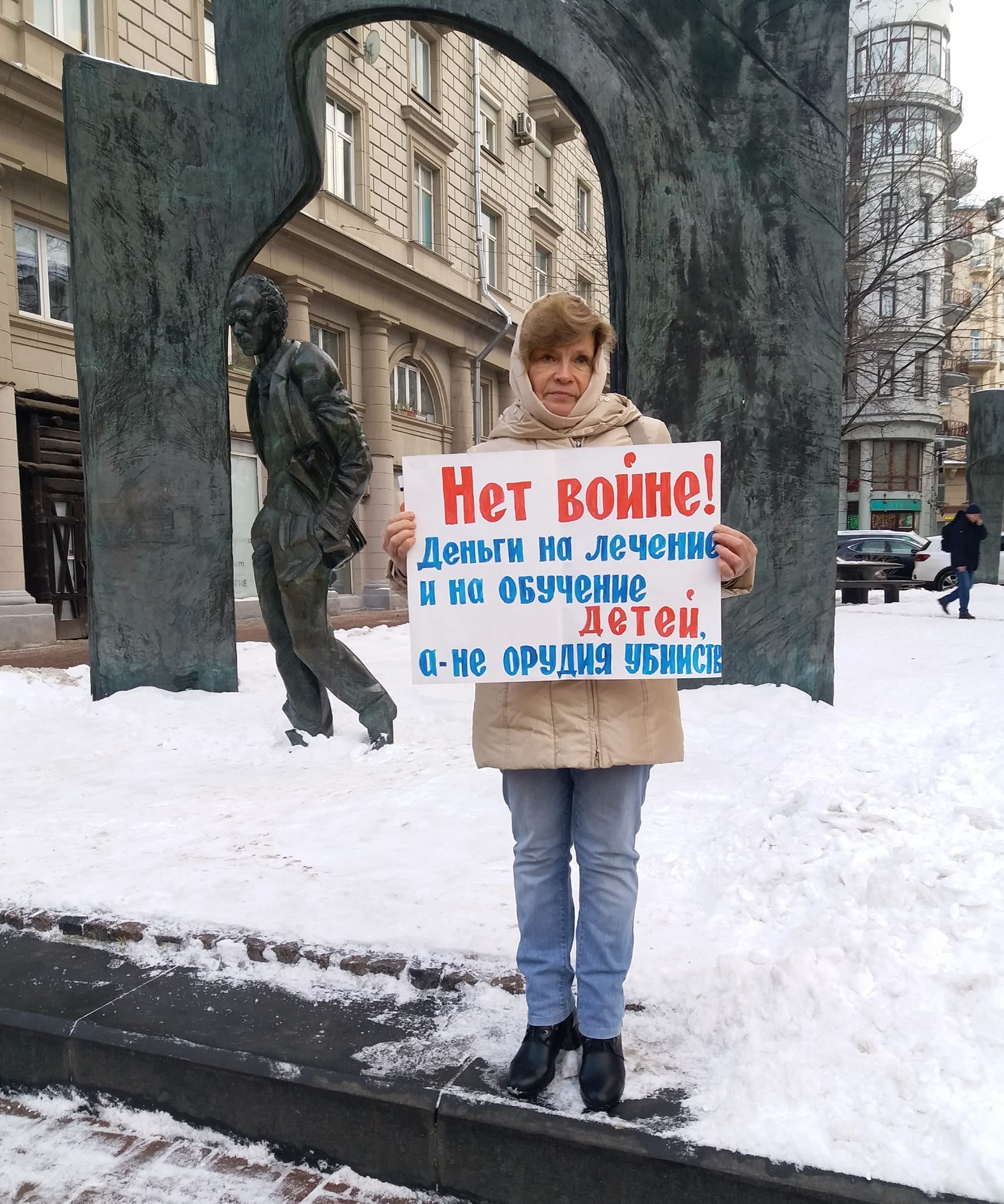
Solo pickets by Russians against the Russian government’s aggression in Ukraine. December 12, 15, 22, 27 and 28, Moscow. My deepest gratitude to these brave people. [There are several more photos at the link — TRR.]
“No to war! Money for the treatment and education of children, not for murder weapons.”