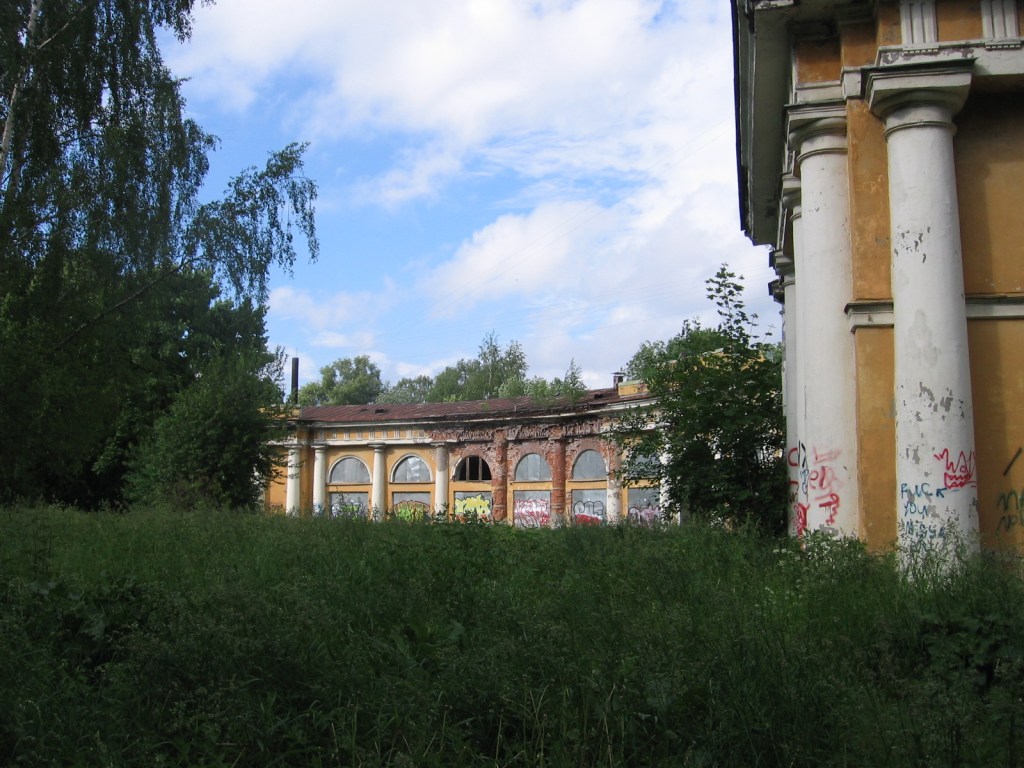
Where Apocalypse Is Now

Utkina Dacha, St. Petersburg, 17 June 2012. Photos by the Russian Reader


Last week on a bus to Leningrad, as a bottle was passed around, I got angry for Finland. The Finns aboard found this very funny. For three hours we jolted on atrocious roads through [the] Karelia[n Isthmus], former Finnish heartland gobbled by Stalin in the Winter War of 1939, then regained and lost again during the Second World War. Amid forests of birch and pine, I glimpsed a long disaster. This was my first time in the USSR (my fourth in Finland). I was unprepared for the brokenness of every human thing, the old Finnish farmhouses and lakeside villas collapsing or collapsed, the travesties of farming apart from neat kitchen gardens. The once famously cosmopolitan Baltic port of Vyborg (Viipuri in Finnish), which could be the prettiest small city in the world, felt post-nuclear, its citizens (non-Finns, with whose forebears Stalin replaced the native population) listlessly wandering. Some gaped as our fancy tour bus wallowed by. The single purposeful activity I saw in [the] Karelia[n Isthmus] was that of a man painting an ornamental fence around a roadside ammunition bunker. The contrast to Finland’s grace and bustle was unbearable.

“Vyborg,” I said to the Helsinki art critic Markku Valkonen, who has Karelian roots. “You want it back.”

“Sure, I would like it back,” he said softly, “but I do not want to spoil my life with bitterness.”

[…]

I thought of it again in Leningrad, where apocalypse is now. The city is huge and grand beyond anything I expected. Its nineteenth-century buildings by C. L. Engel, who also worked in Finland, gave me a first impression of an imperial Helsinki, with aspects of Paris and Amsterdam thrown in. But the beauty is a patch that unravels within a block of the Winter Palace, exposing uniform squalor. The tour went to the Hermitage. There I was overwhelmed by the Rembrandts and by a room of Matisses that nearly forced me to my knees. Like other lovely things in Leningrad, the staggering holdings end abruptly in 1914. Meanwhile, in a separate building of the Hermitage, there was a show of—get ready—Peter Max. I wish I could find that amusing. But the evidence of near-term Soviet vulnerability to Western hustlers is too awful. With its stupid Revolution finished, the USSR may be in for a flood of imported stupidities.

Source: Peter Schjeldahl, “Baltic Views” (Village Voice, 11 June 1991), in Hot, Cold, Heavy, Light: 100 Art Writings, 1988–2018 (Abrams Press, 2019)
A Journey Back in Time to the Isthmus

Old Pictures of the Isthmus Can Be Admired on the Net
Riina Nokso-Koivisto
Etelä-Saimaa
May 30, 2015

panorama_19094876
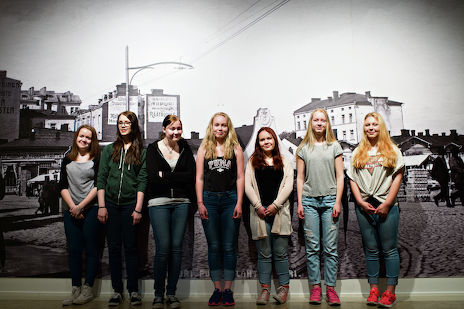
Lappeenranta eighth-graders Elina Lattu, Karoliina Suomalainen, Aino Keijonen, Henna Muukka, Henna Helsiaho, Edith Kauppinen, and Sofia Östman were involved in planning the online exhibition. Photo by Mika Stranden


The South Karelia Museum and the South Karelia Art Museum have opened a new online exhibition on the topic of the Karelian Isthmus. It can be accessed at www.aikamatkakannakselle.fi.

Extensive information on the Isthmus region—for example, old photographs and maps—has been assembled for the exhibition.

The exhibition is primarily intended to cater to school children, which is why young people’s views have been solicited since the beginning of the design process. A group of eighth graders from Lappeenranta’s Kesämäenrinne School and their teacher, Anu Sihvo, promised to help.

The students hoped, among other things, that instead of long texts the online exhibition would contain lots of pictures.

“In addition, we proposed that some games would be involved,” Elina Lattu says.

“And questions on the topic, which you can use to revise what you have read,” Henna Muukka adds.

The exhibition, Time Travel to the Isthmus, is based partly on the major exhibition Barefoot: 10 Lives in the Karelian Isthmus, which is currently on view at the South Karelia Museum and South Karelia Art Museum. Scripted by Anna Kortelainen, Barefoot is based on ten life stories, which are also recounted in the online show. The online exhibition has been scripted by Pauliina Veijalainen.

Time Travel to the Isthmus, however, will function independently.

“In a traditional show, the perspective must be strictly limited. In the online show, we have, instead, the opportunity to present broader knowledge of the Isthmus region,” says curator Mona Taipale.

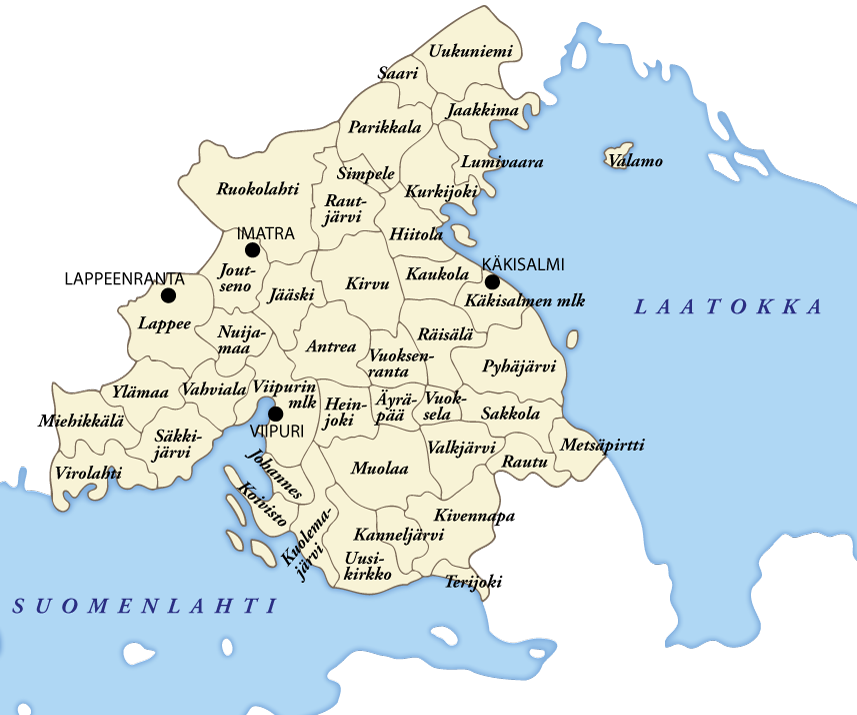
On the Time Travel to the Isthmus website one can find, among other things, old photographs from all over the Isthmus, drawn from the South Karelia Museum’s collection. The history section, for example, contains a map of the parishes or rural municipalities (pitäjät) that made up the Isthmus during the period of Finnish rule.

Pitajarajat-karttaThe parishes of the Karelian Isthmus under Finnish rule. Map courtesy of www.aikamatkakannakselle.fi

Online exhibition texts will also be available in Russian and English. Hence they can be used in history and language curriculum locally, nationally, and internationally. When the actual Isthmus exhibition wraps up early next year, the online exhibition will continue to function.

The site adapts to different environments, so it can be used on a tablet or smart phone in addition to a computer.

Translated from the Finnish by the Russian Reader. The text of the article has been slightly enhanced in a couple of instances to make it more comprehensible to non-Finnish readers.