The Keeper of Antiquities (Arkady Ippolitov, 1958–2023)

Arkady Ippolitov

In memory of an aesthete and an ethicist

“The times now are such that if you’re not in jail you can’t be considered a decent person.”

Arkady Ippolitov, in conversation with the theater critic and writer Sergei Nikolayevich, quoted with the latter’s consent

Oh, that argument sounds so much like Arkady. Although he dealt in the luxury of bygone times, sometimes he felt himself to be a proletarian of intellectual labor, and even more so, a person caught up in contemporary history. He wrote over than 600 pieces of art criticism and 29 books. The most well-known to the general readership are his trilogy Images of Italy (an homage to Pavel Muratov’s classic book): Especially Lombardy, Only Venice, and Just Rome.

The art critic, curator, essayist, lecturer, and writer Arkady Ippolitov was not at all a “keeper of antiquities,” as was suggested by his official position as curator of the Hermitage’s Italian prints. Like the protagonist of Yuri Dombrovsky’s eponymous novel, he sought to combine old and modern art, Robert Mapplethorpe and Jacopo Pontormo, Peter Paul Rubens and Peter Greenaway, the Italian Mannerists and Andy Warhol in his mind, in his articles, and in his exhibition projects.

In the late eighties, Ippolitov’s work appeared in Dekorativnoe iskusstvo (Decorative Art), one of the first respectable journals. There he published uncensored articles about European culture, not about decorative art (which then occupied a modest place in official Soviet art criticism). He expounded the theories of Jacob Burkhardt and Erwin Panofsky vis-a-vis the imaginary space of the local aesthetic, as if this location had a hope for ethical salvation. He explicated the optics of complex masses and graphic art of Piranesi, with his theory of prisons and torture. (This article would later grown into an exhibition of Piranesi’s work along with the catalogue to it.) From a historical perspective, I dare say that Ippolitov’s work in the nineteen-nineties and noughties embodied some of the naivety of the Russian post-perestroika enlightenment, whose adherents believed that Russia would develop along the European path. He curated over twenty exhibitions of contemporary Russian art. (His list of exhibitions of “classical” art is much longer.) The list of his articles in Kommersant and other democratically minded newspapers and magazines of the noughties and twenty-teens is more than impressive. In the Russian artistic context, he sought and found direct parallels between Russia and Europe: see, for example, his project Palladio in Russia, or his last major curatorial works, Roma Aeterna: Masterpieces of the Vatican Pinacotheca, at the Tretyakov Gallery, and Pilgrimage of Russian Art: From Dionysius to Malevich, at the Vatican Museums in Rome.

He was a very successful international curator. He lived an extremely modest everyday life. His wealth сonsisted of a small flat near the Hermitage and a view of the Neva River from his office at the museum. He dressed like a dandy and sometimes behaved like an aristocrat, sometimes like a bully. He loved his mother and his son very much. He had few close friends. It wasn’t easy to make friends with him, but he was a quite loyal friend. He had two vivacious wives, an Italian and a Russian, and tons of fans and admirers of both sexes.

I have two working memories of Arkady. The first memory is of him escorting me through the Hermitage’s service entrance to see his exhibition Hogarth, Hockney and Stravinsky: The Rake’s Progress. It was like seeing a theater’s secret underbelly. We were kicked out by the docents for illegal entry: Arkady’s authority as curator didn’t fly with them. Arkady did not get angry, though; instead, he laughed. The second memory is of strolling around Petersburg with him and talking about his plans for an exhibition dealing Xenia of Saint Petersburg, about how she dressed in her husband’s clothes after his death and performed miracles under his name. It was a secret conversation about transgression and transvestism in the light of metanoia.

Ippolitov was a very Petersburgian person. The city’s coldness, melancholy and depression are reflected in his striking prose. Melancholy was one of his recurring themes, both personal and curatorial. The capital of the former empire and its inhabitants are bound to be melancholic, in keeping with the story of Rome’s fall. In his gloomy text about the Summer Garden in November [published in 2013], in which he predicted his own death, there are, however, incredibly caustic passages about the taste and manners of the powers that be, both Soviet and current. And it contains this passage about Tarkovsky’s The Mirror, which expressed [Ippolitov’s] unfulfilled ideal: “The little boy leafing through a book about Leonardo in the autumnal garden is our all. He is the symbol of Russia. He is its principal value—the encounter between past and future, between child and titan, between tradition and modernity.”

Metaphysical features shone through Arkady’s earthly guise. He was a genuine angel, but one with a damaged wing as it were. In person, he was, alternately, a pure angel and a perfect demon. When polemicizing about culture and time, about beauty and truth, his severity knew no bounds. For those interested in the historical background here, he had no wish to discuss the latest public statements by the director of the Hermitage, considering it beneath his dignity. I hear his peculiar intonation when I read this phrase in a 2016 interview: “Everything my director says is true a priori.” It cannot be ruled out that the Hermitage’s administration reciprocated by ignoring him: from the mid-twenty-teens on, Arkady’s principal curatorial projects were based in Moscow.

He was so handsome, simultaneously so physically powerful (very tall, beautifully built) and so fragile, that I was amazed why he had been granted to this fallen world at all, even before the hell into which Putin turned Russia in February 2022. Arkady meant so much to the metaphysics of beauty that I would not be surprised if he were now in the Paradise of the Renaissance artists, and not even in Limbo, in keeping with Dante’s logic.

Source: Elena Fanailova, “The Keeper of Antiquities: Arkady Ippolitov’s Angels and Demons,” Radio Svoboda, 7 November 2023. Thanks to Comrade Koganzon for the heads-up. For several years not so many years ago, it seemed as if I was constantly in the midst of translating an essay, article, or exhibition catalogue by Mr. Ippolitov. It was unfailingly a pleasure to work on these projects with him. It goes without saying that I must have gained much more from these collaborations than he did, but he always made me feel that the opposite was the case. ||| TRR

Valery Dymshits: Petersburg as Mistletoe

fullsizeoutput_92e

Valery Dymshits
Facebook
October 26, 2017

In May 2016, the Akhmatova Museum hosted an event entitled Debates on Europe, featuring all sorts of outstanding people. I don’t know why, but I was invited, too. We were asked to talk about Petersburg and its place in Europe. I was also part of a special panel, entitled “How Do We See History? How Do We Deal with the Past?” I spoke my mind honestly. Today, I came across the two talks on my computer and thought I mostly agree with myself, so why not post them. So I am posting them. This is the first one, about Petersburg.

The City as Mistletoe
I probably will not be saying anything new if I note that Petersburg was originally built as the world’s largest cargo cult site. Peter the Great and his heirs firmly believed that by reproducing certain forms—and only the forms!—of European architecture and town planning, they would create a great country, a country that would rival or surpass Europe’s best countries.

When I went to Amsterdam, I was amazed by Petersburg’s resemblance to it. (Yet Amsterdam does not look at all like Petersburg, just as children resemble their parents, not vice versa.) In Amsterdam, I noticed that most of the buildings in the historic center had been built in the mid seventeenth century: the dates they were built were displayed on the façades. The entirety of Amsterdam’s huge historic center had been developed literally over twenty to thirty years. It was then I understood Peter the Great’s choice. It was not just the case that Amsterdam was among the magnificent, rich cities of Europe, but unlike Paris and other cities, it had been built not over the course of centuries, but in a few decades. Peter the Great realized that if he built another Amsterdam, so to speak, there was a chance of not only creating a hotbed of European civilization in Russia but also of living to see the project completed. This, of course, is a pure manifestation of the cargo cult.

An airplane hewn from the trunk of a palm tree may never fly, but it can be the pride and joy of an ethnographic museum’s collection. Russia did not become Europe, but Petersburg and its environs came to be a wonderful artwork, a huge artifact. I mean the Petersburg of the palaces and parks, cathedrals and embankments.

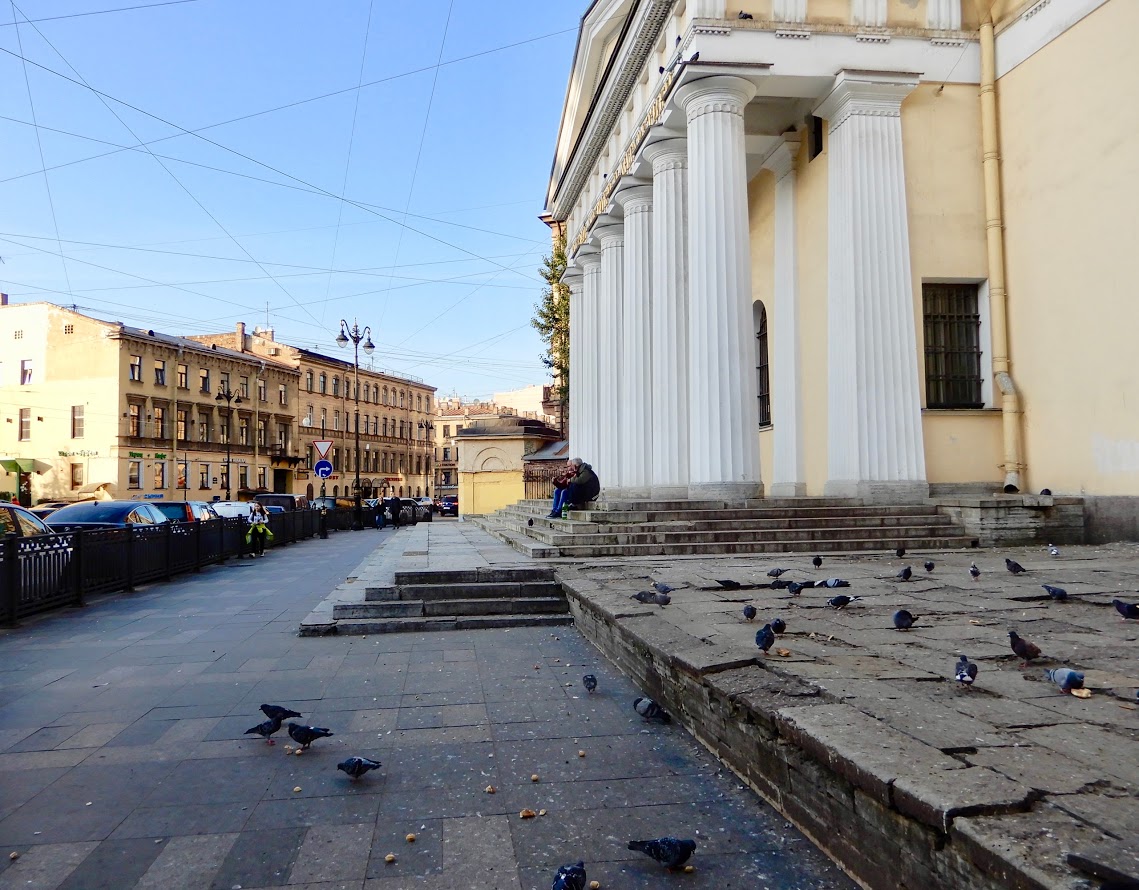
But there is another Petersburg, the one were we live. This is the city of the late nineteenth and early twentieth centuries, built after the launch of Emperor Alexander II’s great reforms. It is the city of huge tenement houses, lush façades, and endless courtyards. This Petersburg was not a frozen magic crystal nor a miraculous receptacle supposed to attract the spirits of Europe with its outward shapes. It was a city of banks and factories, shops and slums: a normal city. We love it no less than we love the city of palaces. The loading cranes in the port and factory smokestacks dominate the city’s skyline as much as its domes and spires do.

But this city, in turn, woud not have emerged if the the first city had not been built. (And it was certainly built on the bones of its builders: animist religions involve human sacrifice.) A cargo cult is a religion and, as such, is no worse than any other religion. A religion’s truth is defined by the fanaticism of its adherents. The Russian cargo cult fashioned a great, artifact-like city. Like a colony of honey fungus inhabiting an old stump, another city sprang up from the first city, and this second city was real.

In fact, the Slavophile critics of Petersburg and the Petersburg period of Russian history were right when they argued that substantial homegrown grounds were needed to really build a great country, not empty, borrowed shapes. But by the time this criticism had become widespread, from the Populists on the left to the Black Hundreds on the right, it had already lost its main justification. Petersburg had become a natural, organic phenomenon, something that had sprung from the culture, not from the soil. As second nature, culture is no worse than nature per se.

Petersburg resembles mistletoe, a parasitic plant that grows on the branches of other trees. Mistletoe is quite beautiful. Since antiquity, it has been a symbol of life, and it was used as an amulet. The Romans and the Celts believed in mistletoe’s miraculous powers. It was a symbol of peace among the Scandinavians. It was hung on the outside of houses as a token travelers would be provided shelter there. If enemies happened to meet under a tree on which mistletoe grew, they were bound to lay down their weapons and not fight anymore that day. Mistletoe protected houses from thunder and lightning, from witches and maleficent spirits.

I would argue it is productive to compare Petersburg with mistletoe, with a beautiful, sacred, safeguarding parasite. We know that people do not quarrel under the mistletoe, but kiss and make up. Petersburg did not make Russia Europe, but the city has become a place where Russia can meet and talk with Europe. This is more or less understood by everyone, by the Russian regime and by its opponents.

Every country, region, and city tries to develop by relying on its own resources. Our resource is distilled culture, cut off from all soil. Let us imagine the Hermitage Museum is a typical mineral deposit, something like an oil well. It differs from other major museums since it is not a cultural feature of a major country and major city, as the Louvre is a a cultural feature of France and Paris. On the contrary, to a certain extent Petersburg is a feature of the Hermitage. I am not speaking of tourists. They have places to go besides Petersburg. I am arguing that, having emerged as the shrine of a cargo cult, Petersburg gradually turned into a condensed expression of European cultural know-how, projected onto a wasteland. The know-how was all the more important, since European cultural shapes have been purged, in Petersburg, of all ethnic specificity. It is a generalized Europe.

The question of how to fill these shapes is open. It is open to everyone: to Europeans, Russians, and Petersburgers alike.

Photo and translation by the Russian Reader. I would like to thank Valery Dymshits for his kind permission to let me translate his essay and publish it here.