
“My friends died at the hands of Russian soldiers. Why can’t I talk about it?”
This question will cost Varvara Volkova 7 years in a Russian penal colony. Here’s her story.
Varvara was a flight attendant, not an impassioned political activist. In a neighbourhood chat, she stated the obvious: Russian forces are killing civilians in Ukraine. The prosecution framed it as “fake news” motivated by hatred toward the armed forces, and the court accepted it.
The mechanism used to go after her relies on a Soviet-style culture of snitching: a Russian tank driver complained about her comments, then a professional informer, who intentionally hunts dissidents, amplified the case and demanded she be jailed.
In fact, there’s a whole network of these informers — they call themselves “SMERSH.” For those who don’t know Russian history, it is a reference to Stalin’s WWII counter-intelligence service. It means “Death to Spies” — a direct revival of the terror methods of the 1930s. They published screenshots of her messages everywhere trying to ruin her life; claimed she called the soldier a “fascist”; said she offered to make tea for Ukrainian soldiers if they reached the Moscow region. For words spoken in anger, the system decided to smash her life to pieces.
There is a grim irony in this tragedy: the regime destroyed Varvara to protect the “honor” of the military and her accuser. But the tank driver who reported her is already dead: he was killed in the war earlier this March.
Observers abroad often underestimate the price of resistance in today’s Russia. It is not just a fine anymore, but years and years of one’s life. Varvara Volkova shows us the true bill — and it is devastating.
I track the consequences of speech in modern-day Russia, make sure to follow for more updates.
Source: Khodorkovsky Communications Center (Facebook), 25 November 2025
Preface by the Editorial Board: Below we publish the translation of an article of our Russian comrades about state repression in their country. The article reports, among others, about the situation of comrade Felix Eliseev. He has been in prison for 2.5 years as part of a 14-year prison term. Felix was sentenced for “treason” as he was accused of making propaganda against Putin’s imperialist war against Ukraine and sending money to Ukraine to buy weapons. While the prison authorities do everything to break him, Felix does not lose his spirit and endures his imprisonment stoically. (See https://www.thecommunists.net/rcit/felix-eliseev-a-revolutionary-communist-in-russian-prison/)
We call readers to support Felix by spreading this information about a communist and anti-fascist serving an unjust sentence!
You can also support Felix financially at www.paypal.me/irinablackbook, with the note “for Felix”.
* * * * *
According to the human rights organization Memorial, there are currently over 1,000 political prisoners in Russia, while other groups estimate the number could be as high as 2,500. This number is three times higher than in 2020, more than twice as high as in 2022, and continues to grow. In 2025, there was a sharp increase in criminal cases under articles on “justification of terrorism,” “sponsoring terrorist activity,” and “treason.” This is not due to increased terrorism, but to the fact that the security forces, having perfected their repression mechanisms, have begun to intensify their crackdown on “sponsorship” cases, such as those of the FBK (Anti-Corruption Foundation, recognized as an extremist organization in Russia) or cases related to money transfers to the Ukrainian army, which occurred back in 2022. The term “terrorism” itself has become so vague that even the average person doesn’t always understand what it actually means.
Among political prisoners are many individuals with progressive leftist views, serving time for anti-war activities or “inaccurate” public statements online. The “Foundation for Support of Left-Wing Political Prisoners” provides support to at least some of these individuals. Among them are: defendants in the “Tyumen Case”; defendants in the “Chita Case”; Anton Orlov, a trade union and leftist activist, coordinator of the independent medical workers’ union “Action” in Bashkortostan; Daria Kozyreva, an activist from St. Petersburg known for her anti-war protests and criticism of the Russian army; Gagik Grigoryan, a young activist imprisoned in 2023 at the age of 17; Azat Miftakhov is a Russian mathematician and anarchist, sentenced in 2021 to six years in prison for allegedly setting fire to the United Russia office in 2018. After serving this sentence, he was arrested again in 2023 on charges of “justifying terrorism” in a private conversation with a prison cellmate and sentenced to four years in prison; defendants in the “Kansk teenagers case”; defendants in the “Network case”; Boris Kagarlitsky is a left-wing publicist known in many parts of the world; Ruslan Ushakov is the author of articles published on opposition Telegram channels, sentenced to eight years in prison for posts in a public chat.
The case of the communist Felix Eliseev
Another political prisoner is Felix Eliseev, a Russian communist, blogger, and administrator of the Telegram channels “She Fell Apart” and “Kolkhoznoye Madness.” He was arrested in December 2022 and charged with justifying terrorism. According to investigators, Eliseev posted two anti-war posts on his Telegram channel, one of which endorsed a Ukrainian Armed Forces helicopter strike on an oil depot in Belgorod. The charges were later upgraded, and Eliseev was charged with “treason”. The court alleges that he transferred funds through a cryptocurrency account to a “curator,” who used the funds to purchase equipment and weapons for Ukrainian Armed Forces soldiers.
Felix, like many other political prisoners convicted of “terrorist and extremist” offenses, is serving his sentence under intense pressure from the prison administration. He is regularly placed in solitary confinement cells, where they do everything they can to break him mentally and physically.
However, political repression in Russia involves more than just horrific criminal cases of “terrorism,” “treason,” and other “betrayals of the nation.” It also includes the persecution of undesirable and dissenting youth who dare publicly speak out against the war and the ruling elite, thereby gathering many other concerned young people around them.
The “Stop Time” case
One example of such government abuse is the “Stop Time” case. The “Stop Time” case concerns the persecution by Russian authorities of members of the St. Petersburg street music group “Stop Time” – Diana Loginova (pseudonym Naoko), Alexander Orlov, and Vladislav Leontyev – for their participation in impromptu concerts, including one near the Ploshchad Vosstaniya metro station, where they performed anti-war songs by artists designated by the authorities as “foreign agents.” On October 16, 2025, Loginova was arrested and sentenced to 13 days of administrative arrest for performing a song by an artist unpopular with the authorities. The other members of the band were also arrested and sentenced to 12-13 days. These events resonated in the media (both pro-government and opposition) and society, becoming a topic of discussion in the context of artistic freedom and the tightening of censorship in modern Russia.
On October 29-30, the musicians received another 12-13 days of arrest, and on November 11, two of them were arrested for another 13 days. On November 23, the musicians were released from arrest. The lead singer and one of the band members left Russia that same day.
In many Russian cities, street bands followed “Stop Time’s” example and performed opposition songs by artists-foreign agents to large audiences in public squares. They also faced pressure from the authorities and harassment from Z-Neanderthals.
Also, recently, spiders in a jar have started eating each other. Criminal cases have been brought against several well-known military Z-bloggers for discrediting the army! More than two years after Strelkov’s imprisonment and Prigozhin’s murder, a new steamroller of repression is purging those loyalists who are too undesirable.
All of the above demonstrates that Russian society has no legal means to publicly express its attitude toward the events unfolding around it. For any word “against,” the sword of Damocles of Russian justice hangs over every citizen. Despite this, concerned Russians, especially young people, are finding ways to rally together and show the world that not all is lost in this country.
Meanwhile, cowardly security officials and government officials tremble at the mere thought that the masses will sooner or later awaken from their slumber and rise to deliver justice to the imperialist oppressors in the Kremlin. In Russia, literal punishments are being introduced for thought crimes. Thus, in September of this year, an administrative law punishing “searching for extremist materials” came into force. This law allows the FSB to view any citizen’s internet search history, and if it contains views of materials deemed extremist or terrorist, the user faces a visit from masked officers and a fine. The first cases under this law have already been filed.
Furthermore, the country is introducing a so-called “white list” for the internet—only those websites approved by Roskomnadzor are permitted to be accessed; others are inaccessible, and VPNs cannot be connected. So far, in the spirit of Russian tradition, this system is poorly functioning and flawed, but the day is not far off when Russian society will find itself locked in a “cheburnet.” (*)
Freedom for political prisoners!
For freedom of speech, conscience, and the internet!
Down with political repression!
Radical democratization of the country, not the fascist regime of a dictator!
All power to the working class and the working masses, not to a handful of oligarchic monopolists!
(*) Cheburnet is a mixture of two words: Чебурашка (Cheburashka) and internet. Cheburashka is a character from Soviet cartoon for children. Despite it is kind and helpful, in modern mass consciousness it is associated with Soviet censorship. So cheburnet basicaly means internet under the censorship of Russian government and intelligence agencies.
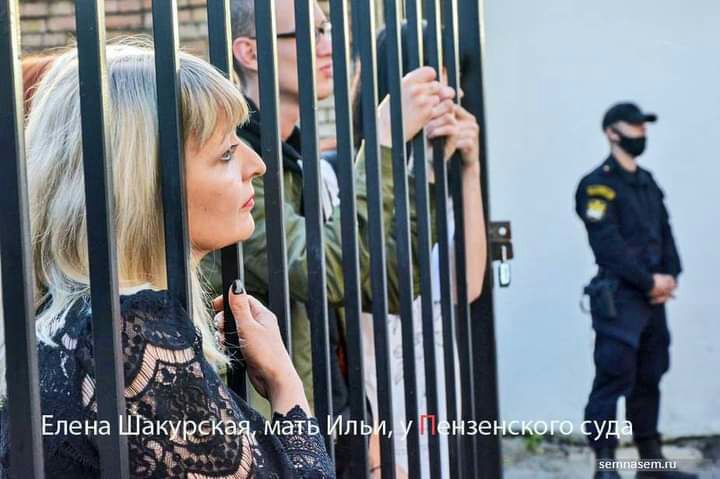
An appeal from Elena, mother of Ilya Shakursky:
My name is Elena Nikolaevna Bogatova, and I am the mother of political prisoner Ilya Alexandrovich Shakursky. I am crying out for help to save my son so that he does not rot away in solitary confinement.
They took my only son away when he was twenty-one years old. He is now twenty-nine. He has been tortured. He has serious health problems that we still cannot solve. He still has eight years to serve, and they could turn him into a disabled person. I cannot help him on my own, so I am asking all caring people to help us.
It is impossible for a mother to know that her child is being destroyed, and that she cannot save him!
Although he committed no crime, he is in prison under the harsh Article 205 [of the Russian Criminal Code; Article 205 proscribes “terrorist acts”], enduring all the hardships of prison life, without ever receiving any encouragement; we cannot even hope for parole. Right now, [the prison authorities] want to turn him into repeat offender so that he cannot have any visits, phone calls, letters, or packages. They want to take everything away from him.
I ask you to write an appeal. I understand that there are many of us now, and everyone is exhausted. But we must stand together for the sake of our loved ones, for the sake of the younger generation, which is currently being destroyed. Hear the cry of a mother who cannot bear the pain for her son and for all those behind bars. If we push with our shoulders, the walls will collapse….
Source: Elena Shakurskaya (Facebook), 28 November 2025. Translated by the Russian Reader
OVD-Info Faces a Critical Situation: We Have Lost All Our Ruble Donations
26.11.2025
Russian payment services have refused to continue working with us, without providing any explanation, and have cut off our ability to accept one-time and recurring donations. This has severed our connection to our main source of support—the 12,000 individuals who regularly transfer money to OVD-Info.
The services’ refusal to cooperate with us is one of the many manifestations of state pressure on human rights organizations and independent media. Some of them even had to close due to the loss of donations in rubles.
This is a severe blow to our work. With these donations we were able to pay for the work of defense lawyers and legal experts, travel to the regions, maintain our free hotline, and help those who are politically persecuted in Russia. Furthermore, regular donations allowed us to plan our long-term work and development.
We do not plan to close or reduce the scope of our work, because repression is not diminishing. Any political activity, expressing a view against the invasion of Ukraine, or criticism of Putin instantly becomes grounds for persecution. We simply cannot abandon Russians to face this brutal, repressive system alone. We are defending over 90 defendants in criminal cases, almost every day we send lawyers to police stations, courts, searches, penal colonies, and pre-trial detention centers. We answer dozens of messages and calls daily—and we want to continue doing this.
However, now everything depends on whether we can find another 12,000 people who will regularly support OVD-Info.
Source: OVD Info

The Second Western Military District court in Moscow last week sentenced Yulia Lemeshchenko to 19 years’ imprisonment for high treason, sabotage, and preparing and training for an act of terrorism.
Yulia, 42, is a Russian citizen, born in Staryi Oskol, in Belgorod region. She lived in Voronezh in southern Russia, until 2014. Then she moved to Kharkiv, Ukraine, with her son and her husband, who had found work there. Later on the couple separated.
Yulia took up powerlifting and in 2021 was named Ukrainian women’s champion.
In 2024 Yulia did military training in Kyiv – firearms, explosives and flying drones – and returned to Russia, via a third country. She sabotaged power transmission infrastructure near St Petersburg, and in Voronezh conducted surveillance on Aleksei Lobodoi, an air force commander responsible for bombing Kharkiv.
Yulia was arrested in January this year. She did not deny the facts outlined in the prosecution case, but told the court that “from a moral standpoint” she considered herself not guilty. This is a translation of her final statement to the court, published by Mediazona.
=
As you see, I don’t have any sheets of paper and I haven’t especially prepared, but I think I will improvise. I will now probably say a few things that were already said during this hearing, but let this be a sort of summing-up, in a monologue.
So I already spoke here about the fact that, in any war, two sides clash, and each side insists that it is right and that its cause is just. I took one of these sides. I am not a citizen of the country for which I decided to fight, but, all the same, for me, Ukraine is home. I love that country. And I love Kharkiv, with all my heart.
There is a district in Kharkiv called Severnaya Saltovka. About 500,000 people lived there. Half a million. A few people I knew lived there. My hairdresser lived there. After the Russian shelling and bombing, not a single house in that district was left undamaged. Not a single one. And I am not just talking about a few broken windows. I am talking about whole blocks of flats in ruins.
Right next to the block where I lived, there were explosions. In my block, on the ground floor, my neighbour Anya lived with her four-year-old son Nikita. A shell exploded right under their window. Their apartment was completely destroyed. What has happened to Anya and her son I don’t know. I don’t know whether they are still alive.
Friends of mine have died in this war, one relative – my second cousin – and colleagues of mine. War is monstrous. I could not stand aside. When war comes, people who are affected can either try somehow to fight, or they can flee. People flee – I don’t know – maybe because they are cowardly or weak. I don’t consider myself to be a cowardly or weak person. So I decided to fight back – to fight against Russian military aggression.
It is possible that, by saying these things, I am getting myself still deeper into trouble. But my honour, and my conscience, are important to me. I did what I believed to be necessary. I did what I could. To regret, to repent – who knows, maybe I will do that on my deathbed. But for now, what will be, will be. I have nothing further to say.
=
When the court hearing began, Mediazona reported that the judge, Vadim Krasnov, read out evidence that Yulia gave after being arrested in January. After the all-out Russian invasion of Ukraine in 2022, Yulia at first moved to Germany. In 2023 she returned to Ukraine and made contact with the “Free Russia” legion, but did not join.
In 2024, when she did her military training, the instructors – who did not answer questions about which part of the armed forces they served in – said that, by way of payment for her work, she could receive Ukrainian citizenship.
The judge asked if she had done so, to which she replied, with a smile, “not yet”.
During the hearing, Judge Krasnov asked Yulia why she had chosen such a radical method of struggle, rather than, for example, providing medical help to the wounded.
“I can only answer that question with another, rhetorical question”, she replied. “Why did Russia decide to use violent methods to destroy Ukrainian cities? A war had started. Do you understand?”
The judge responded that, by 2022, the war had already been underway for eight years. Yes, but it had become frozen, Lemeshchenko said. After the invasion, she wanted to help Ukraine however she could, and was invited to become a saboteur.
“How far were you prepared to go?” asked the judge. “I did not want to do anything that would take human lives”, Lemeshchenko replied. “They accepted that point. On that we had an agreement.”
The judge said that the sabotage Lemeshchenko carried out near St Petersburg left hospitals without electric light. She replied that the aim had been to paralyse a drone factory, that she was sincerely sorry if anyone in Petersburg had suffered. And that she and her son had many times sat in their apartment, without light, when Kharkiv was being bombed.
Lemeshchenko also told the court that, during interrogation, agents of the federal security service (FSB) had threatened to murder her, and pushed her head against a wall. She had tried to tell them the truth. She said that she did not retract her evidence – and nor would she complain about her treatment, as she did not believe that those responsible would be punished.
□ Here is Yulia’s statement in court, recorded with English interpretation. Yulia is recognised as a political prisoner by Memorial, and her case was reported by the Kharkiv Human Rights Protection Group.
□ The last word in court by Anton Khozhaev, a trainee officer accused of desertion to the Ukrainian side, and more on Russian anti-war protesters
□ Voices Against Putin’s War, just published by Resistance Books, includes 12 statements by anti-war protesters and associated material. The livestream of a launch event is here. 27 November 2025.
Source: “‘I decided to fight back. Ukraine is my home.’ Yulia Lemeshchenko’s final word in court,” People and Nature, 27 November 2025
