















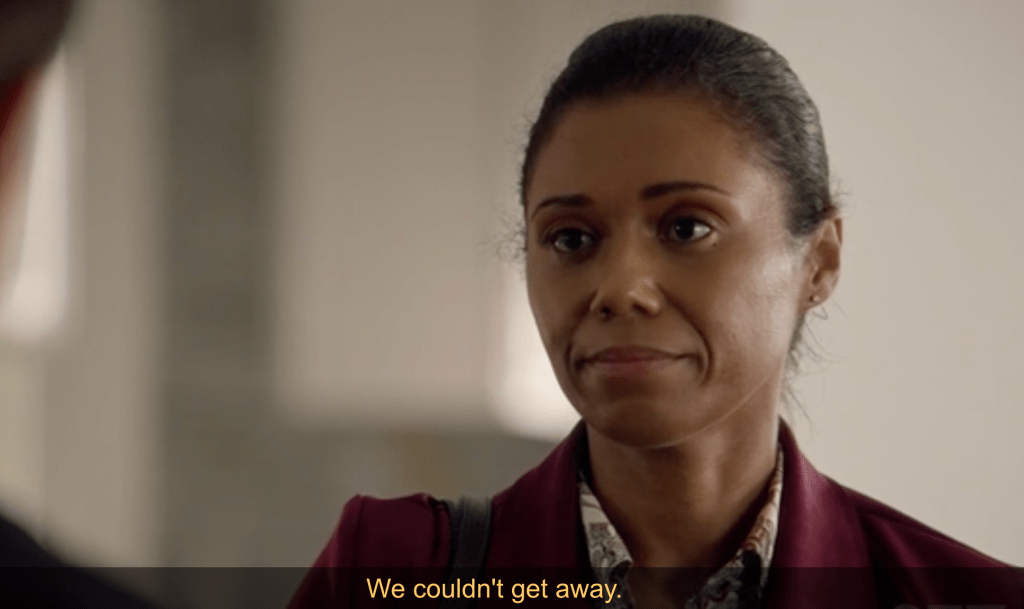

Source: The Rookie, Season 3, Episode 11: “New Blood.” You can read more on the 1985 MOVE bombing here.
“I’m terrified at the moral apathy, the death of the heart, which is happening in my country. These people have deluded themselves for so long, they really don’t think I’m human. I base this on their conduct, not on what they say. And this means that they have become, in themselves, moral monsters.”
–James Baldwin
LET’S GET THIS OUT OF THE WAY: When it comes to the recent deaths of immigrants being held in detention, it would be wrong to describe the situation as wholly unprecedented. Detainees died under Bush, Obama, and Biden. But detainee deaths have accelerated during President Donald Trump’s second term, with 17 already since his inauguration. During the Biden administration, there were 26 deaths in 48 months—roughly one death every two months. During Trump’s term, that rate has nearly quadrupled. And ICE, now one of the best-funded operations of the federal government, is planning to double detention space before the end of the year.
“It’s absolutely horrific,” Rep. Pramila Jayapal (D-Wash.), the ranking member of the immigration subcommittee, told me before jumping into the numbers above. In July, ICE was awarded $45 billion to expand its operations—its budget is now significantly larger than that of the federal prison system. And now, Jayapal points out, a little-known LLC has been awarded a $1.2 billion contract to build a facility in Texas despite never having previously won a federal contract for more than $16 million. Meanwhile, another $2.25 million contract was given to a Republican donor who received a presidential pardon from Bill Clinton in 2000 after having pleaded guilty to mail fraud.
“Contracts are being distributed to Trump’s buddies and people with no experience running detention centers, many of these contracts are no-bid,” Rep. Jayapal said. “They’re incarcerating people and allowing them to die, not providing medical facilities. There are no standards. It’s horrific.”
Most ICE and border patrol agents will continue working during the government shutdown; their status as “essential” will shield them from the layoffs OMB director Russell Vought has requested in lieu of furloughs from most agencies and departments. But the nature of immigration officers’ “essential” work has significantly changed over the past eight months to become something far more brutal than procedural; in some cases, it has come to appear simply heartless. We have entered a period in which it is becoming important to ask: What happens when our leaders and the people who work for them see immigrants not as human beings but as scum? And what happens when that way of thinking about people starts also to be applied to others, like journalists and political opponents?
THE QUESTION OF DEHUMANIZATION isn’t theoretical. Consider the case of Hediberto Ramirez Perez. He was detained on September 4 and wrongfully deported to Guatemala despite having a U.S. work authorization card to work at a factory in upstate New York. Body-camera footage from the scene of the arrest, obtained through a Freedom of Information Act request, recorded the unguarded comments of a federal agent describing his time at the Ursula detention center in McAllen, Texas, where Perez would be sent.
The agent said he routinely denied detainees’ use of a telephone and requests for medical attention:
I would not let anybody out of their cells, so we did it in an orderly fashion, had them all lined up. It’s bathroom time, or it’s f— brush your teeth time, or it’s food time. Other than that, nope, your a— is staying in there. “But you can’t do that.” I absolutely can. “I need a phone call.” No you don’t. “I need to go to medical.” Nope, you look good to me.
“They’re animals anyway,” the agent said. “That’s what I would tell my kids all the time.”
Or consider the case of Silverio Villegas-Gonzalez. On September 12 in Chicago, he had just dropped off his 3-year-old son at day care when an unmarked car pulled in front of his own. Less than a minute later he was dead, killed by an ICE agent.
The Department of Homeland Security was quick to tell us a story of a terrible immigrant who resisted arrest, dragged an agent with his car, and threatened public safety, until he was put down by one of our brave immigration agents.
Well, there is more to the story, including some inconvenient video. As the Chicago Sun Times reported, the footage shows the agent was fully mobile after the shooting and said his own injuries were “nothing major.”
“DHS lied about what happened,” Rep. Delia Ramirez (D-Ill.) said on X. “There needs to be a full, thorough investigation into what happened that morning. All camera footage must be released. And [DHS Secretary Kristi] Noem must come to the [House Homeland Security] committee and account for ICE’s unlawfulness and lies.”
Twelve days after the death of Villegas-Gonzalez, a gunman opened fire on an ICE facility in Dallas killing one immigrant, Norlan Guzmán-Fuente, and injuring two others, one of whom, Miguel Ángel García-Hernández, died a few days later.
How did the agencies and Vice President JD Vance describe the situation? “The obsessive attack on law enforcement, particularly ICE, must stop,” Vance wrote, adding a prayer for everyone hurt and their families. FBI Director Kash Patel revealed that unspent casings had the words “Anti-ICE” on them, without mentioning that the people shot and killed were immigrants.
Immigrants have suffered particularly since Trump returned to the White House, but they are not the only group to have been openly abused. We’ve also seen protesters, Democrats, and journalists attacked, violently assaulted or shot at. It is worth wondering whether a tragedy involving one of these groups could come next.
In Chicago, CBS News reporter Asal Rezaei was driving with the window down when a pepper ball shot by an ICE agent hit the side of her truck, releasing chemical agents inside the cab of the vehicle, inflaming her skin and causing her to vomit. Needless to say, the shooting could have led to serious injury or worse.
On Tuesday, photographer Stephanie Keith posted a video of ICE agents violently throwing to the ground two photographers at the federal courthouse, causing one to be taken out on a gurney.
“ICE is operating as this rogue force, and I’ve never seen anything like it,” Jayapal told me. “Violence is being performed, encouraged, and perpetrated from the top by the White House. . . . they put out these videos celebrating this ethos, that kind of violence they celebrate of all of the masked ICE agents kidnapping people. You look at these videos and think you must be looking at some other country.”
“Carrasquillo, Is There Any Hope?”
I used to have a hilarious colleague, Nicolás Medina Mora, who would randomly say the line above to me. This was circa 2016, if you get my drift. I think of it now because Bulwark readers frequently write to us saying that they appreciate the importance of our reporting but they’re often left grasping for hope or looking for some way forward—signs that good people are still fighting back.
What was reinforced working on today’s newsletter is that the effect of such violence extends beyond its immediate targets, affecting the community at large and interfering with everyday life. But Americans are mobilizing to protect their neighbors and communities. In response to ICE operations conducted around schools, Lorella Praeli, the co-president of Community Change, created the Kids Belong in Classrooms campaign, led by a coalition that includes the two big teachers unions, the American Federation of Teachers and the National Education Association. The goal is for Americans to step up to share best practices and create new tactics to shield their immigrant community members from ICE enforcement near schools. The idea was tested in Washington, D.C., when the National Guard came to town. Within twenty-four hours, a thousand people RSVPed to join the call. Last week, 1,700 people from around the country—including educators, community members, parents, and child-care providers—joined a second call.
“Having ICE enforcement presence outside and around school zones is having a chilling effect not just around immigrant communities, but also disrupting communities writ large,” Praeli told me.
In Dallas, Pastor George Mason has been leading vigils since May outside the Dallas ICE facility where the immigrants were shot and killed. A group of two dozen or more gather to pray and be a supportive presence for immigrants presenting themselves for check-ins. They also pray for the people working for ICE.
“We want ICE to know we’re there, we pray for them, for their safety, but also for their conscience,” he told me. “We’re all aware they have a job to do and they don’t necessarily control what they have to do, but they can control how they do it and how they treat people. We want to be a reminder to them of the humanity of these people.”
With the facility closed after the shooting, Mason’s flock hasn’t held a vigil there, but the pastor plans to return with his group every Monday to bear witness.
I asked him what he would say to people who are following the brutal actions of ICE and feeling increasing despair. He took a breath and a beat to answer.
“What I would say is that history is full of periods when we did not see light in the midst of the darkness. And just as we are surprised that this is taking place right now, we can be surprised by the light that comes, too,” he said. “I think that people can’t stop believing in what is good and right and pursuing it, and although there is no inevitability of an outcome that is rosy and hopeful, there won’t be that future if we don’t persist in pursuing it.”
Source: Adrian Carrasquillo, “The ‘Moral Monsters’ Among Us,” The Bulwark, 1 October 2025. I have depaywalled and shared this article, a practice I would encourage all my readers to engage in, if only because none of us can afford to subscribe to every publication worth supporting. Journalism like Mr. Carrasquillo’s is a public good and should be freely available to everyone. ||| TRR
What if the early morning raid on Chicago’s South Shore apartments wasn’t really about crime or an immigration sweep at all?
What if the real motive is darker?
Perhaps a collusion between federal forces and real estate power working hand in hand to purge Black and Brown communities, to accelerate gentrification, and turn dispossession into profit? After all, our current president isn’t just a politician; he’s a landlord, a developer, and a man who has always seen people as obstacles and buildings as cash flow.
Let’s recap.
On Oct. 1, just after 2 a.m., Black Hawks thundered over 7500 S. South Shore Drive. Federal agents fast-roped onto the roof while U-Hauls and Budget rental vans unloaded hundreds more in combat gear. They carried military-grade rifles fitted with mounted flashlights designed to disorient enemy combatants. They kicked in doors, shattered windows, and ransacked units. Inside were Black Chicagoans, Latino migrants, U.S. citizens, elders, and terrified children. Everyone, including a naked baby, was dragged into the night. Residents described being zip-tied and herded into vans where they were detained for hours while agents checked IDs, citizenship status, and for arrest warrants.
“They just treated us like we were nothing,” said resident Pertissue Fisher, speaking to CBS News.
By dawn, the Department of Homeland Security was touting arrest numbers, and the media megaphone was repeating a word designed to sanitize everything that followed: gang. In the raid’s wake, tenants returned to find their apartments ransacked, belongings stolen, doors broken, blood stains next to baby shoes, and waivers from DHS fluttering on the gates.
Despite the helicopters and hundreds of agents, the government has provided strikingly little clarity about who exactly was arrested. DHS announced that 37 people were arrested, but has released no full roster of names or charges. I combed through reports from WBEZ, CBS Chicago, ABC7, the Chicago Sun-Times, and even national outlets like People and Fox affiliates to see what had actually been verified. The story that emerges is less about solid evidence than about narrative management.
Federal officials claim that those arrested “are believed to be involved in drug trafficking and distribution, weapons crimes, and immigration violations.” That line has appeared in WBEZ and CBS reporting. But when pressed, DHS has not disclosed which of the 37 are accused of which offense or produced court documents tying individual arrestees to those allegations.
DHS also asserted that the South Shore building was “frequented” by members of Tren de Aragua, a Venezuelan gang, and claimed some of those arrested were tied to it. That assertion has been echoed in WBEZ, CBS, and the Sun–Times. Yet no public evidence has been released showing that any of the 37 arrested can be definitively matched to Tren de Aragua membership. It remains a floating allegation without names, records, or trial documents to back it up.
What has been confirmed by numerous outlets is that U.S. citizens were swept up, too. WBEZ reported on Rodrick Johnson, a 67-year-old citizen, who said agents broke into his apartment, zip-tied him, and held him for hours even as he demanded a warrant and a lawyer. What is still unclear is whether these citizens were included in the count of 37 or were collateral detentions not reflected in the official number.
The sweep also spilled beyond South Shore. ABC7 reported that four more people were detained at a Bronzeville shelter the next morning, though it remains ambiguous whether those individuals were part of the same operation or separate follow-on actions.
Perhaps most telling is what advocacy groups have uncovered. WBEZ noted that DHS has released names in some other “Midway Blitz” arrests statewide, but about half of those names and alleged charges cannot be matched to court records. That points to a larger transparency gap: DHS now claims more than 900 arrests across Illinois under this blitz, yet has offered few verifiable details. If the agency cannot, or will not, produce reliable documentation for hundreds of arrests, why should anyone accept its claims about the 37 arrested in South Shore?
What is not known remains greater than what is known. There is still no public, complete roster of the 37 arrested, no court filings that tie them all to the alleged offenses, no clarity on how many were undocumented versus citizens, and no evidence that every unit breached was backed by a warrant. We do not know which arrests were “targets” and which were collateral. We do not know who was released, who remains detained, or where. Until those answers surface, the official narrative rests more on spectacle than on facts.
What we do know is that the spectacle came right on the heels of a presidential directive given to hundreds of military leaders at a Quantico meeting.
On Sept. 30, Donald Trump told senior military leaders that America’s cities should be used as “training grounds.” Less than 48 hours later, Chicagoans were watching rope teams drop from helicopters onto a residential complex while the alphabet soup—Border Patrol, FBI, ATF—stacked doorways like they were clearing a compound in a war zone. ABC7 literally paired the raid coverage with that “training ground” remark.
Do you think it is a coincidence that a presidential line became a tactical plan overnight, with South Shore as stage one? You don’t need a conspiracy board to see the choreography. You just need eyes.
If you live in the South Shore, you already know the punchline wasn’t “public safety.” The punchline was what residents walked back into. On-the-ground reporting (and what tenants showed reporters across outlets) documented doors kicked in and left dangling, units flung open for anyone to strip bare, blood next to baby shoes, belongings tossed into hallways, birth certificates and personal papers scattered, refrigerators buzzing with flies, water damage, mold, and dark corridors that now felt like crime scenes. Property managers were seen throwing mattresses and broken doors into dumpsters.
A blind Army veteran, recently retired after decades at the Postal Service, was escorted through the wreckage he could only smell and feel. Dan Jones, a tenant who’d crashed at an aunt’s to get through the night, came home to find his mattress, iPad, and air fryer gone and trash that wasn’t his on the floor. This wasn’t collateral damage; it was a message. “It looks like hell,” Jones said. “ICE is really just a gang.”
The government’s after-the-fact script leaned heavily on the talismanic power of a label: Tren de Aragua. Yes, a defendant tied to that group was charged with murder months ago in the building. Yes, the blocks around 7400–7500 S. South Shore Drive have recorded robberies and shootings. But the leap from “there is crime in the area” to “drop from helicopters onto 130 units and ransack an entire building in the dead of night” is where public safety becomes theater. CBS’s local desk said the quiet part: information about who was actually picked up and why is “sparse,” including how many, if any, were confirmed gang members. That matters. In a democracy, you don’t get to kick in dozens of doors and hide behind a rumor.
The state wants to narrow the lens to immigration, but South Shore forces us to widen it. This raid didn’t land on a level playing field. It landed on a building that was already structured for harm by absentee ownership, speculative finance, and municipal abandonment. In other words, neglect was a precondition. That fragility was the perfect stage set.
The owner, Wisconsin investor Trinity Flood, has been fighting a $27 million foreclosure covering a trio of South Shore buildings acquired in 2020. The City of Chicago sued her LLCs earlier this year over persistent life-safety code violations at 7500 S. South Shore—fourteen failed inspections, missing fire extinguishers, filthy stairwells reeking of urine. The elevators were broken. The hallways were dark. Security guards had been removed. Tenants had tried to unionize after a gas leak left people without working stoves. In other words, long before DHS turned 7500 into a military set, this address was a case study in the violence of neglect.
When the helicopters lifted off, that neglect didn’t end. It monetized. By Wednesday afternoon, the building looked half-abandoned. Movers were clearing out now-vacant units and hauling out lives like debris, though no one could say who hired them. The movers weren’t an afterthought. They were the tell. The fact that movers were already on-site the next day implies either (a) advance coordination, (b) opportunism from management or investors, or (c) a pipeline of displacement that is so routine it clicks into place like muscle memory, and it doesn’t even need to be explained.
The South Shore raid didn’t just tear through any building. It tore through a 208-unit complex that was literally up for sale. Listed on Crexi for $15.25 million and marketed as part of the so-called “Jackson Park Portfolio,” the building had been updated with new plumbing, windows, and renovated kitchens to attract investors.
In a since-deleted listing, PropertyShark noted it spans nearly 97,000 square feet and was built in 1949, and rebranded as a lucrative opportunity in a neighborhood already under gentrification pressures. Potential buyers scrolling real estate sites saw a polished, revenue-generating asset while residents were about to come home to blood on the floors, busted doors, and their lives tossed into dumpsters. In other words, the building was both a crime scene and a commodity, where human suffering and investor profit converged on the same square footage.
[Editor’s Note: This piece was written and edited on the morning of Oct. 3. Between 11:33 a.m. when the story was turned in, and 2 p.m. as the story was going live, many of the listings and references to this building have been scraped from the internet and are not even available on the Internet Archive.]
And here’s the sleight of hand: the press keeps each piece of this story in its own silo. Local reporters cover the raid. Real estate reporters cover the foreclosure. Political reporters cover Trump’s speech. Almost nobody is braiding those threads. Civil rights groups are stretched thin, fighting a dozen fires at once. Residents are too busy surviving the wreckage to mount an analysis in real time. And for those who benefit from the cycle, the landlords, the investors, the politicians, every incentive points toward keeping the frame on “bad neighborhood cleaned up by law enforcement,” instead of “neighborhood cleared out for profit.”
If you’ve watched Chicago for any length of time, you know this play: use fear to clear, then flip. We need to question how this raid may not have been just enforcement, but a catalyst for displacement. Perhaps it was practice—yes, practice—in how to combine federal muscle with private indifference to move poor people out and “reposition” a distressed asset. That broader pattern of private equity portfolios, CMBS debt, and South Side distress has been written across the city’s trade press all year.
If we zoom back to the street, the picture sharpens.
This was a poor and working-class building where neighbors, including many Venezuelan tenants, tried to make a life the owner refused to maintain. As best they could, residents cleaned the hallways themselves. They dealt with elevators they nursed along, stoves that didn’t work for a month after a gas leak. They weren’t living in a hive of cartel lieutenants. They were living in the familiar American intersection of austerity and opportunism. They were poor, visible, and easy to raid. And once the state framed them as a threat, every smashed door and terrified child could be sold as the price of order.
Here is the uncomfortable truth that South Shore exposes: in America, policing and property are joined at the hip. You do not get a midnight helicopter assault at a 130-unit building without first having a landlord who treats that building as a spreadsheet cell instead of a home. You do not get an operation marketed as “blitz” without politics that need an enemy close to home. You do not get a skyline of rope teams without a president workshopping the phrase “training grounds” into the national bloodstream. The raid is the performance, and the displacement is the business model.
So, what would accountability even look like?
Start with the basics: release the names of the thirty-seven and the specific charges filed, with counsel protections for asylum seekers. If you’re claiming gang membership, show the filings and evidence, not adjectives. Publish the warrant inventory for each breached unit. Release the bodycam and aerial footage with timestamps, not just the sanitized sizzle reel. Provide a restitution mechanism for tenants whose doors were destroyed, and apartments left unsecured. And if the government can’t justify helicopters over a residential block at 2 a.m. to arrest a handful of truly dangerous individuals, if such people exist in this case, then the government owes South Shore an apology and a reparative plan that does not involve treating families like insurgents.
To those insisting that this is the price of safety, ask a simpler question: safer for whom?
The morning after, the only people measurably safer were the officials who got their show of force and the speculators who can now market a half-emptied, “value-add” asset. The people measurably less safe were the families in the building. It’s also why the “gangs” narrative is so crucial to interrogate. When an agency wants free rein, it invokes the worst-case scenario and dares you to rebut it without the evidence it refuses to publish.
If we zoom out from South Shore, what emerges is a political program, a pipeline that fuses immigration panic, domestic militarization, and distressed real estate into one machine of dispossession.
South Shore is the proof of concept. But Trump didn’t stop at Chicago. He named the targets: New York, Los Angeles, San Francisco, Detroit, Atlanta, Baltimore, Washington, D.C.—the “enemy cities” in his political theater. And each has the same ingredients: neglected housing stock, redlined blocks, crumbling public housing, and distressed multifamily portfolios. Visible vulnerability: migrants bused in and warehoused in shelters, unhoused encampments, Black and Brown neighborhoods starved of investment for decades. Financial appetite: developers and investment funds circling like vultures, salivating over “value-add” opportunities. And political cover: an endless loop of rhetoric branding these cities as “lawless,” “unsafe,” and ripe for a federal “blitz.”
Chicago’s South Shore raid shows the mechanics. In New York, it could mean targeting migrant-heavy hotels converted to shelters. In Los Angeles, encampments under freeways or motels in South Central. In Detroit or Baltimore, already foreclosed housing stock where families still squat. In D.C., public housing slated for “redevelopment.” The choreography is portable and travels.
This isn’t just about Chicago. It’s about a doctrine. And if the logic feels disturbingly familiar, it’s because the world has been watching the same grammar play out in Gaza. The scales are different, but the logic rhymes. Homes rendered uninhabitable not as an accident but as a tactic. Families displaced en masse under the banner of “security.” Civilian spaces turned into “training grounds” for military doctrine. Territory cleared to be reconfigured under new control. In Gaza, it’s bombardment and siege. In Chicago, it’s helicopters and code enforcement. But the grammar of collective punishment and dispossession as governance is shared.
Think again about the visuals: helicopters over a residential block, agents fast-roping onto rooftops, U-Hauls unloading men in combat gear, mothers herded out in nightclothes, children clutching their parents, doors splintered and left open. This is all occupation theater.
The message to South Shore, and by extension to every city Trump has marked for blitz, is unmistakable: we can treat your block like a battlefield. And when we do, the collateral damage isn’t just fear. It is families displaced, property values reset, and capital can be repositioned. That is not policing. That is a business model.
If DHS wants the public to believe this was about gangs, then prove it. Release the names. Release the charges. Release the warrants. Release the body cam and aerial footage. Release the evidence tying specific people to specific crimes. Until then, “gang” is not a finding. It is a cover story.
South Shore is not an isolated incident. It is the prototype for a national campaign. Trump set the frame. DHS staged the spectacle. And the real estate market is waiting in the wings. The next “blitz” could hit a city near you. The choreography will be the same: target a vulnerable building, say there are “gangs,” “illegal aliens,” or “terrorists” living there, then stage a militarized raid, destabilize tenants, and let capital swoop in.
This is not immigration enforcement. This is not policing. This is the state, in collusion with capital, practicing how to turn entire neighborhoods into training grounds. South Shore was the prototype. The next blitz could be anywhere. And if we don’t name it now, we’ll wake up to find every city turned into a battlefield, and every eviction masked as ‘law and order.’
Dr. Stacey Patton is an award-winning journalist and author of “Spare The Kids: Why Whupping Children Won’t Save Black America” and the forthcoming “Strung Up: The Lynching of Black Children In Jim Crow America.” Read her Substack here.
