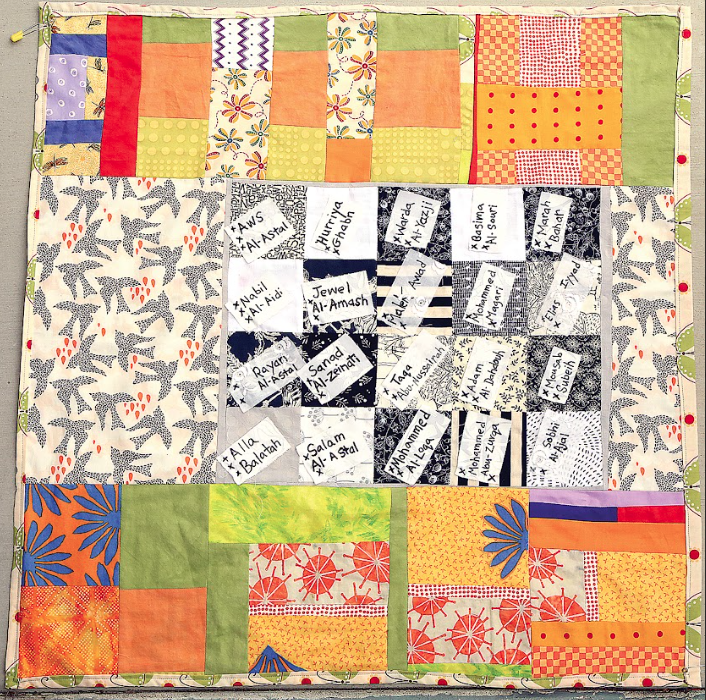
LOCAL INSPIRATION of the day. This quilt by Joleigh Kambic is part of a larger quilt titled “Babies in Gaza Who Never Made It To Their First Birthday.” The quilt is composed of smaller quilts created by nearly 40 quilters from across the Monterey Bay, commemorating the children who were killed in the Israel-Hamas war. It is on display through Oct. 3 at the Unitarian Universalist Church of the Monterey Peninsula, 490 Aguajito Road in Carmel.
Source: Monterey County NOW newsletter, 29 September 2025


Special detention center for waifs and “troubled” teens. Moscow, 1988. Photos: Igor Stomakhin
Source: Igor Stomakhin (Facebook), 1 September 2025. The first of September (aka Knowledge Day) is the first day of the school year in Russia and other former Soviet countries.
Source: “Ukraine’s Stolen Children: Inside Russia’s Network of Re-Education and Militarization,” Yale School of Public Health Humanitarian Research Lab, 16 September 2025. Thanks to News from Ukraine Bulletin for the heads-up.
Key findings
- Over the last decade, inflation-adjusted weekly wages for teachers declined by $46.39 but increased by $220.46 for other college graduates.
- The regression-adjusted relative gap between the weekly wages of teachers and college graduates working in other professions grew to a record 26.9% in 2024, a significant increase from 6.1% in 1996.
- On average, teachers earned 73.1 cents for every dollar relative to the earnings of other similar professionals in 2024—much less than the 93.9 cents earned in 1996.
- Although teachers typically receive better benefits packages than other professionals, this “benefits advantage” is not sufficiently large to offset the growing wage penalty that teachers face. In 2024, the teacher total compensation gap was -17.1%.
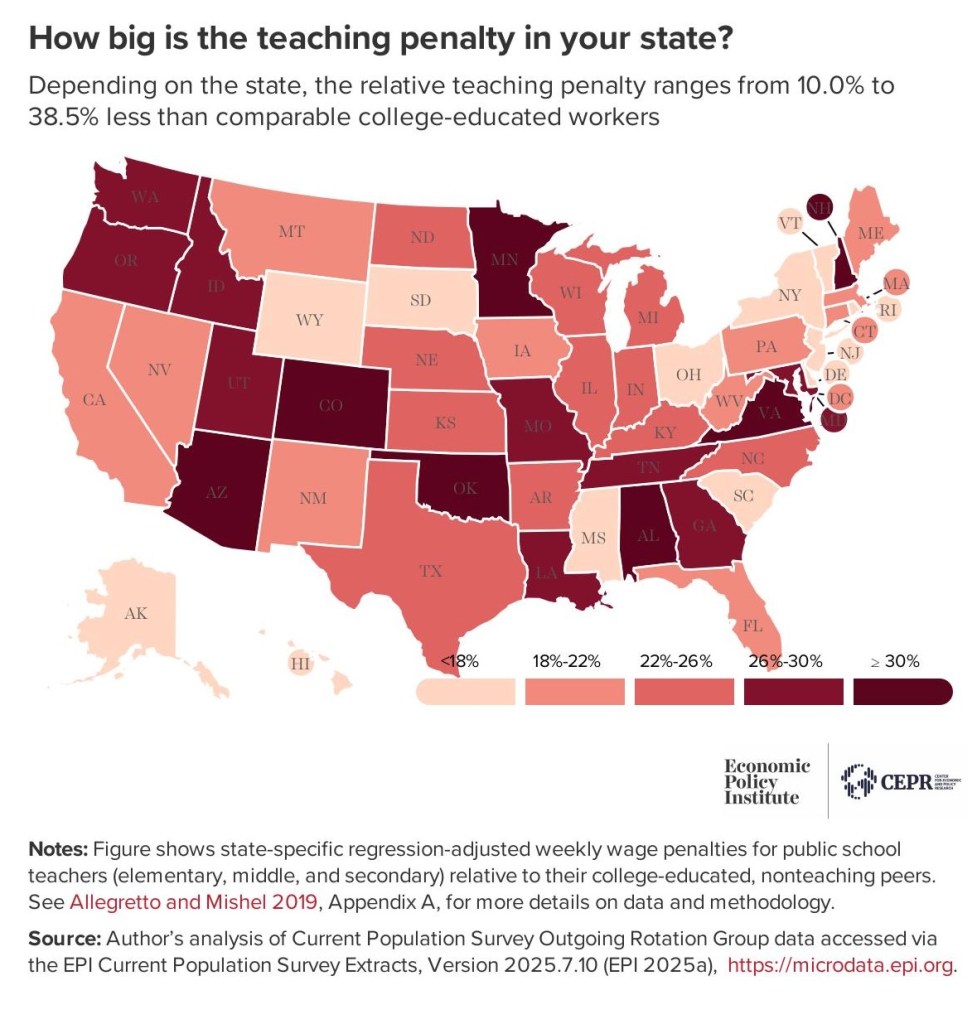
- Across states, relative teacher pay gaps span from -10.0% in Rhode Island to -38.5% in Colorado. The relative teacher pay penalty was at least 25% in 20 states.
Why this matters
Closing the pay gap between public teachers and similarly educated professionals is essential to attracting and retaining qualified educators, boosting student achievement, and securing the future of public education.
How to fix it
Targeted and sustained investments in public education are needed to mitigate, let alone reverse, the growing teacher pay penalty. Funding efforts at the local and state levels, along with support from the federal government, are needed to improve teacher pay and compensation. Additionally, public-sector collective bargaining should be upheld and expanded, given the role of unions in advocating for improved job quality and better pay.
Across the US, increasing numbers of Black children are growing up without fathers. Some of these families have been fatherless for up to four generations, which has profoundly impacted the wellbeing of their children for decades.
These families’ fathers are absent because of systemic racial violence and the many societal practices that led to this violence. Children – especially boys – who grow up without their dads are more likely than their peers to get caught up in that cycle of violence themselves.
Black boys are disproportionately more likely to end up in prison than their white peers, and Black people are more likely to experience police misconduct than white people. Large cities with the largest Black populations suffer from some of the highest levels of community violence in the United States. From murders to shootings and carjackings, the statistics are bleak.
We want to interrupt this cycle. Many of the egregious racial injustices which formed our current system constitute crimes against humanity. These are crimes which should be accounted for, and justice should be had. I believe there’s no better place to start than with Black men growing up fatherless. This country needs widespread reparations to heal the wounds caused by institutional racism, slavery, segregation and the War on Drugs.
I am a reparations scholar and activist, and the executive director of Reparations United, a US organisation educating and organising people for restorative justice. We have designed a programme to support fatherless men to stay in and help heal their families and communities, through a combination of reparative basic income grants, training and community support.
We’ve set up a new entity, the Federal Redress Advancement Network, and we’re currently asking the Department of Labor to establish a work and skills restoration initiative with a reparative basic income to redress the Jim Crow-era crimes that it, the department itself, committed. Our plan is ready: it now needs to be put into action.
[…]
On June 28, 2025, Jackie Merlos, her four children and her mother were arrested by U.S. Customs and Border Protection at Peace Arch Historical State Park in Blaine, Washington. A few days later, her husband Carlos was arrested by immigration authorities outside the family’s home in Portland, Oregon. The four children, who are U.S. citizens, were released to longtime friends Mimi Lettunich and Kris Wigger. Carlos and Jackie are still being held at the Tacoma detention center. The children’s parents are among the thousands who have been detained in Oregon and across the country, upending lives and separating families.
