Ilya Kukulin: Dostoyevsky, Kundera, and the Culpability of Russian Culture

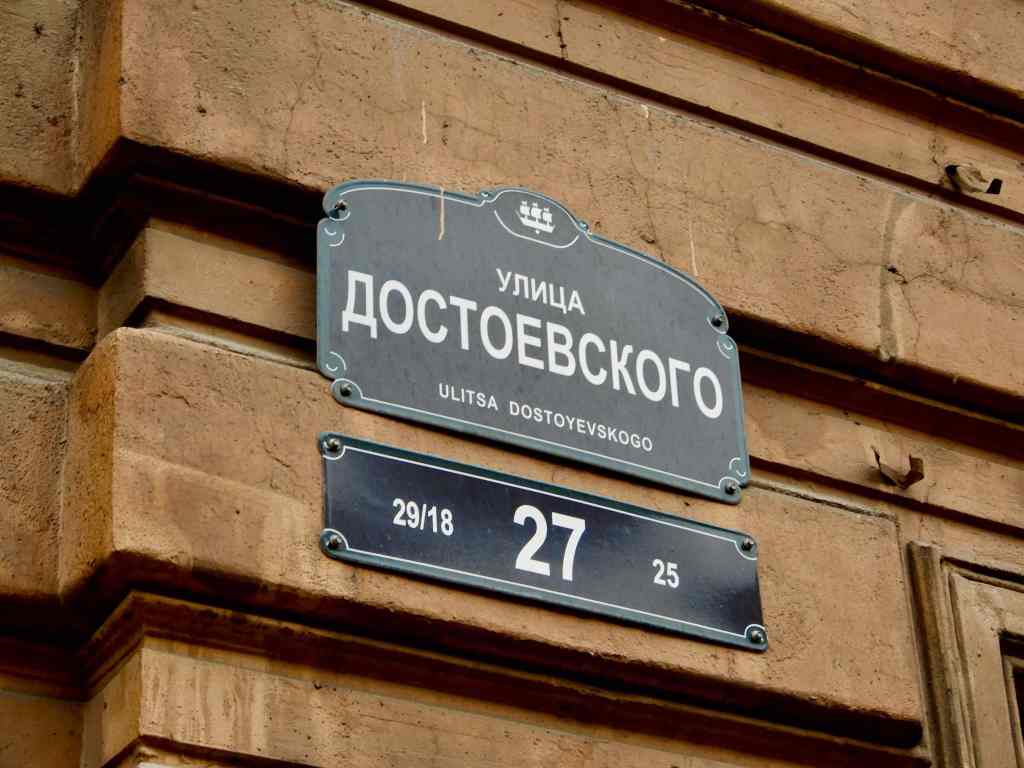
A house sign on Dostoyevsky Street in Petersburg, 10 October 2018. Photo by the Russian Reader

1

Since the second phase of Russia’s war of aggression against Ukraine began on 24 February 2022, there have been heated debates in the press and social media about the extent to which Russian culture—not Soviet culture, but precisely classic Russian culture, starting with the nineteenth century (if not earlier)—is culpable for what has been happening. The accusers say, for example, that all of Russian culture and its leading figures have invariably been infected by the imperialist spirit and the oppression of other countries and cultures. The objections raised against this view can be grouped into several lines of argument. Some opponents say that we shouldn’t ascribe today’s problems to classic writers, while others argue that an entire culture cannot be blamed for this aggression, even if it is supported by the political elite and a considerable portion of society. A third group claims that the Russian officers hurling missiles at civilian settlements or the Russian soldiers looting occupied villages have hardly been immediately influenced by any books whatsoever, so the question of culture’s culpability is entirely irrelevant. Some of the people who object to the notion of a “single and unified” Russian culture hold that those who allege its unity are unwittingly playing into the hands of Kremlin propaganda, which also asserts that Russian culture in its entirety is founded on a “code” and immutable “values,” which the state is supposedly taking great care to uphold by bombing neighboring countries and arresting all dissenters.

I would argue that these debates about culture’s culpability are a psychological trap that takes us back to the early twentieth century, when the humanities were dominated by essentialism—that is, a view of society founded on the absolute certainty that, for example, women and men, or sexual minorities (see Vasily Rozanov’s People of the Moonlight, 1911), or different nations and religions have an immutable essence that predetermines the behavior of individual members of these groups. In the early twentieth century, essentialism was used as an argument in favor of inequality: the “innate characteristics” of women were supposedly such that women should not be allowed to vote, and the “innate characteristics” of colonized peoples were such that they did not deserve the right to self-governance. It is no accident that the twentieth century witnessed the unfolding of two deeply interlinked processes: one social—the fight for the civil and political rights of marginalized groups (feminism, anti-colonialism, queer emancipation), and one in the humanities and sciences that sought to overcome essentialism and affirm the view that the self-consciousness of men and women, the self-consciousness of large cultural or racialized groups, etc., is internally variable and always the result of a long process of historical evolution. Today, we seem to be plunging back down the ladder onto an older rung. As cultural studies scholar Jan Levchenko has astutely noted, Putin’s hostility toward modernity and his rejection of the idea of the future has unleashed an archaization of consciousness in several countries. It is important to resist this process.

A distressing example of the new essentialism can be found in a column published in the Frankfurter Allgemeine Zeitung on 8 September 2023 by the Berlin journalist Nikolai Klimeniouk, titled “Sie wollen, dass wir sie ‘lieben’” (“They want us to ‘love’ them”).[1] Klimeniouk claims that contemporary Russian culture (or all Russian culture? his article does not make this clear) is supposedly founded on the idea of a non-consensual love that does not respect personal boundaries and demands reciprocal “consent” from those nations who were subjected first to Soviet and now to Russian aggression. This belief in the unimportance of other people’s boundaries, Klimeniouk argues, is shared by the intellectuals of Russian descent who defended Andrei Desnitsky, the biblical scholar who was recently fired from Vilnius University following a heated public campaign in the Lithuanian media. The organizers of that campaign took Desnitsky to task for publishing an article in 2012 about the 1940s Soviet occupation of Baltic countries in which he made statements that, in spite of all his caveats at the time, have been read in today’s context as an expression of sympathy for the occupiers. 

In his discussion of Desnitsky, Klimeniouk makes an unexpected logical leap. First, he rehashes the viewpoint of the scholar’s supporters:

“The journalist [who wrote about Desnitsky – I.K.] was [not a journalist but] a denouncer. The decision was undemocratic. Desnitsky is an important scholar who brought renown to the university. This would never happen in a civilized country. In Lithuania, they punish you for expressing your opinion, and Russians are hated everywhere.

“This framing is frighteningly similar to a discussion of significance to contemporary Russian culture, which began in 1985 on the pages of the New York Times Book Review, and, it appears, was never concluded.”

Klimeniouk then summarizes two essays which appeared in The New York Times Book Review at that time: “An Introduction to a Variation,” by Milan Kundera, and “Why Milan Kundera is Wrong about Dostoyevsky,” a response by Joseph Brodsky. The turn to this older polemic is symptomatic: Klimeniouk believes that it is possible nowadays to make arguments of the same sort that these two writers exchanged almost forty years ago—although, truth be told, these arguments already sounded quite outmoded even at the time. That’s why it is worth going over these essays in more detail than Klimeniouk provides, since his column revives a debate that already proved unfruitful once.

Milan Kundera’s essay begins with the tale of how, in 1968, a Soviet military patrol stopped him—expelled from all Czechoslovak institutions, his books banned—as he was driving from Prague to Budějovice. The officer in charge tells Kundera, “It’s all a big misunderstanding, but it will straighten itself out. You must realize we love the Czechs. We love you!” This strange declaration of love by an officer of the occupying army makes Kundera recall Dostoyevsky, with his irrationalism and fetishization of strong emotions, as well as Solzhenitsyn, whose Harvard commencement speech criticized the spirit of the European Renaissance. In his essay, Kundera positions himself as a defender of the European cultural values that emerged during the Renaissance: self-consciousness, rationalism, irony, and playfulness.

Joseph Brodsky, already famous in the States but not yet а Nobel Prize winner (that would happen a year after the events described here), took it upon himself to defend Dostoevsky against Kundera on the pages of the New York Times Book Review. However, he also resorted to the same kind of essentialist rhetoric—perhaps to an even greater degree—as his opponent, and to top it off, he also tried to humiliate Kundera, possibly out of sheer irascibility. “[Kundera’s] fear and disgust [toward the occupiers] are understandable, but soldiers never represent culture, let alone a literature – they carry guns, not books. […] Mr. Kundera is a Continental, a European man. These people are seldom capable of seeing themselves from the outside.”

These are more or less the kind of thoughts, according to Klimeniouk, that can be found in the minds of today’s Russian émigré intellectuals, which is why they defend Desnitsky and refuse to entertain the idea of a connection between Russian culture and Russian aggression—they don’t see a link between “guns” and “books” either.

Klimeniouk devotes the rest of his column to a discussion of statements made by Russian writer Maria Golovanivskaya on the topic of love (in an interview with Lev Oborin on the website Polka) and a now-deleted Facebook post by Tatyana Tolstaya (rather unconscionable musings about the rapes of German women by Soviet soldiers). Finally, he quotes a new history textbook for the eleventh grade, written by [former Russian culture minister] Vladimir Medinsky and Moscow State Institute of International Relations (MGIMO) rector Anatoly Torkunov, before concluding, “[In contemporary Russia,] high culture has once again lost the battle with state repression.”

This conclusion seems to me both illogical and, perhaps, formulaic: it seems to follow from a different argument than the entire preceding column. In order for culture to “once again [lose] the battle” with the state, there must be a conflict between the two, and Klimeniouk had so far tried to show that there was no conflict whatsoever between Russian culture and the Russian government. What is more, Klimeniouk ascribes to Russian culture “perennial” motifs that can be expressed with equal success using quotes from Brodsky, Golovanivskaya, or Tolstaya. These same “perennial” motifs underlie, in his view, the connection between Russian culture and today’s war of aggression.

It’s not clear whether one should argue with Klimeniouk. This is a scathing newspaper column, published, albeit, in one of Europe’s most influential papers. As for Klimeniouk’s attack on Desnitsky, the composer Boris Filanovsky has already offered an excellent response on his Facebook page. Is there anything we must add to his objections?

I think that we should analyze the psychological stance underlying Klimeniouk’s article. These days, this approach threatens to spread much farther than a single newspaper article, and not just in the media, but also in scholarship. This is precisely why I think that what matters now is not whether Klimeniouk is interpreting Brodsky correctly, or even what all this has to do with Andrei Desnitsky getting fired. What matters is methodology. How can we contextualize and explain this rhetoric of “love” that Klimeniouk apparently considers something akin to an incurable (or, at any rate, intractable) disease of Russian culture?

2

A newspaper column certainly has its own generic rules: it is meant to quickly convince readers that the author is right. Nevertheless, even taking these rules into account, it is surprising that Klimeniouk does not bring in several rather obvious nineteenth-century texts in which the “love” rhetoric he describes is most effectively expressed. Looking at these texts, however, makes it clear that this rhetoric is an expression of a specific historical-evolutionary line that can be traced to the mid-nineteenth century, rather than reflecting universally shared qualities of Russian culture. This line could be called expansionist universalism. The texts created within its framework became a crucial intellectual resource that facilitated the emergence of the Russian state’s current rhetoric of war—but not as texts per se, but because this rhetoric was later substantially reworked by late-Soviet Russian nationalists.[2]

The first example is Fyodor Tyutchev’s poem “Two Unities” [“Dva edinstva,” September 1870). Addressed to the “Slavic world” (the same sort of ideological construct as the “Russian world” is in our time), with its famous second stanza pointing to Otto von Bismarck as the “oracle of our day”:

«Единство, — возвестил оракул наших дней, —
 Быть может спаяно железом лишь и кровью…»
 Но мы попробуем спаять его любовью, —
 А там увидим, что прочней…

“Unity,” declared the oracle of our day,
“Can be forged solely through iron and blood.”
 But we shall bond our unity through love,
 And then we shall see which of the bonds gives way.

Tyutchev called for the creation of a Slavic federation led by Russia, which was to be founded on “love.” The famous Czech poet and journalist Karel Havlíček Borovský (1821­–1856) once wrote about this “love”: “Russians call everything Russian Slavic in order to later call everything Slavic Russian.” But Havlíček did not mean all Russians when he said “Russians”; he meant the Slavophiles, who were unwittingly playing along with their government. And, while Havlíček criticized the Slavophiles and the Russian state’s autocracy, he also translated Gogol and Lermontov into Czech.

The second example is Dostoyevsky’s “Pushkin Speech,” delivered in 1880. It declares love as the basis of the Russian people’s “world-scale kind-heartedness”:

«…Мы [русские] разом устремились <…> к самому жизненному воссоединению, к единению всечеловеческому! Мы не враждебно (как, казалось, должно бы было случиться), а дружественно, с полною любовию приняли в душу нашу гении чужих наций, всех вместе, не делая преимущественных племенных различий, умея инстинктом, почти с самого первого шагу различать, снимать противоречия, извинять и примирять различия, и тем уже выказали готовность и наклонность нашу, нам самим только что объявившуюся и сказавшуюся, ко всеобщему общечеловеческому воссоединению со всеми племенами великого арийского рода…»

“Indeed, we [Russians] then impetuously applied ourselves to the most vital universal pan-humanist fellowship! Not in a spirit of enmity (as one might have expected) but in friendliness and perfect love, we received into our soul the genius of foreign nations, all equally, without preference of race, able by instinct from almost the very first step to discern, to discount distinctions, to excuse and reconcile them. Therein we already showed what had only just become manifest to us—our readiness and inclination for a common and universal union with all the races of the great Aryan family.”

The third example is Alexander Blok’s poem “The Scythians” (1918), which literary scholars have noted was directly influenced by the “Pushkin Speech”:

Да, так любить, как любит наша кровь,
       Никто из вас давно не любит!
 Забыли вы, что в мире есть любовь,
       Которая и жжет, и губит!

Мы любим все — и жар холодных числ,
       И дар божественных видений,
 Нам внятно все — и острый галльский смысл,
       И сумрачный германский гений…

Yes, to love the way that our blood loves,
      None of you has loved in countless years!
 You have forgotten that there is a love
       That burns and wrecks and wakens fears!

We love it all—the sear of ice-cold numbers,
       The gift of divine illuminations,
 We grasp it all—the sharp-edged Gallic wit,
      The gloomy genius of the Germans.

The version of universalism on which Tyutchev, Dostoyevsky, and Blok insisted assumed that practitioners of Russian culture, who had arrived late to the dialogue of European culture(s), could occupy a central place in that dialogue because they (speaking as it were on behalf of “Russians”) could allegedly understand everything, and this ability to understand was underpinned by the unique Russian capacity for “love.” Mastering a foreign culture, as based on this universal “love,” becomes a form of self-affirmation for the “lover.” This rhetoric was a means of alleviating and masking the constant tension between two images of Russia produced in the press and in government publications, a tension felt ever more strongly over the course of the nineteenth century: Russia as the nation-state of Russians and Russia as a multi-ethnic empire. But this task of “all-conquering love” was not declared on behalf of the government, but rather on behalf of society. While the “we” in Tyutchev’s poem could still encompass the and society, in Dostoyevsky’s speech and Blok’s poem the “we” points first and foremost to a society that was ready, in their opinion, to bring about cultural expansion in place of the state.

Some of their contemporaries sharply criticized this rhetoric. For example, the well-known critic Nikolai Mikhailovsky noted very soon after the publication of the “Pushkin Speech” that Dostoyevsky’s calls for a “united Aryan tribe” had anti-Semitic undertones.

If we examine the examples given by Klimeniouk with a view to older history, it becomes clear that the Russian intelligentsia’s universalism has not always and across the board had an expansionist character. There have been at least two variations. The first is westernizing, which assumes that Russian culture is too archaic and that it can and must be renewed with the help of transfers of Western European culture into Russia. This thinking was, for instance, foundational for the translation strategy of the Russian Symbolists, who were able in the 1900s and 1910s to “catch up” to French poetry, which was developing rapidly at the time. This westernizing conception influenced the program of the World Literature publishing house, founded by Maxim Gorky in 1919. At a different historical stage, westernizing universalism manifested itself in a passion for Polish culture (jazz, poetry, fashion magazines) among the nonconformist intelligentsia in the 1950s-1960s; Brodsky himself was a Polonophile in his youth. Of course, Thaw-era Soviet Polonomania was rarely marked by a deep interest in the other; it was often just the urge to imagine an alternative, better life for oneself, but cultural transfers often occur in exactly this fashion.

The second, rarer variation is philanthropic, whereby the popularization of different cultures in Russia served to express sympathy and moral support for the bearers of said culture(s). In 1916, immediately following the Armenian (and Assyrian) genocide in the Ottoman Empire, an enormous book of translations entitled The Poetry of Armenia from Ancient Times to the Present Day was published under the editorship of the prominent poet and critic Valery Briusov. The translators included other well-known poets such as Jurgis Baltrušaitis, Konstantin Balmont, Ivan Bunin, Vyacheslav Ivanov, Vladislav Khodasevich—and even Alexander Blok, author of “The Scythians.” The anthology did not have colonial or expansionist intentions, however; instead, it voiced Russian civil society’s solidarity with a people subjected to genocide (even though that word didn’t even exist yet). Briusov took on direction of the project only after he gave himself a crash course in basic Armenian and read several books about the history of Armenian literature.

The anthology was the first in a series of translated compendiums of ethnic minority literatures of the Russian Empire, for whom the catastrophes of the First World War were particularly hard. These anthologies were of major philanthropic significance and were edited by Briusov, Maxim Gorky, and several other Russian writers. They included An Anthology of Armenian Literature (Sbornik armianskoi literatury, Petrograd: Parus, 1916, edited by Gorky); An Anthology of Latvian Literature (Sbornik latyshskoi literatury, Petrograd: Parus, 1916, edited by Briusov and Gorky); and An Anthology of Finnish Literature (Sbornik finliandskoi literatury, Petrograd: Parus, 1917, edited by Briusov and Gorky). Adjoining them is an anthology of translations from then-contemporary Hebrew poetry, The Jewish Anthology, published in 1918 by the Moscow publishing house Safrut, and edited by Khodasevich and Leib Yaffe.

In the Soviet context, beginning in the mid-1930s when Stalin veered into isolationism and “Russocentrism” (David Brandenberger’s term), universalism became a stealth-oppositional attitude. It expressed­—to use Osip Mandelstam’s coinage—a longing for the world culture beyond the “iron curtain,” and was a way of resisting the notion of Russian culture as something absolute, self-important, and completely adapted to Soviet conditions. There was a reason why in late Stalinism any attempts to study the influence of Western literary traditions on Russian literature were subject to persecution. Research of this sort was stigmatized as “cosmopolitanism” and “kowtowing to the West.”

In the late Soviet period, there was an official universalism in which the rhetoric of “love” à la Tyutchev or Dostoyevsky was invoked only rarely, but which reproduced a construction typical of their texts: “the primacy of the one who loves.” The Russian people were to be understood as an “elder brother” implicitly united with the Soviet state (“The unbreakable Union of free republics / was bound all together by Great Rus,” as the first line of the Soviet national anthem declared).[3] This Soviet official universalism appears to be exactly what the officer whom Kundera encountered was relaying: “we” love “you,” the Czech people, and this is exactly why we saved you from the Prague Spring, from the “pernicious” desire to live as you wish. And this paternalistic, protective, colonialist universalism, ramped up into a sort of cargo cult (“we will repeat what was said then—and it will be as it was then”) is replicated by Margarita Simonyan in one of her tweets (13 July 2023), in which she writes:

“What did you not like about living with us? What was so bad about it? Most of you have us to thank for statehood, you got culture thanks to us. Who was oppressing you? Who messed with you?”

This Soviet version of universalism is exactly what today’s stylistics of “re-enactment” has been replicating, and it is one of the intellectual resources driving Russia’s war against Ukraine. The people who have written and write in this tradition can certainly be held responsible for what is happening today. But there are other forms of universalism that have been preserved and survive in Russian culture. Understanding universalism as a complex, evolving discursive system containing many variations makes it possible to look at Russian culture not as a single, unified, and timeless whole invested with a unified, singular culpability, but as a space open to polemics in which different ideas grapple with each other.   

3

Let me move on from the discussion of the varieties of universalism to more general thoughts on the methodology of the contemporary humanities and social sciences. They might seem trivial to my colleagues in history, but over the last year and a half these basic tenets of the profession have seemingly been overshadowed, and it would behoove us to recall them.

A historian is not required to forgive or rehabilitate the figures they write about, but it is important to understand these figures within the context of their own time—what they could or could not think about, what concepts they used, what kind of knowledge or resources were available to their characters, or to whose questions they were responding. This paradigm of historical knowledge was established by the French historians of the Annales school and further developed by the intellectual historians of the Cambridge school—e.g., John Pocock and Quentin Skinner.

Proponents of historicism are sometimes accused of enabling relativism: general rules do not exist; each era has its own norms. Still, the example of late-Soviet humanities scholars—of figures such as Sergei Averintsev, Aron Gurevich, and Mikhail Gasparov—shows that they did not think of historicism as a branch of relativism but as a tool for understanding people from different eras and cultures, and this work of understanding (especially for Gasparov) enabled them to grasp the limitations of the cultural conventions of their own time. They developed their concepts of historicizing interpretation as a tool for understanding over the course of the 1970s and 1980s, and this approach was one of the most significant advances in the late-Soviet humanities and social sciences in terms of both its scholarly and existential utility.

This interpretative sequence—understanding the other so as to better understand one’s own situation and, by reflecting on one’s own situation, gaining an even more accurate understanding of the other—was laid out by proponents of the philosophical school of hermeneutics. Yet neither the hermeneutic philosophers (Paul Ricœur and Hans-Georg Gadamеr) nor the unofficial Soviet humanities scholars directly inquired into the consciousness of an interpreter belonging to a repressed or silenced societal group (even though unofficial humanities scholars in the USSR certainly belonged to such a group), or to one identifying their own sense of self with those in an unprivileged position. (Yuri Lotman’s persistent discussion of the history of the Russian intelligentsia as a stigmatized and marginal group shows that he understood the position from which he was speaking quite well.) In hermeneutics, the interpreter of the world appears as a kind of “default subject” (implicitly, a white European man), so it may seem as if hermeneutics were at odds with critical theory and its closely affiliated approaches—feminism, postcolonial and decolonial theory, queer studies. But the current intellectual state of affairs shows that these approaches can be synthesized.

Critical theory teaches researchers to ask themselves questions—and not just about their own privilege (“check your privilege”), but also about the conceptual tools they are using. For example, I myself should consider whether my mind retains the traces, the discursive debris, of the expansionist universalism which I discussed earlier.

Today, when we talk about history as the result of human efforts with specific social, discursive, and conceptual parameters, feminist, queer, postcolonial and decolonial theory all help to focus our gaze more sharply. But these methods could also benefit from the acuity afforded by historicism, because the human conflicts and interactions they study have differed in different eras and took on a particular shape in each specific instance. Now, let’s turn to why this kind of synthesis is necessary.

In 2011, Stanislav Lvovsky wrote that, sooner or later, Russian culture would have to be reconstituted on new foundations. It is now obvious that he was right. When undertaking this project, it will be important to take stock of the resources available to сultural professionals in their fight against the tendencies that Russia’s leaders have let proliferate and become dominant—no matter how many states emerge out of the ruins of today’s regime at the end of the current political cycle. I think that if we examine the different versions of Russian universalism historically, using the methods developed by the Annales school, we will find that, alongside the passive-aggressive tradition observed by Kundera, Russian culture also has resources for resisting the state’s rhetoric of “paternalistic love.” These resources are primarily found in works of unofficial literature and unofficial scholarship.    

I dearly hope that Ukraine wins this war, but a mere military victory would not be enough for me. At the end of the Second World War, scholars in different countries set to  thinking up ways to undermine the intellectual foundations that gave rise to Nazism. (Many years after the war, Michel Foucault’s foreword to Gilles Deleuze and Felix Guattari’s Anti-Oedipus called the book “an introduction to non-fascist life.”) Today, people in many different countries also have reason to think about how they can subvert the intellectual foundations which are producing an aggressive right-wing populism that stigmatizes minorities. When right-wing populism is implemented by former security-service officers gripped by ressentiment, you get the nightmare that is playing out in Russia today.

I think that the future of humanity lies not in national but post-national states—societies organized as federations of different minorities. The methodology of the contemporary humanities and social sciences can function both as a common language that different minority groups can use for collective action, and as a crucial tool for understanding the other, and others.

Source: Ilya Kukulin, “Dostoyevsky, Kundera, and the culpability of Russian culture,” Colta.ru, 11 September 2023. Translated by Ainsley Morse and Maria Vassileva. I am grateful to them for their fine translation, and to Mr. Kukulin for his permission to publish it here. ||| TRR


[1] The excerpts from Klimeniouk’s article quoted here were first translated from the original German into Russian by the author himself, and then rendered in English by the translators.

[2] See, for instance, the uncensored version of Stanislav Kunyaev’s poem “Okinu vzgliadom Severo-Vostok,” [“I will cast a gaze at the North-East”], which was first published in 1986: “Let the Mansy salute Yermak, / And it is meet for the Uzbek to praise Skobelev, / for the fact that we now have gas and timber and cotton, / and have room for lots of missiles.”

[3] Text by Sergei Mikhalkov and Gabriel El-Registan.
Vexations

Igor Levit performing Erik Satie’s “Vexations” (short edit)

On 30 May 2020, Igor Levit performed all 840 repetitions of Vexations at the B-sharp Studio, Berlin. The performance streamed on Periscope, Twitter and other platforms, including on The New Yorker‘s website. Levit said the recital was in response to the COVID-19 pandemic, his reaction to which he characterised as a “silent scream” (stumme Schrei). The 840 sheets of music were sold individually to assist out-of-work musicians.

Source: “Vexations” (Wikipedia)


Finland will ban entry to passenger vehicles registered in Russia starting Saturday, the Nordic country’s top diplomat announced Friday afternoon.

“Our decision is for the ban to come into force after midnight,” Finnish Foreign Minister Elina Valtonen was quoted as saying by the state broadcaster Yle.

“We estimate the new rules will significantly reduce traffic on the border between Finland and Russia,” she added.

EU citizens and “their immediate circle,” as well as diplomats and those traveling for humanitarian reasons, would be exempt from the restrictions, according to Yle.

Lithuania, Latvia and Estonia issued no-exception entry bans this week for Russian-registered cars after the European Commission clarified that existing regulations prohibit the import or transfer of goods originating in Russia.

Estonian and Lithuanian officials later suggested that cars with Russian license plates would be confiscated if they refused to re-register or leave.

Finland’s Valtonen ruled out confiscations in her country, telling Yle that vehicles with Russian license plates would have to leave Finland by March 16, 2024.

Supporters of jailed Kremlin critic Alexei Navalny urged Baltic leaders to lift the vehicle ban on claims that they harm Russian war exiles and play into the Kremlin’s narrative of anti-Russian feelings in the West.

Moscow has accused the EU of “racism” for its ban on passenger vehicles, while former President Dmitry Medvedev called for a suspension of diplomatic relations.

Finland, a member of the European Union, joined NATO this year, thus doubling the length of the U.S.-led military alliance’s border with Russia.

Finland’s neighbor Norway, which has joined the EU’s sanctions against Russia despite not being a member of the bloc, said it was also considering banning entry to Russian-registered vehicles.

Source: “Finland Follows Baltics, Bans Entry to Russian Vehicles,” Moscow Times, 15 September 2023. The emphasis is mine. Judging by the outsized reaction to this news by “anti-war Russians” in the press and on social media, the proposed vehicle entry ban vexes them more than the endless repetitions on violent death, widespread destruction, and genocide in Ukraine, unleashed by their country’s now-572-day-long invasion of their former neighbor. ||| TRR


This is an actual headline:

“Nobody is safe from Russia’s wave of re-nationalization.”


This how and what the former “Fennomans” from the newspaper Delovoi Peterburg write about Finland today (in their morning newsletter)—without a hint of shame, so to speak:

Finland is selling its house in St. Petersburg, and the Central Bank is struggling with the fall of the ruble. Such are the economic news in St. Petersburg this week.

How much does the “Finnish House” cost? The issue is very difficult, given Finland’s unfriendly attitude towards us and the sanctions. Basically, with the sale of the building on Bolshaya Konyushennaya, which belonged to Finland, an entire era of good neighborliness between our countries ends.

Source: Thomas Campbell (Facebook), 15 September 2023. Translated by the Russian Reader


Not all attempted performances of this work have been successful. In 1970, Australian pianist Peter Evans decided to abandon a solo performance of the piece after five-hundred and ninety-five repetitions because he felt that “evil thoughts” were overtaking him and observed “strange creatures emerging from the sheet music.”

Source: “Vexations” (Wikipedia)


Quiver, quaver, flutter, squirm, twitch
Shimmy, wobble, shake, convulse, twist
Tremble, jerk, shudder, vibrate, writhe
Jiggle, bobble, sway, waggle, die

Source: Annelyse Gelman, Vexations (University of Chicago Press, 2023), p. 40


Colleagues, I may have missed something, but how do Finland, Poland, etc., make the case for the reasonableness of banning cars with Russian license plates from entering?

I mean, how does this contribute to the stated goals of combating military aggression?

Source: A “friends only” social media post by a Russian acquaintance, 16 September 2023. Translated by the Russian Reader


We demand that Western leaders end the policy of avoiding “escalation of the conflict.” It only allows Putin to blackmail the West with the very “escalation,” hoping to force him to “geopolitical capitulation.” Any international legal order is maintained only as long as its violator meets a collective rebuff. While his co-founders are ready to fight for him.

We demand a fundamental expansion of military assistance to Ukraine up to the direct participation of NATO troops in hostilities. Ukraine should receive binding security guarantees now, not after the end of the war.

We urge Western leaders to put aside fears about the possible collapse of the Russian Federation as a result of the fall of the regime. None of the “painful consequences” of this will outweigh the danger of preserving the imperial state, which will reproduce aggressiveness and revanchism. Either Russia will become confederate, democratic and “pro-Western,” returning to its European roots, or it must disappear as an integral entity.

Source: Paul Goble, “‘Victory for Ukraine; Freedom for Russia’ — Four Russian Activists Call for a World without Putin and Putinism,” Window on Eurasia (New Series), 14 September 2023


The space between good and bad began to diminish
Daughter studied botany while I analyzed the transference
Over the PA someone said, And the wisdom to know the difference
We integrated our sensory impressions into a coherent scene
Her hair was getting long, her eyes were turning green
As for wisdom, we didn’t know what to do with it


There was a time before and after thinking of death
As the worst thing that could happen to a person
Bodies were interred and then exhumed again
Satisfactory, said Hank, which meant the opposite
We had overestimated our capacity for wonder
We had underestimated our capacity for pain

Source: Annelyse Gelman, Vexations (University of Chicago Press, 2023), p. 40. The book has been longlisted for the 2023 National Book Award for Poetry in the United States.

Guns in Schools

Dummy ammo at Petersburg’s Udelny flea market. Photo: Anton Vaganov/Delovoi Peterburg

A Petersburg district court has ordered schools in the city’s Nevsky District to outfit themselves with dummy Kalashnikov assault rifles and copies of military regulations and of the Constitution of the Russian Federation, the consolidated press service of the municipal courts reports.

The Petersburg prosecutor’s office had motioned the Nevsky District Court to oblige schools No. 331, 323 and 339 to purchase the required equipment for their health and safety classrooms. The administrations of these educational institutions were also required to purchase manuals on the basics of shooting, dummies of the Kalashnikov assault rifle and the upgraded Kalashnikov assault rifle, and fifteen copies each of the Constitution, of the law “On Military Duty and Military Service,” and the of presidential decree “On Authorization of the General Military Regulations of the Armed Forces of the Russian Federation.”

“Counsel for the defendants acknowledged the claims made under the lawsuits. They explained that they were ready to equip the classrooms as required,” the municipal courts press service reports.

On September 15, the court ruled in favor of the plaintiffs in all three suits.

A similar ruling was made by Petersburg’s Kuibyshev District Court on 12 February 2023. Then, the court ordered School No. 294 in the the city’s Central District to purchase the gear for its health and safety classroom that it lacked: equipment for studying traffic regulations, first aid tools, and manuals and dummy weapons to be used for basic military training (NVP).

Since September 1, basic military training and labor education have been introduced as subjects in all Russian schools. DP took a look at how the uniform standards changed school education.

Source: “Court orders Petersburg schools to buy dummy Kalashnikov assault rifles,” Delovoi Peterburg, 15 September 2023. Translated by the Russian Reader

Business Models

Source: The Bell


While I’ll be the first to admit that The Bell‘s weekly newsletters are worth far more than the fifteen minutes or so it takes to read them, I can’t imagine that they’re worth $168 a year. I subscribe to way too many print and online newspapers and magazines than are good for me or which I have the time to read, but most of those subscriptions cost me far less $168 a year (in fact, most of them cost less than $30 a year).

The only one that costs more is the “newspaper” put out by the style councillors at the Economist (at $192.50 a year, the last time I paid my rates), and that’s probably a rip-off too. But it’s a rip-off that sends me 78 pages of usually super-informative reporting and provocative commentary a week (and in impeccable English!), plus any number of daily and weekly newsletters. (I’ve quoted one of them, below.)

On the other hand, The Russian Reader is free to read (and will always be free) and usually comes out more than twice a week. At last count, I’ve received $448.50 in donations so far this year.

That’s my “business model.”

It’s not even remotely sustainable, of course, but I’d rather take on more part-time jobs (as I’ve been doing recently) than suddenly be seized by the moxie to charge any of you $168 a year for what has always been a labor of love. My foolishness, though, should never deter any of you from sending me donations, however small or large. ||| TRR


Kim Jong Un and Vladimir Putin concluded several hours of talks at the Vostochny spaceport in Russia’s far east. No details were made available, but before the meeting analysts speculated that North Korea may offer Russia artillery ammunition in exchange for missile or satellite technology, in violation of UN Security Council resolutions. Mr Kim toasted his host’s health, and predicted that Russian troops would win a “great victory” over their adversaries, according to reports in Russian state media.

Source: “The World in Brief” newsletter (The Economist), 13 September 2023

Elections Wrap-Up

Photo by Alexandra Astakhova

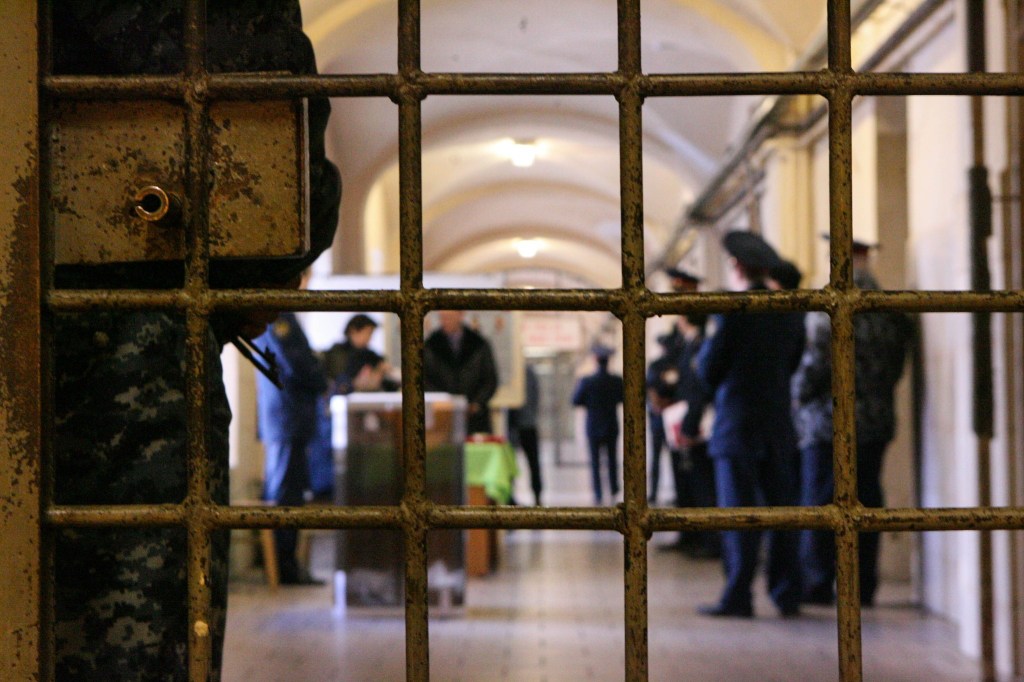
Voting in prison is not a bad form of entertainment. Dozens of prisoners are escorted to the ballot boxes simultaneously, providing a rare opportunity to chat and exchange news with your neighbors.

We were assembled in the “gully” and launched in pairs into a room equipped for a polling station. The convicts had fun arguing who to vote for. Mostly, of course, there were juicy quotes from Leningrad’s song about elections….

“Elections! Elections! The Candidates Are Buggers!” The song, written by Alexei Kortnev for the theater production Election Day (2003), was performed in the eponymous film (2007) by Sergei Shnurov and Leningrad

With a clear conscience, I wrote “FOR RUSSIA WITHOUT PUTIN” on my ballot paper. After that, I conducted a spontaneous exit poll at the prison polling station, thanks to which it transpired that most of the inmates had voted for anyone, just not for [ruling party] United Russia. Only one of them admitted that he had ticked the box for [incumbent Moscow mayor Sergei] Sobyanin. The guy, however, is a United Russia activist himself: he embezzled a factory and is now serving a sentence for fraud. So it all makes sense.

And I also saw and hugged Sergei Klokov (Vedel) for the first time in several months. For a year and a half, the man has been doing time for a telephone conversation with relatives, bugged by the security services, during which the murders in Bucha were discussed. He looks tired and misses his family, including his two young children. But he is slightly encouraged by the news that Ukraine is willing to exchange its collaborators for Russian political prisoners. I hope Sergei will be released soon. He’s a good guy.

Source: Ilya Yashin (Facebook), 11 September 2023. Translated by the Russian Reader


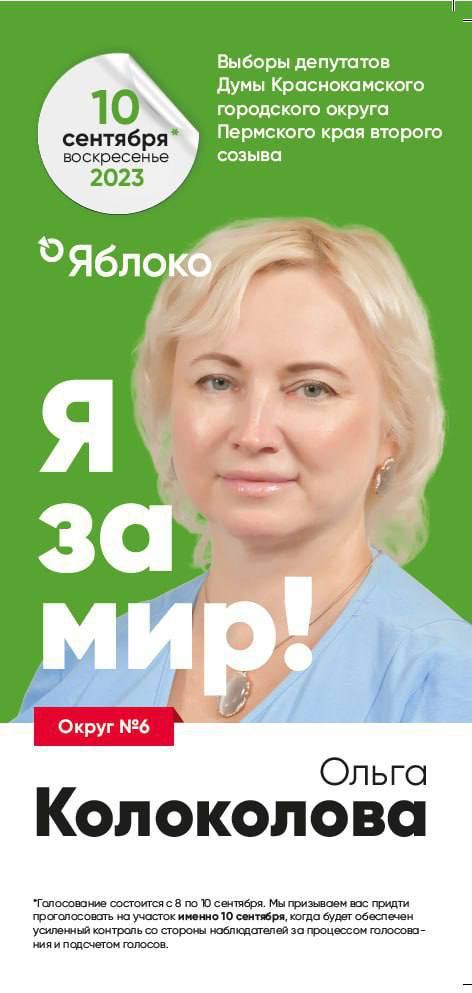
Olga Kolokolova’s campaign poster in the 10 September 2023 elections in Krasnokamensk (Perm Territory): “I’m for peace!” Image courtesy of Igor Averkiev

Olga Kolokolova, the head of the Perm regional branch of the Yabloko Party for many years, won the elections to the City Duma in Krasnokamsk (a satellite city of Perm). Moreover, she won running on the slogan “I’m for peace!”

Having received 55.2% of the votes cast, Olga Arkadyevna was returned to the Krasnokamsk City Duma, of which she was a deputy from 2005 to 2018.

Kolokolova is a veteran of the Perm loyal democratic opposition. (I say this without the slightest hint of judgment: the loyal opposition has its own positive mission, especially during periods when the regime relaxes the rules.) She is one of the most well-known politicians in Krasnokamsk, and the most consistent and most well-known Yabloko Party activist in the region.

Despite her status as a member of the loyal opposition, the election of Olga Kolokolova as a deputy in our time, and running on such a slogan, is really an unusual event, a kind of relic or vestige of the Putin regime’s bygone hybridity. In any case, it is impossible not to be happy for Olga Arkadyevna.

Source: Igor Averkiev (Facebook), 11 September 2023. Translated by the Russian Reader


A screenshot of the front page of the Moscow Times website, 11 September 2023

Inside Russia’s sham ‘election’ in occupied Ukrainian territories (Open Democracy, September 6th)

Ukrainians in occupied territory forced at gunpoint to vote for fake candidates in Russia’s pseudo-election (Kharkiv Human Rights Protection Group, September 4th)

Source: News from Ukraine Bulletin 63 (11 September 2023)

GOOP

Veterans of the special military operation and combat veterans will be able to teach the new subject “Fundamentals of the Security and Defense of the Motherland” in schools after undergoing retraining at the State University of Education (GOOP), according to Education Minister Sergei Kravtsov, who was speaking at a plenary session during the Russian national pedagogical forum “Memory Is Sacred.”

“A center for retraining veterans of the special military operation and combat veterans as teachers was created this year at GOOP to implement a new subject area with a priority on practical training in the new subject ‘Fundamentals of the Security and Defense of the Motherland,'” Kravtsov said.

The official logo of the State University of Education (GOOP)

According to the minister, the basic military training module would be enhanced in this subject, which is being implemented as part of the “Fundamentals of Health and Safety” curriculum. The new subject would be trialed this year, and it would be taught in schools beginning in the next academic year, he added.

On June 30, Kravtsov said that, as part of the subject, schoolchildren would gain knowledge of the “role the defense of the country plays in its peaceful socio-economic development and the current complexion of our our Armed Forces.” Schoolchildren would be introduced to concepts such as “military duty” and “military service.” The minister emphasized that the load on schoolchildren would not increase—the number of classroom hours would remain the same.

GOOP’s acting rector Irina Kokoyeva told Vedomosti that the Apex Center for Military-Patriotic Education had been operating at the university since September 1. One of the center’s focus areas is the professional development and retraining of special operation veterans as coordinators of military-patriotic clubs and teachers of the subject “Fundamentals of the Security and Defense of the Motherland.” “We plan to recruit a pilot group in this focus area. Information about the conditions and criteria for recruitment will be posted on the university’s official website in the near future,” she added.

Tuition for veterans of the special operation will be free, Olga Kazakova, head of the State Duma’s education committee, told Vedomosti. According to her, the program at the training center will help veterans who don’t have the requisite knowledge in the fields of child psychology or pedagogy. The deputy also recalled that it was the education committee’s initiative to establish the center. “Together with the State Duma’s defense committee, we are forming a working group on the teaching of this subject. And, of course, we will be directly involved in the process of preparing the curriculum, teachers, and the facilities and resources for these lessons,” she added.

All people, regardless of whether they were involved in the special operation, must undergo special psychological tests to be cleared to work with children, says clinical psychologist Ilya Gavin. “It is good practice to check any category of people working with children. People come in all shapes and sizes, including those with PTSD [post-traumatic stress disorder],” the expert said.

Per the Health Ministry’s standing order No. 342n, all teaching staff are required, as of 1 September 2022, to undergo a psychiatric examination to be cleared to work with children. Previously, teachers were only required to undergo an annual medical examination, as well as an examination when applying for a job. Prior to 2022, employees of educational institutions underwent psychiatric examination at least once every five years.

According to Gavin, the time it takes to recover from PTSD and return to everyday life directly depends on the severity of the disorder, because it can also be accompanied by the emergence of addictions. “The rehabilitation period can vary from three months to a year. The PTSD treatment protocol also includes ten to fifteen sessions of work with a psychologist once a week,” Gavin concluded.

Source: Anastasia Mayer, “Duma readying retraining program for special operation veterans to teach in schools: soldiers will gain knowledge in child psychology and pedagogy,” Vedomosti, 7 September 2023. Translated by the Russian Reader


GENEVA, June 15 (Reuters) – A group of U.N. experts said on Thursday they had written to Moscow raising concerns about the use of torture by Russian military forces on Ukrainian civilians and prisoners of war.

The U.N. experts said in a statement the torture included electric shocks, hoodings and mock executions and had been carried out to extract intelligence, force confessions or in response to alleged support for Ukraine’s forces.

It had resulted in damage to internal organs, cracked bones and fractures, strokes and psychological traumas, they said.

A spokesperson for Russia’s diplomatic mission in Geneva did not immediately respond to a request for comment. Moscow has previously denied torturing or mistreating prisoners of war and says it does not deliberately target civilians in Ukraine.

While torture allegations have previously been levelled against both sides in the 15-month conflict, the team of U.N. independent experts said Russian forces’ methods may be “state-endorsed”.

The consistency and methods of alleged torture suggested “a level of coordination, planning and organisation, as well as the direct authorisation, deliberate policy or official tolerance from superior authorities”, according to U.N. Special Rapporteur on Torture Alice Jill Edwards, who sent the letter on 12 June alongside several other independent experts.

“Obeying a superior order or policy direction cannot be invoked as justification for torture, and any individual involved should be promptly investigated and prosecuted by independent authorities,” she said.

Under the U.N. system, a government has 60 days to give a formal response.

Source: “UN experts raise ‘widespread’ torture concerns with Russia,” Reuters, 15 June 2023

Communist Dissidents in Early Soviet Russia

Communist Dissidents in Early Soviet Russia. Five documents translated and introduced by Simon Pirani

This book gives voice to Russian communists who participated in the 1917 revolution, but found themselves at odds with the Communist Party as it consolidated its rule in the early 1920s. One Red army veteran demands action against corrupt officials; another mourns the dashed hopes of 1917 and the loss of friendship and solidarity; a “collectivist” group aspires to new cultural and technological revolutions; other oppositionists denounce material inequalities, the return of workplace exploitation and creeping state authoritarianism. The five documents in the book are published in English for the first time, with an introduction and notes.

“These voices of rank-and-file worker communists, from the early 1920s, convey not only accurate diagnoses of the situation then, but also prophetic warnings of the consequences of the Bolshevik Party’s bureaucratic degeneration and of workers’ alienation from control over power. This book is an important contribution to the study of early Soviet history, and necessary for understanding the overall legacy of those Soviet dissidents who criticised the ruling regime from the left, from socialist and democratic positions.”

– Ilya Budraitskis, author of Dissidents Among Dissidents: ideology and the left in post-Soviet Russia (Verso, 2022)

“This slim volume offers a valuable addition to our insights and understandings of worker resistance and opposition in the early Soviet period. The documents themselves are captivating. They are expertly translated and annotated, and the introduction provides crisp and scholarly contextualisation. It will be particularly useful in the classroom for undergraduate and graduate students.”

– Professor Sarah Badcock, author of Politics and the People in Revolutionary Russia: A Provincial History (Cambridge, 2007)

“Given how the Soviet Union developed and the persistent anticommunism around the world today, it is easy to forget that early Soviet Russia was a time and place rich in possibility and in diversity of experience and vision, even among Marxists themselves. The dissident communist voices in Simon Pirani’s compact collection of well introduced, contextualized, annotated, and translated documents from 1920-22 brings this vital era alive intellectually, ideologically, and even emotionally. We hear in this small but diverse selection of largely forgotten communist voices great uncertainty and determination, disillusionment and hope, desire and despair. These voices offer critical viewpoints on ideology and politics, but also richly textured feelings about the condition of the revolution in these key years. Frustration, anger, shame, disgust, and melancholy are among the interpretive emotions weaving through these texts. And we hear important critical perspectives on the failings of the new society—inequality, corruption, bureaucratism, authoritarianism, dishonesty, poverty of thought—and important principles for a new society, including democracy, collectivism, and worker power. This collection is ideal for stimulating student discussion in courses and will be of interest to anyone who wants to understand the experience of revolutionary Russia beyond dismissive stereotypes and simplifications.”

– Mark Steinberg, author of The Russian Revolution, 1905-1921 (Oxford, 2017) and Russian Utopia: A Century of Revolutionary Possibilities (Bloomsbury, 2021)

Contents

Introduction. 1. Anton Vlasov’s letter to the Central Committee (September 1920). 2. Declaration of the Workers and Peasants Socialist Party (Moscow, May 1921). 3. ‘We are Collectivists’ (1921). 4. Appeal of the Workers Truth group (1922). 5. From Iosif Litvinov’s diary (1922). (120 pages)

About the author

Simon Pirani is Honorary Professor at the University of Durham. He is author of The Russian Revolution in Retreat, 1920-1924: Soviet workers and the new communist elite (Routledge, 2008) and other books and articles about Russia and Ukraine.

Where to get your copy

□ Order from Troubadour bookshop here

□ Download the book as a PDF here

 □ Russian PDF download here

□ Go via https://bit.ly/communist-dissidents

Source: People & Nature

When the Taxi Driver Asked Where You’re From

Eva Morozova, “When the taxi driver asked where you’re from”

When the taxi driver asked where you’re from

(If you’re not in the mood to explain why you still haven’t ousted the president)

[Image of Russian Federation foreign travel passport briefly flashes onscreen]

1. He, he, he! Huh?

2. Could you repeat your question? [in English]

3. Sorry, I don’t speak languages. [in English]

4. Artists have no nationality.

5. My ancestors came from the lower reaches of Transnistria.

6. From here and there, brother.

7. I’m not a fan of the concept of the state per se.

8. I’m from Rio de Janeiro.

9. When God made the earth, there were no borders.

10. From Siberia.

11. Look, a flock of pigeons!

[Pigeons drop the last passenger into “neutral waters.” Image of Russian Federation foreign travel passport flashes onscreen again.]

Source: Eva Morozova (YouTube), 28 June 2023. Translated, where necessary, by the Russian Reader. Thanks to Tatiana Kosinova for the heads-up and so much more.


@george.spb wrote the following comment when Eva Morozova posted the cartoon, above, on their Instagram page:

I always say that I am from Russia, even though I am [an ethnic] Georgian. I have never got a single unfriendly look. At most, they might somehow make a good-natured joke about it. All foreigners are well aware that not all people in Russia support the military action, especially those who have left. The only thing I won’t do is demonstrate Russian symbols or sing the Russian anthem until the war is over, a correct assessment of what happened has been made, and the perpetrators have been justly punished. I can’t change anything else; I was born there. And if a person is biased about it, then it’s not my problem anymore.

@intelligent_beauty_paris wrote:

It happened once here:
– Vous êtes d’où? – Where are you from?
– De la Russie. From Russia.
– C’est pas grave! / No big deal
/ It happens/ Don’t worry about it!

Source: eva__ morozova__ (Instagram), 27 June 2023. Translated from the Russian and the French by the Russian Reader


YALTA, Crimea, Aug 29 (Reuters) – In years past, Siberian Viktor Motorin could hop on a plane and arrive in Crimea just four hours later to relax at his holiday apartment. Now he must fly first to Moscow and then spend a day and a half on the train.

The war in Ukraine, now 18 months old, is making it harder for many Russians to reach their favourite summer haunts in the Black Sea region of Crimea, which Moscow seized and annexed from Ukraine in 2014.

And safety is a factor for some, especially after two major Ukrainian attacks since last October on the 19 km (12 mile) Crimean Bridge that links Russia by road and rail to the peninsula.

But after weighing up such concerns, Motorin, from the city of Khanty-Mansiysk in western Siberia, said he decided that making his annual trip was still a risk well worth taking.

“We calculated that it was reasonably safe, especially when my colleagues had already come here in June, early July. They said it was all calm here with no problems on the Crimea Bridge. The goods, the prices, everything is like before,” he said.

[…]

Source: “Russian tourism in Crimea is down, but many still shrug off risks,” Reuters, 29 August 2023


In 2022, the year when Russia’s full-scale invasion of Ukraine began, more than 4,300 people renounced their Russian citizenship, the highest such figure for the last three years. Among them were several major Russian businessmen, including [former] Troika Dialog CEO Ruben Vardanyan, venture capitalist Yuri Milner, and Tinkoff Bank founder Oleg Tinkov. However, the Russian Foreign Ministry said that the increase in “refuseniks” was due to the pandemic that raged earlier, claiming that “there are no particular changes in the numbers of requests to withdraw from Russian citizenship from abroad.” And the Russian Interior Ministry recently proposed reviewing the cases of people who have renounced Russian citizenship, that is, theoretically, a person’s citizenship could be forcibly reinstated. Farida Kurbangaleyeva talked to people who decided not to be Russian nationals anymore and found out why it mattered to them.

“If I have the sudden urge to live in Russia I’ll get a residence permit”

Andrei Kreinin, USA, renounced his Russian citizenship

I’ve wanted to emigrate to the USA since I was fifteen, when I saw the good old American movie Short Circuit 2. Spoiler alert: it ends with a scene of the main characters taking the oath of citizenship. I went to the States many times on a tourist visa, and in 2011 my family and I won a green card and moved to Chicago. In Moscow, I worked in telecommunications and I got a job in the same field in our new home.

The decision to renounce citizenship was made on February 25, 2022—after the brutal bombing of Kharkov, when people were hiding in the subway there. Firstly, because there is such a thing as a conscience, and secondly, my mother was born in Kharkov, and it was impossible for me to remain a Russian national. My family said, “We won’t do this. If you want to, do it, but then don’t pine for Russia.” I said I understood them perfectly. I had a couple of friends from Russia who called me bad words on social media, and I had to ban them. But mostly the attitude ranged from neutral to understanding: “It’s your business, Andrei.”

To renounce your citizenship, you need to do two main things—deregister your place of residence [in Russia, where everyone is required to register their place of residence] and get a paper stating that you owe no back taxes in the Russian Federation.

They say that it can be difficult to deregister remotely, so in June 2022 I flew to Russia. I took care of transferring my real estate and deregistering from my apartment. Basically, I covered all the important bases to the max. Before the trip, I carefully monitored the situation: I understood that there would be a mobilization. I actually thought it would be announced on May 9 [celebrated as Victory Day in Russia].

When I had collected all the paperwork, I took it to the consulate in New York. It did not go smoothly. About three months later, I received a letter saying my application had not been approved, because, according to the Interior Ministry’s databases, I was still registered—although I even had a stamp in my [internal] passport stating I had been deregistered. Consequently, I spent two or three sleepless nights, due to the time difference, trying to get through to the proper authorities in Russia. They said, “Send us your application again and a photo of the discharge stamp.” I sent them, and two days later I received a reply that I had been removed from the residence register.

Andrei Kreinin
Photo courtesy of Mr. Kreinin via Republic

I forwarded the whole thing to the consulate again, hoping that they would accept the documents online. But they said, “No, you’ll have to come to New York again.” I went again, resubmitted [my application], and after another two and half months I was informed that my application had been approved. I was told to report to the consular department and hand over my [internal and foreign travel] passports, which I did.

I have heard that the [Russian] state does not like people like me, because it is one thing to renounce Russian citizenship in a country where it is a necessary condition for obtaining the local citizenship, for example in Germany or the Netherlands, and another thing when you could retain your Russian citizenship, but you renounce it of your own free will.

But I didn’t notice any particularly negative attitude on the part of the staff at the Russian consulate. They behaved absolutely normally.

When I was in Russia, I forgot to withdraw my military registration. I had to call the military enlistment office. “This is how it is, guys, I’m renouncing my citizenship,” I said. Surprisingly, they did not yell at me or call me a traitor to the motherland, although I expected it. They just said, “Theoretically, we don’t do this sort of thing, but as soon as you complete the procedure, send us your military registration card, a copy of the certificate of renunciation of citizenship, a copy of your US passport, and a written request to be removed from military registration.” There is no mail service between the US and Russia nowadays. I had to make use of different “private couriers”: there are special Facebook groups for [arranging pickups and deliveries of letters and parcels]. Three weeks later, a letter from the military enlistment office addressed to me arrived in Moscow, saying I’d been removed from the register.

I have now applied for a Russian visa, which is granted to US citizens for up to three years. Not that I was planning to go there, but, as the Ukrainians say, schob bulo [“just in case”]. Plus, my father is still in Russia. He has already sent me an invitation to me, but he says, “Just please don’t come.”

I have no plans to reinstate my Russian citizenship under any circumstances. If I have the sudden urge to live in Russia, I can easily get a residence permit. It’s more than enough for me.

As my experience in dealing with the Russian Federation shows, it is better, paradoxically, to be a foreigner—you have fewer obligations.

A residence permit grants a person the same privileges as citizenship [sic], except the right to vote. On the other hand, no one can force me to do military service. The civil service will also be closed to me, but I’ve never aspired to join it either in Russia or the US.

[…]

Source: Farida Kurbangeleyeva, “‘It is better to be a foreigner in the Russian Federation—there are fewer obligations’: seven stories of people who relinquished Russian citizenship,” Republic, 28 August 2023. Translated by the Russian Reader, who lived on a resident permit in Russia for many years and knows for a fact that Mr. Kreinin is dead wrong about the “privileges” of living there in that tenuous capacity.


The grandfather of renowned Crimean Tatar historian Shukri Seitumerov was executed during Stalin’s Terror for supposed ‘counter-revolutionary terrorist propaganda’. Eighty years later, Russia’s FSB came for Shukri’s two elder sons, Seitumer and Osman Seitumerov, as well as his wife Lilia’s brother, with the ‘terrorism’ charges they faced no less politically motivated.  Such arrests and subsequent sentences of up to 20 years are part of Russia’s ongoing attack on the Crimean Solidarity human rights movement and are also simply ‘good for FSB statistics’.  For the next round of victims, armed Russian FSB burst into the Seitumerov home yet again at 4 a.m. on 24 August, this time taking Shukri and Lilia’s last son away from them.Abdulmedzhit Seitumerov is just 23 and became a father less than 2 months ago.

Armed and masked enforcement officers carried out multiple ‘searches’ in the early hours of 25 August, with six Crimean Tatars taken away.  All are now facing the huge sentences that have become a standard part of Russa’s most cynical conveyor belt of repression in occupied Crimea.  Ruslan Asanov (b. 1975); Remzi Nimetulayev (b. 1985); Seidamet Mustafayev (b. 1995); Abdulmedzhit Seitumerov (b. 1999); Ametkhan Umerov (b. 1986) and Eldar Yakubov (b. 1980) are Crimean Solidarity activists who had previously faced administrative prosecution for peaceful acts of solidarity with other political prisoners. 

This is one of the many identical elements in these cases which have been internationally condemned as politically motivated persecution.  The ‘armed searches’ are invariably carried out without the men’s lawyers allowed to be present, and with the FSB most often bringing the so-called ‘prohibited religious literature’ that they then claim to have found.  The men are generally forced to the ground, often in front of their terrified children, and then taken away as though criminals, although none is accused of any recognizable crime. 

The charges are equally predictable with the Crimean Tatars accused solely of unproven ‘involvement’ in Hizb ut-Tahrir.  This peaceful transnational Muslim organization was declared ‘terrorist’ by Russia’s Supreme Court in 2003, with the ruling passed in secret and probably politically motivated (making it easier for Russia to send refugees back to Uzbekistan where they faced religious persecution for involvement in Hizb ut-Tahrir).  No explanation has ever been provided for why an organization not known to have committed terrorist attacks anywhere in the world should be so labelled, and the organization has always been legal in Ukraine.  

Despite the lack of any grounds and in clear violation of international law which prohibits Russia from applying its legislation on occupied Ukrainian territory, Russia has been imprisoning Crimean Tatars (and a few other Ukrainian Muslims) on these charges since 2015.  The sentences have been getting longer and longer (up to 20 years), as Russia openly targets Crimean Solidarity journalists and activists speaking out about repression in occupied Crimea.

In all such ‘cases’, at least one man is invariably charged with the more serious Article 205.5 § 1 of Russia’s criminal code (‘organizing a Hizb ut-Tahrir group’), while the others face the lesser charge of ‘involvement’ in the purported ‘group’, under Article 205.5 § 2.  There is plenty of evidence from previous ‘trials’ that the more serious charge (carrying sentences of 17-20 years at present) are often laid in reprisal, for example, against Raim Aivazov for refusing to remain silent about the torture he faced from the FSB.  The men will likely also be charged with ‘planning a violent uprising’ (Article 278).  Once again, this is purely based on the 2003 Supreme Court ruling, with none of the political prisoners having ever been accused of actions or direct plans to commit any action aimed at ‘overthrowing the Russian constitutional order.’

The ‘evidence’ is as flawed as the charges.  It hinges on FSB-loyal ‘experts’ providing ‘assessments’ of innocuous conversations about religion, Russian persecution, etc. to fit the prosecution and ‘anonymous witnesses’, whose testimony cannot be verified, and who may have never met the men. 

Six families have been ripped apart, with children left traumatized and elderly parents facing never seeing their sons again.  

Russia uses such arrests and ‘trials’ as a weapon against the Crimean Solidarity human rights movement and as an instrument of terror and propaganda against Crimean Tatars who have from the outset demonstrated so clearly their identification with Ukraine.  The FSB are known to get promotion or bonuses for providing such ‘cases’ and can boast of ‘good statistics on fighting terrorism’.

Abdulmedzhit Seitumerov (b. 1999) was just 20 when the FSB came for his brothers, Seitumer Seitumerov (b. 1988) and Osman Seitumerov (b. 1992) and their uncle, Rustem Seitmemetov (b. 1973).  For his parents, this was already a terrible blow, especially since Russia illegally imprisons the men thousands of kilometres from their homes.  Now all three sons have been taken from them, and, if Russia is not stopped, Abdulmedzhit’s son Khamza, born on 5 July this year, will spend most of his childhood without his father.   Abdulmedzhit had been active in Crimean Solidarity, speaking out in defence of his brothers and other political prisoners.

Ametkhan Umerov (b. 1986)

The 37-year-old Crimean Solidarity activist was detained and fined in July 2019 for a picket in Moscow in support of four Crimean Tatar political prisoners.  He was one of 21 Crimean Tatars detained inh November 2021 for trying to stand outside an occupation ‘court’ during the appeal hearing in the case of three other political prisoners. Then in February 2022, he was jailed for several days for trying to attend a purportedly open (but political) ‘court’) hearing.

Ametkhan has three daughters and a son, all of them very young: Zamira (b. 2015); Khatidzha (b. 2017); Ali (b. 2019) and Zainab (b. 2021).

Seidamet Mustafayev (b. 1995)

Seidamet is just 28, but has faced several administrative prosecutions since 2017, when he was jailed for 10 days for taking part in what the occupation regime called an unsanctioned meeting (in fact, people standing outside in solidarity) during an armed search of the home of (now) political prisoner Seiran Saliyev.  In 2021, he was also detained and fined for having tried to stand outside an occupation ‘court’ during a political hearing.  In February 2022, he was also jailed for several days for trying to attend a purportedly open (but political) ‘court’) hearing.

Seidamet has four small children: Suleiman (b. 2014); Salsabil (b. 2016); Latifa (b. 2020) and Osman (b. 2023).

Remzi Nimetulayev (b. 1985)

Remzi was detained for the first time on 23 November 2021 when he came to the police holding unit in occupied Simferopol to greet lawyer Edem Semedlyaev, who had been jailed for 12 days for trying to carry out his professional duties.  Remzi was  jailed for 10 days.

He has five daughters: Aishe (b. 2009); Anife (b. 2019); Adile (b. 2013); Yasmina (b. 2016) and Alime (b. 2020).

Eldar Yakubov (b. 1980)

The 43-year-old was detained and fined on 25 October 2021 outside the Crimean occupation military ‘court’ during an appeal hearing against the sentences passed on three political prisoners.  

He has four daughters and two sons: Safiye (b. 2004); Khalid (b. 2008); Meryem (b. 2013); Khamza (b. 2017); Selime (b. 2018) and Asiya (b. 2021).

Ruslan Asanov (b. 1975) is also a Crimean Solidarity activist.

Source: Halya Coynash, “Russian FSB seize Crimean Tatar family’s last son in new wave of terror against Crimean Solidarity activists,” Kharkhiv Human Rights Protection Group, 25 August 2023

Just a Smack at Auden

Just a smack at Auden:


“The summer before college, Auden meets the mysterious Eli, a fellow insomniac. While the seaside town of Colby sleeps, the two embark on nightly quests to help Auden experience the fun, carefree teen life she never knew she wanted.”


A puzzling poem discovered at the tombstone of the late Yevgeny Prigozhin, the Russian Wagner mercenary leader, has emerged, intensifying the speculation that he may still be alive.

Once recognized as “Putin’s chef,” Prigozhin met his demise alongside nine others when his Embraer Legacy 600 aircraft crashed to the earth during a recent flight connecting St Petersburg and Moscow.

Reports of a possible explosion on the plane have surfaced subsequently. Confirming the 62-year-old’s demise required genetic analysis of the fire-engulfed aircraft wreckage. An ongoing inquiry into the crash is also underway.

Despite the official verification of his passing, numerous conspiracy theorists and supposed Russian “specialists” persistently assert that he remains living in an undisclosed location abroad.

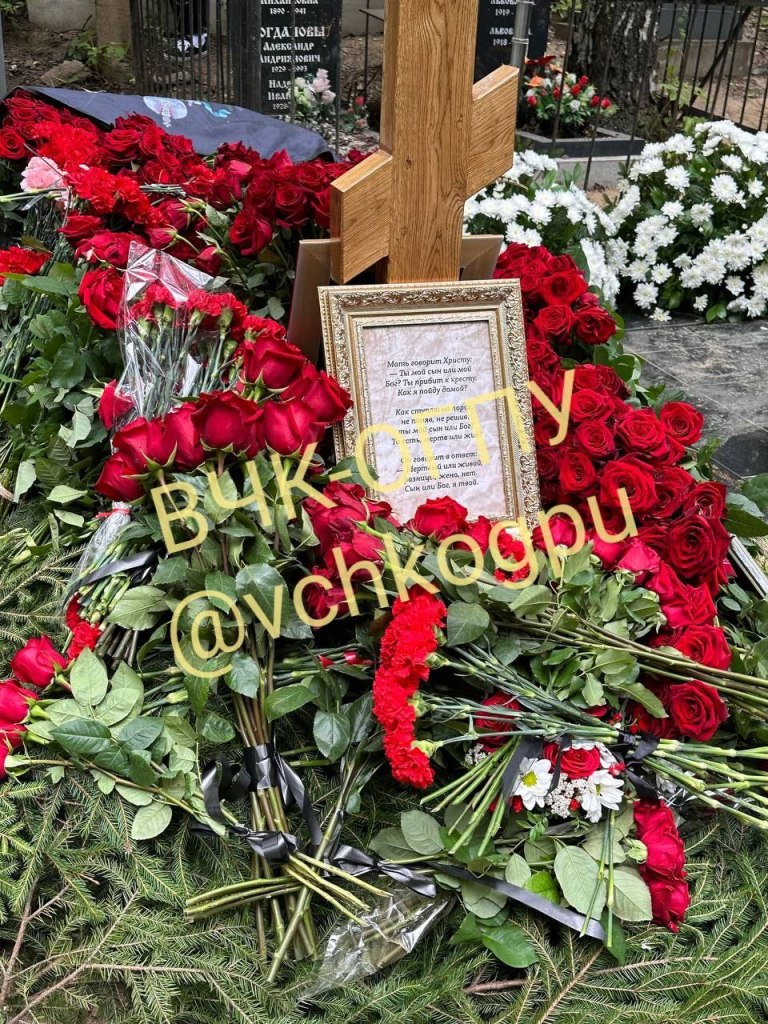
Presently, photographs from his restricted funeral—purportedly arranged by his mother, Violetta Prigozhin—exhibit armed guards, scent-tracking canines, and a peculiar poem framed and positioned on the grave marker.

Source: VChK-OGPU (Telegram), 30 August 2023

As per the state-endorsed Russian media outlet Moskovskij Komsomolets and the Telegram channels Rotunda and VChK-OGPU, the framed poem, observed during the funeral attended [by] Lyubov Prigozhina, 52, and the Wagner mercenary supremo’s elder daughter Polina, 31, comprises these verses:

‘Mother says to Christ: Are you my son or my God? You’re nailed to the cross, how will I go home?’ it read.

‘How will I step on the threshold, not understanding, not deciding: Are you my son or God? That is, dead or alive.

‘He says in response: Dead or alive, no difference, woman. Son or God, I am yours,’

The excerpt is borrowed from a composition by the Russian/Soviet Union poet Joseph Brodsky, entitled Still Life.

Earlier that day, a hearse was spotted traversing St Petersburg en route to the Porokhovskoye Cemetery.

As per Rotunda’s assertion, the Russian Ministry of Internal Affairs remained unaware of the funeral’s precise location. The ultimate lines of the poem supplement the intrigue, echoing assertions made by Russian authority Valery Solovey the previous day.

He commented, “Prigozhin himself was not aboard. His doppelgänger had taken flight in his stead—Vladimir Putin is keenly cognizant of this fact. If you… place your faith in the official declarations of the Russian administration, then what more can I add…?”

Source: Abhishek Awasthi, “Wagner chief Prigozhin alive? Poem on his grave fuels speculation,” Firstpost, 30 August 2023