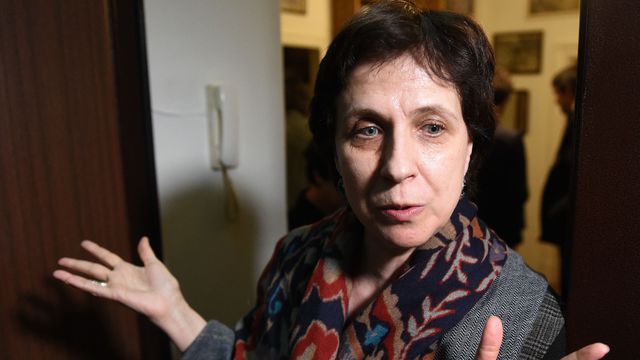
Photo courtesy of Mikhail Zakharov/Kazansky Reporter
Tatfondbank Depositors Protest in Kazan RBC
March 4, 2017
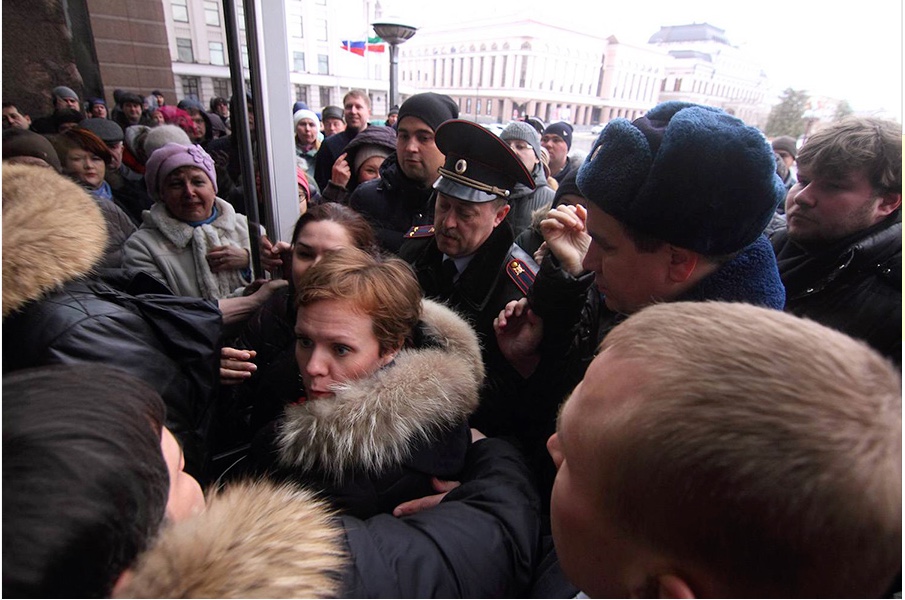
On Saturday, March 4, depositors of Tatfondbank, whose license has been revoked, held a protest rally outside the Republic of Tatarstan’s government house. The protesters presented Ildar Khalikov, the republic’s prime minister, with a petition demanding the government challenge the Russian Central Bank’s decision to revoke the bank’s license and compensate depositors for their losses. The depositors gave the authorities three days to think it over. Otherwise, they will call for the republic’s president and cabinet to resign. Tatfondbank’s license was revoked on March 3.
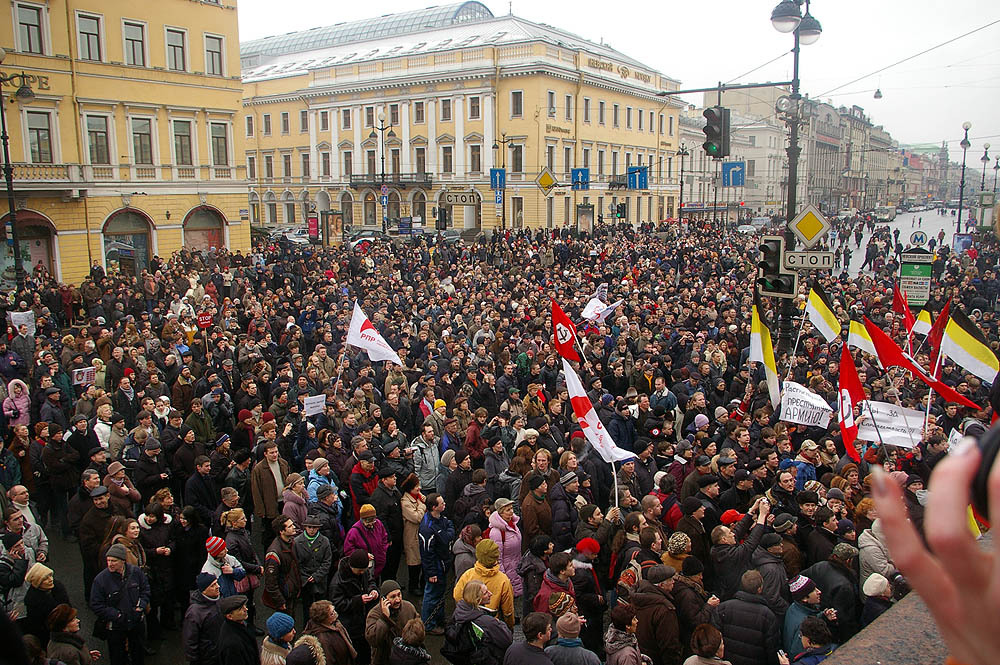
Anti-Putin protesters gathered on Nevsky Prospect in Petersburg next to the old City Duma building, March 3, 2007. Photo courtesy of Wikipedia
A comrade reminds me that today (March 3, 2017) is ten years to the day from the first March of the Dissenters in Petersburg (March 3, 2007), in which thousands of anti-Putin protesters who had been kettled by riot police on Ligovsky Prospect near Insurrection Square broke through the police lines and marched, nearly unimpeded and without anyone’s “authorization,” all the way down the Nevsky to the old City Duma building, where various “ringleaders,” including the then-fearless and inspiring local politician Sergei Gulyaev, several Natsbols (during their “liberal” phase, now long since forgotten), and Garry Kasparov tried to mount the steps to give speeches, which they did with more or less success until the riot cops infiltrated the huge crowd gathered around the Duma and dragged them away to paddy wagons.
Needless to say, it was a wonderful day, one of the most memorable in my life, and a rare manifestation of real grassroots people power in a city whose populace is too often prone to wait for the cops to give them permission to stand in a dirty, invisible corner of town and hold up their handmade placards, which will be seen by no one except their mostly fairweather friends on Facebook.
If you weren’t there that day, but could have been, you made a big mistake, for which, I suspect, the gods of Ingria will never ever forgive you.
Villanova University basketball team in action. Photo courtesy of Forbes.com
“Russia is neither the juggernaut nor basket case it is varyingly made out to be. A well-reasoned Russia policy begins by quelling one’s hysteria long enough to recognize this and then engaging it accordingly.”
—Mark Lawrence Schrad, “Vladimir Putin Isn’t a Supervillain,”Foreign Policy, March 2, 2017
Try telling a great many people in Russia that the country isn’t a basket case, or that Putin and his regime aren’t a total menace, especially to Russians themselves, as Mark Lawrence Schrad argues in the article I’ve quoted above. They would laugh in your smug face.
I wonder if this useful idiot and assistant professor in political science at Villanova has ever lived in the country long enough to figure this home truth out. Probably not.
Villanova has a great basketball team this year, however. Maybe I should focus on them.
Somehow, I have to stay positive in the midst of the dawning awareness that lots of Anglo-American Slavists would, seemingly, like to work for the KGB if they could. Or are simply too clueless to do their jobs.
At very least, Professor Schrad’s article would have been accepted for publication in Russian Insider as is. TRR
This is what a “non-basket case” looks like in real life, not from one’s office in Philadelphia.
“Arenda” (“For Rent”) is definitely the most popular shop sign in the neighborhood around Voznesensky and Izmailovsky Prospect when I went there the other day to do a couple of errands, and it is complemented by lots of shops that aren’t flying the “Arenda” banner just yet, but which are definitely closed for business forever, like this Chinese restaurant, now known as “Khui” (if you read the fine print on the plasterboard that has replaced the broken glass in the door).
“Fuck.” Photo by TRR
Except for a few parts of central Petersburg where commercial spaces never stay empty for long, even in bad times, this is the visual-economic landscape you would see all over town. It is a landscape of “mixed and uneven development,” to put it charitably.
I don’t see how any self-respecting scholar wouldn’t start with this grassroots reality when analyzing Russia’s current state, rather than with a grab bag of rank speculations, half truths, and outright falsehoods he or she has read in English-language newspapers, magazines, and websites.
But that’s mostly how the new, actually quite fairly hysterical “anti-hysteria”/”anti-Russophobia” school of half-baked journalism and “Russia hands” scholarship operates. Its adepts sit far from Russia and tells Russians how good they’ve got it. TRR
__________________
Exhibit Two: How the Russian Countryside Is Dying
How the Russian countryside is dying.
A sad name for a reportage. But first of all one feels for the people in the reportage, who have worked the land for many years.
I visited the hinterland just yesterday at the request of the workers at the Vegetable Integrated Agricultural Production Company in Tonshalovo, Cherepovets District, Vologda Region. The fact is that everything there has been frozen, and the company has been put on the road to bankruptcy. The prosecutor’s office is looking for the guilty parties, but instead of reading thousands of words, I suggest you watch the video. The inhabitants of our country utter many wonderful, sincere words in the video. What is happening with agriculture nowadays all over Russia is quite sad.
Nettle Info, How the Russian Countryside Is Dying. YouTube video, in Russian. Posted January 23, 2017, by Nettle Info
Translated by the Russian Reader. Thanks to Comrade Koganzon for the heads-up
__________________
Exhibit Three: Russia’s Wildly Corrupt Prime Minister
Russian opposition politician Navalny links PM Medvedev to billion euro property empire Deutsche Welle
March 2, 2017
Navalny alleges Medvedev took bribes from key Russian oligarchs under the guise of donations to charities. In a 49-minute exposé, Navalny even flies drones over lavish properties he alleges were bought with corrupt money.
Russian opposition politician Alexei Navalny accused Prime Minister Dmitry Medvedev of massive corruption in a report accompanied by a Youtube video he posted on Thursday.
The anti-corruption activist alleged Medvedev controls a property empire including mansions, yachts and vineyards financed by bribes from oligarchs to a network of non-profit organisations.
“Based on the documentation disclosed, we can confirm that at least 70 billion rubles (1.3 billion euros or US$1.19 billion) have been transferred in cash and assets to Medvedev’s foundations,” said Navalny, who heads the Anti-Corruption Foundation.
Medvedev “practically openly created a corrupt network of charitable foundations through which he receives bribes from oligarchs and frantically builds himself palaces and vacation homes across the whole country,” the report alleged.
The report was welcomed by Transparency International Russia, a non-profit organization that targets corruption, though it questioned some of its conclusions.
Findings met with skepticism
Navalny has sworn that he will be a candidate in upcoming elections despite being dogged by legal problems
“There are certain doubts in the story of Ilia Yeliseyev, the deputy chairman of the Gazprombank. It is doubtful that Yeliseyev is just a scarecrow. Despite the fact he was a classmate of Medvedev, he is an important figure. He could have earned that fortune himself,” spokesman Gleb Gawrisch told DW.
Gawrisch also said although it looked suspicious it wasn’t actually illegal for Medvedev to use real estate owned by non-profit organizations
“Corrupt officials often use non-profit organizations to hide financial flows and property,” he conceded in a statement to Deutsche Welle.
“The problem is finding out who the ultimate beneficiary is, and we are delighted that the Anti-Corruption Foundation has succeeded in presenting such an extraordinary investigation.”
Navalny, also a lawyer, garnered notoriety for his denunciations against corruption and was sentenced to five years in prison with a suspended sentence for embezzlement, which forbid him from being a candidate in the elections.
His [49]-minute video amassed several hundred thousand views in a few hours on YouTube.
Anti-Corruption Foundation, Don’t Call Him Dimon: Palaces, Yachts, and Vineyards—Dmitry Medvedev’s Secret Empire. YouTube video, with subtitles in English. Posted March 2, 2017, by Alexei Navalny
Navalny said that the foundations receive “donations” from oligarchs and companies, which are then used to purchase lavish properties for Medvedev, who is never registered as the owner.
“The prime minister and his trusted friends have created a criminal scheme, not with companies registered in tax havens as usual, but with non-profit foundations, which makes it virtually impossible to determine the owner of the assets,” he said.
“Medvedev can steal so much and so openly because Putin does the same, only on a bigger scale,” he wrote, presenting his team’s online report.
Navalny said he was able to establish the links to Medvedev by tracing the purchases online.
Medvedev’s spokeswoman dismissed the allegations as promotion for Navalny’s presidential bid.
“Navalny’s material is clearly electioneering in nature,” Natalya Timakova told RIA Novosti state news agency. “It’s pointless to comment on the propagandistic attacks of an oppositional convict,” she added.
_____________
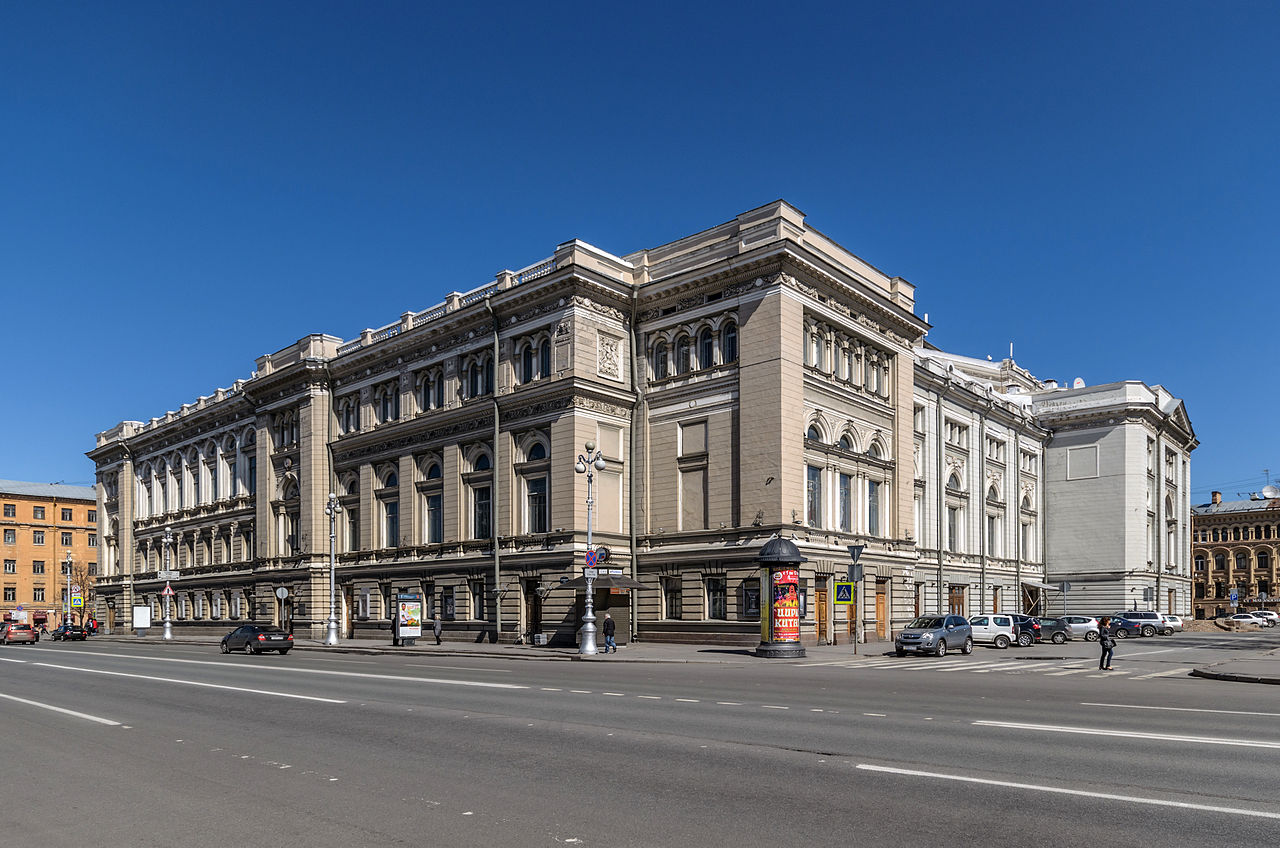
P.S. An acquaintance just told me the average monthly salary at the world-renowned St. Petersburg Conservatory is 11,000 rubles a month (approx. 178 euros), but employees there have not been paid since the end of last year.
And you would still say Russia is not a “basket case,” Mark Lawrence Schrad, assistant professor in political science at Villanova? Could you live on 178 euros a month while also not being sure you would actually be paid that measly sum on time every month?
I imagine that Professor Schrad was paid more than a paltry 178 euros for his wildly misleading article in Foreign Policy.
St. Petersburg Conservatory. Photo courtesy of Wikipedia
Supreme Court Chief Justice Accused of Persecuting Dissidents during Soviet Times He convicted human rights activist Felix Svetov, whose daughter Zoya Svetova had her apartment searched by the FSB yesterday
Alexei Obukhov Moskovsky Komsomolets
March 1, 2017
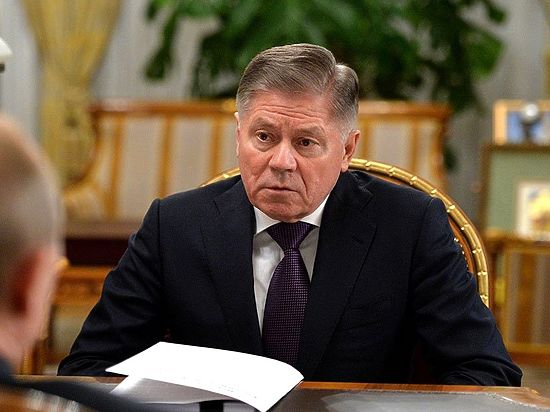
Memorial has published documents relating to the case of journalist and human rights activist Zoya Svetova’s father, Felix Svetov, who was convicted in the Soviet for his human rights works. His trial, in 1986, was presided over by Vyacheslav Lebedev, who has been chief justice of the Russian Federal Supreme Court since 1989.
Chief Justice Vyacheslav Lebedev. Photo courtesy of Kremlin.ru
According to Memorial, Svetov was found guilty because he had made “defamatory” allegations that “innocent people [were] thrown into prison” and accusations that the authorities did not observe socialist laws and violated the rules of the Criminal Procedure Code.
Ultimately, Lebedev, who was then deputy head judge of Moscow City Court, sentenced Svetov to five years of exile.
Memorial published the information in connection with the search conducted this past Tuesday in the apartment of Felix Svetov’s daughter Zoya Svetova, an employee of Open Russia, which is headed by Mikhail Khodorkovsky. A similar search had taken place before Svetov’s trial in 1986.
Yet investigators have claimed that the hours-long search, which in particular involved confiscating the computers of Svetova’s children, the well-known journalists and brothers Filipp, Tikhon and Timofei Dzyadko, was carried out as part of the case against Khodorkovsky’s company Yukos, launched back in 2003. Svetova herself has suggested the real reason for the search was her work on the Moscow Public Monitoring Commission.
Memorial added that, in 1984, Lebedev handed down a guilty verdict to human rights activist Elena Sannikova. She was convicted of “anti-Soviet agitation and propaganda.”
_________________________
Moskovsky Komsomolets Deletes Article on Supreme Court Chief Justice’s Involvement in Persecuting Soviet Dissidents Meduza
March 1, 2017
On March 1, an article entitled “Supreme Court Chief Justice Accused of Persecuting Dissidents during Soviet Times” vanished from the website of newspaper Moskovsky Komsomolets. The article was published on Wednesday afternoon and was accessible on the site for a few hours.
No reasons have been given for its deletion. A copy of the article has been cached in Google Search results. Moskovsky Komsolets editor-in-chief Pavel Gusev told Meduza he was unaware of why the the article had been deleted and was hearing about the matter for the first time.
The article discusses Memorial’s publication of documents relating to a police search of the home of Felix Svetov and Zoya Krakhmalnikova, parents of Zoya Svetova, which took place in 1982.
Among other things, Memorial’s Facebook post points out that the presiding judge in Svetov’s case, which was heard in the mid 1980s, was Vyacheslav Lebedev, who would become chief justice of the Russian Federal Supreme Court in 1989.
FSB investigators searched journalist Zoya Svetova’s home for over ten hours on February 28, 2017, allegedly, as part of the Yukos affair. Svetova works for Mikhail Khodorkovsky’s Open Russia, but claims she knows nothing about Yukos’s business.
Translated by the Russian Reader. Thanks to Comrades AK and JM for the heads-up
Russia: ‘Deeply alarming’ raid targets human rights activist and journalist Zoya Svetova Amnesty International
28 February 2017
After Russian criminal investigators searched the flat of Zoya Svetova, a prominent journalist and human rights activist, this morning, Sergei Nikitin, Director of Amnesty International Russia, said:
“Today’s search of Zoya Svetova’s flat is deeply alarming. She is one of Russia’s most respected journalists and human rights activists – it is unclear what she might have to do with the criminal investigation against YUKOS.”
“This search seems like a blatant attempt by the authorities to interfere with her legitimate work as a journalist and perhaps a warning for her and others of the risks of human rights work and independent journalism in Russia.”
Zoya Svetova previously worked for Reporters without Borders and Soros Foundation in Russia.
The search was conducted by 12 officers from Russia’s Investigative Committee that probes serious crime. According to Svetova’s lawyer, it was linked to a case of alleged embezzlement and tax fraud by the former YUKOS oil company head Mikhail Khodorkovsky. One of the most prominent critics of the Kremlin, Khodorkovsky served 10 years in jail and in 2011, after being convicted of another offence and sentenced to a new term of imprisonment, he was declared a prisoner of conscience by Amnesty International.
In December 2016 Russian Investigative Committee officers raided the apartments of seven Open Russia activists as well as the movement’s offices in Moscow and Saint Petersburg. The Investigative Committee claimed it was seeking evidence of money laundering by former YUKOS executives with links to Khodorkovsky.