El lector ruso: El pueblo libre de Vorónezh

El 22 de abril del 2025 la policía de Vorónezh allanó los domicilios de activistas que, según el Centro “E” [la policía antiextremista rusa], estaban vinculados al canal de Telegram Pueblo Libre de Vorónezh. Los registros también incluyeron graves golpizas y amenazas, y algunos activistas fueron obligados a grabar vídeos de apoyo a Putin y su guerra en Ucrania. Casi todos los activistas habían sido ​​previamente procesados por acusaciones  políticas, pero ahora han sido intimidados a tal punto que ahora temen presentar alguna  denuncia por tortura contra la policía.

Un video de 38 minutos fue publicado en el canal del Pueblo Libre de Vorónezh el 16 de abril del 2025. En el video, visto por menos de trescientas personas, cuatro activistas —Grigory Severin, Nadezhda Belova, Yuri Avsenyev y Alexander Zheltukhin— comentan noticias antes de trotar por la orilla del río Vorónezh. Este género es llamado “charla de café”: con las noticias como punto de partida, los amigos hablan sobre el problema del alcoholismo, la apatía social, el aumento del consumo de drogas y la sensación general de pesimismo.
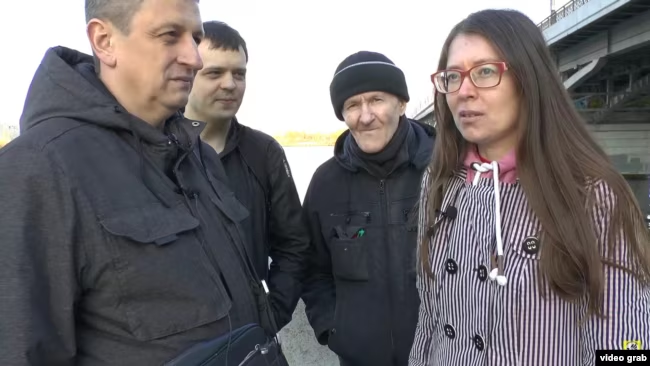
Activistas del canal de Telegram del Pueblo libre de Vorónezh: Grigory Severin, Alexander Zheltukhin, Yuri Avsenyev y Nadezhda Belova

Nadezhda Belova resume el contenido del video al principio del mismo.

“En síntesis, todo está mal, y es más, todo empeorará. Para resumir, la situación en este lugar está en su fase terminal” dice ella.

Sostiene que Rusia inevitablemente se encamina hacia “Corea del norte”: una dictadura desmantelada y podrida, porque los rusos, de alguna manera, todavía la defienden y quieren vivir en ella. Belova tiene motivos para ser pesimista: incluso antes de la guerra, el Estado la había acusado de “apología del terrorismo” por comentarios que hizo en redes sociales tras el atentado suicida de Mijaíl Zhlobitski contra una oficina del FSB en Arkhangelsk. El 2020, un tribunal militar la condenó a pagar una multa de 400.000 rublos. Estuvo en la lista de “terroristas y extremistas” de Rosfinmonitoring durante varios años y su familia tuvo que abandonar su pueblo natal para alquilar un piso en Voronezh, ya que sus vecinos no la asistieron en su lucha contra las injustas acusaciones.

Vídeo publicado en el canal de Telegram Pueblo Libre de Voronezh el 16 de abril del 2025

“Nuevamente, toda Vorónezh está cubierta de anuncios de drogas. Las fuerzas del orden protegen el tráfico [ilegal de drogas] y si no lo hicieran, estos anuncios no existirían. En la tienda Pyaterka [de veinticuatro horas] de mi barrio, justo en la entrada, hay un colorido grafiti pintado en el umbral: «Comprar drogas es como salir a comprar pan»», dice Alexander Zheltukhin. En años anteriores, Zheltukhin fue multado, por protestar contra la persecución de Belova, y arrestado por protestar en apoyo a Navalny. «Y si no estuviera protegido, diría yo, por el mismísimo FSB, que probablemente se lleva un porcentaje…»

—¡Cuidado! Estás desacreditando al FSB —dice Belova, interrumpiéndolo—. ¡No estoy de acuerdo! ¡No puede ser!

Las advertencias y omisiones se repiten a lo largo de toda la conversación. Los activistas saben que cualquier uso de la libertad de expresión es potencialmente peligroso en la Rusia de hoy y tratan de cubrir sus bases siempre que pueden. (Spoiler: no funcionó).

“Ellos dicen que es imposible no confesar”

Unos días después, el 22 de abril, la policía allana los domicilios de las cuatro personas implicadas en el trote, así como los de otros activistas de Vorónezh. Se realizaron registros en ocho lugares presuntamente relacionados con el Pueblo Libre de Vorónezh. En la mayoría de los casos, las fuerzas del orden actuaron con extrema dureza. Utilizaron esposas y pistolas eléctricas, golpearon a la gente, intimidaron a los activistas y a sus familias, y los maltrataron emocionalmente.
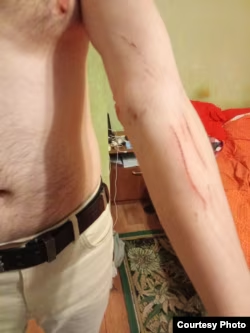
Foto publicada por Nadezhda Belova

Todos los miembros de la familia de Belova recibieron disparos de pistola paralizante. Belova, posteriormente, publicó en Facebook fotos de sus propios moretones y las marcas de sangre en los cuerpos de su hijo y su esposo. La policía confiscó todos sus dispositivos electrónicos y dejó su piso de alquiler en un estado tal que la casera exigió a los Belov que desalojaran inmediatamente después del registro. La policía amenazó con enviar a su hijo,  estudiante universitario, a la guerra, y tras la inspección, un policía grabó un video de Belova arrepintiéndose.

“Fuera de cámara [el policía que golpeaba al esposo de Belova] preguntó: ‘¿Apoya [la operación militar especial]?’. Le digo: ‘Sí’. Me pregunta: ‘¿Apoya a Putin?’. Le digo: ‘Sí’. Es un comentario a la ligera, pero repugnante, sobre todo cuando veo una pistola eléctrica presionando la pierna de mi hijo”, declaró Belova a Okno.

La policía grabó en vídeo similares “confesiones” de muchas otras personas [capturadas en las redadas].

Tras los registros, Zheltukhin acabó en el hospital con cinco costillas rotas y varias vértebras dañadas. Él declaró a OVD Info que cayó del tejado de una casa del pueblo al intentar escapar de la “operación punitiva”: “Parece que me rompí las costillas al caer, y me golpearon [en esas costillas], me duele mucho”. La policía le puso una bolsa en la cabeza y le aplicó una descarga eléctrica con una pistola paralizadora. Sus amigos lo fotografiaron posteriormente en el hospital: tenía la cara cubierta de moretones.

Fyodor Orlov, de 36 años, también fue golpeado. Tras esto, afirmó que “se lo hizo todo él mismo”. Se autoinfligió todos los moretones y raspaduras, se vendó los ojos con una bufanda y permaneció sentado así durante dos horas, hasta que cayó solo en un zarzal: hay fotos de su espalda, completamente cubierta de sangre. “Entonces alguien —es decir, yo— me dibujó un órgano sexual en la cabeza calva solo por diversión”, declaró a OVD Info. Los agentes del orden también amenazaron con cortarle un dedo, dejándole arañazos delatores.

Detalle del dedo de Fyodor Orlov

“Fue bastante duro. Lo más duro posible, hasta el punto de que dicen que ahora entienden por qué la gente confiesa crímenes que no cometió. Porque, dicen, es imposible no confesar. Orlov tiene cientos de marcas de pistola eléctrica [en el cuerpo]. ¡Cientos! Lo llevaron al bosque. Creyó que lo llevaban allí para matarlo», dice Pavel Sychev, de 38 años.

Sychev es activista y consultor político de Vorónezh. Conoce a los administradores del canal Pueblo Libre de Vorónezh por su pasado activista: no tienen un contacto cercano aunque los haya visto en piquetes. El domicilio de Sychev también fue registrado el 22 de abril, aunque sin  violencia.

[La policía] registra mi casa, por lo general, sin infringir la ley, y nunca usan la fuerza conmigo o con mi familia. Vienen a mi casa todos los años desde el 2022. Son registros rutinarios. Siempre me han intervenido como testigo en causas penales con las que ni siquiera tengo conexión indirecta”, dice Sychev. “[Cuando] hay un caso federal [por ejemplo, el caso contra Grigory Melkonyants y otros activistas del movimiento Golos—Okno] y realizan una serie de registros por todo el país, y vienen a registrar mi casa por si acaso”.

“El mal ama al silencio”

Es improbable que la nueva serie de registros se debiera al último video publicado en el canal de Telegram. Nuestras fuentes sugieren, más bien, que el motivo de los allanamientos es que en el Pueblo Libre de Vorónezh se escribe y habla constantemente de personas condenadas por alta traición y terrorismo (por sabotear cajas de cambio de vías férreas, torres de telefonía móvil, etc.). Los administradores del canal tratan a estas personas como opositores a la guerra. Para las fuerzas del orden, en cambio, son delincuentes condenados por delitos violentos.

El pretexto formal para la serie de registros del 22 de abril fue la causa penal contra Grigory Severin por cargos reiterados de desprestigio del ejército. Según se desprende del escrito de la acusación, mientras cumplía condena en una colonia penitenciaria [había sido condenado a dos años y medio de prisión por “incitar públicamente al extremismo”, condena que cumplió para ser liberado el otoño pasado–Okno], Severin desacreditó a las fuerzas armadas rusas. Tras el allanamiento, fue detenido.

Sychev cree que este caso penal fue “preparado”.

“Ya ves, en Rusia tenemos la práctica de ‘casos de cajón’. Esto significa que ya existe una causa penal en su contra: todo un expediente preparado de antemano que se encuentra guardado en un cajón, esperando su turno. En el caso de Severin, su primer caso también estaba guardado en un cajón. Cuando fue arrestado, se supo que todo su expediente se había preparado un año antes”.

Se desconoce qué llevó a la policía a sacar el expediente del cajón en ese momento. Pero el hecho mismo de que Severin se enfrente a un proceso judicial no sorprende a Sychev.

“Cualquiera que conozca a Grigory, aunque sea de pasada, sabe que es un hombre que no se queda callado. Si alguien le pregunta directamente qué opina sobre tal o cual cosa, él responde sin rodeos, incluso si la respuesta conlleva el riesgo de ser acusado penalmente. Es un hombre que siempre intenta demostrar a todos el punto de vista que defiende. Que yo sepa, el primer cargo por “descrédito de las fuerzas armadas” en su contra ocurrió por explicar su filosofía de vida a unos agentes de tráfico que lo habían detenido. El segundo cargo se originó al comunicar su postura a sus compañeros de celda. En su caso, esto es normal: no se calla; habla abiertamente, sin rodeos. Así que era cuestión de tiempo. Cuando alguien habla abiertamente sobre un tema tan peligroso y delicado —y en nuestro país la “operación militar especial” es un tema delicado— hay muchas probabilidades de que, tarde o temprano, sea procesado”.

Ese mismo día, se abrió una causa penal contra el activista Yury Avsenyev, de 65 años, otra persona implicada en el trote por el dique del río Vorónezh. Su domicilio también fue registrado el 22 de abril, pero fue puesto en libertad bajo fianza. Avsenyev es sospechoso de incitar públicamente al extremismo.
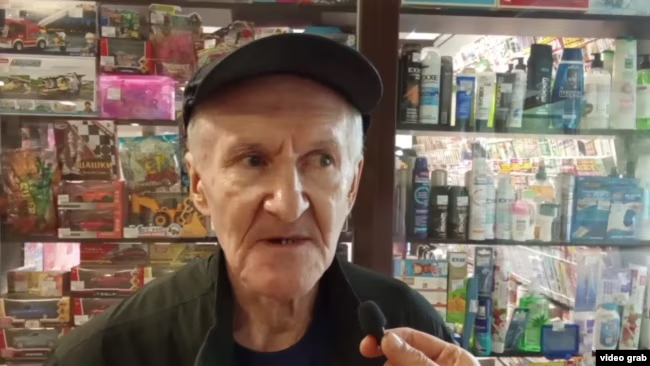
Yuri Avsenyev

Los activistas de Vorónezh víctimas de la brutalidad policial aún no han tenido la valentía de presentar denuncias y temen una publicidad excesiva.

“Están realmente asustados”, dice Pavel Sychev. “La información que ahora tengo es que no presentarán denuncias por tortura, pero no sé, quizás alguien los convenza. Tienen mucho miedo de que, si lo hacen, no haya ningún llamado de atención a las fuerzas del orden, sino que simplemente estos vendrán y se vengarán de los denunciantes. Todos están convencidos de que los matarán. Les dije que el mal ama al silencio, y que si no reaccionan ahora hay más probabilidades de que esto se repita. Pero dijeron que es muy fácil juzgar desde fuera cuando no has sido torturado. ‘Tenemos miedo de que nos hagan algo’ [dicen]”.

Nuestras fuentes señalan que esta ilegalidad oficial no había ocurrido nunca en Vorónezh. Usualmente, los registros domiciliarios de activistas políticos y las detenciones se han llevado a cabo siguiendo  las normas, sin violencia. El único caso, ampliamente difundido, de impunidad oficial culminó con cargos penales contra los agentes de policía implicados y una indemnización económica para las víctimas. En mayo del 2018, los investigadores criminales Sergei Kosyanenko y Oleg Sokolovsky torturaron a los estudiantes universitarios Maxim Grebenyuk y Sergei Troyansky con la esperanza de obligarles a confesar que habían robado un teléfono móvil. Los estudiantes fueron retenidos en la comisaría n.º 4 del distrito de la Comintern de Vorónezh durante seis horas, esposados ​​y estrangulados con una bolsa de plástico. Se negaron a autoincriminarse y, posteriormente, documentaron sus lesiones y presentaron una denuncia por tortura ante el Comité de Investigación. El 2021, Grebenyuk recibió un millón de rublos y Troyansky, 500.000 rublos como compensación por su tortura.

La brutalidad actual de la policía de Vorónezh podría deberse a la proximidad del frente, según sugiere una fuente que ha pedido permanecer en el anonimato. Lo cierto es que, desde el inicio de la invasión a gran escala, las fuerzas del orden de Vorónezh han sido destacadas regularmente en los llamados nuevos territorios: las regiones ocupadas de Donetsk y Luhansk.

“Hay graves problemas legales en esos ‘nuevos territorios’. Y las prácticas que allí se emplean son inhumanas, creo. Cuando regresan aquí, a su tierra natal, simplemente no se vuelven a adaptar”, dice nuestra fuente, que no está conectada con el canal de Telegram del Pueblo Libre de Vorónezh. “Se consideran por encima de la ley. Creen que están involucrados en una buena causa y que pueden torturar a gente mala por el bien de la buena causa. Cuando alguien lo intenta una vez, cuando se da cuenta de que puede salirse con la suya sin ningún problema, es muy difícil frenarlo, y la situación sólo se agravará”.

Fuente: “‘Estado terminal’: Agentes del orden de Vorónezh golpean brutalmente a activistas durante allanamientos,” Okno, 29 de abril del 2025. Traducido a inglés por The Russian Reader y al español por Hugo Palomino

Free People of Voronezh

Alexander Zheltukhin

On 22 April 2025, Voronezh police raided the homes of activists believed by Center “E” [Russia’s “anti-extremism” police] to be connected to the Telegram channel Free People of Voronezh. The searches also involved severe beatings and threats, and some of the activists were forced to record videos supporting Putin and the war in Ukraine. Almost all the activists had previously been prosecuted on political charges, but now they feel so intimidated that they are afraid to file a torture complaint against the police.

A 38-minute video was posted on the Free People of Voronezh channel on 16 April 2025. The video itself was viewed by less than three hundred people. In the video, four activists—Grigory Severin, Nadezhda Belova, Yuri Avsenyev, and Alexander Zheltukhin—discuss the news before jogging along an embankment of the Voronezh River. The genre is the “coffee klatch”: using the news as a springboard, the friends talk about the problem of alcoholism, apathy in society, increasing drug use, and the overall sense of doom and gloom.

Activists of the Telegram channel Free People of Voronezh:
Grigory Severin, Alexander Zheltukhin, Yuri Avsenyev, and Nadezhda Belova

Nadezhda Belova sums up the video’s content at the very beginning.

“To cut it short, everything is bad, but it will get worse. To put it in a nutshell, the situation in this place is at the terminal stage,” she says.

She argues that Russia is inevitably moving in the direction “North Korea”—toward a mothballed, rotten dictatorship, because Russians “somehow still support it and want to live in it.” Belova has reason to be pessimistic: even before the war, the state had charged her with “condoning terrorism” for comments she had made on social media in the wake of Mikhail Zhlobitsky‘s [suicide] bombing of the Arkhangelsk FSB. in 2020, a military court sentenced Belova to pay a fine of 400,000 rubles. She was on Rosfinmonitoring’s list of “terrorists and extremists” for several years, and her family had to leave their home village and rent a flat in Voronezh, as their fellow villagers did not support Belova in her fight against the unjust charges.

The video posted on the Telegram channel Free People of Voronezh on 16 April 2025

“Again, the whole of Voronezh is covered with drug adverts. The law enforcement agencies run protection for [the illegal drug trade], and if they didn’t run protection for it, there wouldn’t be these adverts. At my neighborhood Pyaterka [convenience store], right at the entrance, there is a graffito painted in color on the doorstep: ‘Buying a stash is like going out for bread,'” says Alexander Zheltukhin. In previous years, Zheltukhin was fined for picketing against Belova’s persecution and arrested for protesting in support of Navalny. “And if it was not protected, I would argue, by the selfsame FSB, who probably take a percentage from it—”

“Watch out! You are discrediting the FSB,” Belova says, interrupting him. “I don’t agree! It cannot be!”

Caveats and omissions run through the entire conversation. The activists know that any free speech is potentially dangerous in today’s Russia, and they try to cover their bases whenever possible. (Spoiler: it didn’t work).

“They say it’s impossible not to confess”

A few days later, on 22 April, police raided the homes of all four people involved in the run, as well as those of other Voronezh activists. Searches were done at eight locations, allegedly connected with Free People of Voronezh. In most cases, the law enforcers acted extremely harshly. They used handcuffs and stun guns, beat people, intimidated the activists and their families, and emotionally abused them.

A photo posted by Nadezhda Belova

All the members of Belova’s family were shot with a stun gun. Belova later posted photos of her own bruises and the bloody marks on the bodies of her husband and son on Facebook. The police confiscated all their electronic devices and turned upside down their rented flat, which the landlady demanded that the Belovs vacate immediately after the search. The police threatened to send the son, a university student, to the war, and after the search, a policeman recorded a repentant video featuring Belova.

“Off camera, the [policeman beating Belova’s husband] says, ‘Do you support the [special military operation]?’ I say, ‘Yes.’ He says, ‘Do you support Putin?’ I say, ‘Yes.’ It’s light fare, but disgusting, especially when I saw a stun gun pressed against my son’s leg,” Belova told Okno.

The police recorded similar video “confessions” by several other people [caught up in the raids].

After the searches, Zheltukhin ended up in hospital with five broken ribs and several damaged vertebrae. He told OVD Info that he had tried to escape from the “punitive operation” and fell from the roof of a village house: “I broke my ribs when I fell, apparently, and they hit me [on those ribs]: it hurts a lot.” The police put a bag over his head and shocked him with a stun gun. His friends later photographed Zheltukin at hospital: his face was covered with bruises.

Fyodor Orlov, 36, was also beaten; after the experience, he says that he “did it all to himself.” He inflicted all the bruises and abrasions on himself, blindfolded himself with a scarf and sat like that for two hours, and fell into a briar bush on his own; there are photos of his back, entirely covered with flecks of blood. “Then someone—that is, I—drew a sex organ on my bald head just for fun,” he told OVD Info. The law enforcers also threatened to cut off one of his fingers, leaving behind telltale scratches.

Fyodor Orlov’s finger

“It was quite rough. As rough as possible, to the point that they say that now they understand why people confess to crimes they did not commit. Because, they say, it’s impossible not to confess. Orlov has several hundred stun gun marks [on his body]. Several hundred! They drove him into the woods. He thought they were taking him there to kill him,’” says Pavel Sychev, 38.

Sychev is a Voronezh activist and political consultant. He knows the administrators of the Free People of Voronezh channel from his past work as an activist: they crossed paths at pickets, but do not keep in close contact. Sychev’s home was also searched on 22 April, but there was no violence.

[The police] search my home, as a rule, without breaking the law, and they never use force against me or my family. They have been coming to my home every year since 2022. These are just routine searches. I have always been searched as a witness in criminal cases to which I don’t even have an indirect connection,” says Sychev. “There is a federal case [for example, the case against Grigory Melkonyants and other activists of the Golos movement—Okno], and they do a series of searches all over the country, and they come and search my house for good measure.”

“Evil loves silence”

It is unlikely that the new series of searches was occasioned by the latest video posted on the Telegram channel. Our sources suggest, rather, that the reason for the raids was that Free People of Voronezh constantly writes and speaks about people convicted on charges of high treason and terrorism (for sabotaging railroad switch boxes, cell towers, etc.). The channel admins treat these people as anti-war resisters. For law enforcers, on the contrary, they are criminals convicted of violent crimes.

The formal pretext for the series of searches on 22 April was the criminal case, on charges of repeated discrediting of the army, brought against Grigory Severin. As follows from the indictment, while serving his sentence in a penal colony [he had been sentenced to two and half years in prison for “publicly calling for extremism”; he served his time and was released last autumn—Okno], Severin discredited the Russian armed forces. After the search, he was detained and placed under arrest.

Sychev believes that this criminal case was “canned.”

“You see, in Russia we have the practice of ‘desk drawer cases.’ Meaning you already have a criminal case against you: the entire case file is ready in advance, and it is lying in a desk drawer, waiting for its day to come. In the case of Severin, his first case was also ‘in a desk drawer.’ When he was arrested, it transpired that the entire case file had been readied a year earlier.”

It is not known what prompted the police to pull the case file from the drawer right now. But the fact that Severin faces prosecution does not surprise Sychev in itself.

“Everyone who knows Grigory, even in passing, realizes that he is a man who will not stay quiet. If anyone asks him directly how he feels about this or that situation, he will answer directly, even if the answer risks criminal charges. He is a man who will always try to prove to everyone the viewpoint which he espouses and defends. As far as I know, the first ‘discrediting of the armed forces’ case against him came from his explaining his philosophy of life to traffic police officers who had pulled him over. The second charge came from telling his cellmates about his stance. This in the order of things for him: he does not keep silent; he speaks openly, directly. So it was a matter of time. When a person speaks openly about a very dangerous and sensitive topic—and in our country the ‘special military operation’ is a sensitive topic—there are many chances that sooner or later they will be prosecuted.”

On the same day, a criminal case was opened against 65-year-old activist Yury Avsenyev, another person involved in the run along the Voronezh River embankment. His home was also searched on 22 April, but he was released on his own recognizance. Avsenyev is suspected of “publicly calling for extremism.”

Yuri Avsenyev

The Voronezh activists who fell victim to the police brutality have not yet worked up the courage to file complaints, and they fear excessive publicity.

“They are really spooked,” says Pavel Sychev. “The information I have now is that they will not file torture complaints, but I don’t know, maybe someone will persuade them to do it. They are very much afraid that if they do it, the law enforcers won’t be reprimanded in any way, but will just come and take revenge on them. They are all convinced that they will be killed. I told them that evil loves silence, and if you don’t react now, there is a greater chance of a repeat than if you do. But they said it’s very easy to judge from the outside when you haven’t been tortured. ‘We are afraid that they might do something to us,’ [they say].”

Our sources note that such official lawlessness had not previously occurred in Voronezh. Usually, searches at the homes of political activists and arrests were carried out by the book, without violence. The only widely known case of official lawlessness ended in criminal charges against the police officers involved and monetary compensation for the victims. In May 2018, criminal investigators Sergei Kosyanenko and Oleg Sokolovsky tortured university students Maxim Grebenyuk and Sergei Troyansky, hoping to force them to confess that they had stolen a mobile phone. The students were held at Police Station No. 4 in Voronezh’s Comintern District for six hours in handcuffs and strangled with a plastic bag. They refused to incriminate themselves, and afterwards they documented their injuries and filed a torture complaint with the Investigative Committee. In 2021, Grebenyuk was awarded one million rubles, and Troyansky, 500,000 rubles, in compensation for their suffering.

The Voronezh police’s current brutality may be due to the proximity of the front, suggests a source who requested anonymity. The fact is that, since the start of the full-scale invasion, Voronezh law enforcers have regularly been seconded to the so-called new territories, the occupied Donetsk and Luhansk regions.

“There are quite big problems with the law in those ‘new territories.’ And the practices that are used there are inhuman, I think. When they come back here, to their native land, they simply do not reconfigure themselves,” says our source, who is not connected with the Free People of Voronezh Telegram channel. “They consider themselves above the law. They think that they are involved in a good cause, and they can torture bad people for the sake of the good cause. When a person has tried their hand at it once, when they realize that they can get away with it absolutely scot-free, then it is quite difficult to put the brakes on, and it will grow.”

Source: “‘Terminal stage’: Voronezh law enforcers brutally beat activists during searches,” Okno, 29 April 2025. Translated by the Russian Reader