
Mail.ru Group Speaks Out against Punishments for Likes and Reposts
Company Proposes Changing the Law and Law Enforcement Practice
Olga Churakova and Yekaterina Bryzgalova
Vedomosti
August 6, 2018
 Mail.ru Group has repeatedly criticized high-profile law bills and laws affecting the internet. Photo by Yevgeny Yegorov. Courtesy of Vedomosti
Mail.ru Group, which owns the largest social networks in Russia, VK and Odnoklassniki [“Classmates”], has harshly condemned the practice of filing criminal charges against social media users for likes and reposts on social networks.
“Often the actions of law enforcement authorities have been clearly disproportionate to the potential danger, and their reaction to comments and memes in news feeds are inordinately severe,” reads a statement on the company’s website. “We are convinced laws and law enforcement practices must be changed. We believe it necessary to grant amnesty to people who have been wrongly convicted and decriminalize such cases in the future.”
Recently, the number of convictions for posts and reposts on social networks has reached a critical mass, explained a Mail.ru Group employee. Most of the convicitions are not only unjust but also absurd. He would not explain what specific corrections the company was going to propose.
“We believe current laws need to be adjusted, and we are going to make pertinent proposals,” VK’s press service told Vedomosti.
Mail.ru Group has repeatedly criticized high-profile laws and law bills affecting the internet. In 2013, for example, the company opposed an anti-piracy law. In 2015, it teamed up with Yandex to criticize the “right to be forgotten” law. In 2016, it opposed a law bill that proposed regulating messengers and search engines. But punishing people for likes and reposts has become a political issue. Members of the opposition and social activists have often been the victims of Criminal Code Article 282, amended in 2014 to allow prosecution of people for incitment to hatred or enmity while using the internet.
Communist Party MP Sergei Shargunov addressed the problem during the President’s Direct Line in June of this year.
“If Article 282 were taken literally, certain zealots would have to convict Pushkin, Tolstoy, Dostoevsky, and Mayakovsky, and have their works removed,” he said.
Putin agreed it was wrong to reduce such cases to absurdity. Subsequently, he tasked the Russian People’s Front (ONF) and the Prosecutor General’s Office with analyzing how the notions of “extremist community” and “extremist crime” were employed practically in law enforcement.
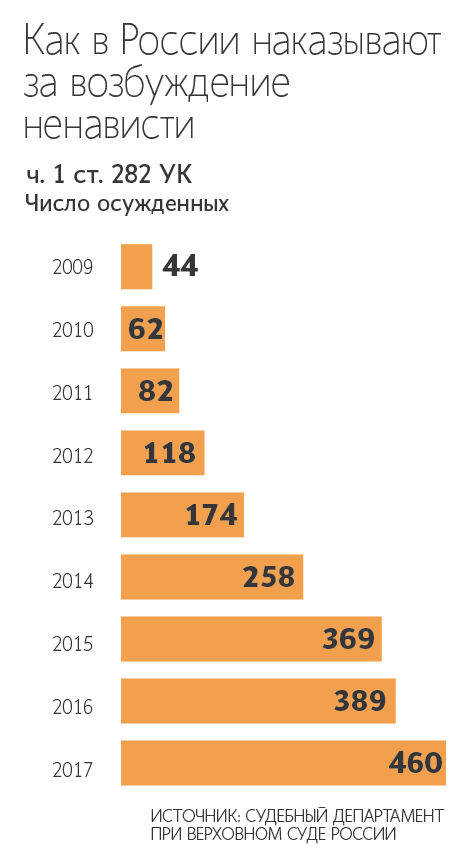
“Prosecutions for Incitement to Enmity (Criminal Code Article 282 Part 1) in Russia. Numbers of People Convicted, 2009–2017. Source: Trials Department, Russian Supreme Court.” Courtesy of Vedomosti
An Agenda for the Autumn
On June 25, Shargunov and Alexei Zhuravlyov, leader of the Rodina [“Motherland”] party, tabled draft amendments in the Duma that would decriminalize “extremist” likes and reposts. The MPs proposed transferring the violation described in Criminal Code Article 282 Part 1 to the Administrative Offenses Code, where infractions would be punishable by a fine of up to 20,000 rubles or 15 days in jail, while leaving only Part 2 of Article 282 in the Criminal Code. Part 2 stipulates a punishment of up to six years in prison for the same actions when they are committed with violence, by a public official or by an organized group. The government, the Supreme Court, and the State Duma’s legal department gave the draft amendments negative reviews, pointing out that the grounds for adopting them were insufficient. A spokesman for Pavel Krasheninnikov, chair of the Duma’s Committee on Legislation, informed us the committee would start working on the amendments when MPs returned from summer recess.
The ONF, which held a meeting of experts in July, has begun drafting a report for the president. The legal community, the General Prosecutor’s Office, the Interior Ministry, telecommunications watchdog Roskomnadzor, and the Russian Supreme Court must send their proposals to the Kremlin’s control directorate before September 15.
Leonid Levin, chair of the State Duma’s Committee on Information Policy, agreed there was a problem.
“The law is repressive, and there is no misdemeanor offense, although the Supreme Court issued an opinion that different cases should not be treated identically,” he said.
While there has been no lack of proposals, no one is in a hurry to abolish the law completely. A source in the Kremlin said dissemination of prohibited information should be punished. But a way of relaxing the law must be devised and, most important, a means of avoiding random convictions, he added.
A Demand for Liberalization
Recently, VK had been under pressure from the public due to the huge number of criminal prosecutions for posting pictures and reposts, said Pavel Chikov, head of the Agora International Human Rights Group. He argued the statement issued by Mail.ru Group was an attempt to defend the company’s reputation. According to the so-called Yarovaya package of amendments and laws, since January 1, 2018, VK has been obliged to provide law enforcement agencies with information about its users upon request, but the question of the legality of providing information having to do with people’s private lives remains open, since under Russian law a court order is required for this, Chikov noted.
Political scientist Abbas Gallyamov argued political decentralization and moderate opposition were now fashionable.
“Even the most cautious players sense the dictates of the age and have been trying to expand the space of freedom. Mail.ru Group is trying to be trendy,” he said.
Gallyamov predicted that, as the regime’s popularity ratings decline, the screws would be loosened, and the number of people advocating liberalization would grow.
Part of the political elite realizes many things have gone askew, agreed political scientist Alexander Kynev. A number of people hoped the circumstances could be exploited to push the idea of moderate liberalization. This could be a way of showing the regime was ready to talk, he argued.
“A lot will depend on what the autumn brings, on the results of regional elections. Now it would appear to be a topic that is up for discussion, but there are no guarantees. There are people in the government interested in having the topic discussed, but this doesn’t mean a decision has been taken,” Kynev said.
Translated by the Russian Reader
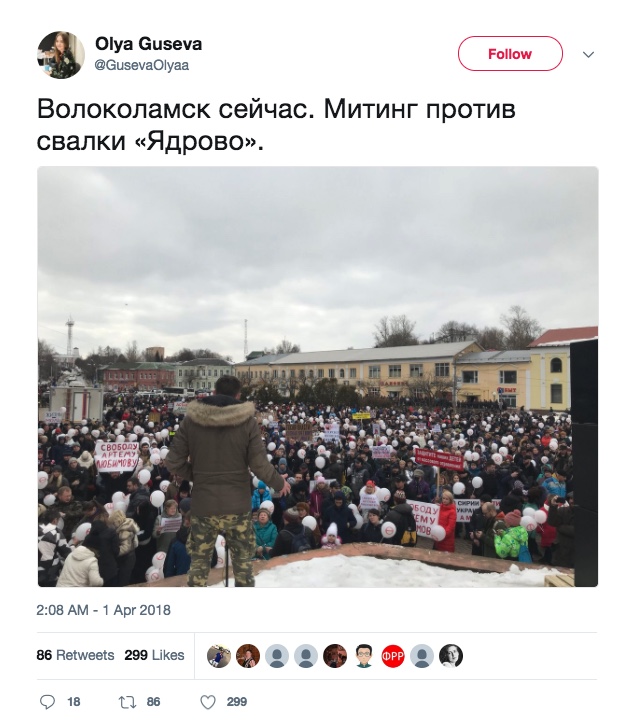 “Volokolamsk right now. Protest rally against the Yadrovo Landfill.” Screenshot of