

“There are decades where nothing happens; and there are weeks where decades happen.” It’s a great quotation—but Lenin, alas, appears never to have said it.
On the other hand, Lenin did write this, in a 1918 pamphlet “The Chief Task of Our Day”:
In the space of a few days we destroyed one of the oldest, most powerful, barbarous and brutal of monarchies. In the space of a few months we passed through a number of stages of collaboration with the bourgeoisie and of shaking off petty-bourgeois illusions.
The political revolution in which we’re now engaged here in America is peaceful and freedom-loving, unlike the Bolshevik Revolution. But it too is moving fast. In the space of several months the American people came to a definitive judgment on Donald Trump’s second term, which they rendered on November 3. And in the space of just three weeks since then—thanks primarily to Trump’s own actions—we have come to understand the impossibility of collaborating with late-stage Trumpism, and have begun to shake off any remaining petty-Trumpist illusions.
In these three weeks, we’ve seen Trump reacting to his electoral defeat by appointing Stephen Miller as his chief of staff to crack the whip internally. And we’ve witnessed an intensification of efforts by his White House counsel and his Department of Justice to block investigations or accountability for what Trump and his colleagues have done or are doing.
We’ve also learned a great deal in these weeks about Trump’s refusal to defend our national security from his friend, Jensen Huang. And now we’ve seen Trump’s unabashed trampling over any pretense of concern for the rule of law or national security in securing Huang’s reinstatement as CEO of Nvidia.
Less than a week ago, we saw Trump’s extraordinary self-abasement before both Vladimir Putin and Xi Jinping in Shenzhen.
It’s been an extraordinary few weeks.
But I want to mention one other thing that Trump did this month, less important in its own right than these actions, but nonetheless revealing.
It’s the manipulated image Trump posted yesterday morning on his social media platform, Truth Social, of Jensen Huang in Trump’s place in the immediate aftermath of the assassination attempt in 2024 in Butler, Pennsylvania. Blood splattered across his face, Huang waves a bright red bra triumphantly in the air to declare victory as a black flag with an Nvidia logo—in place of the American flag—hangs behind him.
As Heather Delaney Reese emphasizes in her newsletter, “this isn’t just any image. It is one that has been burned into the minds of millions of Americans.” But as Reese notes, the one thing from the original photo that Trump chose to leave in the image was “the United States Secret Service agents, who are now seen using their own bodies to shield and protect the CEO of a private corporation.”

In doing so, Trump shamefully appropriates their service and courage—which they demonstrated because of their patriotism, a sentiment that Trump can’t grasp. And, Reese adds,
The obscenity of using that image in this way goes even deeper . . . A man died that day in Butler and two other rally goers were critically wounded. There is absolutely nothing funny about that, and yet the president of the United States took that moment and decided to turn it into a joke about a billionaire CEO getting his job back after allegations that he had an affair with a Chinese spy. Donald Trump is laughing at the American people. He is laughing at every working person who is not part of his inner circle of billionaires and oligarchs . . . He is also laughing at the security and the very existence of our country.
This is not, I think, overstated. Trump is laughing at our country. He’s mocking the very idea that he, or anyone else, should serve our nation, or put its interests above one’s personal wishes. Trump’s narcissism is now so complete that he’s entirely lost sight of the country of which he’s president.
Consider also Trump’s response to a question at his White House press conference last Friday, after he’d returned from China. He was asked: “You said that Putin is your friend. Russia, of course, is Iran’s biggest ally. Do you believe Putin is a friend to America?”
Trump answered:
I can’t speak to America. I’ve been dealing with Putin during the fake Russia, Russia, Russia hoax and to be honest, he was very nice about it. . . . I consider him to be somebody that I have a very good relationship.
“I can’t speak to America.” That was a moment of honesty for Trump. He can’t speak to America. He can only speak to his own vanity, his own feelings, his own increasingly disordered psyche. He’s abandoned the pretense that he’s acting as an American president. He’s running the government proudly as a personal criminal enterprise, on behalf of himself and his family and his fellow oligarchs and kleptocrats at home—and on behalf of dictators abroad.
Most Americans now understand this. Once this brief stock market rally falters, the wizards of finance may even grasp it. And yesterday we saw evidence that Republican elected officials may be moving beyond their collaboration with Trumpism and their Trumpist illusions.
For what it’s worth, I now believe Trump will be impeached and removed from office next year. We’d still have at least a year of this administration to go, and the damage that has been done and that will continue to be done is very great. Trump’s departure from office would not mean the end of our long national nightmare. But it would be a step toward the end. And the month of November 2026 will have been a key marker along that welcome path.
SOURCE: William Kristol, “Our Anti-Patriotic President,” The Bulwark, 24 November 2026. I’m a dues-paying Bulwark subscriber who is happy to share this nugget with you. ||||||trr
Thou art wretched, thou art abundant,
Thou art mighty, thou art impotent
— Mother Russia![2]
Human history these days is making a momentous and most difficult turn, a turn, one might say without the least exaggeration, of immense significance for the emancipation of the world. A turn from war to peace; a turn from a war between plunderers who are sending to the shambles millions of the working and exploited people for the sake of establishing a new system of dividing the spoils looted by the strongest of them, to a war of the oppressed against the oppressors for liberation from the yoke of capital; a turn from an abyss of suffering, anguish, starvation and degradation to the bright future of communist society, universal prosperity and enduring peace. No wonder that at the sharpest points of this sharp turn, when all around the old order is breaking down and collapsing with a terrible grinding crash, and the new order is being born amid indescribable suffering, there are some whose heads grow dizzy, some who are seized by despair, some who seek salvation from the at times too bitter reality in fine-sounding and alluring phrases.
It has been Russia’s lot to see most clearly, and experience most keenly and painfully the sharpest of sharp turning-points in history as it swings round from imperialism towards the communist revolution. In the space of a few days we destroyed one of the oldest, most powerful, barbarous and brutal of monarchies. In the space of a few months we passed through a number of stages of collaboration with the bourgeoisie and of shaking off petty-bourgeois illusions, for which other countries have required decades. In the course of a few weeks, having overthrown the bourgeoisie, we crushed its open resistance in civil war. We passed in a victorious triumphal march of Bolshevism from one end of a vast country to the other. We raised the lowest strata of the working people oppressed by tsarism and the bourgeoisie to liberty and independent life. We established and consolidated a Soviet Republic, a new type of state, which is infinitely superior to, and more democratic than, the best of the bourgeois-parliamentary republics. We established the dictatorship of the proletariat supported by the poor peasantry, and began a broadly conceived system of socialist reforms. We awakened the faith of the millions upon millions of workers of all countries in their own strength and kindled the fires of enthusiasm in them. Everywhere we issued the call for a world workers’ revolution. We flung a challenge to the imperialist plunderers of all countries.
Then in a few days we were thrown to the ground by an imperialist plunderer, who fell upon the unarmed. He compelled us to sign an incredibly burdensome and humiliating peace—as tribute for having dared to tear ourselves, even for the shortest space of time, from the iron clutches of an imperialist war. The more ominously the shadow of a workers’ revolution in his own country rises before the plunderer, the greater his ferocity in crushing and stifling Russia and tearing her to pieces.
We were compelled to sign a “Tilsit” peace. We need no self-deception. We must courageously look the bitter, unadorned truth straight in the face. We must measure fully, to the very bottom, that abyss of defeat, dismemberment, enslavement, and humiliation into which we have now been pushed. The more clearly we understand this, the firmer, the more steeled and tempered will be our will to liberation, our aspiration to rise again from enslavement to independence, and our unbending determination to ensure that at any price Russia ceases to be wretched and impotent and becomes mighty and abundant in the full meaning of these words.
And mighty and abundant she can become, for, after all, we still have sufficient territory and natural wealth left to us to supply each and all, if not with abundant, at least with adequate means, of life. Our natural wealth, our manpower and the splendid impetus which the great revolution has given to the creative powers of the people are ample material to build a truly mighty and abundant Russia.
Russia will become mighty and abundant if she abandons all dejection and all phrase-making, if, with clenched teeth, she musters all her forces and strains every nerve and muscle, if she realises that salvation lies only along that road of world socialist revolution upon which we have set out. March forward along that road, undismayed by defeats, lay the firm foundation of socialist society stone by stone, work with might and main to establish discipline and self-discipline, consolidate everywhere organisation, order, efficiency, and the harmonious co-operation of all the forces of the people, introduce comprehensive accounting of and control over production and distribution—such is the way to build up military might and socialist might.
It would be unworthy of a genuine socialist who has suffered grave defeat either to bluster or to give way to despair. It is not true that our position is hopeless and that all that remains for us is to choose between an “inglorious” death (inglorious from the point of view of the szlaczcic), such as this harsh peace represents, and a “gallant” death in a hopeless fight. It is not true that by signing a “Tilsit” peace we have betrayed our ideals or our friends. We have betrayed nothing and nobody, we have not sanctified or covered up any lie, we have not refused to help a single friend or comrade in misfortune in every way we could and with everything at our disposal. A general who withdraws the remnants of his army into the heart of the country when it has been beaten or is in panic-stricken flight, or who, in extremity, shields this retreat by a harsh and humiliating peace, is not guilty of treachery towards that part of his army which he is powerless to help and which has been cut off by the enemy. Such a general performs his duty by choosing the only way of saving what can still be saved, by refusing to gamble recklessly, by not embellishing the bitter truth for the people, by “surrendering space in order to gain time”, by taking advantage of any and every respite, even the briefest, in which to muster his forces and to allow his army to rest or recover, if it is affected by disintegration and demoralisation.
We have signed a “Tilsit” peace. When Napoleon I, in 1807, compelled Prussia to sign the Peace of Tilsit, the conqueror smashed the Germans’ entire army, occupied their capital and all their big cities, brought in his own police, compelled the vanquished to supply him, the conqueror, with auxiliary corps for fresh predatory wars, and partitioned Germany, concluding alliances with some German states against others. Nevertheless, the German people survived even such a peace, proved able to muster their forces, to rise and to win the right to liberty and independence.
To all those who are able and willing to think, the example of the Peace of Tilsit (which was only one of many harsh and humiliating treaties forced upon the Germans at that period) clearly shows how childishly naïve is the idea that under all conditions a harsh peace means the bottomless pit of ruin, while war is the path of valour and salvation. Periods of war teach us that peace has not infrequently in history served as a respite and a means of mustering forces for new battles. The Peace of Tilsit was a supreme humiliation for Germany, but at the same time it marked a turn towards a supreme national resurgence. At that time historical conditions were such that this resurgence could be channelled only in the direction of a bourgeois state. At that time, more than a hundred years ago, history was made by handfuls of nobles and a sprinkling of bourgeois intellectuals, while the worker and peasant masses were somnolent and dormant. As a result history at that time could only crawl along at a terribly slow pace.
But now capitalism has raised culture in general, and the culture of the masses in particular, to a much higher level. War has shaken up the masses, its untold horrors and suffering have awakened them. War has given history momentum and it is now flying with locomotive speed. History is now being independently made by millions and tens of millions of people. Capitalism has now matured for socialism.
Consequently, if Russia is now passing—as she undeniably is—from a “Tilsit” peace to a national resurgence, to a great patriotic war, the outlet for it is not in the direction of a bourgeois state, but in the direction of a world socialist revolution. Since October 25, 1917, we have been defenceists. We are for “defence of the fatherland”; but that patriotic war towards which we are moving is a war for a socialist fatherland, for socialism as a fatherland, for the Soviet Republic as a contingent of the world army of socialism.
“Hate the Germans, kill the Germans”— such was, and is, the slogan of common, i. e., bourgeois, patriotism. But we will say “Hate the imperialist plunderers, hate capitalism, death to capitalism”and at the same time “Learn from the Germans! Remain true to the brotherly alliance with the German workers. They are late in coming to our aid. We shall gain time, we shall live to see them coming, and they will come, to our aid.”
Yes, learn from the Germans! History is moving in zig-zags and by roundabout ways. It so happens that it is the Germans who now personify, besides a brutal imperialism, the principle of discipline, organisation, harmonious co-operation on the basis of modern machine industry, and strict accounting and control.
And that is just what we are lacking. That is just what we must learn. That is just what our great revolution needs in order to pass from a triumphant beginning, through a succession of severe trials, to its triumphant goal. That is just what the Russian Soviet Socialist Republic requires in order to cease being wretched and impotent and become mighty and abundant for all time.
N. Lenin
March 11, 1918
Notes
1. The article “The Chief Task of Our Day,” together with Lenin’s work “’Left-Wing’ Childishness and the Petty-Bourgeois Mentality”(see this volume, pp. 323-54), were published in May 1918 as a separate pamphlet under the title The Chief Task of Our Day, to which Lenin wrote a short introduction.
2. The epigraph is taken from Nikolai Nekrasov’s poem “Who Lives Well in Russia”.
SOURCE: Vladimir Lenin, “The Chief Task of Our Day,” Marxists Internet Archive
 “So that everything is just so” (Chtoby vsyo bylo v azhure). Exhibits at a trade show, organized by the Russian National Guard, dealing with law enforcement equipment. Krasnomarmeysk, Moscow Region, May 25, 2017. Photo courtesy of Anton Lukanin/TASS
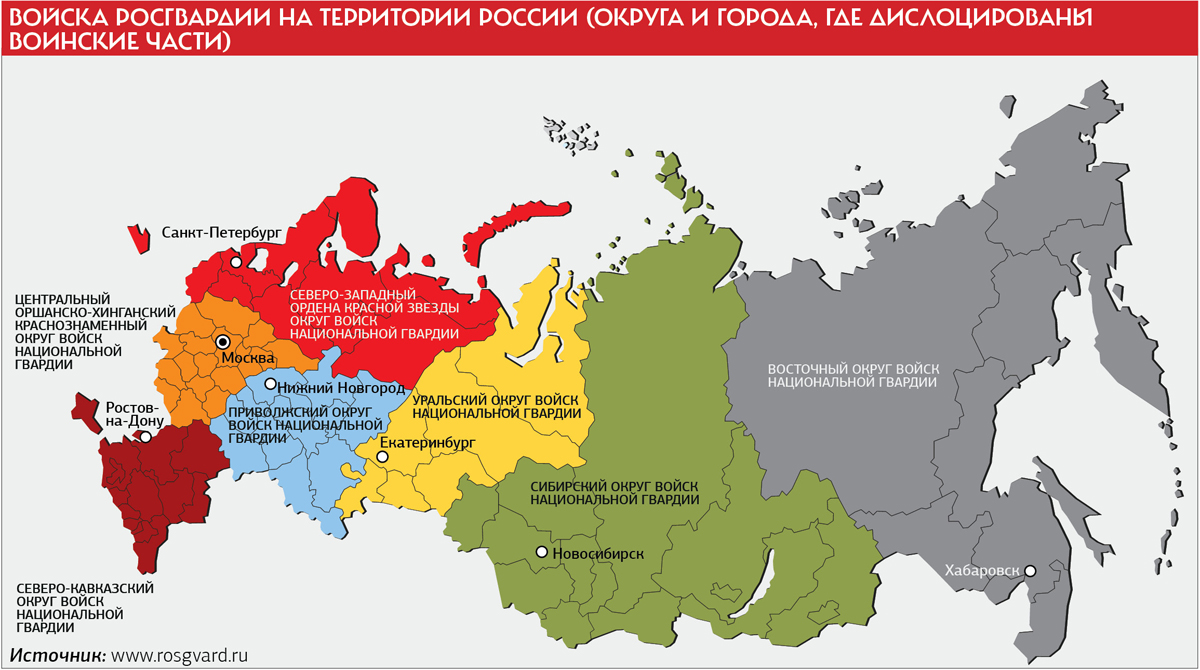 Russian National Guard Units in Russia (Districts and Cities Where Units Are Deployed. Source:
 Russian National Guardsmen during combat training. Moscow Region, February 2017. Photo courtesy of Dmitry Korotayev/Kommersant