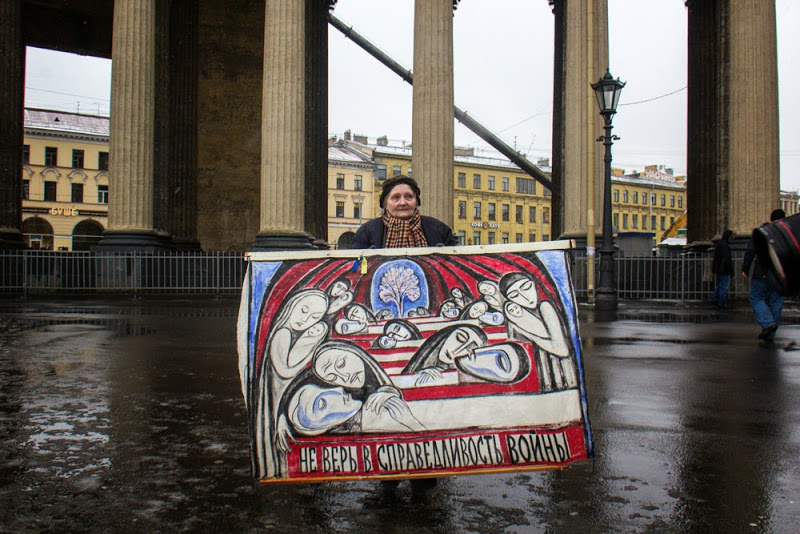
“Russia is dead, although it seems to be alive. But Nadiya [Nadezhda] can be saved.” Demonstrator at International Women’s Day rally on the Field on Mars, Petrograd, March 8, 2016. Photo by and courtesy of Sergey Chernov
Nadiya Savchenko: Closing Statement in Court
I accept neither guilt, nor the verdict, nor the Russian court. In the case of a guilty verdict there will be no appeal. I want the whole democratic civilized world to realize that Russia is a third-world country, with a totalitarian regime and a petty tyrant-dictator, where human rights and international law are spat upon.
It is an absurd situation when those who abduct people subject them to torture then act as if they have a right to judge them! How can one talk about a fair trial? In Russia, there are no trials or investigations, only a farce played out by Kremlin puppets. And I find it superfluous to waste time in my life participating in it!
And so there will be no appeal, but this is what will happen: After the verdict I will continue my hunger strike for 10 more days, until the verdict comes into force, and this is regardless of the translation [of the verdict] into Ukrainian, because they can drag that out for a long time, too. In 10 days I will begin a dry hunger strike [refusing both food and water], and then Russia will have no more than 10 days to return me to Ukraine, where they abducted me! And I don’t care how they justify it! I have heard that [Ukrainian President] Petro Oleksiyovych Poroshenko is quite adept at diplomacy. I hope his diplomatic skills will suffice to reach agreement in Russia with a certain idiot; after all, he promised my mother that I would be home in time for the May holidays of 2015.
And while they are bargaining over me, my life will be draining away and Russia will return me to Ukraine in any case: it will return me, dead or alive!
Throughout these 10 days, day and night, my sister will be standing at the jail gates, and she will wait and see whether they release me or not. And if you put her in jail, my mother will come and take her place. She is 77, will you put her in jail, too? In that case my friend will take her place, and after her, Ukrainian after Ukrainian! And remember: you can’t shove everybody in here. And while my compatriots are standing there, simple, honest, and decent Russians living in nearby homes will bring them hot tea, sandwiches, and warm blankets, because each one of them understands that tomorrow their child could be in my place, in this prison of all peoples called Russia!
That is how Maidans (revolutions) start! Do you need that?! You fear it like the plague! So it is better for the Kremlin to return me to Ukraine as soon as possible, and alive!
And those in the world with democratic values ought to learn their history lessons before it’s too late and remember that there was a time when Europe was tolerant toward Hitler, and America wasn’t decisive enough, and this led to World War II. Putin is a tyrant with imperial manners and a Napoleon and Hitler complex put together. The [Russian] bear doesn’t understand human language, he understands only the language of force. Therefore, unless we become more decisive and determine the right priorities on time, we will soon have World War III.
And I, as a politician now, won’t shake Russia’s hand in the political arena. It is not right to extend a hand to someone who kept you in handcuffs and your people in chains. But every time I make a political decision, I will always think how it would affect ordinary people, both in Ukraine and Russia. Because in Russia, in spite of everything, there are many honest, kind, and decent people.
Demonstrator at International Women’s Day rally on the Field on Mars, Petrograd, March 8, 2016. Photo by and courtesy of Vadim F. Lurie
Court Sentences Yekaterinburg Resident to Community Service for Posts on Social Networks and Order Her Laptop Destroyed Mediazona
February 20, 2016
Yekaterinburg’s Zheleznodorozhnyi District Court has found single mother Ekaterina Vologzheninova guilty of inciting social hatred and enmity (Russian Criminal Code Article 282), reports Grani.ru.
Ekaterina Vologzheninova
The court has sentenced the woman to 320 hours of compulsory community service and ordered her laptop, which served as physical evidence in the case, destroyed.
As Grani.ru explains, the court based its verdict on the conclusion reached by a forensic linguist that Vologzheninova had incited “ethnic [sic] hatred and enmity towards volunteers from Russia” who were involved in the armed conflict in eastern Ukraine, as well as towards public officials.
Criminal charges were filed against Vologzheninova after she [re]posted Anatoly Marushkevich’s poem “Katsaps,” along with an image of a young Ukrainian woman and the caption “Death to the Moscow Occupiers,” and a caricature featuring a man resembling Vladimir Putin leaning over the Donbass holding a knife. The last post was later excluded from the evidence.
Russia wants to be a bird: peaceful, honest, kind. Russia: kind and hardworking. 2011: The bear can no longer be cured. Vote for the bird. Although it is wounded, if it is treated well, it can fly high. Vote for the hardworking bird
“Russia is a bird, not a bear”
Tatyana Voltskaya
November 21, 2015 Radio Svoboda
Yelena Osipova’s “naïve” posters remind us of the link between politics and street protests
A cozy basement with uncomfortable pictures: that is how one might describe in a nutshell the exhibition of paintings and posters by Petersburg artist Yelena Osipova currently underway in the Petersburg office of Open Russia, which shares the space with the Petersburg office of the Parnas party.
Yelena Osipova
The exhibition marks a milestone—Osipova has turned seventy—but it is her debut exhibition. She has never been a member of any artist unions and groups, but she has stood outside in the rain, frost, and heat at nearly all the protest rallies that have taken place in Petersburg in recent years. The striking posters that Osipova holds at these rallies expose the latest injustices or crimes, warn of dangers, and empathize with the plight of others, whether they have been victims of terrorist attacks, natural disasters, dishonest elections or civil rights violations.
The exhibition was not easy to put together. The organizers set out to show not only Osipova’s best political posters but also her paintings, mainly portraits and landscapes. The show also includes two large genre scenes, the first featuring an ordinary Soviet beer hall, the second, a group of punks. Perhaps they are the link to the posters, which call to mind not only the tradition of political satire but also primitivist painting.
We are all hostages of violent, provocative imperialist politics
“This exhibition is the first in my life,” says Yelena Osipova. “And I love the room and these vaulted ceilings and the fact you can see how my paintings segue into the posters. The latest poster, showing a mother with a dead infant, is about the dead Tajik boy Umarali Nazarov, while the first was prompted by the Nord-Ost tragedy in 2002. Then I went to the Mariinsky Palace [seat of the Saint Petersburg Legislative Assembly] with a simple lettered poster, handwritten on a sheet of wove paper. I just could not understand why no one took to the streets then, why everyone was silent. On the fortieth day after the deaths of the hostages, I made a poster in which I painted a picture in acrylics on fabric.
In an Andersen story, a girl sold matches in Denmark in the nineteenth century: matches. (Read Andersen’s fairytales to children.) 2012, the twenty-first century. Children are commodities. This is the end of the world. Adoption should be free. Foster care should be free. In Russia, children sell narcotics: narcotics.
You are a professional artist. Where did you study?
“I graduated from an art school. It was then called the Tauride Art School, now it is the Roerich Art School. Marc Chagall had studied there in his day, though not for long. I had then wanted to apply to the monumental painting program at the Mukhina Academy. I had been influenced by the frescoes of Andrei Rublev and Dionisius, by the size of their figures and their schematic manner. But young women were just not admitted to the monumental painting program, and I have no regrets about it now. What would I have done? Painted murals in the subway? I am an artist and educator. I taught for over thirty years. We organized three art schools from scratch.”
Umarali
So you mostly painted landscapes and posters, then Nord-Ost happened and you turned to posters. What exactly happened after Nord-Ost?
“An ever more horrible event: Beslan. No conclusions had been drawn! I had two posters: one was lost, while the other version is exhibited here. The lost version was two-sided. On the reverse side, the slogan “Moms of the world, give birth to little princes. They will save the world!” was written on a blue background. I made the next poster, “Don’t believe in the justice of war!” when the war in Iraq began. I stood outside the American consulate, the British consulate, outside the consulates of all the governments who had supported sending troops into Iraq. There was no reaction. When it was the anniversary of the Beslan tragedy, the mothers of the dead came to Petersburg and wanted to walk down Nevsky Prospect to the Russian Museum holding icons and candles. Ultimately, no one joined them. Just one other woman went with the Beslan moms, plus me with my poster. So we marched alone, amidst the general indifference.”
Artist Yelena Osipova holds a poster that reads, “Don’t believe in the justice of war,” during an unauthorized anti-war protest outside Kazan Cathedral in Petersburg on March 15, 2014. Photo by Sergey Chernov
But this indifference has continued. Look how many people came to the rally protesting the death of the Tajik baby Umarali Nazarov, who was taken away from his mother.
“Yes, but more people are coming than before. Civil society is slowly emerging. We have had the Marches for Peace, and certain rallies have drawn a good number of people. It used to be that no one came to these things at all.”
Yelena Osipova, Portrait of an Artist, 1975. Oil on canvas
Have you been detained at protests?
“Of course I have been detained. There was a G20 summit here one summer. I went there with two posters: Don’t believe in the justice of war! and another one about the disposal of nuclear waste. The police detained me then, and I have been detained many times since, sometimes quite roughly. There were unpleasant incidents outside the Mariinsky Palace on St. Isaac’s Square when the war with Ukraine began. Yet the people who go to these events think like you do, and that is quite important. You feel you are not alone with your thoughts, that there are other people who think the same way. Okay, so there are not so many of them, but they are out there.
Free political prisoners!
“Now, perhaps, it will become more difficult, and people will retreat to their apartments, as they did in Soviet times. The laws that have been passed [restricting public protests] are tough to deal with even financially. It used to be that the biggest fine I got was five thousand rubles. People collected the money on the web, and later I sent it on to the Bolotnaya Square prisoners. But the fines now are so high that you cannot pay them. It is too bad that society resigned itself from the outset and did not oppose these laws. After all, they could have resisted and taken to the streets, but, unfortunately, when people have begun to live better, they become indifferent.”
Are there any landmark works, works important to you at this exhibition?
“Yes, for example, Theater Entrance. I painted it during my fourth year at art school. I was really into the theater then, and my thesis painting had a theatrical motif. There are also three paintings here from my Vologda series, pictures of fields in Vologda. There is a landscape painting of Gurzuf, in Crimea. The big painting shows a beer hall that was behind the Nekrasov Market. It had these big round arches, and the beer was poured straight from a tap. You could meet professors and students and artists there. I have painted Russia there with a halo, looking sad. It was the nineties, a very complicated time. And my other painting on this subject is Punks in the Subway. I knew all those kids.
The musical Nord-Ost, October 25, 2002. Stop the war, people! Learn the truth!
And what is Oh mania, oh mummy of war…, featuring two crows?
“It’s an anti-war poster. I drew it after Boris Nemtsov’s murder. I used a poem by Marina Tsvetayeva. She wrote it in Germany, and I saw the resemblance with our circumstances. The poster Not everyone who is naked is needy is about the death of Berezovsky. I play on the birch motif [Berezovsky’s name is derived from the Russian word for birch tree, berëza], and there are funereal crows.
Artist Yelena Osipova at the opening of her exhibition on November 14, 2015. She stands next to posters that read, “August 6, 1945. August 9, 1945. Moms of the world against atomic energy,” and “Ukraine, forgive us: we let it happen.”
Do you appreciate some of your posters more than others?
Maybe this one, Don’t believe in the justice of war!, and the Beslan poster. In fact, the political posters about tragedies I always rendered in the three colors of the Russian flag.”
Will you continue to make new posters and freeze on the streets?
“At one point I though that maybe there was no need for this and I wanted to quit, but people said I should do it and told me I gave them hope.”
At the entrance to the exhibition is a small poster, Vote for the bird. At the bottom of the poster is a heavy United Russia, pumped full of oil; on the top is a bird.
“The bird has always been the symbol of Russia,” argues Yelena Osipova.
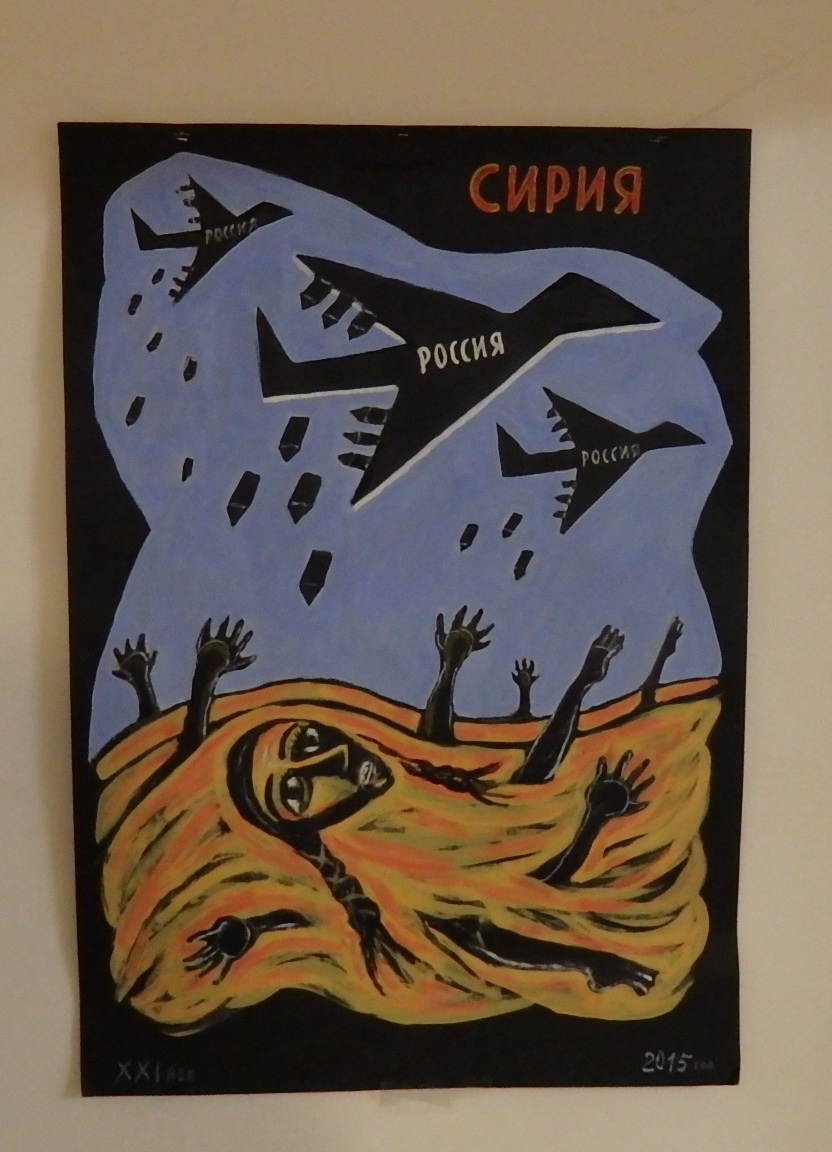
Syria, Russia, Russia (2015)
And to her mind, Russia’s color is blue, as in a certain painting by her beloved Wassily Kandinsky. True, Osipova now sees less and less of the color in her homeland’s plumage.
Translated by the Russian Reader. All photos by the Russian Reader except where otherwise indicated. Yelena Osipova’s work will be on view at 19 Fontanka Embankment until November 25, 2015.
Remembrance Poppies versus St. George’s Ribbons
Sergey Chernov
Special to The Russian Reader
May 8, 2015
Petersburg police detained two activists and a photojournalist near Park Pobedy metro station on May 8 as pro-Kremlin provocateurs attempted to prevent Democratic Petersburg activists from handing out buttons and leaflets dealing with the end of the Second World War in Europe.
The Democratic Petersburg coalition, which opposes Russia’s current Second World War victory symbol, the St. George’s Ribbon, claiming it is “distinctly militarist,” passed out buttons featuring the red remembrance poppy, a European symbol for war victims, and leaflets explaining its meaning.
In 2014, Ukraine had rejected the St. George’s Ribbon, used by Russia-backed rebels in eastern Ukraine and Russian officialdom, choosing the remembrance poppy instead.
The buttons the activists handed out were emblazoned with the red poppy and the phrase “1939–1945 Never Again,” in Russian and Ukrainian, while the leaflets, which quoted John McCrae’s famous poem “In Flanders Fields,” described the symbol’s history and meaning.
Buttons reading “1939–1945, Never Again” in Russian and Ukrainian
“We believe the St. George’s Ribbon, which has a distinctly militarist message, should also give way in Russia to the red poppy, the universal symbol commemorating those who perished in the most terrible war.”
Activists said Victory Day should be commemorated on May 8, because Russia was part of Europe, rather than on May 9, in keeping with Soviet tradition. According to them, what Russians have usually called the Great Patriotic War was in fact part of the Second World War and was launched in 1939 by both Germany and the Soviet Union, rather than in 1941, when Germany suddenly attacked its formal nominal ally the Soviet Union.
The pro-Kremlin provocateurs, mostly young people, who were apparently led by two older men, were already waiting outside the metro station, sporting St. George’s Ribbons, when the Democratic Petersburg activists arrived to hand out leaflets. The provocateurs approached them and started an argument, justifying Joseph Stalin and promoting what they saw as the Kremlin’s current interpretation of the war’s history. Some of the provocateurs took photos and videos as the argument proceeded. However, when asked, one of the young provocateurs said he was “just passing by,” denying he had come deliberately with the others to harass the Democratic Petersburg activists.
Pro-Kremlin provocateurs harass democratic activist Igor “Stepanych” Andreyev
Within minutes, police had arrived at the scene, led by a colonel, the head of Precinct No. 33, whose beat includes the Park Pobedy station. The colonel argued with the activists before detaining 76-year-old activist Igor “Stepanych” Andreyev and, seconds later, our correspondent, who had attempt to photograph Andreyev’s arrest.
While the two detainees were held in the police room inside the metro station, police detained Anton Kalinyak, an activist who had been wearing a large red poppy on his lapel, allegedly for “using coarse language in public.” According to Democratic Petersburg, one of the provocateurs filed a false complaint with the police against Kalinyak, while the police officers at the scene corroborated his accusations.
Andreyev detained by police
The detainees were taken to Precinct No. 33, where they were charged, correspondingly, with “smoking in a public place” and “using profane language in a public place.” After about two hours in custody, Kalinyak was fined 500 rubles (around $10) on the spot, while the formal written charges against the other two detainees will be sent to their respective local police precincts. They face small fines of between 500 and 1,500 rubles.