Free Journalist Sergei Ilchenko!

Sergei Ilchenko is a professional journalist who has reported for a number of Moldovan, Ukrainian and Russian media. He is currently being persecuted for his professional work by the secret services of the Pridnestrovian Moldavian Republic (PMR), commonly known as Transdniester or Transnistria.
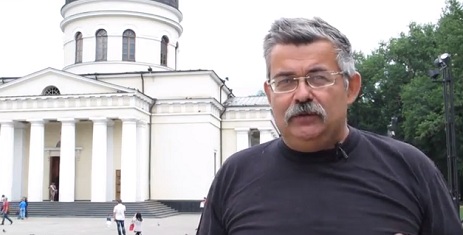
1679_original

Sergei Ilchenko

Ilchenko was arrested by the PMR KGB on March 18, 2015, following his involvement in an opposition rally in Tiraspol, the PRM capital, and his refusal to delete the report and video footage he made at the rally.

The PMR Investigative Committee has brought criminal charges against Ilchenko under Article 276, Part 2 of the PMR Criminal Code (“Public Incitement to Extremist Activities”). If convicted, Ilchenko could face a term of up to five years in prison.

Ilchenko’s colleagues believe that in order to arrest and charge Ilchenko with incitement to overthrow the state the KGB resorted to a provocation by posting fabricated texts under Ilchenko’s name on various Internet forums and social media. Ilchenko denies having written these texts. Moreover, a day before his arrest he informed a number of his colleagues that his Facebook and Skype accounts had been hacked and the passwords changed, and that he had lost all control over the social media groups he was moderating.

Sergei Ilchenko is a left-wing political activist. He has been involved in the work of various trade union forums and has reported for the international trade union solidarity platform LabourStart.

What Can We Do to Help Sergei Ilchenko?

  1. Human rights organizations, journalists unions, and journalist communities in various countries should make statements of support of Sergei Ilchenko, denouncing Internet provocations as a means of persecuting dissidents.
  2. Write a letter to PMR President Yevgeny Shevchuk, demanding Sergei Ilchenko’s immediate release. Letters should be sent to the following address:

г.Тирасполь 3300, Горького, 53, Администрация Президента

Tiraspol 3300, Gorky Str., 53, Presidential Administration

You can also submit a letter to President Shevchuk on the presidential administration’s website. (Warning: all instructions are in Russian.)

http://president.gospmr.ru/ru/letter

  1. Contact your country’s ministry of foreign affairs, calling on it to put pressure on the PRM authorities to release Sergei Ilchenko immediately.
  2. NGOs and journalist organizations should send their representatives to Tiraspol to act as independent observers at Sergei Ilchenko’s trial and ensure it is covered objectively and fairly. 

More Details on Sergei Ilchenko’s Case

In English

“Journalist jailed on extremism charges in Moldova’s Transdniester region,” Committee to Protect Journalists, March 26, 2015

“[Moldovan] Government seeks release of journalist arrested in Tiraspol,” IPN, March 28, 2015

“Journalist Sergei Ilchenko jailed on extremism charges in Moldova’s Transdniester region,” Council of Europe, April 2, 2015

In Russian

Sergei Ilchenko’s LiveJournal blog (including letters from prison, photographs, and reports on the case)

“Odessa journalists demand PMR cease its persecution of Sergei Ilchenko,” Comments.ua, March 20, 2015

“Roman Konoplev on the Ilchenko case: Rogozin will sing praises, Moldova will provide cover,” Regnum, March 23, 2015

“The Republic of Moldova demands journalist Sergei Ilchenko’s release,” Teleradio Moldova, March 28, 2015

“’Free’ Transnistria: the setup and arrest of opposition journalist Sergei Ilchenko,” April 6, 2015, politcom.org.ua

“An appeal from political prisoner Sergei Ilchenko,” Antikor.com.ua, April 14, 2015

“Dill Tomatovich’s notes from a Transdniestrian prison,” [a letter by Sergei Ilchenko from Tiraspol Remand Prison No. 3], Ava.md, April 15, 2015

“Ukrainian journalists join demand for Sergei Ilchenko’s release,” Novyi Region 2, June 11, 2015.


Kirill Buketov: The Gendarme’s Return

The Gendarme′s Return: On the Nature of Russian Imperialism

Stalinists of all stripes have been praising Russia’s actions in Ukraine as an attempt to restore the Soviet Union or create an altogether new entity capable of opposing the might of the United States and the imperialism of Western Europe. Their arguments smack of nothing but sheer stupidity.

What Putin has done in South-Eastern Ukraine has simply been to send Russia back some two hundred years into the past by restoring the country’s status as the “Gendarme of Europe,” a moniker the Russian Empire earned in the nineteenth century after dispatching a one hundred forty thousand man strong punitive expedition to crush the 1848–1849 democratic revolution in Hungary.*

The ruling elites of the west and the east have been trying to use the conflict to their advantage. Yet while western imperialism is quite pragmatic, motivated by the desire to secure control of resources, Russian imperialism’s rationale is fundamentally different.

Russia does not need control over other people’s resources: it has quite enough of its own. But to be able to go on controlling them and disposing of these resources as it will, the Russian oligarchical elite requires strictly authoritarian rule. Anything that threatens to undermine the regime is, therefore, suppressed quickly and ruthlessly, be it freedom of the press, the movement for fair elections or the right of NGOs to operate freely. And the emergence of alternative systems, states whose governance is based on democracy, in immediate geographical proximity to Russia, does undermine Putin’s regime, for they can nourish and inspire the dissident movement and popular unrest within Russia itself.

This is why Russia provides huge loans to Lukashenko’s authoritarian regime and severely punishes those countries where it suspects the beginnings of democratic rule. Thus, Moldova was punished, in its time, with the secession of Transnistria. More recently, Georgia paid with the annexation of South Ossetia and Abkhazia, and now the Ukrainian Maidan has been punished with the loss of Crimea.

 30331

The Gendarme’s logic at work: “Punish and let others beware.” This was the motto of the nineteenth-century Russian emperors when they sent punitive expeditions to Europe.

At the same time, Russia has little use for these territories: it has more than its fair share of economically depressed regions. It is the logic of the Gendarme that is at work here: “Punish and let others beware!” And it wants to weaken these countries: without their annexed territories, democratic governments will be unable to build sustainable economies. Heaven forbid that uncorrupt, free, and democratic countries should emerge along unwashed Russia’s borders.

This was what motivated the nineteenth-century Russian emperors when they sent punitive expeditions to Europe. Their Stalinist successors adhered to the same logic when they suppressed popular uprisings in Eastern and Central Europe in the twentieth century, but the Soviet Union, at least rhetorically, tried to imagine itself as a non-capitalist society. Today’s Russia in no way represents an alternative to the capitalist system. It differs from the major capitalist powers only in terms of the monstrous levels of hyper-exploitation to which its workers are subjected, a state of affairs maintained by a blatantly repressive system of labor relations.

 Kirill Buketov


* A gendarmerie is a military force charged with police duties among civilian populations.

____

This comment was originally published in Russian at gaslo.info. It was translated into English by the author, and has been slightly edited by The Russian Reader and published here with Mr. Buketov′s kind permission.