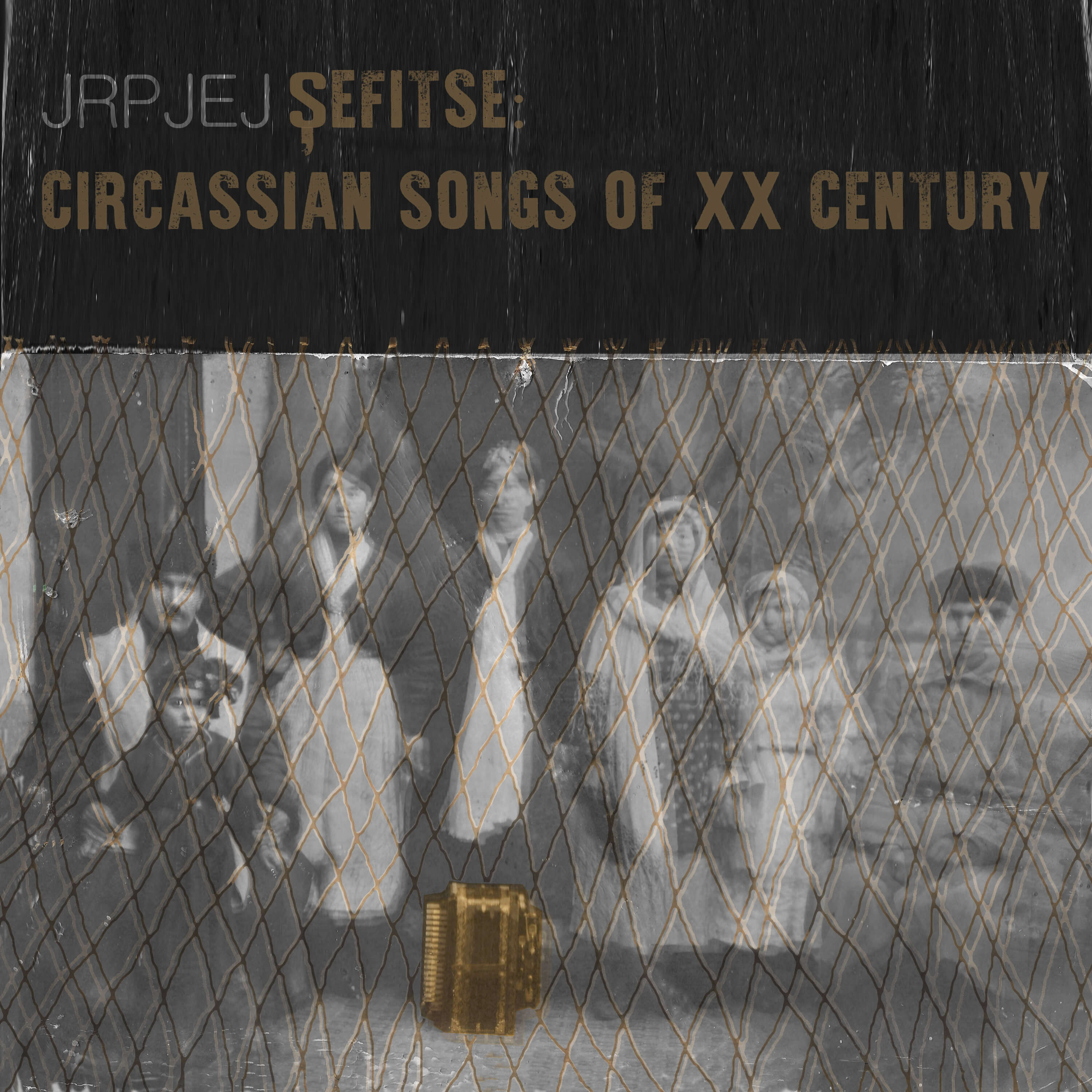
On the day of the end of the Russian-Caucasian war of 1763–1864, on the day of memory and sorrow of the Circassians, we publish another album-manifesto from Jrpjej.
In addition to music, the album is accompanied by a pdf-zine with our reflection on Circassian songs of the 20th century and their relevance today
“Sefitse” is a line from the song “Quedzoqo Tole Tsiku.”
In the Adyghe language, “se” is a homonym that means both milk and bullet. To intensify the tragedy, the bullet in the song is called black. We found this metaphor and wordplay profound. Death and the life-giving drink go hand in hand, as death permeates the everyday life of wartime.
It is important for us to release this album on May 21st, the Day of Remembrance for the Adygs. For several years now, we have been releasing special albums on this day. Most often, these are songs from the period of the Russo-Caucasian War. The accompanying text to these albums hardly changes, just as the official discourse in the political space of the North Caucasus does not change. In fact, it has only gotten worse — the 2022 Jrpjej album was our protest against the ban on the mourning procession in Nalchik.
In 2023, the traditional procession is once again officially banned for fabricated reasons. Therefore, any action that helps people remember and resist assimilation seems particularly important to us.
Songs about the executed Zalimgery Keref, the battle of Kars, of Tole Kodzoko bleeding in the trench, and others tell us that the methods of repression do not change. But no matter how much our voices are drowned out, these songs still resonate. One hundred years ago and right now.
This album is about memory, action, and solidarity.
Jrpjej:
Timur Kodzoko
Daiana Kulova
Alan Shawdjan
Gupsa Pashtova
Astemir Ashiboko
Zaurkan Mazlo
Session musicians:
Aslan Tashu
Dzhanet Siukhova
Iland Khadjaev
Recorded on September 2022 and April 2023.
Recording location: Dom Radio, Nalchik, Kabardino-Balkaria
Sound and mixing: Timur Kodzoko
Cover art: Milana Khalilova
Liner notes: Bulat Khalilov
Translation: Bella Mirzoeva
Source: Ored Recordings (Bandcamp) Please consider paying (whatever you like) at the link and thus being able to download a high-quality mp3 file of the album, which includes a fascinating 47-page illustrated booklet in Russian and English. ||| ••• TRR •••
[…]
Unlike Inversia, Nalchik’s Platform festival was conceived, organized and launched literally on the fly. In the summer of 2019, Bulat Khalilov and Timur Kodzokov, the founders of the ethnographic music label Ored Recordings, specializing in the traditional music of the peoples of the Caucasus, came up with the idea of holding an educational and musical marathon in their hometown of Nalchik. They appealed for support to Oksana Shukhostanova from the Art Hall Platform Urban Development Institute, an agency under the municipal administration, who acted as an intermediary between the mayor’s office and festival organizers, and also gave the event its name.
“Platform is primarily a festival of urban culture, and music is only one of its components”, Khalilov says. “In terms of engaging with urban spaces and communities, we have both strengths and points that are sagging and need to be improved. For example, we open new places for fun-filled informal events. So, the first festival breathed life into the almost-forgotten but once-popular Dance Hall. It had been a long time since live music was played there, especially in this format.”
Subsequently, the festival was held in one of the halls at the House of Trade Unions in the city center, where, according to the event’s organizers, no cultural events had ever been held at all.
“It is quite odd, because both the pompous Soviet-style building itself and the hall, with its excellent acoustics, were begging for something interesting to happen in them. Last year, at this location, we staged performances by Utro, Pasosh, Fyodor’s Garden, Alina Petrova and Sergei Khramtsevich, and Foresteppe. And most recently (in January 2021), Platform had a cool spin-off – a collaboration between Ored Recordings and Le Guess Who? For this project, Platform and Ored swapped places: the label was the organizer, while the institution was the partner. A mini-festival of contemporary Circassian music – from traditional to black – was held in the concert studio of Radio House, where folk choirs, orchestras and many more musicians were recorded in Soviet times. Now we (Ored and Platform) are planning to work with regional radio, so we want to continue to do something interesting in these spaces.”
On the other hand, Platform has not yet able to utilize several venues at once, thus immersing the whole of Nalchik in an atmosphere of musical celebration. Khalilov argues that this is a problem of scale and resources: at this stage, the organizers cannot afford to invite many musicians and hold a large number of other activities in the city – for example, educational events (lectures, seminars, master classes, film screenings) and interdisciplinary events (exhibitions, audiovisual performances, theater productions) – in order to engage more locations and more diverse sites.
“I see a problem in the fact that we don’t always manage to involve local communities,” says Bulat. “In terms of music, this happens because the local scene is still in its infancy: we have almost no musicians that we could put in the same line-up with Brom or Utro without compromising the quality. The exceptions are the local traditional music and rare gems like the vinyl DJ RK.”
The organizers also note that interacting with city hall is one of the most difficult aspects of their work. As in the case of Inversia, communication with the authorities often comes down to solving formal issues and proving to officials that the festival has great potential for developing the city, improving its image, boosting tourism in the region, and so on. The Platform team admits, however, that the Nalchik administration provides all possible assistance to their undertaking: the festival receives a considerable chunk of its budget through city hall. And yet, they say, the cooperation could be closer and more productive, thus benefiting, first of all, the city itself. Because, as Platform’s curators emphasize, the main goal of the festival, as well as of Ored Recordings, is to build a community or environment for traditional music that would fit into a contemporary context – that is, to generate conditions in which performers understand how and why to make music, and listeners, where to listen to it. Platform aims to grow communities in Nalchik that will nurture profoundly local phenomena (in music, literature, etc.) that are in demand both at home and globally.
“That’s why we combine traditional music and the provisional ‘stars’ of independent music in the line-up,” Khalilov says. “Having Pasosh and Susanna Talijokova on the same stage with dance performances is strange even by the standards of local music lovers. I’m not sure that our audience deciphers this message, but with each subsequent festival, it is noticeable how the teenagers who have come for the post-punk and fans of Circassian music get used to each other and do not perceive different music as something strange.”
Finally, the Platform team regards the negative experience of interacting with local non-folk musicians as another problem. “Many of them send applications to play at the festival, but rarely come to the festival itself,” says Bulat. “It’s strange when people seem to want their moment of glory at the festival, but they don’t seem to need it.” He notes that, perhaps, it is a matter of time and soon there will be groups of a suitable format in Nalchik, or maybe something deeply local in contrast to Platform, since the festival is focused on a somewhat narrow albeit woke audience. (According to him, there are other events in Nalchik for mass audiences, including Art Bazaar, Gastrofest, and the Festival of Flowers.) Any of those outcomes would be tantamount to progress in Khalilov’s eyes.
“In terms of interacting with the city and the local community, we look at festivals like Le Guess Who? and Unsound, and among the Russian festivals we are inspired by Bol and Inversia,” Khalilov continues. “Although it’s a young festival, Platform copes with this job at some level. We always have something local on stage. If the festival had more resources, it would be possible to recruit more local musicians to various projects. We are working in this direction, but it is also vital that local content is presented not only as part of a quota or due to having a local residence permit. You cannot make allowances for a musician because they live in Nalchik. I am sure that Jrpjej is invited to major festivals not because they’re ‘exotic’ (although some of the audience, of course, perceives them as these weird Circassians), but because of their unique sound and good material. We think it’s important to show local residents and local musicians that, musically speaking, geography and your home address are not big obstacles. You can find more advantages than obstacles in living in Nalchik.”
Platform’s impact on Nalchik’s cultural image is still difficult to assess — the festival is too new. There are a lot of people in the city who haven’t even heard of it. The organizers are sure that their project and Ored Recordings reveal and highlight an important problem: in fact, there is neither a culture industry nor a clearly delineated media space in Nalchik.
“If you’re promoting a concert at DOM or Shagi in Moscow, I understand that you have to send announcements to Afisha and The Village, and post info on the right Telegram channels and VK community pages, but it’s not entirely clear how you convey information to the Nalchik audience,” Bulat says. “There are no information channels, everything is as spontaneous and quirky as possible. We are working on this aspect, which is also a good thing.”
On the other hand, Platform has formed its own audience, which waits for the festival to come around each year and asks the organizers to invite specific performers (from Ivan Dorn to M8L8TH). There are also fans from other regions who come to Nalchik specifically for Platform. And, finally, there is attention from the media. So, for some locals and outsiders, Nalchik has already become a more comfortable and interesting place to live and visit.
[…]
Source: Kristina Sarkhanyants, “South by Northeast: Music Festivals and the Cultural Cachet of Mid-Size Russian Cities,” trans. Thomas H. Campbell, V–A–C Sreda, no. 20 (May 2021)
The authorities of Kabardino-Balkaria have banned holding events in memory of the victims of the Caucasian War, threatening responsibility for violating the ban, reports Aslan Beshto, the chair of the Coordinating Council of Adyghe Public Associations.
Caucasian Knot has reported that in 2022, the authorities of Kabardino-Balkaria refused to sanction a march in memory of the victims of the Caucasian War. Despite the ban, on May 21, a mourning meeting was held at the “Tree of Life” monument, and several dozen young people held a march in memory of the victims of the Caucasian War on the streets of Nalchik. The police drew up a report on the violation of public order against a horseman who took part in the march.
On May 20, 2022, participants of the mourning events held at the “Tree of Life” monument in Nalchik lit 101 candles. The activists criticized the republic’s authorities for cancelling the march on the Circassian Day of Mourning.
According to Aslan Beshto, the chair of the Coordinating Council of Adyghe Public Associations, he was warned that if organizers held an unsanctioned rally, they would be brough to responsibility under the “rally” article, Kavkaz.Realii reports.
This article was originally published on the Russian page of 24/7 Internet [news] agency Caucasian Knot on May 14, 2023 at 01:08 pm MSK. To access the full text of the article [in Russian], click here.
Source: “Nalchik activists refused [i.e., were denied permission] to hold events on Circassian Day of Mourning,” Caucasian Knot, 15 May 2023
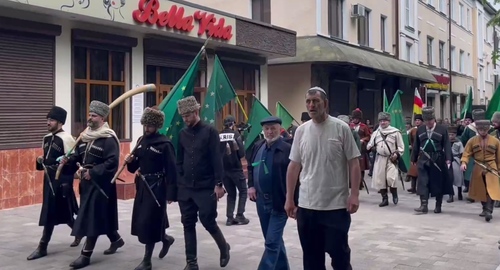
Events have been held in Nalchik to commemorate the Circassian Day of Mourning, including a march through the streets of the city that was not permitted by the authorities. The people involved in the events considered it vital to preserve Adyghe traditions.
As Caucasian Knot has reported, May 21, the Day of Remembrance for the Victims of the Caucasian War, was officially declared a holiday in Adygea, Kabardino-Balkaria and Karachay-Cherkessia, where Circassians are the titular nation. This year, the authorities in Kabardino-Balkaria banned holding events in memory of the victims of the Caucasian War on May 20 and 21, threatening to prosecute those who violated the ban, said Aslan Beshto, chair of the Coordinating Council of Adyghe Public Associations.
Adyghe (Circassians) is the common name for a people living in Russia and abroad, who have been divided into Kabardians, Circassians, and Adygeans. May 21 is celebrated annually as Circassian Day of Mourning, according to the Caucasian Knot reference guide.
Several events were held in Nalchik to commemorate the Circassian Day of Mourning
Events commemorating the 159th anniversary of the end of the Caucasian War began in Nalchik on the evening of May 20 at the Tree of Life Memorial. There, the republic’s musical groups performed folk songs about the dramatic events of the Caucasian War, and 159 candles were lit. Traditional funeral treats, lakum, were handed out to attendees our correspondent reported.
Today, the main events took place in Nalchik, including an unauthorized march by several dozen people through downtown Nalchik from the railway station to Abkhazia Square, and from there to the Tree of Life Memorial. The marchers carried [Circassian] flags and periodically shouted the phrase “the Adyghe tribe is alive” in their native language. Although the march had not been permitted by authorities, no one stopped them.
The Caucasian War, which lasted from 1763 to 1864, brought the Adyghe peoples to the brink of extinction. After the war and the mass deportation of Adyghe to the Ottoman Empire, a little more than 50,000 Adyghe remained in their homeland. The Russian authorities have not yet acknowledged the Circassian genocide during the war.
Several hundred people gathered in the park near the Tree of Life Memorial. At twelve noon Moscow time, a rally began. It was kicked off by Mukhadin Kumakhov, Kabardino-Balkaria’s minister of culture. He explained that the head of the republic, veterans, members of parliament, members of the government, heads of administration of districts and villages, clergy and elders had came to honor the memory of their ancestors.
Most of the speech given by Houti Sokhrokov, president of the International Circassian Association, was in Kabardian. In Russian, he said that 159 years had passed “since the bloodiest war.” “We stand today in a place sacred to all the Adyghe, the Tree of Life Memorial, and remember those who fell in that war. We shall cherish the memory of their courage in our hearts, and pray that this never happen to any nation again,” he said.
Sokhrokov then asked for a minute of silence, after which continued his speech. “As we remember today the events of those distant years, we pay tribute to the wisdom, foresight, fortitude and perseverance of our ancestors, who, despite all their hardships, saved the Adyghe people, remained faithful to the fateful choice they had made once upon a time, and preserved their historical homeland for future generations. This historical continuity has not been severed. It is only thanks to this that the Adyghe have preserved their language, traditions and culture,” he said.
The republic’s leading Muslim clerics performed a dua, a memorial prayer ritual, after which flowers were laid at the memorial, our correspondent reported.
Nalchik residents pointed out the importance of preserving Adyghe traditions
The date is a sad one for Adyghe, Timur Shardanov, chair of the Council of Veterans of the War in Abkhazia told our correspondent. “Today is a sad day for us Adyghe. We war veterans have come to honor the memory of ancestors who passed away at that time. We cherish their memory and try to pass it on to our [children]. We must do this so that it does not happen again somewhere. We know what war is, and we don’t want our children to see it,” he said.
Shardanov argues that an equestrian procession is optional on the Day of Mourning. The main thing, in his opinion, is to come to the memorial and stand for a while there.
An injustice was committed against the Adyghe, which consists not only in the expulsion of the people, but “also in an attempt to erase the memory of this page of history,” another attendee, Alexei Bekshokov argues. “The Koran says: I have forbidden injustice to myself and I forbid it to you,” he explained to our correspondent
Bekshokov considers the ban on the equestrian procession an excessive measure. “Nothing would have happened if it had taken place. Horse marches were part of Circassian history,” he said.
In 2022, the authorities in Kabardino-Balkaria turned down a request by a grassroots group to hold a solemn procession in memory of the victims of the Caucasian War. Despite the ban, on 21 May 2022, several dozen young people marched through the streets of Nalchik. The security forces charged a rider who took part in the procession with disturbing the peace. The atmosphere during the march was tense, and the clash between the police and the riders heated it up even more, eyewitnesses said. The march had been held for many years without incident, Martin Kochesoko, the president of [rights group] Habze, noted at the time.
Anatoly Thagapsoev, a resident of Nalchik, argues that the best tribute to the memory of their ancestors would be if the Adyghe did not lose traditions which have been part of their existence for centuries.
“I see that women without headscarves and men without hats have come to the memorial event. This used not to be allowed among the Adyghe. They bring children in ethnic costumes and take pictures of them in front of the memorial, as if it were a holiday. The line between the Adyghe man and the Adyghe woman, the older and younger [generations], is also being erased. Previously, a woman had no right to cross a road in front of a man. When a man passed by, a woman had to stand up, even if it was a boy, for the boy is a future man. These are nuances, but being Adyghe consisted of them,” the Nalchik resident told our correspondent.
Community leader Idar Tsipinov believes that the Adyghe Day of Remembrance contributes to the revival of national consciousness. “Personally, I am opposed to globalization. I believe that the more nations, the more different cultures there are, the more interesting it is. This does not mean that we live in the past. This means that we live in the present, we look to the future, but we don’t forget the past either,” he told our correspondent.
Caucasian Knot collects articles on the situation of Circassians in Russia and abroad on the thematic page “The Circassian Question.” Our “Reference” section also contains the article “The parade in Krasnaya Polyana: How Russia broke the Circassian resistance.”
Source: “Nalchik residents hold march on Circassian Day of Mourning despite ban by authorities,” Caucasian Knot, 21 May 2023. Translated by the Russian Reader
The Circassian Day of Mourning (Adyghe: Шъыгъо-шӏэжъ маф, Russian: День памяти жертв Кавказской войны) or the Day of Mourning for the Victims of the Circassian Genocide (often censored in Russian media as Day of Remembrance for the Victims of the Caucasus War) is mourned every year on 21 May in remembrance of the victims of the Russo-Circassian War and the subsequent Circassian genocide by members of the Circassian diaspora. The choice of the date is due to the fact that on 21 May 1864, General Pavel Grabbe held a military parade in the what is now Krasnaya Polyana in honor of the victory in the Battle of Qbaada.
Background
From 1763 to 1864 the Circassians fought against the Russians in the Russian-Circassian War. During the war, Russian Empire employed a genocidal strategy of massacring Circassian civilians. Only a small percentage who accepted Russification and resettlement within the Russian Empire were completely spared. The remaining Circassian population who refused were variously dispersed or killed en masse. Circassian villages would be located and burnt, systematically starved, or their entire population massacred. Leo Tolstoy reports that Russian soldiers would attack village houses at night. Sir Pelgrave, a British diplomat who witnessed the events, adds that “their only crime was not being Russian.”
A mass deportation was launched against the surviving population before the end of the war in 1864 and it was mostly completed by 1867. Some died from epidemics or starvation among the crowds of deportees and were reportedly eaten by dogs after their death. Others died when the ships underway sank during storms. Calculations, including taking into account the Russian government’s own archival figures, have estimated a loss of 80–97% of the Circassian population in the process. The displaced people were settled primarily to the Ottoman Empire.
In 1914, Nicholas II celebrated the 50th anniversary of the defeat of the Circassians, describing it as one of the empire’s greatest victories. Boris Yeltsin acknowledged in 1996 when signing a peace treaty with Chechnya during the First Chechen War that the war was a tragedy whose responsibility lies with Russia.
Holiday
In 1990, the Circassians designated 21 May as the Day of Mourning for their people, on which they commemorate the tragedy of the nation. It is memorable and non-working day in the three republics of the Russian Federation (Adygea, Kabardino-Balkaria and Karachay-Cherkessia) as well as in the Circassian villages of the Krasnodar Krai. The government of the partially recognized Republic of Abkhazia also mourns the day of mourning on May 21 (until 2011, it was mourned on May 31).
The day is also widely mourned with rallies and processions in countries with a large Circassian diaspora, such as Turkey, Germany, United States, Jordan and other countries of the Middle East.
Source: Wikipedia
The Russo-Circassian War (Adyghe: Урыс-адыгэ зауэ, romanized: Wurıs-adığə zawə; Russian: Русско-черкесская война; 1763–1864; also known as the Russian invasion of Circassia) was the invasion of Circassia by Russia, starting in July 17, 1763 (O.S) with the Russian Empire assuming authority in Circassia, followed by the Circassian refusal, ending 101 years later with the last army of Circassia defeated on 21 May 1864 (O.S), making it exhausting and casualty-heavy for both sides. The Circassians fought the Russians longer than all the other peoples of the Caucasus, and the Russo-Circassian War was the longest war both Russia and Circassia have ever fought.
During and after the war, the Russian Empire employed a genocidal strategy of systematically massacring civilians which resulted in the Circassian genocide where up to 2,000,000 Circassians (85-97% of the total population) were either killed or expelled to the Ottoman Empire (especially to modern-day Turkey; see Circassians in Turkey), creating the Circassian diaspora. While the war was initially an isolated conflict, Russian expansion through the entire region soon drew a number of other nations in the Caucasus into the conflict. As such, the war is often considered the western half of the Caucasus War.
During the war, the Russian Empire did not recognize Circassia as an independent region, and as a result, it considered Circassia Russian land which was under rebel occupation, despite the fact that the region was not and had never been under Russian control. Russian generals did not refer to the Circassians by their ethnic name, instead, they called the Circassians “mountaineers”, “bandits”, and “mountain scum”. The war has been subjected to historical revisionism and it has also garnered controversy due to the fact that later Russian sources mostly ignored or belittled the conflict, and Russian state media and officials have gone as far as to claim that the conflict “never happened” and they have also claimed that Circassia “voluntarily joined Russia in the 16th century”.
[…]
Source: Wikipedia
May 21 marks the Circassian Day of Mourning, a time of remembrance for the victims of the Russo-Circassian War.
In 1864, the Caucasian War ended on this day. The Russian Empire held a prayer service and celebrated the victory. For Circassians this war ended in tragedy: the loss of independence, mass extermination of the population, eviction to the Ottoman Empire, Syria and other countries, the breakdown of the social system, and a colossal trauma.
For Circassians May 21 is more than just a sad date, and the Russo-Circassian War is not a thing of the past. These events still determine our reality. What the official Russian historical science interprets as a military-political conflict or even the pacification of a troubled region, Circassians perceive as genocide.
The events of 1864 and the subsequent colonization of the former Circassia and the North Caucasus remain an acute problem that official authorities ignore.
One can re-read the texts for our releases on May 21 or the posts we have made in past years. They are all relevant and can be reproduced again and again. There are no shifts or new trends in Russian society or the official political course.
There are also alarming signs that discourse is being further constricted. In 2020 and 2021, the traditional mourning procession in Nalchik was canceled due to the pandemic. The Circassian public accepted the extraordinary circumstances, and it did not cause any indignation.
In 2022, the rally was canceled again for strange reasons. The authorities of Kabardino-Balkaria did not clarify them, and the International Circassian Association referred to “difficult times” and “the situation with the special operation in Ukraine”.
The Circassian community was outraged by the absurdity of these statements. And so were we.
Initially, we did not plan to release an album, but make a post about grief and memory. On May 17, we learned that the main Circassian symbolic event in our hometown was canceled. Yes, there will be a minute of silence and other mourning events, but there will be no main unifying procession in which Circassians of different views, confessions, and political orientation stand shoulder to shoulder to make a peaceful democratic statement.
And we decided to record and publish an album with songs of the Russo-Circassian War.
This is our traditional way of memorizing the past, a call for working with heritage and defending our subjectivity. We believe that problems need to be discussed and solved together, and not put off until better times. Otherwise, these better times will never come.
The songs on this album are war and mourning ballads of those who fought for their independence. For us, this is also an anti-militaristic statement, since all this music is set against repression and aggression.
Circassians, who have suffered from imperialism, must understand that colonial optics and repressive methods are unacceptable against any other groups of people, small or large. Every group or community has the right to determine its future.
Jrpjej:
Timur Kodzoko — guitar, shichepshin, vocals
Alan Shawdjan — vocals, accordion
Daiana Kulova — vocals, shichepshin, percussion
Guest singers:
Zaurbek Kozh
Zaur Nagoy
Sound recording: Timur Kodzoko
Sound editing, mixing: Timur Kodzokov
Cover photo: Elina Karaeva
Cover design: Milana Khalilova
Text: Bulat Khalilov and Bella Mirzoeva
Recorded on May 20-21, 2022
Recording location: Dom Radio, Nalchik, Kabardino-Balkaria
Except “Тыгъужъыкъо Къызбэч,” recorded by Daan Duurland at Katzwijm Studio, Netherlands, November 2021.
NB. This entry was updated on 22 May 2023. ||| ••• TRR •••