This is the second in a series of posts in which I showcase some of the newsletters, blogs, Substacks, and websites — all of them produced by hardworking, passionate lone wolves or tiny, perpetually underfunded grassroots collectives — which inspire me to continue making the Russian Reader and inform me about parts of the world and communities about which otherwise I would be utterly clueless.
Erin Reed describes Erin in the Morning as a place to “stay up to date on all of the most important pieces of trans and queer news and legislation for the week. I summarize it all complete with links to source documents. I hope to distill the information that you get from me in other places like @erininthemorn on TikTok and Twitter into a digest so that you can be sure you didn’t miss anything!”
Ms. Reed’s latest post on Erin in the Morning, endorsing Kamala Harris for U.S. president, could not be timelier, of course. More importantly, as a blogger who has chronicled the Putin’s regime ferocious war on Russia’s LGBT community and their rights, I cannot help but be inspired by Ms. Reed’s fierce, fact-driven defense of the transgender community and their rights in the U.S. I hope you’ll consider subscribing to Erin in the Morning and supporting it financially, as I have done. \\\ TRR
As one of America’s leading transgender journalists, I have reported on the wave of anti-transgender legislation sweeping across the United States over the past four years. These laws impact nearly every aspect of our lives: from using restrooms in peace to accessing essential medical care, from seeing our histories taught in schools to expressing our identities through art at Pride parades. I’ve listened to thousands of hours of testimony on these bills. Facing the 2024 election, I can’t stay silent on the dangers a second Trump term would pose to my community. For the long-term safety and dignity of transgender Americans, I believe there is only one viable path forward: electing Kamala Harris this November.
In some of my earliest reporting on anti-trans laws, many Republican elected officials were less fanatical than they are today. For instance, the first bill banning transgender healthcare in Arkansas was vetoed by Republican Governor Asa Hutchinson. In his veto statement, Gov. Hutchinson described the bill as “overbroad and extreme,” noting that it would “create new standards of legislative interference with physicians and parents.” In early 2022, Republican Gov. Spencer Cox vetoed a sports ban, making an impassioned plea: “I want them to live.” Many anti-trans bills failed early on, failing to gather enough Republican votes. Even Republican-nominated justices crossed party lines to side with Democratic-nominated justices, affirming that transgender individuals deserve protection under the constitution.
But soon after, the party began waging a fear campaign, leaving countless people in my community harmed in the process. I watched as one Republican-controlled statehouse after another, spurred on by far-right Freedom Caucus members, voted to enact some of the most draconian laws targeting transgender individuals ever seen. I listened as members of my community were labeled “dangerous,” “an infection,” and even “demons.” Gov. Cox no longer “wanted us to live,” and instead quietly signed the first bathroom ban to cross his desk.
I have seen transgender people forced to flee anti-trans states, seeking new lives in places where they are protected. Some of my earliest work involved families in Texas with transgender children who were targeted by Attorney General Ken Paxton, accused of child abuse simply for supporting their kids. Soon, other states followed with healthcare bans, bathroom bans, and more. I reported on these bills as families begged their state legislators for dignity, only to be ignored. I then helped these families raise funds, and I’m glad to report that many now lead fulfilling lives as valued members of their new communities.
I am keenly aware of which states transgender people are fleeing—and which ones they are fleeing to. Every state enacting extreme anti-trans laws has either a Republican trifecta or a Republican supermajority. Meanwhile, transgender people are finding refuge in states where Democrats have established safe havens. One of those havens is Minnesota, thanks to Governor Tim Walz. I know people whose lives were saved by his actions—people who can now live authentically and freely, without fear of government persecution.
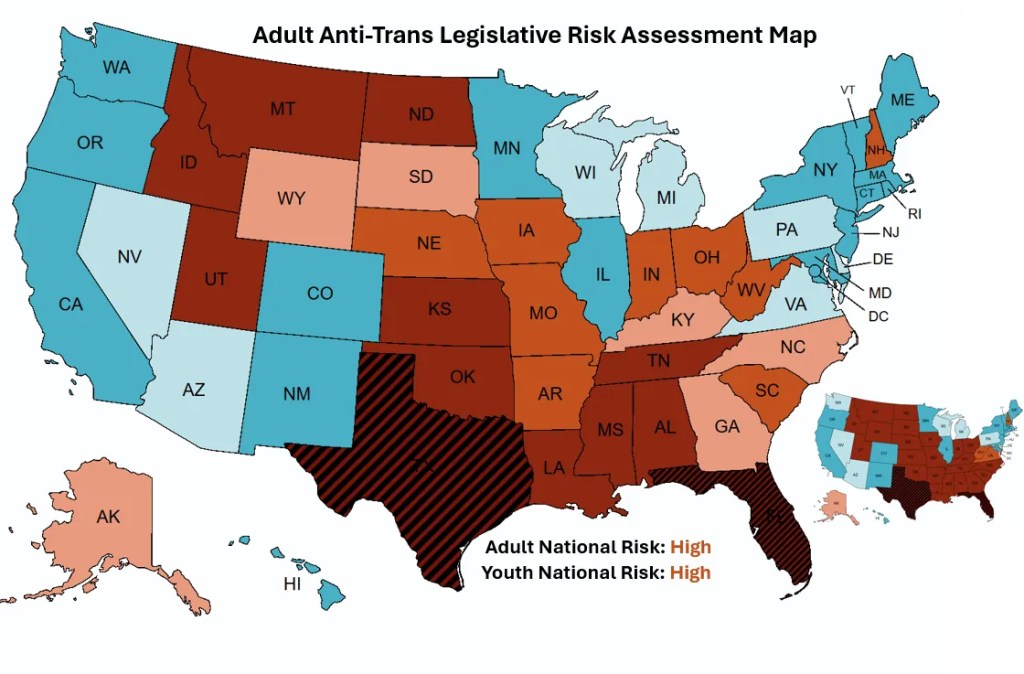
I have followed this election cycle intently and was among the first to report that transgender people would be a primary target of Trump’s 2024 campaign. In early 2023, Trump released a video outlining a dozen anti-transgender policies he would enact upon taking office, including national bans on trans care for youth, investigations into hormone therapy manufacturers, probes into affirming teachers, and eliminating funding for schools that treat transgender students with dignity and respect. These policies would take the harmful measures I’ve seen in Republican statehouses and nationalize them.
In 2024, it’s clear that the Trump campaign intends to follow through. If you’ve watched any sporting event or turned on the TV in a battleground state, you’ve seen the culmination of this fear campaign against transgender people, now led by Trump himself. Nearly $100 million in anti-trans ads have blanketed the nation, with Trump spending more on these ads than on immigration, housing, and the economy combined. I have seen what other Republican leaders do when they center their focus on my community, and I know the end results are not pretty.
When Kamala Harris was chosen as the Democratic nominee, I watched her closely. While the Biden administration was not flawless on transgender rights—and I often criticized it for these shortcomings—no federal anti-trans laws passed during his presidency. I reported on the defeat of 50 anti-trans and anti-LGBTQ+ policy riders as Republicans threatened to shut down the entire government over transgender issues, and Biden did not back down. His nominees have overturned anti-trans laws and policies. Thanks to Biden, I was able to change my passport, even though my home state of Louisiana doesn’t allow birth certificate changes. I wanted to see if Harris would continue that commitment.
I’m convinced she will. One of Harris’s first moves that reassured me was selecting Gov. Tim Walz as her choice for vice president, fully aware of the Republican attacks against him for making Minnesota a safe haven for those fleeing anti-trans laws in other states. Walz, who campaigned on his record of starting his high school’s first Gay-Straight Alliance decades ago, has consistently been at the forefront of supporting LGBTQIA+ people. He brought that commitment with him to the Governor’s office, where he governed with a focus on making the state welcoming and inclusive for all.
Then in the final weeks of the campaign, she and Tim Walz were asked no less than three times about transgender people in interviews with Fox News, NBC, and Glennon Doyle’s podcast. I was encouraged to see Harris stand on her record of supporting transgender people when questioned. She had ample opportunity to throw us under the bus—as some other Democrats have done this campaign cycle—but she did not.
On Fox News, she criticized Trump for spending $20 million on ads targeting our community. On NBC, echoing her stance on abortion, she emphasized that transgender care is a decision to be made between doctors and patients. Her framework mirrored the approach used by many Democrats—and even some Republicans—to successfully push back against anti-trans bills in dozens of states. Meanwhile, that same week, Walz passionately defended transgender youth, stating that Donald Trump was attempting to “demonize a group of people for being who they are” and pledging that the administration would appoint justices committed to protecting our rights.
With over 1,000 bills introduced in the past three years targeting trans and queer people, undoing the harm they’ve caused will require sustained and strategic effort. The path forward depends on nominating justices who can help reverse these laws, while also protecting our rights in cities and states that offer refuge. For those living in oppressive states where their care, bodily autonomy, and right to exist freely have been threatened, we will continue organizing, supporting each other through mutual aid, and building the foundation to dismantle these discriminatory laws for good. The future rights of transgender people depend on electing Harris, uplifting Walz’s leadership, and securing the justices their administration will appoint.
If Trump wins a second term, we could be bound by his justices for an entire generation. Many transgender adults may never see the day when his court no longer controls our right to exist peacefully in public. Project 2025 could become a national reality, turning the same hateful bills and rhetoric shaping statehouses across the country into federal law. Schools could be defunded for allowing transgender youth to use restrooms in peace, and our very existence could be labeled obscene. There may be no return from the harm he intends to inflict on our community.
Transgender people are in a fight for our lives, and we are a powerful voting force, with millions of us across the United States. In an election that could come down to a few thousand votes in key swing states, we have the numbers to make a difference. In states like Georgia and Arizona, the transgender population is four times the size of the previous vote margins. We cannot afford complacency this election cycle. There is a path forward from the harm inflicted by Republican policies championed by Trump—a path that depends on us showing up and casting our votes for Kamala Harris.