The Zhanaozen Massacre: Four Years Later

Kazakhstan: who ordered the killings and tortures?
People and Nature
December 13, 2015

Who ordered police to shoot down oil workers demonstrating for fair living standards? Who organised the torture of activists in police cells?

Four years after police killed at least 16 demonstrators and injured 60 more in the oil city of Zhanaozen in western Kazakhstan, trade unionists and human rights campaigners are demanding answers.

They will spell out their calls for justice again on Wednesday this week, the fourth anniversary of the massacre, on December 16, 2011.

After the killings, some rank-and-file police officers who opened fire were jailed, and some local officials punished for corruption offences. But those who organised and instigated the crackdown have so far escaped justice.
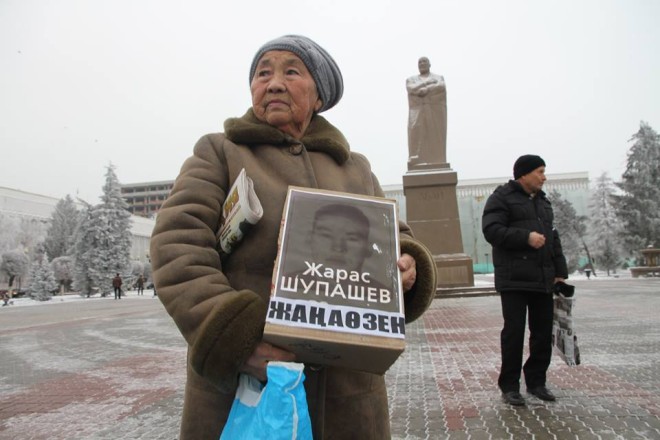
Demonstrators in Uralsk, Kazakhstan, on the third anniversary of the Zhanaozen massacre last year. Photo: R. Uporova/ Uralskaya Nedelya newspaper

Demonstrators in Uralsk, Kazakhstan, on the third anniversary of the Zhanaozen massacre last year. Photo: R. Uporova/ Uralskaya Nedelya newspaper.

The well-documented use of torture against trade union activists after the massacre has gone unpunished.

Demands for an independent international enquiry, by the United Nations and international trade union federations, have not been met.

In the Kazakh oil fields, workers have been told they will be sacked if they dare to mark the anniversary on Wednesday. Activists in Ukraine, Russia and elsewhere will demonstrate at Kazakhstan’s embassies. If you live in another country, you can mark the anniversary by sending a message of support or taking any other type of solidarity action. (See links at the end.)

Here is an update on the campaign for justice for those killed, injured and tortured while fighting for workers’ rights.

Justice for those killed and injured on 16 December 2011

Statements about the Zhanaozen killings by the Kazakh authorities contradict each other, contradict accounts by other witnesses, and are difficult to reconcile with video and audio recordings made on the day.

Trade unionists and international campaign organisations supporting the oil workers’ families fear that, by jailing a small number of officers – all of whom have now been released – the government hoped to cover up the chain of command that led to the killings.

Journalist Saniya Toyken, who is based in the Mangistau region (which includes Zhanaozen), this month explained in an article (link to Radio Azattyq site here, Russian only) that:

■ On 18 December 2011, two days after the Zhanaozen killings, Kazakh internal affairs minister Kalmukhanbet Kasymov denied that anyone had ordered police officers to open fire on peaceful demonstrators. He claimed that police were unarmed, but went to fetch Kalashnikov rifles and ammunition after disorder broke out.

■ On the same day, the Kazakh general prosecutor admitted that 15 people had been killed in the course of the forcible response to the oil workers’ demonstration. Ten days later, on 27 December 2011, the prosecutor announced that five officers would be charged for “exceeding their legal powers.” At a trial in April-May 2012, five officers were found guilty of “exceeding their legal powers with the use of firearms.” The indictment against one, police colonel Kabdygali Utegaliev (who received the heaviest sentence, of seven years), referred to him “giving an order to use weapons.”

■ At the trial it was stated that police lieutenant-colonel Bekzhan Bagdabaev, former head of the department for combating extremism of the department for internal affairs, had killed Zhanar Abdikarimova, a peaceful resident of Zhanaozen – and that the same bullet that killed Abdikarimova had also struck Rakhat Tazhmivanov and Rzabek Makhambet. The
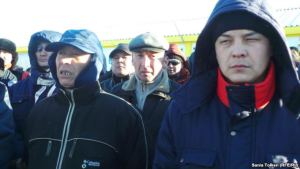
Oil workers at Munaifildservis in the Mangistau field at a meeting in February 2014. Photo: Saniya Toiken

Oil workers at Munaifildservis in the Mangistau field at a meeting in February 2014. Photo: Saniya Toiken

charges against three other officers (colonel Erlan Bakytkaliuly, senior lieutenant Rinat Zholdybaev and police captain Nurlan Esbergenov) mentioned deaths of, and injury to, specific victims.

■ Another victim, Bazarbai Kenzhebaev, died as a result of injuries received in police detention after the demonstration. Zhenisbek Temirov, who had been the officer in charge, was also jailed – again on charges of “exceeding his legal powers” – and made to pay 1 million tenge (about $5000) to Kenzhebaev’s family.

■ The verdicts were publicly questioned by Bagdabaev’s wife, Gulzhikhan, who in a media interview said that her husband had not opened fire and had been unjustly punished, whereas those who had used their weapons – and could be clearly seen doing so on videos – had not been brought to justice.

Relatives of massacre victims expressed dissatisfaction with the trial’s outcome, and demanded that charges of murder – rather than “exceeding legal powers” – be brought. In August 2012 they took an appeal to the regional cassation court (which re-examines legal issues, but not evidence). Judge Doszhan Amirov confirmed the trial decision but said that the question of murder charges “remained open.”

The relatives, and human rights organisations who supported them, reacted fiercely to a statement made during the officers’ trial that “unknown police officers used unregistered weapons without permission.”

Asel Nurgazieva, the legal representative of victims’ families, said: “How can police officers be described as ‘unknown’? This would mean that the whole state does not know who it employs and in whose hands it places weapons.”

Max Bokaev of the human rights campaign group Arlan, who acted as a trial observer, said in a recent interview with Toyken that while police officers’ faces were not visible in videos – which were in any case not used as evidence – their voices could be identified from sound recordings. “Now it will be complicated to ascertain who concretely shot and killed people, but those who gave the orders could be identified,” he said.

Ninel Fokina of the Helsinki committee in Almaty pointed out that there was no provision in Kazakh law for civil society to monitor the use of weapons by state agencies.

In addition to the shootings at Zhanaozen, firefighter Serik Kozhaev was killed, and 11 people injured, when police opened fire on demonstrators at the nearby railway station of Shetle on November 16, 2011. A week later, a local internal affairs ministry official, Serik Kozhaev, told journalists that police officers had fired on the crowd.

“That firefighter was on the other side [i.e. the demonstrators’ side]”, Kozhaev said. “Who opened fire? We did! We have the right to use service weapons in life-threatening situations.” Kozhaev claimed that some of the demonstrators were armed, but no evidence of this was brought to court.

One day, hopefully, our campaign efforts will lead to a genuine investigation of the killings. Then, a list of the senior security services officers responsible for the police action – compiled by Saniya Toyken, and reproduced below (“Officials with questions to answer”) – will come in useful.

Justice for trade unionists who were imprisoned and tortured

Security services officers who tortured trade unionists and their supporters  imprisoned after the Zhanaozen events have gone unpunished. These crimes have not even been investigated by the Kazakh authorities.

Thirty-seven Zhanaozen residents were tried in April-May 2012 for their part in the oil workers’ struggle, and 13 of them jailed. (More details here.) The trial judge passed numerous claims of torture, made in court, to the Mangistau district prosecutor’s office, which declined to open a criminal case, citing a lack of evidence. The office did not explain why it chose not to exercise its investigative function.

Kazakh human rights campaigner Erlan Kaliev, who acted as an observer at the oil workers’ trials, wrote on this site last year:

In court, the accused started publicly to deny the testimony that they had given during the investigation. They argued that they had been compelled to give that testimony under the strongest psychological and physical pressure from police officers. They spelled out concrete examples of how torture had been used against them.

The most common methods were suffocation with plastic bags; soaking with cold water at a temperature of minus 20 or minus 30 degrees; and hanging by the hair from the ceiling, as was the case with Roza Tuletaeva. The accused were made to stand for many hours, to sleep on the bare, or even iced-over, floor. They threatened to rape underage children, as became clear from the statements [in court] of Tanatar Kaliev and Roza Tuletaev. [Aleksandr] Bozhenko spoke of how they beat him mercilessly with switches [sheafs of branches] and jumped on him.

What’s more, all the victims gave the names of those who had treated them so brutally. They said that the perpetrators – police officers, prison staff or Committee of National Security operatives – very often made no attempt to cover up their identities. Their first names and surnames are in the court record. But there has been no investigation.

Victims of torture, listed in another recent article by Saniya Toyken (link here, Russian only), include:

■ Maksat Dosmagambetov, oil worker and trade union activist jailed at the 2012 trial and given conditional early release in February this year. He has cancer of his facial bones, apparently caused by the beating he received in police custody. In March, after his release, he travelled to South Korea for treatment. Dosmagambetov had pointed to a police officer and
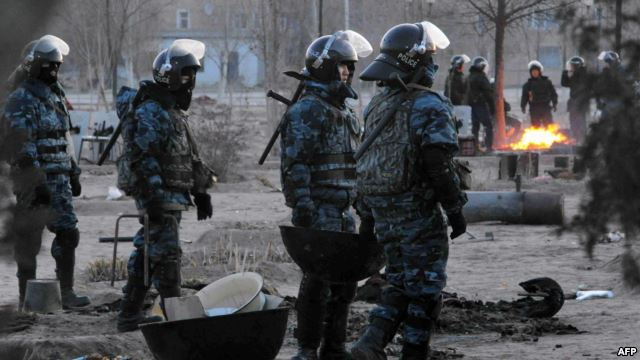
Police at Zhanaozen on 16 December 2011

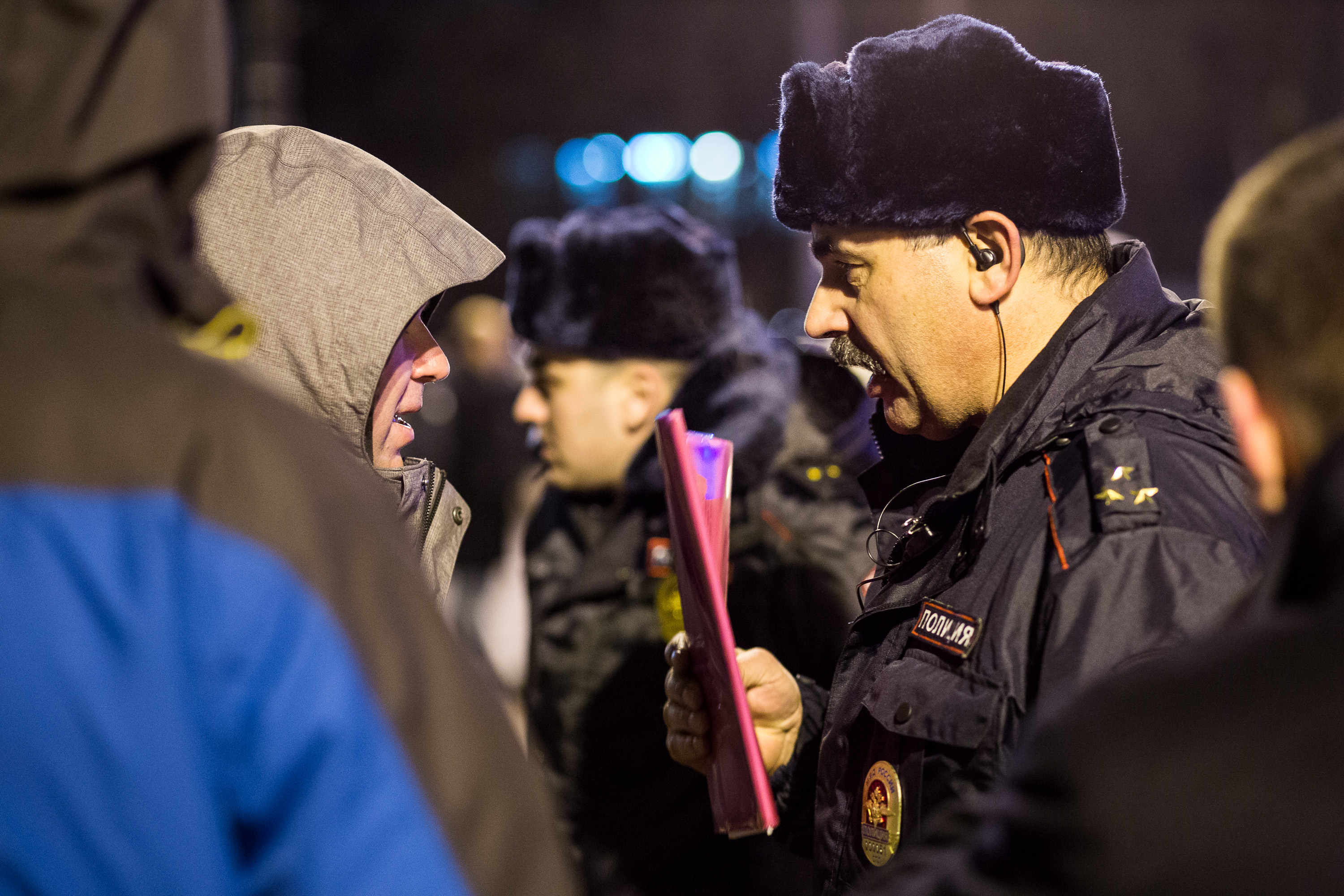
Police at Zhanaozen on 16 December 2011

said: “You saw with your own eyes how they beat me and punctured my ears with a staple gun.” Another defendant, Tanatir Kaliev, repeated the claim. (Activists have not published the name of the officer, who has not been charged.)

■ Yesengeldy Abdrakhmanov, an unemployed man from Zhanaozen who was sentenced to three years’ imprisonment but released via an amnesty, told the court that he had contracted tuberculosis as a result of police torture. “I was stripped naked. They poured freezing water over me and beat me.”

■ Shabdol Otkelov, sentenced to five years, said in court that a security services officer “put a cellophane bag over my head and, stuffing it in to my mouth, forced me to confess to the preparation of explosives and to sign papers prepared by an investigator based in Astana [the capital of Kazakhstan].”

■ Roza Tuletaeva, a trade union activist who told the court she had been suffocated and hung by her hair, demanded that the tortures be investigated.

■ Kairat Adilov, sentenced to three years, told how an investigator put a gun to his head and threatened to shoot if he did not confess guilt.

■ Allegations of torture by police, prison officers and other security personnel were also made to the court by Ergazy Zhannyr, Serik Akzhigitov, Islam Shamilov, Bauyrzhan Telegenov, Zharas Besmagambetov, Samat Koyshybaev, Ertai Ermukhanov, Sisen Aspentaev, Zhenis Bopilov and Rasul Mukhanbetov.

■ Trial observers from Open Dialog say that, furthermore, six trial witnesses made allegations of torture in court. One, Aleksandr Bozhenko, who repeated the claims in television interviews, was murdered in unclear circumstances ten days later.

In 2013, Amnesty International accused Kazakhstan of “routinely” using torture, including in the Zhanaozen cases. (Amnesty report downloadable here.) Now some campaigners are calling for a “Zhanaozen list” of officials to be compiled, similar to the “Magnitsky list” drawn up by human rights activists in Russia, which led to the USA sanctioning security services officers involved in the ill-treatment and death in prison of lawyer Sergei Magnitsky.

Lyudmyla Kozlovska of the international campaign group Open Dialog, that has championed human rights cases in Kazakhstan, said in an interview with Saniya Toyken that putting together a list would take time. “The question of tortures is not being raised [by the authorities] in Kazakhstan, because it involves people at the highest levels of government.”

The UK connection

There are strong business links between the UK and Kazakhstan. BG Group (former British Gas, now merging with Shell) and other oil companies work there; Kazakh companies raise money through the London markets. Tony Blair, former prime minister, advised Kazakhstan’s government – including specifically encouraging them to hush up the Zhanaozen issue – and UK government ministers, together with Prince Andrew, keep the relationship sweet. GL, 13 December 2015.

■ Send solidarity messages via the Confederation of Labour of Russia (email ktr@ktr.su) and/or via the Justice for Kazakh oil workers facebook page, and/or via gabriel.levy.mail@gmail.com.

Kazakh oil workers information page

Kazakhstan: oil companies threaten activists

Officials with questions to answer

►Kalmukhanbet Kasymov, minister of internal affairs at the time of the Zhanaozen massacre, has twice been reappointed to that position. In 2014 he was awarded the Order of Honour, and in 2015 was given the rank of general-colonel.

►Amanzhol Kabylov, who was head of the department of internal affairs of Mangistau region, and was appointed commandant of Zhanaozen when the state of emergency was declared there after the massacre, has been promoted. He now works as the deputy chairman of the criminal investigation committee of the Astana police.

►Abkrasul Oteshov, former deputy head of the directorate of internal affairs in Zhanaozen, who was accused of torture at the oil workers’ trial, is currently deputy head of the directorate of internal affairs of Munailinsky district of Mangistau region. 

►Former head of the directorate of internal affairs of Zhanaozen, Mukhtar Kozhaev, has been promoted to a position as head of criminal police in Astana.

►Another deputy head of the directorate of internal affairs in Zhanaozen, Nuraly Barzhikov, who has said “I was on the square [where the shootings took place] and I used firearms,” remains at his post.

►Officer Marat Kyzylkuluky, who admitted using firearms, now works with the migration police in Zhanaozen.

►Colonel Ulykbek Myltykov, who said in court that he had not fired on fleeing demonstrators – and after being showed video vidence, said he “did not know why [officers] fired” – is currently head of the administrative police of the department of internal affairs of the Mangistau region.

►Former deputy head of the department of internal affairs of Mangistau region Erzhan Sadenov currently works as the head of the department of internal affairs transport division in Astana.  

__________

Kazakhstan: oil companies threaten activists
People and Nature
December 13, 2015

Oil company managers have warned workers not to demonstrate on the fourth anniversary of the Zhanaozen massacre, Kazakh opposition news sites reported last week.

A fresh wave of unrest is brewing in the oil field after the announcement of redundancies, caused by the falling oil price and company cutbacks. A Kazakh-Chinese drilling company laid off 200 people in August.

Activists jailed after the 2011 strikes – which ended with police killing at least 16, and wounding 60, when they opened fire on protestors on 16 December 2011 – are under special scrutiny. “The security services have

Roza Tuletaeva. Photo: Saniya Toyken

Roza Tuletaeva. Photo: Saniya Toyken

been active, and have carried out ‘preventive discussions’ with activists, especially those who have been released from prison,” Respublika newspaper reported.

“They have promised [the activists] that they will again be put behind bars, especially if they try to influence trade union elections, as happened on 21 November in Zhanaozen.”

Akzhanat Aminov, one of the activists who was jailed and conditionally released, has been given an additional one year suspended sentence. That was a response to his election in June this year as chairman of the trade union committee of Ozenmunaigaz, the largest state-owned oil production company, the socialismkz.info site reported.

Roza Tuletaeva, a prominent trade union activist who was jailed at the Zhanaozen trial, said last month in a telephone interview with Radio Azattyq that she is back at work in the well drilling division of Ozenmunaigaz. She expressed concern for the condition of Maksat Dosmagambetov, her fellow activist who is seriously ill following torture in detention. Roza added that she remains in touch with the 12 other workers jailed at the Zhanaozen trial.

While the Zhanaozen prisoners have now been released, the politician Vladimir Kozlov of the democratic movement Alga was last week denied conditional release terms. He was jailed in a general crackdown following the oil workers’ strikes, of which he was a prominent supporter. GL, 13 December 2015.
Editor’s Note. My profound thanks to Gabriel Levy for his permission to reproduce these articles here.

Waiting for the Anti-Platonists: Striking Truckers Prepare to Convoy to the Moscow Ring Road

“What is Basil Saying? Where is Oversize Lyokha? And How is Platform Trailer Vadim?”
Kommersant Explored How Truckers Are Convoying to the Moscow Ring Road to Protest 
Alexander Chernykh and Katerina Shcherbakova
December 3, 2015
Kommersant

The protests by truckers that have taken place over the past three weeks because of the introduction of the Plato payment system are nearing their climax. On Thursday, drivers around the counters waited for President Putin to mention their problems and promise to get to the bottom of them in his annual Address to the Federal Assembly. When this did not happen, truckers begin forming the convoys that will attempt to travel to Moscow and block the Moscow Ring Road.

The Meeting Place Must Be Changed

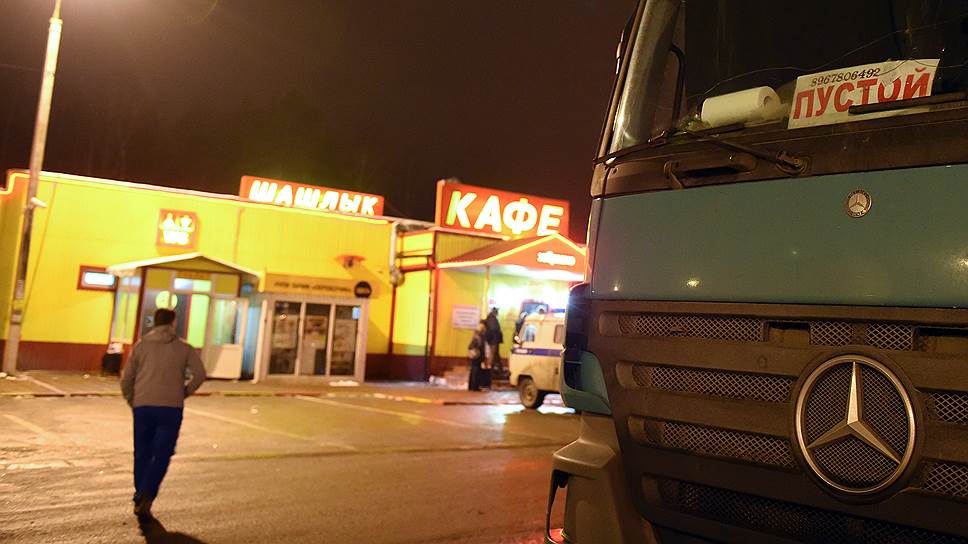
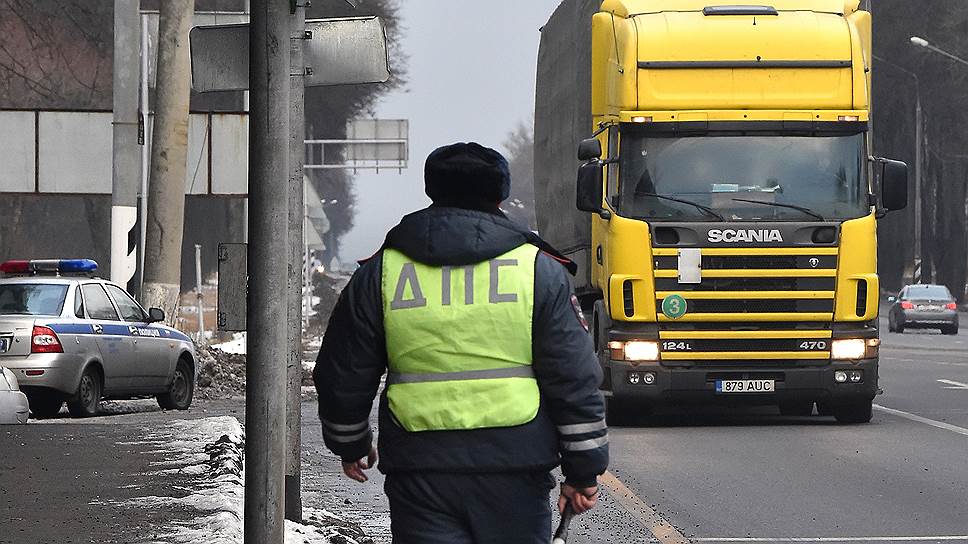
The protesting truckers should have been in Moscow a few days ago, but the traffic police have been successfully countering them all week. Nationwide, traffic cops have been stop suspicious drivers at every post, checking their documents for several hours, looking for explosives or narcotics in their cargo, fining them for not having first-aid kits and fire extinguishers, and simply turning the most active of them around. This has seriously complicated coordination of the protests: several times, police have shown up right at secret meeting places. To learn the location of another such spot, we had to spend two nights in an online dialogue to convince suspicious drivers that we were reliable. Ultimately, our source did send us a telephone number, a contact name, and the address of a small roadside cafe around 200 kilometers from Moscow. We were given strict instructions to not mention the exact location at all over the phone.

When we got there, it turned there was no more need for conspiracy: the drivers had been been made by the police the day before.

“They didn’t even hide,” smiling in amazement, says Viktor, a young trucker from Novgorod the Great. “I had thought I would never notice if I were being tailed. This business is not my thing. But in this case it is all very simple. That passenger vehicle over there arrived after us and has been sitting next to the cafe for a suspiciously long time. Then a Gazelle [light truck or van] with an antenna on its roof parked next to it.”

When the bored drivers decided to go for a ride in a passenger car, the suspicious automobile immediately pulled out behind them, tailed them for the duration of the trip, and then parked in the exact same place. After this, some of the drivers decided to take their trucks to another stop and drove toward Moscow, but within several kilometers they were all stopped by traffic cops, who asked where the convoy of trucks was headed.

“The guys thought they could outfox them. They said they were really going to Petersburg and were just looking the U-turn on the highways,” recounts one of the drivers who has stayed behind. “But the cops told them they would escort them to the regional border. So they traveled with a motorcade.”

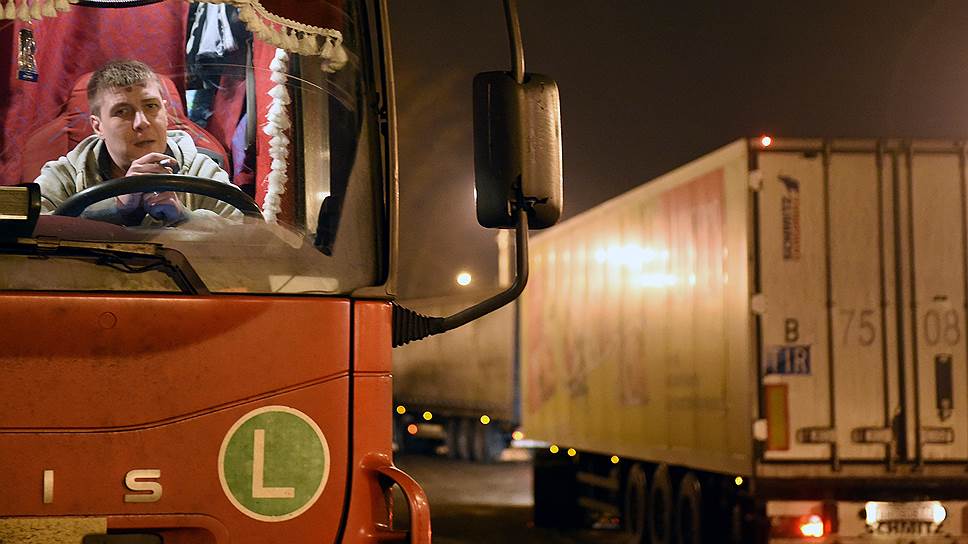
Photo: Dmitry Lebedev / Kommersant

A roadside cafe chockablock with truckers is an ordinary sight for those who travel federal highways at night. But this time the setting resembles a black-and-white Soviet film about revolutionary sailors and striking railway workers. Several drivers sit at a table in the corner and noisly discuss where protesters set out for Moscow and where they got stuck. The situation is aggravated by the fact that the protest has no unified leadership, truckers from different cities do not know each other, and communications between individual convoys have to be established right now.

Mysterious phrases break through the buzz of the conversation.

“What is Basil saying?”

“Where is Oversize Lyokha?

“How is Platform Trailer Vadim?”

“He says he has thirty platform trailers behind him.”

“We are confused ourselves,” gaily remarks Viktor to universal laughter. “We are confused about the highways, the days of the week, and about life in general.”

Communication between the convoys is maintained by  delegates, trucker drivers who have got behind the wheel of passenger cars to get past the traffic police posts.

“Andryukha traveled to the Don Highway and talked with the groups [of truckers] parked there. In some places there were a hundred trucks, in other places, thirty,” explains Vova, a well-built man in a sweater. “We have to get the lay of the land, to understand how many trucks in all are planning to convoy and what people’s moods are. Meaning the protest movement is looping back on itself. Tonight, everyone should be on the line so that the coordination is tighter the closer we get to Moscow.”

No one knows the exact number of protesters involved, even the date is still under question, but all the truckers know what they have to do: get to the Moscow Ring Road on Saturday, get into the far right lane, and reduce speed to the minimum allowed.

“Picture this. At the same time, we drive onto the ring from different directions and take up positions in our rightful lanes, one and two,” describes Vova, his eyes blazing. “And our Moscow activists switch to passenger vehicles and driver alongside us in lanes three, four, and five. You thus end up with a giant snail: five lanes on the Moscow Ring Road in both directions. And in Moscow, two such snails are enough for everything to short circuit and grind to a halt,” he says, smiling proudly.

The truckers do not know what they will do next.

Heavy Duty Arithmetic

The date when the snail was to crawl on the Moscow Ring Road has been postponed several times. Now the truckers have seemingly come to a final agreement. On Thursday (December 3, 2015) at noon, they will watch President Vladimir Putin’s speech to the Federal Assembly.

“This whole time, nobody has reported about us and our demands, neither Channel One nor NTV,” Victor says with resentment in his voice. “Only the Internet has written about us, but radio and TV have been silent. We are waiting for the address in order to see whether Putin knows about the problem or not, whether he intends to do something or whether we are ‘uninteresting’ to him.”

“I think he doesn’t decide such issues. It is all done for him. Well yeah, the Rotenbergs are his friends. But the law was passed while Medvedev was still president, and he signed this ‘rubbish.’ Maybe Putin just does not have all the information,” says a young driver, a little haltingly.

Photo: Dmitry Lebedev / Kommersant

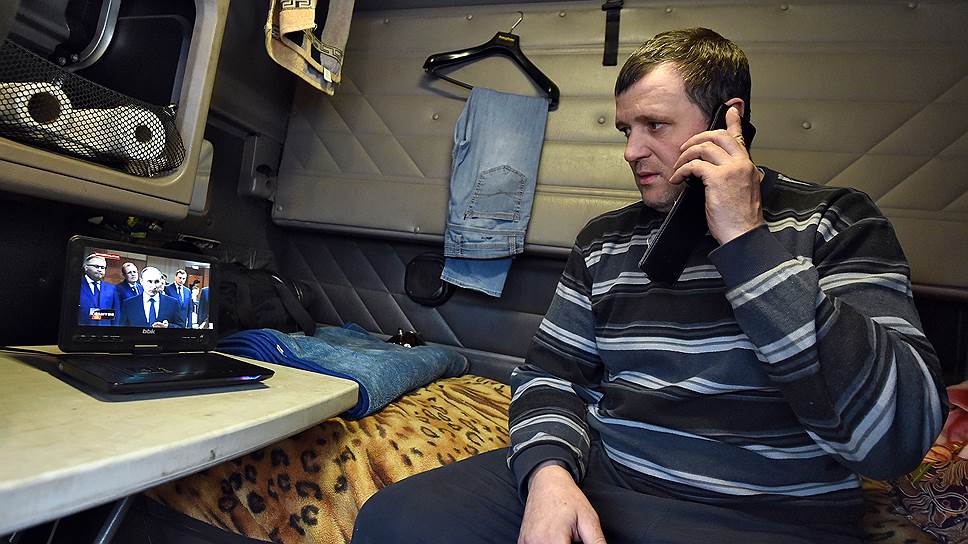
“Personally, I am fed up with this uncertainty,” wearily says a very thin young man with close-cropped hair as he approaches the table. He is Alexander, a convoy delegate who recently returned from Rostov. It is evident he can barely stand on his feet from lack of sleep, but he shakes hands with everyone and sits down at the table.

“Putin should say it clearly: pay, guys. That is what we have decided and we are not going to change it. It would be good if he came out to the people and told them straight in the eye.”

“And then what?”

“Then I’ll sell my truck, pay off my loans, and go live in some other country.”

Currently, Plato charges 1.53 rubles per kilometer, but beginning in March of next year this rate will double, to 3.06 rubles per kilometer. Self-employed truckers are completely certain that the new toll system will bankrupt them within a few months. To prove this, they discuss their incomes and expenses in detail, citing figures.

“Well, look. A freight run between Petersburg and Moscow costs 36 to 40 thousand rubles. This is considered a very good rate for a round-trip run,” says Viktor. “But almost 20 thousand rubles of this sum goes for fuel. The exact figure depends on the truck. European trucks use less fuel; American trucks use more. Russian trucks use even more.”

On the road, truckers need to fuel up themselves.

“You can see yourselves what the prices are like in the cafes. You go into eat and you spend no less than 300 rubles, sometimes a whole 500 rubles. You run up a food bill of no less than two or two and half thousand rubles during a run.”

A run lasts from three to five days. Moscow is closed at night to trucks, so they often have to idle on the approach to the capital.

“As a result, I have one, at most two runs a week,” says Viktor. “Excluding fuel and food I make 16 to 18 thousand rubles per run. And that is if nothing has broken down on the road. It can happen that you run over a piece of metal and burst a tire. Then you hand over that 18 thousand for repairs. You haven’t been home for an entire week, and you show up with no money.”

In addition, there are monthly expenses on routine maintenance of the truck—topping up the oil, making small, preventive repairs—whose costs come to about 20% of the fuel consumed over a month.

“I also pay 40 thousand a year in motor vehicle taxes,” the drivers says, bending his fingers. “Plus around six thousand for insurance. And I am registered in Novgorod Region, where the rates are tiny. Vovka pays twice as much in Leningrad Region.”

Vovka nods in agreement.

“And there is the excise tax for fuel, seven rubles a liter,” continues Viktor. “And I also have to pay for vehicle inspection, tire replacement, and all expendable supplies. We all here are just barely earning the minimum, and they are trying to finish us off with a new tax.”

According to Viktor, he puts between 100,000 and 150,000 kilometers a year on his truck.

“Next year, the toll will be 3.06 rubles [per kilometer],” the trucker reminds us. “So I will have to pay at least 400 thousand rubles [approx. 5,500 euros at current exchange rates] to the Rotenbergs. Meaning to Plato.”

Photo: Dmitry Lebedev / Kommersant

The truckers have no idea where they will get the money. Officials at the Ministry of Transportation have tried to persuade them that their wallets will not suffer because their customers will end up paying the difference.

“Yeah, the customer will pay me more, but he will raise his prices. I will go into his store and pay more,” says Viktor, shrugging.

In addition, the Ministry of Transportation has not taken into account the fact that truckers have to run empty for many kilometers.

“I live in Novgorod the Great. It is a small city. We have nothing to transport,” says the trucker. “The largest freight turnover is between Moscow and Petersburg. For me to get to a customer in Petersburg I have to travel 200 kilometers, mileage I pay out of my own pockets. Dropping by home is 200 kilometers there and 200 kilometers back. And so it goes every time.”

“I am from Tver. We have work for a fifth of our drivers at most. Everybody else goes to Moscow or Petersburg,” confirms the man sitting next to him at the table.

“Listen, but even if you are traveling empty, you are still damaging the road, no?” I ask.

The truckers eye me suspiciously. Stating that trucks have negative impact on the road surface is a grievous heresy to them.

“Look at the ring roads in Moscow and Petersburg,” they argue. “Cargo vehicles are forbidden from driving beyond the second lane. So what is the lowdown? In the left lanes, where only passenger vehicles travels, the ruts are much deeper and the bumps bigger than in the lanes where trucks travel.”

“And most importantly, what are we paying for?” asks Alexander. “I traveled though Totma just now, the snow was coming down, and they were putting down asphalt? Right under the snow, can you imagine? And they are demanding money from us for this.”

And yet the drivers point out that Platon will be a blow not just for them but for all of small business. Alexander quietly tells us about a small furniture factory  in Saratov owned by three young men his age. The factory used to send three truckloads a day to stores in Moscow and Petersburg, but in recent months, they have been sending three truckloads a week.

“They say that because of the crisis all their supplies have become more expensive,” recounts Alexander. “The parts and the leatherette are from China, their furniture has become more expensive, and people don’t want to buy it at the new prices.”

If the factory now has to pay its driver an additonal five or six thousand rubles for each run, it will simply go bust.

“And it is local people who work there, not Uzbeks. I have talked to them. They make 40 to 50 thousand rubles a month, good money. I went into the cafeteria, and there you can eat for fifty rubles, without a markup,” says Alexander. “Who is going to win if the factor closes and dozens of people lose their jobs? Who wants that?”

“That is why we private drivers are so worried< he says, turning to me. “We see our customers, talk with them, and realize that many of them will just not be able to cope. This road toll will finish them off.”

Photo: Dmitry Lebedev / Kommersant

“Well, what are we all going to do?” Viktor asks angrily from the other end of the table. “My daughter is five months old. My wife is taking care of her and cannot work for now. And my wife has a problem with her milk, she has been underfeeding her. We have been buying dry milk now. A can costs 1,200 rubles and lasts for a week. Figure out how much that comes to for a month.”

“I don’t mean this is such an unbearable amount,” he continues with such fervor it immediately becomes clear that this is big money, why hide it? “But it’s another fifteen hundred for diapers. Then it’s something else, and something else again. Now it’s this Plato,” he says angrily. “What am I supposed to? What are we supposed to do now? Where do we go? To be honest, all we know how to do is drive trucks.”

The other truckers look at him in silence.

An eighteen-wheeler slowly passes the window.

“There is another one driving under the black flag,” someone at the table scornfully utters. “Profiting at our expense, the bugger.”

Due to the fact that some drivers are involved in the protests, there has been a deficit of free trucks in recent weeks. Customers have begun offering two times as much for runs, and many private drivers have gladly agreed to haul their goods. But, in order to save money, they also have not installed the Plato system. The striking truckers regularly ridicule them on CB radio, but they prefer to remain silent.

“Well, so what should we call them?” one of the drivers asks me indigndantl. “Strikebreakers? What kind of breakers are they? They’re out-and-out ‘reptiles’ is what they are!”

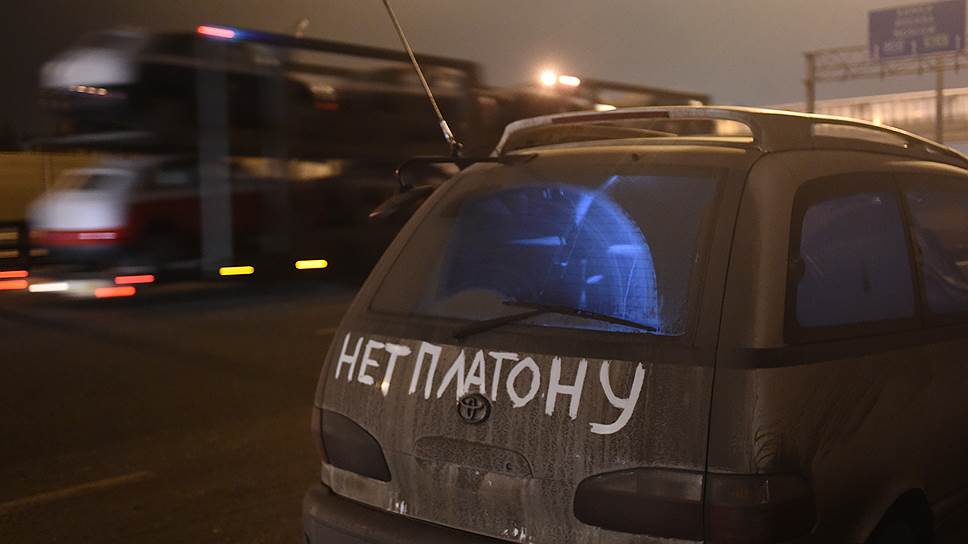
“No to Plato!” Photo: Dmitry Lebedev / Kommersant

Viktor recounts how he recently quarreled with his father-in-law, who is also a truck driver, but said that resistance was useless and installed the Plato system.

“The war hadn’t even begun, and he had already surrendered,” said the driver, outraged. “I told him so. I said, ‘You are my enemy, and I don’t want to know you.”

“You remember how Stalin didn’t free his son from the Germans?” Victor asks unexpectedly. “Well, I thought that if Stalin did not spare his son, then why the hell did I need such a father-in-law. The boys here with me, they are my family.”

The Road to the Moscow Ring Road

Late at night, most of the drivers disperse to their trucks to sleep. Those who are participating as passengers stay up to drink with stringer photographers who have shown up from somewhere. The whole time well-built men drink vodka sourly at the next table. Suddenly, one of them approaches the drivers and screams at a photographer, allegedly, for taking a picture of him. The situation becomes heated instantly. The strangers began pushing and challenging the other men to “come outside and talk.”

“They look like titushky,” says one of the truckers. “We saw them today. They were hanging around that car that has been following us. Now they’ll start a fight, and the cops will show up and detain everyone.”

“No, they’re just drunks,” his comrade disagrees with him. “But it’s unpleasant all the same.”

A fight has already begun outside, and the drivers advise all outsiders to leave the cafe until morning. We go to warm up in the truck of Valera, a calm 49-year-0ld man who proudly tells us he has been driving big rigs since 1987.

“Take off your shoes and come in. We’re going drink tea now,” he cordially invites us into the cab of his truck as if it were a flat.

Hearing about the drunken comrades, he shakes his head disapprovingly.

“We are already losing soldiers on the way to Moscow.”

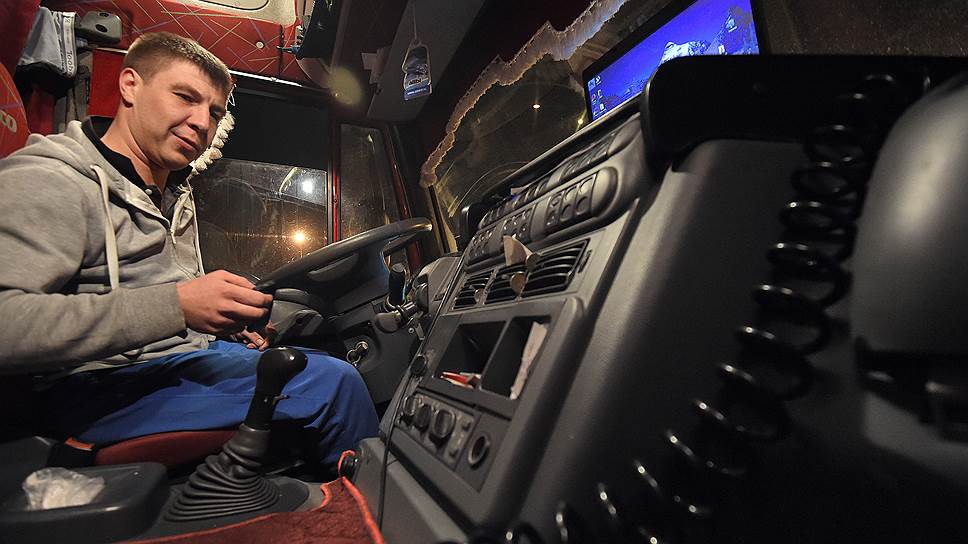
Valera ignites a small burner and puts a tiny metal teapot on it. As the water heats up, we thaw in the warmth and inspect the cab.

Photo: Dmitry Lebedev / Kommersant

“I’ll have to sell the truck now,” the middle-aged driver says softly. “Although who wants it? I’ll get kopecks for it. Yes, it’s old, but I bought it that way on purpose, then repaired it myself. I am good with my hands.”

I ask him why private truckers would rather leave their jobs than work for a haulage company.

“A comrade of mine worked for a company. He made 50 thousand rubles a month,” Valera drily replies. “Only he spent one or two days at home a month. He gets back to Petersburg from a run, leaves his truck at the boss’s lot, gets on a commuter train, rides seventy kilometers, spends the night at home, and in the morning gets a call telling him to come in right away. Is that a life? I cannot take that anymore, I’m too old. And nobody can take it. That is why almost 80% of long-haul drivers are private drivers or tiny individual entrepreneurs who own a couple of trucks.”

We drink hot tea as Valera unfolds the sleeping berth.

“We all realize, of course, that the government suddenly needed money,” he says as we part. “We have got the turmoil in Syria, and missiles also cost money. But MPs should find other reserves to pay for this, not pay for it at our expense.”

In the morning, the drivers sleepily gather for a smoke next to their trucks.

“Policemen approached us last night and warned that everyone would be stopped at the nearest Road Patrol Service post and charged with extremism,” one of them grimly recounts.

“Come on, he was pulling your leg. What kind of extremists are we?” a comrade responds to him incredulously.

“Well, maybe he was kidding, but it is unpleasant in any case,” concludes a third driver.

While the drivers gather in the cafe, where they have planned to watch the president’s speech together, we drive to a Road Patrol Service post.

“We are not looking for any extremism here,” the police commander answers firmly as his subordinates snatch trucks and semis from the stream of traffic with waves of their batons.

“We are just in the midst of Operation Anti-Terror, and we are selectively checking all vehicles,” he explains in an official tone before adjusting a young policeman’s sagging reflective vest and walking away.

The policemen at the post copy down the license numbers and passport details of the truck drivers.

“Are you waiting for the anti-Platonists?” asks one of the policeman, unable to contain himself. “They won’t make it here. They will be stopped before they get here.”

Photo: Dmitry Lebedev / Kommersant

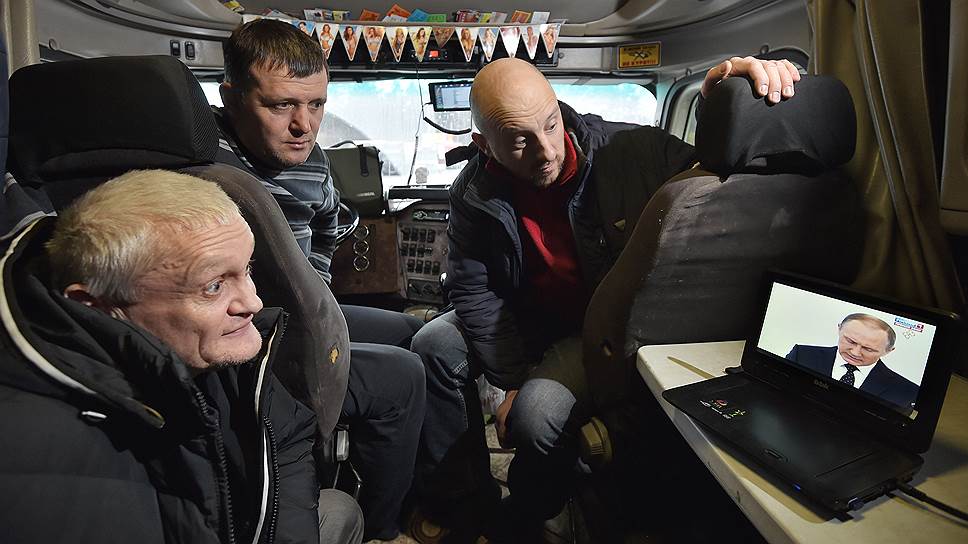
Ten minutes before the start of the broadcast, the drivers suddenly change their location and drive a couple of kilometers to the next cafe, where about a dozen truckers are already sitting. The drivers silently listen to the president. They refrain from commenting on his speech, but with each passing minute they lose more and more interest in it. When the head of state begins talking about the problems of villagers, the drivers start telephoning their comrades and discussing different routes to Moscow.

Petersburg Truckers Say No to Plato

Petersburg Truckers Say No to Plato
David Frenkel
Special to the Russian Reader
November 27, 2015

On November 24, Petersburg truckers joined protests against the new levies imposed heavy tonnage cargo trucks known as the Plato payment system, which have sparked unprecedented work stoppages and other protests by Russian truckers nationwide.

<br
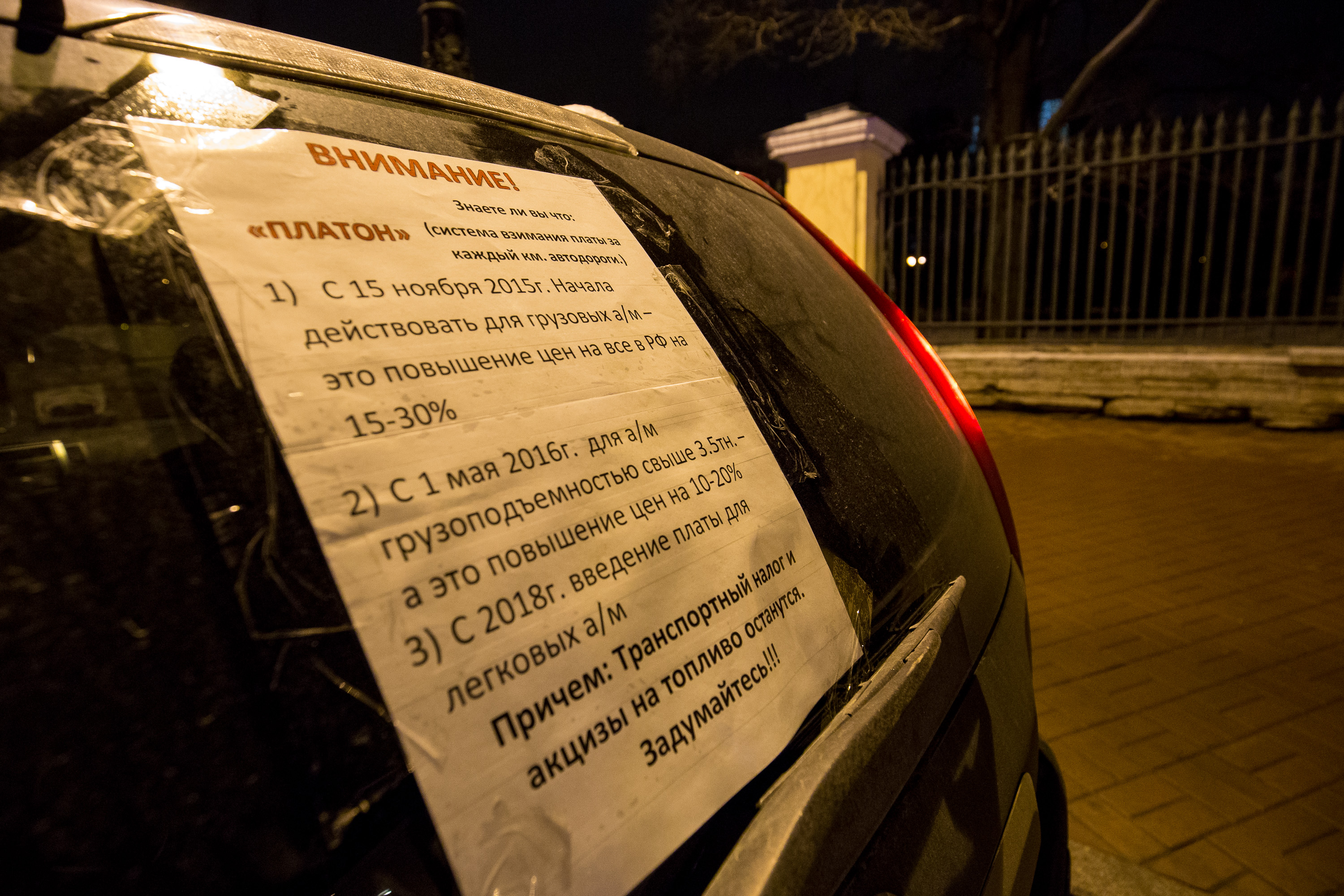
ATTENTION! PLATO (a system for charging a levy for every kilometer driven). Did you know that? 1) It went into effect for cargo vehicles on November 15, 2015. This means a 15-30% rise in prices for everything in the Russian Federation. 2) It goes into effect on May 1, 2016, for vehicles with a cargo capacity over 3.5 tones. This means a rise in prices of 10-20%. 3) It goes into effect for passenger vehicles in 2018. Moreover, the motor vehicle tax and fuel excise tax remain in effect. Think hard about this!

Alexander Rastorguyev, leader of the TIGR (Association of Go-Getting Russian Citizens) movement, and Sergei Gulyayev, an ex-deputy of the Saint Petersburg Legislative Assembly, both known for their opposition politics, inspired local truckers to launch a “snail” protest convoy.

gulyayev and rastorguyev
Sergei Gulyayev (left, in black) and Alexander Rastorguyev (right, in yellow vest)

The truckers took off in two separate convoys on parallel streets, Moscow Highway and Sofia Street, at 11 a.m. Shortly afterwards, another group of trucks joined them, increasing the number of slowly moving trucks to three hundred.

The truckers held a spontaneous rally on Sofia Street, where Rastorguyev urged them to keep driving to the Smolny, Petersburg city hall, where the authorities would “listen to them.”

During the rally, a tire was set on fire, an obvious reference to the Euromaidan protests.

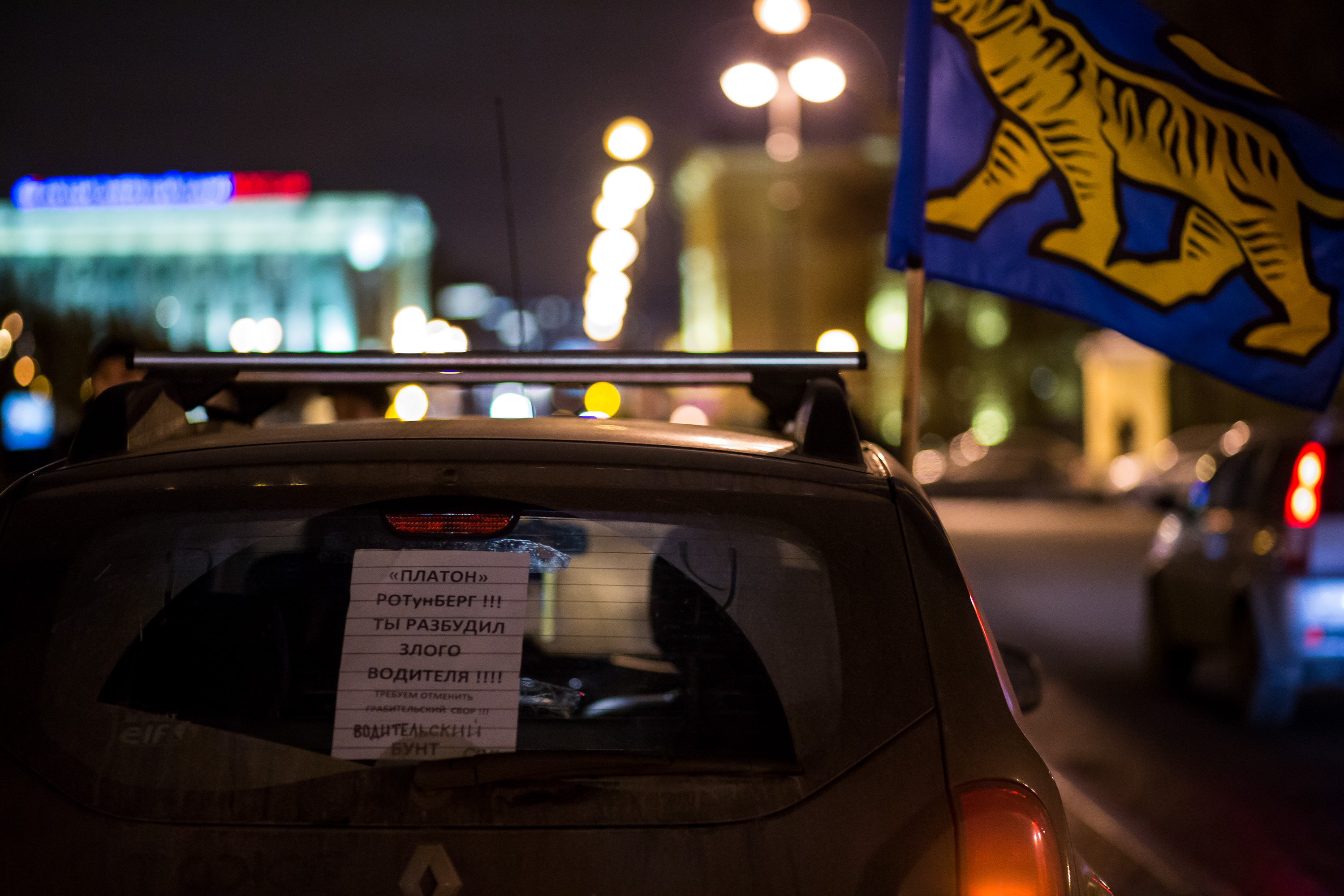
The truckers slowly moved onto the Petersburg Ring Road, paralyzing traffic in the streets. The convoy was led by a group of cars plastered with anti-Plato posters. Traffic police regularly stopped the drivers, although no one was detained.

IMG_2704
“‘Plato’ Rotenberg!!! You have aroused an angry driver!!! We demand that the extortionate levy be abolished!!! Driver mutiny”

While the truckers made their way to the Smolny, authorities negotiated with protest leaders. The authorities warned the trucks would paralyze the downtown and suggested that truckers choose six delegates to negotiate with a deputy governor in his office another part of the downtown.

The truckers, however, did not want to elect delegates. They wanted a meeting directly with authorities at the Smolny and as an entire group.

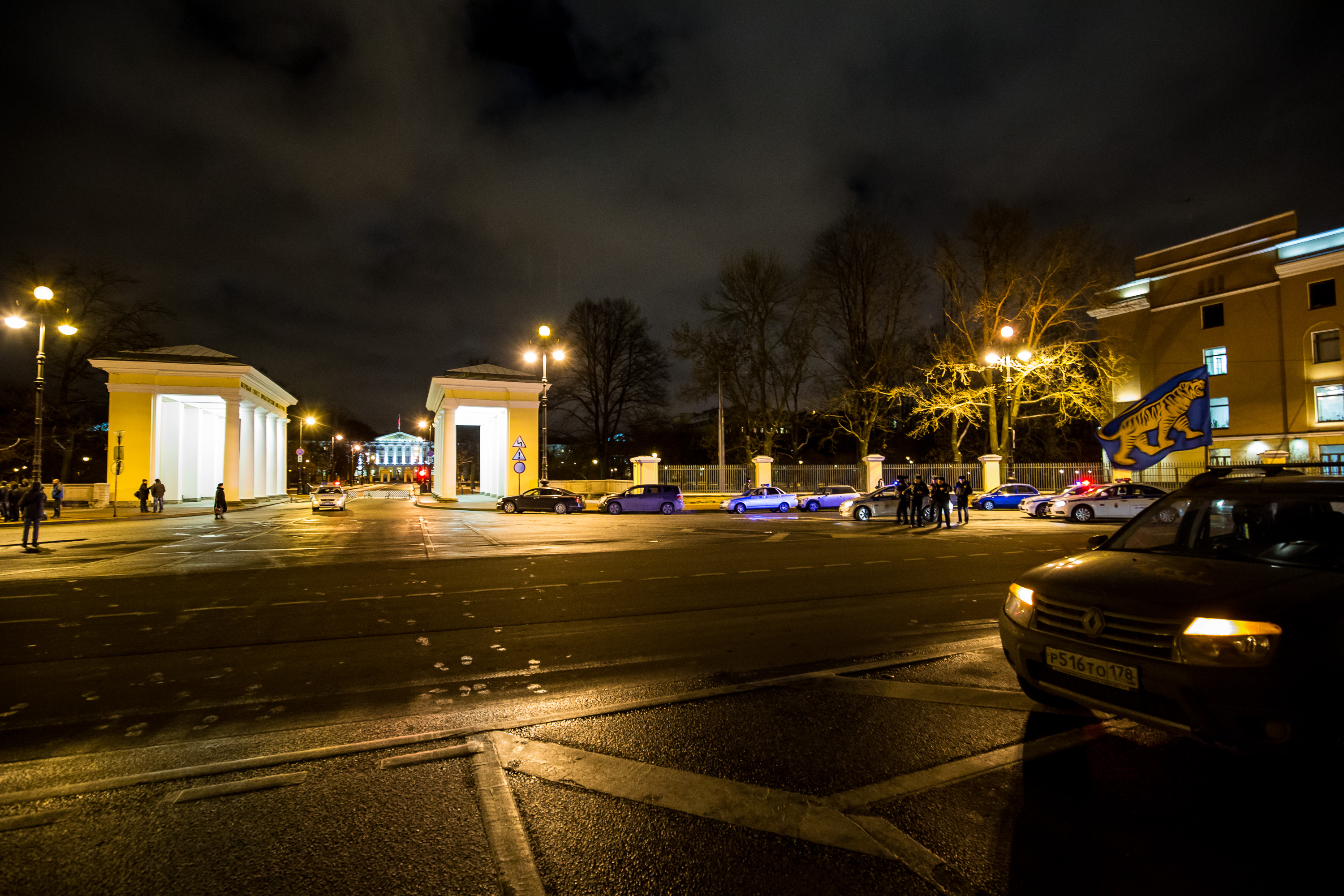
Around thirty truckers finally reached the gates to the Smolny, although they had to leave their trucks on the other side of the Neva River. They gathered around the entrance and waited for officials to come out and negotiate with them. They waited in vain.

The gates to the Smolny, Petersburg city hall

They stood and talked among themselves for about an hour until police arrived. A police officer demanded they disperse and organize a legal rally instead. Claiming they had not “come for a revolution,” they decided to give the authorities a chance, promising to organize a snail convoy to Moscow if their demands were not fulfilled in the coming days.

IMG_2834

All photos by and courtesy of David Frenkel

Read my previous posts on the new Plato cargo haulage levy system and protests by Russian truckers:

Striking Petersburg Truckers: “If the Politicians Think We Are Disorganized Louts, They Are Wrong”

Striking Petesburg truckers Oleg Krutskhikh and Alexei Zhatko

“Soon the whole country will work for the Rotenbergs”
Antonida Pashinina
November 25, 2015
Rosbalt

Long-haul truckers have continued their protests against the Plato system in Russia. Truckers are outraged by new tolls on federal highways and are determined to have them abolished. In the Northern Capital, drivers got all the way to the Smolny [Petersburg city hall], but a dialogue with the authorities did not take place there. Private entrepreneurs and veteran truckers Oleg Krutskikh and Alexei Zhatko told Rosbalt about why they are willing to fight to the last, what they will do in the event of failure, and what their families think about their protest.

How did you start working as truckers?

Oleg: I began driving when I got out of the army, in 1998 or 1999. My dad was a driver, and I followed in his footsteps. You know how it is: army brats are drawn to the army. Well, sons of truckers are drawn to trucking. First, I drove a KamAZ, then a MAZ. I am from the Voronezh Region. In the 2000s, my family and I moved to Petersburg. I spent ten years behind the wheel of cargo trucks, then I became an entrepreneur, although I have kept driving myself.

Alexei: I am originally from the Stavropol Territory. I moved to Petersburg in 1999. I moved my father here. He is a trucker. At first, I worked as a dispatcher in a container company. Then I took a truck from this company to break in. I put Dad behind the wheel, and he went to work. Then I started to drive myself and I bought several trucks.

It was profitable to work in freight haulage then, right?

Oleg: Yes, in the no-holds-barred nineties and noughties, you got paid in cash in dollars. A round trip within the city cost $100, to Moscow, $850–950. Then we were forced to legalize, which was the right thing to do. We started paying taxes. We became self-employed entrepreneurs or turned our operations into limited liability companies. Until 2008, we did more or less all right. We made enough to pay for fuel and pay our drivers. The oil flowed abroad, and the government had enough money both for itself and for people, to throw them some bones. Then the dollar rose, the price of spare parts soared, and there was less work. Depreciation amounts to a lot of money in Russia, and you are left with peanuts. Basically, we cannot afford to replace our vehicle fleets.

Alexei: From 2002 to 2008, when the tax system was semi-gray and payments were made in cash, I bought trucks. I had eight of them. Subsequently, every year I would cut one truck to be able to repair the rest. Now I have one heavy transport truck left. I used to have these issues. I would drive to the service center and they would replace all the bad parts. You won’t believe me, but now I know which city and which demo yard has the cheapest spare parts. What is a demo yard? A place that sells used parts. That means we are not running 100% safe on the road anymore. Even if a part has 20% wear and tear, your safety is lower.

Oleg: The point is that incomes have fallen almost to zero. Basically, [the authorities] want to take the shirt off our backs, but we are refusing to budge. We are not earning anything nowadays. We have ground to a halt and are idling.

Have you been involved in the protests for long?

Oleg: Since November 11.

Alexei: I was out of town for two months. I left in August, and when I got back these new developments had emerged. I was forced to leave the truck in Krasnodar and fly here. It was cheaper. I have not worked since November 15.

The stance of the authorities is clear. Long-haul truckers must pay the damages the big rigs cause to federal highways.

Alexei:  I really do not understand this. If the permissible weight is forty tons, how can I cause damage to roads? I pay motor vehicle tax and excise duties. I cannot cause more damage than is stipulated by the State Standards. But I am told that I cause more damage than I should anyway.

Nobody knows how the motor vehicle tax is spent. Take a look at our roads. The M10 from Petersburg to Moscow is more or less okay. The M7, to Tatarstan, is good, and the M4 is not bad. There are no other [decent] roads [in Russia]. Take, for example, the M5. The section from Syzran to Penza is a disaster. From Samara almost to Ufa there are two hundred-odd kilometers that we travel at a snail’s pace. And then they say they are closing the highway because it has drifted. In fact, they just do not plow the road, and traffic moves slowly. You cannot climb hills or get up to speed. So the authorities decide to close the whole thing. It is easier for them.

Oleg: Or take a look at how much the toll roads cost. They have now opened a road near Vishny Volochyok to Moscow. It is 920 rubles one-way, meaning nearly 2,000 rubles round trip [approx. 28 euros]. The toll on the M11 is 1,200 rubles. So a round trip has gone up by 4,000 rubles. And I have not figured in the tolls on the Western High-Speed Diameter. Plus, the Plato system costs around 2,000 rubles until March, then it will cost 5,000 rubles. The rise in expenses due to toll roads will come to around 9,000 rubles. That is a 25% increase.

Look, a 25% rise in freight haulage costs means that all the prices in the shops will go up. Old ladies and pensioners will bear the brunt. I think the authorities are keen to put tolls on absolutely all roads. For example, Leningrad Region Governor Drozdenko said that regional roads should be toll roads, too. They have gone after the truckers first, because we could be accused of damaging the roads. If they imposed this law on all drivers at once, it would not be just us who were out protesting. Others would come have out as well.

Do you think the authorities were afraid of mass protests?

Oleg: I think they wanted to get us to this point stage by stage. At first, they will work out the bugs on us, and then gradually incorporate everyone else.

It will come to the point where drivers of passenger cars will pay the duty as well. If we do not squash it and stop it, the entire country will work for the Rotenbergs. The burden will fall on everyone’s shoulder. We will be like slaves. They will legally be able to use us.

Alexei: Try and understand the trucker’s mindset. I like my job because I am as free as the wind. If I want to go Novosibirsk, I go there. Tomorrow, I might want to go to Krasnodar. It is a kind of freedom. But now they are trying to put a noose around my neck, and they can always tighten it. I find myself in Novosibirsk, for example. They tighten the noose, and I cannot make it back home. My only choice would be to abandon everything, sell the truck, and get home on some other form of transport. So I don’t want this noose. But long-haul truckers are a kind of caste who are no strangers to hardship. Our lifestyle differs little from that of a dog. We live in our rigs like a dog in a kennel. Just like a dog pisses on the wheel, so do we. So if truckers do end up moving on Moscow [in protest] that will not be a problem. Living in our rigs for a month near Moscow would be easier than pie.

You have not even tried to register on the Plato system?

Alexei: Why should I? I don’t recognize it and I am not planning to recognize it.

It would be easier for me to run my rig downtown sometime, drive it up to the Smolny ignoring all the traffic warning signs, and set fire to it.

What is the point of working under such a system? I am ashamed for the government. I used to idolize Medvedev. I used to respect him. Three or four years ago, he said that we would add a tax of seven rubles to the price of fuel and abolish the motor vehicle tax. I was really happy about this. I thought, let it be that way. I did not quite get it, but it would be simpler for me than running to the state savings bank all the time to pay the taxes and fees. But how has it all turned out?

Now they are promising to reduce the fines, but there is not a single regulatory document backing this promise up. You phone Rosavtodor (the Russian Federal Road Agency), and [they tell you] the rates on the Plato website are still in effect. How is that? My idol Dmitry Medvedev says one thing, but something else happens. This has political implications. But still, it is painful, what can I say.

I understand that you don’t want to associate your protests with politics?

Oleg: This is our life. We are fighting for it, for the lives of our families and their families.

Alexei: We don’t need revolutions and upheavals, because there are problems after all upheavals, and the economy will have to recover. There won’t be any work, and the country will suffer from poverty. We don’t want that.

And what is the difference? One group of people is now in power, then people just like them will take over. The only thing I do not understand is why a barrel of oil cost eight dollars in the 1990s, and now it costs over forty dollars, but we still do not have enough money. And why in the 1990s, if someone in the government admitted his mistakes, he offered his resignation, but nowadays an official who has goofed up big time says, “Well, that didn’t work out. Sorry, but I am going to keep working.”

Oleg: And what happened with [former Russian defense minister] Serdyukov? How could you, guys? They spit in the country’s face. If they spit in the Investigative Committee’s face, who are we truckers? I won’t be surprised if [the powers that be] do not react to us at all, if they just have the riot police crush us.

You think they could start cracking down on the protests using the riot police?

Oleg: For now we are being treated more or less decently. Time will tell.

What is the news from the field? Do you know anything about how the events have affected businesses in Russia?

Alexei: The first [city] to sound the alarm has been Tyumen. They produce their own bread and milk, but everything else is shipped in. The produce will not last long. In Volgograd, a glass factory has temporarily shut down. But here I am thinking: many factories are certainly owned by politicians, by MPs. Ordinary people would not own them. And this is a blow to the owners. So while we are not driving, there should be some movement on the part of our rulers.

According to my information, there are four ferries at a standstill in Novorossiysk, and New Year’s is around the corner. In Derbent, there are many train cars loaded with persimmons, tangerines, and pomegranates that are not going anywhere. They simply have nowhere to offload the produce there. The persimmons arrive there in ordinary heated freight cars and cannot be stored for long. I think if we continue the stoppage, then it will not just be a protest—

But a strike, rather.

Alexei: It is a strike. We cannot go back on the roads. We have been cornered. If things go on like this, it will be worse.

Approximately how much do you pay in taxes per year?

Oleg: I did the calculations for seven trucks. We burn through about 30 tons of diesel a month. Multiply that by 7 rubles, and it comes to 210,000 rubles a month, or two and half million rubles a year. Plus there is the motor vehicle tax and the taxes for individual entrepreneurships and limited liability companies. All in all, it comes to around three and a half million rubles [approx. 50,000 euros]. Meaning that if Plato goes online, we will probably bite the dust, and the treasury will come up three and a half million rubles short. If you do the math, that amounts to good pensions for twenty-eight old ladies or tiny pensions for fifty old ladies. So all those old ladies will lose their pensions. The people who work for me will end up at the unemployment office, and the state will have to cut them unemployment checks.

The truckers have shown all Russians a great example of solidarity. Basically, people from different parts of the country have united to fight for their rights.

Alexei: Despite the fact that the media have been blacking us out, all of us—our groups of drivers and our dispatchers—have been getting the message out. I have lots of dispatchers who have been explaining to customers that they are not going hand over loads to anyone, because we are all in solidarity, because each of us has his trucks out there. When I was driving from Novorossiysk to Krasnodar to store my truck in the lot there, a traffic cop stopped me. He asked where I was going. I explained I was going to a lot, then flying to Petersburg.

That was a traffic cop who asked me. What does this tell us? That the traffic police, too, probably have their own trucks out there or friends and acquaintances. They support the truckers, but they have their orders. I myself am a former military man. Everyone understands everything perfectly.

As far as I know, the police have so far not been actively hindering the protests. In Petersburg, for example, the protesters got off with small fines.

Alexei: No, their objective is to break up the convoys of trucks.

Are you not afraid of provocations?

Oleg: We got together to figure out how we would run our protests, and there was immediately news on the web that Oleg Krutskikh was an accomplice of Navalny and all. Someone started writing to truckers that there would be no protest, that it had been called off. A specific agency is working against us.

Alexei: People get SMS alerts that a protest will not take place. That so-and-so works for Navalny and is trying to start a commotion.

What do you think about United Russia MP Yevgeny Fyodorov’s statement? He said you were protesting “at the behest of the United States.”

Alexei: That is insane. Perhaps the man has some problems. Maybe he reads too much about America. There is no trace of commonsense audible or visible in what he said.

Oleg: I would like to appeal to you as a member of the media. 80% of the news is about Egypt and Syria. Guys, we have so many problems in our own country that at least 95% of the population could care less what is happening abroad. Only the 5% who have business abroad care. I have a huge request for you all: tell us, the 95%, about Russia. When things have been put to right in Russia, maybe you can tell us about life in other countries.

Alexei: I guess then it will be difficult for someone to raising his popularity rating. Showmen dominate politics in our country. More than anything they want good ratings, not to solve the major problems within the country.

I really am unconcerned about what is going down in Donetsk when I have nothing to eat at home. I have to feed my own people. I have two children, after all. I have been shut down for two weeks, and I realize that my wallet is empty.

Will your reserves last long enough to keep off the road like this?

Alexei: It doesn’t matter. We will go take out a loan then. Clearly, we won’t be able to pay it back. But we do not have much of a choice. We have to live.

So you are going hold out to the last, then?

Alexei and Oleg: We will hold out to the last. We have nothing to lose. We cannot go back out on the road: we will be fined.

How have your families reacted to your involvement in the truckers’ protests?

Alexei: My family has never been involved in politics. My spouse, although I do not share information with her, sees and understands everything perfectly well. She is a speech therapist and a teacher, who gets paid no more than fifteen thousand rubles a month [approx. 215 euros]. Yet she tells me I should quit this business. But I cannot quit my job. This is a lifestyle.

Oleg: It would be hard now to retrain to do some other job. As for the protests, my involvement has been spontaneous. They say I am an activist. I am no activist. I am just someone who generally likes the truth.

Everyone now involved in the protests are activists.

Alexei: Yeah, take any trucker. Any of us can be slapped with the charge of organizing a protest. Because all of us are on the telephone communicating.

We exchange telephone numbers at our encampments, and that has united us even more. But we have no leaders. All of us are organizers. We agree to meet by calling each other. One person passes the information on to the next person. The radio is our mass medium. All of us could be locked up as organizers.

In Dagestan, for example, it is not just Dagestanis who are attending the protests, but people from different regions. The guys at our encampment in Novorossiysk snapped and took off for Dagestan, because they knew it would be the hottest spot. That is how fast information spreads among our lot. And if the politicians think we are disorganized louts, they are wrong, although that is what many of them are saying.

Translated by the Russian Reader. Photo courtesy of Rosbalt

“Rotenberg Is Worse than ISIS!”: Russian Truckers on Strike in Dagestan and Elsewhere

“On November 30, we will go to Moscow and shut down the Moscow Ring Road!”: Major protests by truckers in the Caucasus
Irina Gordiyenko | Dagestan
November 22, 2015
Novaya Gazeta

A major protest by truckers is taking place in the Caucasus. Officials are trying to ignore it, and in response truckers are threatening to move on Moscow 

“No to Platon! On November 30 We Block the Moscow Ring Road.” Photo: Irina Gordiyenko/Novaya Gazeta

Strikes by truckers against the introduction of a new road tax have swept across Russia. The biggest of them is still underway in Dagestan. Hundreds of truckers have lined up along dozens of kilometers of highway. Manas, Khasavyurt, Kizlyar, and Kayakent are the spots where people have been striking for a week. The protests have been ignored. Officials have avoided contacting the strikers, while television has refused to cover the strike. Amateur videos posted on the web are immediately removed and their users blocked.

The strikers are determined. If their demands are not heard, they intend to move on Moscow on November 30.

The roadside of the Rostov-Baku M29 highway near Khasavyurt looks gaudy at the moment. Trucks with yellow, red, blue, and green cabs are parked in two tight rows next to each other. The trailers are hung with enormous posters reading, “Hands off long-haul trucking!” and “Stop robbing the people!” The chain of trucks stretches for dozens of kilometers, and at any moment the annoyed truckers could block this federal highway.

“We don’t want to do it,” says Dibir, a trucker from a small village nearby. “We know it will be violently dispersed. But they don’t want to hear us. We went to the city administration, to the Ministry of Transportation, and to Rosavtodor (Russian Federal Road Agency). They wouldn’t even let us in the door. We called the TV channels: they have refused to come cover us. Instead, they sent in trucks of riot police.”

An excited crowd of around two hundred people stands around an improvised stage. From time to time, someone mounts the stage to appeal to the truckers not to give up and stand their ground.

They have been here for five days. They sleep in their cabs, cook their own food, and during the daytime they welcome the growing number of colleagues who have been joining the strike. They are no strangers to hardship. They have been tempered by runs on rough roads lasting many days.

As of November 15, vehicles weighing over twelve tons are charged an additional fee for each kilometer of federal highway they travel. The government issued a decree setting the fee at three rubles six kopecks per kilometer. The new system of taxation has been dubbed Plato. In effect, truckers (or trucking companies) are obliged to register with Plato and choose one of two methods of payment. They can either buy a special onboard device that counts the kilometers of federal highway they travel and then calculates the fee, or before each run, they can buy a detailed route map from the company running Plato.

If they refuse to pay, individual entrepreneurs can be fined 40,000 rubles [approx. 580 euros]; legal entities, 450,000 rubles [approx. 6,500 euros].

In the best case scenario, you can make forty to fifty thousand rubles per run,” says Dibir. “The [new] tax adds an additional fifteen thousand rubles in costs. What are we going to live on?! We are not on the Forbes list.”

All Russian truckers now know about the Forbes magazine list of Russia’s wealthiest people and the spot occupied on the list by Arkady Rotenberg.

The surname Rotenberg is now quite popular in Dagestan. Posters bearing it can be seen all along the the M29, for example, “Rotenberg is worse than ISIS” (a terrorist organization banned in Russia) and “Russia without the Rotenbergs.” Every trucker now knows that billionaire Arkady Rotenberg is a friend and supporter of President Putin, that Arkady Rotenberg has a son named Igor Rotenberg, and that Igor Rotenberg owns a little company that mysteriously signed a contract with the government farming the new federal transportation tax out to this private company.

Truckers are not only the people who haul loads from their own regions to other regions, for example, Dagestani cabbage. (There are several districts in Dagestan that traditionally cultivate green cabbage on an industrial scale and then supply it to other parts of Russia during the winter.) Truckers are one of the foundations of the Russian produce economy.

Watermelons, tomatoes, onions, aubergines, pomegranates, and oranges: all this produce is brought from Iran and Azerbaijan, and the geography of further transshipments covers the entire country. For example, Dagestani truckers literally “pick up” and transport the entire harvest of Krasnodar Krai, Stavropol Krai, Astrakhan Region, and Volgograd Region to other parts of the country. They supply the major markets of Moscow and Saint Petersburg with produce.

“We are in the fifth day of our strike. Around three hundred train carloads of persimmons have piled up on the Azerbaijani border, right in the middle of the fruit’s season,” one of the strikers explains to me. “Three hundred train carloads is nine hundred truckloads that we should have delivered to Russian markets. Instead, the produce is spoiling. Take a look at how much persimmon prices skyrocket now.”

“Rotenberg is worse than ISIS.” Photo: Irina Gordiyenko/Novaya Gazeta

There are over two million heavy trucks officially registered in Russia. Around half of these are registered in the south of Russia. Cargo transportation is now in the truest sense one of the most important sources of income in Dagestan, a republic of three million people.

Take, for example, the large village of Gudben. Its population is around fifteen thousand people, and it has two thousand registered trucks. The average family in Gudben consists of five people, so at least ten thousand residents of Gudben survive on the money earned from cargo runs.

“We would love to find other work,” says Guben resident Tahir, “but there is just no other work in Dagestan. This is the only way we can feed our families.”

The second major site of the trucker protests is the federal highway near the small village of Manas. Several days ago, outraged truckers blocked the highway, demanding that authorities come meet with them. The authorities did come, but incognito. They threw up their hands and left. Then they sent in truckloads of riot police, who dispersed the protest.

So far the truckers have agreed not to block the highway. They are waiting. But riot police are on duty there. Every day they detain dozens of people, charge them with misdemeanors and send them to jail for ten days, videotape the truck drivers, and rip the license plates from their trucks.

The truckers are philosophical about such methods of coercion. We will not succumb to provocations. We want to be heard, they say.

The Dagestanis have been joined in their protests by truckers from other regions.

“I cannot imagine how we will go on living. This is going to be a big blow to our wallets,” says Vladimir from Saratov.

A couple days ago, Vladimir unloaded a cargo of Sakhalin fish in Krasnodar. Hearing that a big strike was underway in Dagestan, he decided to join it.

“In other parts of Russia, the protest actions have quickly come to an end. They have been quickly dispersed. But the folks here are stubborn,” says Vladimir.

And Vladimir is not alone. Many truckers from other regions who made runs to the south over the past week have joined the Dagestanis, including Chechens. In Chechnya itself, there is a strict taboo on any protest, so they are forced to travel to neighboring regions to strike against the injustice.

“A liter of diesel costs thirty-three rubles. For example, you need half a ton [of fuel] to get to Moscow,” continues trucker Tahir. “Under Medvedev, the price of diesel went up by seven rubles and we were promised a decrease in the transportation tax. We believed them. But the tax never was decreased. And now a new tax has been introduced to boot.”

In addition to fuel, every trucker has to pay the transportation tax (around forty thousand rubles a year), insurance (around fifteen thousand rubles per run), and customs duties (if the produce hails from Iran or Azerbaijan), plus license fees and a ton of other related formalities. We should also consider that any breakdown is the driver’s responsibility. Spare parts for all trucks, whether they are Volvos or KamAZes, are expensive.

“I ran into a pothole on a dark highway in Volgograd Region. I was stuck there for a week. I paid twenty thousand rubles [for repairs]: that is about half of what I earned from the run. You cannot imagine how awful the roads are around Volgograd and Samara! And for this we have to pay more?!” relates one trucker.

But there is yet another nuance. The new road tax will inevitably lead to higher rates for cargo transportation. The truckers will be forced to include them in the cost of their services, and so prices for the goods they transport will increase nationwide.

“We do not want to do it. People here live very poorly as it is,” says the trucker Dibir. “Price have gone up at the markets in Khasavyurt. We will fight to the last. And if they do not want to hear us, we will drive to Moscow and set up camp on the Moscow Ring Road. We are used to living in field conditions.”

“Peace to the world. No to Plato!” Photo: Irina Gordiyenko/Novaya Gazeta
Translated by the Russian Reader


Further reading (in Russian):


UPDATE (?) Carl Schreck, “Road Warriors: Russia Yields On New Transport Tax After Long-Haul Trucker Protests,” RFE/RL, November 20, 2015. Thanks to Comrade SC for the heads-up