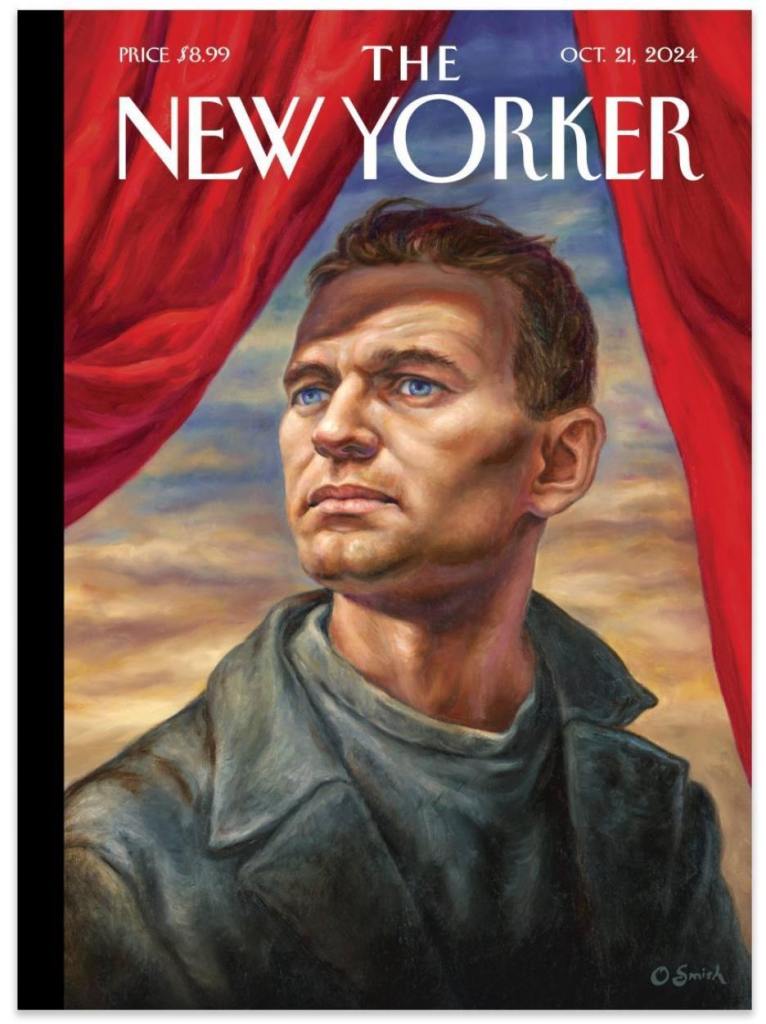
Remembering Navalny

There’s shoddy work everywhere. Even great publications suffer ridiculous failures.

This is the cover of the new issue of the New Yorker.

What ridiculous crap.

(You can probably guess who that is supposed to be.)

Source: Sergei Parkhomenko (Facebook), 12 October 2024. Translated by the Russian Reader


I wouldn’t want Navalny to be remembered the way he has been remembered this past year.

I haven’t read the book Patriot yet, but I was quite upset by Mikhail Zygar’s review of it. Zygar compares Navalny to Jesus and concludes that by dying, Navalny bequeathed us an idea that would rid future generations of cynicism and teach them to believe.

This is feeble sentimentalization, in my opinion. Navalny didn’t not dream up any particular ideas. He called for action, not faith. The meaning of his sacrifice, in my mind, is practical and political, not abstract and ideological. It can and should benefit the current generation, not some future generation.

Navalny didn’t dream up a new ideal. The “beautiful Russia of the future” is a feeble image, but Navalny understood better than anyone how tyranny operates on the mechanical level. I often complain that the FSB understands better how Russian society functions than do opposition politicians, sociologists and psychologists. Navalny couldn’t be accused of this shortcoming.

He was the only person in Russian politics who talked about power relations as a two-way street. He didn’t talk about the enormous resources Putin has, but about the fact that we give Putin power. It is not the security services, the army and the tanks that give Putin power. We give Putin power.

This view evolved over the course of Navalny’s career, becoming more and more central. As time went by, it separated Alexei more and more from his colleagues in the opposition. Toward the end of his life, Navalny’s writings centered on the idea that power consists in consenting to obedience, in “obeying in advance.” We say to ourselves: I cannot disobey, because if I don’t obey, they will (notice me/file administrative charges against me/fire me/banish me from my profession/send me to jail/kill me).

“The only fear there should be is that we leave our homeland to be plundered by a pack of liars, thieves and hypocrites, that we surrender without a fight, voluntarily, both our own future and the future of our children.”

Only by obeying in advance can governing by unfulfilled threat be scaled up indefinitely, to a country of 140 million people, because this means of governing doesn’t require any resources. We obey without taking resources from the state. Putin’s estimates for the war in Ukraine include every dollar, euro, and pound spent on Ukraine’s defense. They are what counts against Russian budgets, not “faith in democracy” or “anti-war sentiment.” I understand Alexei’s decision to return to Russia in this sense; I see it as logical and unusually tenderhearted on the personal level. By returning to Russia, Alexei was able to provide Russians with one more example of tyranny’s limits: Putin never had power over Alexei. Had he stayed in Germany, Putin’s power would have extended to Navalny.

At the end of his life, Navalny did not call for faith, he called for deeds: “If your convictions are worth something, you must be willing to stand up for them. And if necessary, make some sacrifices. And if you are not willing, then you don’t have any convictions. You just think you do. But they are not convictions and principles. They are just thoughts in your head.”

Navalny was concerned not with the thoughts in our heads, but with whether our deeds matched our thoughts. I appreciate Christian philosophy, but I could never accept the postulate that a second of faith can save a person, no matter their actions — “Now thou shalt be with me in paradise,” and so forth. The Russian opposition, for as long as I’ve been watching it, wants to get to democracy approximately the same way the thief gets to paradise — by believing in it. The notion that we are democrats and decent because we believe in democracy while all remaining Russians are slaves and awful because they don’t believe in it is the main obstacle to democracy in Russia, in my mind, and the Koshchei’s egg of tyranny. A “democracy” in which only “democrats” have a stake and which only they want is an oxymoron that makes democracy impossible and tyranny in Russia perennial. Democracy cannot be for Muscovites alone. It cannot be built via media outlets in which only Petersburg and Moscow have a voice. It cannot be built without equal representation of activists, issues, and interests from other regions and ethnicities.

Late in life, Navalny hated talk about the “freewheeling ’90s” and the good Chekists/bad democrats dichotomy, which doesn’t prevent his supporters from remaining stuck in this selfsame paradigm.

“I hate the authors of the authoritarian [Russian] constitution, which was sold to us idiots as democratic, even then granting the president the powers of a full-fledged monarch. […] I hate the ‘independent media’ and the ‘democratic community,” which fully supported one of the most dramatic turning points in our new history — the fake presidential election of ’96.”

Navalny was able to cringe at his former self: “I repeat that back then I vigorously supported all that stuff. Not election fraud, of course — I didn’t like that even then — but I did everything I could to ignore it, and the general unfairness of the elections didn’t fluster me one bit. Now we are paying for the fact that in ’96 we thought that election fraud was not always a bad thing.”

Alexei started his career in Russia’s faux democracy project, which was unfair from the get-go. He entered politics as a “democratic nationalist,” desiring greatness and a better elite for Russia. It was within this same paradigm that he pursued the most successful project of his life: “fighting the regime by legal means.” By the end of his life, however, he came to realize that Russian power is held by a hypocritical elite which justifies its obedience by talking about white coats, and is not willing to share power. It is not even willing to think about being the equals of other Russians, let alone the equals of Ukrainians, for example.

This, in my opinion, is what Navalny left behind. It pains me to see how the legacy he left at such a high cost is being frittered away by films about traitors, stupid speeches, and sentimental religious comparisons.

Source: Vladimir Ponizovskiy (Facebook), 23 October 2024. Translated by the Russian Reader

Three Years Later: Suicide by Crimea

Suicide by Crimea
Nikolay Klimenyuk
oDR
March 17, 2017

As long as Russia maintains its grip on the Ukrainian peninsula, significant changes for the better at home are impossible.

In the three years that have passed since the annexation of Crimea, a consensus has taken shape in Russia. Everything having to do with the Ukrainian peninsula is Russia’s internal affair, and far from the most important one.

The “accession” of Crimea has even quite succesfully happened in the heads of the regime’s opponents. In November 2016, while arguing on Facebook with Crimean Tatar journalist Ayder Muzhdabaev, Mikhail Khodorkovsky expressed a stance then supported by many publicly prominent liberals, including activists and intellectuals. Russian society, he argued, wants to deal with other problems. The opposition’s biggest task is regime change, but returning Crimea to Ukrainian jurisdiction by democratic means would be impossible because public opinion would be opposed. Crimea is not mentioned at all in Alexei Navalny’s 2018 presidential campaign platform.

Russian media outlets generally considered “liberal” (these media usually eschew the word “opposition”) havealso swallowed the annexation and most of the rhetoric surrounding it without a peep. TV Rain, RBC (even before its top editors were replaced), and the online Meduza, which operates out of Latvia and is not not subject to Russian laws, have all long routinely called and depicted Crimea as part of Russia. The standard explanation—it is required by Russian law, and insubordination is fraught with penalties—sounds like an excuse. The law does not require that questions about Crimea be included in a quiz on knowledge of Russian cities (which was amended after public criticism) or that reporters term the annexation a “reunification” (Meduza edited the latter term to “absorption.”)

At the same time, Russian reporters usually have no problem demonstratively violating Ukrainian laws (which require them to enter the occupied territory through the checkpoint at Perekop) and flying to Crimea from Russia (as Deutsche Welle reporter Yuri Resheto did), because it’s cheaper, faster, and simpler, and because Ukraine’s rules are cumbersome, inconvenient, and nonbinding.

After that, you can write critical reports on human rights violations in Crimea till the cows come home, but it won’t change what matters. The voluntary observance of inconvenient Ukrainian rules is tantamount to acknowledging Ukraine’s sovereignty over Crimea, and hardly anyone in Russia wants to do that.

In fact, the seizure of Crimea has been the cause of many pressing problems in Russia that have been on the Russian opposition’s agenda. It has laid bare peculiarities of Russian society that existed longer before the attack on Ukraine.

For example, not only did the extent of imperialist moods become clear but also Crimea’s place in how Russians see themselves as a society and a nation. The imperial myth, still alive and well in Russia, was concocted during Catherine the Great’s reign. From the moment they were implemented, Peter the Great’s reforms had provoked a mixed response. They smacked of “sycophancy,” and modeling the country on Holland seemed somehow petty.

Catherine, on the contrary, conceived a great European power, rooted in antiquity, Byzantine’s direct heir, the Third Rome, a Europe larger than Europe itself. Her ambitious Southern Project, which involved defeating Turkey, uniting all the Orthodox countries in a single empire, and installing her grandson the Grand Duke Constantine on the throne in Constantinople, was brought low by political reality. The only one of her great fantasies she made come true was seizing the Crimean Khanate, in 1783.

The conquest was extremely atypical of Russia. A troublesome neighbor was not subjugated. Rather, the annexed lands were completely reimagined and rewritten. The rewriting was attended by the first mass expulsion of the Crimean Tatars. They did not fit at all into the pictures of the radiant past that Grigory Potemkin was painting in reality on the annexed lands. Crimea was resettled with Plato and Aristotle’s Orthodox descendants: Pontic Greeks, Great Russians, and Little Russians (i.e., Ukrainians). Naturally, all these particulars have been forgotten long since. What has not been forgotten is Crimea’s central place in the self-consciousness of a “great European nation,” as manifest, for example, in the absurd, endlessly repeated expression, “Crimea has always been Russian.”

The saying perfectly illustrates the peculiarities of historical memory in Russia. Crimea’s current “Russianness” is the outcome of over two hundred years of the uninterrupted genocide and displacement of the “non-Russian popuation,” which culminated during the Second World War. After the two Soviet deportations of 1941 and 1944 (ethnic Germans, Greeks, Bulgarians, Italians, Armenians, Karaites, and Crimean Tatatrs were deported), losses during battles, and the Nazi extermination of Jews and Crimeans, only a third of Crimea’s pre-war inhabitants were left. It was resettled with people from Russia and Ukraine, especially by military officers and veterans of the Party and the secret services.

Naturally, few people in Russia today regard Crimea as a conquered and ravaged country, in which a full-fledged state existed until relatively recently, an indigenous culture was long maintained, and Russians were never the ethnic majority even during the lifetimes of the present elder generation.

Regarding Crimea as a territory, not a society, and treating Crimeans as an annoying inconvenience, was a habit in Catherine’s times and has survived into the present. The formal excuse for the Russian incursion was the “defense of Crimea’s Russophone population,” and yet the “Crimea is ours” attitude of Russians to the peninsula’s residents has been quite skeptical from the get-go. They imagine the main business of Crimeans is leaching off tourists, and the only thing that attracts them about Russia is high wages.

Moreover, this opinion is common across the entire political spectrum. Sergei Parkhomenko, a liberal journalist and public figure, expressed it in a very telling way.

“If first you take five days to explain to the population of Crimea that if they return to Ukraine’s jurisdiction, their wages and pensions will be increased, and they’ll also be permitted to build even more chicken coops for holidaymakers in the coastal zone, and only then you ask them to vote in a referendum, 95% will vote for going back. […]  These people have proved they could not care less what country they belong to. And if there is anyone for whom I now feel not an ounce of sympathy as I read about how they are being fooled, robbed, milked, and put under the rule of gangsters pretending to be officials and bosses, it is the population of Crimea.”

The massive support of Russians for the annexation has much more serious and immediate consequences than a display of deeply rooted chauvinism. Having signed off on “Crimea is ours,” Russians have deemed their own power above the law and sanctioned its use in violating all laws and treaties for the sake of higher interests or “justice.” The Russian authorities had behaved this same way previously, but now they have obtained the relevant mandate from society. Quite naturally, the crackdown following the seizure of Crimea has been chockablock with spectacular acts of lawlessness.

One such act was the demolition of commercial kiosks and pavilions in Moscow, which happened despite legalized property rights and court rulings. There was nothing accidental about the fact the Moscow authorities justified their actions by citing the law adopted for settling real estate disputes in Crimea. And the twenty-year-sentence handed down to Oleg Sentsov set a new ceiling for verdicts in political trials. Before Crimea, activists would get a dvushechka (two years) for especially vigorous protests. After Crimea, the Russian authorities have been sentencing people for reposts on VK and holding solo pickets.

Actually, any regime that tasks itself with establishing the rule of law in Russia will first have to annul this “mandate to lawlessness.” The Russian opposition’s attitude to Crimea shows the rule of law is not among its priorities at all. Bewitched by the figure of Putin, the opposition does not regard regime change as a product of the rule of law. The fact that it cannot offer a realistic scenario for regime change is not a problem in itself. Russia’s currrent regime does not presuppose a peaceful change of power. Systemic change might happen as it did in the Soviet Union, at the behest of the bigwigs and under the impact of external circumstances: the state of the economy, public sentiment, foreign policy factors.

The opposition’s most serious problem is that it doesn’t have a meaningful outline of what would come next.

If we believe the alternative to Putin is neither Navalny, Khodorkovsky nor anyone else, but a democratic state based on the rule of law, there are two obstacles in our way: Crimea and Chechnya. The opposition has no vision of how to establish control over Chechnya and incorporate it into Russia’s legal system, but it is possible in theory, at least. There is no such possibility with Crimea. It is impossible to hope for international recognition of the peninsula as part of Russia, and if we keep regarding it as part of Russia, it will thus remain a legal anomaly. Moreover, no rule rule of law is even formally possible without observance of international law.

When discussing Crimea, the Russian opposition evinces a notion of democracy that differs little from Putin’s, although it is consonant with the rhetoric of Donald Trump and the European populists: that democracy is rule based on majority support and not burdened by the observance of laws, procedures, and international obligations. Khodorkovsky, for example, considers “democratic procedure” not the restoration of law, but the adoption of a decision on Crimea based on the opinion of the majority, which, allegedly, is against giving Crimea back to Ukraine. Navalny has suggested holding a new, “normal” referendum.

Yet what the majority really thinks, whether there is such a thing as public opinion on any issue and how to measure it, obviously means nothing at all either to Khodorkovsky, Navalny or many other members of the opposition. By the same token, since Putin is supported by the majority of the Russian population, there is nothing for the opposition to do at all. All these contradictions can be eliminated only by unconditionally recognizing both the illegality of Crimea’s annexation and the total impossibility of keeping it in the Russian Federation on any grounds.

With Crimea in tow, Russia has no positive alternative to the current regime. And as long as the Russian opposition is concerned only about regime change and avoids discussing Crimea, the only thing it can offer is a Putinist Russia sans Putin. Whoever ends up in his place, however, the changes won’t be too noticeable.

Nikolay Klimenyuk writes about politics and culture in Germany and Russia. He was an editor at Forbes Russia, Bolshoi Gorod, and other periodicals. He has lived in Berlin since 2014 and writes for Frankfurter Allgemeine Zeitung and other German mass media. Translation and photo by the Russian Reader

Last Address

10421163_10206129901875995_3233971240525847287_n

Felix Franzevich Baginski was a senior communications engineer services on the Kirov Railroad. He was shot in Leningrad on January 5, 1938, at the age of 33. He was rehabilitated in 1962.

Rudolf Petrovich Ruben was an employee of the Urania sewing cooperative. He was shot on January 8, 1938, aged 45, and was rehabilitated in 1989.

Anatoly Eleazarovich Gadzevich led a design team at the State Water Transportation Planning and Surveying Institute (Giprovodtrans). He was shot on November 27, 1937, at the age of 41, and was rehabilitated in 1964.

They had two things in common. Article 58 [of the RSFSR Criminal Code], under which they were convicted. And house number 19 on Pushkinskaya Street in Leningrad, which was their last address.

Sergei Parkhomenko (Facebook)

__________

One can find more epithets in praise of this article than Turgenev once assembled to praise the Russian language, or Nekrasov to praise Mother Russia: great, powerful, abundant, highly ramified, multiform, wide sweeping 58, which summed up the world not so much through the exact terms of its sections as in their extended dialectical interpretation.

Who among us has not experienced its all-encompassing embrace? In all truth, there is no step, thought, action, or lack of action under the heavens which could not be punished by the heavy hand of Article 58.

—Aleksandr Solzhenitsyn, The Gulag Archipelago (NY: Harper & Row, First Edition, 1973), p. 60

__________

You can read more about the Last Address project here, here, and here.