The So-Called Partners: How the Kremlin Corrupted an Unimaginable Number of People in the West
Alexander Morozov
Colta.ru
March 14, 2017
Before Crimea, everyone “cooperated” with the Russians. Until mid 2016, there was confusion about this past. The sanctions did not almost nothing to change this mode of cooperation.
But since the elections in the US, quite significant changes have been occurring that are hard to describe accurately and identify. Outwardly, this is encapsulated in the fact that people accused of communicating with the Russians have been losing their posts, and all this comes amidst public scandals. It’s not that people cooperated maliciously, but they were involved in what Russian gangsters call zaskhvar, “getting dirty.”
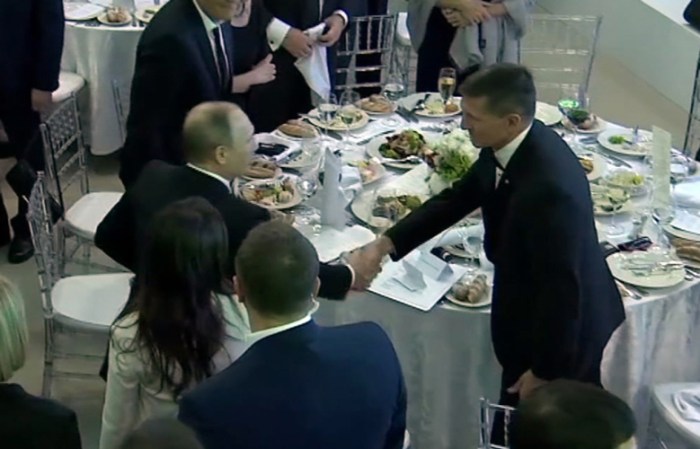
No one doubted Flynn’s loyalty, but he resigned due to “contacts.” The deputy speaker of the Lithuanian Seimas, Mindaugas Bastys, resigned the other day. He resigned because the Lithuanian secret services refused him access to secret information, although the list of Russians with whom he palled around at different times doesn’t contain anyone special: employees of Russian state corporations in Lithuania, crooked local Russian businessmen, and so on. Recently, the mailbox of an adventurer who has worked for the Kremlin in four countries (Poland, Czech Republic, Slovakia, and Hungary), and the Balkans to boot, was hacked. It transpired that Russian businessman Konstantin Malofeev had discussed or conducted ops of some kind during the elections in Bosnia and Poland.
Malofeev is, seemingly, an extreme example of frankly subversive actions in other countries. Perusing the correspondence and knowing the atmosphere of Russian affairs in Europe, you realize that Malofeev’s strategy and tactics differ not a whit from the actions of dozens and hundreds of similar actors operating outside the Russian Federation. Before Crimea, all of this resembled benign “promotion” of their interests on the part of all those who cooperated with such people. But now retrospection kicks ins. What trouble have those who were involved in the Petersburg Dialogue, the Valdai Club, the Dialogue of Civilizations, and the dozens and hundreds of programs where the Russians either footed the bill, generated incentives or simply provided a one-time service got themselves into? I was told by people from compatriots organizations (who fairly early pulled out of Russian World’s programs) that initially they were fooled by Nikita Mikhalkov’s early cultural projects outside Russia. They sincerely supported his appeal to the descendants of the post-revolutionary emigration. Around 2008, however, they sensed they were getting sucked into a system of ideological support for the Kremlin. Many even continued to travel to Moscow to the compatriots congresses, but inwardly they already felt like observers. They had already decided then that this was a new “Comintern,” and it would be wrong to accept grants from it. But others happily kept on taking the grants and sailed off with the Kremlin for Crimea.
* * *
But all these political, humanitarian and media contacts pale next to the vastness of business collaborations. Millions of people worldwide were involved in Russian money for over a decade. After all, so-called capital flight occurred on a massive scale. This capital was then partly reinvested in Russia through offshores, and partly spent on buying various kinds infrastructure outside of Russia (firms, shares in businesses, real estate, yachts, etc.). This entire giant machine for circulating the Putin corporate state’s money was serviced by millions of people as counterparties, including lawyers, dealmakers of various shapes and sizes, politicians, MPs, movie stars, cultural figures, translators, and so on.
The outcome, when Crimea happened, was a huge spontaneous lobby. This doesn’t mean all these people had literally been bought off, to describe the process in terms of the battle against corruption. People simply “cooperated” and received various bonuses from this cooperation. It is not a matter of recruitment, but a psychological phenomenon. Any of us, having once received money from a rich childhood friend, even if we are critical towards him, would still remain publicly loyal to him. Would you want to shout to the heavens about the atrocities of a man thanks to whom, say, you had earned enough money to buy a new house? You would just keep your lips sealed.
* * *
In other words, for around ten years, beginning approximately in 2004, after the takeover of Yukos, the Russian economy “warmed up” foreign strata whose scale is hard to evaluate. It was not a matter of corruption in the narrow sense of the word. Of course, on their part it was regarded as economic cooperation with a peculiar type of “eastern” economy that involved “pats on the back,” kickbacks, exchanges of various bonuses and preferences, trips to the banya, hunting for wild sheep from helicopters, and so on. But it was not criminal. On their part, it was indulged as a “peculiarity.” Russia is hardly the only economy marked by these ways. It was a partnership in the primary sense. The world’s major companies opened offices and production facilities in Russia. Until recently, it was a privileged economy, included in the BRICS grouping.
Crimea turned all the fruits of this decade-long warming-up into a problem. It is obvious Putin used Crimea to implement an instantaneous mobilization amongst those involved in the partnership. He confronted all the partners with the need to define themselves. Putin’s use of the word “partners,” which he pronounces ironically, has often been thought to relate to the diplomatic lexicon. But in fact Putin has in mind other partners, the millions of people who have received big bonuses for dealing with Russian contracts, Russian money, and various undertakings with Russians for a decade.
* * *
Now these partners have big problems, and we must sadly note that the problems are not due to Crimea as such nor to the regime of sanctions and countersanctions, nor to the ambivalence of having been involved in toxic projects with Russians in the past. The problems lies entirely in the fact that Putin does not want to stop.
This entire massive milieu would sigh in relief if it found out that Putin had “transferred the title to himself” (i.e., focused on Crimea) and called it a day.
But the extreme ambiguity has been maintained and even intensified from 2014 to 2017. It was not Putin who shot down Malaysia Airlines Flight 17, but folks mobilized by Malofeev. It was not Putin who murdered Nemtsov, but Chechen security officials. It was not Putin who hacked the Democratic Party’s servers, but volunteer hackers, who maybe were Russians or maybe not, but they used Russian servers. The attempted coup in Montenegro was not orchestrated by Putin, but by persons unknown. It was not Putin who plotted to destroy Ukraine as a country and establish Novorossiya, but, say, Sergei Glazyev. The pro-Russian rallies in European countries were organized not by Putin, but by a guy named Usovsky, who raised money for the purpose from patriotic Russian businessmen. And so on.
The list now grows with every passing day. Yet the Kremlin doesn’t really distance itself from any of it with a vigor that would be comprehensible to its so-called partners. The Kremlin has not conducted an investigation of any of these events, but has played an ambiguous game that can be clearly read as “covering up” all of “its own” people.
So the ten-year economic warming-up has been transformed before our very eyes into “inducement to conspiracy.” Everyone is now looking back and asking themselves, “Who was it we ‘partnered’ with? Maybe it was Russian intelligence? Or, from the get-go, was it just bait to get us involved in an unscrupulous lobbying scheme?”
* * *
There is tremendously frightening novelty at play here. Everything happening before our eyes with the State Department and pro-Russian politicians in Europe lays bare a complex problem. The boundaries between lobbying, partnership, espionage, propaganda, and corruption have been eroded.
A situation is generated in which it it impossible to tell benign partnership from complicity in a politics that erodes the limits of the permissible. Just yesterday you were a Christian Democrat building a partnership with the Russian Federation, but today you are just a silent accomplice in eroding the norms of Europe’s political culture. You are not just tight-lipped, refusing to evaluate the Kremlin’s actions. On the contrary. “Maintaining fidelity,” so to speak, to the fruits of your past partnership with the Kremlin, you even raise a skeptical voice. “What’s so criminal about Putin’s policies?” And others do the same. “The sanctions have been been ineffective. Frankly, Crimea has always been Russian.”
And if you were somehow able to take in at a glance the entire so-called Kremlin propaganda machine abroad as a combination of the work of Moscow news agencies and little-visited European websites run by left- and right-wing critics of American hegemony who for that reason sympathize with Putin, it would be utterly impossible to get a glimpse of the giant roots the Kremlin has put down in the western economy. It is beyond estimation, just like the transformation or, rather, the corruption not only of its own native population but also huge circles in the west, a task the Kremlin has accomplished in ten years.
Three years ago, I imagined Putin was putting together a kind of right-wing Comintern, and I wrote about it. Now it is often dubbed the “black Comintern.” I think, however, the situation is more complicated and a lot worse. The “Putinist Comintern” is the fairly insignificant and well-visible tip of a much larger process taking place on other floors of European life, where people who are not involved in either ultra-rightist or ultra-leftist politics remain silent about the Kremlin’s actions. Condemning it, they remain loyal nevertheless. They considerately wait for Putin to return to European norms of partnership. These people cannot see and do not want to see that the ambiguity fostered by the Kremlin in the matter of responsibility for murders, paramilitary detachments, mercenaries, and destabilization of small countries is not a temporary phenomenon. It has been conceived that way. And it will continue that way in the future.
Alexander Morozov is a Russian journalist and political analyst. Translated by the Russian Reader