Alexandra: A Russian Trans Woman in Trump’s America

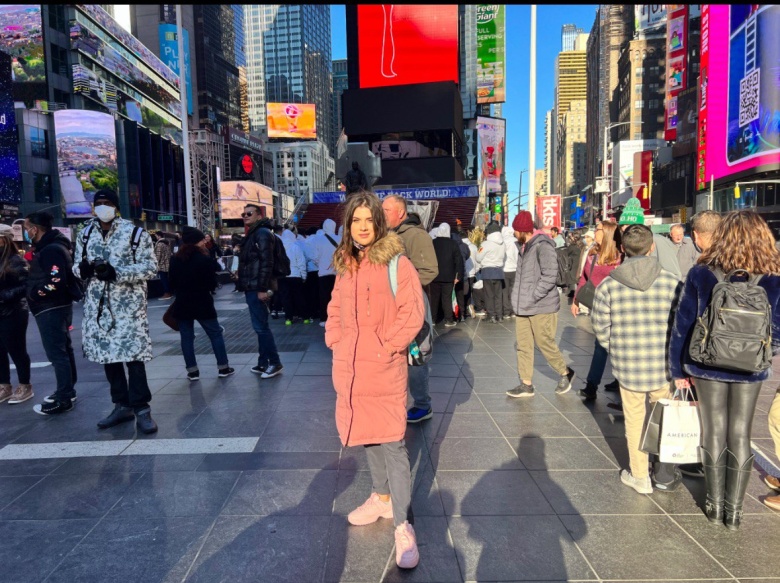
Alexandra in Times Square. Personal photo courtesy of Republic

Alexandra left Russia four years ago, fleeing oppression, propaganda, and ever harsher anti-LGBT laws. She applied for political asylum in the U.S., made a home in New York, and felt safe for the first time. But with Donald Trump’s return to power, her fears have returned. The new rules and laws, the rhetoric, and the swaying of public sentiment against trans people have been much too reminiscent of what she had escaped. Alexandra spoke to Republic about how America has been changing and what now lies in store for thousands of people like her.

I arrived in the U.S. exactly four years ago yesterday. A lot has changed in that time. I arrived right when the covid restrictions were still in force. Just a couple of days before I arrived in New York, an order to wear two masks each had been issued. The city was completely empty. I went straight to Times Square, and there were maybe one or two people walking down the street. Gradually, the restrictions were lifted, and more and more people were out in public. And then the border with Mexico was opened, and everything changed dramatically in terms of jobs, the economy, and real estate — rent went up about forty percent. Now there are new problems: Trump and Musk. But first things first.

“I always had a hard time in Russia”

I am thirty-four years old. I lived in Perm until I was twenty-five, then I moved to St. Petersburg and lived there until I moved to the U.S. I did a lot of jobs in Russia, mainly sales. In my final years in Perm, I worked at a real estate agency.

I had traveled a lot and at first I decided to just move to a big city in Russia, which didn’t make me safe in the end. I decided to leave Russia after the lockdown started. My ex-husband had gone to the U.S. in 2011 on the Work and Travel Program and he had really liked the country. Besides, when it was possible to fly anywhere again, the only valid visas we had were for the U.S.

When I was twenty-five years old, I officially changed my gender and got a woman’s passport. This was in 2016, back in Perm. It was quite difficult to do this. The problem was that at the real estate agency where I worked, no one knew about me, but I had to sign legal documents there. So I had to change my surname, first name, and patronymic to something feminine, but without specifying my gender. The civil registry office did not immediately know how to do this legally: they discussed it among themselves for several months. In the end, they changed my name and surname to the feminine versions of the original ones. I had been Alexander, and so I became Alexandra. They got rid of my patronymic because they didn’t know how to come up with a feminitive for it.

Later, after the updated information had been entered into my birth certificate, I went to the passport office. They remembered me there because a couple of years earlier they had refuse to issue me a passport on the grounds that the photo I had given them was of a young woman, but my papers indicated my gender as “M.” I had filed a complaint with the prosecutor’s office, but it hadn’t led to anything at the time. Ultimately, though, the [passport office] staff decided to meet my needs and help me. I was issued a passport with an “F” in it. I have had several cosmetic surgeries, but have not had intimate plastic surgery, meaning I haven’t undergone a complete transition, but a social one. I don’t want to have surgery yet.

It was always hard for me in Russia. If you are lesbian or gay, you can hide it from society somehow. This is impossible for us transgender people.

You go to apply for a job and you are simply rejected, at best. At worst, you are threatened and humiliated.

I was also harassed at school. For example, I was subjected to a full body search with no clothes on at the checkpoint when I took my Unified State Exam. When it comes to medical institutions, even if you go to a private clinic for a paid operation, you still face discrimination. When I tried to get permission for a sex change, they suggested I go to the male ward because in the female ward they thought I would “rape all the female patients.”

I was an activist in Rainbow World, the Perm branch of the Russian LGBT Network: I constantly attended events and was actively involved in organizing them. When I needed supporting evidence [for my asylum claim] from the head of Rainbow World, she was afraid to communicate with my lawyers, since she seriously feared reprisals from the authorities. Now she doesn’t contact me at all.

We once took part in the May Day rally. We had got all the permissions beforehand, but the placards had not been discussed, and so we ended up having our own mini-gay pride parade. Things were still relatively calm at the time: we marched down the street and people heard us; we were written about and discussed. But then the pressure started. Public opinion shifted dramatically in the direction of aggression towards LGBT people. A few months later, the police came to the offices of our organization and searched them. They confiscated our laptops, and there, of course, they found all our info — addresses, contacts, and passwords. No one thought at the time that things would take such a turn for the worse.

At one point, when I was working at the real state agency in Perm, a local activist came into my life. I don’t know who he was, but he had sent me clip from an episode of the Malakhov show in which he had taken part. He was always stalking me outside the real estate office where I worked. When I would walk past him with my colleagues, right in front of them he would say, “You have to give me an interview.” I would say, “I don’t know you. What’s this about anyway?’ And he would say, “If you don’t, I’ll tell everyone who you are.” This would happen in public, right on the street.

After the first law banning so-called LGBT propaganda for minors was adopted in 2013, police officers started showing up at my house because I right then I was helping out transgender teenagers. The police would knock on our door and ring the doorbell. They would try to get into my flat under various pretexts. One time they stood outside the door for three hours. We just pretended nobody was home. Then, when it got quiet, we looked out the window. The police officers looked up too, realized we were looking at them, and came upstairs again. They stood outside our door again for a while.

Then some people assaulted me and my ex-husband. It turned into a brawl, and a police patrol turned up “by chance.” We were all taken to the police station and advised to “keep quiet and stay inconspicuous.” After that, in 2019, we decided to move to Peter. Everything was relatively calm in Petersburg. But then they found us there too. I do not know what kind of databases they have, but they found us, although I didn’t show my face anywhere at all in Petersburg, and I wasn’t involved in any organizations. The only thing I did was go to the Side by Side LGBT film festival.

I was in no hurry to leave Russia because I have an elderly father, who is seventy-one. I didn’t want to leave him. And I never thought that I should leave the country where I was born, grew up, worked, and paid taxes. Plus, I had a flat and a car in Russia. I didn’t want to start all over again in another place. When covid started, my husband’s and my Schengen visas had expired. We only had our U.S. visas left, and they were still valid for about six months. We decided to give it a try, because we were afraid that, later, the authorities wouldn’t let us go anywhere at all, that the country was heading towards the Iron Curtain.

“Since Moving to the U.S., I Haven’t Been Hiding Anything from Anyone at All”

We arrived in New York on a visa, on a direct flight from Moscow. We started looking for human rights organizations who could provide free lawyers. We called various places: our English was nonexistent, so we used online translators and sometime just read the text into an answering machine. Several organizations reached out to us. Eventually, an organization which deals with domestic violence helped us out. We lived in a hotel at first. We were quarantined there for a fortnight, then we rented a place through Airbnb and looked for a permanent place. I started working three weeks later.

I am currently working as a cleaner and as a webcam model. Webcam modeling is not an easy gig. I started doing it back in Petersburg, because I was afraid of getting a on-the-books job. Initially, you think that it’s easy money and that it won’t affect you in any way, but then you realize you’re just a piece of meat. It’s quite tough psychologically. All this overlapped with my old traumas, and eventually led to big psychological problems. Before the New Year, I stopped taking the antidepressants I’d been taking since 2018.

You can make $100, $300, and $500 a day in the webcam industry. Here in the U.S., it’s a legitimate job, you pay taxes, it’s all above board. Since moving to the U.S., I haven’t been hiding anything from anyone at all. It’s my new principle in life.

I am horrified to read the news from Russia about LGBT people being labeled “extremists” and being murdered in prisons, about gay bars and clubs being raided. It’s wacky, it’s incomprehensible. After moving to the U.S., especially after Russia’s war with Ukraine began, I realized how effective propaganda was in Russia. All my friends and acquaintances in Russia suddenly changed their opinions about politics dramatically, even about LGBT people. Even my friends who are LGBT people themselves either try to avoid the topic or say, “Well, that’s right, but what can we do? It’s the way it has to be.” Some of them I’ve stopped talking to, some I haven’t. Maybe they are simply afraid to say too much.

The authorities inserted pedophilia into the law on “LGBT propaganda” and thus made a strong link in people’s heads between LGBT people and pedophiles. This propaganda has been effective even in my own family.

My dad’s new wife has a niece. The niece’s son was three years old at the time. Kids are drawn to me and I always play with them. But at one point I saw how afraid she was to leave her child alone with me. The propaganda has affected even those closest to me.

In the U.S., I saw a completely different world and attitude towards people like me. When I told someone at work for the first time that I was a transgender woman, I got a neutral reaction, as if I was talking about something quite ordinary. The first time I went to the New York Pride March, it was more like a carnival: it was beautiful, friendly, and flamboyant. There were a lot of children there, and there were separate events for them. For the first time in my life I felt I was no different from anyone else, that I had rights, that I could speak openly, that I could receive proper medical care. When I lived in Perm, I was even unable to find an endocrinologist who did hormone replacement therapy. [Living in New York] has changed my sensibility a lot.
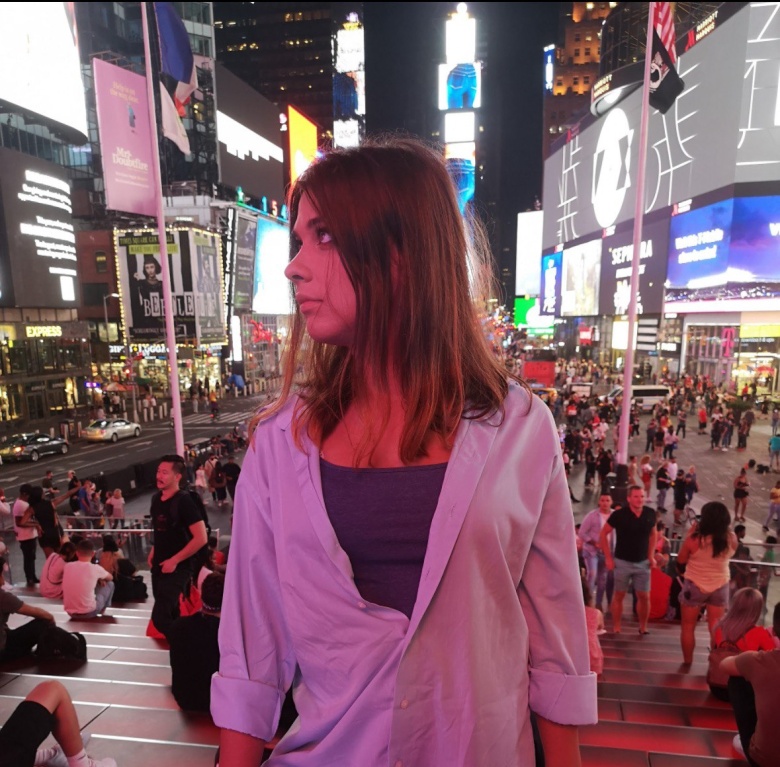
Alexandra in Times Square. Personal photo courtesy of Republic

Donald Trump’s policies have not affected me specifically yet. But knowing how it all kicked off in Russia, I am scared. In 2013, there was the ban on “gay propaganda,” and consequently, teenagers were left without the support that, for example, they had received from Lena Klimova and her project Children 404. I also helped kids out then, shared my know-how with them, and tried to support them. All transgender people have been dismissed from the [U.S.] army. It’s a nightmare. When the state starts cracking down on a single albeit tiny segment of the populace, and it succeeds, it keeps on going.

“Judging by the First Month of Trump’s Presidency, We Are in for Tough Times”

I believe that common sense should prevail in all things. Previously, the bias had gone in the other direction in the U.S.: people used to be afraid to say something against LGBT, and this was also wrong. Everyone should have freedom of speech. For example, my acquaintances from [the country of] Georgia had this thing happen to them. They were working on a commission for a moving company: a gay couple was moving. One of the workers looked askance, or they said something among themselves. They then got a call from the front office and a dressing-down. They were warned that they would be fired if it happened again. Or there was the case of the flower shop: the owners refused to sell flowers for a same-sex wedding, and the shop had to close because of the scandal that erupted. That’s over the top. I think that if you’re refused service somewhere, you can go to some other place. Let them lose their profits. It’s the same with clubs: if the bouncers don’t let you in, well, those are their views. Everybody has different views. But now it’s going too far in the other direction and it’s scary. I hope that one day we will reach a sensible balance.

Now I live with my fiancé, who is from Ukraine. We discuss politics, and we both want the war to end soon, for people to stop dying. I would like to make a trip to Russia.

I don’t think Russia belongs to Putin and his lackeys. It’s my country, just like it is yours, just like it is everyone else’s. I would like to believe that things will change and we can go back someday.

I am in the U.S. legally, but I am waiting for political asylum. There are numerous such cases, and they take a very long time to process. The approximate wait time for a green card in the past was ten years . I was involved in a class action lawsuit against the U.S. Immigration Service, and I was told that as long as I had a short wait time, the case would not be considered. I appealed that decision and have been scheduled for an interview for late 2026. I would like to go to Turkey, for example, to meet my relatives. I would really like to see my dad. But even if everything goes well at the interview, I will probably not get a green card until 2028.

My father loves me, but over the last three years, since the war started, we have come to disagree about Russian politics, and over time we stopped discussing it. He watches [Russian] television and relays to me what is said there. He constantly accuses me of being under the influence of “American propaganda” and “brainwashed.” But I just reply, “Fine.”

They usually say that the first one hundred days of a presidency set the course for the next four years. Judging by the first month of Trump’s presidency, we are in for tough times, although maybe these measures are like Margaret Thatcher’s — first shock therapy, then stabilization. I hope to get citizenship in the future. I would finally feel safe: there is still a risk of deportation for now. I try not to give up, to hope for the best. Let’s see if positive thinking does the trick.

Source: Maria Litvinova, “‘Trump’s rhetoric has become similar to Putin’s, and it’s scary’: How does a Russian trans woman who emigrated to America under the Democrats feel?” Republic, 27 February 2025. Translated by the Russian Reader
“It’s Showtime”: Open Space Moscow vs. SERB

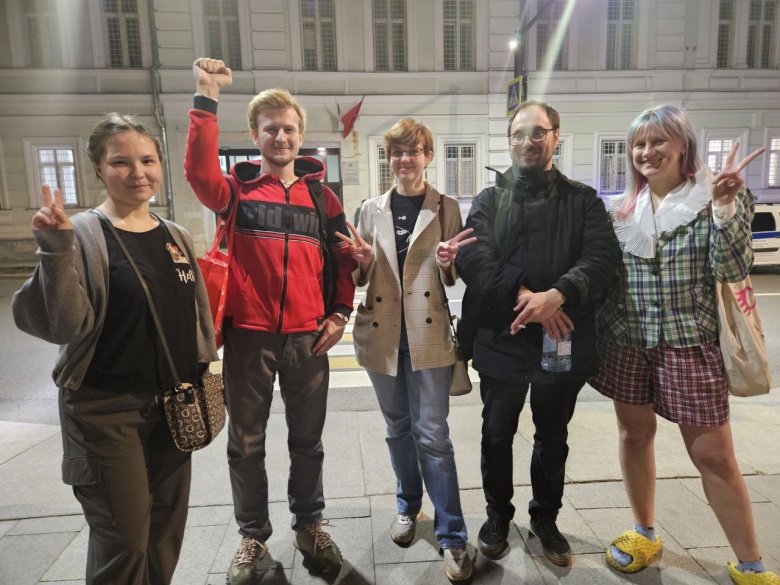
Open Space is a project that supports grassroots activists. It has two sites, in Moscow and St. Petersburg, with co-working spaces, a human rights center, and a psychological center. The Moscow site is at odds with the pro-government movement SERB, known for its provocations against the opposition. Republic correspondent Nikita Zolotarev is often at Open Space, sometimes as a volunteer. That was how he found himself at the Moscow co-working space last Saturday, where he was detained along with other visitors on the basis of a complaint filed by the “Serbs,” who were assisting the police, and then spent several hours at the Basmannoye police precinct. Here is how it went down.

“It’s showtime,” SERB leader Igor Beketov said on his movement’s video stream before knocking on Open Space’s door. He and another SERB activist, Pyotr Rybakov, were able to get inside after the police arrived.

SERB’s video recap of the SERB-assisted police raid on Open Space Moscow, as posted on their Telegram channel on 19 May 2024

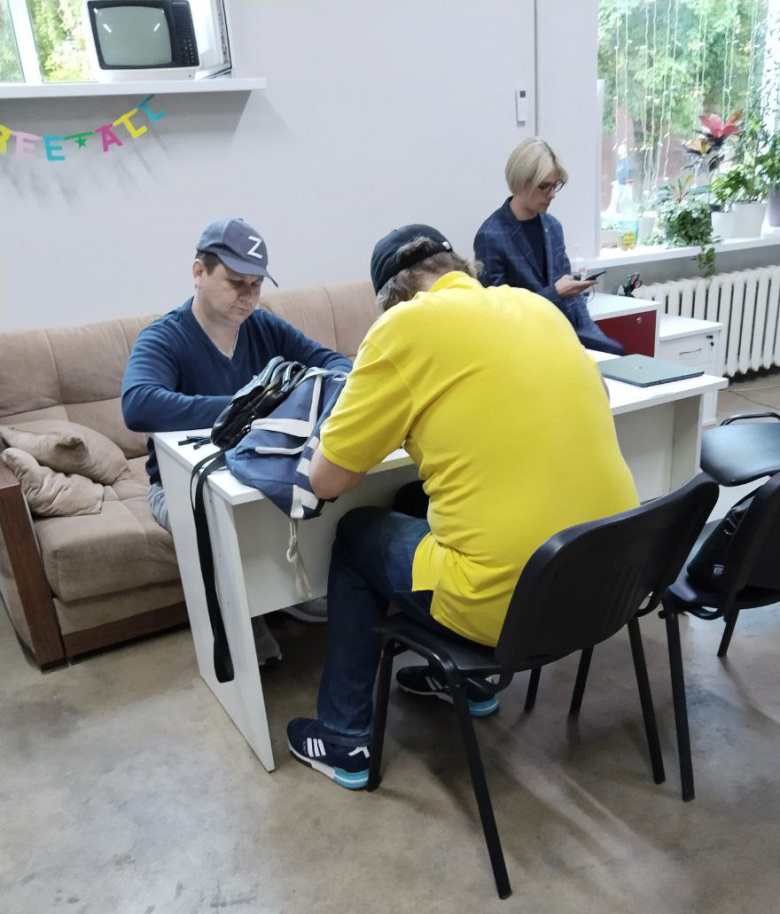
“A circus is about to kick off,” a young woman sitting across from me named Thiya texted a friend at 6:09 p.m. A knock on the door distracted her from solving a strength of materials problem. Nine minutes later, she sent a new message, writing that “the Serbs and the police” had come in.

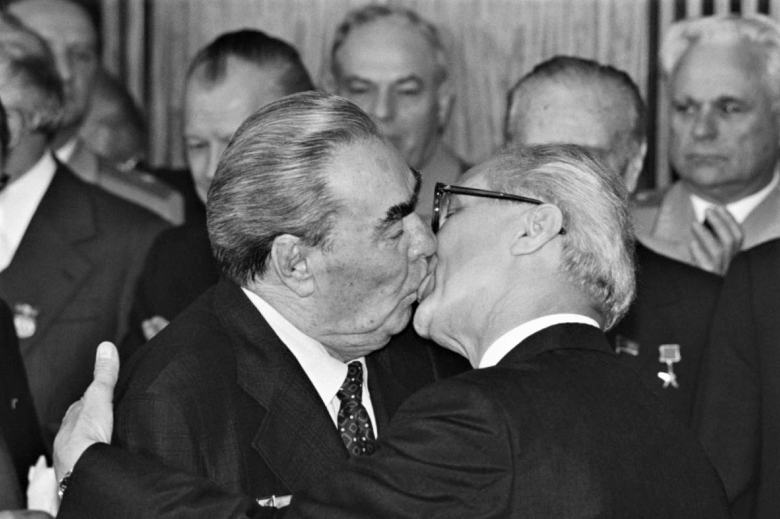
The [pro-regime] activists walked around filming anything they saw as “extremist propaganda” and drawing the attention of police officers to it. Thus, halting near a painted copy of “The Brotherly Kiss,” the famous photo of Brezhnev kissing [East German leader Erich] Honecker, Pyotr and Igor began explaining something to a policeman. “What does this mean?” Rybakov asked, pointing to the drawing. “Since Soviet leaders could do it, it turns out that…,” he answered his own question uncertainly. The police officer remained expressively silent and photographed the image just in case.

The photograph known as “The Brotherly Kiss” was taken in 1979 at a meeting between Leonid Brezhnev and Erich Honecker in Berlin during the GDR’s thirtieth anniversary celebrations. Source: Regis Bossu/Sygma/Corbis

Then they went looking for members of Left Socialist Action (Levoe sotsialisticheskoe deistvie, or LevSD, for short), having prudently abbreviated the name of the organization to “LSD,” because, after perusing “the page of this movement, [they] saw that it does not smell of any left-wing movement.” What exactly they did not fancy about “LSD” on a day when the latter were holding “an evening of letters from some political prisoners” remains unclear.

“They came and almost broke down the door,” recalls Anastasia, who organized the event. The SERB activists asked her why her movement was holding an event in support of Ukraine, a conclusion at which they arrived after seeing a couple of posts with Ukrainian flags on Lev SD’s Telegram channel. Anastasia tried to persuade them that such “flags are posted after the massive shelling of Ukrainian cities to express condolences.” A brief discussion ensued, whose acme was the following question from Pyotr Rybakov: “Did you see Soviet people publishing posts in support of Germany during the bombing of Dresden?”

This discussion was witnessed by Anastasia’s friend Andrei, a expert on the history of Yugoslavia. He was surprised that Pyotr “probably didn’t know that there was no Telegram back then” and asked what, in Pyotr’s opinion, “equates the Great Patriotic War [World War Two] with current events.” The “Serb” responded by comparing Zelensky’s regime to Hitler’s, dubbing it “absolutely fascist.” After mentioning NATO, they smoothly segued to the bombing of Yugoslavia. This discussion did not last long: Pyotr soon ran out of arguments against the facts Andrei presented. The culmination of their conversation was when Andrei asked whether the SERB activist had read Kurt Vonnegut’s Slaughterhouse Five, to which Pyotr replied that he had “never read Bunin.” Andrei recalls this conversation with a little annoyance: he says that if they had more time, he would have tried to wheedle some “less cannibalistic” information out of this “ideologically charged man” and “make him think.”

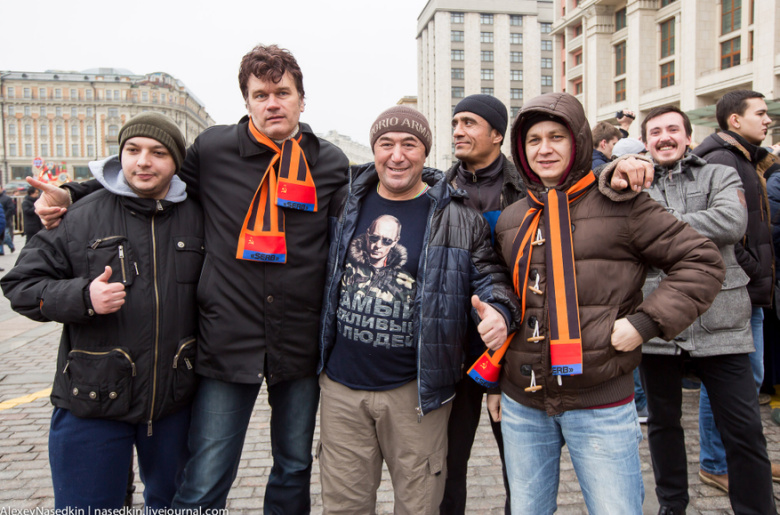
SERB leader Igor Beketov (aka Gosha Tarasevich) and his associate Pyotr Rybakov, both wearing black-and-orange scarves. Source: theins.ru.

At 6:32 p.m., a police officer let some of the people who wanted to smoke out by going out with them. It was as if he knew what the visitors were going to experience a little later.

In addition to writing letters to political prisoners event, a session of board games under the auspices of the Libertarian Party of Russia was being held in the basement of the co-working space. As organizer Vladislav tells it, the libertarians were having a quiet time when Open Space volunteer Sasha suddenly appeared and said, “We’ve got a situation: the police have showed up, the ‘Serbs’ have showed, but so far everything is fine.”

“We took note. I won at Jenga: my buddy had happily wrecked the tower,” recalls Vladislav. After that, he went to make coffee on the first floor of Open Space—where he saw the “Serbs” writing a complaint to the police.

At that moment, Andrei, the expert on Yugoslavia, made a terrible blunder for which he repented long afterwards: he offered the provocateurs Roshen caramels, a Ukrainian brand. On the table with the tea bags there was a metal box, where volunteers put sweets that keep for a long time. The ill-fated caramels were in this box on the day in question.

“Subtle trolling,” Beketov said.

“Everyone knows that Roshen belongs to [former Ukrainian president Petro] Poroshenko,” Rybakov added.

“You can’t get these candies so easily in Moscow—you have to make an effort to find them,” the SERB leader noted.

Forgetting about their complaint to the police, the “Serbs” paced the room talking about Roshen candies. Everyone else in the room was silent, listening attentively to their arguments. But since the entire candy argument consisted of no more than five sentences per two people—Beketov and Rybakov kept repeating the same thing—their listeners could barely contain themselves from laughing. “Sometimes candy is just candy,” Open Space volunteer Sasha finally told them and suggested they taste the caramels, adding that they were delicious. The activists resisted. “Roshen is good quality, no one is arguing about that. But they are Ukrainian candies!” they said. The conversation about candy was interrupted only by the advent of a paddy wagon.

Rybakov and Beketov writing their complaints to the police during the raid on Open Space, 18 May 2024: Source: social media

The people at the board game event hastily made to leave, but a police officer soon came down to them, and, according to Vladislav, “it was clear [we] would spend the next few hours in a less comfortable place.” The moment the policeman stepped away, Vladislav “snuck through a window.” The policeman shouted after him, summoning his partner, but Vladislav managed to escape to a subway station. Not knowing what to do, he wrote on the Libertarian Party’s Telegram channel that the police had begun detaining attendees at their event.

First, the attendees of the two events and several visitors to the space who were just minding their own business were dispatched to the police bus. One of the detainees calmly recalled how she went to the police bus: “Going to the police station isn’t the same as digging a ditch, and I was so tired anyway I wasn’t about to resist. It was a comfortable ride, but it’s a pity they didn’t bring me back.”

Anastasia, who for some reason was transported to the station separately from the others, recalls how she “snapped at the policemen while dying inside.” When asked if she had any sharp objects for stabbing or cutting, she “blurted out that only her tongue was sharp.” The policeman was amused, and a small exchange of pleasantries ensued, but he stopped laughing at her jokes as they neared the Basmannoye precinct.

Ten Open Space visitors went on the first trip to the station. I was among the second batch of six detainees. There were five seats on the Ford Transit bus, not counting the seats reserved for officers, and between the seats was a table, which Thiya occupied by placing the worksheets with the strength of material problems on it.

“More comfortable than in a economy class sleeping car,” said one of the detainees.

The “Serbs” stood by the police vehicle, taking turns proclaiming “Open Space is closed!” They seemed to enjoy the play on words. They too headed to the police station to file their complaint.

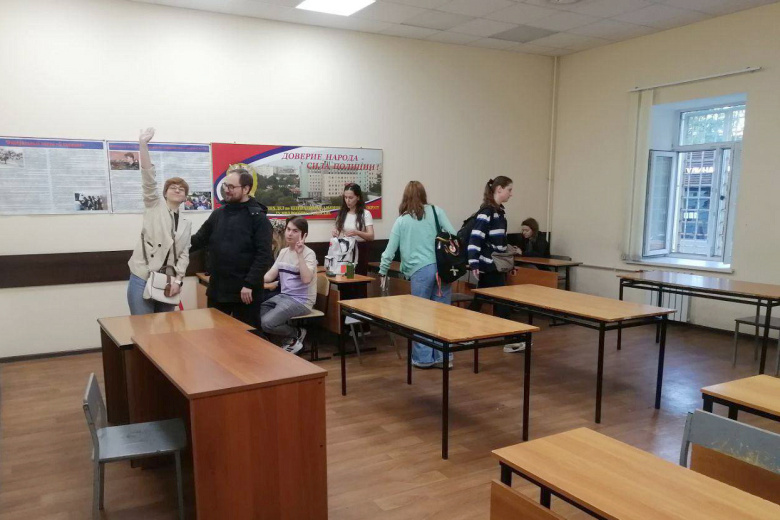
The Open Space detainees in the educational classroom at Basmannoye police precinct. Source: social media

We were taken to an educational classroom, where some of the people detained earlier were already located, as well as a couple of people who had been brought to the precinct independently of us—a young man detained for brawling and a woman who had attempted to strangle her sister. Some of the Open Space people were in another office. As transpired later, the officers wanted to take their fingerprints, and several people consented.

As one of the detainees recalls, when the officer “was taking our prints he referred to some order issued by [Interior Minister Vladimir] Kolokoltsev, dated such-and-such a day in July 2023, that all those brought to police precinctd must be fingerprinted.” There is no such order. Moreover, according to Article 13, Paragraph 19 of the Federal Law “On the Police,” an officer has the right to fingerprint a detainee only if their identity cannot be ascertained in any other way. Since almost all the detainees had [their internal] passports with them, they were used to establish their identities. And those detainees who refused to be fingerprinted and later signed statements that they refused to undergo the procedure, left the precinct even earlier than those who had been fingerprinted.

The key question we were all asked by the interrogators was whether we had anything to do with LGBT and whether we were involved in any activities related to this movement. Yevgeny, a lawyer who aid the LevSD detainees, recounted that all the police officers with whom he spoke were convinced that “this was some kind of LGBT gathering, a gay bar and so on.”

“When I told them about the event to aid political prisoners, they started telling me, ‘Come on, stop pitching us a yarn,'” the defense lawyer recalled. In response to the flyer for the event, which Yevgeny showed them, the officers told him, “That’s how they encrypt themselves.”

Around 8 p.m., we were given water and food, and journalists and a support group gathered under the windows of the classroom. At that time we were called out of the classroom to make our statements. It was my turn.

“You’ll tell me all about LGBT. I’ll tell you something too.”

With these words the interrogator started lazily looking for the copy of my passport and preparing a blank form for my statement. At that moment someone called him—probably some supervisor giving additional instructions. The interrogator mostly agreed with what the caller was saying, only at one point he uttered, “They’re mostly came to play board games, that’s all.”

Our conversation flowed smoothly, albeit with a few, brief lyrical digressions.

“What were you doing there?” the interrogator asked in a tired voice.

“I was helping Thiya do her homework, on strength of materials, as it turns out. She still has those strength of materials worksheets with there.”

“Oh, I see. Shear and moment diagrams and all that?” he asked, drawling the phrase.

I rejoiced.

“Yes. Maybe you can help her out later?”

“No, I forgot most of that stuff a long time ago.”

Another officer passed behind me, and my interrogator seemed to come to life.

“Listen, wait! There should be a broad in red pants out there. You cannot let her go!”

His colleague shared his worries.

“Everyone refuses to be fingerprinted.”

“The hell with them. What matters is the woman in red pants…. Don’t let anyone go at all!”

He was talking about Sasha, the Open Space volunteer.

“Nobody’s going anywhere.”

“That’s fucking great.” After a little silence, he added, drawling his words again, “The journalists haven’t arrived yet for some reason. But never mind.”

“Are you expecting them?” I asked with hope in my voice.

“They already filmed me.”

And then he complained me about how he wanted to get home, how he had already “one foot in [my] slipper, and then your gang arrived.” Suddenly, in an animated voice, he asked the key question of the evening:

“What’s up with LGBT?”

“I don’t know anything, I haven’t seen anything, I don’t belong to LGBT.”

“You getting married soon?”

“I am getting married soon,” I said, and showed him my engagement ring.

Trying to guess what material the ring was made of, he let me read the statement. When I asked him if I could get a copy of it just in case, he waved me off, saying, “Don’t even think about it.” I quoted The Heart of a Dog, the passage about the “ultimate in certificates,” but it transpired that the interrogator had not “waded through” the novella. And he had not watched he movie version, either, because it was, from his point of view, a “cheesy farce.” He and I parted on these words.

Inside Basmannoye police precinct

While I was giving my statement, an officer came into the educational classroom and asked whether there was a “competent person” among those present, meaning someone legally literate, apparently, someone whou would write a refusal to be photographed and fingerprinted, so that everyone could write their own refusals using his as their model. Such a “competent person” was found, and the question itself provoked laughter among the detainees.

After my return to the “waiting area,” Thiya went to her interview, her strength of materials worksheets in tow. She returned twenty minutes later with a look of bewilderment on her face. The fact is that she is getting married soon—but not to me—and in the process of making her statement, the interrogator, after finding out that Thiya also had nothing to do with LGBT and was also getting married soon, assumed that she was getting married to me. Thiya wasn’t about to argue with him.

The interrogator reread her statement aloud: “I am getting married. I am not inviting the chief of police.”

“The above is an accurate record of my statement,” Thiya added in writing to the end.

One of the detainees who heard this conversation saw my surprised face—I was planning to marry someone else after all—and gave me a piece of advice.

“When questioned later, you answer that it was dark, and that’s why you mixed up [the fiancees].”

“Uh-huh. I was drunk, I don’t remember!” I joked back, and we laughed together.

“Seryoga, did you count the number of [detainees]?” one of the officers asked my interrogator in the meantime.

“I don’t fucking know. How many are there supposed to be? There’s a whole fucking busload of them, a whole fucking classroom of them. Count them as a pack,” Seryoga the interrogator replied. At some point he took the worksheets from detainee Thiya, scrutinized them, and pointed out a flaw in the diagram to her.

Meanwhile, Vladislav the libertarian was walking towards the police station—he wanted to support his comrades. His fellow party member Georgy Belov was signaling to him from the window: fearing that Vladislav would be detained by the police, he waved his hand at him, telling him to get away. One of the officers at the Basmannoye police department did head toward Vladislav, but he managed to escape again. He then went to the store to buy food to give to his fellow party members and, as he put it, “our buddies from LevSD.” Some time later, LevSD and LPR agreed to hold joint events, primarily debates.

At 8:30 p.m., the officers at the station detained Vladislav all the same. When he and the other libertarians at large brought the care package, the policemen noticed him standing under the windows and took him inside.

Vladislav the libertarian is detained outside Basmannoye police station. Source: Rus News

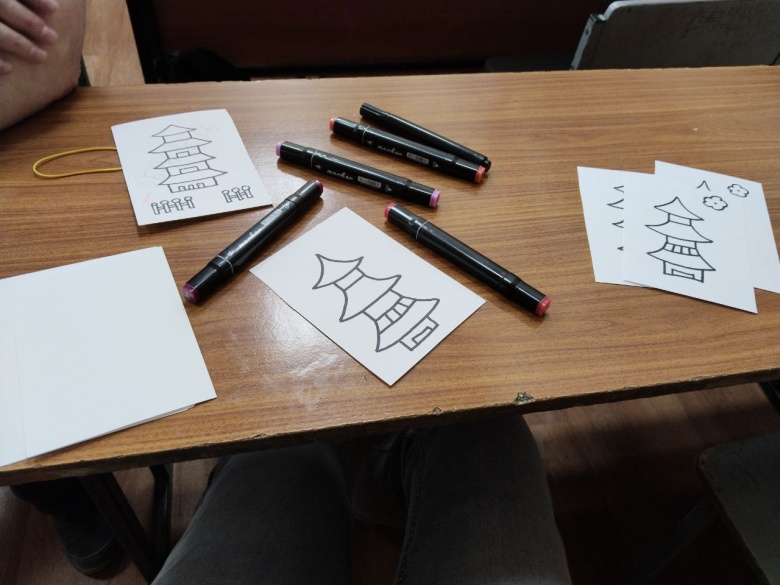
My attention was drawn to a female detainee who at some point started making postcards for political prisoners. She said that she would send them with the note “A postcard from Basmanny police station.” Someone wanted to work, but since there was no free Internet in the department, they were unable to. “I’m giving them a negative rating for not having wi-fi,” a young woman joked.

Anastasia was indignant.

“We are locked up here, a group of people who were not involved in anything criminal at all, while locked up here as well are a young man who was nicked for brawling and a woman who tried to strangled her sister. Instead of dealing with these people, the cops are dealing with political activists.”

This made her so angry that she stopped being afraid.

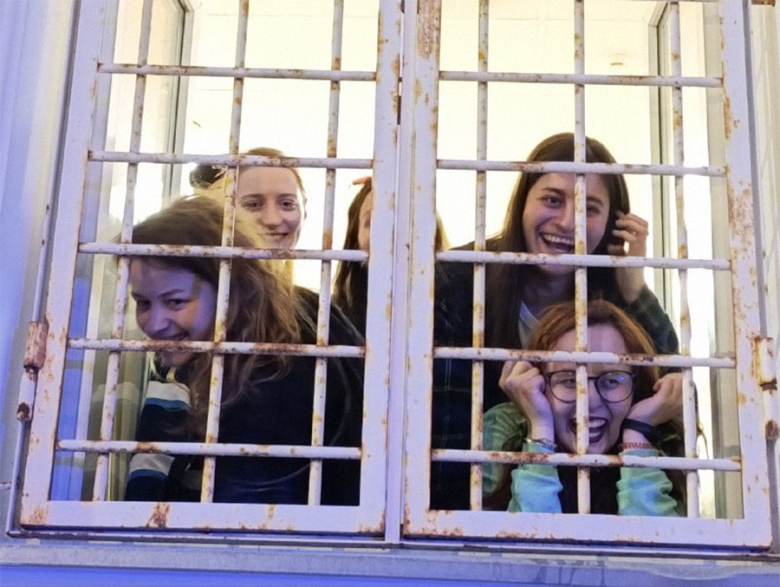
At some point, all the officers in the precinct left our part of the department. The metal door leading to the officers opens with a key card, so we had no communication with them. For a little over an hour we had “free time.” Everyone socialized, joked, and planned where they would go to drink beer after we were released, while some of the detainees chatted with the support group outside since the windows were open. And if it were not for the bars on those windows, it might have seemed that the detainees had not even left the co-working space.

From Open Space to Basmannoye police precinct. Source: social media

At around 10 p.m., the interrogator and another officer (the head of the department, probably) brought all the paperwork. They caloled the detainees by name, collecting their papers—the copies of their passports, fingerprinting refusals, and statements—and handing back their passports and escorting them to the queue for release.

At first, those who had not been fingerprinted were released, because “the staff had lost their fingers” [sic]. At 10:07 p.m., I found myself outside with a group of detainees. We waited for the others to be released. Journalists taped our commentary for their news dispatches. At that time, Sasha, the Open Space volunteer in the red pants, was driven away by the Basmannoye police officers for an inspection of the “crime scene,” during which they confiscated several stickers and posters. The last detainee, libertarian Georgy Belov, was released at 11:34 p.m.

Activist Alexandra (“Sasha”) Kalistratova on the seizure of stickers and posters in Open Space by law enforcers.
Source: Rus News (Telegram)

“I feel like we had an interesting, productive time, but it was complete fucking rubbish per se,” said one of the female detainees. “Saturday night was unforgettable,” concluded Andrei.

Left Socialist Action members after their release. Source: Left Socialist Action (Telegram)

Source: Nikita Zolotarev, “Theater of the Absurd at Basmannoye Police Station: Provocateurs and Police vs. Letters to Political Prisoners and Libertarian Board Games,” Republic, 25 May 2024. Translated by the Russian Reader
Postage Stamps and Gunpowder: Syria and the Russian Economy

embrace

Postage Stamps and Gunpowder: How Important Is Syria to the Russian Economy?
The Kremlin has been trying—unconvincingly—to repackage its military campaign in this devastated country as a long-term investment project. 
Yevgeny Karasyuk
Republic
February 27, 2019

The economy was probably the last thing on the Kremlin’s mind when it decided to get involved in a civil war in the heart of the Arab world. But now that Russian military forces have been in the region for several years, the Kremlin has been increasingly trying to spin its support for Bashar Assad’s regime as a sound investment, a contribution to a prosperous trading future between the two countries.

Russia has claimed it is willing to export to Syria anything it can offer in addition to weapons, from wheat to know-how for preventing extremism on the internet. Along with Iran, the country has big plans for taking part in the postwar restoration of Syrian cities and Syrian industry, including the energy sector. Russia’s governors speak touchingly of their readiness to go to Damascus at the drop of a hat to negotiate with the Syrian government.

“When the talk turns to Syria, I immediately catch myself thinking I need these meetings,  I need to see those people again and again, and I need to be useful,” Natalya Komarova, head of the Khanty-Mansiysk Autonomous District said at the Russian Investment Forum in Sochi two weeks ago.

The expenses Russia has incurred during the Syrian campaign are shrouded in mystery. Analysts at IHS Jane’s calculated in October 2015 that Russia could have been spending as much as $4 million a day.  In July 2017, the opposition Yabloko Democratic Party published its estimate of the overall bill: as much as 140 billion rubles [approx. 1.87 billion euros], but this total did not include associated costs, including humanitarian aid. In 2017, according to RANEPA, 84% of Russia’s official total of disbursed humanitarian aid ($19.6 million) went to Syria. What kind of economic cooperation could justify such figures?

It would be pointless even to try and find an answer in recent trade trends between the two countries. Its volumes are negligible. During the first nine months of 2018, Syria’s share of Russia’s exports was 0.09%, while Syria accounted for 0.002% of imports to Russia during the same period. This has always been more or less the case.

trade

“Trends in Russia’s trade with Syria (in billions of US dollars).” The pale violet line indicates Russia’s exports to Syria, while the blue line indicates Russia’s imports from Syria. The data for 2018 is only for the first nine months of the year. Source: Russian Federal Customs Service. Diagram courtesy of Republic

The largest transaction in the history of the economic partnership between the two countries was Moscow’s cancellation of $9.8 billion dollars in debt, 73% of what Syria had owed the Soviet Union. At the end of the 2005 meeting at which this matter was decided, Bashar Assad and Vladimir Putin also spoke publicly of the idea of establishing a free trade zone. Subsequently forgotten, the undertaking was mere camouflage for the political bargain reached by the two men, which was and remains support for the Syrian dictator’s regime in exchange for the dubious dividends the Kremlin has received by increasing its influence in the region. It is believed Russian strategic bomber saved Assad, who had already been written off by the west. But explanations of what Russia has ultimately won for its efforts and what its economic strategy might look like have been more muddled and contradictory than before.

In an October 2018 interview with Euronews, Russian Foreign Secretary Sergei Lavrov avoided directly answering a question about joint economic projects. During his tenure as head of the Russian Export Center, Pyotr Fradkov (not to be confused with his father former PM Mikhail Fradkov, the current head of the Russian Foreign Intelligence Service or SVR) talked about Russia’s potential involvement in developing the “high-tech segments of Syria’s economy.” A month ago, however, the selfsame Russian Export Center placed Syria at the bottom of its ranking of 189 countries in terms of their favorability for foreign trade.

The Syrian economy, in turn, can currently offer Russia even less. Mainly, its exports boil down to fruit, but in such small and unstable quantities that they cannot seriously compete with deliveries from Turkey. Russia has been promised priority access to the development of natural resource deposits in Syria, which are teeming with oil, natural gas, and phosphates. But the smoldering war and the lack of security guarantees for investments have hampered implementing these plans.

Russian experts pin their hopes on the surviving remnants of industry in the government-controlled areas of Latakia, Tartus, and Damascus. Based on the fact that “the level of production that survived has enabled Assad to almost fully provide himself [sic] with food during five years of war,” Grigory Lukyanov, a political scientist at the Higher School of Economics has concluded the Syrian government “depends on a well-developed business community.”

Syria, however, seemed like a nightmare for investors well before the country was turned into an open wound. “Only a crazy person would go into Syria at his own behest,” Vedomosti quoted a source at a major company that was involved in negotiations with the Syrian government in the summer of 2012. Suffering from international sanctions, Syria proposed that Russian companies take part in construction of a thermoelectric power station in Aleppo. Four years later, one of Syria’s largest cities had been turned into ruins by heavy bombardment.

The Rothschilds [sic], who made fortunes on wars, thought the best time to invest was when blood was flowing in the streets. Their approach might seem to resemble the Kremlin’s strategy. But let’s not kid ourselves: unlike the famed financiers, President Putin is completely devoid of insight when it comes to the economic consequences of his military escapades. Business plans are not his strong suit.

Photo courtesy of Mikhail Klementyev/AP and the Washington Post. Translated by the Russian Reader