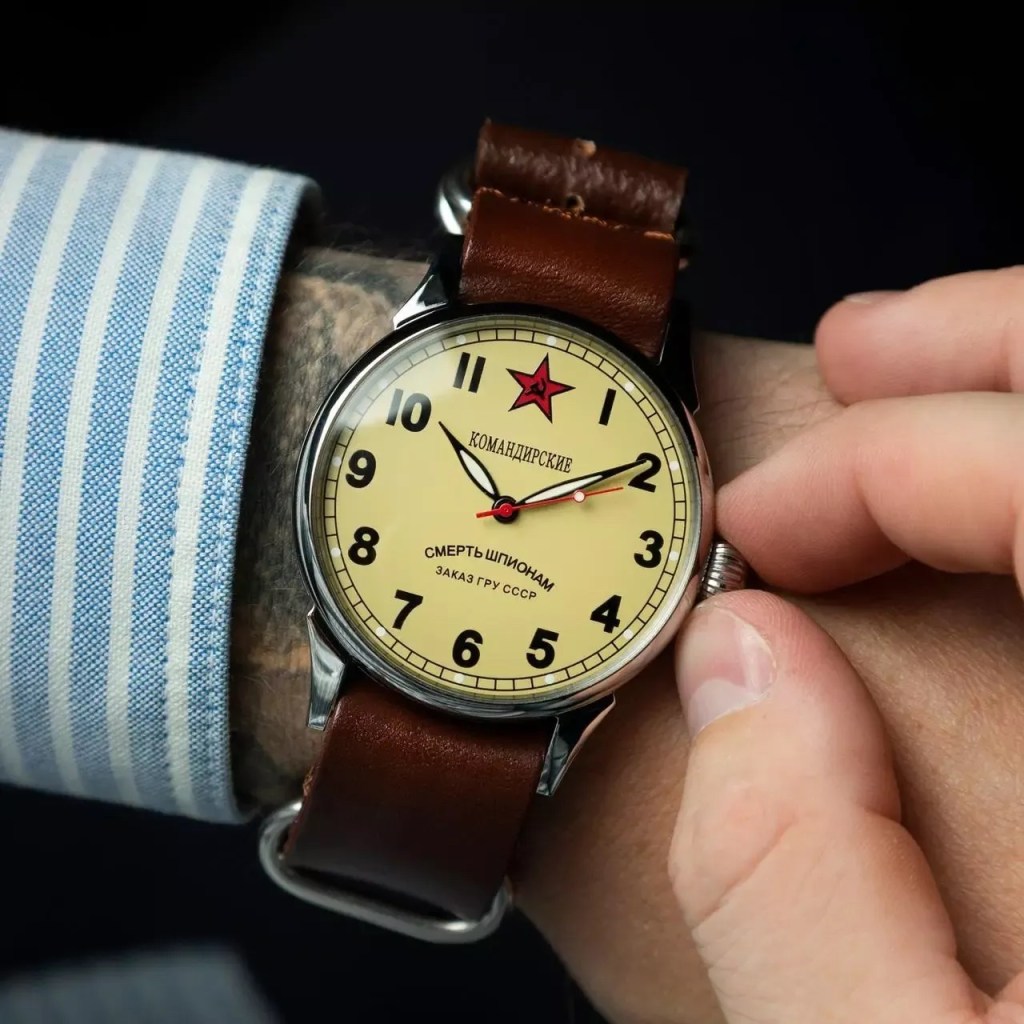
A Bill of Goods

“Commander [watch]. Death to spies: commissioned by the GRU of the USSR.”
Source: Kitenhome, where the watch is identified as a “vintage men’s wrist watch” from 1990. It is priced to sell at $29.99.

Only the blind can claim that Vladimir Putin wants to revive the Soviet Union. On the contrary, he has built one of the most Darwinian and irresponsible capitalist systems on the planet. Only its imperial ambitions and the normalization of permanent theft bear any relation to the late Soviet state. Only the fear of the return of a totalitarian regime, which struck several generations in Russia, has delayed a left turn among the young. But the war has finally started it.

After February 24, the protest against the Putin regime, amplified by antiwar sentiment, was embodied in a digital resistance movement. The global media has been largely silent about this fact, but military commissariats in Russia burn down every few days, freight trains with weapons or raw materials for military factories derail, and the walls of houses and fences are covered with huge pro-Ukrainian graffiti at night. Volunteers take care of Ukrainians forcibly displaced to Russia and help them flow to Europe. This resistance is horizontal and egalitarian, and it is mainly engaged in by twenty- to thirty-year-olds. What values drive them?

[…]

The range of the views of this new left is wide — from anarcho-federalism to social liberalism — but at its heart is a clear demand for equality and a restart of the state with an economy focused on personal self-realization, the satisfaction of basic needs, and the protection of rights. As Russians come to accept responsibility for the terror inflicted on Ukraine, we can expect turbulence to last for decades. But one reason for optimism is the likely fact that any new Russia — or several Russias — will be leftist.

Source: Nikolay V. Kononov, “The Russian Left Is Standing Against Putin’s War in Ukraine,” Jacobin, 4 September 2022. Thanks to Charles Keener and Marxmail for the heads-up. This same article was published in Tribune on 29 August 2022.


Mr. Kononov is identified by Tribune as the “editor-in-chief of Teplitsa Journal, a Russian-language media outlet about activism.” I had trouble finding this “journal” online until my boon companion suggested it might have something to do with the so-called Teplitsa sotsial’nykh teknologii (“Greenhouse of Social Technologies”), an organization that describes itself as a “support system for NGOs and activists.” Teplitsa Journal is only referred to as such in Mr. Kononov’s Anglophonic ventures outside the “hothouse” of Russia’s overhyped (and in fact mostly nonexistent) “anti-war movement.” Teplitsa Journal is not a “Russian-language media outlet,” but a section on Teplitsa’s website.

Among other things, Mr. Kononov recently published an interview there with the philosopher Artemy Magun. This passage in particular struck me as another “bill of goods,” this one intended not for wobbly-kneed western leftists, but for Russian “dissidents” eager to blame anyone else but the Russian regime and an overwhelmingly compliant Russian society for the brutal, utterly unprovoked invasion of Ukraine.

— What is the source of the war?

— A mutual misunderstanding among three countries and cultures: Ukraine, Russia, or rather its leadership, and the West, by which I mean Europe and the US plus Japan and South Korea. Imperial chauvinism comes from Russia, nationalism comes from Ukraine. And on the third hand, there is the as it were universal imperialism of the United States, infused with their special version of civic nationalism.

US relations with other countries are based on soft power, hegemony. This involves not only the dominance of the dollar and financial institutions, not only technological innovations, but also the assertion of national democratic and humanistic values.

As for Russia, it is not only the collapse of one ideology and the misunderstanding of another, but also economic dependence. Russia does not have high-tech products, not only due to backwardness and corruption, but also because many markets have not been opened to it. The free trade space turned out to be not entirely free. For example, Russia was not admitted into the European Union, by and large, except for its energy resources. Do you remember the conversation with Ukraine in 2013–2014 about the common customs zone? Ukraine then refused to join the Russian-Belarusian customs union and was going to sign an association agreement with the European Union, and the Russian elites argued that the loss of its partners in production chains would be economically painful — and it really would have been. Why am I saying this? Imperialism as political economic rivalry among capitalist powers — this situation exists, it is not contrived. And until 2022, everything really did resemble the beginning of the twentieth century, before the First World War. But that’s why it seems to me that the economic factors that led to the war cannot be considered the main ones. Ideological and political [factors], in my opinion, were more important.

— And what are these factors?

— [After the collapse of the USSR and a sharp decline in its influence in the world], the rejection of communism or socialism as a kind of humanistic perspective became a framework factor. Instead, a liberal democratic ideology was proposed that is contradictory. It asserts a universal order of human rights, and at the same time electoral democracy, which is based on national sovereignty. Plus neoliberalism, which asserts the autonomy of economic entities and total competition among [them].

Now there is pressure from the West under the auspices of the universalist empire, aimed at building global liberal democratic institutions. The trick is that this global program and policy is not entirely global. The West, arriving [in the former Soviet bloc] with the universal idea of democracy, did not fully implement its program. They entered undemocratic countries, tried to build democracies there, but they were in no hurry to spend money — nothing like the Marshall Plan was offered anywhere else. Instead of strong support for these countries, a neoliberal political economy was devised, which played a disastrous role by turning their populace away from America.

Source: “In Russia, activism is an existential, heroic choice,” Teplitsa sotsial’nykh tekhnologii, 15 August 2022. Translated by the Russian Reader


The most discussed session at the congress was the session featuring spokespeople from grassroots anti-war initiatives, who were allotted the standard hour and a half for six presentations. Vika Fas of Feminist Anti-War Resistance (FAS) boasted that the movement, founded by activists on February 25, already had sixty cells in Russia and thirty abroad.

“If you don’t know about FAS yet, you should read about us on Wikipedia. I think it’s interesting to observe a grassroots initiative that has become so popular in six months… Feminism was not taken seriously until we gained media weight, but we need international support for our communities and assistance in the form of grants,” she said in a passive-aggressive manner.

Alexander Belik, a spokesperson for the Movement of Conscientious Objectors to Military Service, said that after February 24, they had fielded a good number of requests for assistance from military personnel already deployed in Ukraine.

“Everything is happening quite successfully: you can still refuse conscription and even from serving if you’re already serving there. Everything is possible with due perseverance,” he said.

The recorded live stream of the Congress of Free Russia (Vilnius, 31 August 2022).
The panel discussed by Ilya Azar begins at the 2:54:00 mark.

Maria Novikova thanked [the organizers] for maintaining gender balance at the session and explained that the NITKA project had tried out different formats, but had settled on an “unusual and creative” TikTok account.

“Our audience is not intellectuals who get everything as it is, but ordinary people who need enlightenment. Not only cringeworthy videos about Putin’s battalions are popular [on our account], but also serious videos about various aspects of the war in Ukraine and the crackdown in Russia,” she said.

NITKA, Novikova says, has already garnered more than nine thousand subscribers, and one video has been clicked more than two million times.

The project Media Partisans, according to Olga Demidova, arose when it became clear that due to the fact that large numbers of protesters were being detained by police during protests, “it [was] pointless to take to the streets in Russia.”

“At first, everyone [sic] wanted to stop the war and Putin, but it takes time.”

“Many saw that their protest did not bring results, and they were disappointed, so you need to choose small goals and set realistic tasks,” she explained.

Media Partisans has seven projects: for example, a Telegram channel featuring anti-war artwork and instructions on how to safely distribute leaflets and stickers, as well as the Brave Partisans bot (@bravepartizanbot), where you can get an assignment for a performance or posting leaflets.

Timofey Martynenko of the Vesna Movement boasted that the anti-war rallies and marches in late February and early March were held at the behest of his movement, and talked about other projects, in particular a service for sending appeals to State Duma deputies.

“The same people are seated in the State Duma, and it is vital to show them that a huge number of people oppose the war,” said the activist.

At the end of his talk, Martynenko said that Vesna does not believe that Russians have a “slave mentality” or that there is a “bloodthirsty ‘deep folk’ who love Putin.”

“It is vital to talk about the depoliticization of Russian society, about civic involvement, about how democratic institutions and the media have been destroyed.”

“The problem is not that we are monstrous imperialists at the genetic level, but the monstrous centralization of Russia and the destruction of local self-government,” Martynenko tried to persuade the audience.

Against the backdrop of the war in Ukraine, conversations about TikTok and a service for sending appeals to Russian MPs seemed frankly lightweight, but the young people were clearly pleased with themselves. After the session, I asked the chairman of the Mejlis of the Crimean Tatar People, Refat Chubarov, who had traveled [to the congress] from Kyiv, what he thought about the anti-war movement in Russia.

“I would thank them for what they are doing, and it would be sincere. But it’s all very childish. And they also have to be very careful, because an incorrect diagnosis can lead to incorrect treatment,” Chubarov replied.

The head of the Mejlis said that he had gone up and talked to Martynenko because he strongly disagreed with his “pompous claims that Russians do not suffer from imperialism and servility.”

“About a million Russian nationals [sic] pulled up stakes and settled in occupied Crimea without any remorse. What the fuck? That’s what imperialism is. When we [Crimean Tatars] returned [to Crimea] in the late [19]80s, we didn’t evict a single [Russian] family. I personally purchased the rooms where my mom had been born. When we return to Crimea again, none of those who settled there after 2014 will [be allowed to] live in Crimea. No servility? But what is it when a mother says that her son is being held [as a POW in Ukraine], but immediately adds that he is defending Russian interests? What Russian interests?” said Chubarov.

Source: Ilya Azar, “On the threshold of great achievements: a congress of the Russian emigration took place in Vilnius,” Novaya Gazeta Europe, 4 September 2022. Translated by the Russian Reader


[…]

The ballrooms of the Grand Vilnius Resort, set on a golf course on the outskirts of the Lithuanian capital, were a universe away from the front lines in the Ukrainian regions of Kherson and Donbas. And while the motto of the Congress of Free Russia was “Be Brave Like Ukraine,” this was a gathering of Russians who have fled their country out of fear of what Mr. Putin’s regime might do to them.

Hanging over the three-day gathering was the knowledge that — while Ukrainian President Volodymyr Zelensky has been hailed as a hero for refusing to flee Kyiv — many Russian dissidents who have stood their ground are either dead, or jailed by their government.

[…]

Source: Mark Mackinnon, “Russian dissidents squabble over how to ensure Putin’s defeat,” The Globe and Mail, 2 September 2022
The Eighty Percent: Defending Ethnic Russians in Russia

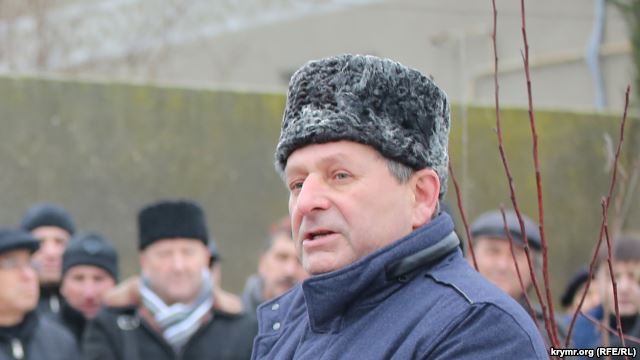
Ahtem Chiygoz, a member of the Mejlis of the Crimean Tatars who has spent the last year and a half in jail on trumped-up charges of "organizing rioting" and "destruction of property." Photo courtesy of 112 UA and RFE/RL
Ahtem Chiygoz, a member of the Mejlis of the Crimean Tatar People who has spent the last year and a half in jail on trumped-up charges of “organizing rioting” and “destruction of property.” Photo courtesy of 112 UA and RFE/RL. See the second article, below, for details

FADN Called on to Protect Ethnic Russians
Irina Nagornykh
Kommersant
July 27, 2016

Nine percent of Russian citizens feel they are discriminated against ethnically. In some regions, for example, Tuva, such citizens constitute as many as twenty-six percent, and they hail from the Russian-speaking population. These figures were arrived at by pollsters commissioned by the Federal Agency for Ethnic Affairs (FADN), Igor Barinov, the agency’s head, said yesterday at the Terra Scientia camp. Barinov promised to protect the ethnic Russian population in such regions, and said next year the agency planned to earmark 170 million rubles [approx. 2.3 million euros] on grants for projects in the field of interethnic relations.

Barinov cited the results of a сlassified Georating survey conducted by the Public Opinion Foundation (FOM) while speaking to young people at the Terra Scientia Russian Education Youth Forum on the Klyazma River on the last day of a session that brought together young experts in the field of interethnic relations. According to Barinov, the poll was conducted in June at the FADN’s behest. Pollsters discovered that, on average nationwide, nine percent of the population experienced ethnic discrimination. In certain regions, however, such as Karachay-Cherkessia and Tuva, the situation was more tense. In Tuva, twenty-six percent of citizens complained of ethnic discrimination.

According to Barinov, the number coincided with the number of Russian speakers resident in Tuva, which means we can assume it was this segment of the population who felt they were ethnically discriminated against. Barinov was asked who would protect the interests of ethnic Russians. According to some young people in the audience, ethnic Russian were not as well organized in defending their interests as other ethnic groups in Russia. Barinov cited the fact that 115 million ethnic Russians resided in the Russian Federation, which constituted eighty percent of the country’s population, and in places where the ethnic Russian population predominated, as in Central Russia, this assistance was social and economic in nature. But in regions like Karachay-Cherkessia and Tuva, he promised to protect ethnic Russians.

“We have the authority,” he stressed.

Responding to the same question, Magomedsalam Magomedov, who oversees ethnic relations in the presidential administration, said the “Russian people’s historical mission [was] to unite Russia’s ethnic groups,” and the outcome was the “emergence of a unique civilization whose national leader is President Vladimir Putin.”

“None of the ethnic groups in Russia can feel good if the Russian people feels bad,” concluded to Mr. Magomedov.

According to Barinov, next year the FADN plans to allocate around 170 million rubles on grants for projects in the field of ethnic relations.

“If everything is okay with the budget. We’re at the head of the Finance Ministry’s queue,” he added, reminding the audience that the FADN is awaiting the transfer of the part of the Federally Targeted Program for developing Crimea that concerns the rehabilitation of ethnic groups repressed during Soviet times.

Campers will receive several grants in the amounts of 300,000, 200,000, and 100,000 rubles to support existing interethnic policy projects in the country’s regions from the camp’s organizers: the Russian Federal Public Chamber, Rosmolodezh (Russian Federal Agency for Youth Affairs), and the presidential administration’s Office for Domestic Policy. Moreover, the FADN plans to summarized suggestions made by the campers on concepts for celebrating National Unity Day (November 4), including the brand Russian Braid, which would weave together all the peoples of Russia, comics about different ethnic groups on buses, video clips in airports, and the project Travel with Purpose, which would involve ethnic youth exchange tourism. Session participants plan to appeal to the present not to limit the celebrations to one day a war, but to declare an entire “year of national unity.”

Translated by the Russian Reader. Thanks to Sergey Abashin for the heads-up

________

Who Is Ahtem Chiygoz? The Story of a Crimean Tatar Political Prisoner
Ehor Vasylyev
112 UA
July 29, 2016

A Case That Will Last for Years
Ahtem Chiygoz was arrested on January 29, 2015, as part of the so-called February 26 case. That day he went to the State Investigative Committee in Crimea for questioning, and in the evening the illegitimate Kyiv District Court of Simferopol sentenced him to three months in police custody.

Chiygoz was charged under Article 212.1 of Criminal Code of the Russian Federation: organization of riots accompanied by violence and destruction of property.

Russia accuses activists of being involved in the “riots” on February 26, 2014, which arose near the Crimean parliament during two rallies, one held by the supporters of Ukraine’s territorial integrity , another, by activists of the party Russian Unity.

Since Chiygoz’s arrest, the Crimean courts have been periodically extending his time in police custody. (The last time it was extended until October 8, 2016.)

From March 8 to March 11, 2016, Chiygoz was a hostage: a so-called judge of the Crimean Supreme Court, Galina Redko, arbitrarily (extrajudicially) extended his time in jail.

In addition to Chiygoz, other Crimean Tatars have been charged with involvement in the “riots”: Ali Asanov, Mustafa Degermendzhi, Eskender Kantemirov, Arsene Yunusov, and Eskender Emirvaliev.

The first two have been in police custody for over a year. Another two men, Eskender Nebiev and Talat Yunusov, have already been convicted and sentenced to probation.

In February 2016, two years after the events, the court decided to re-investigate the case. Chiygoz, Asanov, and Degermendzhi were forced to remain in custody.

On July 20, the preliminary hearing began, but it was closed to the public. The Supreme Court of Crimea proposed to divide the case and try Chiygoz separately from the other defendants.

“There are 80 injured parties and witnesses: the case could drag on for years. The court usually questions one or two witnesses a day,” says one of Chiygoz’s lawyers, Emil Kurbedinov.

An Alien Land
Russian prosecutors accuse Ahtem Chiygoz of acts carried out in Ukraine by a Ukrainian citizen against other Ukrainian citizens. Russian prosecutors have prosecuted only Crimean Tatars.

The prosecution is trying to assert the right of the Russian justice system to react to the February 26 rally, which was allegedly directed against Russian interests. The prosecutor general says Russian Unity had a special permit for holding a rally, while the Mejlis did not have such a document.

In addition to violence during the riots, Chiygoz is accused of destruction of property.

“Unidentified Crimean Tatars rushed into the Crimean Parliament, damaged and destroyed its property in the amount of 9,730 rubles,” claims one of the court documents. However, a few hours after the incident, armed Russians occupied the Crimean Parliament and also damaged property.

Why Chiygoz?
“Ahtem Chiygoz at first took a moderately radical position. The prosecutor’s office called him a man ‘in charge of the Mejlis power bloc.’ In winter 2014, he openly expressed the quite radical position that we should not recognize anything,” noted First Deputy Chairman of the Mejlis Nariman Jalal.

In fact, Chiygoz’s position coincides with the opinion of Ilmi Umerov, who is known as an experienced, fairly moderate politician. Ilmi Umerov is quite close to Chiygoz. They both belong to the Bakhchisarai wing of the Mejlis.

“In 2014, we organized many pickets, along the roads, near the military units. Ahtem was actively involved in organizing these events,” says Umerov.

Chiygoz was warned about avoiding “extremist activity,” and some people even complained about him to the Russian FSB. However, Chiygoz did not stop his work, and a month before his arrest, he attended a meeting between Crimean leaders Mustafa Dzhemilev and Refat Chubarov and Ukrainian President Poroshenko.

In 2014, the two Crimean Tatar leaders, Dzhemilev and Chubarov, were not allowed entry to Crimea.

“Chubarov had five deputies, and Ahtem was the main one,” Umerov explains.

Dzhemilev and Chubarov were refused entry to Crimea as a part of a Russian plan. The Mejlis should be headed by a collaborator. Ahtem Chiygoz was the main obstacle to implementing this plan.

“The Russians believed that Chiygoz encouraged them to rebel. That was why they decided to remove him. At the same time, Chiygoz has been a ‘show’ victim: do not stick your heads out, otherwise your fate will be the same,” stresses Nariman Jalal.

But the plans to co-opt the Mejlis have failed.

“It was a miscalculation. They thought Chiygoz was a kind of central link. They failed to realize the majority of the members of the Mejlis took the same position as Chiygoz; they did not want to be co-opted,” adds the First Deputy Chairman of the Mejlis.

Chiygoz called upon all Crimean Tatars to harshly boycott compatriots who collaborated with the occupying power.

“Different challenges have befallen our people. And we deal with them with honor! No one can break us with prisons or camps! We are not afraid of searches and arrests! We cannot be fooled by puppets! Crimea will never be without the Crimean Tatars,” Chiygoz has written from prison.

And his name is etched in gold in the history of Crimea.

The original of this article was published, in Russian, by Ukrainska Pravda. I have lightly edited the heavily abridged English translation, above, to make it more readable. TRR

The Prosecutor General’s Speech

Crimean Prosecutor General Natalia Poklonskaya, arguing before the Crimean Supreme Court today, April 26, 2016, on why the Mejlis of the Crimean Tatar People should be declared an extremist organization and banned in the Russian Federation.

Crimean Prosecutor Natalia Poklonskaya
Crimean Prosecutor General Natalia Poklonskaya. Photo courtesy of Novaya Gazeta

“The Mejlis receives protection and support from international terrorist organizations,” she said. “It is no coincidence that such organizations, which are banned in Russia, as the Gray Wolves, who killed Russian pilot Oleg Peshkov in Syria, and Hizb ut-Tahrir have spoken out in support of the Mejlis.”

According to Poklonskaya, Mejlis leader Refat Chubarov “has not ceased [his] extremist activities even during proceedings on banning the organization, but on the contrary has continued work aimed at violating Russia’s territorial integrity, participating in the formation of the volunteer Crimean Tatar battalion Asker, whose goal is to tear Crimea away from Russia.”

“Today, may it please the court to hear, we are building a world in which every Crimean will live safely and happily, where roses will bloom and grapes grow,” said Poklonskaya. “The Mejlis is trying with all its might to prevent this. Why do we need this Mejlis?”

Finally, the prosecutor quoted from St. John of Kronstadt.

“If we gather everyone’s will into one will, we will stand our ground! If we gather everyone’s conscience into one conscience, we will stand our ground! If we gather everyone’s love for Russia into one love, we will stand our ground!”

Source: Novaya Gazeta

_________

The Mejlis was labeled an “extremist organization” and subsequently banned by the Crimean Supreme Court on April 26, 2016. According to Regional Prosecutor General Natalia Poklonskaya, it was banned because its leaders had sought to destabilize Crimea since the 2014 annexation of Crimea by Russia through the “promotion of aggression and hatred towards Russia, inciting ethnic nationalism and extremism in society.” Also on April 26, 2016, the Council of Europe’s Commissioner for Human Rights, Nils Muižnieks, urged the court to reverse the ban since he believed “equating [the Mejlis] with extremism paves the way for the stigmatization and discrimination of a significant part of the Crimean Tatar community and sends a negative message to that community as a whole.” Exiled in mainland Ukraine, the Chairman of the Mejlis, Refat Chubarov, stated the court’s decision was unjustifiable and that “the occupiers in Crimea are doing everything to crush the Crimean Tatars and force everyone to be silent.” Amnesty International stated the ban “demolishes one of the few remaining rights of a minority that Russia must protect instead of persecute.” The Deputy Chairman of the Mejlis, Nariman Dzhelal, vowed the organization would try to continue its work despite the ban, “it will continue working in Ukraine and other countries.”

Source: Wikipedia (slightly adapted for readability)