International politics have reached Carmel. Carmel Music Society canceled a November concert featuring Russian pianist Valentina Lisitsa [lisitsa means “vixen” in Russian], who had performances scrubbed in recent years due to her perceived pro-Russia views. Agata Popęda here, the Weekly’s Slavic expert-in-chief, with at least a part of the story.
Lisitsa comes with quite a background. Of mixed Russian-Ukrainian-Polish heritage, she was discovered as a talented pianist by a YouTube audience while living in North Carolina in 2013. The same year, she was described as “the classical pianist with 55 million YouTube hits,” then signed to a label in May, which released her London concert debut—at the Royal Albert Hall—a month later.
While her YouTube videos and most Facebook posts show her life as a musician, Lisitsa mostly uses Twitter (now X) to share her political views. Posts start in the time of the pro-Western Maidan protests in Ukraine, which resulted in the ouster of the country’s pro-Russia president in 2014.
But soon her tweets and retweets became more provoking. “If people are really interested in digging deeper, they can see that I am not pro-Putin, I’m not pro-Russian. I’m an equal-opportunity slanderer,” she said in an interview. She also tweeted: “In a new European Ukraine, the camps will give the subhumans [ethnic Russians] condemned to the gas chambers an opportunity to offset their carbon footprint.”
In 2015, her concert with the Toronto Symphony Orchestra was canceled after controversial comments she made about the conflict in eastern Ukraine. Since then, many venues and organizations have done the same.
In early 2022, when Russia invaded Ukraine, Lisitsa expressed her opposition to what she considered Western interference within Ukraine. On May 9, 2022 she played a concert in Mariupol, Ukraine in commemoration of its control by Russia.
It’s unknown if her Carmel cancellation was directly related to her posts—Carmel Music Society declined to comment on the situation, while Lisitsa had not responded to a request for comment as of press time.
Naturally, this story also presents a free speech issue, and when and where free speech ends. On X? On the streets? In a concert hall? And then, we have questions about artists as political individuals. Do they owe us moral decency because they are in the spotlight?
After embracing Russia’s war on Ukraine, Valentina Lisitsa, a Kyiv-born classical pianist and the self-styled “Queen of Rachmaninoff,” has seen her concerts canceled around the world. But not in Bulgaria’s capital, where the 53-year-old pianist is expected to play twice in April.
The move is sparking backlash and calls for her planned performances to be canceled. Amelia Licheva, a professor of literature in Sofia, told RFE/RL’s Bulgarian Service that she wants recently installed Bulgarian Culture Minister Nayden Todorov, an accomplished musician and conductor who has performed with Lisitsa and still directs the Sofia Philharmonic, to exclude Lisitsa from the April 20 and 23 concerts to celebrate 150 years since the birth of Russian composer Sergei Rachmaninoff.
“The thesis that we should judge the creator by their art and not by their personality is fundamentally important, but not always effective,” Licheva said, calling the Sofia Philharmonic’s invitations “shameful and immoral.” In a time of war, she said, “art must give way to morality.”
Lisitsa’s troubles started in 2015, when her concert with the Toronto Symphony Orchestra was canceled after controversial comments she made about the conflict in eastern Ukraine. Lisitsa lashed out on social media, accusing “haters” of trying to “silence me as a musician.”
Controversial Statements
Among other controversial statements, Lisitsa described Ukraine’s situation after 2014 as a “civil war” and repeated pro-Kremlin talking points such as the prevalence of “neo-Nazi” elements in Ukraine. She touted herself as having become adept at “unmasking fakes published by Western media.”
A few months after the Kremlin’s full-scale invasion of Ukraine in February 2022, Lisitsa performed under Russian occupation in the devastated southern Ukrainian city of Mariupol. A video clip of her playing and her purported rendition of “Victory Day” were used by Russian-backed separatists and pro-Kremlin state media to propagandize for Russian “liberation.” The clip’s timing, May 9, appeared to be symbolic as it fell on the day that Russia marks its victory in World War II over Nazi Germany, further infuriating Ukraine’s defenders on social media.
In May 2022, Budapest’s Margitsziget Theater canceled a planned performance by Lisitsa, citing the Mariupol appearance and, in December of the same year, an invitation to play at the legendary La Fenice opera house in Venice was withdrawn by the organizers.
Born to a Ukrainian father and a mother of Russian and Polish descent, Lisitsa grew up speaking Russian. After graduating from the conservatory in Kyiv she moved to the United States in 1991 with her partner, fellow pianist Aleksei Kuznetsov, whom she later married. A biography on Lisitsa’s website said in 2019-20 that she was splitting her time living between Moscow and Rome.
In 2007, she posted her first video on YouTube of herself playing the piano; by 2012, she was the most popular pianist on the video-sharing platform, with her clips getting millions of views.
The Washington Post’s chief classical-music critic in 2013 hailed Lisitsa as salvaging a “tanking” career to become “a growing star with a big-label recording contract and concert dates with the big orchestras and in the big recital halls of the world.”
Lisitsa has defended some of her social-media posts. “If you wish, please take the time to read my tweets. You may find some of them offensive — maybe. Satire and hyperbole are the best literary tools to combat lies,” she wrote in a 2015 Facebook post.
Despite the other cancellations, the concerts in Sofia appear to be going ahead. Lisitsa last made a guest appearance for the Sofia Philharmonic Orchestra in October 2021, notably performing under Culture Minister Todorov’s baton in a guest appearance.
‘It’s Shameful’
Critics have praised the efforts of Todorov, who was named culture minister in February, to expand the list of guest soloists and collaborators after he took over the Sofia Philharmonic in 2017. It is unclear when the Sofia Philharmonic extended its invitations to Lisitsa for the upcoming concerts and neither the philharmonic nor the Culture Ministry responded to RFE/RL inquiries for this article.
Addressing Todorov, Licheva wrote on Facebook that “inviting her several years ago was possible, today it is not!” Licheva, who teaches at Sofia University’s St. Kliment Ohridski, said that the events “should be canceled urgently; it’s shameful!”
Speaking to RFE/RL, Licheva acknowledged Lisitsa’s talent but said that, by siding with an undemocratic aggressor, “she becomes the object of another type of assessment.” The appeal to around 4,600 Facebook followers sparked more than 170 likes and dozens of comments, but seemingly failed to attract widespread support.
Bulgaria is a member of the European Union and NATO with a history of close ties to Russia. Against a backdrop of institutional political crisis, Bulgarians have grappled with a unified response to Russia’s invasion of Ukraine.
Regarding public perceptions of Russia in Bulgaria, Dimitar Bechev, a visiting scholar at Carnegie Europe and a lecturer at Oxford University, told RFE/RL in October 2022 that “sociological surveys have indicated that one-quarter to one-third of the electorate holds strong pro-Kremlin views,” although adding “that’s about the same percentage of the staunch pro-Western Bulgarians.”
Lisitsa is not the only musician to face repercussions for supporting Putin or failing to criticize Russia’s war on Ukraine. Conductor and Kremlin-loyalist Valery Gergiyev was fired in March 2022 from his position as chief conductor of the Munich Philharmonic. A Kremlin-friendly Russian pianist, Denis Matsuyev, faced cancellations in Austria, the Czech Republic, and Italy, along with Russian opera singers, Ildar Abdrazakov and Anna Netrebko.
Written by Andy Heil based on reporting by RFE/RL Bulgarian Service correspondent Dilyana Teoharova in Sofia
Ana Tavadze and Dachi Imedadze, members of Georgia’s Shame Movement. Photo: 60 MINUTES
Ana Tavadze: We’re going in with a government that’s completely corrupt, a government that’s pro-Russian, clearly anti-Western, clearly does not really care about what the majority of the population wants and needs.
Ana Tavadze and Dachi Imedadze are members of the Shame Movement – a group with thousands of young followers working towards Georgia’s entry into the European Union.
Ana Tavadze: If Russia wins, it means loss of freedom, loss of everything that we fought for in the past 30 years basically. It’s a fight for values, it’s a fight for where you want to stand in this big fight for democracy.
Dachi Imedadze: As soon as the West in any form, be it the U.S. partnership, be it the European Union, is not represented in this country, Russia will fill the void right away.
They say the influx of Russians is already changing the face of Georgia.
Ana Tavadze: What are they doing, if we look at it? They’re buying apartments. They’re buying private property. They are opening up businesses. Their actions changed — Georgian economy.
Dachi Imedadze: The Russians are buying apartments here in every 33 minutes. They’re purchasing a piece of land in every 27 minutes. And they’re registering a business in every 26 minutes. So, I think we are on the brink of very dangerous situation here in Georgia.
According to public records, Russians have registered more than 20,000 businesses in Georgia over the last two years. And launched five new Russian-only schools, none of which are licensed by Georgia’s department of education.
Russians have driven rent up nearly 130%, prices for everything from food to cars have gone up 7%. over 100,000 Georgians have left the country because many of them can’t afford to live here anymore.
Sharyn Alfonsi: I’ve heard this described as a quiet invasion.
Dachi Imedadze: Quiet invasion, yeah. There is a risk of the economic diversions. There is a risk of military intervention. And there’s a risk of — Georgia’s statehood being destroyed.
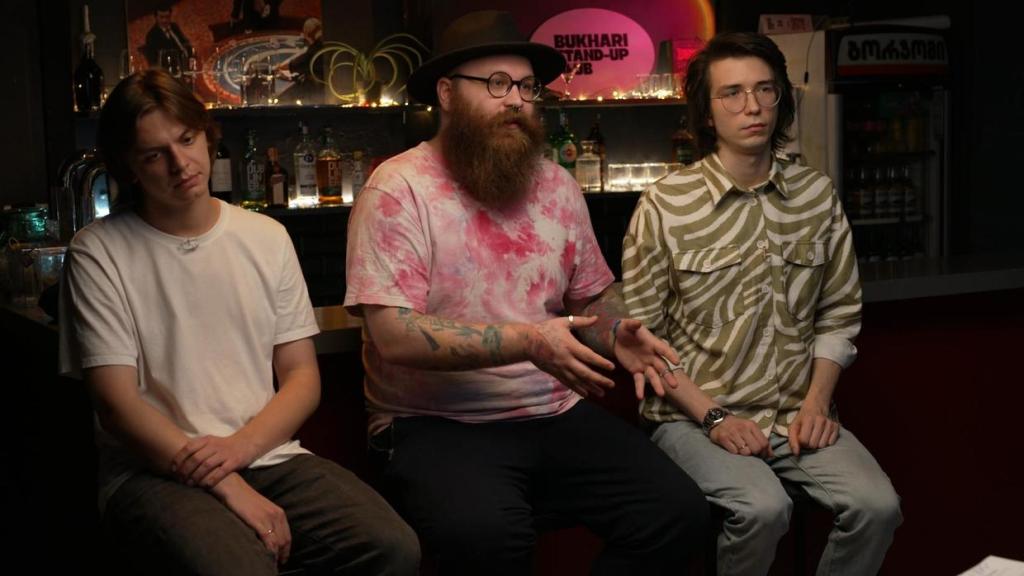
Emmanuil Lisnif, George Smorgulenko and Pavel Bakhadov don’t look like much of a threat.
All Russians in their twenties, they fled their country for fear of being drafted or imprisoned for speaking out against Putin.
George Smorgulenko, Emmanuil Lisnif and Pavel Bakhadov are all Russians living in Georgia. Photo: 60 MINUTES
They now live in Georgia and work at this Russian-owned comedy club in Tbilisi.
Emmanuil Lisnif: I try and said ‘I’m against the war in Russia. I was beaten. and after that going to prison three times.’
Sharyn Alfonsi: So three times you went to jail?
Emmanuil Lisnif: Yes, yes three times.
Pavel Bakhadov: I believe and I know that Russians actually against the war.
Sharyn Alfonsi: You think that most Russians are against the war?
Emmanuil Lisnif: Yeah, just scared, really scared.
Sharyn Alfonsi: Have any of you had any aggression towards you because you’re Russian?
Pavel Bakhadov: Actually I have a big writing on the wall. It’s the biggest thing I see from my window, just big ‘Russians go home.’
There is no subtlety in spray paint… anti-Russian graffiti blankets the city along with support for Ukraine.
This text is based on interviews I did as part of the Hidden Opinions public opinion polling project, which I launched in 2022 and continued in 2023 and 2024. I spoke with dissenting Russians — with those who oppose the current regime and its military actions against Ukraine, both those who have stayed in Russia and those who have left the country. My youngest respondent at the time of the [first] survey was sixteen years old, while the oldest was seventy-two years old. These people hail from a wide range of professions and walks of life, but what they have in common is their categorical opposition to the actions of the Russian authorities. In just two years, I have interviewed 154 people for this project, some of whom I have spoken with two or three times.
In 2022, all of my respondents — both those who had left the country and those who stayed — espoused anti-war views and expressed a negative attitude toward the Kremlin’s policies. However, in 2023, about a year and a half after the war’s outbreak, a group amongst my sources in Russia emerged. Small at first, but constantly growing, it consisted of people who had changed their negative attitudes toward the war and/or the government.
This does not mean that such changes are impossible among those Russians who have left the country. Amidst a full-scale war, research based on representative samples is hampered by the fact that the most accessible respondents are those who have agreed to be interviewed as a result of self-selection. This is a significant limitation to the project.
My research is qualitative, not quantitative, meaning that it would be wrong to speak of a particular percentage of anti-war Russians who have become pro-war. I think it is important to study and understand how views are transformed and what triggers them to change. It is the subject of this text.
***
The sociologist and philosopher Zygmunt Bauman, experimenting with means of gauging the conservatism–to–radicalism spectrum, asked his students to do the following exercise. They were shown twenty drawings, the first one depicting a dog, the last one depicting a cat; in between, the dog gradually shed its canine features and turned into the cat. It was vital that the researcher record the moment when the test subjects had doubts about what exactly was depicted in the picture, when they realized that the dog had mutated irreversibly. In a sense, I have been doing something similar, trying to record the moment at which anti-war or anti-Putin views have been transformed into pro-war or pro-government views.
I have observed that such a change in views depends on a number of extrinsic factors, and the more such factors that are combined, the more likely it is that the person’s stance will change. In addition, a great deal is determined by an individual’s (psychological, social, etc.) resources. Finally, inconsistent views play an important role in transformation and adaptation. In recent years, sociologists have increasingly noted that people often pursue mutually exclusive goals simultaneously without noticing the contradictions in their own behavior.
New rationalizations, disillusionment and loneliness
The gradual realization that the war is a long-term affair, combined with Alexei Navalny’s sudden death in a penal colony, has had a considerable impact on those resisting the regime within Russia. One can swim against the current, but it requires a considerable amount of strength, something not everyone possesses. It is difficult to be amongst the minority for years on end, to conceal one’s views and live in fear of being reported to the authorities. Respondents have thus begun reformatting [sic] their attitude to reality, explaining events in a new light and providing new rationalizations.
Failing to receive the expected support from the outside world or the possibility of a dignified workaround, some of my respondents eventually chose non-resistance to the regime, which in some cases has transmogrified into full-fledged loyalty.
“I don’t want to go to prison, I don’t want to play the rebel. I just want to live. If they send me to listen to ‘Exorcist TV,’ I’ll go without question. If they tell me to go to a [pro-war] concert, I’ll go. I’m not trying to convince anyone of anything anymore. I’m tired. I can only accept it and live the life I have.”
This stance is not directly bound up with support for the war or the regime. Rather, it indicates fatigue and the lack of strength to resist. If the circumstances shift in a direction more in keeping with their own values, these people will gladly slough off the “burden of adaptation.”
It is worth noting that, over the last year, many of my respondents have stopped following the news and focused on their daily lives. There are respondents who, despite the troubling times, have decided to have children. This is also a way of disconnecting from current events.
Another important factor influencing the change of respondents’ views is the narrowing of their circles of trust. Fearing denunciation, dissenters avoid making new contacts. Afraid of being alone and unwilling to live in fear, uncertainty and/or exile, they then join the majority.
The distance between Russians who have left Russia and those who have stayed in Russia has grown greater with every passing year. In 2022–2023, when I asked my respondents about opposition members who had left Russia, they most often would say nothing or would limit themselves to brief remarks along the lines of “We still watch them on YouTube, but they have less and less sense of what’s happening at home.”
Expressions of resentment and frustration have become more frequent in my interviews in 2024. My sources have said that the opposition often engages in wishful thinking and plays fast and loose with the facts, and that the west does not always act logically and decently.
Consequently, previously opposition-minded people have chosen to abandon painful and exhausting self-reflection in favor of loyalty to the regime. This helps them to get on with their lives, normalizing both the war and the political crackdowns. As one respondent put it, “Since the opposition and the west cannot be trusted, we will make friends with Putin. He is an ogre, but he is our own ogre.”
“Western countries seem to be doing everything to help Putin’s propaganda machine. I was quite surprised when I heard Angela Merkel say that all our negotiations were just a smokescreen: we wanted to let Ukraine catch its breath, and the negotiations were just a deception. That is, the leader of one of the largest countries in Europe openly says: a) we can’t be trusted in any negotiations, and b) we have conspired to deceive you. […] Putin’s propaganda machine skillfully makes use of this. But the point is not that the propaganda machine is using it, it’s that it is reality. As a normal person, a question occurs to me: if they treat us this way, [then] we are their enemies. After such statements, the ‘west’ is regarded as the enemy of Russians, and, accordingly, their enemy — Putin — is our friend.”
Those respondents who have changed their views on the war emphasize that when the west blocked their bank cards and accounts, when they heard what Ukrainians (including their relatives and friends) were saying about Russians and how they called for killing them, they decided that the current regime, whatever it was like, was less hostile to them on balance.
Tired of guilt, shame, disappointment and indignation, they have essentially chosen peace by joining the majority and accepting the existing rules: don’t discuss politics, don’t speak out publicly, swear to the values that the government declares. This choice seems reasonable to them in a situation in which no political activism is possible anyway, and the political crackdown machine is only picking up steam.
This strategy ensured material well-being and career success for some of my respondents. For example, some mid-level specialists in the IT sector received good positions and salaries, while for other people the involvement of their relatives in the war has been a means of social mobility and a source of access to material goods. Still others have benefited from the war by arranging parallel imports, etc.
Another factor contributing to the shift in sentiment from anti-Putin to pro-government has been the radicalization and polarization of society.
“A sharp delineation between ‘black and white’ leads to the opposite outcome. Any attempts to express doubts about the actions of the Ukrainian or western side are automatically regarded both inside and outside [Russia] as pro-Putin behavior, the outcome of brainwashing, etc. The other side appears infallible and beyond criticism.
“If you criticize the west’s actions in any way, you are automatically pigeonholed as a ‘Putinist.’ It makes me feel like saying: if that’s how you treat me, well, to hell with you, chalk me up as a Putin supporter.”
The state of rejection and isolation provokes protests amongst some people: since the west condemns them for staying in Russia, they “will go the full mile and become real orcs.”
The mechanisms by which feelings of rejection are transformed into collective pride have been described by researchers and are not unique to Russia. These feelings reinforce nationalist sentiments and contribute to the strengthening of authoritarian regimes.
Emotional dilemma
Speaking about the change in their views from anti-war to pro-war, my respondents noted that in one way or another they were surrounded by people who had suffered in the war: classmates or school friends who had been drafted to the front or had volunteered for combat, their children, colleagues, and mere acquaintances. Telling them straight to their face that their sacrifices were in vain had become both emotionally more difficult and more dangerous. To maintain relationships and friendships, my sources generally had to listen in silence to their acquaintances’ stories about what they had experienced and seen at the front. And if they were people who mattered to them, it was impossible not to sympathize with them.
We should understand that Russians who initially opposed the war and the regime but remained in Russia feel definitely closer to those who went to the front or delivered humanitarian aid there than to those who have left the country. They are “in the same boat” as their relatives, friends, and colleagues. They feel compassion for them.
“When we were teenagers, all sorts of things happened. If the guys were caught [by the authorities], I would perjure myself and lie in all sorts of ways. Later I could tell them what I actually thought of them, but I wouldn’t abandon them. That’s not the way that blokes do things. Now I realize with my head that they are wrong a hundred times over, but they are my boys, I am on their side. And even if I am against the war, I cannot be against them.”
Propaganda equates anti-war sentiment with betrayal, and it paints people who espouse such views as accomplices of Russia’s enemies, who want to kill as many Russians as possible. This causes a very heavy feeling, my respondents note.
Meanwhile, the state softens such emotional blows by offering loyal citizens new benefits and additional material and social goods, free concerts, and beautiful and comfortable urban environments, demonstrating concern for people in general and for those returning from war in particular. “People-centeredness” has become the buzzword in the PR strategies of many employers and officials throughout Russia.
Russians who are concerned about their neighbors also respond to calls for help front-line soldiers, because amidst war and external isolation it is these people with whom, they say, they “share a common plight.” One of my respondents, overwhelmed by such sentimental feelings, volunteered for the army.
As a religious man, he hoped he would not face the need to kill others, but would be able to help “his boys” without bearing arms, because he “could not stand on the sidelines any longer.” If the need to kill arose, he would desert, my source had decided, explaining that he was emotionally prepared to be beaten up and go to prison.
Another type of people whom I have encountered more and more often are those whom researchers Maria Lipman and Michael Kimmage have characterized as anti-anti-war: these people do not necessarily support the war, but they strongly condemn or resent “unpatriotic” fellow citizens who do not support the Russian army or who even take the side of Ukraine.
Seeing soldiers returning from the front and watching the growing number of Russians killed in combat, my sources now often place the blame not on Putin or the Russian military, but on their compatriots who oppose continuing the war until Russia achieves total victory.
Ressentiment and the “demons” of propaganda
Propaganda has awakened ressentiment in some of my respondents. They have come to believe that this war is really about maintaining Russia’s status as a great power, which its enemies are trying to flout and rob. Such people believe it vital that Russia maintain its status as a victor, and they accept the state-imposed version of Russian history that asserts Russia’s greatness in all periods.
War, as happens under autocracies and dictatorships, is seen as the ultimate manifestation of the nation’s strength and vitality and a guarantee that its culture and traditions will be maintained. In conversations with me, my sources have repeatedly used the phrase “releasing demons,” referring to the fact that the current situation helps their acquaintances and themselves experience a sense of unity and superiority over the rest of the world, a sense of their own righteousness and chosenness.
Some respondents noted that the official rhetoric, concrete and catchy, seemed more acceptable to them than the verbose arguments and meaningless self-reflections of the opposition.
Meanwhile, according to my respondents, the number of anti-war-minded Russians today is decreasing. Since Navalny’s death, I have often heard in interviews that every second or third person in the orbit of my sources has changed their views.
It is difficult to say how strong this trend really is. I would estimate that a third of those who unequivocally opposed the war and the regime when I spoke to them [initially] have changed their views, but of course these numbers are in need of supplemental verification, which is not easy to accomplish today. There are probably also people who have switched their pro-war patriotic views to oppositional ones, but I assume that we hear the voices of these people even less frequently.
Respondents who are in a state of uncertainty and/or in the course of switching their views feel the need for support, at least informational support. They need arguments explaining that anti-war sentiments are not a betrayal and that the current war is destroying Russia, not restoring its greatness. But they also acknowledge that such an argument would hardly convince them under the current circumstances. For now, the only thing they think they can do is to maintain their sanity and adapt to reality in order to live to see better days.
***
The Russian regime has proven to be “smarter” and more adaptive than Russian opposition activists and western democracies thought, but this does not mean there is no point or possibility of supporting by any means possible those who have remained in Russia and are still resisting the regime or straddling the fence. One way or another, positive change in Russia is impossible without their involvement.
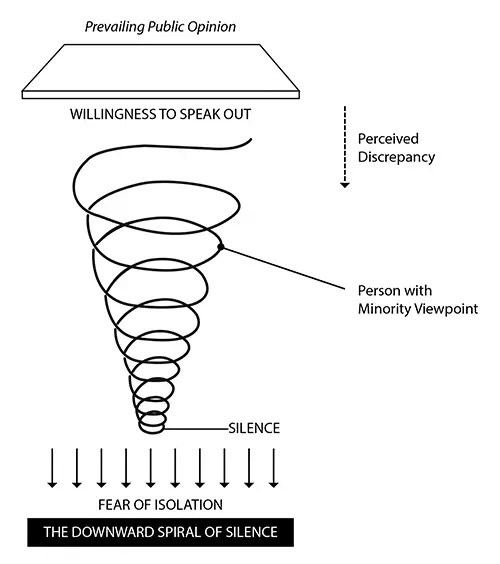
Popular opinion polls show that the majority of Russians support the military action in Ukraine. Researchers, however, continue to argue that society’s support for the war is much lower than these figures suggest. In their new study “Perception of the conflict with Ukraine among Russians: testing the spiral of silence hypothesis,” V.B. Zvonovsky and A.V. Khodykin, drawing on Elisabeth Noelle-Neumann’s “spiral of silence” model, argue that many opponents of the war are not willing to voice their opinion, believing that it is unpopular and fearing social disapproval.
Noelle-Neumann argues that before people with a “limited interest in politics” decide to voice their opinion on a politically significant matter, they assess the risk of being condemned by others. The spiral of silence “twists” as follows: people who are afraid of being isolated due to the unpopularity of their opinion refrain from voicing it → this opinion is thus heard less and less often in society → people thus increasingly think that their own opinion is not popular → they are thus even less likely to be willing to voicing it.
Zvonovsky and Khodykin discovered that the spiral of silence actually does have a great impact on discussion of the Russian-Ukrainian conflict in Russian society. They were able to verify this by doing a nationwide telephone survey (N = 1977) using Noelle-Neumann’s “train test.” The “train test” measures the willingness of “adherents of a particular stance on a socially significant matter to openly voice it by discussing it on a train with a random fellow passenger.” Supporters of the more popular stance, in their opinion, are more likely to openly voice it, believing that they are “in a stronger camp and less at risk of being judged by others.” Sometimes, their opponents are also encouraged to side with the “stronger” position.
Applying the “train test” to the Russian context showed that the topic of the war is highly sensitive both to its supporters and opponents, and that the spiral of silence affects both sides of the discussion. However, its impact on opponents of the war has proved to be much stronger than on its supporters. Thus, people who oppose the special military operation in Ukraine are less willing to discuss the Russian-Ukrainian conflict with those who support it.
Another important finding made by the researchers is the fact that a person’s willingness to speak out about the war is influenced most by the distribution of opinions about it in their immediate circle of acquaintances. So, the more people in the orbit of respondents who had shared a similar opinion with them, the more the respondents were willing to discuss the war, and vice versa. It can be assumed that the need to maintain social ties is stronger for Russians than the need to defend and disseminate their political views, as we noted in our analytical report “The war near and far.” Zvonovsky and Khodykin suggest another explanation, however: the “bad experience” of political discussions, which often end in conflict and frustration, also has an impact, since the opinions of interlocutors are not changed, and the desire to talk about the war with one’s political opponents thus simply disappears.
The last interesting finding of the authors about which we want to tell you is the following. If the environment of the respondents is divided approximately equally (~50% “for” the war and ~50% “against”), then the probability that those oppose the special military operation will discuss it does not decrease—unlike supporters of the war, who are much less likely under the same circumstances to discuss the military operation with strangers of opposite views. Thus, the opponents of the military conflict “have learned to resist the spiral of silence better than their opponents.” This means that if the distribution of opinions in Russia changes, “opponents of the military conflict will have greater opportunities than [their] opponents to promote their own narrative about the Russian-Ukrainian conflict.”
IOWA CITY, Iowa — Anti-Donald Trump Republicans know they are in the middle of a critical moment to stop the former president’s political comeback. But for some, the steep cost of voicing resistance to Trump often renders them silent.
“If you go against Trump, like — you’re over,” said Kyle Clare, 20, a member of the University of Iowa’s College Republicans.
“I don’t talk about Donald Trump a lot because I’m afraid of the backlash,” said Jody Sears, 66, a registered Republican from Grimes, Iowa.
“If you would say something negative about Trump, we had one person that would just go bang for your throat,” said Barbra Spencer, 83, a former Trump voter describing her experience living in senior apartments in Spillville, Iowa.
Trump still enjoys broad popularity in the Republican Party, and that’s driving his polling leads among Republicans in Iowa, New Hampshire and every other state ahead of the 2024 primaries. But he has also used that popularity to enforce unity. And the same impulse that has led Republican officeholders to avoid criticizing Trump because of potential threats to their safety and their jobs is also holding back rank-and-file voters from opposing the former president in public with the full strength of their personal convictions.
NBC News spoke to more than a half-dozen Iowa voters turned off by Trump — but some were anxious about talking on the record out of fear of being shunned by friends or family. One Iowan said they plan on saying they caucused for Trump when asked by members of their community but will actually caucus for Vivek Ramaswamy.
That adds up to signs going unplaced on front lawns, conversations with friends and family about other candidates avoided — and fewer opportunities for opposition to Trump to take hold in different Republican communities.
NBC News first spoke with Clare in a University of Iowa auditorium Aug. 23, the night of the first GOP presidential debate. Fellow College Republicans were reacting to the debate and voicing steadfast support for the GOP candidate who wasn’t on the stage: Trump.
Clare chose to wait until the end of the night, after the rest of his classmates left the auditorium, to share his thoughts.
“I’m just so scared of doing this right now,” he said, fighting back tears. “I want to be able to have my opinions on our politicians, and I want to be able to speak freely about them and people still understand I’m a conservative.”
Clare criticized Trump, particularly for his actions Jan. 6, 2021, saying, “The end of his administration was un-American.” He also said Trump’s supporters are in denial about losing the 2020 election.
“They don’t want to believe he lost the election. It’s hard to swallow. Losing is hard to swallow. But it’s important that when we lose, we recognize that we lost and we think, ‘What can we do better next time to win over Americans?’” Clare said.
Clare was right to expect backlash from speaking out on Trump. After NBC News published the interview with him on a “Meet The Press” social media account, hateful and homophobic comments poured in. Clare said later that a student came up to him at a university event, shoved a phone in his face with the video on it, and asked him why he’s “scared of Trump and not scared of getting AIDS from having gay sex.”
“Say something they disagree with, and they go after your sexuality,” said Clare, who added that he doesn’t regret doing the interview with NBC News. Many of the comments questioned if Clare — who holds a leadership role at the University of Iowa’s College Republican organization, interned for a Republican on Capitol Hill, and is heavily involved in the Johnson County, Iowa, GOP — was truly a Republican.
“I think it shouldn’t be a bad thing for me to say I am conservative and that I think there are other options, and I don’t think that this person is good for our country,” Clare said. But he’s worried those opinions will stunt his own long-term political ambitions.
“If people as powerful and as prominent as members of Congress can be taken down because of their criticisms of one man, what’s stopping that from happening to me?” Clare noted, referring to the Republicans ousted from Congress after voting to impeach Trump.
Trump’s criticism forced several senators and House members into retirement or primary defeat during his first years in office. Later, of the 10 House Republicans who voted to bring impeachment charges against Trump following the Jan. 6 Capitol riot, four retired before facing voters in 2022 and another four lost their next primaries. Only two remain in the House.
In the Senate, three of the seven Republicans who voted to convict Trump have since retired or resigned, and Sen. Mitt Romney of Utah is retiring next year.
Romney recounted to biographer McKay Coppins that Republican members of Congress confided to him they wanted Trump impeached and convicted but would vote against the charges because they were worried about threats to their families.
Former Rep. Liz Cheney of Wyoming, one of the Republicans who lost a 2022 primary after voting to impeach Trump, detailed similar conversations in her new memoir.
Cheney wrote about one colleague that she “absolutely understood his fear” about what would happen if he voted to impeach Trump. But, she continued, “I also thought, ‘Perhaps you need to be in another job.’”
‘It was easier to be quiet about it’
Rank-and-file voters are less prominent and thus less likely to be harassed or threatened, but some of the same worries and experiences remain. Sears, the Republican from Grimes, Iowa, feels Trump doesn’t reflect her values. But that’s an opinion she kept to herself until recently, because of the fear of being cast off by family and friends.
“Family and people I work with are Trump supporters,” said Sears, describing her hesitancy to speak out about her beliefs.
“I think Trump supporters tried to coerce or bully people into also being Trump supporters. And so it was easier to be quiet about it,” she said.
Spencer, a retiree now living in a nursing home in Decorah, Iowa, says Trump supporters at her previous retirement community created a toxic environment that stopped her and her friends from voicing opinions.
“We were afraid of arguments,” she said. “When you live with that many old people, sometimes they have very strange but very firm thoughts and you better think the way they do,” she said, explaining her silence.
Clare, Sears and Spencer are not the only people who feel this way.
And as Cheney and Romney’s stories demonstrate, social ostracization isn’t limited to just voters who speak out against Trump. Former Rep. Denver Riggleman, a Republican who represented a slice of Virginia from 2019 to 2021, says his mother texted him, “I’m sorry you were ever elected,” after he came out against Trump.
“It was so soul-crushing to have a family member choose Donald Trump over you,” Riggleman continued. He said evangelical Trump supporters in his life saw Trump as being blessed by God. “I was going directly against religious beliefs. And that’s a losing battle.”
It’s now been almost six months since a member of Congress endorsed a non-Trump candidate in the 2024 GOP primary, according to NBC News’ endorsement tracking.
The trend has popped up elsewhere on the 2024 campaign trail, too. When Iowa Gov. Kim Reynolds endorsed Ron DeSantis in November, the Florida governor mentioned in an interview with NBC News that he “had people come to me and say they endorsed [Trump] because of the threats and everything like that” during the campaign.
Trump quickly went after Reynolds after news of her DeSantis endorsement broke, posting on social media that it would “be the end of her political career.”
‘Vortex of controversy and vilification’
Charlie Sykes was a conservative radio show host in Wisconsin for more than 20 years before Trump burst onto the political scene. Sykes was skeptical and critical of Trump, eventually confronting him in a heated interview about insults Trump hurled at Texas Sen. Ted Cruz’s wife in 2016. But for Sykes, it began to become clear that there was no room anymore for anti-Trump conservatives on talk radio.
“The audience of conservative talk radio began to think that loyalty was required. They wanted conservative media to be a safe space for them,” Sykes said, describing how his role became untenable.
After leaving radio, Sykes didn’t let up on his Trump criticism, which he says got him booted from a think tank and led him to lose friends and become a self-described political orphan. He says his criticism was met with bullying — and he understands why people who don’t work in the public eye might be hesitant to voice their true feelings about Trump.
“I do understand why people in their normal lives don’t want to be caught up in this vortex of controversy and vilification — why they would step back from all of this,” Sykes said.
Another longtime Wisconsin Republican recently detailed one of the results of that pressure.
Former House Speaker Paul Ryan recently spoke on video at an event for Teneo, a global consulting firm where he serves as vice-chair. Ryan said the impulse to avoid getting on the wrong side of angry Trump supporters pushed former colleagues to vote against impeachment even though they wanted Trump gone — and now he thinks there are many who regret those votes.
“They figured, ‘I’m not gonna take this heat and I’m going to vote against this impeachment because he’s gone anyway,’” Ryan said. “But what’s happened is that he’s been resurrected.”
All the swindlers are fleeing Russia:
They have property in the West.
The bandits and sodomites are fleeing
And all those killed by their conscience.

The Judases are running, all going there,
Where there is no love, where there is no Christ.
Where there are gay parades and Nazis,
Liberals and globalists.

God is cleansing Holy Russia,
He protects it himself like his own daughter!
He will not let the evil ones torment us,
May God grant that we keep our faith.
Only an ignoramus doesn't understand
Russia as the last hope.

Let the enemy shout that Putin is bad
And under him all in Russia is bad.
If the whole herd of fleas is mad,
Evidently our Putin has done everything right!
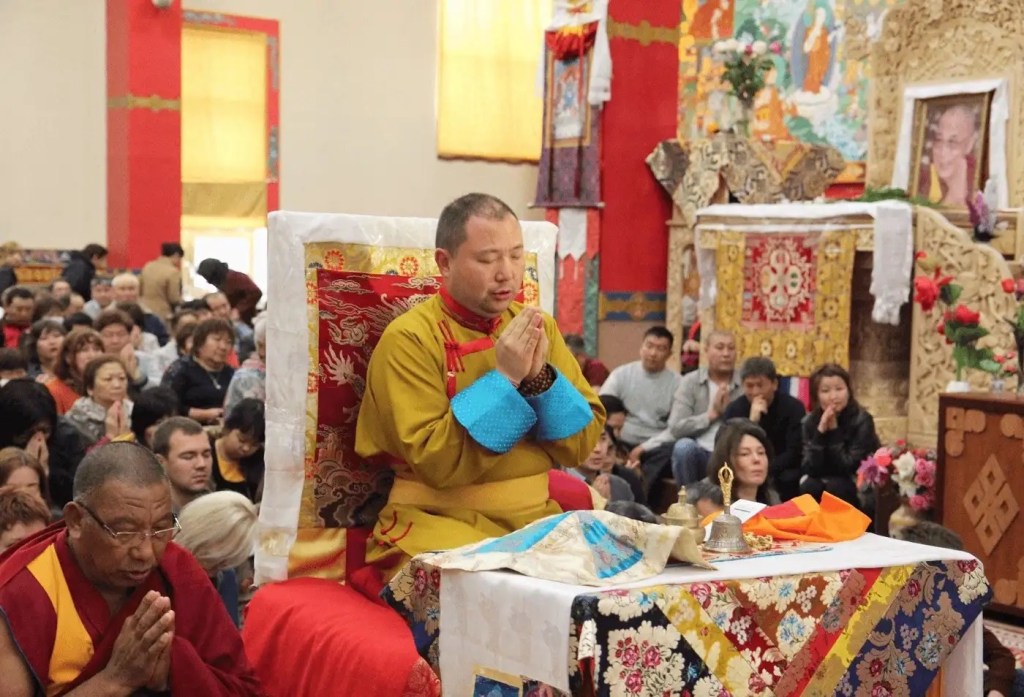
Telo Tulku Rinpoche, the now-former Supreme Lama of Kalmykia
On Friday, January 27, 2023, the Russian Justice Ministry placed Telo Tulku Rinpoche (Erdni-Basan Ombadykov) on its registry of “foreign agents.” Rinpoche is еру president of the Association of Buddhists of Kalmykia and the 14th Dalai Lama’s official representative in Russia, Mongolia and the CIS countries. The ministry’s press service said that the Buddhist leader had been placed on the list because he had “spoken out against the special military operation in Ukraine and openly spoken in support of Ukraine,” and also because he “is a US citizen and lives outside the Russian Federation.”
In addition to Rinpoche, the list of newly minted “foreign agents” that day included Little Big soloist Ilya Prusikin, journalist Fidel Agumava, Free Idel-Ural Movement co-founder Rafis Kashapov, and Feminist Anti-War Resistance coordinator Darja Serenko.
The following day, January 28, Telo Tulku Rinpoche announced that he had resigned his post as the Supreme Lama of Kalmykia.
“In the last two days, many people have expressed concern and sympathy over my inclusion in the registry of foreign agents. I am sincerely grateful to them for their involvement in and appreciation of my work. In these difficult times, I would like the people of Kalmykia and all followers of Buddhism to maintain courage, steadfastness and commitment to the ideals of compassion, love and nonviolence that form the basis of the Teaching of the Buddha that we profess. […] In my thoughts, deeds and prayers, I remain entirely with the Kalmyk people and Buddhists all over Russia, to whose service I have devoted my life,” the monk said.
Who Is Telo Tulku Rinpoche?
Telo Tulku Rinpoche (Erdni-Basan Ombadykov) was born in the United States in 1972 to a family of Kalmyk immigrants, according to the lama’s biography on the Kalmykian Buddhist community’s website.
In 1991, Rinpoche visited Kalmykia for the first time as part of a delegation led by the 14th Dalai Lama. Shortly after the visit, which the website refers to as “the starting point for the restoration of Buddhism in the republic,” Rinpoche was chosen as the supreme lama of the region, the Shajin Lama.
“While serving as the Shajin Lama, Telo Tulku Rinpoche has made great efforts to strengthen the religious and cultural ties that have existed for centuries between the traditionally Buddhist regions of Russia and the Tibetan community, led by His Holiness the 14th Dalai Lama XIV,” the website notes.
Another highlight of Rinpoche’s tenure as the Shajin Lama has been, according to the website, “comprehensive support for peaceful coexistence and cooperation among members of Kalmykia’s traditional confessions — Buddhism, Christianity and Islam.” In addition, under the lama’s leadership, more than thirty temples and prayer houses were erected in Kalmykia.
Rinpoche is a US citizen. He was applying for Russian citizenship, and was scheduled for an interview on February 24, 2022, but it was canceled due to the beginning of Russia’s invasion of Ukraine.
Russian Buddhists and the War
In an interview posted on the YouTube channel Alchemy of Soul on September 30, 2022, Rinpoche openly opposed the “special operation.”
“I think it’s wrong,” he said. “This war is needless. […] I think that the Ukrainian side is in the right. It is defending its country, its land, its rights, its Constitution, its people.”
The lama explained that he had not spoken out against the war earlier because he had been worried about the safety of Buddhists in Russia and their families.
“I didn’t want to spoil the relationship between the authorities and our Buddhists. I didn’t say anything, but nevertheless, every morning I always prayed for everyone, both Buddhists and non-Buddhists,” Rinpoche explained.
The monk said that he had left Kalmykia and was in Mongolia, where he was helping Russians fleeing the military mobilization. Rinpoche was negotiating an extension of the visa-free regime for Russian nationals and helping with their accommodation and the purchase of sleeping bags.
“American born Telo Tulku Rinpoche is a Buddhist leader in Russia. In this video Anzhela and Rinpoche discuss Buddhism’s philosophy on war, Russian mobilization of citizens to support the invasion of Ukraine, and steps Russian men are taking to avoid mobilization.” (In Russian, with English subtitles)
However, not all Buddhists share Rinpoche’s opinion about the “special operation.” Damba (Vasily) Ayusheev, head of the Buddhist Traditional Sangha of Russia, explained that the lama’s anti-war stance had to do with the fact that he is a US national.
Ayusheev himself voiced his own support for the war in Ukraine on February 28.
“We live in a single Russian state and defend the interests of our country, against which a dirty information war is being waged. […] We must have a strong and reliable home front. Our sahyusan [dharmapala] are on our side, our Great Khambo Lamas are on our side, and Buddha is on our side,” Ayusheev said on Buryad FM Radio on February 28, according to Infpol.
“It is a sacred duty. We Buddhists must defend our homeland. […] In our system, in Buddhism, the man must defend [the homeland, and] if necessary, go to war, be victorious, and return to his family, to his homeland,” Ayusheev said on September 30 in a conversation with Izvestia. The Buddhist added that he was proud of his co-religionists’ involvement in the war, and called the annexation of the Ukrainian regions to Russia a “historic moment” and a “great event.”
Jampa Donied (Buda Badmayev), the deputy head of the Buddhist Traditional Sangha for Russia’s Northwestern Federal District, also argues that Buddhists are involved in the “special operation” to defend their spiritual values.
On March 16, 2022, an “initiative group of Buddhists and sympathizers of Buddhism” published an open letter in support of [the Russian government’s] military actions in Ukraine on a VK group page.
“Buddhism — which is undoubtedly a peaceful doctrine — teaches us to calm the mind, maintain internal balance and find peace in all worlds. But Buddhism is not a doctrine of non-resistance to evil, if evil is ready to destroy everything its midst. […] In response to evil, we must not trigger negative emotions of anger and malice in ourselves, but we should be able to resist aggressive attacks from external forces in a calm state of mind. We must defend ourselves without letting evil into our hearts.”
The activists called upon people to sign the letter to “express solidarity with the President of Russia’s decision to pacify Ukraine, making it possible to establish peaceful and neighborly relations with this country.”
As of March 26, 2022, forty-two people from different regions of Russia had signed the letter. Three more people have signed it since then.
According to Alchemy of Soul presenter Anzhela Kalsynova, Rinpoche is the only [Russian] Buddhist leader who has publicly condemned Russia’s invasion of Ukraine. And yet, the lama himself suggests that his co-religionists do not support the war, but are not openly opposing it due to concerns for their own safety.
The law on “foreign agents” in Russia is discriminatory and is used to combat those who have fallen out of favor with the authorities. All “foreign agents” are required to report their activities, income and expenses to the Russia Justice Ministry. They are restricted in their ability to disseminate information and find sources of funding. They face increased official oversight and lose their working partnerships. Like Rinpoche, they are deprived of the opportunity to continue their life’s work.
This is the 7×7 team on the line. This newsletter has been written by Oleg Gradov. What inspired the environmental protests at Shiyes and why there is no mass protest nowadays is the subject of our newsletter today.
Approximate reading time: 4 minutes.
I’m sorry if you’re from Moscow and our headline hurts your feelings. No one will be scolding the residents of the capital in this newsletter. The quote “Moscow lost its fucking mind” refers only to the leadership of that city and our country, but we will talk more about this later.
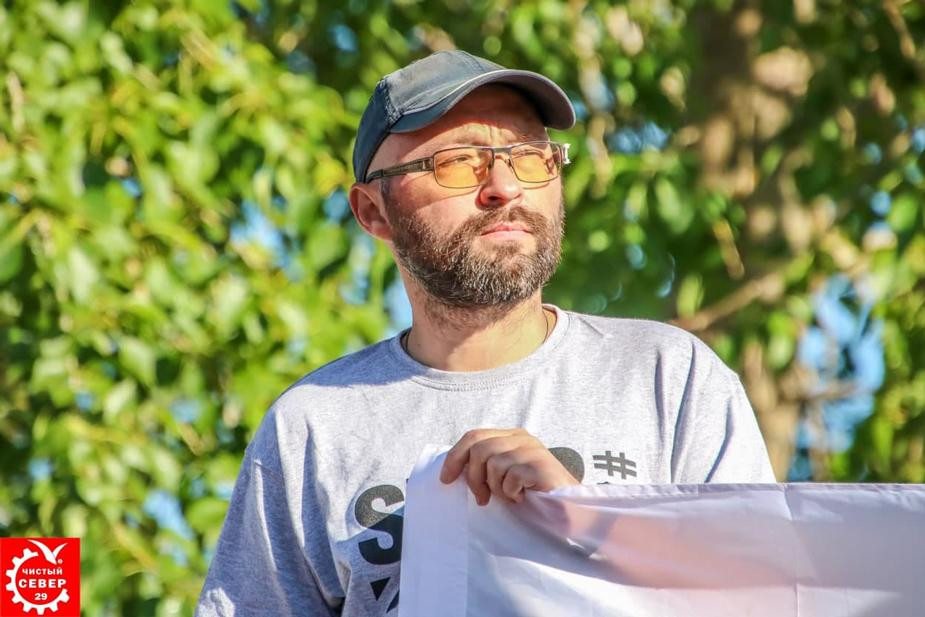
One of the few successful cases of protest in Russia’s recent history is Shiyes. In 2018, the authorities decided to construct a landfill in the Arkhangelsk Region to dispose of the waste produced by residents of the Russian capital. The locals did not like it, they started holding protest rallies, and eventually the landfill project was canceled. For this newsletter, I spoke with Dmitry Sekushin, one of the participants and coordinators of the Shiyes protest movement. Marina Feldt, an ex-staffer with the Navalny organization in Arkhangelsk, spontaneously joined our conversation.
What is Shiyes?
Shiyes is a small railway station in the southeast of the Arkhangelsk Region on the border with the Komi Republic. Protests against the landfill took place between 2018 and 2021. The protests at Shies were heavily supported by residents of the Arkhangelsk Region: [according to a poll by the Levada Center] 95% were opposed to the landfill, while 25% were willing to attend unsanctioned protest rallies. The activists were supported by both Russian and foreign journalists, as well as by residents of thirty Russian regions who were concerned about environmental problems and held protests in their own cities.
“The metropole does what it wants”
Where does such support for a regional protest come from? “The landfill itself would have made only a few people want to fight back,” says Dmitry Sekushin. “You have to understand how people feel about this. In our case, it was the feeling that we are a colony, and the metropole does what it wants with us. The idea that Moscow had lost its fucking mind united people.”
Realizing that you were part of a whole, not a splinter, was an important piece in the protests at Shiyes. People were aware of their responsibility for their native land and were proud of their background. “If someone in 2017 in Arkhangelsk had said that he was a Pomor, people would have thought that he was a freak. But in 2019, everyone was already proud to call themselves Pomors. This does not mean that we want to see Pomorye separated from Russia. It was just a unifying factor,” says Dmitry.
People can unite without becoming a homogeneous mass. The protests at Shiyes were environmental, not political: the activists’ demands had to with the basic human right to a decent environment. “One shouldn’t see the mass of protesters who defended Shiyes as ants,” Dmitry says on this score. “They were completely different people. I don’t see anything surprising about the fact that many of the protesters turned out to be fascists [i.e., they now support the war or are involved in it — 7×7]. They were like that in the first place.”
The goal makes all the difference
An achievable goal defines the methods of protest. “We had a goal — getting the [Shiyes landfill] project canceled. Not overthrowing Putin, not overthrowing Orlov, our [regional] governor. The goal was to shut down the project,” Sekushin emphasizes. Politicizing the protests at Shiyes could have a negative impact on the movement.
However, every day the activists were approached by people who argued that they were “protesting the wrong way.” “Some were dissatisfied with the fact that we did not talk about politics and did not chew out Putin,” says Sekushin.
To preserve the environmental component of the protests, Dmitry had to partly abandon media publicity from the opposition. “In the first few months of our protest, around December 2018, I wrote to Leonid Volkov asking Navalny not to say anything about Shiyes. I understood that the authorities would hold Navalny against us,” he says.
If you hang out on VK, you’ll go down on criminal charges
The activists used social networks to unite the protesters: they ran accounts on Instagram, Twitter, and Facebook, as well as a group page on VK. In Russia’s regions, VK remains one of the primary social networks even now, despite all the security risks. “We used VKontakte for contact with the outside world. It is wildly popular in the Arkhangelsk Region — 85-90% of social media users are on it. But for internal matters, we used only Telegram, which is a more secure network,” says Sekushin.
Nowadays, many activists do not trust Telegram, preferring instead such open-source messaging apps as Signal and Element.
Why are there no mass protests now?
Whereas, during peacetime, activists tried to separate environmental protests from political protests, it is almost impossible to do so now. On 26 February 2022, the Pechora Rescue Committee published a post on its VK group page demanding an end to the hostilities. “Protecting social, environmental and other human and civil rights is impossible in conditions of war,” the activists wrote in their statement. Movements that were originally focused on the environment began to make political demands, and the environmental protest movement was politicized.
“Last year there were no mass protests in Russia because people are afraid,” he says. “Because they’ve learned to be helpless. This is the result of the yearslong destruction of critical thinking and political competition, and the yearslong implicit social contract [between the Putin regime and the Russian people]: ‘You don’t meddle in politics, and we don’t interfere with your lives.’ This agreement is no longer valid, but it’s too late to change anything.”
At this point, Marina Feldt, an ex-staffer at the Navalny organization’s office in Arkhangelsk, joins my conversation with Dmitry. She argues that people in Russia support the war because it gives them positive emotions.
“The main idea of the protests at Shiyes was ‘Moscow is fucked in the head,'” she says. “This is the idea of disconnection: there is Moscow, and and then there is us — Pomorye. But the war in Ukraine is driven by the idea of unification. People in the regions often lack a sense of involvement with the rest of Russia; it seems to them that that they are unwanted. But this war is where people can feel needed by their Motherland. The government has humiliated people so much that now they can rejoice in something that would not be considered decent under normal circumstances.”
Dmitry Sekushin argues that any country can be brought to such a state: “If you propagandized a European country like this for twenty-two years, it too would become fascist.”
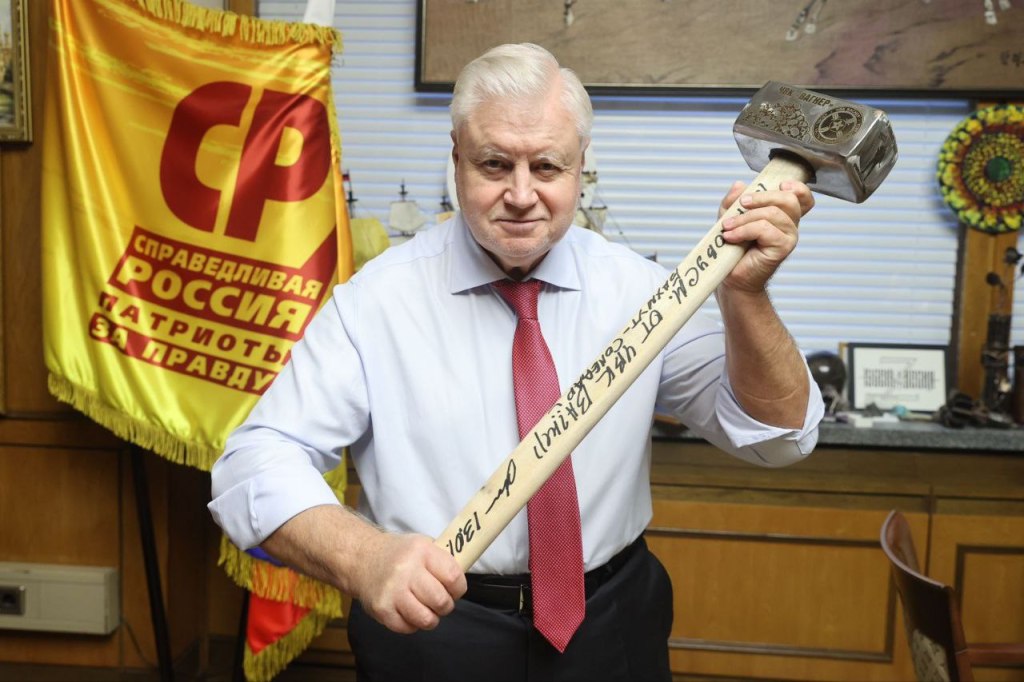
Sergei Mironov receives sledgehammer as gift from Yevgeny Prigozhin: “Together we will punch a hole in the Nazi ideology”
Sergei Mironov, leader of the party A Just Russia and a State Duma deputy, thanked Wagner Group founder Yevgeny Prigozhin for the sledgehammer, which the businessman sent as a gift to the politician. “With its [the tool’s] help, together we will punch a hole in the Nazi ideology, which has set itself the goal of destroying our country. May all our enemies finally realize that they will not succeed,” Mironov wrote on his Telegram channel, adding the hashtag #the_sledgehammer_rules.
The sledgehammer presented to Mironov has a mound of skulls depicted on it and bears the Wagner Group’s trademark stamp. The tool gained notoriety after the death of ex-Wagner fighter and former convict Yevgeny Nuzhin. He was brought back to Russia from Ukrainian captivity and executed with a sledgehammer.
In the early noughties, Oskar Kuchera was the star of Muz TV, a popular music TV channel. Twenty years later, he vigorously criticizes Ukraine, and supports Putin and the Russian army. We met and talked.
0:00 Opening 0:42 Why did Kuchera agree to the interview? 4:47 When people of my generation found out about Kuchera 9:36 A place where it is convenient to work for remote work 12:41 “Soldiers”: a serial about the army in which there was no war 14:40 “I knew what would happen in September 2021.” How? 20:16 Why did Russia start the war? 36:25 Is it okay to bomb infrastructure? 37:08 Are there Nazis in Ukraine? 39:29 The ultra-right is fighting on Russia’s side: Can Russia be denazified? 51:58 “The geopolitical right to be friends with Ukraine” What the heck is that? 59:09 Russia is meddling in Ukraine’s affairs, although it has problems of its own. Is that normal? 1:11:27 Crimea 1:15:30 Why America’s and Europe’s help bad? 1:21:54 Why do you enthusiastically follow the news from the US? 1:25:31 Why does your son have a US passport? 1:27:47 “The Stars Converge” on NTV. What happened? 1:32:17 Did you put up with it for three years for the money? 1:37:13 Why is it a bad thing to flee the war? 1:43:43 How can you support the army but oppose the war? 1:50:15 How would you react if your children were conscripted? 1:51:39 Why do you support Putin? 1:55:12 “I believe we’ll stroll the streets of Berlin and Paris again.” Do you want to conquer Europe? 2:01:51 Germans supported their army in 1939–1945. Were they right? 2:04:25 Is Zelensky bolder than Putin? 2:11:52 Why does Putin lie so often? 2:20:16 Is it normal to support the regime and have real estate in a NATO country? 2:26:32 Why do you need a Telegram channel about politics? 2:29:45 Oh 2:33:56 What future do you see for children? 2:38:21 Does it suit you that you don’t know anything about Putin’s personal life? 2:47:10 Could you have imagined, twenty years ago, that someday you spend three whole hours excusing Putin and the regime?
Source: “The supporter of Russian troops,”vDud (Yuri Dud), YouTube, 16 January 2023, with English subtitles. Annotation translated by TRR. As of today (21 January 2023), the interview has garnered almost sixteen million views.
After an interview with Yuri Dudyu [sic]* (recognized as a foreign agent), the actor and TV presenter Oscar Kuchera fell into a new avalanche of fame. The release of a three-hour conversation, where the actor, including expressing his position on the situation in Ukraine, provoked thousands of posts on social networks. For the most part, the characteristics for Kuchera were not complimentary. On January 18, in an interview with a RIA Novosti correspondent, he told what he thinks about this.
“I did not expect that there would be such an amount of support. And the fact that I support our guys is something I can only be proud of. Well, it’s better to be a fool than a scoundrel,” says Kuchera.
He noted that before the interview, he agreed with Dud to discuss work on Muz-TV and the TV series Soldiers, music and citizenship. In the published three-hour talk, the first three topics are given a few minutes. The rest of the time, Kuchera confusedly explained why he was against military operations, but for the military, who are now in Ukraine.
“But it turned out what happened. Probably, I should have got up and left, but I am a passionate person. So I’m responsible for everything myself, ”the artist complained.
The audience ridiculed Kuchera for his incoherent and illogical speech, as well as for his position. The TV presenter said that he supported Russia, but did not deny that his son was born in Miami and received an American passport. Commentators immediately stated that they recognized their elderly relatives in the hero. The facial expression of Yuri Dud during a conversation with Kuchera also became a meme.
* The Ministry of Justice added Yuri Dud to the list of foreign media agents