The 501st: Russian Death

russian death
“Russian Death”

‘Sociologist Denis Volkov from Moscow’s independent Levada Center pollster, on the other hand, says the bill is unlikely to make Russians more wary about what they post on the Internet. “Most people are not aware of these laws,” he says.’

Ha-ha. It’s good that reporters are forced to turn to “sociologists” and “pollsters” for quotable quotes, and that the Putinist state decided at some point long ago it would pollocratize everyone and their cousin into submission, because otherwise the “independent” Levada Center would have had to pull up stakes long ago and move to Nevada to start calling odds on the trifecta at Santa Anita racetrack.

I have already seen the chilling effect that the bill and the generally malignant, soul-destroying climate of the last year or so have had on what people talk about politically (or not) in daily life, much more dare to post on the Internet, e.g., Russia’s role in Syria, which absolutely no one I know has discussed, publicly or otherwise, under any circumstances for a very, very long time now. And that is just the top of the list.

A fair number of Russians, young and old, know very well how to read signals coming from on high and when to keep their mouths shut. Or how to substitute abstract, self-important chatter or furious trivial pursuits for meaningful conversations about what is happening in their country and what to do about it. Now is one of those times, and it is absolutely depressing.

All it will take is a few more “light touches,” and the country will essentially be dead, that is, waiting for its Supreme Leader to kick the bucket (when? twenty years from now?) so it can rejoin the rest of the world and resume building “democracy,” “capitalism” or whatever it has been pretending to do the last twenty-five years.

Photo courtesy of the Facebook page of Russkaia smert’ (Russian Death)

Irina Bogatyreva: How Opinion Polls Are Conducted in Russia

How Opinion Polls Are Conducted in Russia
Irina Bogatyreva
July 23, 2015
About Russia

11151029_877218092326378_2792365210284757073_nIrina Bogatyreva

I just took part in one of the famous polls by VTsIOM (Russian Public Opinion Research Center). They actually exist!

You are warned the survey is anonymous. First, you are asked your name (no surname), whether you are a citizen of the Russian Federation, whether you have a residence permit and whether you have had it for long, your age, education, and, finally, your occupation, income level, and your address, after all.

I was warned the survey would be about the erection of monuments, but in the event I was asked about my attitude to the president, the prime minister, the government, and the mayor, which party I intended to vote for at the elections, about Moscow’s problems, about [the incredibly controversial compulsory residential housing renovations fee, now included in monthly housing maintenance payments in Moscow], whether I am planning to emigrate abroad, and whether I consider emigrants traitors.

This was all prefaced with the phrase, “Of course, maybe you consider questions about politics uninteresting, but . . .”

I was asked twice about the monument to Dzerzhinsky, at the beginning and the end. (“Why twice?” “I don’t know, I’m just the interviewer.”) The first time I could reply as I chose, the second time, I could not. I wonder: if people give different answers, which one counts?

[Translator’s Note. It appears the Communist Party itself has just called off its proposed referendum which would have asked Muscovites whether they wanted a controversial monument to Cheka founder Felix Dzerzhinsky, torn down in August 1991, returned to its former site on Lubyanka Square.]

There were three possible answers to the question of [where to place a 24-meter-tall monument to Prince Vladimir, which has caused a huge public outcry in Moscow]: on Lubyanka, on Borovitskaya Square, in the Sparrow Hills. Saying “I don’t want it at all” was not an option.

Here and there, the survey was worded quite quaintly. For example, “Which party, in your view, has made the greater contribution to Moscow’s development?” All the existing parties where listed off, although only the Udrussians [United Russians], the commies, and one Zhirinovskyite sit in the Moscow City Duma. (“Your question is worded incorrectly.” “I don’t know anything, I’m just the interviewer.”)

They rang me at 1:00 p.m. I just happened to be at home. Working people are usually at work at this time, while it is pensioners and housewives who are at home then. I have long suspected that it is these people who “shape” all these polls.

Translated by The Russian Reader. Thanks to Comrade SC for the heads-up. This is the latest in a series of occasional posts about the Russian authoritarian regime’s use of public opinion polling, which I have dubbed pollocracy. After all, what kind of “anonymous” polling requires the respondent to identify their address?

The Kids Are (Not) Alright, Part 2

What’s wrong with this picture?

1

What follows is an excerpt from the seemingly endless series of “grassroots” exposés of the irremediable “stupidity” of twentysomethings, “most ordinary” Russians, Ukrainians, amerikosy, etc., that are posted in such abundance on the Runet these days.

At work, I have a personal assistant, a young woman, Nastya, a Muscovite, 22 years old [sic], who is in her final year at law school. She asked me a question.

Wow, why do they build the metro so frigging deep? It’s inconvenient and difficult!”

“Well, you see, Nastya, the Moscow metro originally was dual purpose. It was planned to be used both as public transportation and as a bomb shelter.”

Natasha grinned incredulously.

“A bomb shelter? How stupid? What, is someone planning to bomb us?”

[…]

“Have you been to the Baltic States?”

“I have. I’ve been to Estonia.”

“Well, how was it? Was it a hassle to get a visa?”

“I was there under the Soviet Union. We were one country then.”

“What do you mean, ‘one country’?”

“All the Baltic States were part of the Soviet Union! Nastya, did you really not know that?”

“Holy shit!”

“Now you’re going to totally freak out. Belarus, Ukraine, and Moldova were also part of the USSR. And Kyrgyzstan, Tajikistan, Kazakhstan, and Uzbekistan. As well as Azerbaijan, Armenia, and Georgia!”

“Georgia! You mean those assholes there was a war with?!”

“The very same. You do know that the Soviet Union existed then collapsed? You were even born in it!”

“Yes, I know there some kind of Soviet Union that then collapsed. But I didn’t know it lost so much territory…”

I was riding in the metro and looking at the people around me. There were lots of young faces. All of them were younger than me by ten years, a dozen years. Were they all just like Nastya?! The zero generation. Ideal vegetables…

Source: Kazbek Magerramov (Facebook), via allmomente.livejournal.com

Among the numerous comments to this Zadornovesque anecdote, most of which empathize with the author’s blunt point and bewail the allegedly vegetable-like state of the “zero generation,” I couldn’t find a single comment pointing out that if silly Nastya were now indeed twenty-two years old, she would have had to have been born in 1992 or 1993, that is, one or two years after the actual Soviet Union actually collapsed in 1991. But in this shaggy-dog story, the first-person narrator tells dumb Nastya that she was somehow born in this magical land about which she is so woefully ignorant.

This logical gaffe makes me think the whole thing has been made up. Like half the “tales from real life” about the laughable simplicity of “ordinary blokes,” twentysomethings, pindosy, ukropy, women or, alternately, the gritty folk wisdom of cabbies, roaming the mighty virtual steppes of the Runet nowadays.

The kids are alright, really. It’s just that they have been left to their own devices. Which, like all the other discriminated and marginalized groups left to their own devices over the last twenty-four years by the state, the ruling classes, the mainstream media, and their allies in the newfangled virtual Kadet parties and Unions of the Russian People, makes them ideal figures of “fun,” scorn, and fear. And perfect stalking horses for transparent exercises in post-imperial melancholy like this one.

Putin’s Russia (how it pains me to type this phrase) is not just a pollocracy. It is also an “anecdotocracy.” Researchers of “post-authoritarian” societies like Russia really should be delving deeper into how polls and anecdotes have been used to help people to oppress themselves and make common cause with others impossible.

Spiral of Silence

spiral-of-silence-communication-theory

Greg Yudin
Facebook
April 3, 2015

Let me tell you a story about opinion polls.

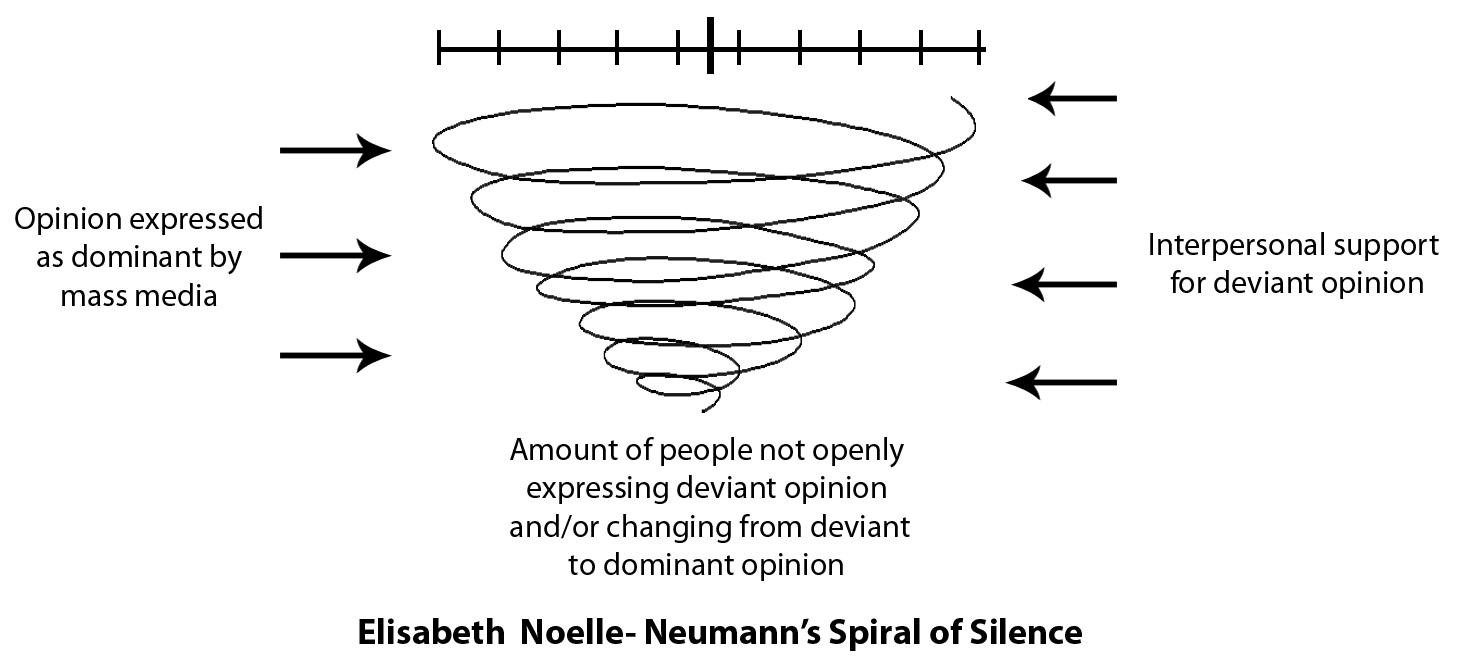
The so-called spiral of silence has often been recalled recently in Russia in connection with public opinion polls. The idea behind the spiral of silence is simple. As soon as an opinion is conveyed either in the media or those selfsame surveys as having support from the majority, the minority, out of fear, prefers either to keep silent or join the majority. The idea has been used to explain where unanimous opinions, 86% ratings, total approval, etc., come from. Elisabeth Noelle-Neumann, the “godmother” of public opinion polling in post-war Germany, coined the term “spiral of silence” in 1980. And so in Russia, it is usually argued that the spiral of silence is an inherent feature of public opinion, because it was discovered in Germany, a proper bourgeois country.

We know that Noelle-Neumann was a Nazi. She did not join the party per se, but she did head a branch of a party student organization, made a considerable stir in the US by actively promoting Nazism, and later worked for two years at Goebbels’s weekly newspaper Das Reich.

But that is not so important. Many people suffered from Nazi fever, including social scientists. What is more interesting is that while many of those people somehow reflected on their Nazi experiences, trying in different ways to explain what had led them to do the things they did, Noelle-Neumann went into total denial. All her life, she maintained that she had done nothing extraordinary, that Hitler was a charming man, and that she had just been forced to denounce Jews, and in fact, she had secretly opposed the regime. It is easy to see how she opposed it if you take a gander at the articles she wrote for Das Reich. It is as if a columnist for the current incarnation of Izvestia would say that he had secretly been fighting for peace and harmony in Russia.

Subsequently, the spiral of silence theory was repeatedly tested, and it turned out that it works poorly in multipolar societies. If it explains anything at all, however, it explains the personal experience of Noelle-Neumann herself. It is her own fear that she identifies with the intimidated majority. She tries to justify this fear by arguing that the spiral of silence is something ordinary and inevitable. But this is a bad excuse, because, in order to save her conscience, she justifies political repression, not only past repression but future repression. It is one thing to recognize that no normal person is immune from becoming a beast, and quite another thing to say it is a normal thing when people turn into animals.

In fact, as far back as her 1940 dissertation (which simultaneously functioned as a report to Goebbels’s office on American attitudes to Germany), she writes directly about the difference between the US and the Third Reich.

“In Germany, public opinion figures like the body of the people, which receives orders from the head and ensures their implementation. […] In one case, public opinion holds sway. In others, it is guided.”

All this came to mind after the stunning lecture last week by my colleague Grigory Kertman from the Public Opinion Foundation (FOM). Kertman spoke about the fear of respondents during interviews. It cannot be measured directly. You cannot ask respondents, “Are you afraid of me right now?” But Kertman cleverly got around this by collecting information from the interviewers who conduct the polls. He discovered that they are used to the fact that respondents are afraid: this is the most common cause of insincere responses. A significant part of the interview takes place in circumstances where the respondent’s fear is so strong that it is palpable to the interviewers.

This silence of the lambs is abnormal, and it has nothing to do with the “nature of public opinion.” The insatiable desire to pass human beings off as naturally cowardly creatures and justify those who systematically bully them always comes from those who themselves have been victims of violence. Nothing good will come of it. We definitely do not want to go where this spiral would lead us.

Greg Yudin is a research fellow and lecturer at the Higher School of Economics in Moscow. Translated by the Russian Reader. See my previous posts on Russia’s pollocracy. Image courtesy of masscommunicationtalk.com

Viktor Voronkov on Why You Shouldn’t Trust Russian “Public Opinion” Polls

Can we trust opinion polls on the president’s popularity?
Serafima Taran
December 2, 2014
Gorod 812

Sociologists weekly poll Russians about their attitude to the president and government policies. Despite all the events happening inside and outside Russia, the level of trust in Vladimir Putin has remained virtually unchanged. 

According to the Public Opinion Foundation (FOM), nearly three quarters of the populace (72%) view the president’s actions positively. Can these figures be trusted? Sociologist Viktor Voronkov, director of the Center for Independent Social Research (CISR), discussed this in an exclusive interview with Gorod 812.

Can opinion polls be used to predict the near future, at least, whether stability or social upheaval awaits us?

The first thing I would note is that opinion polls are manipulative techniques that shape public opinion rather than reflect anything. You can interpret them as you like. This means, actually, that they are probably not amenable to interpretation.

In addition, most of the questions asked by polling centers are outside the competence of the people responding to them.

Sociology is generally not in the business of forecasting. That is not its function. Sociology studies the rules by which people live and act.

Is there a great difference between polls taken in authoritarian societies and polls in democratic societies?

In an authoritarian society it is more difficult, of course, to determine what people actually mean to say. Like the Soviet Union (although to a lesser degree), our society is now dominated by fear. The fear of saying the wrong thing, the fear that someone will use this information the wrong way, and so on. So just to be on the safe side, one has to stick to the mainstream when speaking.

But sociologists and the people in Kremlin probably realize this. Why, then, are so many polls conducted?

Their function is purely manipulative, but it is also has a lot to do with making money. The state manipulates public opinion polls and this, in turn, really influences people.

In general, the nature of public opinion in modern Russia is extremely primitive. There is Putin, whose rating is stable and basically cannot change rapidly. All other existing ratings are directly dependent on what President Putin says. You needn’t bother studying public opinion in Russia. It is enough to study the opinion of only one man, because in one way or another all other opinions will fall in line with this principal opinion.

We see, for example, how sentiments toward the US have evolved in recent years. In 1999, NATO bombed Kosovo. Putin condemned the US, and the country’s rating dropped to thirty-five percent. In 2001, the terrorist attack took place in New York. Putin expressed condolences: sympathy for Americans rose sharply, reaching seventy-five percent. We now have a negative outlook on the US, but if Putin decides tomorrow that we are friends with America, everything will change.

It doesn’t mean anything, except that people basically are not very concerned about it.

So the main objective of these polls is impacting the populace by publishing them in the media?

Of course. The media is mainly responsible for spreading the contagion of propaganda. I would say that in terms of impact on people, media publications of poll results are akin to horoscopes. Horoscopes, as we know, affect people’s lives. People try to interpret their lives in accordance with what the horoscopes say. It is the same with opinion polls.

But there is, nevertheless, real public opinion in Russia. Can one find out what it is?

Suppose you ask someone how he relates to the issue of “Crimea is ours” [Russia’s annexation of Crimea]. He says, “Yeah, it’s wonderful, it’s great, I support it.” You continue questioning him, asking him to tell you more. And the reply you hear is, “You know, I have no time for this. I’ve got work and kids. Spare me your nonsense!” So it is real life that is important, not sketchy answers to staged questions.

The fact that people give answers in no way means we can assess their behavior in terms of these answers.

Opinion polls reflect (at best!) attitudes, the values that society imposes, perhaps. But you would need to study people’s behavior, their real personal motivation, because there is no unambiguous connection between attitudes and behavior. People think one thing and then do something else altogether.

 Is it like this in any society, closed or open?

It is easier in an open society. People tell you what they think, but again, this does not mean their behavior will match it.

But in a closed, Soviet-type society, on the one hand, a “small victorious war” raises the government’s rating, because everyone rallies around the leader. On the other hand, within the country, everyone criticizes everything. There is no confidence in the army or the police, not to mention the parliament and the courts. There is no real confidence in anyone.

But in foreign policy, society almost unanimously supports “its” powers that be. The bulk of Russia’s citizens have an imperial mindset: it was not for nothing they were raised as patriots for seventy years, beginning with Stalin’s ideological turnaround in 1934. So the people see any foreign adventure undertaken by the Russian government as a symptom of our being “picked on.” And their justification of any aggression—the invasion of Afghanistan, Czechoslovakia, Hungary, etc.—follows this. All these military actions were fully supported by the people. The 2008 Georgian War had exactly the same support. The annexation of Crimea is now supported for the same reasons.

In Russia, it is almost impossible to find out not what public figures and experts think, but what the “common man” thinks.

This is true. The common man has very little right to be heard anywhere. Current sociology and anthropology, which are not dominant in Russia, aspire to give the average man a voice. Hence the spread of so-called qualitative, as opposed to quantitative, methods, publications of interviews with “ordinary” people. Attempts are made to produce texts in collaboration with them. Some sociologists even just publish the texts of these people without commentary.

But why don’t Russian sociologists do this?

In Russia, sociology has adapted to serve the powers that be. And the powers that be have little interest in the real opinions of ordinary people. Our powers that be are even uninterested in the opinions of sociologists, except those who publicize what the powers that be themselves say, couched in academic discourse.

If economic difficulties worsen, will the mood of Russians change?

People have now had a taste of a relatively prosperous life. At least twenty percent of the population has seen what life abroad looks like, and they are unlikely to want to live under war communism or as in North Korea. But it is already clear that this little splash of the good life, which was due to high oil prices in the 2000s, has ended. Real income levels will now fall. Those who lived in poverty will feel almost nothing. They will go on living as before. But the so-called middle class, who are supposed to support the authorities because they live well, will feel this first and foremost.

So I think that a political crisis cannot be avoided, whatever propaganda or opinion polls are thrown at it.

__________

See my previous posts on Russia’s authoritarian “pollocracy”:

Halluci Nation

BabiBadalov8light

__________

Maybe there is no direct connection, but soon after the first article, below, ran in The Moscow Times, the following message appeared on the newspaper’s web site: “Due to the increasing number of users engaging in personal attacks, spam, trolling and abusive comments, we are no longer able to host our forum as a site for constructive and intelligent debate. It is with regret, therefore, that we have found ourselves forced to suspend the commenting function on our articles. The Moscow Times remains committed to the principle of public debate and hopes to welcome you to a new, constructive, forum in the future.” When I glanced at the comments to this article, it did seem that a lively “debate” was underway, but I no longer read such things to preserve what is left of my mental well-being. The emphasis, below, is mine.

Russia’s Empire State of Mind
Pyotr Romanov
October 26, 2014
The Moscow Times

Following World War I, the Russian Empire bid farewell to Poland, Finland, the Baltic states and Bessarabia [in modern Moldova]. The Soviet Union later regained only some of that territory — and yet that did not prevent the world from continuing to view the Soviet Union as an empire. After the collapse of the Soviet Union, Russia decreased in size even more than it had after World War I, and yet many today continue referring to it as an empire.

I recently read an impassioned plea on Facebook from several Ukrainians that God call down on Russia a host of biblical chastisements and hasten its demise. In their view, the only way to escape the claws of the Russian bear is to kill the animal. At the same time, they have no intention of fighting the beast themselves, convinced that Europe and the U.S. alone have the power and the responsibility to vanquish the foe.

In other words, they prefer that others break their bones in the bear’s den so they can mount the pelt over their fireplace. I somehow doubt that the rational West finds that prospect very attractive.

In fact, a number of historical figures dreamed of dismembering Russia. Peter the Great’s arch-rival King Charles XII of Sweden held that dream even before Russia formally declared itself an empire. The French ambassador in Stockholm at that time said, “The king will make peace with Russia only after he has arrived in Moscow, toppled the tsar from his throne, divided the state into small principalities and summoned the boyars to divvy up the kingdom into their personal provinces.”

In hindsight, knowing how the Swedes suffered defeat at the Battle of Poltava, it is tempting to assess such a claim as pompous bravado. However, that was a serious plan that the Swedish king and his allies had discussed on more than one occasion. Charles really did plan to install his own puppet ruler on the Russian throne. He dreamed of Pskov, Novgorod and all of northern Russia as Swedish possessions. He planned to allot all of Ukraine and the Smolensk region to Polish King Stanislaw Leszczynski. Charles agreed to give Russia’s southern lands to the Turks and Crimean Tatars. There are countless other similar stories in history — but where are all those dreamers today?

However, this is not the main point. I see no reason to blame my ancestors for their imperialist actions. Russians have no more to feel ashamed of in this regard than do the British, Germans, Spaniards and French. All of their imperialist pasts were dictated by fate, God, geopolitical factors and their national character — that with which it is absolutely pointless to fight.

The collapse of the Russian Empire deeply troubled many of its citizens, and the later collapse of the Soviet Union gave them a disturbing sense of deja vu. Even today, millions of Russians wax nostalgic for the past — particularly for the Soviet Union — recalling much that was also good from that time.

This is the second time in a century that Russia has gone through such painful “withdrawal symptoms” while overcoming its imperialist mentality. Russians have nothing of which to feel ashamed: the same process was no less painful for other “imperial” nations.

Of course, modern Russia is not an empire, and it is unbecoming to act like a broken record, continually repeating the same old cliches. It is just that the process of adapting to the new realities is not moving as quickly as some in the West — and also in Russia, by the way — would like it to. But it is impossible to hurry it along.

It is decidedly easier for a tiny little ship of a state such as Monaco to make a sea change than it is for a massive ocean liner such as religiously diverse, multiethnic and multicultural Russia. A little patience is needed.

I understand that what seems fast by historical standards might appear painfully slow to people. History is measured in ages, but individuals measure time in terms of a single lifespan. Nonetheless, it takes nine months for a baby to come into this world, and no amount of impatient fingernail-biting will change that.

Making a baby come into the world any sooner is not the healthiest option either. In the same way, it does no good to keep impatiently tugging on Russia’s sleeve. Every fruit has its given period of maturation. When the time comes, Russia will let go of the last vestiges of its imperial past.

Until then, praying for God to curse Russia with a swarm of locusts or the 10 plagues of Egypt is not only unseemly, but also a bit archaic and completely meaningless.

Pyotr Romanov [sic] is a journalist and historian. 

___________

Post-imperial melancholy has also got the unnamed editorial writer (the West’s most beloved Russian “leftist”?)  at Russian “leftist” web site Rabkor.ru waxing poetical in the vozhdist mode in the run-up to November 4, National Unity Day.

The West intends to play hardball in its long negotiations with Moscow. Zeal and rigidity might betray it, and then events will not go as planned. That has already happened in Ukraine. However, the US and the EU understand that Russian liberals have increased their grip on power and will stubbornly seek a compromise. Dmitry Medvedev has already said that a “reset of relations” requires a return to the “zero position,” meaning normal trade without sanctions. The ruling class will do anything for its sake, particularly if its position is complicated by economic problems. If solving the problem with Western Europe and the US requires presenting Putin’s head on a platter, then that it is how the problem will be solved.

But Russia is not a banana republic or a tiny country in Eastern Europe, where you can just organize a color revolution by gathering several thousand “civil society” activists on a central square. And so only Putin himself can remove Putin’s head for the US, and not only through his own carelessness.

Patriots stubbornly dream of persuading the current president to become like Stalin or Ivan the Terrible. Members of the liberal intelligentsia scare each other and the gullible western public with this same prospect. However, with each passing day, our ruler [sic] becomes like a completely different predecessor, Mikhail Gorbachev, who was also, incidentally, a politician who banked on compromises.

The growing prospect of a “liberal putsch” becomes more apparent with each passing day. The final act has not started, but the play is already underway. Liberals are making ritual sacrifices. They are sacrificing the exchange rate of the ruble and social policies. They are sacrificing Novorussia [Novorossiya]. They are sacrificing the country’s dignity. They are destroying the possibility of Russian society’s development. They are even willing to sacrifice the one who protected the system for many years. Only none of this will bear fruit, because only a different course can save Russia from economic disaster.

And let no one be deceived: if the liberal coup becomes a reality, its authors will quickly discover how correct the thesis “Ukraine is not Russia” was. Unlike its neighboring country, Russia, with the exception of the capital, will turn into one solid Donbass.

The preceding was an excerpt from “Who Will Bring Them Putin’s Head?”, published on October 20, 2014, by Rabkor.ru. You can read the entire editorial in English here, as translated by other, less shaky hands.

__________

After a friend mailed me the following “news” item, he wrote, “This is how the whole ‘television—Levada—television’ scheme works.” As Kirill Rogov has argued, many people will tell pollsters what authoritarian state television has told them to think, especially when it comes to things that don’t really matter to them, like musician Andrei Makarevich’s alleged “treason.” It’s no wonder that one of the world’s leading offshore Putin apologists was worried, last year, when it seemed as if the state was cracking down on the Levada Center. He needn’t have worried. My friend titled his email to me, “Levada will receive the Stalin Prize posthumously.” That about sums it up.

Almost Half of Russians Consider Makarevich a Traitor to the Motherland 
October 27, 2014 | Gazeta.ru

Almost half of Russians believe that when he performed in Slovyansk, which is occupied [sic] by the Ukrainian army, musician Andrei Makarevich betrayed the interests of the motherland, according to the results of a survey conducted by the Levada Center.

45% of those polled agreed with the statement “Makarevich betrayed the interests of Russia, and now the public does not want to go to his concerts.” However, among Muscovites there was a high percentage (32%) inclined to believe that Makarevich “acted in good conscience” and that he had been the target of a defamation campaign. 28% of respondents admit that Makarevich behaved unpatriotically, but that administrative resources have been used to disrupt his concerts in various Russian cities.

The percentage of those supporting Makarevich and condemning the defamation campaign was quite low—13%. Respondents with a higher education were generally more supportive of what the musician did than Russians with less than a secondary education.

The poll was conducted among 1,630 people aged eighteen years or older in 134 municipalities in forty-six regions of the country.

Earlier, Makarevich recorded a song about how he has been hounded. On October 27, news came of another cancellation of one of the musician’s concert, this time in Kurgan.

__________

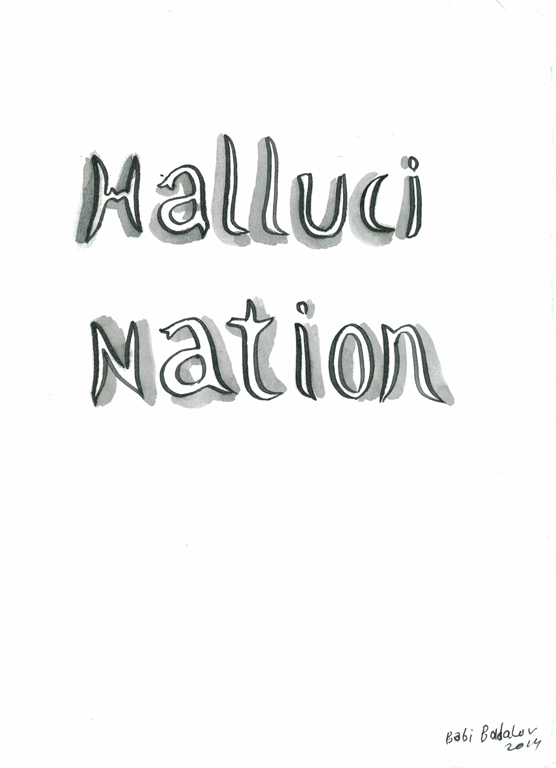
Image (above): Babi Badalov, Halluci Nation (Orna-mental poetry), 2014; ink on paper, 26.5 x 19 cm. Courtesy of La Galerie Jérôme Poggi, Paris, and the artist.

Zorkin: The Road (Back) to Serfdom?

valery-court-constitutional-chairman-862.siValery Zorkin

A little over a week ago, western media outlets made a big little fuss over an article by Russian Supreme Court chief justice Valery Zorkin, published on September 26 by Rossiiskaya Gazeta, the official government newspaper. They accused Zorkin of advocating a “return to serfdom.” Elena Holodny, writing in Business Insider, seems to have broken the story in the English-language press and thus set the tone for subsequent coverage:

He advocates for serfdom and says that it was the main “staple” holding Russia together in the 19th century. He justifies his argument by saying that serfdom is beneficial for the serfs.

In the article he writes (translated from the original Russian by Business Insider):

Even with all of its shortcomings, serfdom was exactly the main staple holding the inner unity of the nation. It was no accident that the peasants, according to historians, told their former masters after the reforms: ‘We were yours, and you — ours.’

[…]

The roughly translated term “staple” (in Russian “скрепа”) is significant. It’s an older word that has become popular in recent years after Putin used it in a news conference in 2012.

Prior to the conference, that word was basically never used in speech.

In the news conference, Putin said there was a “lack of a spiritual staples” among Russians — meaning there was no spiritual unity. And he subsequently indicated that Russia needed a “spiritual cleanse.”

“Putin essentially used the term ‘скрепа’ to mean the ‘spiritual staples that unite the Russian society.’ He was saying that we need a spiritual unity amongst the whole Russian society,” a Moscovite [sic] told Business Insider.

Following Putin’s news conference, Russian politicians and citizens have started using the word all over the place.

And Zorkin is following suit by using the Putin terminology to indicate that serfdom is the “spiritual staple that unites the [Russian] society.”

In the current climate of cheap hysteria and mental laziness, it is easier to make headlines, literally, saying a top Russian official wants his country to return to serfdom than to read his long, mostly dry-as-dust, pseudo-scholarly article and figure out what he was really trying to say. The payoff, in fact, comes in the final three paragraphs of Zorkin’s article, in which there is no mention, much less “praise,” of serfdom (the emphasis, below, is mine):

Opinion polls and many conflicts in our courts show that the broad masses of our people only suffer as a given the style and type of social, economic, political, and cultural life that the era after the revolution of 1991 brought to Russia. But internally they do not regard them as just and proper.

Moreover, polls show that the greatest degree of aversion pertains to legislative innovations that attack the moral and ethical sphere of social life. [This aversion] is registered primarily among religious people, regardless of denominational affiliation. It is especially pronounced among the older and middle generations. In contrast to the results of opinion polls taken a decade ago, however, it has also begun to manifest itself quite clearly among completely atheistic young people. The new legislative “tolerance” in family, gender, behavioral, and educational relations has been met with growing and increasingly widespread protest.

In connection with the above considerations and historical analogies, I want to reiterate a thesis that I have repeatedly voiced before. Any attempt to overcome “in a single leap” the gap between the law (and law enforcement) and mass perceptions of welfare and justice are fraught with social stress, shock, the growth of all kinds of alienation within society, and between society and the authorities, and, finally, social chaos. Which, as a rule, has to be extinguished by means of counter-reforms and repression.

Zorkin’s article is thus an apology not for serfdom as such. After all, before it was abolished, serfdom really had been the glue that held the Russian political economy together, just as slavery had been in the southern American states, and Zorkin goes to great lengths in his article to show that the nineteenth-century Russian elites, even the nominal conservatives among them, mostly agreed that serfdom was an evil that had to be “extinguished”—eventually and ever so gradually. The article is, rather, a defense of the current reactionary regime, which has increasingly used a combination of funhouse mirrors (“pollocracy,” the relentless manufacture and promotion of moral panics, wildly manipulative and frantically suspicious media coverage of political and social conflicts abroad, “weaponized absurdity”), outright crackdowns on prominent political dissidents, and targeted ultraviolence to persuade itself, the various Russian publics (whether liberal, leftist, conservative or indifferent), and western reporters, policymakers, and pundits that it is acting on behest of a “conservative” popular base dwelling in the heretofore unknown “Russian heartlands.” And even (by way of giving the talking classes more nonexistent fat to chew) that this newfound “traditionalism” has considerable appeal well beyond those heartlands, in the allegedly morally fatigued countries of the perpetually collapsing liberal West.

As a friend of mine wrote to me when we were discussing Zorkin’s article, “It is no longer enough to gang up on gays. We must also make women wear long skirts and headscarves. And forbid them from getting a higher education.” This new overwhelming necessity to de-modernize Russia, however, is not grounded in an actual conservative groundswell or the perennial aversion of the “broad Russian masses” to reform and (God forbid) revolution. Rather, it is meant to jam up brain cells so they cannot ponder (much less act against) sleights of hand like this:

Sanctioned [Russian oligarch] villa owners could be reimbursed with Russian pension savings: The government said in mid-September it was setting up a fund to support sanctioned companies, which would receive a cut of the 309 billion rubles ($7.8 billion) gleaned from redirecting part of the public’s pension savings to the budget this year, the RBC news agency said at the time.

Zorkin has not been the only top Russian official contemplating the lessons of Russian history in the past couple of weeks:

German Gref, head of Russia’s biggest lender Sberbank, on Friday castigated systemic inefficiencies in the Russian government that, he said, waste trillions of rubles and threaten to drag Russian society back into Soviet times.

“We have inconceivable social costs in the area of public administration,” Gref said in a speech to investors and top officials gathered at the VTB Russia Calling investment forum.

These costs increase government spending and render well-intended initiatives ineffectual, threatening Russia with a repeat of past mistakes, he said.

“[Soviet leaders] didn’t respect the laws of economic development. Even more, they didn’t know them, and in the end this caught up with them. It is very important for us to learn from our own history,” Gref said.

Actually, Gref’s speech was much more revolutionary (whatever you think of his neoliberal biases) than this mild account would suggest. If you listen to the whole thing (below, in Russian), you will realize it was a direct attack on the myth of Putin’s extreme competence as a manager of economic policy and the omniscient wizard behind Russian’s alleged newfound prosperity:

In this light, Zorkin’s article should not be seen as a literal call for a return to serfdom, but yet another warning (dolled up, as is often the case with pseudo-scholarship like his, as a “sober” reading of Russian history) that at least one important part of the ruling class is supremely ready and willing to deepen and expand the Duginist quasi-Talibanesque media spectacle of the past year, in which basically anyone at all (except the ruling class itself, of course) is blamed for Russia’s misfortunes or accused of plotting against it—the “Kiev junta,” “foreign agents” (i.e., local NGOs defending basic rights), NATO, Obama, singer Andrei Makarevich, “Ukrainian fascists,” western rock bands, Greenpeace activists, the EU, American students studying Russian at Petersburg universities, “extremist” journalists, you name it. The only solution offered for repelling these “assaults” is to intellectually and culturally medievalize the country that once, not so long ago, gave the world its first artificial satellite and sent the first man into space. But the real point of all this flailing is to prevent anyone from asking too forcefully why this incredibly wealthy country’s vast human and natural resources are siphoned away on frivolous mega projects like the Sochi Olympics and making a few members of a lakeside dacha cooperative fantastically wealthy.

In any case, serfdom’s alleged new best friend, like so many latter-day enemies of “innovative” gender relations and education for women, was singing a very different tune (almost the opposite one, in fact) only eight years ago. They do have ways of making a guy talk. And polling the life out of people whose heads they are otherwise stuffing with nonsense and who cannot be trusted to vote the “right” way.

Kirill Rogov: Why You Shouldn’t Trust Russian “Public Opinion” Polls

One of my hobbies in recent years has been closely observing the development of Russia’s “pollocracy”—the proliferation of “public opinion” polling, media discussions of poll results, and the obvious ways in which this “mirror” has been held up to the actual Russian public to con it into believing it supports the country’s authoritarian regime and its policies with ever increasing wildness and fervor, even as other democratic venues for it to voice its opinion, such as free elections, grassroots organizations, and protest rallies, have been whittled away, hacked at or more or less outlawed (depending on the season and the concrete causes) by the regime, its security services, and the loyalist media. 

So I was amused, the other day, to read about yet another such “public opinion” poll. This one “showed” that over seventy-two percent of Petersburgers support Georgy Poltavchenko, the Putin-appointed nonentity currently warming the chair, in the city’s upcoming gubernatorial elections. Even more hilariously, this same poll claimed to have discovered that the “majority of respondents rated the campaign as calm, and not interfering with the usual lifestyle” of Petersburgers.

When I sent the “news” article about this goofy, cynical poll I had found to a local journalist friend of mine, he responded by complaining that he had been having a hard time explaining to colleagues and acquaintances in the West that “public opinion” polls attesting to the Russian public’s allegedly overwhelming support for Putin and his aggressive policies vis-a-vis Ukraine should be treated with a grain of salt, at very least. Why, he had asked, do people who otherwise think that Russia is not a free country have an almost religious faith in Kremlin-directed polls alleging fantastic levels of support for Putin? Doesn’t it occur to any of these otherwise skeptical people that there might be something fishy about the polls, how they are conducted, and the conditions (of unfreedom, rampant propaganda, fear-mongering, and coercion) in which they are conducted?

He also wondered whether I had translated anything on this topic, something he could use in his arguments with Western friends. I said that I hadn’t, but I immediately recalled the following column by liberal political analyst Kirill Rogov, published in December 2013 in Novaya Gazeta. Sadly, it has become only more relevant and timely over the intervening nine months.

lifeforce-19_2124977i

The Fiction of the “Backwards Man in the Street”
Kirill Rogov
December 3, 2013
www.novayagazeta.ru

Not a week goes by without a dreary discussion in the media of the results of yet another opinion poll showing the narrow-mindedness and conservatism of the majority of the Russian people.

The week before last, the discussion focused on a survey showing that most Russians support the repressive decrees of the “enraged printer”—the self-styled Russian Duma. Last week, poll results showing that around eighty percent of Russians believe enemies surround our country were eagerly paraphrased.

Week after week, like cold raindrops falling on the heads of the educated class, these surveys persuade it of the futility of striving for something better. They demoralize the opposition and plunge business and the liberal elite into depression. Pack your bags and turn out the lights!

In general, the past year of Russian history has been an excellent case study for political scientists, showing how authoritarian regimes buy time by tearing it, so to speak, from the clutches of history.

An explosive mixture of revolving political (and not only political) crackdowns, unbridled propaganda, and a series of skillfully organized public hysterias have spread the dark pollen of proto-fascism in the air, which has settled as a deep depression in the souls of the educated class. And those people who a year and a half ago were confident in their strength and rightness (“Who is the power here?”) walk around with heads sunk down to their collars and their pretty tails tucked between their legs.

Polls are an important part of the picture. They are the “naked sociological truth,” after all, and have a powerful effect on just those people who are able to resist the onslaught of fear, hysteria, and propaganda. It is not so easy to understand how sociological surveys are turned into a weapon of authoritarianism in its fight against society’s desire for progress.

But let us turn to facts no less naked than the polls themselves. The experience of the elections of 2011–2013 definitely implies that data about the political preferences of Russians, as reflected in the polls conducted by two of our leading pollsters, FOM and Levada Center, are regularly biased in favor of the authoritarian regime by at least ten to twelve percentage points. When purged of falsifications, voting results show that not sixty-five percent, but a little over fifty percent voted for Putin in the 2012 presidential election; not sixty percent, as the pollsters had it, but around forty-eight percent voted for Sobyanin in the 2013 Moscow mayoral race; and not fifty percent, but a little over thirty-five percent voted for United Russia in the 2011 parliamentary elections. This follows from both statistical calculations and the data collected from a fairly broad sample of monitored polling stations.

We will leave the conspiracy theories as to why this is so to the lowbrows. The non-conspiracy theories are more interesting. We can assume that the regular shift in the data comes from the fact that everyone involved in the process has a solid understanding of the “correct” result.

Simply put, they know that the majority is for Putin, Sobyanin, United Russia, and “everything bad.” As a result, people who do not support “everything bad” will be on average more likely to shy away from contact with sociologists.

Of course, there are firm “supporters” and “opponents” who express their opinions, regardless. There are, say, from fifteen to twenty percent of such people on each side. But between them is the “majority,” those people for whom politics is not a matter of daily reflection. For them, the most important thing is not even fear, as is sometimes suggested, but ordinary self-doubt and discomfort from the fact that their feelings do not coincide with the views of the “majority,” views of which they are aware in advance.

It is logical these people will be more likely to refrain from participating in polls. (The quasi-Duma, after all, has not yet issued regulations stipulating fines, suspension of driving licenses, and corrective labor for such evasiveness.) We can assume, as is likely, that they participate half as often as those whose opinion coincides with the “correct” view. (Such escapism, by the way, is quite typical not only of the uneducated but also of many educated people, whose awareness of the gap between their opinion and the “common” opinion provokes an irritated rejection of the entire public sphere and social scientists as well.) On average, this will mean, for example, that of twenty people “for Putin” and twenty “against” him, ten of those who are “for” him will agree to respond to sociologists, while only five of those who are “against” him will respond. Sociologists will come to the depressing and mathematically precise conclusion that two thirds of respondents support Putin.

Let me say it again. The majority of people, who are not very politically motivated and do not think a lot about politics, find it extremely uncomfortable to express an opinion that is not supported by “public esteem” and does not coincide with the opinion of the “majority.” This can be defined as the indirect effect of propaganda. The direct effect is when people reproduce what they have heard on TV. The indirect effect is when they do not express opinions that differ from those they hear from “authoritative sources.”

In polls on “hot” topics, this distorting effect should be even stronger. People are asked whether they think Pussy Riot should be punished, whether adoptions of Russian children by foreigners should be allowed, and whether we should feud with our enemies. But the truth is that the majority does not think anything at all about these topics. The values conflicts behind these questions are remote from these people’s lives, and all they can say about them is what they have heard from the same authoritative sources. Or they can avoid answering the questions.

This does not mean we should give up on sociology. On the contrary, we need more of it. Personally, polls are like bread, water, and air to me. We just need to understand that what sociology measures are not “thoughts” and “opinions,” but the echoes of thoughts and opinions. It finds out what clichés and ideologemes people use. Under pluralism, quantitative sociology usually works as follows: the mass media, politicians, and experts actively discuss two viewpoints on a topic, and sociologists go out into the “field” and measure which way the scales are tipping. Under authoritarianism, in which channels of public communications are monopolized, this mechanism stops working or, rather, its meaning changes. In this case, polls reflect not the balance of opinions, but the imbalance in communications—authoritarianism’s informational superiority in quantitative terms.

However, we should remember that the “common people” do not always “obey” the TV. Thus, on the issue of corruption and lawlessness, the opinion of seventy to eighty percent of respondents radically diverges from the TV’s opinion.

That is because this problem lies within the scope of their daily experiences. But the admissibility of self-expression on church altars, the international situation, and adoption regulations are complete abstractions, and the man in the street can only repeat what he has heard in passing. And we know what he has heard in passing. But this does not mean that the average person is willing to put up with all the other outrages of the regime.

The image of the “backwards man in the street” who supports “everything bad” is a fiction created by authoritarianism and is meant to justify its existence by suppressing the will of “dissenters” to resist. Not that this “backwardness” does not exist, but authoritarianism amplifies it several times over, simultaneously suppressing other overtones of public perceptions. The success of this technique, on the one hand, extends the life of authoritarianism, but on the other hand, it generates the mechanism of unpredictability that plays a key role in its subsequent downfall.

rtx157tw

 Photos courtesy of The Telegraph and Business Insider.

The Closing of the Russian Mind: Four Snapshots

Here are four reasons why, despite my affection for Kirill Medvedev’s work, I found his recent appeal to the “intelligentsia,” the “youth,” and all other Russians of good will a little odd. He should be honest enough to know he is appealing to what is, increasingly, thin air. Fifteen years of Putinism have decimated “public discourse” and intellectual life in Russia, and now it seems the regime wants to finish the once-mighty Russian mind off once and for all.

Which is not to say that the pro-Putin “euphoria” described in the first two snapshots is not a stage-managed affair to a huge degree, as obliquely suggested by the fourth snapshot.

1.
According to a survey published this week by the respected independent pollster Levada Centre, 82% of Russians believe MH17 was brought down by either a Ukrainian army fighter plane or missile. Just 3% thought the insurgents were to blame. Given these kind of figures, the prospect of Putin facing a backlash of public anger over suspected weapons supplies to separatist gunmen is virtually zero. Ironically, Putin probably faces more danger from Russians disappointed by his failure to provide more assistance to the rebels. “Many people feel cheated by his refusal to use military force [in east Ukraine],” Alexander Dugin, an ultranationalist thinker whose ideas are reported to have influenced recent Kremlin policy, told me recently.

Western officials may be hoping economic sanctions will force Russians to rethink their support for Putin, but in reality such measures will achieve little more than an entrenchment of a growing fortress mentality. State media’s routine and increasingly vitriolic attacks on the west’s “decadent” morals mean Russians are likely to accept any economic and social hardships brought about by US and European sanctions. Tellingly, in another Levada Centre poll this week, 61% of Russians said they were unconcerned by the threat of sanctions, while 58% were similarly unfazed by the looming possibility of political isolation over the Kremlin’s stance on Ukraine.

These head-in-the-sand attitudes are bolstered by what the director of Levada Centre, Lev Gudkov, calls a “patriotic and chauvinistic euphoria”rooted in the almost bloodless annexation of Crimea in March, which was popular among Russians across the political spectrum. It’s alsoworth noting that many “ordinary” Russians are uninterested in politics and have only scant knowledge of the issues at hand.

source: The Guardian

2.
MOSCOW, July 31 (RIA Novosti) – Life satisfaction and social optimism indices in Russia skyrocketed, reaching all-time highs despite political challenges according to polls conducted by the Russian Public Opinion Research Center (VCIOM).

“Within the last three months, indices of social well-being have shown unprecedented growth, stabilizing at extremely high levels. In June the satisfaction index reached its all-time high of 79 points and the indices of financial self-assessment and social optimism, now at 76 and 77 points respectively, have also risen and stabilized at new highs,” says the poll.

The economic sanctions imposed by the US and EU over the crisis in Ukraine seem to have little effect on Russians. According to the polls, Russians are now far less concerned with the future of their country than they were last year.

The number of Russians who have not ruled out the possibility of a war with neighboring countries is now 23 percent of the population, up from just 10 percent last year. However, the number of those concerned about a Western military threat has held steady at 13 percent for the past eight years.

The VCIOM opinion poll was conducted in 2014, interviewing 1,600 respondents in 130 communities in 42 regions of Russia. Data are weighted by gender, age, education, working status and type of settlement. The polls have margins of error of no more than 3.4%.

source: RIA Novosti

3.
It’s bad news for Russian bloggers, then, that starting today, anyone who attracts more than 3,000 daily readers to his blog is considered a de facto journalist and must register. (In a largely symbolic gesture, LiveJournal has already stopped reporting blog subscribers beyond the 2,500 mark.) Registration entails turning over your personal details to the government—including, of course, your name, meaning anonymous blogging is now illegal for many. (By the way, the law applies to any blog written in Russian for Russians; a post you write from a Brooklyn cafe could face censorship from Moscow.) Bloggers will also be held liable for any alleged misinformation they publish, even in comments written by somebody else. And, insult to injury, bloggers aren’t even allowed to use profanity; a single naughty word would put them in violation of the law. Failure to comply results in a $280 to $1,400 fine as well as a ban on your blog.

The new legislation represents a rather obvious attempt by the Russian government to shut down all criticism of the Kremlin, particularly from the left. The government has already granted itself the authority to shut down any website and used this power to crush popular left-leaning news sites. With this next step, the Kremlin clearly hopes to scare the smaller fish into complying with the official party line. And Russia’s insane Internet crackdown won’t stop with blogs: Starting in 2016, all websites that store data on Russian citizens will have to move their servers to Russian soil—a blatant attempt to assert control over social networks and search engines.

source: Slate.com

orthofascists

4.
The application of [the new law on compulsory registration of NGOs receiving foreign funding as “foreign agents”] against scientific institutions, in fact, constitutes a professional ban on sociologists. Sociology that does not affect public opinion (directly or indirectly) is nonsense. Sociology that does not raise sensitive issues or suggest original answers that run counter to public opinion is intellectually bankrupt. Sociology that does not affect management decisions is as defective as governance that does not use the opportunities of independent social research. Sociology that is deprived of critical analysis of different “policies” loses connections with social science and turns into political technology. Sociology that does not succeed in the competitiveinternational research grant market is devoid of incentives for growth and is doomed to extinction.

In the modern world, any science that exists in isolation from the global context loses its ability to develop. All attempts to control global processes of scientific exchange only lead to the bureaucratization of science, the flourishing of pseudoscientific theories, and talented and open-minded scholars leaving the country. The persecution of independent researchers and research organizations puts an end to the development of a full-fledged scientific community and leads to the degradation of the humanities in Russia, which will ultimately result in a deficit of ideas and strategies for the future of our country.

The law on “foreign agents” is not the only sign of the long-standing crisis of the Russian administrative and political system. It is embedded in a series of decisions that aim to expand state control over various aspects of society and their submission to the bureaucratic logic of the “vertical” power. We can see this in the introduction of censorship and persecution of disloyal media, financial and administrative pressure on public (and especially human rights) organizations, the sterilization of historical memory (pressure on the “Memorial” and ”Perm 36”), criminal and administrative persecution for political reasons and independent (not controlled by the state) activism, dismissal of leading high school teachers for being disloyal touniversity superiors and many other cases. Self-censorship is booming in this society, for which survival has become the main motivation for its members. Overt or non-obvious subjection of one’s own activity to the goals of the “vertical” power is turning into the most effective model of behavior.

It is obvious for us that an independent social science is crucial for a society whose interests are not limited to maintaining stability and “unity” at any costs. An authoritarian state does not need reflection that a professional independent research can provide. It is satisfied with VCIOM polls and various ratings that allow the maintenance of “vertical” tension and promotion of “patriotism”. Such a regime will inevitably degrade and become obsolete, but during its heyday it manages to destroy much of what came before it and exists in spite of it.

We believe that the lack of interest towards the professional opinion of independent sociological community, which often oppose bureaucratic perspectives, points to the incompetence of the Russian administration. The pressure exerted on NGOs and non-governmental scientific centers indicates that the political administration of our country no longer needs feedback and has no interest in the actual state of affairs in Russia. This means it condemns our country to the harsh effects of unreasoned political and economic decisions.

source: Centre for Independent Social Research

We Have a Saying in Russia

In the queue outside the centre, there is little sympathy for Greenpeace among relatives of other detainees, as they wait to deliver packages. “We have a saying in Russia: you shouldn’t go into someone else’s house and try to live by your own rules,” said one middle-aged woman who had bought a parcel of food for her 33-year-old daughter, who had been inside for five months on charges she did not want to reveal. She had been waiting in freezing temperatures since 4am to ensure she was among the lucky few who got to deliver her package.

Another man, waiting to deliver a package to his brother, suggested the Greenpeace activists were paid by western oil corporations to undermine Russia and should be “shot, or at least sent to a camp”. The opinions reflect surveys which show that the majority of Russians support the piracy charges.

Shaun Walker, “Greenpeace activists await trial among harsh winds, tears and no sympathy,” The Guardian, 18 October 2013

telefon

For some reason, as the country sinks deeper into the Putinist fascist night, this “saying” becomes more and more popular. I’ve personally heard and read it something like six hundred thousand times over the past few years, but it’s hard to remember anyone ever saying such a thing in the nineties. It’s just remarkable how people participate so willingly in their own enslavement and extinction, and with the help of such “sayings.” Yes, “folk wisdom” really does consist in repeating over and over again what some fat cats with soccer teams in England, kids in Swiss schools, and mansions on the Riviera want you to think.

On the other hand, reporters like Shaun Walker wouldn’t have to look that hard for Russians who don’t think this way, even in Murmansk. And it’s pointless, as he does here, and as avid Russian watchers both inside and outside the country love to do, to cite a “public opinion” poll that, allegedly, shows the majority of Russians don’t support the arrested Greenpeace activists. Aside from any other number of methodological and philosophical issues with such polls more generally, not only in Russia, “public opinion” is a nearly meaningless concept in a country lacking all the things that make it a somewhat more meaningful concept in other countries, things like free elections, broadly based political parties, non-astroturfed grassroots groups, much stronger and more militant independent trade unions and, most important, freedom from constant terrorization and brainwashing, in the not-so-distant past and now again, over the past fourteen years, by officialdom, whether in the form of bureaucrats, police or state media.

Why does “the majority” not support the arrested Greenpeace activists? Because they (or, rather, a good number of the people who answered this dubious poll) thought that this was the response expected from them. Why did they think that? Because state and loyalist media have portrayed Greenpeace as the second coming of Al Qaeda, willing dupes of the CIA, and any other baleful thing you can think of. You don’t even have to believe this stuff. You just know that if some “polling organization” calls you up out of the blue, there are strong cues out there in the big media world to which you have access telling you how to respond to such questions. So what’s the point of thinking something different out loud? But then Shaun Walker, hundreds of other reporters, “political analysts,” “sociologists” and so on cite this “public opinion” as if it weren’t obtained under duress. It’s a vicious circle.