I Apologize

Once upon a time, apologizing on camera was a Chechen and Belarusian practice. Since the outbreak of full-scale war, the Russian authorities have also adopted this method of putting pressure on dissenters, especially in music and pop culture. Here are some examples from the last year.

Underdog and La Virgen bars

To whom: the police.

For what: for holding a charity event to aid Ukrainians.

Quote: “We apologize, including to all law enforcement officers who had to be involved in these events because of us and waste their time.”

Did it help: Yes, the security forces have left the bars alone.

Rapper Scally Milano

To whom: Yekaterina Mizulina, head of the Safe Internet League.

For what: for mentioning drugs in his songs.

Quote: “We have to be role models, but ones with the right values. I urge all performers to be responsible. The moment has come to change everything for the better, and I want to have an impact on this.”

Did it help: Yes, Mizulina gave the rapper another chance: he had his a picture taken with her and deleted some of his songs from streaming services. The security forces stopped disrupting his concerts.

Rapper Loqiemean

To whom: to everyone.

For what: for protest songs.

Quote: “I spent time in prison. More precisely, I spent five days under arrest in a pretrial detention center. On this occasion, I have to shore up my opinion about the complaints about the pots.* I was wrong: I should not wish harm to my army, because the army is inseparable from the people. And I am an inseparable part of this people.”

Did it help: yes, apparently. Roman Khudyakov (which is the rapper’s real name) has stopped making public appearances, however.

*[In a video recorded on 23 March 2022, Loqiemean is shown baking meat in clay pots and saying that he would like those who bombed an apartment building in Odessa to be cooked in clay pots. On 1 May , Yekaterina Mizulina posted this video on her Telegram channel, captioning it as follows: “But we definitely do not need such concerts in Russia. Let him perform at home in his kitchen.”]

Singer Charlotte

To whom: the police.

For what: for anti-war statements and burning his passport.

Quote: “I was mistakenly obsessed with false information [voice-over: “Why were you brought here?”] I had a misfire in understanding what was happening.”

Did it help: no. Charlotte has been charged on four criminal counts, including “disseminating fake news about the Russian army” and “discrediting the Russian army.” He’s now under arrest in a pretrial detention center.


Charlotte, “Posh or Not” (2019):
“When I see a person, I look into their eyes
It doesn’t matter what you look like
It’s important what you’re talking about
When I don’t see a person, I look up at the sky
It doesn’t matter what I look like
It’s important what I’m talking about”

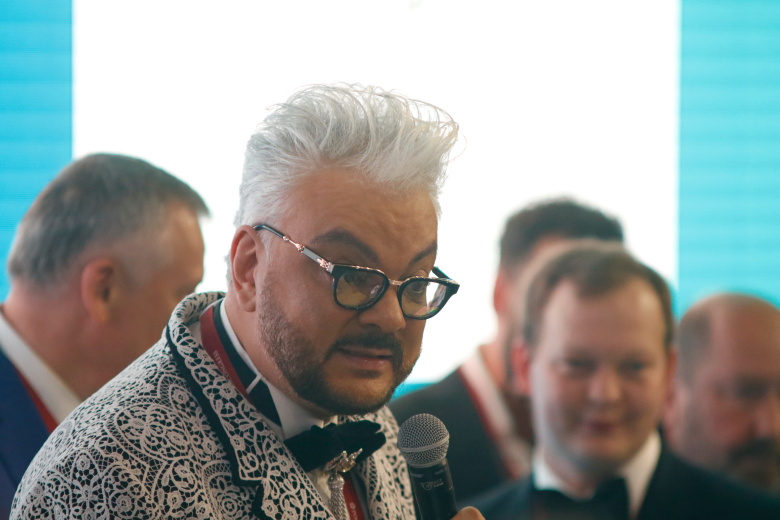
Blogger Nastya Ivleeva, singer Philip Kirkorov, rapper Vacìo, and others

To whom: everyone.

For what: for an “almost naked” party, at which the guests were dressed scantily; Vacìo even came wearing only a sock over his penis.

Quotes:

Vacìo: “I want to say that I don’t support LGBT people in any way and didn’t want to make any propaganda about it. I condemn LGBT supporters. I apologize for offending the feelings of other people and for being involved in such a terrible video at such a difficult time for our country.”

Philipp Kirkorov: “I went through the wrong door. Yes, I knew about the event, had received an invitation, promised to come and came, but I didn’t know about the nature of the events that would take place behind that door. And so I left.”

Ksenia Sobchak: “I can tell you for sure for myself, my friends, I definitely did not want to offend anyone. If someone is offended by my appearance, I apologize for it.”

Did it help: We don’t know yet. It seems that the backlash against Ivleeva and her guests is still underway.

Source: WTF (Mediazona) email newsletter, 28 December 2023. Translated by the Russian Reader


Hüsker Dü, “I Apologize” (1985)

MOSCOW, Dec 28 (Reuters) – A rapper who attended a celebrity party with only a sock to hide his modesty has been jailed for 15 days, sponsors of some of Russia’s best known entertainers have torn up their contracts, and President Vladimir Putin is reported to be unamused.

An “almost naked” party at a Moscow nightclub held at a time when Russia is engaged in a war with Ukraine and the authorities are pushing an increasingly conservative social agenda, has provoked an unusually swift and powerful backlash.

A video clip of Putin’s spokesperson listening to an explanation from one of the stars who attended has been circulating online. Baza, a news outlet known for its security services contacts, has reported that troops fighting in Ukraine were among the first to complain after seeing the footage and that photographs of the event reached an unimpressed Putin.

Dmitry Peskov, Putin’s spokesperson, on Wednesday asked reporters to forgive him for not publicly commenting on the burgeoning scandal, saying: “Let you and I be the only ones in the country who aren’t discussing this topic.”

Maria Zakharova, a spokesperson for the Russian Foreign Ministry, said that the event had “stained” those who took part, but that they now had a chance to work on themselves, according to the Ura.ru news outlet.

The fierce backlash from the authorities, pro-Kremlin lawmakers and bloggers, state media, and Orthodox Church groups has been dominating the headlines for days, displacing stories about rising egg prices and allowing people to let off steam by railing against the show-business elite instead.

The party, in Moscow’s Mutabor nightclub, was organised by blogger Anastasia (Nastya) Ivleeva and attended by well-known singers in their underwear or wearing skimpy costumes who have been staples on state TV entertainment programmes for years.

DOUBLE APOLOGY

Ivleeva, who has since become one of Russia’s most recognised names, is seen in one clip showing off an emerald-studded chain around her backside worth 23 million roubles ($251,000) at a time when some Russians are struggling to get by.

She has since issued two public apology videos for the event which spanned Dec. 20–21.

In the second tearful apology, released on Wednesday, Ivleeva said she regretted her actions and deserved everything she got but hoped she could be given “a second chance.”

Nastya Ivleeva’s second social media apology for the “almost naked” party, posted on Wednesday

Her name has since disappeared as one of the public faces of major Russian mobile phone operator MTS, the tax authorities have opened an investigation that carries a potential five-year jail term, and a Moscow court has accepted a lawsuit from a group of individuals demanding she pay out 1 billion roubles ($10.9 million) for “moral suffering.”

If successful, they want the money to go to a state fund that supports Ukraine war veterans.

“To hold such events at a time when our guys are dying in the (Ukrainian) special military operation and many children are losing their fathers is cynical,” said Yekaterina Mizulina, director of Russia’s League for a Safe Internet, a body founded with the authorities’ support.

“Our soldiers on the front line are definitely not fighting for this.”

Many of the party’s famous participants have recorded apologies, including journalist Ksenia Sobchak whose late father Anatoly was once Putin’s friend and boss.

SOCIAL CONSERVATISM

The scandal comes at a time when Putin, who is expected to comfortably win another six-year term at a March election, has doubled down on social conservatism, urging families to have eight or more children, and after Russia’s Supreme Court ruled that LGBT activists should be designated as “extremists.”

Nikolai Vasilyev, a rapper known as Vacio who attended wearing only a sock to cover his penis, was jailed by a Moscow court for 15 days and fined 200,000 roubles ($2,182) for propaganda of “non-traditional sexual relations.”

Other more famous names have had concerts and lucrative state TV airtime cancelled, contracts with sponsors revoked, and, in at least one case, are reportedly being cut out of a new film.

The scandal has angered those who support Russia’s war in Ukraine.

Standing outside the Bolshoi Theatre on Thursday, Nadezhda, one Moscow resident, told Reuters she was outraged and thought those who took part should be punished and not shown on TV anymore.

“If you’re partying at least don’t film it,” she said. “At such a difficult time (for Russia), they should at least be ashamed. Aren’t they ashamed before those who are fighting for us?”

Alexander, another Muscovite, said those who attended had not broken any law and were free to do as they pleased at what was a private event.

But one woman who said her nephew had lost both legs in combat wrote in a post to the League for a Safe Internet that the stars should pay for prosthetic legs for her relative and others to make amends.

“That would be a better apology,” the unidentified woman wrote.

($1 = 91.6205 roubles)

Source: Andrew Osborn, “Russian stars’ semi-naked party sparks wartime backlash,” Reuters, 28 December 2023


In her first social media post about the scandalous party, released five days ago, Nastya Ivleeva wasn’t apologetic or teary-eyed at all. ||| TRR


The situation around the “naked party in Moscow,” in the course of which the Russian patriotic crowd has canceled many quite pro-regime figures, quite tellingly illustrates the degradation of Russian society. Previously, there were two realities: the reality of official propaganda, and a parallel reality in which there was “contemporary art,” “kinky parties,” and Knife magazine.” In exchange for symbolic loyalty to the regime, one could gain comparative individual freedom.

Now that time has come to an end. There will be no individual freedom even for the chosen ones. The only freedom that remains for Russians is the freedom to vote for Putin and the freedom to apologize to Kadyrov.

There is something incredibly funny about the fact that Russian culture, after all its sobbing about imaginary [culture] “cancellation” [on the part of the west], has finally joyfully taken the plunge and canceled itself.

Source: Aleksandr Wolodarskij (Facebook), 28 December 2023. Translated by the Russian Reader
Funny Things Happened at the Forum

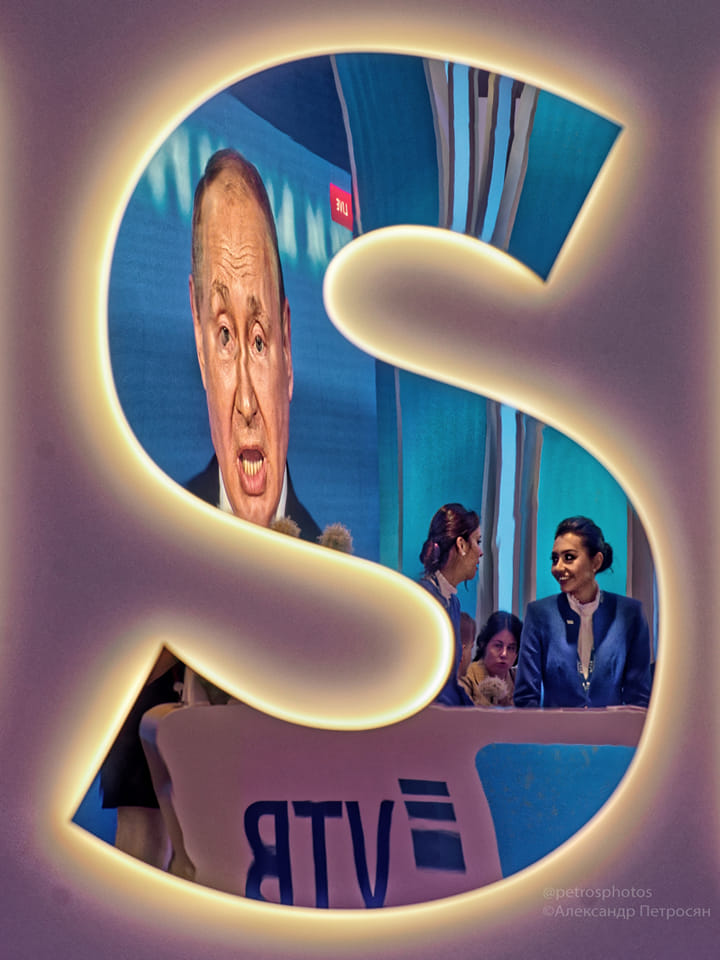
The phenomenal Petersburg photographer Alexander Petrosyan snapped this hyperrealist folk-conceptual photo at this week’s international economic forum in Petersburg, where the honored guests include the Taliban and the “president” of one of the fake Donbas “people’s republics.” There has been a lot of coverage of the remarks made at the forum by this snapshot’s ostensible subject. I have excerpted one article about them, below. This excerpt is followed by my translation of an interview with Sergei Khestanov about the forum and the broader Russian economic outlook in the light of the war and western sanctions.


As is traditional, the forum was dominated by a plenary session involving Putin. Earlier in the week, Peskov announced that Putin would make “an extremely important speech”. A couple of days later, he went out of his way to insist that the president was not about to announce a mobilization. It’s unclear why this was necessary – it’s no longer early March when this rumor was widespread.

The speech itself (which lasted for almost 90 minutes) contained no surprises. Putin spoke Friday about how “crazy sanctions” were not hurting the Russian economy, but, instead, causing pain for the Western countries as they wrestle with a crisis caused by an ill-conceived coronavirus response. “Our special military operation has nothing to do with it,” Putin said. More than once, Putin insisted the Russian economy remained open for business and reaffirmed his belief that the West would come to its senses and that Western companies would soon return to operating in Russia as normal.

But the most interesting part was when the moderator, Margarita Simonyan (head of state-owned RT and a prominent hawk on Ukraine) began putting questions to Putin and Tokayev. Along with the president of Armenia, Tokayev was one of only two heads of state to travel to the forum. It was painfully clear that Tokayev’s presence was repayment for Putin’s support back in January when troops from the Russian-led Collective Security Treaty Organization (CSTO) helped to re-impose order in Kazakhstan and, at the same time, marginalize Tokayev’s predecessor, Nursultan Nazarbayev.

However, Tokayev’s gratitude knows some bounds. That was apparent two days before he shared the stage with Putin when he gave an interview to state-owned Rossiya 24 in which he confirmed that his country would fully comply with Western sanctions on Russia.

Judging by what followed, Putin was aware of that interview. The highlight of the session was Putin’s attempt to pronounce his colleague’s name and patronymic – Kassym-Jomart Kemelevich. In January, when Kazakhstan was at the center of international attention as a result of civil unrest, Putin was already struggling with this difficult – but not impossible – name and twice uttered something incoherent. This time, at the start of his speech, Putin got it right – but during the Q&A session he again referred to Tokayev as “Kemel-Zhemelevich”, prompting a highly suspicious look from his supposed ally (this is clearly visible in the video).

Tokayev’s answers to Simonyan’s questions were far from the platitudes of an ally and some of what he said ran directly counter to Putin’s position. Diplomatic and courteous (Tokayev is a former UN Deputy General Secretary), the Kazakh president told Putin:

  • Kazakhstan “takes sanctions into account” (a response to a question from Simonyan suggesting the West must be pushing Kazakhstan to stop cooperation with Russia).
  • No economy can successfully pursue a policy of self-reliance and import substitution.
  • Ukraine’s accession to the European Union must be accepted as a new reality, even though its economy is in a dreadful condition.
  • The U.S., and the West in general, are not in the throes of a major crisis. At present, the U.S. economy is “modern and dynamic.”
  • That there are some Russian politicians, journalists and cultural figures who make “absolutely incorrect statements about Kazakhstan” and other states and “sow discord between our peoples.” This is likely to refer to occasional calls in the Russian parliament to protect the Russian-speaking population of Kazakhstan, which is concentrated in the north of the country. Such pronouncements are very reminiscent of the rhetoric in Russia about the Donbas region of eastern Ukraine.
  • Finally, without prompting, Tokayev dismissed the possibility of Kazakhstan recognizing the People’s Republics of Donetsk and Luhansk. He dismissed the republics – recognized by Russia – as “quasi-state entities.”

You can watch the whole of the plenary session here, or read a transcript here.

The scandal continued Saturday when Kazakh media reported Tokayev had turned down the Order of Alexander Nevsky bestowed on him by the Russian government. The official reason was that Kazakhstan’s president is not permitted to accept honors from foreign countries while in office – Russian state-owned media devoted half a day to reporting this explanation.

Source: “Showcasing Isolation,” The Bell, 19 June 2022


The St. Petersburg International Economic Forum (SPIEF) wrapped up this weekend. The feelings it generated are complicated. On the one hand, there was a heated discussion of the forum in social media; on the other hand, it was mainly not economic news that was discussed, but the juicy scandals that happened at the forum. Does the international forum have a future in the face of total western sanctions? And have the speeches at the SPIEF made it clearer what will happen next with the Russian economy? We talked about this with Sergei Khestanov, a well-known economist who has developed dozens of financial theories and techniques. He also serves as an adviser on macroeconomics to the CEO of Otkritie Investments.

Judging by the discussion of SPIEF on social media, the hottest guests were the Taliban (an organization that is banned in Russia) and Philipp Kirkorov. Is this due to the exoticism of their being at the economic forum or the absence of significant guests?

— The Taliban were just a kind of exotic highlight, I think. By the way, they were not particularly visible in the latter part of the forum. There weren’t many notable guests, really, but then again there hasn’t been an abundance of such guests for many years. What was unusual was that some guests of the forum (Russians, by the way) were asked not to advertise their participation and to wear name tags that did not spell out their companies and positions, lest they be hit by sanctions. From the economic point of view of, it doesn’t mean anything, but it is a quite interesting reflection on how the forum is seen.

Was western business represented at the forum in general?

— It was practically absent. Many [western businessmen] simply cannot attend without spoiling their reputations, even those who have not yet abandoned the Russian market.

And what was interesting from a substantive point of view?

— In terms of the forum’s substance, I would draw attention to the statement made by [Sberbank chief] Hermann Gref that the Russian economy would be able to reach the level of 2021 in ten years. That’s quite a frank recognition of the state of our economy. Vladimir Putin’s statement about banning audits of businesses is also welcome if the number of such audits is really reduced. However, it bothers me that they have been talking about this for so many years [without doing anything about it.]

Putin also announced a reduction in the preferential mortgage rate to seven percent.

— Volumes of orders have been falling in the construction industry, so we need to support it. And since, as a rule, the construction industry is closely affiliated with local and, sometimes, regional authorities, the desire to support it is quite understandable. Plus, the industry is a multiplier, so helping it helps the metals industry, manufacturers of cement, lumber, and so on. However, the decline in volumes is not yet tremendous, so nothing terrible would happen without help, but nor do I expect the support to trigger a boom.

There is another danger here: real estate prices in Russia, especially in the megacities, are overheated. if the decrease in mortgage rates is not coupled with an increase in down payments, we could end up with a mortgage bubble. And then, under certain unfavorable circumstances, of which there might be many going forward, we could face a terrific downturn in prices and a serious mortgage crisis. I would not say that the danger is great now, but it cannot be ignored.

Wait, what collapse? What crisis? It followed from Vladimir Putin’s speech that we have been successfully coping with western sanctions. Supposedly, foreign exchange earnings are so great that they almost equaled the volume of the frozen portion of Russian gold and foreign exchange reserves.

— Russia is bursting with money that it cannot digest because of import restrictions and the threat of frozen accounts. It turns out that money has been earned, but what to do with it? It isn’t possible to use it constructively. And this madness with shoring up the ruble is due to the fact that there is no demand for non-cash payments: exporters need controls, but they cannot sell currency. So, it’s like a pear is dangling in front of you, but you can’t eat it.

But Central Bank head Elvira Nabiullina in her speech suggested a way out for exporters: they should focus on the domestic market.

— Those are pretty words, but most exporters have been working for the domestic market for a long time. The problem is that the domestic market’s capacity is limited. For oil and petroleum products, for example, domestic demand accounts for about a quarter of current production. That is, if we refocus on the domestic market, we need to cut production threefold. Will that make things better?

Export industries perfectly satisfy domestic demand, and everything else is exported. This also applies to the metals industry, both ferrous and non-ferrous metals, and the oil industry, and the petrochemical industry. Nizhnekamskneftekhim, the world’s largest producer in its class of raw materials for plastics, supplies its products to both the domestic and foreign markets, but only a very small portion of what it produces goes to the domestic market, because such is the demand.

And, for example, aluminum and titanium are used mainly in aircraft construction. Given current conditions in the domestic market, they can be used, at best, to make kvass cans.

— Exactly. The domestic Russian market is simply not able to absorb everything produced by exporters. So, this call to pivot to the domestic market is like that joke. “Bunnies, become hedgehogs, so the foxes won’t eat you.” “Great, but how do we do it?” “I don’t know — I’m a strategist, not a tactician.”

To be fair, Nabiullina had also talked about structural adjustment in the past.

— What the Central Bank head said about structural adjustment is right, but it doesn’t make much sense yet. Unless we note the speech made by [Alexei] Kudrin, who said that it would take two to three months to develop a strategy. I consider him one of the most serious public figures in terms of macroeconomic analysis, so his words carry a lot of weight for me. Two or three months is a realistic amount of time, I think. It would bring us to the beginning of autumn, and all over the world at this time, business picks up after the summer lull. Plus, statistics for macroeconomic indicators will have been reported, and the relevance of the data will have increased. So I’m eighty to ninety percent in agreement with him.

 But what don’t you agree with?

— My main disagreement is that, since the sanctions have not yet ended, the effectiveness of strategies is low. No matter how good a plan is, it will have to be changed quickly and often. Moreover, so far most of the sanctions have impacted imports, and that is not so terrible. Of course, it’s sad that Ivan Sixpack can no longer buy a new smartphone, but this has little effect on the economy. Export sanctions are much more serious when it comes to filling the state coffers. But I think it’s too early to talk about them before next year.

Well, so far, Ivan Sixpack does not seem to be suffering much. Many people say that the sanctions are not really hurting us.

— Since demand has dropped a lot, people are under the illusion that nothing terrible has happened. But by the second half of September, I think that stocks in the warehouses will be exhausted, and it will become clear what is happening with durable goods.

— Especially with spare parts for cars. This topic is now of concern to many people. A friend of mine is now glad that she didn’t buy a foreign car, as she had originally wanted, but a Russian-assembled Renault.

— She shouldn’t be too glad. Some of the spare parts for inexpensive Russian-assembled foreign cars are made in Russia, but only some. The rest are imported.

— So, we will have to establish a shuttle trading business for the delivery of spare parts.

— Maybe, but the whole business will be tedious, time-consuming and, accordingly, much more expensive. As in the 90s, people will have to buy cars that Russian spare parts fit. They will have to learn how to do their own repairs. In Soviet times, I went abroad to buy a used car with cardboard templates in tow to determine whether the wheels from a Lada would fit it, whether the filters would fit. I knew how to re-rivet brake pads. Basically, I can fix anything on a car, except the carburetor. Most of the motorists of that time could do the same. Maybe they couldn’t do everything, but they could do the most basic things like cleaning the spark plugs and changing the oil and filters. Those were the necessary skills. But nowadays, many people don’t even know how to change tires.

— They’ll have to learn. Once again the menfolk will gather in garages on weekends, although many people don’t have their own garages anymore. They only have spaces in multi-story parking lots, and you can’t repair a car there.

— And the skills have been lost. Of course, a parallel import market will be established, and people will learn how to do repairs, but it will be difficult for motorists. It will become immensely more expensive and more difficult to maintain a car.

— Speaking of cars. Industry and Trade Minister Denis Manturov announced plans to resume production not only of the Moskvitch, as discussed by Moscow Mayor Sergei Sobyanin, but also of the Volga and even the Pobeda. The latter, by the way, was produced in the 50s. Is the [Russian] car industry really that bad off? What about the Chinese? Wouldn’t they help us? After all, they are switching to electric vehicles. Could they transfer the production of internal combustion engines to Russia?

— As I understand it, Manturov was actually talking about reviving the brands, not the cars of that generation themselves. Because if there is a demand for classic Ladas now, it’s not very big. In the back country, the fact that they can be repaired easily is appreciated. But all the other cars [of the period] were total tanks. I used to drive a Pobeda back in the day. It really, you know, encourages you to develop your shoulder muscles, because turning the steering wheel involves great physical exertion. The brakes are the same way.

But what they probably have in mind is producing new models under those brands, maybe even stylized to look like the old ones. Aesthetically, the Pobeda is beautiful — it’s just hard to drive it. The Volga 21 is beautiful, and so are the Moskvitches up to the 412 model. And if you also give it a two-tone paint job, like the Moskvitch 403, you could make a very popular model. Volkswagen also produced an updated replica of the Beetle.

 And how will they make them?

— They will probably buy the platforms from the Chinese, or [the Chinese] will even supply the assembly lines. Then designers will be commissioned to come up with designs, maybe even stylized to look like Soviet cars. And so the brands will be reborn.

— In conclusion, let’s return to the guests at SPIEF. In terms of foreign leaders, Kazakhstan President Kassym-Jomart Tokayev attended the forum. Chinese President Xi Jinping also made a short speech via video link. There is probably no point in asking whether SPIEF can now claim the role of the “Russian Davos.” I wanted to ask you abpit something else. Given the current conditions, is there any point to this event?

— Tokayev, I think, just couldn’t help but show up. Everyone paid attention to how he spoke relatively harshly about the DPR and the LPR. Of course, he is a professional career diplomat and spoke in such a way that you can’t find fault with him, so it’s quite difficult to extract any one definite message from his speeches.

— What about when he said that Kazakhstan had no choice but to support western sanctions?

— But this is quite obvious: he didn’t say anything new. It is clear that the economy of Kazakhstan cannot fight a consolidated decision by the western economies. This would not only be difficult, but also not really necessary. So, where its own interests are not affected, Kazakhstan can help Russia — but no more than that. By the way, the Chinese have the same attitude towards us.

Is that why Xi Jinping not only did not come to SPIEF, but was also brief in his video message?

— There is not much to talk about in the current circumstances. So it’s not that Xi didn’t want to talk. There was nothing in particular for him to talk about. It is clear to everyone that the Russian economy is not doing very well. So, our corporations signed contracts with each other, which they happily reported before going their separate ways.

The question of whether SPIEF should be held is another matter: the degeneration of such forums is not only a Russian problem. The Davos forum has also been experiencing a lack of serious ideas. Ten years ago, the substantive part of it was much larger, but nowadays everyone is for all the good things and against all the bad things. And all other [economic] forums face similar problems: a lack of substance and a focus on narrow subjects. So, what is happening with the Petersburg Forum is not unique.

Russian pop singer Philipp Kirkorov at the 25th St. Petersburg International Economic Forum
Photo: Maksim Konstantinov/Global Look Press. Courtesy of Republic

It’s hard to say what the reason is for this. Maybe the format has worn out its welcome. As in art, there is a fashion, a trend, and then times, traditions, and tastes change, and the format goes away. Maybe it is due to the fact that the world economy has been slowing down. When the forums were interesting, the economy was growing; intense economic processes were underway, and reforms were being undertaken in the countries of the former USSR and Eastern Europe. But now there is stagnation everywhere, even in the IT field, about which I know a thing or two. What can I say? Moore’s law has been disproven! The number of transistors on a single chip no longer doubles every eighteen months. So, this is a universal problem. I don’t know whether this trend is reversible or permanent, but for the time being it’s like this. Do you remember the Central Committee plenums in Soviet times? The “resolutions” that were “submitted for consideration” and instantly “approved”? The long tedious speeches about nothing? It’s all coming to look a lot like that.

Source: Tatyana Rybakova, “‘Do you remember the Central Committee plenums in Soviet times? It’s all coming to look a lot like that’: Sergei Khestanov on the St. Petersburg Economic Forum and the future of the economy,” Republic, 19 June 2022. Translated by the Russian Reader