International Day for the Protection of Children

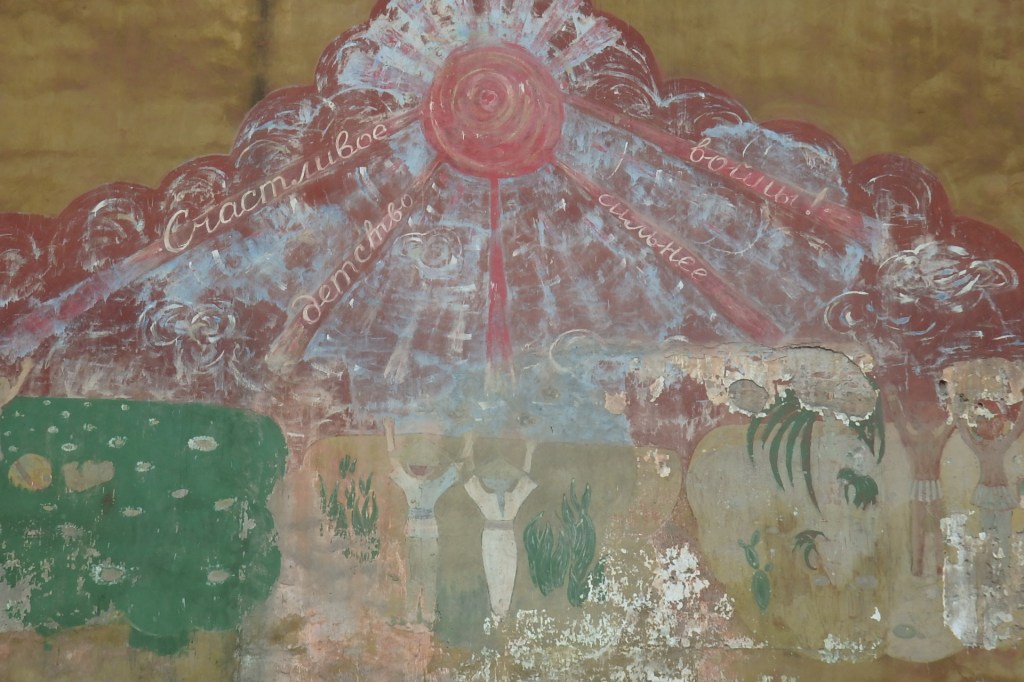
“A happy childhood is stronger than war!”

A ragged urchin, aimless and alone,

   Loitered about that vacancy; a bird

Flew up to safety from his well-aimed stone:

   That girls are raped, that two boys knife a third,

   Were axioms to him, who’d never heard

Of any world where promises were kept,

Or one could weep because another wept.

— W.H. Auden, “The Shield of Achilles”


Wednesday is International Day for the Protection of Children in many former Soviet countries — a joyful celebration typically marked by concerts, outdoor games and arts and crafts.

In Ukraine, it’s a Children’s Day like no other. On Friday, the country will mark the grim milestone of 100 days since the Russian invasion. During that time, at least 262 children have been killed and 415 injured in wartime strikes, according to UNICEF, the U.N. children’s agency, which cited confirmed figures that the United Nations acknowledges are incomplete and much lower than the actual tolls.

Ukrainian officials have said there is little cause to celebrate. The war has left 5.2 million children in need of humanitarian assistance, according to UNICEF, and has disrupted children’s lives and education.
“This year, Children’s Day in Ukraine is celebrated in a different way than usual,” Daria Herasymchuk, an adviser to Ukraine’s president on children’s rights and rehabilitation, said Wednesday, according to the Interfax-Ukraine news agency.

In wartime, children “are forced to hide from the bombing in shelters, in the subway,” Herasymchuk said during a news briefing. “They are forced to leave their homes and seek shelter in safe regions.”

But despite the war, towns and cities across Ukraine still marked the occasion Wednesday — though it looked different than usual.

In the western city of Lviv, the mayor, Andriy Sadovy, posted photos of abandoned school buses, stuffed animals, name tags and backpacks on empty seats, during what Reuters described as an event marking the death of 243 children during the war.

“A school trip that will never happen,” Sadovy wrote in a Facebook post, using the hashtag #emptybuses.

“Stronger than war!”

“Today, the school buses on Ploshcha Rynok [Lviv’s central square] are empty,” he wrote, adding that “243 children will never travel to Lviv again.” He accused Russian forces of “killing children, women and civilians” and continued: “They must be held responsible for every life taken. Today, the whole world must unite to stop these terrible crimes.”

It was not immediately clear whether Sadovy’s figure of 243 referred to children killed in Lviv or more widely in Ukraine.

Meanwhile, soldiers from Ukraine’s army posed with drawings and stuffed animals in a video message for Children’s Day posted on the Defense Ministry’s Twitter account.

“We expect that you know what we do,” the soldiers say in the video. “We defend our native country. And … it is always very important for us to receive support from you, like these kinds of self-made items, pretty drawings and poems. So send them to us. Together, we will pray for our state.”

The video then zooms in on some of the drawings, which bear messages such as “Ukraine will be able to do anything” and “The enemy will not pass.”

In Bucha, where Russian forces were accused of committing war crimes during their month-long occupation of the quiet suburb of Kyiv, photos showed children making “embroidered hearts and paper birds for soldiers on the front line,” according to the Getty photo service.

Most of the 5.2 million children who need humanitarian assistance have been displaced by fighting between Ukrainian and Russian forces, the agency said. On average, the conflict in Ukraine kills at least two children and injures at least four each day, UNICEF and the U.N. agency for refugees said in a news release. It said the casualties occurred “mostly in attacks using explosive weapons in populated areas,” an oblique reference to bombardment by Russia, which went unmentioned in the news release.
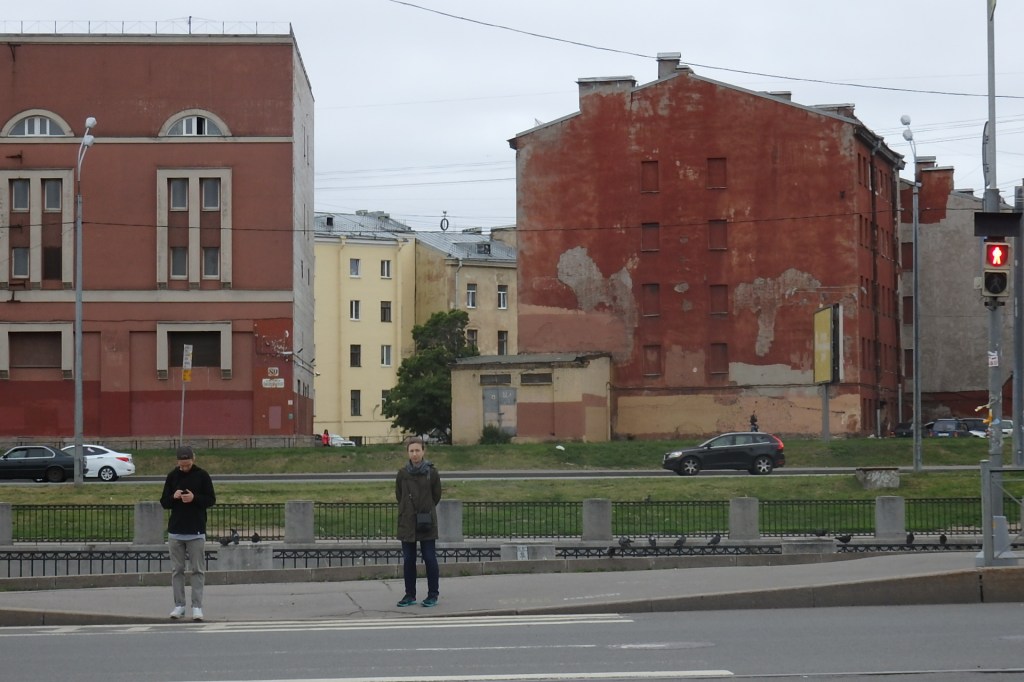
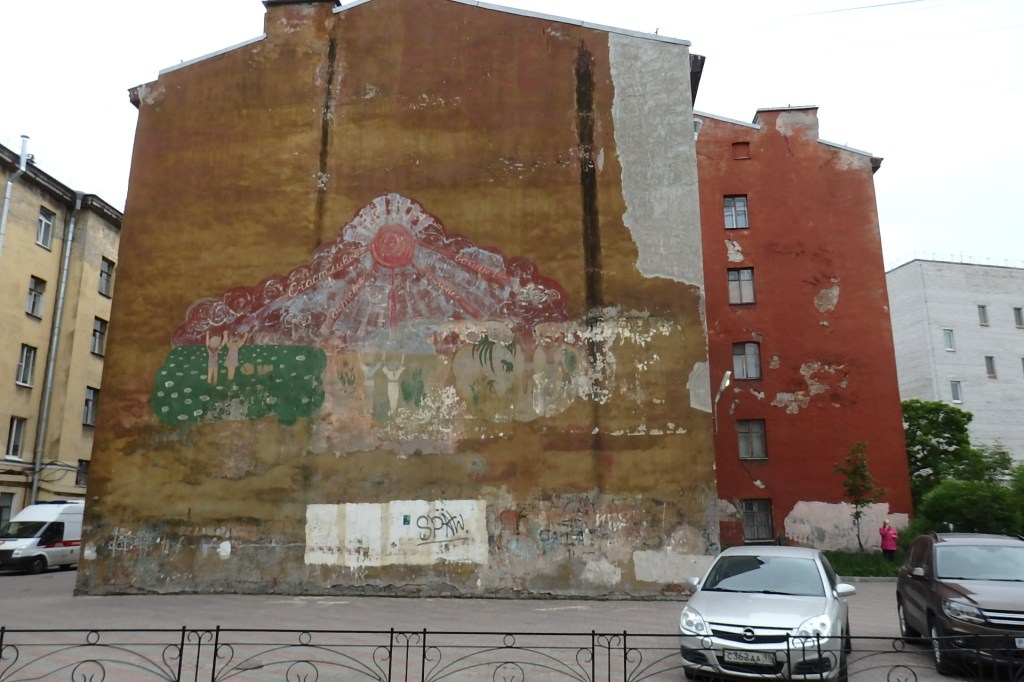
The “pro-children, anti-war” mural is hidden amongst these building on the far side of the Obvodny Canal.

“June 1st is International Day for the Protection of Children in Ukraine and across the region,” UNICEF Executive Director Catherine Russell said in Wednesday’s release. “Instead of celebrating the occasion, we are solemnly approaching June 3 — the 100th day of a war that has shattered the lives of millions of children.”

Russell called for “an urgent cease-fire and negotiated peace” to end the war, without which she warned that “children will continue to suffer — and fallout from the war will impact vulnerable children around the world.”

Source: Annabelle Timsit, “As Ukraine marks Children’s Day, U.N. says 5 million need humanitarian aid,” Washington Post, 1 June 2022. Photos of the late-Soviet or early-post-Soviet-era pro-children, anti-war mural in the courtyard of the residential buildings at the corner of Borovaya Street and the Obvodny Canal in St. Petersburg taken by the Russian Reader on 28 May 2016.


“International Day for the Protection of Children, 1958. USSR Post, 40 kopecks.”

International Day for the Protection of Children is celebrated annually on June 1. Established in November 1949 in Paris by decision of the Congress of the Women’s International Democratic Federation, it was first celebrated in 1950. In addition, World Children’s Day (November 20), International Day of Innocent Child Victims of Aggression (June 4) and African Children’s Day (June 16) are dedicated to children. In terms of international law, the principal relevant document is the Convention on the Rights of the Child, adopted by the UN on November 20, 1989 and ratified by the USSR on July 13, 1990.

[…]

The rights of children in the Russian Federation are protected by the Federal Law “On Basic Guarantees of the Rights of the Child in the Russian Federation,” adopted on July 24, 1998. It guarantees the basic rights and legitimate interests of children as stipulated in the Constitution of the Russian Federation. The State recognizes that childhood is an important stage of human life and prioritizes preparing children for a full-fledged life in society, encouraging them to engage in socially significant and creative activity, and inculcating them with lofty moral qualities, patriotism, and civic consciousness. Russia has a system of local child protection services, which are tasked with monitoring the well-being of children in families in their jurisdictions, as well as local and federal commissioners for children’s rights.

[…]

Abortion opponents have chosen this day to hold events in defense of the right of unborn children to life. In various countries of the world (e.g., the USA, the Czech Republic, Lithuania, Belarus, etc.), they gather on or around June 1 to draw the the general public’s attention to the problem of abortion.

Anti-abortion events have also been held [on this day] in Russia, including a car rally, a procession, a march, a rally, prayer services, pickets, film screenings and discussions, informational leafletting, and suspension of abortions by medical institutions.

In 2016, Patriarch Kirill marked International Day for the Protection of Children with a special appeal to make donations to support women in crisis situations. On May 29, the last Sunday of the month, his appeal was read aloud in every church and [churchgoers were asked to donate] money for the creation of humanitarian aid centers [sic] for women expecting children. The fundraising campaign, which took place throughout the country, garnered 38 million rubles, which were earmarked for the creation of the new humanitarian aid centers.

Source: “International Day for the Protection of Children” (Russian), Wikipedia. Translated by the Russian Reader
All We Have to Look Forward to Are Past Wars and Future Wars, but God Help Us from Revolutions

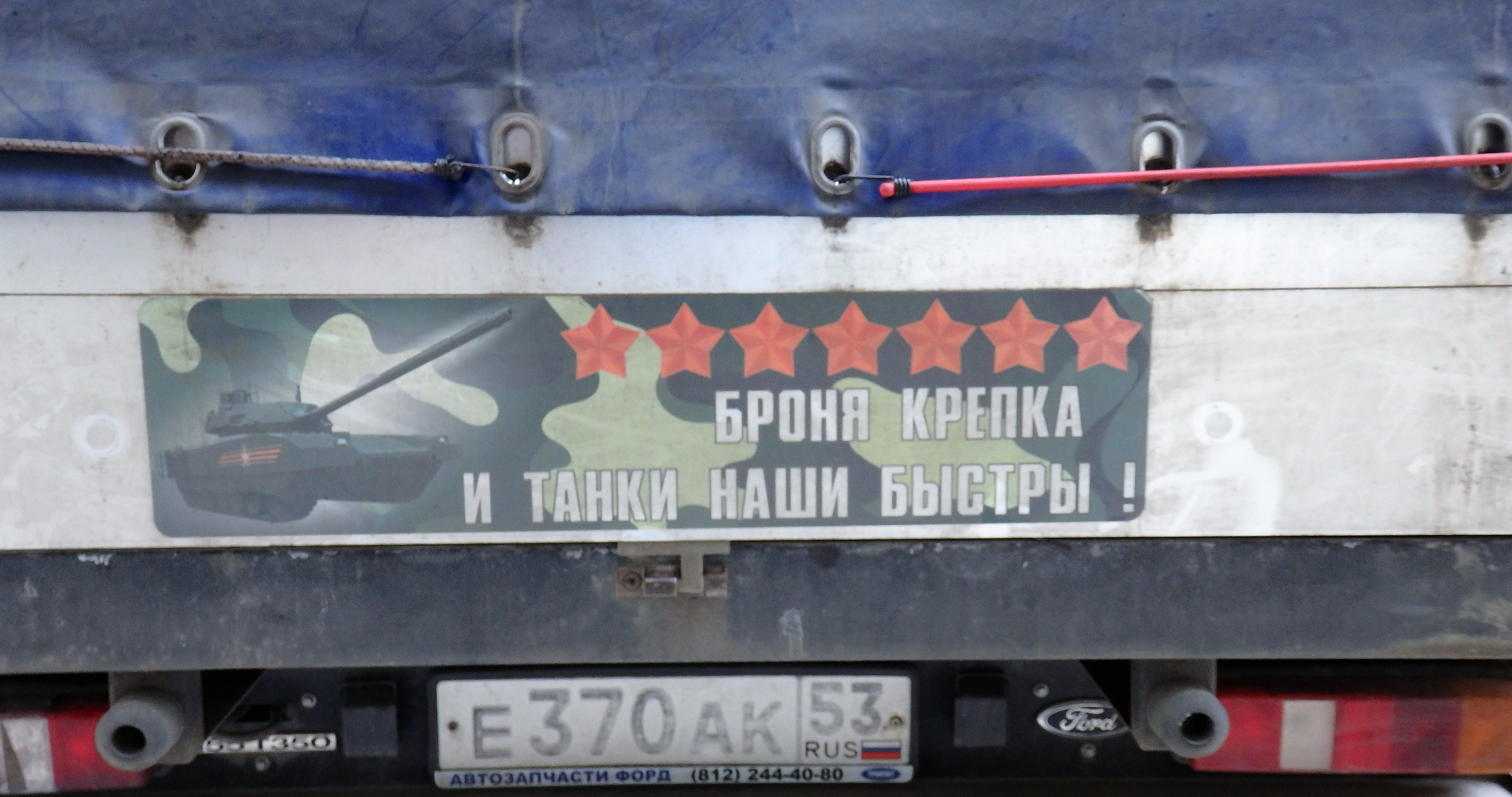
When my charge Abubakar and I emerged from the courtyard of our building earlier today for our afternoon constitutional, we were abruptly confronted by a moving van, almost blocking the exit to the street. The van, which was quite filthy, had two “patriotic” (nationalist) bumper stickers tattooed on its back bumper.

OLYMPUS DIGITAL CAMERA

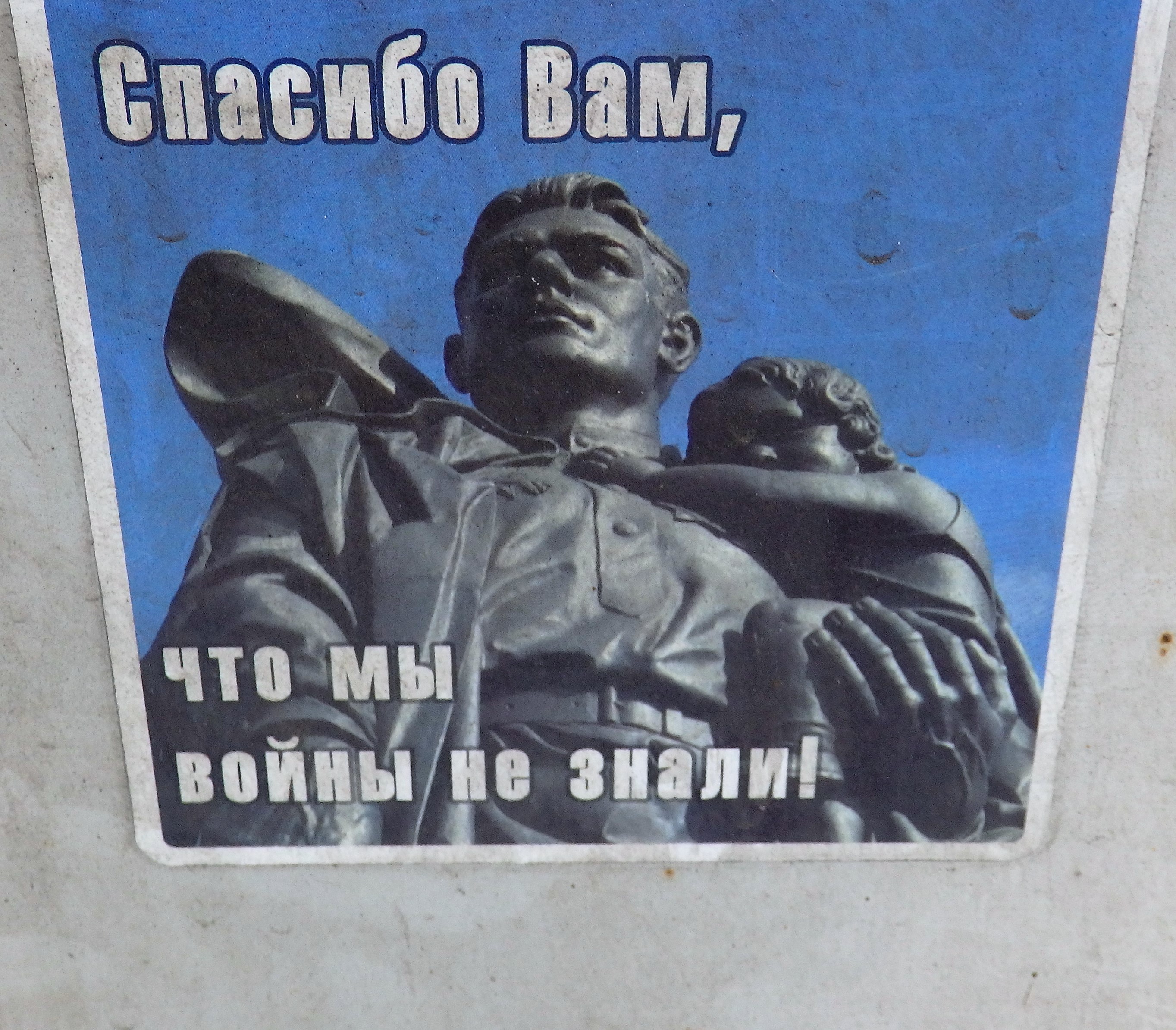
“Thank you that we don’t know what war is like!” You can say what you like about the Soviet War Memorial in Berlin’s Treptower Park, but the Great Fatherland War was definitely not the “war to end all wars” almost anywhere, much less the Soviet Union and post-Soviet Russia, which happily intervened militarily in Hungary, Czechoslovakia, and Afghanistan after the war, as well as enthusiastically engaging in lesser Cold War shenanigans all over the globe with and without its sparring partner the US. Since its convenient self-collapse, it has twice reduced Chechnya to rubble, occupied Crimea, set Donbass on fire, and razed East Aleppo to the ground. So much for not knowing what war is like. The experience has merely been severely localized to keep the ruling and chattering classes of Moscow and Petersburg from knowing what it’s like.

OLYMPUS DIGITAL CAMERA

“Our armor is strong and our tanks are swift!” This particular (modern) tank is emblazoned with the St. George’s Ribbon that has become a de rigueur accessory for “patriots” (nationalists) on holidays such as Victory Day (May 9). Some particular fervent patriots (nationalists) manage to wear the ribbon all year round, like an amulet against the evil eye.

Here we see the historical semantic switch that is always flicked by Russian nationalists, played out, in this case, on a single, dust-encrusted moving van bumper. Since the Soviet Union made the “ultimate sacrifice” in the Second World War, it now gets a free pass in all present and future conflicts, which are somehow, usually vaguely, provoked by the “raw deal” the Soviet Union and, especially, ethnic Russians supposedly got in the aftermath of the Second World War and the Cold War.

The second bumper sticker should thus be seen as a serious “humorous” threat to invade Europe in the very near future. The really funny thing is it is addressed to a purely domestic, i.e., Russian audience. Perpetually “collapsing” Europe, brought to its knees, allegedly, by Muslim fundamentalists, gays, and political correctness (in the Russian popular imagination), and thus deserving of invasion (salvation) by Putinist Russia, literally cannot see this message, ostensibly addressed to it, not to other Russians, who have it drilled into their heads on a hourly basis, unless they avoid the Russian state media altogether, which many of them have done to keep their heads from exploding.

20840926_1698810056830620_6808640191179048680_n
Bolshaya Zelenina Street, Petersburg, August 17, 2017. Photo courtesy of Alexandra Kasatkina

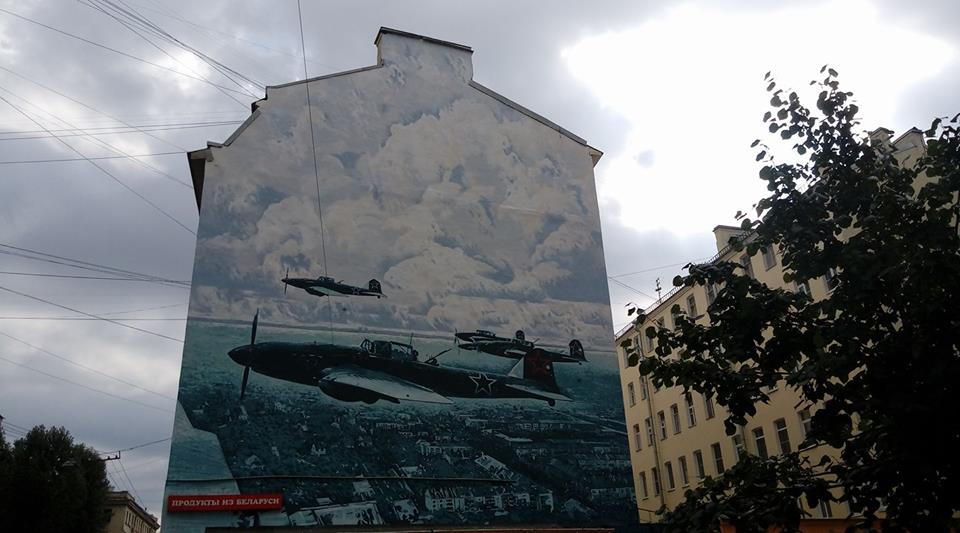
An acquaintance came home today to find a once blank or otherwise adorned firewall, as depicted above, painted over with an alarming, menacing war scene. There was a brief period between the collapse of the Soviet Union and Putin 2.0 or Putin 3.0, when the city’s numerous, achingly beautiful firewalls were freed of portraits of Politburo members and exemplary socialist laborers and allowed to be themselves, which was something like the visual equivalent of one hand clapping. But when money and politics poured back into the city in the noughties, the firewalls were an easy means for district council officials to show residents and city hall they were engaged in “improvements” and not just pocketing the budget money entrusted to them. (They were doing that, too, whatever else they were pretending to do.) Hiring a crew of hacks to paint the firewall in an otherwise dreary courtyard and arranging a few benches or a little garden or playground below the mural was just the ticket.

Those days of mostly harmless kitsch are now long past. Firewalls should now say something big and important, if the city is going to bother to put up the hard cash to paint them, and that message has to be aggressive and “patriotic.” As one commentator wrote, upon seeing the image of the Soviet warplanes, above, the impression they make is that Russia must start a war immediately.

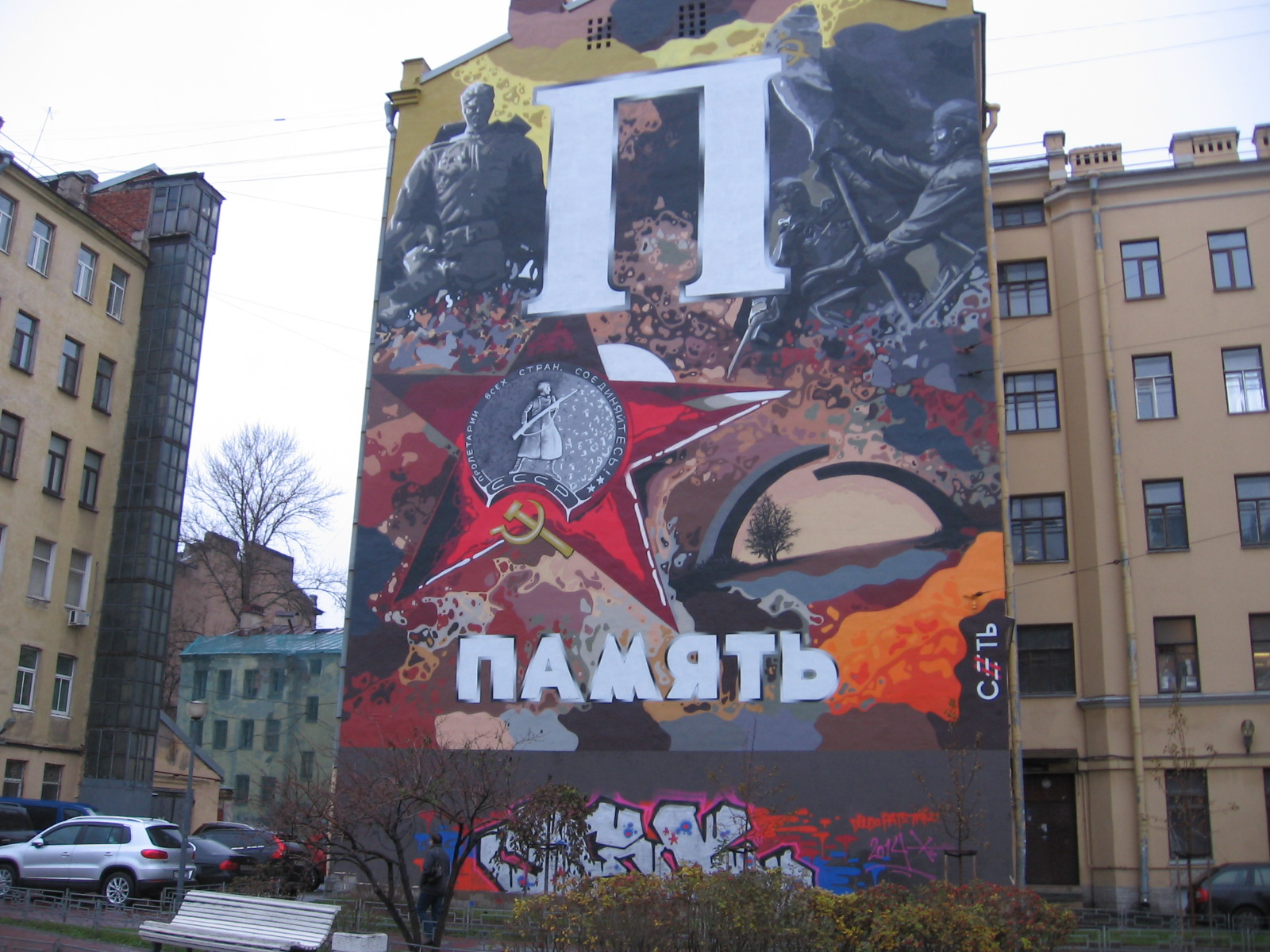
Or, as in a series of five murals painted on different walls in five Russian cities on the occasion of Putin’s birthday in October 2014, “monumental propaganda” is made to short circuit all of Russian/Soviet history, especially the country’s triumphs, to the current regime and its ruler for life.

IMG_5964Memory (P = Pamiat’), one of a series of graffiti-like murals produced by the pro-Kremlin youth group Set (“Network”) to celebrate the president’s birthday in October 2014. This mural was painted on the firewall of an apartment block on the Obvodny Canal in Petersburg. Fortunately, it has since been painted over. Photograph by the Russian Reader

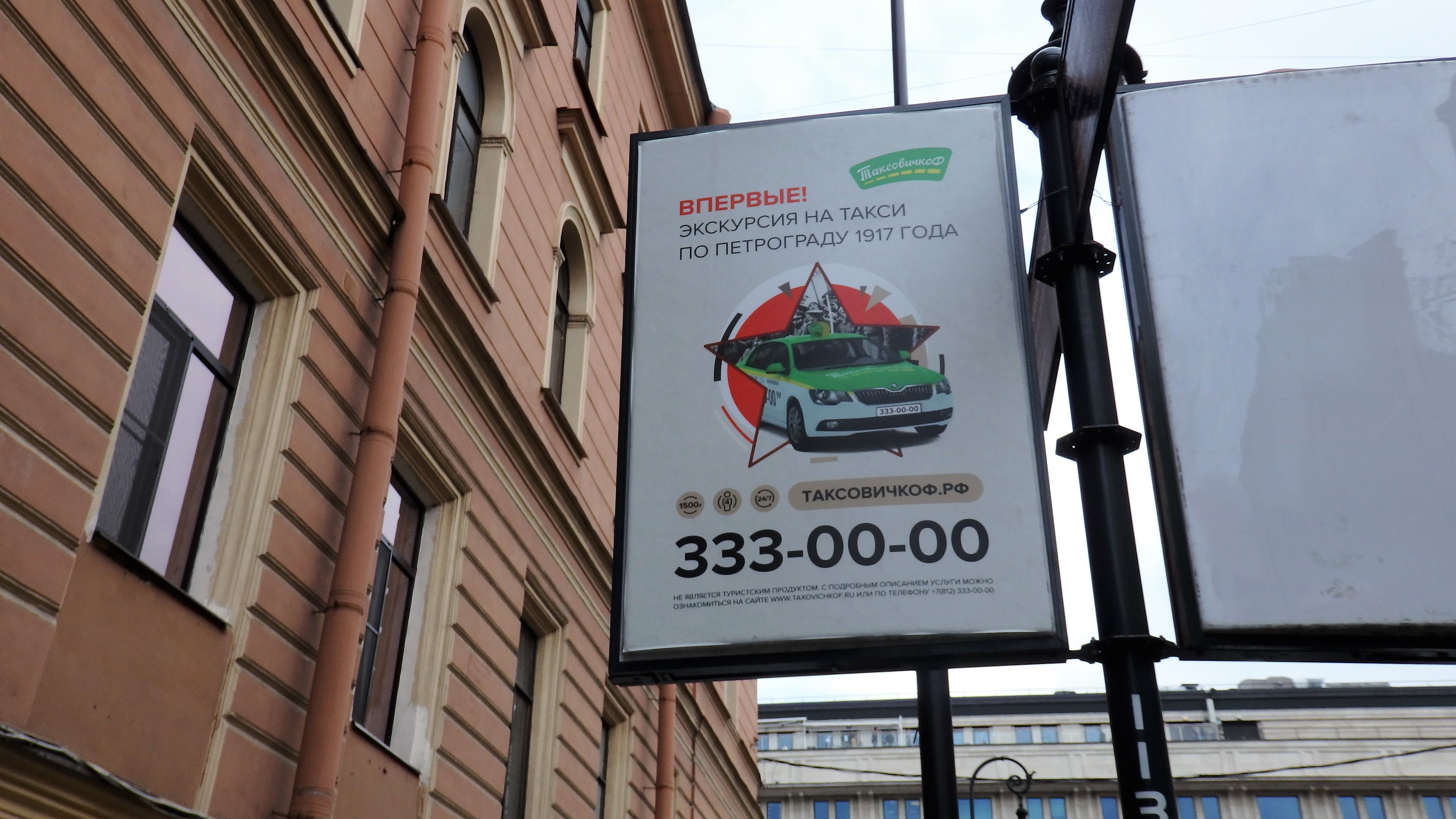
Thankfully, there are times when the public meta-historical messages are either unreadable or deeply ambiguous, as in this advertisement and accompanying promotion for the Uberesque taxi company Taksovichkof. (In the interests of full disclosure, I use their services very occasionally.)

OLYMPUS DIGITAL CAMERA

“A first!” claims the ad. “A taxi tour of 1917 Petrograd”!

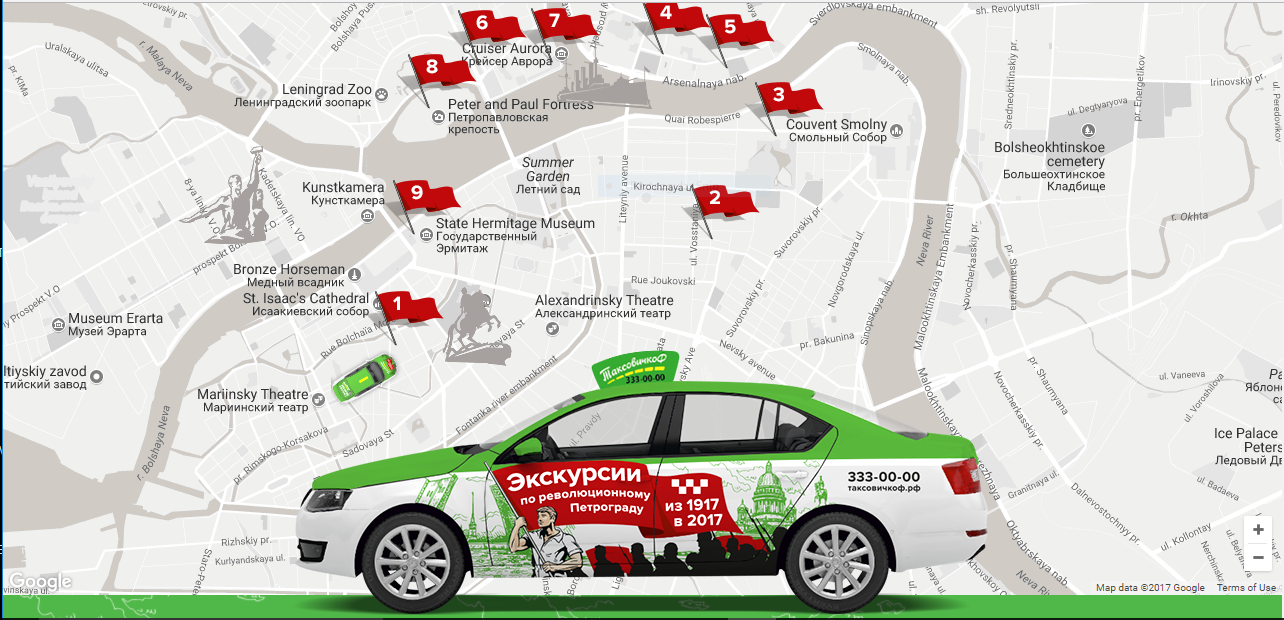
It transpires the route includes St. Isaac’s Cathedral; the barracks of the Volyhnia Regiment, who decisively came down on the side of the Provisional Government during the February 1917 Revolution; the Smolny Institute, where the Bolsheviks were temporarily headquartered in October 1917; the Finland Station; the nearby Crosses Prison, where many revolutionaries of all stripes, not just the Bolsheviks, did hard time; the revolutionary battleship Aurora, which fired the shot heard round the world, returned to its moorings recently after extensive repairs; the mansion of ballerina Mathilde Kschessinska (currently, the Museum of Political History), where Lenin read out his so-called April Theses (“The Tasks of the Proletariat in the Present Revolution”) after returning from exile in Switzerland; the Peter and Paul Fortress, which housed many political prisoners and revolutionaries during the tsarist period; and, finally, the Winter Palace, stormed by a unit of Bolsheviks and other revolutionaries on October 25, 1917, as a means of asserting the hard left’s symbolic victory in the second revolution.

takso-tour 2.PNG
The route of Taksovichkof’s Excursion through Revolutionary Petrograd from 1917 to 2017 [sic]. Image courtesy of Taksovichkof

Unfortunately, knowing a little bit about the political views of the local TV celebrity and historian who recorded the tour’s audio guide, I can anticipate the tenor of the tour will be fairly counterrevolutionary and reactionary (i.e., “liberal”). But it’s better than declaring war on Finland again, I guess. TRR

P.S. The taxi tour costs 1,500 rubles (approx. 22 euros at current exchange rates). It lasts at least an hour and a half depending on traffic conditions, which are usually brutal from morning to night in downtown Petersburg. You can go on the tour from five in the morning (ideal, I would think) to twelve midnight (when the downtown is crawling with merrymakers).