The Story of Igor Paskar, Who Threw a Molotov Cocktail at the FSB’s Offices in Krasnodar

Igor Paskar. Photo courtesy of Vot Tak (Belsat)

On October 28, the trial of Igor Paskar began in the Southern District Military Court in Rostov-on-Don. He is accused of throwing a Molotov cocktail at the FSB’s offices in Krasnodar, and also of setting fire to a [pro-war] “Z” banner. Paskar explains his actions as a protest against the war: after the alleged attempted arson at the FSB, he painted his face in the colors of the Ukrainian flag of Ukraine. The FSB has classified the protest as “terrorism,” and the burning of the banner as “vandalism.” Paskar faces ten to fifteen years in prison if convicted.

To Moscow and Back

Igor Paskar was born and lived until the age of thirty-five in a workers settlement in the Volgograd Region. He came of age in the 1990s, turning eighteen in 1994. After school, he enrolled in the administrative and industrial buildings maintenance program at the Volgograd Institute of Architecture and Civil Engineering, but had to quit his studies in his first year after he was drafted into the army. After two years in a construction battalion, Paskar returned to his native village and immediately began working odd jobs — on construction sites, as a loader, and as a courier.

In 1998, when Paskar was twenty-two, he was first sentenced to five years probation on charges related to drug trafficking. In 2001, he received two years of actual prison time for theft and possession of hashish. He was last convicted of a criminal offense — one and a half years probation for possession of marijuana — in 2006. The last ten years, Paskar told Vot Tak, he has been clean — he completely gave up using light drugs.

In 2013, Paskar moved to Moscow. At various times in the capital, he worked as a courier at Samokat, as a loader, and as a furniture assembler. He also sold rare items on Amazon.

He became interested in politics in 2018 — as his case investigator would later write, he became an “adherent of radical liberal opposition ideas.” In 2021, Paskar was detained in Moscow for taking part in a protest rally called by Team Navalny after the politician’s arrest.

In the summer of 2021, the activist returned to Volgograd, where he got a job as a courier. During one of the interrogations about this period, he said: “I was still interested in the work of the Anti-Corruption Foundation, and I supported Alexei Navalny. I publicly voiced my opinions among people I know, including at work, and I posted my opinions in messengers and chats.”

The FSB on Fire

In February of this year, before the start of the Russian invasion, Paskar responded to an ad and took in a lost dachshund. According to the activist, stray dogs tried to attack the pooch several times, so he bought a flare gun to scare them away. He soon left his village in the Volgograd Region with his dog for work: he had found an unusual vacancy on the internet — picking strawberries in Adygea. Paskar was unable to start the job, however. There was a conflict in the workers’ accommodations over the dachshund, and he fired the flare gun at the ceiling. Paskar himself called the police, and the court sentenced him to five days in jail. After his release from a special detention center, Paskar left for Krasnodar.

In a letter, he describes this period as follows: “I have had a whole series of failures in life over the last three months. When the special operation began, I was unable to transfer money from abroad after the SWIFT system was switched off. I had an Amazon account on which I traded rare items. After the start of the special operation, I lost my earnings. I could not get a job in Volgograd and decided to go to Krasnodar for seasonal work, but there were a number of failures. I was angry at my plight and decided to sacrifice myself for what I believe in — peace.”

Paskar held his first anti-war protest in downtown Krasnodar on June 12, Russia Day. It was then that he threw a lighted bottle of gasoline at a banner featuring the letter Z and the slogan “We do not abandon our own.” No one paid attention to his actions, the banner quickly went out, and Paskar was not detained.

Paskar then decided to carry out a protest action at the FSB’s Krasnodar offices. He did not plan to go into hiding and prepared for his arrest by selling his phone and packing a bag for the pretrial detention center. “My criminal experience has left its mark on me. When a person has [this experience], they are no longer afraid to go to prison. They already know that you can live there too — not very well, but you can do it. It is not hell. This has an impact not so much on radical decisions as on accepting one’s fate,” Paskar noted in a letter to your correspondent.

On June 14, Paskar went to the FSB’s offices on ulitsa Mira [“Peace Street”] in Krasnodar. A Molotov cocktail flew [sic] onto the building’s stone porch. The activist then painted his cheeks yellow and blue and waited for passersby to react and for the authorities to detain him. He hoped that someone would record the protest on their phone and post the video on the internet. Passersby avoided the scene, however. FSB officers came out of the building after a few minutes and detained the activist.
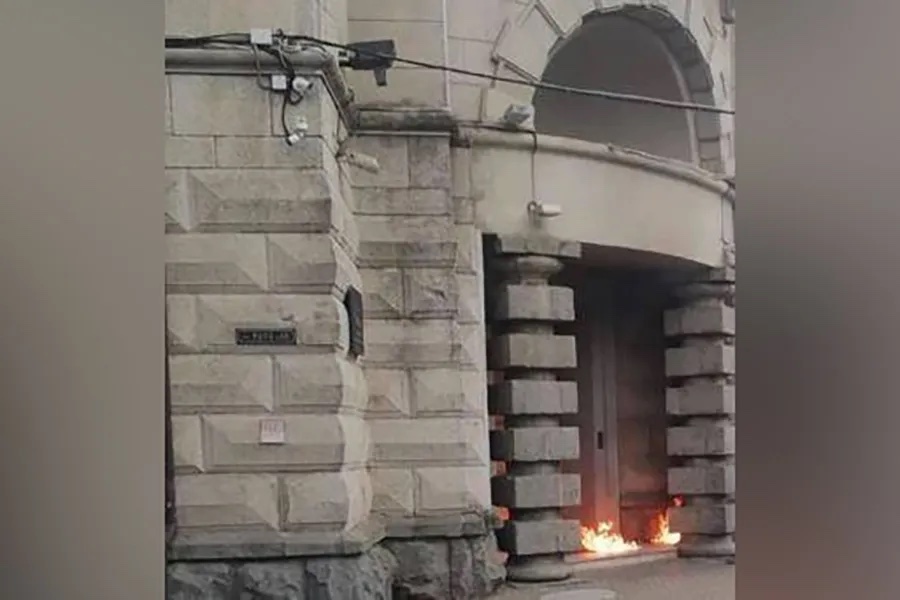
The moment when the fire flared on the porch of the FSB offices in Krasnodar: Source: Baza. Courtesy of Vot Tak (Belsat)

A Burnt Rug

Paskar calls his protest symbolic, emphasizing that his actions could not have caused serious damage — only a rug was burned on the stone porch. Despite this, a criminal case was immediately launched against Paskar under Article 205 (“Terrorism”) of the Russian Federal Criminal Code, which stipulates a penalty of ten to fifteen years in prison.

On October 28, the Southern District Military Court began considering the case — according to the amendments to the law adopted in 2014, only four district military courts [in Russia] can try terrorism cases. The court extended Paskar’s term in the pretrial detention center for six months, and ruled that the trial would be open to the public. The first hearing on the merits in the case was scheduled for November 10.

In 2016, for setting fire to the door of the FSB headquarters in Lubyanka Square [in Moscow], the performance artist Pyotr Pavlensky was sentenced to pay a fine of 500 thousand rubles under Article 243 of the Russian Federal Criminal Code (“Destruction or damage to objects of cultural heritage or cultural artefacts”). And yet, at the trial, the artist demanded that his actions be reclassified as terrorism.

Earlier, the [exiled opposition] politician Gennady Gudkov said that Paskar’s actions could be deemed disorderly conduct: “In any civilized country, such a thing is regarded as disorderly conduct and is punished with a warning or a fine.” And gallery owner Marat Guelman called Paskar’s act activism.

Paskar is being aided by the human rights initiative Solidarity Zone, which previously announced a fundraiser to pay for Paskar’s lawyer.

Source: Ivan Astashin, “‘He became an adherent of radical liberal ideas’: the story of Igor Paskar, who threw a Molotov cocktail building at an FSB building,” Vot Tak (Belsat), 31 October 2022. Translated by the Russian Reader


Vot Tak has published an article about Igor Paskar, who is accused of throwing a Molotov cocktail at the FSB offices in Krasnodar and setting fire to a “Z” banner. He did this to drawn attention to the war and voice support for the people of Ukraine.

On October 28, the Southern District Military Court began trying Paskar’s case.

Solidarity Zone has been providing comprehensive assistance to Paskar.

We are now raising funds to pay for Igor’s lawyer.

Fundraiser details:

💳 Sberbank card

4276 5500 2065 1710 (Zlatislava)

🪙 PayPal: solidarity_zone@riseup.net (marked “for Paskar”).

🥷 Cryptocurrency (be sure to email us at solidarity_zone@riseup.net if you transfer cryptocurrency to support Igor Paskar)

bitcoin: bc1qfzhfkd27ckz76dqf67t0jwm4gvrcug49e7fhry

monero: 86565hecMGW7n2T1ap7wdo4wQ7kefaqXVPS8h2k2wQVhDHyYbADmDWZTuxpUMZPjZhSLpLp2SZZ8cLKdJkRchVWJBppbgBK

ethereum: 0xD89Cf5e0B04b1a546e869500Fe96463E9986ADA3

other altcoins:

https://nowpayments.io/donation/solidarityzone

#solidarity#nowar#prisoners

Source: Solidarity Zone, Facebook, 31 October 2022. Translated by the Russian Reader
Foreign Agents

Lyudmila Savitskaya • Facebook • December 28, 2021

A year ago, the Russian authorities labeled me a foreign agent. THIS MESSAGE (MATERIAL) WAS CREATED AND (OR) DISTRIBUTED BY A FOREIGN MASS MEDIA OUTLET PERFORMING THE FUNCTIONS OF A FOREIGN AGENT AND (OR) A RUSSIAN LEGAL ENTITY PERFORMING THE FUNCTIONS OF A FOREIGN AGENT. During these 365 days, one of my bank cards was blocked on suspicion of money laundering, I was fined over ten thousand rubles for the Journalist-Foreign Agent LLC that I created by order of the Justice Ministry, and I was deprived of the opportunity to work on certain projects. Antidepressants appeared in my medicine cabinet, and a psychiatrist became one of my friends.

My husband Dmitry Permyakov was turned into a family member of an enemy of the people: as a person affiliated with a “foreign agent” he was summoned for questioning by Center “E” and threatened with torture in prison. And another person close to the police called to solicitously warn us that our home had been bugged. You can read this year’s other sad particulars in my column for Sever.Realii – “Luda, the floor is burning under your feet!” (See the link in the first comment.)

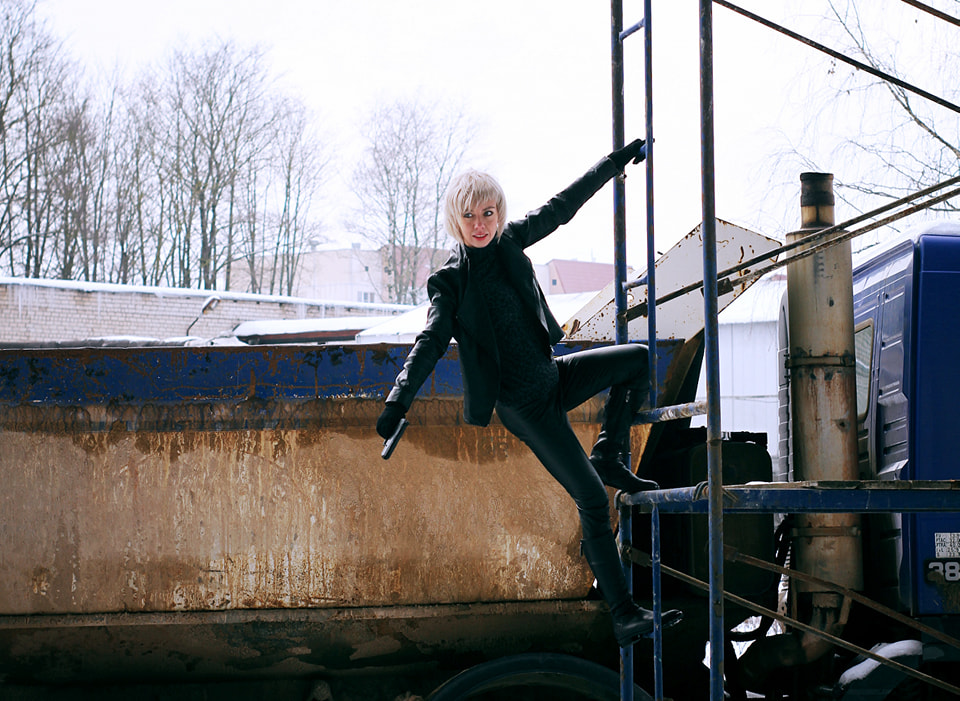
But here you can admire my super agent photo shoot, which was cold but quite a lot of fun. No time to die, happy new year!


Russia Labels Pussy Riot Activists, Satirist ‘Foreign Agents’ • Moscow Times • December 30, 2021

Russia has added members of the Pussy Riot art activist collective, a prominent satirist and an independent journalist its registry of “foreign agents” Thursday.

The designations close a year in which Russia labeled nearly every major independent domestic news outlet, as well as dozens of individual journalists and activists, a “foreign agent.”

Founding Pussy Riot member Nadezhda Tolokonnikova and fellow member Nika Nikulshina have been added to the Justice Ministry’s “foreign agents” registry.

Tolokonnikova, 32, was among the Pussy Riot members who were sentenced to prison for their 2012 protest performance in central Moscow’s Christ the Savior Cathedral that criticized the Russian Orthodox Church’s close ties with President Vladimir Putin.

Anti-Kremlin satirist Viktor Shenderovich; Taisiya Bekbulatova, chief editor of the independent Holod news website; and art collector and former Kremlin advisor Marat Gelman have also been added to the list.

“These people systematically distribute materials to an indefinite circle of persons, while receiving foreign funds,” the Justice Ministry’s statement said.

The ministry’s registry now includes more than 100 entities and individuals, most of which were added in 2021.

Rights advocates denounce the country’s “foreign agents” law, saying it seeks to silence groups and individuals that dissent from state narratives by branding them with a label that carries dark connotations from the Soviet era.

Labeled individuals and entities must submit regular financial reports and detailed lists of income and spending, as well as prominently display a wordy disclaimer on all articles, social media posts and other publications — or else face criminal charges.

But officials defend the law, pointing to what they say are harsher equivalent laws in Western countries.

On Monday, prominent BBC Russian investigative journalist ​Andrei Zakharov said he left the country two months after being labeled a “foreign agent,” saying he faced “unprecedented surveillance” following his designation.

And Russian courts this week ruled to liquidate the two main structures of Memorial, Russia’s leading human rights group and a key pillar of its civil society, citing repeated violations of the “foreign agent” law.


Alexander Morozov • Facebook • December 30, 2021

After seeing today’s list of “foreign agents,” I thought: is any more proof required that this status is exclusively political, that its legal aspect does not matter at all? These are not foreign agents in the sense of “lobbyists of a foreign state.” They are “agents of the West” (in the broad sense of “the hostile West”). In this respect, their status directly depends on the Kremlin’s conflict with the outside world. The next stage of escalation (which, in my opinion, is inevitable) will automatically mean that, regardless of their legal status as “foreign agents,” the people on the list will be criminally prosecuted. After all, the list is “good to go”: it exists and therefore should be put to work. So the list is no joke at all. Anyone who does not leave the country before the Kremlin’s conflict with the West accidentally escalates will end up behind bars. Therefore, I won’t congratulate people dear to me on having this label conferred on them. It’s a very dangerous and grim business.


Pussy Riot • Facebook • December 30, 2021

THIS MESSAGE (MATERIAL) CREATED AND DISTRIBUTED BY A FOREIGN MASS MEDIA PERFORMING THE FUNCTIONS OF A FOREIGN AGENT

two of Pussy Riot, Nadya Tolokonnikova and Nika Nikulshina, were added to the government list of “foreign agents” & required to start every tweet w this disclaimer.

OFFICIAL REACTION:

1. lol

2. we will not label my posts, the government can label their asses if they’d like.

3. we will appeal in court.

4. Russia will be free.


Matvey Ganapolsky • Facebook • December 30, 2021

I want to say what will happen with the Russian media in 2022.

1. Domestic opposition media outlets will be destroyed and gutted. TV Rain and Echo of Moscow will have huge problems, including closure or reformatting, because they broadcast oppositional viewpoints. Neither [Alexei] Venediktov nor [Nobel Peace Prize winner Dmitry] Muratov will be able to save them.

2. Under various, poorly concealed pretexts, the local offices of Radio Svoboda [Radio Liberty] and the BBC will be closed. Radio Svoboda’s internet broadcasts and podcasts will be blocked, as well as the websites of these companies. VPNs will also be blocked.

3. The West will find itself in a paradoxical situation in which it will be necessary to resume short-wave broadcasting. Russia will respond by jamming them. Young people will run to their grandparents to retrieve old radios.

4. The media situation will be at the level of the late USSR. It will change only with Putin’s departure or death.

Items 1, 3, and 5 translated by the Russian Reader

Nadya Tolokonnikova: The Year in Review

6_bottle

Nadya Tolokonnikova
The Year in Review, or, An Eternal Russian Winter in Solitary Confinement
December 29, 2015
Facebook

We rang in 2015 seeing Oleg Navalny sent off to a penal colony for three and a half years for the fact his brother was involved in politics.

Pyotr Pavlensky rang in 2015 by starting a bonfire on a Moscow quay.

“You spend the year the way you ring it in,” said Pavlensky as he left the Guelman Gallery, where we were seeing in 2015, and went off to an icy quay on the River Yauza to start a fire.

In November 2015, Petya pulled off the biggest art action of the year by torching the doors of the FSB. Pavlensky will greet the New Year in a cell at Butyrka remand prison.

In 2015 we found out you cannot only be imprisoned for political activism but also gunned down for it in the center of Moscow.

As 2015 ended, arrests in the Bolotnaya Square case continued. Anarchist Dmitry Buchenkov was arrested on December 3. The defense claims he was not at Bolotnaya Square on May 6, 2012.

Gallerist Guelman held a charity auction at his gallery in support of the Bolotnaya Square prisoners. The result was that the Guelman Gallery was no longer Guelman’s gallery. He was not forgiven by the powers that be for the auction, and the gallery was wrested away from him.

But the government also made humane decisions in 2015. After sentencing Vasilyeva to five years in prison, the court let her out on parole two months later.

In 2015, the government also destroyed embargoed produce, because they had no fucking clue what to do about falling oil prices. Russians were weaned off the notion of stability and tightened their belts as the Russian economic crisis made $400 a month a serious, substantial salary, as in the early noughties. In a number of Russian cities, the critical debts owed by municipal governments to fuel suppliers have led to stoppages of public transport, and electric companies have turned off the lights in the stairwells of apartment blocks.

The myth of stability has been destroyed, the state is the new punk, a rifle is a party, and everything is going to fucking hell in a hand basket. The New Year’s meal, by the way, will cost on average 5,790 rubles this year, which is 28% more than a year ago. So it is better to save money on December 31 and take a nap.

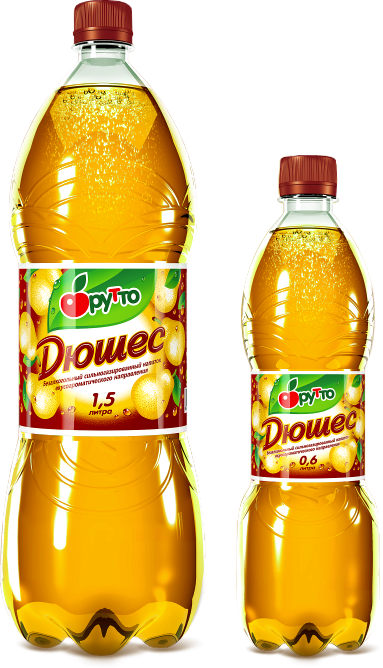
And, while you are sleeping, to dream of Pyotr Pavlensky, Oleg Navalny, and Bolotnaya Square political prisoner Alexei Gaskarov celebrating the New Year in their prison cells and pouring Duchesse, a domestic carbonated beverage, into recycled plastic instant mashed potato cups.

Amen.

Translated by the Russian Reader. Image of Duchesse soda bottles courtesy of Frutto

Russia vs. Russia: Political Art and Censorship

Victoria Lomasko
April 14, 2015
Facebook

During the last discussion at the Russland vs. Russland. Kulturkonflikte forum, the event’s title finally paid off.

Kristina Leko, an artist and teacher at the Berlin Institute of Art, opened the discussion. The organizers had invited her to comment on the forum and the exhibition of Russian “critical art.”

She wondered how much the objets d’art for Marat Guelman’s Perm project (documented at the forum) had cost, whether the money had come from the city’s budget, and if it had, whether the citizens for whose sake this monumental street art had allegedly been made had agreed with this. Leko noted that she had found it unpleasant to listen to the presentation of the project, during which it was stated that the residents of Perm were “insufficiently educated to understand art.” She also said that after carefully viewing the video documentation for MediaImpact, she could not understand where the audience for this sociopolitical art was. Did Russian “critical” artists even want to communicate with the general public? Leko asked whether it was possible to make “critical art” now without taking Russia’s aggression in Ukraine into account, and whether one could be a “critical artist” while ignoring gender and racial discrimination.

Her talk was suddenly interrupted by artist Alexander Brener, who burst into the circle of panelists and yelled, “All of this is shit! We must talk about what matters most!” Brener was not a forum participant. He had come every day to listen to the speakers and several times had expressed his dissatisfaction, but in much more acceptable form.

Brener had interrupted Leko’s talk and continued to shout about shit, but the panelists interpreted his stunt variously. One group sided with Brener, calling him a great Russian artist. This was a performance, a compliment to the forum’s organizer. The talk had been boring: let Brener have his say, they said. The moderator, sociologist Alexander Bikbov, demanded that Leko be allowed to finish her talk. He was backed up by cultural studies scholar Olga Reznikova, who told Brener that there had been many boring and offensive presentations over the past three days and asked him why he had not felt the urge to shout down a high-profile male who had been talking “shit.” The only Ukrainian participant in the forum, Vasily Cherepanin, director of the Visual Culture Research Center in Kyiv and editor of the Ukrainian edition of the journal Krytyka Polityczna, said he felt sorry for us, since we were accustomed to rudeness and could not tell the difference between it and art. As a manager of an institution, he himself kicks out such “performance artists,” no questions asked.

While this was happening, Leko’s hands were shaking. The German audience was shocked. One of the German participants asked perplexedly, “Why is there no solidarity among Russian artists?”

I am certain that the majority of men in Russia who identify themselves as “leftists” are incapable of uniting with women on an equal footing and dealing with our professional work appropriately, without loutishness. Personally, I have no desire to identify with those “leftists” or liberals who try talking down to me or do the same thing with other women. I had had enough of that at the Feminist Pencil show at MediaImpact.

I said that sexism was one of the causes that prevented people from uniting.

Hearing the word sexism, some of the Russian participants began laughing and making faces. They then pointedly left the room altogether when the topic of gender was picked up by Olga Reznikova, Heinrich Böll Foundation coordinator Nuria Fatykhova, and the German audience.

Vasily Cherepanin raised the next topic. He spoke about the war in Ukraine, stressing it was a war of aggression on Russia’s part. At the same time, many Russian socially and politically engaged artists have preferred to remain apolitical on this matter and not make anti-war statements. One of the Germans asked why the Russians were trying to depoliticize the discussion of sexism and the war in Ukraine. After this question, another third of the Russians dashed from the room, while the artist Brener, who had been sitting quietly in the corner, again broke into the circle of panelists, screaming at Cherepanin, “Fuck off!”

Moderator Alexander Bikbov summarized the discussion by noting that too few “critical” artists had stayed for its final part. As soon as the conversation had turned to the things that mattered most—politics within the art scene and the war in Ukraine—many were not prepared to discuss them.

But then at the farewell dinner, the participants who had left the discussion early continued giggling among themselves about gender and feminism.

____________________

Russia vs. Russia: From Censorship to Self-Censorship
New Russian laws—from a ban on swearing to protections for the feelings of religious believers—have made life difficult for artists. But the main obstacle to freedom of creativity has become self-censorship.
Yekaterina Kryzhanovskaya | Berlin
April 13, 2015
Deutsche Welle

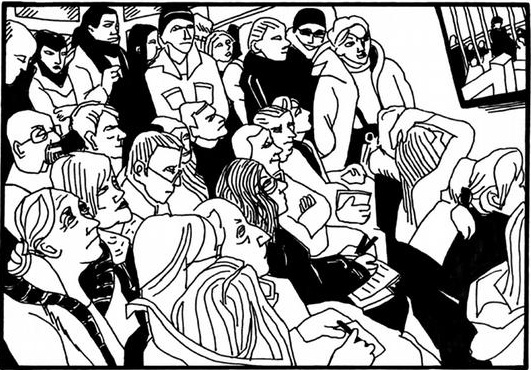
lomasko-courtVictoria Lomasko, Prisoners of May 6, from the Drawing Trials project

For several years, Victoria Lomasko has been doing socially engaged graphic art, producing graphic reportages from court hearings and political rallies, and drawing the real stories of juvenile prisoners, migrant workers, rural teachers, and Orthodox activists. But the Russian woman can now longer speak openly about what concerns her through her drawings: now her black-and-white “comics” could be subject to the articles of the Russian Federal Criminal Code.

“My work Cannibal State, in support of political prisoners, today could be regarded as insulting state symbols. Liberate Russia from Putin clearly rocks the boat; it’s a call for rebellion, for revolution, and this is ‘extremism.’ A work from the Pussy Riot trial, Free the Prisoners! Shame on the Russian Orthodox Church!, featuring Patriarch Kirill, no doubt insults the feelings of believers,” the artist recounts.

Could she now, as she did earlier, freely post her political posters in social networks or show them at exhibitions?

“Hardly. But just two years ago several of them were even published in magazines,” notes Lomasko.

From censorship…

At the forum Russia vs. Russia: Cultural Conflicts, held April 10–12 in Berlin, Lomasko was not the only one bewildered about the prospects of protest art.

“In Russia nowadays you cannot do anything,” states Artyom Loskutov, an artist and organizer of the annual May Day Monstration marches in Novosibirsk.

In 2014, the Monstrators took to the streets of Novosibirsk holding a banner that read, “Hell is ours.” When the Russian media were excitedly talking about the virtues of federalizing Ukraine, Loskutov and his allies announced they would be holding a March for the Federalization of Siberia.

“If people in Russia hear every day that separatism in Ukraine turns out to be a good thing, that cannot slip through the cracks. We have simply hastened the next stage, when separatism will be seen as good for our country as well,” Loskutov emphasizes.

Russian federal media watchdog Roskomnadzor responded by sending fourteen letters to various media, including Ukrainian publications and even the BBC, demanding that they delete even mentions of this protest.

…to self-censorship

According to many forum participants, however, censorship was not the worst that was happening to them today.

“The worst thing that infiltrates our heads is self-censorship. It is impossible to know about the new laws and not to think about the consequences if you make a work about something that really concerns you,” argues Lomasko.

A congress of ultra-rightist nationalists was held in March in Petersburg, completely legally. And yet the media could not publish photographs of congress participants in clothes featuring swastikas because they would be fined for extremism.

“I really want to speak out on this subject. But if I were to draw something, I could be accused of spreading fascist ideas. And if I put it on the Web, everyone who reposts the picture automatically becomes my accomplice,” explains Lomasko.

Consequently, she said, there have been almost no artworks openly criticizing the annexation of Crimea or the war in Ukraine. Doubts about the legitimacy of Moscow’s actions are now also subject to the Criminal Code.  A rare exception is the graffiti piece Broads Will Give Birth to New Ones, in which a pregnant woman holding a Molotov cocktail is depicted with an infant soldier in her belly. But it was produced anonymously by members of the Petersburg group Gandhi.

Monumental propaganda

On the other hand, you can express your joy over the actions of Russian politicians without the sanction of officials. Thus, on the eve of the referendum in Crimea, a monumental graffiti proclaiming “Crimea and Russia: Together Forever” suddenly appeared on the wall of a house in Moscow’s Taganka Square where an officially authorized map of the Tagansky District was supposed have been painted.

“The contractor himself decided that the Crimean agenda was more topical and interesting, and he willfully painted what he did, not the map he had been commissioned to paint,” explains Anna Nistratova, an independent curator, researcher, and artist.

0,,18377432_401,00Victoria Lomasko

Later, such monumental propaganda began to appear all over the country, both as commissioned by the authorities, and at the behest of the population, including activist artists, many of whom also believe, according to Lomasko, “Crimea is ours, Donbass is ours, and Ukraine basically doesn’t exist.”

“In matters of propaganda, orders from the top are not obligatory. Our citizens themselves are capable to taking the initiative,” notes Nistratova.

__________

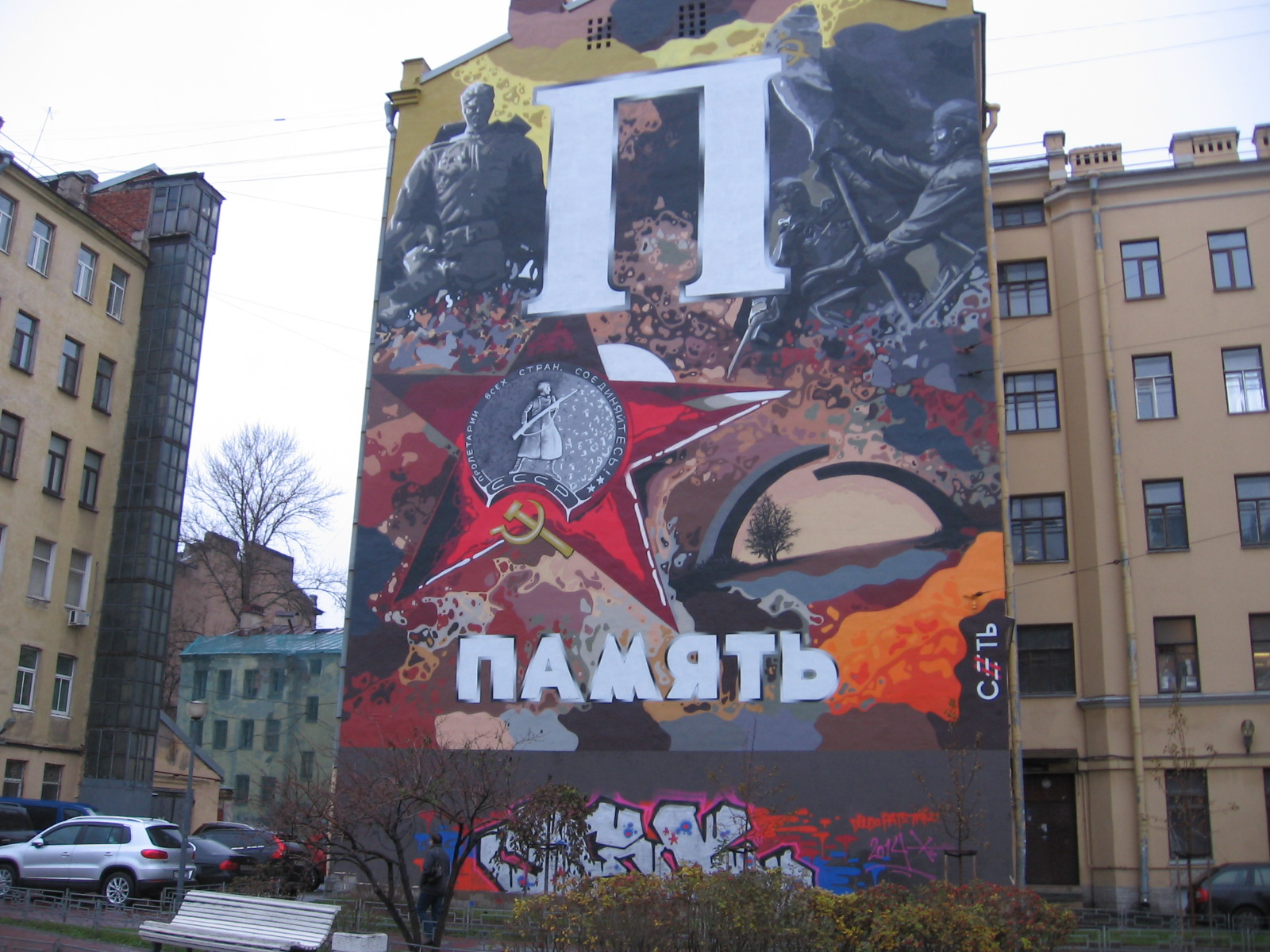
IMG_5964“Memory” (P = Pamiat’), one of a series of “graffiti” murals produced by the pro-Kremlin youth group Set (“Network”) to celebrate Vladimir Putin’s birthday in October 2014. The five murals, which appeared in different cities, each featured a different letter from the president’s surname; each letter was associated, children’s primer-style, with a different “patriotic” virtue (e.g., such as “memory” of the war). This mural was painted on an apartment block on Petersburg’s Obvodny Canal. Photograph by The Russian Reader

__________

Lost status

Nistratov points out that there are very few artists involved in political art in Russia. Besides, neither exhibitions nor the very best artworks nor inscriptions on the streets have any effect on society, in her opinion.

“The artist in Russia today is a strange, marginal subject. His status as an intellectual, as a moral exemplar, which existed earlier, has been completely forfeited,” says Nistratova.

Confusion is, perhaps, the feeling that is prevalent throughout the talks given by the participants of the forum Russia vs. Russia: Cultural Conflicts. By and large, the activist artists have no clear strategies for operating under new conditions.

“The only thing that seems to me worthwhile is maintaining one’s own little environment, a bubble inside the shit. Because if this nightmare ever ends, we have to make sure we are not faced with a scorched, absolutely bare field, bereft of political and social art, activism, and civic consciousness,” argues Lomasko.

♦♦♦♦♦♦♦♦♦♦♦♦♦♦♦♦♦♦♦

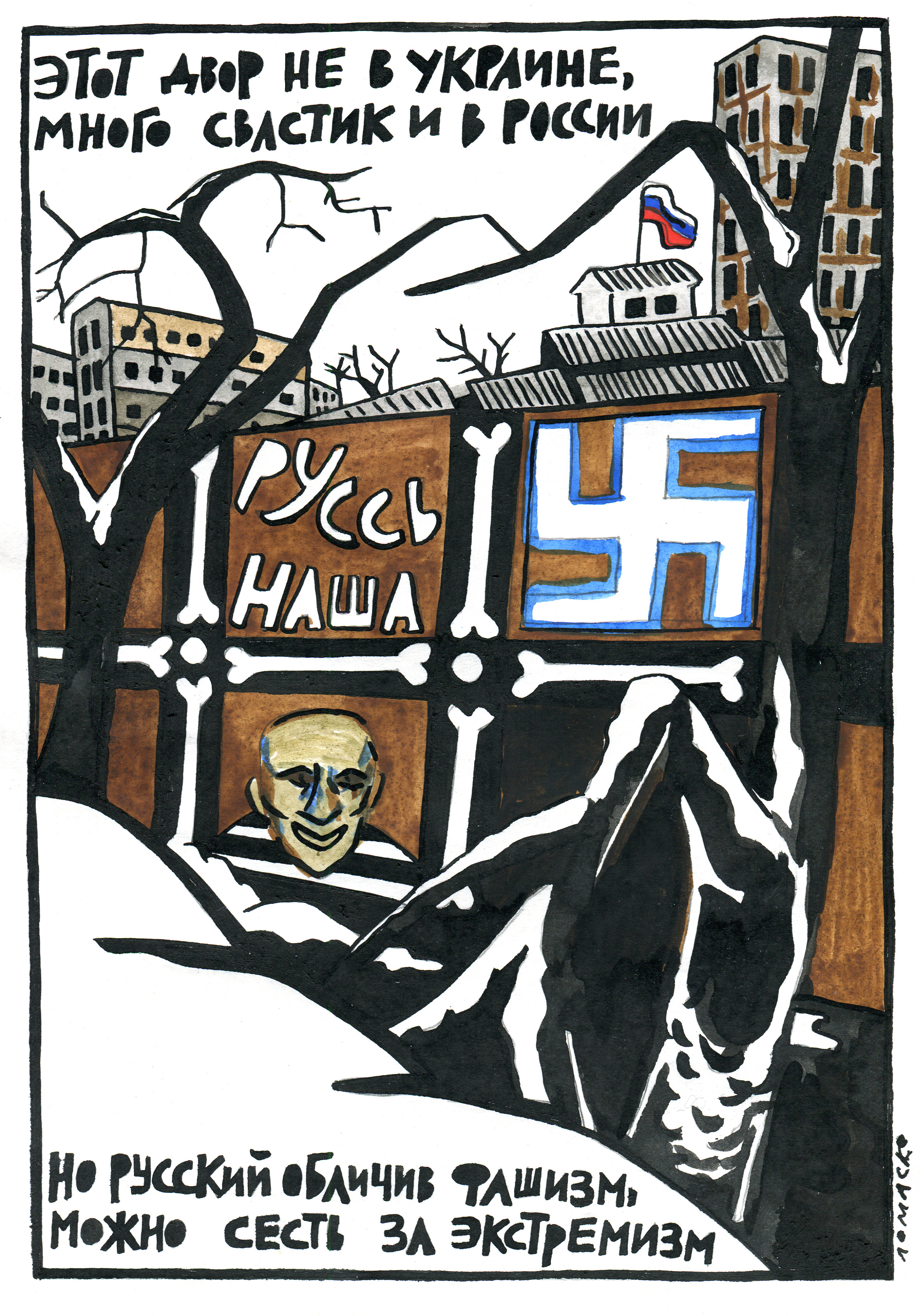
This is a real courtyard in my neighborhood, near a playground. Parents stroll around the yard with their children, discussing the news from “fascist” Ukraine.

Do I have the right to draw and show you this landscape featuring a swastika, a landscape that is fairly typical in Russia? During the recent trial of the Combat Organization of Russian Nationalists (BORN), their lawyer argued that the anti-fascists are just another street gang like the fascists. So why not label any denunciation of fascism “propaganda” of fascism itself?

Nationalists freely held an international congress in Petersburg in March. The only people the police arrested were the anti-fascists who protested the congress. Nationalists can walk around sporting neo-fascist symbols, but the authorities will prosecute publications that dare to publish photos of them. Juvenile prisons are filled with skinheads, but nationalist ideas are fomented on television.

Attn: Center “E”. I am opposed to fascism.

fashizm_colourThis yard is not in Ukraine. There are many swastikas in Russia, too. But if Russian citizens try to expose fascism, they can be charged with “extremism.” Inscription on wall: “Russ [sic] is ours!”