Regime Cracks Down on Protesting Krasnodar Farmers

“They Have Really Gone After Us”
After returning to Krasnodar Territory, participants of tractor convoy feel the heat from the very people against whom they complained
Anna Bessarabova
Novaya Gazeta
August 28, 2016

The farmers after their tractor convoy was dispersed. They have been sentenced to three to ten days in jail. Not a single independent human rights activist came to their court hearings in the village of Kazanskaya. Photo courtesy of Anna Artemieva/Novaya Gazeta

The farmers were threatened during the convoy. We will stage a second Novocherkassk massacre for you and dice you like cattle in a slaughterhouse, they were told by security officers, who after the protest was dispersed have been zealously carrying out checks of their homes and farms.

Around thirty FSB officers raided Nikolai Borodin’s farm in the village of Kazanskaya, which they turned upside down. The tax inspectorate has been looking into property owned by the relatives of protest leader Alexei Volchenko. Other men have been interrogated by the prosecutor’s office. Nina Karpenko escorted her driver Seryozha Gerasimenko, a young fellow with three small children, to the detention center. He has been jailed for three days. The other men were also issued misdemeanor charge sheets: the authorities even went to the trouble of delivering the documents to their homes. The hearings took place on the weekend (Saturday) in the Kavkazsky District. Sergei Gorbachev was jailed for five days, Slava Petrovsky, for four days, Andrei Penzin and Semyon Smykov, for three. The rest of the protesters are waiting their turn.

“Nearly everyone in the villages has been paid visits by prosecutors and police,” farmer Ludmila Kushnaryova told Novaya Gazeta. No one knows what they are looking for. Or what the charges will be, either. The pressure has not stopped.”

“I cannot believe this is happening to us, in our country. We had no idea it would be so frightening,” said Nina Karpenko. “They have really gone after us. The deputy chief of the district traffic police escorted my tractor drivers and me to the hearings. He followed us for 250 kilometers. Whatever for? There were two people working in the courthouse on Saturday: the judge and the chairman. Didn’t they have anything else to do?”

Nikolai Maslov and Oleg Petrov, two convoy participants jailed for ten days, have been transferred to Novocherkassk.

“Dad called early this morning. He said everything was alright. But who knows. Maybe he just didn’t want to scare us?” said Igor Maslov, worried about his father. “We still haven’t found lawyers for them. How much do you think they’ll gouge us?”

Alexei Volchenko’s colleagues and friends have been looking for him. He has not been answering calls to any of his phones. He is not to be found in his home village. He has disappeared. The last thing the farmers heard was that Volchenko had been fined in Rostov Region. He made it back to Kuban, where he was detained again and sentenced to ten days in jail in Ust-Labinsk. The authorities are now, allegedly, preparing to charge him with extremism.

The Russian government, the Prosecutor General’s Office, and the Russian Investigative Committee have been pretending nothing is happening in Kuban. The official TV channels have been airing election campaign spots about the ruling party’s ability to listen to people, but they have not aired any stories about the events in Krasnodar Territory.  They have maintained their silence for a week.

Alexander Popkov, a lawyer with the Agora International Human Rights Group, Boris Titov, federal commissioner for the rights of entrepreneurs, former Federation Council member Ivan Starikov, and Russian Federal Public Chamber chair Georgy Fyodorov have promised to help the participants of the tractor convoy.

“Obviously, the farmers have committed no offenses, and the wild imitation of law enforcement involving riot police and arrests for a ‘rally’ in a cafe are aimed at suppressing a peaceful and reasonable protest campaign,” said lawyer Alexander Popkov. “The first thing we are going to do is file appeals, and then we are going to see whether there is any point in beating our heads against the courts in Russia or whether we should immediately file a class-action complaint with the European Court of Human Rights.”

“I have been in contact with the farmers, their wives, and their children. They are drafting an appeal, and next week we plan to hold a big press conference in Moscow,” Ivan Starikov informed Novaya Gazeta. “Their problem needs to be solved systemically. People’s land shares are being confiscated, and there are around 300,000 victims of this practice nationwide.”

According to Valentin Pyshkin, attorney for convoy participants Nikolai Maslov, Oleg Petrov, and Sergei Vladimirov, the farmers have filed an appealed against the court decisions that sentenced them to ten days in jail.

“But we won’t get an answer earlier than Monday,” the lawyer explained. “On August 26, I was not admitted to the Novocherkassk detention center and allowed to talk with my clients, because, you see, according to their internal regulations, prisoners are entitled to representation by a lawyer only from two to four in the afternoon. It is an odd rule. But at four o’clock I had a court hearing in Aksai. Rustam Mallamagomedov from the Association of Russian Carriers (OPR) was on trial. On August 24, he had gone to the police station on his own to find out what had happened to the detainees, and the police didn’t let him back out of the station.”

Truckers Ready to Fight for Farmers 

Andrei Bazhutin, chair, Russian Association of Carriers (OPR):

“We arrived from Petersburg to Moscow, where we were getting ready for a car convoy through Siberia. We learned about the arrest of the tractor convoy on the morning of August 23 and changed our plans. We went to support the tractor drivers. We were stopped by police for eight hours on the Moscow Ring Road, and eight hours in Voronezh Region. Along the way, we were written up for violating Article 20.2 of the Misdemeanors Code [“Violation of the established rules for organizing or holding an assembly, rally, demonstration, march or picket”  — Novaya Gazeta], but they did not stop us from traveling further.

“By the time we got to Rostov, two of our activists [who had been with the tractor convoy from the beginning — Novaya Gazeta] had been sentenced to ten days in jail, while another two had been fined 10,000 rubles. Now we are here in Rostov: we have four big rigs and some cars. We are working with the lawyers and human rights activists and trying to help the guys out. We think it is necessary to gather journalists and advance on Krasnodar Territory to draw attention to these court hearings. Center ‘E’ [the Interior Ministry’s Center for Extremism Prevention — TRR] has intimidated everyone here.

“We have also contacted the miners on hunger strike in Gukov and agreed to support each other. Our demands will be voiced at their next picket too.”

Translated by the Russian Reader. Read my previous postings about the protest by Krasnodar farmers and the regime’s crackdown against it.
Polite Farmers Are Dangerous Farmers

Court Orders Arrest of Tractor Convoy Organizer and Participants
Lenta.ru
August 28, 2016

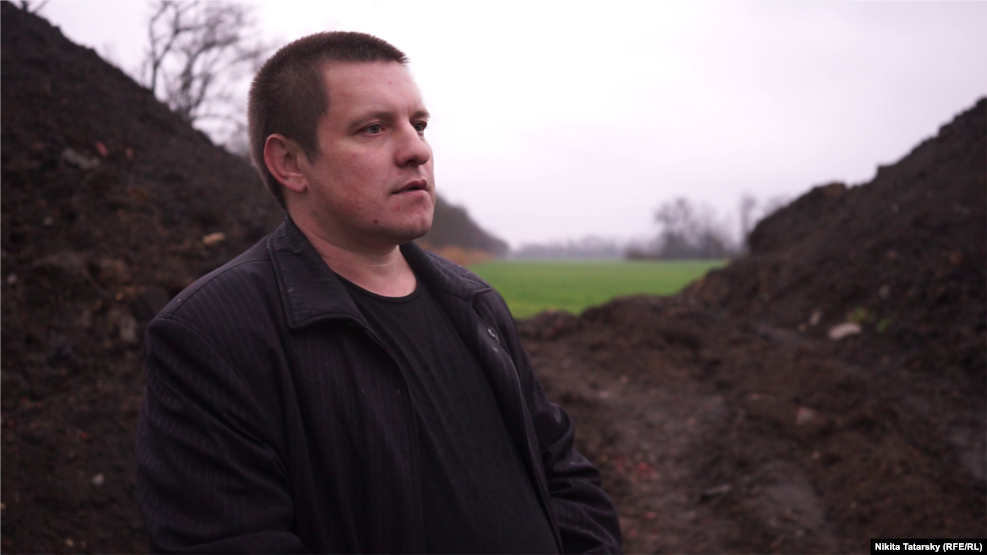
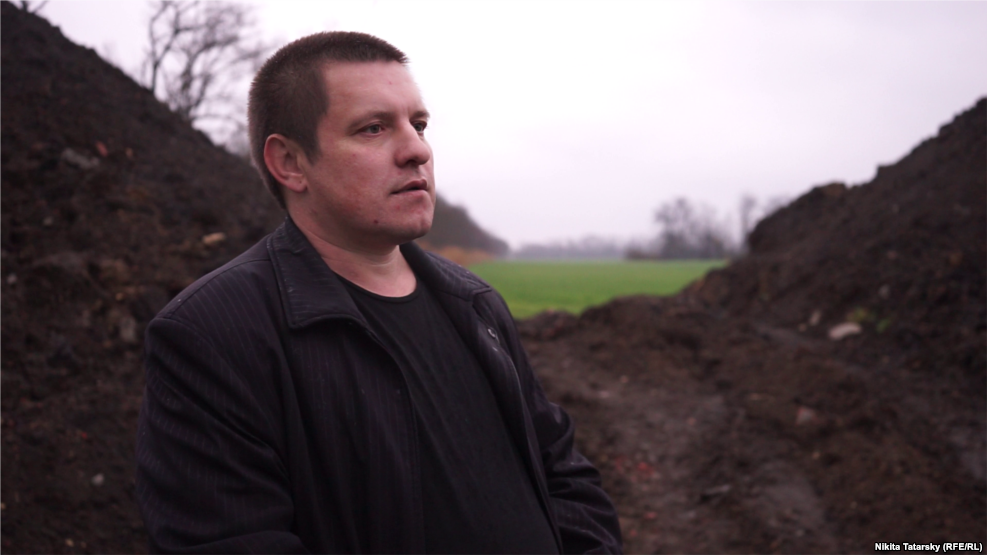
Alexei Volchenko, leader of the Polite Farmers movement. Photo courtesy of Nikita Tatarsky (RFE/RL)

The Kavkazsky District Court in Krasnodar Territory has ordered the jailing of Alexei Volchenko, leader of the Polite Farmers movement, and eleven other participants of a planned tractor convoy to Moscow. Quoting Olga Golubyatnikova, a member of the Krasnodar Territory Public Oversight Committee, the news website Caucasian Knot reported the arrests on Sunday, August 28.

Volchenko will spend ten days in jail for not authorizing the convoy with Krasnodar Territory authorities. The other farmers will spend between five and ten days in jail. According to Golubyatnikova, the leader of the Polite Farmers admitted his guilt “due to pressure from the police.” According to her, Volchenko said at his court hearing that a policeman had threatened to charge him with extremism.

Golubyatnikov also reported that Volchenko would be serving his administrative arrest in the Ust-Labinsk detention center.

On August 25, the Askay District Court in Rostov Region ordered three of the participants in the tractor convoy jailed for ten days and fined eleven others, ruling their actions an organized political rally. The farmers themselves claimed they had not organized a political rally but had simply been attending a meeting with Leonid Belyak, deputy presidential envoy to the Southern Federal District, and Andrei Korobka, deputy governor of Krasnodar Territory.

On August 24, the Rostov Regional Prosecutor’s Office organized an inquiry into the legality of the farmers’ protest.

The Krasnodar farmers’s convoy set off on August 21. Fifty people in seventeen tractors and several passenger vehicles left the village of Kazanskaya in Krasnodar Territory’s Kavkazsky District and headed towards Moscow. They had planned to ask Russian President Vladimir Putin to solve the problem of the courts, which, in their view, issued unjust rulings [sic]. On August 22, the activists were invited to meet with Kuban authorities and temporarily halted the procession. On August 23, they were detained by police officers.

Translated by the Russian Reader

See my previous dispatches on the ill-fated Krasnodar tractor convoy:

Tractor Pull: Police Block Farmers’ Protest Convoy to Moscow

_90878658_14114609_1347781818573054_688418267_o
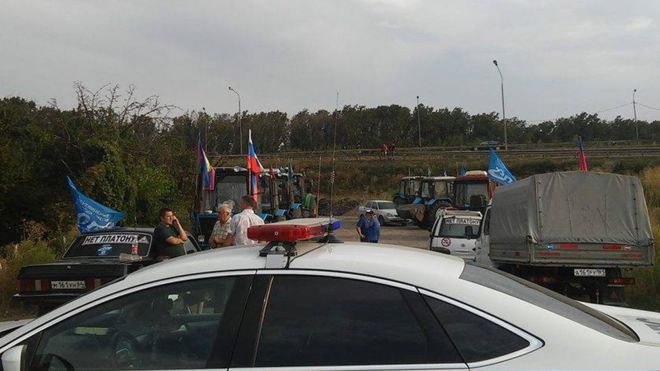
Police stop protesting Krasnodar farmers near Rostov-on-Don. Photo courtesy of BBC Russian Service

Krasnodar Farmers Say Convoy to Moscow Blocked
Grigory Naberezhnov and Dmitry Nosonov
RBC
August 22, 2016

The Farmers told RBC that over a hundred police had blocked the tractor convoy from Kuban to Moscow near Rostov-on-Don. The farmers had complained of “large agricultural holdings taking away land from farmers.”

Police have halted a tractor convoy of Krasnodar farmers headed for Moscow, according to rally organizer Alexei Volchenko.

According to Volchenko, the farmers “were blocked every which way,” and “probably half the Rostov police force had been sent out.”

A total of seventeen tractors, two heavy truckers, and a number of passenger vehicles have been trapped in the road block. According to Volchenko, twenty patrol cars and 150 police officers were involved in the road block.

“The officers did not inform us of the reason for the stop,” Volchenko added. “I tried to figure out why a tractor cannot travel freely through the Russian Federation. They couldn’t give us an explanation.”

Ekaterina Vasiltsova, duty officer at the press service of the Interior Ministry’s Rostov office, told RBC they were “verifying information” about the incident.

The tractor drivers had been stopped in the village of Dorozhny near Rostov-on-Don, Volchenko told the BBC.

The farmers now plan “to travel to Krasnodar and have a chat with our governor,” he told RBC.

According to Volchenko, the president’s envoy to the region had promised them that if authorities were unable to reach an agreement with the farmers, “the road to Moscow would be open to them.”

If the road is not opened, “then I will publicly declare him a liar,” said Volchenko.

On the morning of August 22, Volchenko told RBC that the farmers had been facing constant checks by police.

“In Krasnodar Territory alone, they stopped us seven or eight times for long stretches of between forty and fifty minutes. They would sometimes take two hours to check our papers and write up tickets,” he said.

The farmers from Krasnodar Territory had set out on their tractor convoy to Moscow the day before, on August 21.  Prior to their departure, they held a rally in the village of Kazanskaya in Krasnodar Territory’s Kavkazsky District.

Volchenko has told the Peasant Gazette (Krestyanski Vedomosti) that a “vicious practice” had taken root in Krasnodar Territory in recent years.

“Local authorities have refused to allocate their legal [land] shares to land owners, illegally leased them to third parties, usually large agricultural holding companies or they have violated their property rights altogether,” he told the paper.

“The large agricultural holding companies take land away from farmers and shareholders, and basically bring [the rural areas] to their knees, because the villages live on the money farmers spend, while the agricultural holdings are all registered as offshore companies in Cyprus and so on,” Volchenko told RBC in an interview.

The principal demand of the protesters was to “restore order through the courts.”

In March 2016, the Kuban farmers had planned to organized tractor convoy to Moscow. Around a hundred farmers were slated to take part in the protest.  They planned to deliver a petition to President Vladimir Putin. The farmers then met with Natalya Kostenko, deputy head of the executive commite of the Russian People’s Front (ONF).

“She persuaded us to abandon the protest,” Volchenko told the Peasant Gazette. “[She] promised to speak with regional leaders about restoring order in land relations. [However,] six months have gone by, and basically nothing has changed.”

Translated by the Russian Reader

More proof, as if more proof were needed, that President Putin could care less about his wholly fictitious “base” in the wholly fictitious “Russian heartlands.” These tropes have been used by journalists and “experts” too willfully blind (?) to see the Putin regime was in fact an authoritarian smash-and-grab police state junta that was quickly switching to autopilot. It had no need then of real popular support, and it has much less need now. It does, however, generate the illusion of popular support through sham elections, self-fulfilling opinions polls, wars, and relentless mainstream and social media propaganda. But my experience in talking to lots of different people and my intuition tell me it is actually deeply unpopular among the folk who are supposedly its biggest supporters, like these farmers from the Kuban region. The regime’s real support comes from the officials and businessmen who have made out like bandits these past 17 years. They are its real base. TRR

Krasnodar Farmers Head to Moscow in Tractor Protest Convoy

Krasnodar Farmers Head to Moscow in Tractor Convoy
Olga Nadykto
RBC
August 21, 2018

Farmers from Krasnodar Territory have set off on tractors to Moscow. The total number of tractors in the convoy is seventeen. This is the second attempt by the farmers of Kuban to organize a “tractor march” on Moscow

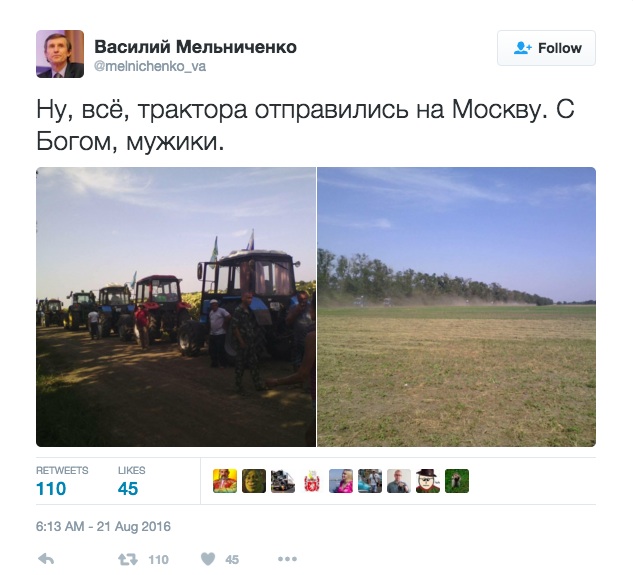
The Krasnodar farmers’ tractor convoy has left for Moscow, Vasily Melnichenko, one of the protesters, reported on his Twitter account.

Vasily Melnichenko: "Well, that's it, the tractors have set out for Moscow. God be with you, fellows." Twitter, August 21, 2016
Vasily Melnichenko: “Well, that’s it, the tractors have set out for Moscow. God be with you, fellows.” @melnichenko_va, Twitter, August 21, 2016, 6:13 a.m.

Before the convoy set off, the farmers held a rally in the village of Kazanskaya in the Kavkazsky District of Krasnodar Territory. As reported by Novaya Gazeta, after the rally was over, a convoy of seventeen tractors and a few dozen cars headed for the neighboring Rostov Region on the federal highway. The newspaper reported that protesters intend to meet with federal authorities in Moscow.

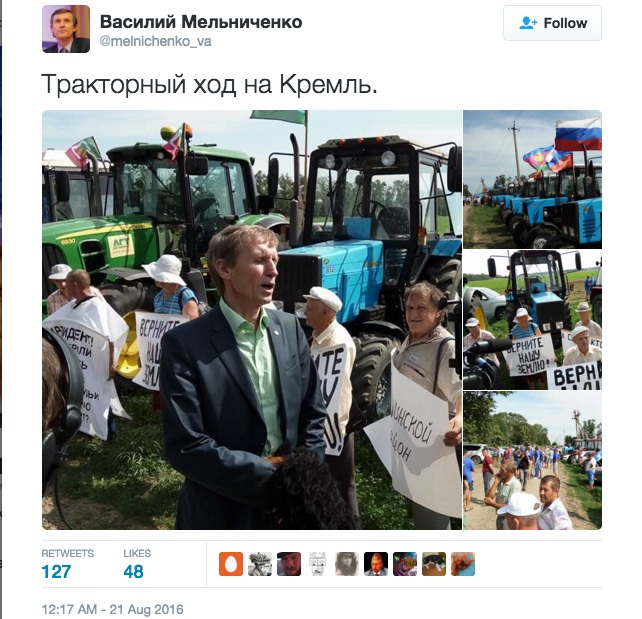
"Tractor procession to the Kremlin." melnichenko_va, Twitter, August 21, 2016
“Tractor procession to the Kremlin.” melnichenko_va, Twitter, August 21, 2016. Melnichenko is identified on his main Twitter page as “Director of the Galkinskoye Agricultural Enterprise.”

As a co-organizer of the tractor convoy, Alexei Volchenko, earlier told Krestyanskie Vedomosti (Peasant Gazette), the protest has been coordinated with the traffic police.

“There was moaning and groaning, and nerves were on edge, but we got the traffic police to sign off on the tractor convoy. They promised an escort, as the rules says they should,” said Volchenko.

According to Volchenko, the farmers are protesting the violation of their property rights and transfer of land to major agricultural holding companies.

The farmers of Kuban had initially tried to carry out a tractor convoy to Moscow in March of this year. Around a hundred farmers from nine districts in Krasnodar Territory announced plans to drive their tractors to Moscow, where they intended to deliver a petition to Russian President Vladimir Putin. However, the farmers later declined to carry out the protest.

Translated by the Russian Reader

Nice Work If You Can Get It

Oleg Derispaska
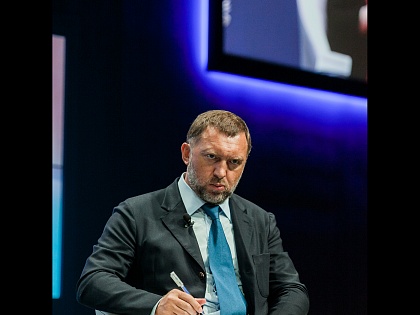
Oleg Deripaska. Photo courtesy of deripaska.com

“I believe that it takes just 100 people to change a country for the better provided that these people are driven professionals capable of creating something new. I am sure that in Russia there are far more than 100 such people, so let’s join forces and work together.”
Oleg Deripaska

_________

Deripaska’s Company Releases Sales Figures for “Olympic” Apartments
Natalya Derbysheva
RBC
May 27, 2016

sochi-olympic village marina
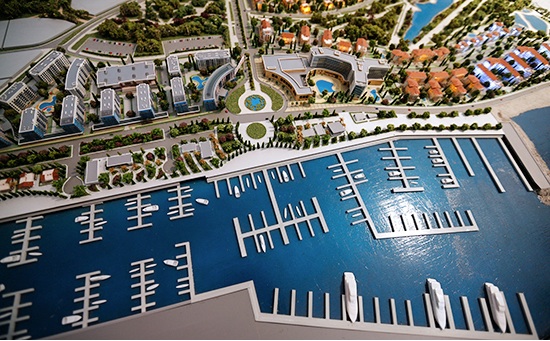
Mockup of the Sochi Olympic Village’s Coastal Cluster. Photo: Andrei Golovanov and Sergei Kivrin/TASS

Oleg Deripaska’s company RogSibAl has sold 20% of the luxury apartments it built on the Black Sea coast in Sochi for the Winter Olympics. The company believes this is a good result. 

RogSibAl, a subsidiary of Oleg Deripaska’s Basic Element, built 2,700 luxury  apartments on the Black Sea coast for the 2014 Winter Olympics in Sochi. Athletes lived in the apartments during the competition. According to Vnesheconombank, the project’s budget was 25.3 billion rubles, 22.3 billion rubles of which RogSibAl borrowed from Vnesheconombank.

The coastal Olympic Village is now known as the Imereti Resort District. It consists of four quarters, the Coastal Quarter, the Maritime Quarter, the Park Quarter, and the Reserve Quarter. Apartments are available for purchase in all four quarters. The price per square meter ranges from 152,000 rubles to 195,00 rubles [approx. 2,070 euro to 2,650 euros per square meter—TRR].

Since the apartments went on sale in 2013, 20% of them have been sold, a Basic Element spokesman told RBC, meaning that over 500 apartments in all have been sold. Basic Element’s spokesman added that the company had sold 118 apartments from January to May 2016.  The company plans to have sold 350 apartments for a total area of 25,000 square meters on the year.

Basic Element has been renting out the unsold apartments. According to the company’s spokesperson, the rental demand for the 2016 summer season is 97–100%.

The sales figures are worse than what Basic Element had planned in 2011. Igor Yevtushevsky, RogSibAl’s general director, had then told Vedomosti that the company was planning to sell 50% of the apartments before the start of the Olympics, and the other half in 2014–2015.

Basic Element’s spokesman said it would be unfair to compare current sales figures with projections made in 2011.

“The project has undergone big changes,” he explained.

The company cites data from the MACON Realty Group, according to which 387 business- and luxury-class real estate transactions were concluded in Sochi from January to May 2016, meaning that the Imereti District’s share of this business was 23%.

The government has discussed the conditions of restructuring the loans issued by Vnesheconombank for building Olympic sites, RBC’s sources told it earlier this week. A federal official explained that Deripaska’s companies were in the most complicated circumstances in terms of loans, since the demand for apartments was not great.

Sochi Olympic Village. Photo courtesy of Nikita Kulachenkov

Basic Element has not disclosed the figures of the income from its sales of the properties. Its spokesman did say, however, that all the proceeds were being wholly turned over to Vnesheconombank in repayment of the loan and that RogSibAl had been fulfilling all its obligations to the bank.

Given that sales usually begin at the design and construction stage of a property, 20% sales in the second year after a property has been operation is hardly satisfactory, argues Marina Udachina, director of the Institute for Innovations, Infrastructure and Investments. According to her, the situation is partly due to a slowdown in economic growth and a reduction in the demand for luxury properties.

__________

Nikita Kulachenkov
Facebook
May 27, 2016

Only 20% of the apartments in the Olympic Village have been sold in two years.

Here is what we wrote about this a month before the Games:

“The site is being built by oligarch Oleg Deripaska, one of the few private investors in the Olympics. Only he is building with public money. Twenty-two of the twenty-five billion rubles in the project’s budget has been secured with a loan from state-owned Vnesheconombank. Derispaska’s company is planning to pay back this money by selling the village as a residential complex after the Games. It will be hard for them to find buyers. A single bed in the village costs as much as a two-room flat in Moscow.”

Of course, the crisis, sanctions, and being “surrounded by enemies” have inevitably led to a drop in demand for fairly pricey holiday apartments. On the other hand, this was offset by the fact that demand was supposed to shift to the domestic market from Greece, Cyprus, Turkey, and other countries where housing had become almost twice as expensive for Russians.

As a result, sales did not take off, which is a pity. I know that after the Games a good person, familiar to a lot of my people on my wall, worked on the project.

We can also add to this news the latest about Sberbank, which after agonizing for a long time has today finally sold the Mountain Carousel ski resort on the installment plan to the former governor and current minister Tkachyov* and his young but quite talented son-in-law. The joke there is that Sberbank invested 25 billion rubles into Mountain Carousel, while Vnesheconombank loaned it 55 billion rubles. Vnesheconombank fiercely resisted the sale, because it is one thing when Sberbank is in hock to you to the tune of 55 billion rubles, and quite another when it is Tkachyov and family. Apparently, Gref is tougher and stronger than the moribund Vnesheconombank, although it does not make our lives any easier.

Since for some reason business has not been booming at nearly all the former Olympic sites, the government has authorized the repayment of Olympic loans over a period of 25 years at a reduced 5% interest rate. And to keep Vnesheconombank from kicking the bucket altogether, the Finance Ministry will give it another 150 billion rubles straight from our pockets.

I probably do not need to remind you of the total amount that we, the taxpayers of the Russian Federation, paid for the construction of all these “great power” bells and whistles.

P.S. I’m going to do a little populism practice. Anyone in Russia want a twenty-five-year mortgage at five-percent interest? Ask Tkachyov, Potanin, Deripaska, and Vekselberg “how.” )))

Translated by the Russian Reader. Thanks to Alexei Navalny for the heads-up. This post should be read in tandem with my post for May 25, 2016, “The Decline Has Gone Uphill.”

* On August 2, 2012, Tkachyov announced plans to deploy a paramilitary force of Cossacks in Krasnodar Krai, beginning September 2012, as vigilantes to discourage internal immigration by Muslim Russians. In a speech to police, he stated, “What you can’t do, the Cossacks can. We have no other way—we shall stamp it out, instill order; we shall demand paperwork and enforce migration policies.”

Source: Wikipedia, New York Times